Flexographic Printing Inks Market Growth Driven by Sustainable Packaging Demand, Low-Migration Ink Innovation, and High-Speed Printing Technologies
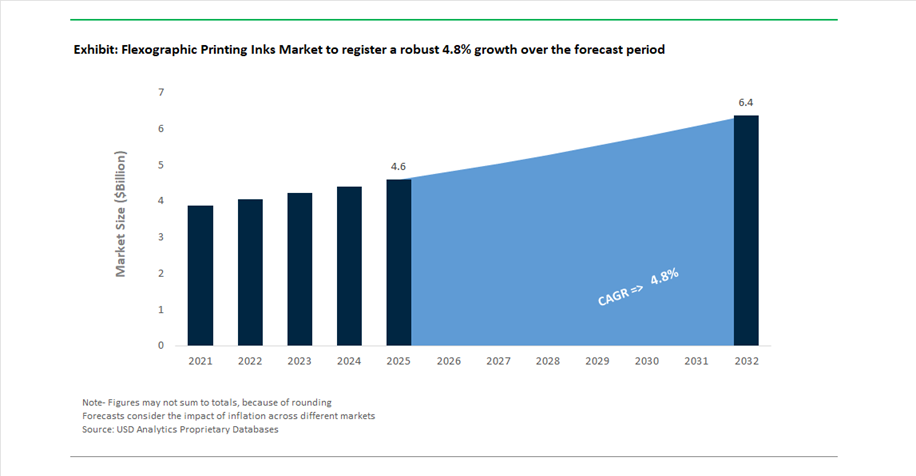
The global Flexographic Printing Inks Market was valued at USD 4.6 billion in 2025 and is projected to grow at a CAGR of 4.8% between 2025 and 2032, reaching USD 6.4 billion by 2032. This growth is primarily driven by the expanding demand for flexible packaging, labels, corrugated printing, and food-safe packaging solutions, particularly in fast-moving consumer goods (FMCG), pharmaceuticals, and e-commerce sectors.
Flexographic printing inks are widely used due to their versatility, cost-efficiency, and compatibility with high-speed printing processes across substrates such as plastic films, paper, and foil. A major growth driver is the increasing adoption of sustainable and recyclable packaging formats, which require inks that do not interfere with recycling streams. This is accelerating the shift toward water-based, UV-curable, and bio-based ink systems, replacing traditional solvent-based formulations.
Another structural trend is the rising importance of low-migration and food-safe inks, especially in pharmaceutical and food packaging applications. Regulatory pressure and consumer safety concerns are pushing manufacturers to develop inks that prevent chemical transfer (such as MOAH contamination) into packaged goods. Additionally, advancements in LED and UV curing technologies are enabling faster production speeds, improved print quality, and reduced energy consumption, enhancing operational efficiency for converters.
Strategic Acquisitions, Low-Migration Ink Development, and Digital Integration Reshape Market Dynamics
The flexographic printing inks market is undergoing a significant transformation driven by strategic expansion, sustainability innovation, and technological advancements in curing and formulation. In March 2026, Siegwerk announced the acquisition of Hi-Tech Inks, strengthening its footprint in Africa and the Middle East. This move is aimed at capitalizing on the growing demand for localized flexographic inks in flexible packaging and labeling markets across emerging economies.
Sustainability-driven product innovation is accelerating across the industry. In January 2025, Sun Chemical expanded its nitrocellulose (NC)-free ink portfolio, introducing polyurethane-based systems designed to improve recyclability by eliminating thermal instability and contamination issues. Additionally, Sun Chemical’s AquaHeat platform, launched in January 2024, provides water-based, bio-based inks capable of withstanding high-temperature food packaging applications without degradation or migration.
Low-migration ink development is becoming a critical competitive differentiator. In October 2025, Siegwerk entered the Indian pharmaceutical packaging segment, investing significantly to develop mineral-oil-free inks that prevent contamination in sensitive applications. This positions the company ahead of anticipated regulatory tightening in emerging markets.
Technological advancements in curing systems are also reshaping production efficiency. In September 2025, Fujifilm introduced the CuremaX ink range alongside the LuXtreme Pro LED curing system, enabling higher press speeds, improved adhesion, and enhanced gloss properties for premium labels and flexible packaging. Similarly, in March 2026, hubergroup showcased its iray UV flexo inks and Gecko solvent-based systems, designed for high-speed industrial printing environments.
Innovation is also targeting circular packaging solutions. In April 2024, Flint Group introduced compostable and NC-alternative ink systems, including ZenCode CPT and OmniLam F, supporting the transition toward fully recyclable and compostable flexible packaging structures.
Digital transformation is emerging as a new competitive frontier. In April 2026, Flint Group implemented a global brand refresh, emphasizing its FlintLink digital platform, which provides real-time access to technical data and safety documentation, improving operational efficiency for printers and converters.
Cost pressures and pricing dynamics continue to influence the market. In January 2024, Toyo Ink implemented global price increases due to rising raw material and labor costs, reflecting broader inflationary pressures across the specialty chemicals sector.
Mineral Oil-Free Flexo Ink Systems Emerging as Standard for Food-Grade Packaging Compliance
The flexographic printing inks market is undergoing a critical transition as global brand owners and regulators intensify focus on food safety, specifically targeting the elimination of mineral oil hydrocarbons from packaging materials. Mineral Oil Saturated Hydrocarbons and Mineral Oil Aromatic Hydrocarbons present migration risks from printed substrates into food products, prompting a widespread shift toward mineral oil-free flexo ink formulations. This transition is being reinforced by increasing regulatory scrutiny across Europe and Asia, as well as proactive adoption by global FMCG companies mandating the exclusion of mineral oils as intentionally added substances in fiber-based packaging. In India, the market has witnessed significant investments exceeding INR 350 crore in 2026 toward the development of vegetable oil-based flexographic inks that meet stringent migration safety standards. Concurrently, rising costs of petroleum-based packaging materials, with increases ranging from 20% to 32%, are accelerating the shift toward paper-based flexible packaging formats that require high-performance, non-toxic ink systems. These inks must provide strong barrier properties against moisture and oil while maintaining print clarity and adhesion. The convergence of regulatory compliance, consumer safety expectations, and packaging material shifts is positioning mineral oil-free flexographic inks as a new industry baseline in food-grade packaging applications.
Electron Beam Curing Gaining Adoption Over UV-LED in High-Speed Flexible Packaging Applications
Electron beam curing technology is rapidly gaining traction in the flexographic printing industry, particularly for wide-web flexible packaging applications where migration safety and production efficiency are critical. Unlike UV-LED systems, electron beam curing does not require photoinitiators, eliminating a major source of chemical migration in food-contact packaging. This makes EB-cured inks highly suitable for high-speed production lines in food and pharmaceutical packaging sectors. Additionally, EB curing operates as a cold process, preventing thermal deformation of thin film substrates and enabling an increase in press speeds of approximately 15% on sensitive materials. From an operational standpoint, while EB systems involve higher initial capital investment, they offer long-term cost advantages through approximately 20% lower energy consumption and reduced formulation complexity due to the absence of photoinitiators. Performance metrics also favor EB technology, with studies from 2025 demonstrating a 25% improvement in chemical resistance and enhanced rub resistance and gloss levels compared to UV-LED cured inks. These benefits are driving the adoption of electron beam curing as a high-performance, compliant, and cost-efficient solution for next-generation flexographic printing applications.
USPS Automation Upgrades Driving Demand for High-Contrast and NIR-Readable Flexographic Inks
The modernization of postal automation systems is creating a specialized opportunity for high-performance flexographic inks designed for machine readability and high-speed processing. The United States Postal Service is upgrading its sorting infrastructure through programs such as Distribution Quality Improvement, increasing demand for inks that deliver high optical density and near-infrared readability. These inks are essential for achieving barcode recognition rates exceeding 98% in automated mail streams, reducing manual intervention and improving operational efficiency. The deployment of advanced sorting technologies capable of processing up to 36,000 parcels per hour requires inks that resist smudging and maintain print clarity under mechanical stress. Additionally, the integration of hybrid printing systems is creating demand for flexographic primers that enable seamless compatibility with inkjet overprinting, allowing for secondary barcode application on unreadable packages. This capability is particularly important in data-intensive logistics environments where traceability and accuracy are critical. The increasing reliance on intelligent mail systems and automated parcel handling is positioning high-contrast flexographic inks as a key enabler of efficient, data-driven logistics operations.
India’s Plastic Waste Management Rules 2025 are accelerating the transition toward circular packaging solutions, creating strong demand for de-inkable flexographic inks that support high-quality recycling processes. The regulatory framework mandates progressive recycling targets, requiring producers to achieve 30% recycling rates in 2025–26, increasing to 50% in 2026–27, thereby placing pressure on packaging design and material compatibility. De-inkable and washable ink systems are becoming critical in enabling efficient removal of ink layers during recycling, particularly in polyethylene and polyethylene terephthalate streams, where contamination can significantly reduce recycled material quality. The introduction of mandatory traceability requirements, including QR codes and barcodes on all plastic packaging units, is further driving demand for inks that maintain high resolution and durability on recycled substrates. Additionally, the implementation of eco-modulated fee structures is incentivizing the use of recyclable and environmentally compatible ink formulations, such as nitrocellulose-free systems that do not interfere with mechanical recycling processes. These regulatory drivers are fostering innovation in sustainable flexographic inks and positioning de-inkable technologies as a key component in achieving circular economy objectives within the packaging industry.
Flexographic Printing Inks Market Share 2025: Acrylic Resins and Eco-Friendly Formulations Lead Industry Shift
Resin Type Insights: Acrylic Resins Dominate with Water-Based Ink Adoption
The acrylic resin segment leads the flexographic printing inks market with a 36% market share in 2025, driven by the widespread adoption of water-based flexographic inks in packaging and labeling applications. Acrylic emulsions serve as the backbone of these inks, particularly in food packaging, corrugated boxes, and folding cartons, where regulatory restrictions on solvent-based inks are tightening across Europe and North America. Their excellent pigment wetting properties enable superior color strength, sharp print clarity, and consistent performance on porous substrates such as paper, cardboard, and uncoated films, making them the preferred choice for high-volume printing operations. Additionally, acrylic-based inks support faster drying times and reduced odor, aligning with sustainability goals and workplace safety standards. As demand for low-VOC, high-performance printing inks continues to rise, acrylic resins will remain central to innovation and growth in the flexographic printing inks market.
Functional Property Insights: Eco-Friendly Inks Gain Traction Amid Sustainability Regulations
The eco-friendly inks segment accounts for the largest 34% share in the flexographic printing inks market in 2025, reflecting strong momentum toward sustainable and regulatory-compliant printing solutions. Increasing implementation of plastic packaging taxes and Extended Producer Responsibility (EPR) regulations is compelling manufacturers to adopt low-VOC, water-based, and UV-LED flexographic inks that minimize environmental impact. These formulations eliminate heavy metals and reduce emissions, making them suitable for environmentally conscious packaging production. Furthermore, major global brands such as Unilever, Nestlé, and Procter & Gamble are enforcing strict sustainability scorecards, requiring the use of certified eco-friendly inks to meet their 2025–2030 plastic reduction and carbon neutrality targets. This shift is significantly influencing supplier selection and product development across the value chain. As sustainability becomes a core competitive factor, eco-friendly functional properties will continue to drive demand and reshape the flexographic printing inks market.
Flexographic Printing Inks Market Competitive Landscape Driven by Sustainable Packaging, UV LED Technologies, and Circular Ink Systems
The flexographic printing inks market is highly competitive, driven by sustainable packaging demand, low-migration ink technologies, and UV LED curing systems. Key players are focusing on bio-based inks, recyclability compliance, and integrated ink-adhesive solutions to serve flexible packaging, labels, and food-contact applications.
Sun Chemical strengthens flexographic inks leadership with AquaHeat™ platform and pigment supply integration
Sun Chemical, a subsidiary of DIC Corporation, is reinforcing its leadership in the flexographic printing inks market through the launch of the AquaHeat™ platform, designed for food-safe, high-temperature packaging applications. The company introduced HP Indigo-compatible primers and SunLam solvent-free ultra-low monomer adhesives to support sustainable multi-layer laminates. Its strategic investment in Quinacridone pigment production enhances supply chain security for premium red and violet inks used in brand packaging. Sun Chemical achieved an EcoVadis Silver rating, placing it among the top ESG performers in the chemical sector. The company also implemented price adjustments across nitrocellulose and epoxy portfolios to manage raw material volatility. These initiatives position Sun Chemical as a leader in high-performance, sustainable flexographic inks.
Flint Group drives flexographic inks innovation with ONECode platform and UV LED curing technologies
Flint Group is advancing the flexographic inks market with the launch of its ONECode platform, including VertixCode for standardized global print quality and reduced ink-room complexity. The company expanded its EkoCure® UV LED portfolio, enabling full transition from conventional UV curing to energy-efficient LED systems for narrow-web applications. Its AQUACode water-based inks are optimized for recycled substrates, delivering strong color performance with reduced ink consumption. Flint is managing supply chain challenges through regional pricing strategies to ensure consistent supply. The company’s leadership in low-migration ink technologies supports food-safe packaging requirements. These innovations strengthen its position in next-generation flexographic ink systems.
Siegwerk leads circular flexographic inks with RecyClass-approved NC-free and UV-curable systems
Siegwerk Druckfarben is a pioneer in sustainable flexographic inks, achieving RecyClass approval for its UR 62 nitrocellulose-free ink series compatible with PE and PP recycling streams. The company also became the first to secure approval for UV/LED-curable inks on PE films, addressing a critical industry challenge. Its RethINK Packaging strategy focuses on polyurethane binders to replace traditional NC systems, improving recyclate quality and eliminating odor issues. Products like SICURA Nutriflex NT26 enable full compatibility with colored flexible packaging recycling streams. These innovations provide brand owners with greater design flexibility while meeting circular economy requirements. Siegwerk continues to lead in eco-friendly and recyclable flexographic ink technologies.
DIC Corporation accelerates flexographic inks innovation with AI-driven manufacturing and regional expansion
DIC Corporation is enhancing its competitiveness in the flexographic printing inks market through its Vision 2030 Phase 2 strategy, integrating AI and robotics into manufacturing processes. The company is expanding localized production in India to capture growth in the South Asian packaging sector. Its collaboration with Emerald aims to reduce R&D lead times through AI-driven chemical synthesis. DIC is also demonstrating cross-industry innovation with advanced CMF design concepts. These initiatives improve formulation precision and operational efficiency. This positions DIC as a forward-looking innovator in functional and high-performance ink systems.
Toyo Ink Group drives APAC flexographic inks growth with wide-gamut technologies and integrated systems
Toyo Ink Group, operating under the Artience brand, is a dominant player in the Asia-Pacific flexographic inks market with 40% regional share. The company offers high-reproducibility inks for complex substrates such as elastic films and recycled cardboard. Its wide color gamut process inks enable standard four-color presses to achieve expanded color ranges, reducing reliance on spot colors. Through its Toyo-Morton subsidiary, the company provides integrated ink and adhesive solutions for flexible packaging applications. This ensures compatibility and performance in high-speed production environments. These capabilities position Toyo Ink as a leader in advanced flexographic printing technologies.
Wikoff Color strengthens niche flexographic inks market with energy-curable systems and digital hybrid integration
Wikoff Color Corporation maintains a strong presence in the North American flexographic inks market through its energy-curable ink technologies and customized solutions. The company developed ultra-low-migration water-based inks tailored for premium food and beverage labels, supporting the rise of craft packaging aesthetics. Its investment in digital-hybrid printing enables seamless integration between flexo and inkjet processes using specialized base inks. Wikoff’s regional lab network allows for customized formulations optimized for legacy printing equipment. This flexibility enhances adoption among converters with varied production setups. These strengths position Wikoff as a key niche player in specialized flexographic ink solutions.
China Flexographic Printing Inks Market: Green Printing Mandates and High-Speed Production Driving Scale Leadership
China continues to dominate the global flexographic printing inks market, driven by aggressive environmental policies and massive packaging demand. Under updated VOC emission standards (2025), approximately 20% of solvent-based printing lines in key regions like the Yangtze River Delta have transitioned to water-based systems.
Scale and innovation go hand in hand. High-speed CI flexo presses (up to 800 m/min) are enabling efficient printing on non-woven and packaging substrates, while rapid growth in e-commerce logistics hubs is boosting demand for rub-resistant, soy-based inks. Sustainability is also advancing through washable ink systems for PET recycling, improving material recovery rates. Additionally, UV-curable flexo inks are gaining traction in premium segments like cosmetics and dairy packaging due to zero-migration safety requirements, reinforcing China’s leadership in both volume and technology.
United States Flexographic Printing Inks Market: UV-LED and Hybrid Technologies Driving High-Value Innovation
The U.S. market is defined by its shift toward digital-hybrid flexo printing and energy-efficient curing technologies. Investments in UV-LED systems and hybrid presses have increased by ~10% in 2025, driving demand for specialized ink formulations compatible with multi-platform printing.
Innovation is centered on sustainability and performance. The launch of EB-curable inks (e.g., GelFlex™) eliminates lamination requirements, enabling mono-material recyclable packaging. Additionally, bio-based inks with 50–90% renewable content are reducing carbon footprints by up to 30%, particularly in retail packaging. Regulatory pressure from the EPA is accelerating adoption of nitrocellulose-free (NCF) inks for food-contact applications. Key applications include pharmaceutical and nutraceutical labeling, where UV inks provide high chemical resistance and thermal stability.
Germany Flexographic Printing Inks Market: Circular Economy and De-Inkable Systems Driving Sustainability Leadership
Germany is the innovation hub for sustainable flexographic inks, strongly influenced by EU circular economy policies. Under the Packaging & Packaging Waste Regulation (PPWR), manufacturers are developing de-inkable and nitrocellulose-free (NCF) ink systems to support full recyclability of packaging materials.
Technological advancements are enhancing efficiency. AI-driven color management and automated doctor blade systems are reducing ink waste and improving consistency. Additionally, oxygen-barrier coatings integrated with flexo inks are enabling a shift from multi-layer packaging to recyclable mono-material structures. Strict compliance with Swiss Ordinance and Nestlé standards has become the baseline for food-grade inks, reinforcing Germany’s leadership in high-performance, eco-compliant formulations.
India Flexographic Printing Inks Market: Flexible Packaging Boom and Localization Driving Rapid Growth
India is one of the fastest-growing markets, driven by flexible packaging demand and manufacturing expansion. Government initiatives like the PLI scheme for food processing have led to a ~12% increase in demand for low-odor, food-safe water-based inks.
Infrastructure and industrial growth are key drivers. Expansion of CI flexo presses and modernization of logistics networks are boosting demand for fire-retardant inks for industrial labels and high-performance packaging inks. Regulatory tightening by the Bureau of Indian Standards (BIS) is enforcing heavy-metal-free formulations, especially in food and dairy packaging. Additionally, investments by global players like DIC and Siegwerk in local blending centers are enabling just-in-time ink customization, improving efficiency and quality. Growth in e-commerce packaging (multi-wall paper mailers) is further expanding the application scope.
Brazil Flexographic Printing Inks Market: Solvent-to-Water Transition and Premium Label Growth Driving Expansion
Brazil is leading Latin America’s transition toward sustainable flexographic inks, with increasing adoption of water-based and UV/EB-curable systems. Market dynamics are shaped by the need to balance cost efficiency with environmental compliance.
Innovation is focused on performance and adaptability. High tinting-strength solvent inks are enabling thinner ink films, reducing raw material consumption while maintaining color quality. Additionally, the development of compostable-compatible ink systems is supporting growth in organic food packaging. Investments in smart ink-dispensing systems across major printing hubs are improving color consistency and reducing waste. The expansion of premium labels for beverages and personal care is also driving demand for high-performance laminating inks.
Japan Flexographic Printing Inks Market: Precision Engineering and Bio-Based Innovation Driving Advanced Applications
Japan is at the forefront of high-precision and bio-based flexographic inks, particularly for advanced packaging and electronics. Innovations include ultra-low-viscosity UV inks capable of achieving offset-level print resolution in high-speed narrow-web applications.
Sustainability and functionality are key priorities. Japanese firms have commercialized inks with up to 40% plant-derived resins, aligning with strict green procurement standards. Additionally, conductive flexo inks are enabling large-scale printing of RFID tags and smart packaging sensors. Regulatory updates under Japan’s Positive List (2025) are enforcing stricter controls on photoinitiators in food-contact inks. Advanced features such as tactile and soft-touch coatings for premium labels further highlight Japan’s leadership in high-value, specialized ink technologies.
Flexographic Printing Inks Market Report Scope
Flexographic Printing Inks Market
Parameter
Details
Market Size (2025)
$4.6 Billion
Market Size (2032)
$6.4 Billion
Market Growth Rate
4.8%
Segments
By Technology (Water-based Inks, Solvent-based Inks, UV-curable Inks, Electron Beam), By Resin Type (Acrylics, Nitrocellulose, Polyurethane, Polyamides, Vinyl Resins, Others), By Application (Flexible Packaging, Labels and Tags, Corrugated Cardboard and Boxes, Folding Cartons, Print Media, Specialty Applications), By End-Use Industry (Food and Beverage, Healthcare and Pharmaceuticals, Personal Care and Cosmetics, Household and Cleaning Products, Industrial and Logistics, Others), By Functional Property (High-Heat Resistance, Chemical and Moisture Resistance, Low-Migration, Anti-microbial, Eco-friendly)
Study Period
2019- 2025 and 2026-2032
Units
Revenue (USD)
Qualitative Analysis
Porter’s Five Forces, SWOT Profile, Market Share, Scenario Forecasts, Market Ecosystem, Company Ranking, Market Dynamics, Industry Benchmarking
Companies
Sun Chemical Corporation, Flint Group, Siegwerk Druckfarben AG & Co. KGaA, Sakata INX Corporation, Toyo Ink SC Holdings Co., Ltd., hubergroup Holding SE, ALTANA AG, Fujifilm Holdings Corporation, Wikoff Color Corporation, T&K TOKA Co., Ltd., Zeller+Gmelin GmbH & Co. KG, Kao Corporation, Marabu GmbH & Co. KG, Nazdar Ink Technologies, RUCO Druckfarben
Countries
US, Canada, Mexico, Germany, France, Spain, Italy, UK, Russia, China, India, Japan, South Korea, Australia, South East Asia, Brazil, Argentina, Middle East, Africa
Flexographic Printing Inks Market Segmentation
By Technology
Water-based Inks
Solvent-based Inks
UV-curable Inks
Electron Beam
By Resin Type
Acrylics
Nitrocellulose
Polyurethane
Polyamides
Vinyl Resins
Others
By Application
Flexible Packaging
Labels and Tags
Corrugated Cardboard and Boxes
Folding Cartons
Print Media
Specialty Applications
By End-Use Industry
Food and Beverage
Healthcare and Pharmaceuticals
Personal Care and Cosmetics
Household and Cleaning Products
Industrial and Logistics
Others
By Functional Property
High-Heat Resistance
Chemical and Moisture Resistance
Low-Migration
Anti-microbial
Eco-friendly
Leading Countries in the Industry
North America (United States, Canada, Mexico)
Europe (Germany, France, Spain, United Kingdom, Italy, Russia, Rest of Europe)
Asia Pacific (China, India, Japan, South Korea, Australia, South East Asia, Rest of APAC)
South and Central America (Brazil, Argentina, Rest of SCA)
Middle East and Africa (Saudi Arabia, UAE, MENA, Sub-Saharan Africa)
Top Companies in Flexographic Printing Inks Market
Sun Chemical Corporation
Flint Group
Siegwerk Druckfarben AG & Co. KGaA
Sakata INX Corporation
Toyo Ink SC Holdings Co., Ltd.
hubergroup Holding SE
ALTANA AG
Fujifilm Holdings Corporation
Wikoff Color Corporation
T&K TOKA Co., Ltd.
Zeller+Gmelin GmbH & Co. KG
Kao Corporation
Marabu GmbH & Co. KG
Nazdar Ink Technologies
RUCO Druckfarben
*- List not Exhaustive
Table of Contents: Flexographic Printing Inks Market
2. Flexographic Printing Inks Market Landscape & Outlook (2025–2032)
2.1. Introduction to Flexographic Printing Inks Market
2.2. Market Valuation and Growth Projections (2025–2032)
2.3. Sustainability Transition and Regulatory Compliance Landscape
2.4. Technological Advancements in Printing and Curing Systems
2.5. End-Use Industry Demand Trends (FMCG, Pharmaceuticals, E-commerce)
3. Innovations Reshaping the Flexographic Printing Inks Market
3.1. Trend: Shift Toward Water-Based, Bio-Based, and UV-Curable Ink Systems
3.2. Trend: Low-Migration and Food-Safe Ink Development
3.3. Opportunity: Digital Integration and Hybrid Printing Technologies
3.4. Opportunity: Circular Packaging and De-Inkable Ink Solutions
4. Competitive Landscape and Strategic Initiatives
4.1. Mergers and Acquisitions
4.2. R&D and Material Innovation
4.3. Sustainability and ESG Strategies
4.4. Market Expansion and Regional Focus
5. Market Share and Segmentation Insights: Flexographic Printing Inks Market
5.1. By Technology
5.1.1. Water-based Inks
5.1.2. Solvent-based Inks
5.1.3. UV-curable Inks
5.1.4. Electron Beam
5.2. By Resin Type
5.2.1. Acrylics
5.2.2. Nitrocellulose
5.2.3. Polyurethane
5.2.4. Polyamides
5.2.5. Vinyl Resins
5.2.6. Others
5.3. By Application
5.3.1. Flexible Packaging
5.3.2. Labels and Tags
5.3.3. Corrugated Cardboard and Boxes
5.3.4. Folding Cartons
5.3.5. Print Media
5.3.6. Specialty Applications
5.4. By End-Use Industry
5.4.1. Food and Beverage
5.4.2. Healthcare and Pharmaceuticals
5.4.3. Personal Care and Cosmetics
5.4.4. Household and Cleaning Products
5.4.5. Industrial and Logistics
5.4.6. Others
5.5. By Functional Property
5.5.1. High-Heat Resistance
5.5.2. Chemical and Moisture Resistance
5.5.3. Low-Migration
5.5.4. Anti-microbial
5.5.5. Eco-friendly
6. Country Analysis and Outlook of Flexographic Printing Inks Market
6.1. United States
6.2. Canada
6.3. Mexico
6.4. Germany
6.5. France
6.6. Spain
6.7. Italy
6.8. UK
6.9. Russia
6.10. China
6.11. India
6.12. Japan
6.13. South Korea
6.14. Australia
6.15. South East Asia
6.16. Brazil
6.17. Argentina
6.18. Middle East
6.19. Africa
7. Flexographic Printing Inks Market Size Outlook by Region (2025–2032)
7.1. North America Flexographic Printing Inks Market Size Outlook to 2032
7.1.1. By Technology
7.1.2. By Resin Type
7.1.3. By Application
7.1.4. By End-Use Industry
7.1.5. By Functional Property
7.2. Europe Flexographic Printing Inks Market Size Outlook to 2032
7.2.1. By Technology
7.2.2. By Resin Type
7.2.3. By Application
7.2.4. By End-Use Industry
7.2.5. By Functional Property
7.3. Asia Pacific Flexographic Printing Inks Market Size Outlook to 2032
7.3.1. By Technology
7.3.2. By Resin Type
7.3.3. By Application
7.3.4. By End-Use Industry
7.3.5. By Functional Property
7.4. South America Flexographic Printing Inks Market Size Outlook to 2032
7.4.1. By Technology
7.4.2. By Resin Type
7.4.3. By Application
7.4.4. By End-Use Industry
7.4.5. By Functional Property
7.5. Middle East and Africa Flexographic Printing Inks Market Size Outlook to 2032
7.5.1. By Technology
7.5.2. By Resin Type
7.5.3. By Application
7.5.4. By End-Use Industry
7.5.5. By Functional Property
8. Company Profiles: Leading Players in the Flexographic Printing Inks Market
8.1. Sun Chemical Corporation
8.2. Flint Group
8.3. Siegwerk Druckfarben AG & Co. KGaA
8.4. Sakata INX Corporation
8.5. Toyo Ink SC Holdings Co., Ltd.
8.6. hubergroup Holding SE
8.7. ALTANA AG
8.8. Fujifilm Holdings Corporation
8.9. Wikoff Color Corporation
8.10. T&K TOKA Co., Ltd.
8.11. Zeller+Gmelin GmbH & Co. KG
8.12. Kao Corporation
8.13. Marabu GmbH & Co. KG
8.14. Nazdar Ink Technologies
8.15. RUCO Druckfarben
9. Methodology
9.1. Research Scope
9.2. Market Research Approach
9.3. Market Sizing and Forecasting Model
9.4. Research Coverage
9.5. Data Horizon
9.6. Deliverables
10. Appendix
10.1. Acronyms and Abbreviations
10.2. List of Tables
10.3. List of Figures
Flexographic Printing Inks Market Segmentation
By Technology
Water-based Inks
Solvent-based Inks
UV-curable Inks
Electron Beam
By Resin Type
Acrylics
Nitrocellulose
Polyurethane
Polyamides
Vinyl Resins
Others
By Application
Flexible Packaging
Labels and Tags
Corrugated Cardboard and Boxes
Folding Cartons
Print Media
Specialty Applications
By End-Use Industry
Food and Beverage
Healthcare and Pharmaceuticals
Personal Care and Cosmetics
Household and Cleaning Products
Industrial and Logistics
Others
By Functional Property
High-Heat Resistance
Chemical and Moisture Resistance
Low-Migration
Anti-microbial
Eco-friendly
Leading Countries in the Industry
North America (United States, Canada, Mexico)
Europe (Germany, France, Spain, United Kingdom, Italy, Russia, Rest of Europe)
Asia Pacific (China, India, Japan, South Korea, Australia, South East Asia, Rest of APAC)
South and Central America (Brazil, Argentina, Rest of SCA)
Middle East and Africa (Saudi Arabia, UAE, MENA, Sub-Saharan Africa)
Growth is primarily driven by the expansion of flexible packaging, e-commerce logistics, and food-safe labeling requirements. Increasing demand for sustainable packaging is accelerating the shift toward water-based, UV-curable, and bio-based inks. Additionally, high-speed printing technologies are improving efficiency and supporting large-scale production environments.
Low-migration inks are essential in food and pharmaceutical packaging to prevent harmful substances such as mineral oil hydrocarbons from transferring into packaged goods. Regulatory pressure and brand owner requirements are pushing adoption of safer formulations, especially in sensitive applications where compliance and consumer safety are critical.
Sustainability is driving a shift away from solvent-based inks toward eco-friendly alternatives such as water-based and UV-LED inks. Regulations and corporate ESG goals are encouraging the use of recyclable, de-inkable, and bio-based ink systems. Countries like India are enforcing plastic waste management rules that promote circular packaging and environmentally compatible ink technologies.
Curing technology is central to print performance and production efficiency. Advanced systems such as UV-LED and electron beam curing enable faster drying, higher press speeds, and improved chemical resistance. Electron beam curing is gaining traction because it eliminates photoinitiators, reducing migration risks in food-contact packaging.
Key players include Sun Chemical Corporation, Flint Group, Siegwerk Druckfarben AG & Co. KGaA, Toyo Ink SC Holdings Co., Ltd., and Fujifilm Holdings Corporation. These companies are investing heavily in sustainable ink technologies, low-migration solutions, and digital integration platforms to strengthen their market positions.