Ginger Oil Market to Reach $16.7 Billion by 2034 at 5.4% CAGR Driven by Pharmaceutical GRAS Expansion and High-Purity Extraction Technologies
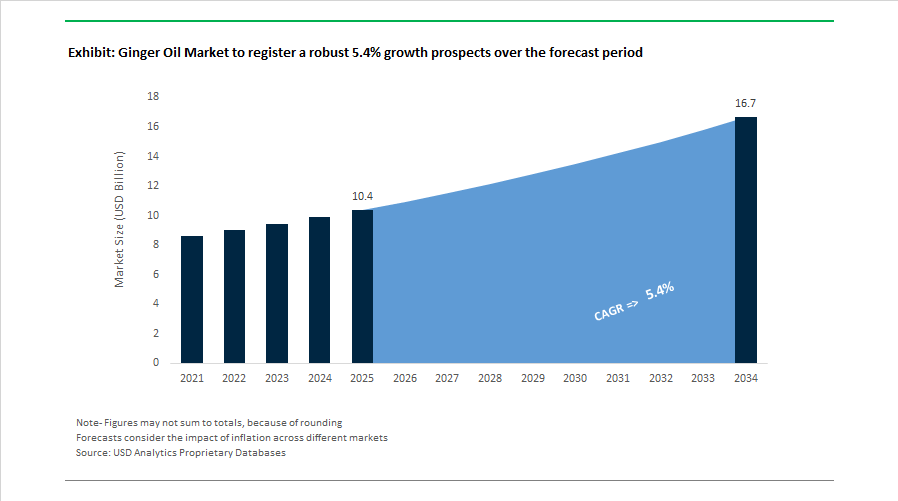
The Ginger Oil Market is projected to grow from $10.4 billion in 2025 to $16.7 billion by 2034, registering a CAGR of 5.4%. Market expansion is supported by rising demand for high-purity ginger essential oil and ginger oleoresin across pharmaceuticals, nutraceuticals, functional beverages, cosmetics, aromatherapy, and clean-label food formulations. Increasing regulatory validation, improved post-harvest infrastructure, and advanced extraction technologies are strengthening ginger oil’s role as a bioactive ingredient rich in gingerols and shogaols with anti-inflammatory and digestive health properties.
In February 2024, Nykaa Naturals launched its Ginger & Apple Cider Vinegar hair care line, positioning ginger oil as a primary scalp-soothing and anti-inflammatory ingredient in mainstream personal care. In May 2024, Givaudan SA partnered with Alibaba Group’s Tmall platform to accelerate the penetration of botanical ingredients, including ginger-based cosmetic oils, into China’s fast-growing beauty market. In September 2024, the Spices Board of India launched the $50.8 million SPICED program to upgrade post-harvest handling and ensure ISO and AFNOR-compliant export standards for high-value spice derivatives such as ginger oil. In October 2024, Nigeria announced financial intervention measures to address a ginger blight epidemic, stabilizing raw material supply from one of the world’s key producing regions.
Regulatory clarity and supply chain modernization accelerated in 2025. In early 2025, updated U.S. FDA recognition of ginger oil as Generally Recognized as Safe for broader applications catalyzed its integration into pharmaceutical and nutraceutical formulations targeting digestive health, inflammation management, and immune support. In March 2025, doTERRA International received the SEAL Sustainability Innovation Award, recognizing its environmentally responsible sourcing model and smallholder partnerships that enhance traceability and supply stability. The same month, global logistics providers introduced specialized cold-chain solutions for fresh ginger and high-value extracts, reducing oxidation risk and preserving volatile compound integrity during international transport.
Technological upgrades in extraction and traceability are reshaping quality benchmarks. By mid-2025, processors such as Synthite Industries Ltd. and AOS Products Pvt. Ltd. reported adoption of supercritical CO2 and ultrasonic-assisted extraction systems, improving gingerol recovery rates by up to 20% and delivering higher potency oil profiles required by pharmaceutical and functional beverage manufacturers. In 2025, brands including Young Living Essential Oils implemented blockchain-enabled traceability frameworks, enabling verification of origin, harvest data, and chemical composition to counter adulteration concerns.
Infrastructure investment in origin markets further strengthened value addition. In December 2025, the Government of Mizoram announced commissioning of a modern ginger processing facility in Sairang, operational in January 2026, aimed at converting raw harvests into export-grade ginger oil and oleoresins. This reinforces India’s position as a high-value processing hub. In January 2026, major beverage companies expanded ginger-infused ready-to-drink cocktail lines utilizing natural ginger oil instead of synthetic flavorings, aligning with global clean-label and plant-based beverage trends.
The Ginger Oil Market outlook reflects regulatory-driven pharmaceutical adoption, advanced CO2 extraction, blockchain traceability, cold-chain logistics enhancement, and infrastructure modernization in key producing regions. Competitive differentiation increasingly depends on gingerol concentration levels, origin certification, sustainable farmer partnerships, export-grade purity compliance, and clean-label positioning across nutraceutical, cosmetic, and beverage industries.
Ginger Oil Market Trends and Strategic Growth Opportunities
Standardized Chemotype Sourcing Accelerates Pharmaceutical and Therapeutic Adoption
The global ginger oil market is undergoing a decisive shift from bulk flavor applications toward chemotype-specific, standardized sourcing models aligned with pharmaceutical and nutraceutical requirements. Drug developers and functional ingredient formulators are increasingly demanding precise gingerol and shogaol profiles to ensure reproducible therapeutic outcomes. Clinical and formulation research published in July 2025 confirmed that liquid ginger oil matrices significantly enhance the bioaccessibility of key bioactives such as 6-gingerol and 6-shogaol, reaching absorption levels above 23% and 11% respectively, compared with less than 4 percent in raw botanical powders. This performance gap is repositioning standardized ginger oil as a preferred delivery medium for antioxidant, anti-inflammatory, and metabolic health formulations.
Extraction technology is reinforcing this precision-driven trend. Supercritical carbon dioxide extraction is now widely adopted to produce select-grade ginger oils with tightly controlled terpene composition. Suppliers are marketing these oils with batch-level Certificates of Analysis that guarantee high concentrations of zingiberene exceeding 30% alongside beta-sesquiphellandrene and curcumene. This level of specification is transforming ginger oil from a commodity spice derivative into a pharmaceutical intermediate suitable for regulated applications. Supply-side stability is also improving. In January 2025, Department of Biotechnology announced the release of genome-edited ginger cultivars engineered for higher oleoresin yield and resistance to bacterial wilt. These developments are creating a more predictable raw material pipeline for large-scale distillers and contract manufacturers serving regulated end markets.
Organic and Regenerative Certification Becomes a Structural Market Gatekeeper
Certification has evolved from a branding differentiator into a structural entry requirement for premium ginger oil supply chains, particularly in North America and Europe. By mid to late 2025, leading consumer packaged goods and nutraceutical brands began mandating certified organic and regenerative sourcing to align with net-zero and biodiversity commitments. This trend is especially visible in Latin American origins such as Peru and Brazil, where commercial ginger cultivation is shifting toward regenerative organic practices that emphasize soil carbon sequestration, water efficiency, and reduced chemical inputs.
Traceability requirements are rising in parallel. In response to stricter European maximum residue limits, top-tier ginger oil exporters implemented blockchain-enabled traceability platforms by late 2024. These systems provide end-to-end visibility from rhizome harvest through distillation, creating digital compliance records that support both USDA Organic and EU Organic certification. Trade policy is also reshaping sourcing strategies. Newly implemented U.S. tariffs on organic ginger imports in 2025 have increased landed costs, prompting importers and ingredient companies to invest in domestic greenhouse cultivation, controlled-environment agriculture, and high-efficiency milling operations. Together, these forces are raising the barriers to entry while favoring well-capitalized, vertically integrated suppliers.
Advanced Topical Analgesics and Anti-Inflammatory Therapeutics
Ginger oil is emerging as a high-value active ingredient in next-generation topical analgesic and anti-inflammatory products, driven by its documented ability to inhibit cyclooxygenase pathways and prostaglandin synthesis. Clinical evidence published in September 2025 demonstrated that topical formulations containing 10% red ginger gel significantly reduced knee joint pain in elderly osteoarthritis patients. Red ginger varieties are attracting premium positioning due to their elevated concentrations of 8-gingerol and 10-gingerol compared with conventional yellow ginger, creating a differentiated raw material segment for pain management and sports recovery applications.
Delivery system innovation is expanding this opportunity. Mid-2025 formulation studies showed that incorporating ginger oil into nanostructured lipid carriers and phytosome systems substantially improves transdermal penetration and bioavailability. These advances are enabling the development of ginger-based patches, roll-ons, and ointments designed for deep-tissue inflammation, muscle fatigue, and post-exercise recovery. As regulatory authorities increasingly favor botanical actives with strong mechanistic validation, ginger oil is well positioned to capture share within the growing market for natural over-the-counter pain relief solutions.
Veterinary Nutraceutical Applications in Digestive Health and Nausea Management
The rapid humanization of pet care is opening a high-growth opportunity for ginger oil in veterinary nutraceuticals, particularly for digestive health and nausea management. Veterinary research published during 2024 and 2025 highlighted ginger oil’s anti-emetic properties in companion animals, supporting its use for motion sickness, post-surgical recovery, and chemotherapy-related nausea in dogs and cats. These applications align with the broader shift away from synthetic anti-emetics toward plant-based, well-tolerated alternatives in pet health.
Commercial opportunity lies in formulation and palatability innovation. Manufacturers are developing veterinary-grade liquid tinctures, soft chews, and encapsulated formats that leverage ginger oil’s carminative benefits while addressing its strong sensory profile. Advanced flavor masking and controlled-release technologies are enabling consistent dosing and improved acceptance, particularly among cats. As premium pet nutrition and veterinary supplements continue to expand, ginger oil is positioned to become a core functional ingredient across digestive support, stress management, and recovery-focused animal health products.
Ginger Oil Market Share and Segmentation Insights
Ginger Oleoresin Leads the Ginger Oil Market Through Concentrated Flavor and Functional Compound Content
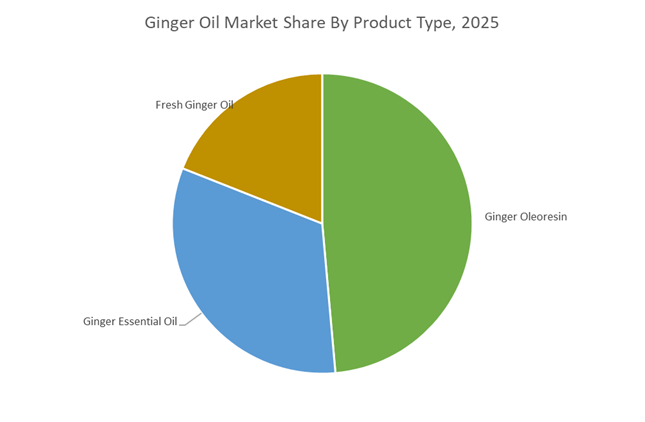
Ginger Oleoresin accounted for 48.60% of the Ginger Oil Market share in 2025, positioning it as the most commercially significant product type in the global ginger extract industry. Ginger oleoresin contains both the volatile aromatic compounds present in ginger essential oil and the non-volatile pungent components such as gingerols and shogaols, providing the complete flavor and functional profile required for food processing, nutraceutical formulations, and pharmaceutical preparations. This dual composition allows ginger oleoresin to deliver strong flavor intensity, consistent pungency, and enhanced stability compared to standard essential oils, making it highly suitable for large-scale food manufacturing and supplement production. In 2025, the segment is witnessing strong growth through the introduction of standardized ginger oleoresin extracts developed for nutraceutical and pharmaceutical markets. Major botanical extract producers now offer oleoresin products standardized to specific gingerol and shogaol concentrations, allowing manufacturers to ensure precise dosing and consistent bioactive potency in finished products. These high-specification extracts command premium pricing within the ginger oil market, reflecting their superior quality and functional reliability.
Food and Beverage Applications Drive the Largest Demand for Ginger Oil and Ginger Oleoresin
Food and Beverages represented 52.80% of the Ginger Oil Market share in 2025, establishing this sector as the primary demand driver for ginger-based extracts and oils. Ginger is one of the most widely used flavor ingredients globally, incorporated into carbonated beverages, bakery products, confectionery, sauces, marinades, and traditional ethnic cuisine preparations. The natural warmth and pungency of ginger flavor make it particularly valuable in beverages such as ginger ale, craft sodas, herbal teas, and flavored alcoholic drinks, where it contributes both flavor intensity and perceived health benefits. In 2025, the beverage industry is experiencing significant innovation through the expansion of functional and wellness-oriented drink categories. Ginger oil and ginger oleoresin are increasingly incorporated into kombucha beverages, digestive health tonics, functional wellness shots, and herbal beverage blends, where consumers associate ginger with digestive support, anti-inflammatory properties, and natural immune support. This growing link between ginger ingredients and wellness positioning is driving premium product development across the functional beverage and nutraceutical drink market.
Competitive Landscape in Ginger Oil Market
Robertet Group Expands Premium Ginger Oil Processing in Southeast Asia
Robertet Group remains a global benchmark in natural aromatic raw materials with a strong position in the premium ginger essential oil segment. In 2025, the company reported revenue of €843.9 million, reflecting 4.5% growth, supported by a 12.4% surge in raw material sales. Its Ginger Blue and standard ginger oils are characterized by a fresh, grated olfactory profile preferred by luxury fragrance houses. In early 2026, Robertet commissioned a new processing facility in Indonesia to strengthen regional extraction capabilities for Southeast Asian botanicals. The company continues to advance CleanRscent and sustainable extraction technologies, reinforcing its Seed to Scent traceability model and strengthening supply security in a volatile spice market.
Symrise AG Drives Circular Extraction and Organic Integration
Symrise AG is advancing circular economy leadership within the ginger oil sector through its Full Side-Stream Valorization strategy. Using its patented Symtrap® process, the company extracts aromatic molecules from aqueous distillation by-products that were previously discarded, enhancing yield and reducing waste. In 2025 and 2026, Symrise launched SymVital® Mada, a cosmetic-grade ginger extract produced through supercritical CO₂ extraction in Madagascar. The company has integrated its supply chain backward, supporting more than 7,000 farmers with pregerminated roots to ensure fully traceable organic sourcing. Its Millesime collection now includes Grand Cru Ginger oil produced through cooperative farming models that fund local healthcare and water initiatives, strengthening ESG positioning.
Givaudan Integrates Ginger into Active Beauty and Nootropic Portfolios
Givaudan SA continues to expand ginger’s role beyond flavoring into Active Beauty and nootropic wellness formulations. The company reported 2024 sales of CHF 7.4 billion with double-digit local-for-like growth, while 53% of its raw materials are responsibly sourced under its Sourcing4Good framework. Its Zingiber officinale root extract is positioned within a Nootropics collection for skin regeneration and brightening applications. Through AI-driven sensory mapping technology acquired via Myrissi, Givaudan correlates ginger’s warming sensory attributes with emotional and wellness responses. In early 2026, the company maintained a CDP AA climate transparency rating, supported by audited spice supply chains in India and Nigeria.
doTERRA International maintains strong presence in the consumer ginger oil segment through its direct-to-consumer wellness model. The company sources fresh ginger rhizomes primarily from Madagascar, requiring one to two pounds of fresh ginger to produce a single 15 ml bottle, a differentiation point in purity positioning. Under its Co-Impact Sourcing® initiative, doTERRA supports smallholder farmers and enforces CPTG testing protocols to ensure chemical integrity. Expansion into India during 2024 and 2025 has enhanced localized distribution across Asia-Pacific. The brand markets ginger oil primarily for digestive support, emphasizing α-zingiberene concentration and gastrointestinal comfort benefits within the natural wellness sector.
Synthite Industries Ltd., headquartered in India, remains the world’s largest producer of value-added spices and a dominant supplier of ginger oleoresins. Leveraging India’s position as the largest ginger-producing nation, Synthite processes a substantial share of global ginger raw material into oils and extracts. Its supercritical CO₂ extraction technology preserves gingerol pungency often diminished during steam distillation. Through its Sustainable Spice Initiative engagement, the company promotes pesticide-free cultivation and fair labor standards across Kerala and Karnataka. In late 2025, Synthite invested in digital supply chain software enabling real-time Field-to-Factory traceability for B2B clients, reinforcing transparency in global spice exports.
Young Living Enhances Blockchain Transparency and Metabolic Positioning
Young Living Essential Oils continues to build loyalty under its Seed to Seal quality framework, emphasizing sourcing, science, and standards. In early 2026, the company integrated blockchain tracking for flagship oils, enabling verification of harvest dates and distillation batches. Alongside its core ginger essential oil, Young Living markets a Black Ginger supplement targeting metabolic support and energy enhancement segments. The company is expanding Mediterranean and East African partner farms and scheduled its 2026 European Convention in Greece to highlight supply chain transparency. Strategic promotion through large-scale events across Asia and Europe reinforces its brand authority in therapeutic-grade essential oils.
India: Northeast Industrialization and Premium Extraction Leadership
India’s ginger oil industry is undergoing a structural transformation anchored in the Northeast, with Mizoram emerging as a strategic processing hub rather than a raw rhizome supplier. Following consultations with NITI Aayog, Mizoram was formally designated the “Ginger Capital of India” in December 2025, a move that directly preceded the commissioning of a large-scale ginger processing facility at Sairang in January 2026. This unit is designed to convert locally grown ginger into export-grade essential oils and oleoresins, materially improving value realization for farmers. Supply-side stability has been reinforced through the introduction of a ₹50 per kg Minimum Support Price in late 2025, ensuring consistent feedstock availability for domestic distillation units and reducing price-induced volatility in refinery operations.
Technology diffusion and export orientation are accelerating industry maturity. Under the 2026 Handholding Scheme, the Mizoram Agricultural Marketing Board deployed indigenous Rapchung and Tapchhak drying systems to standardize moisture levels before oil extraction, improving yield consistency. The CSIR-CIMAP expanded Aroma Mission Phase III into ginger-dominant clusters, deploying mobile distillation units to curb post-harvest oil losses among smallholders. On the demand side, APEDA has established dedicated organic export corridors to the EU and U.S., while innovation-led players such as Kancor Ingredients under Mane SA have scaled supercritical CO₂-extracted fresh ginger oil tailored for craft beverages and high-end botanical fragrances.
Vietnam: From Volume Exporter to High-Potency Oil Specialist
Vietnam has repositioned itself as a high-value ginger oil and oleoresin supplier, moving decisively away from bulk rhizome exports. By 2025, the country had become the world’s third-largest ginger exporter, generating over USD 48 million in ginger-related exports. This growth occurred despite a 19.1% decline in export volumes, underscoring a deliberate shift toward refined oils and standardized extracts with higher unit values. Expanded cultivation across Quang Ngai, Nghe An, and Lam Dong, now exceeding 45,000 hectares, has been supported by irrigation-focused government subsidies that favor industrial processing over spot-market sales.
Quality standardization has become the sector’s defining feature. Vietnamese refineries are now calibrating ginger oil profiles for elevated gingerol content, aligning output with nutraceutical and pharmaceutical-grade specifications. The Ministry of Agriculture and Rural Development’s Green Spice program certified more than 20,000 hectares in 2025 for low-input, drought-tolerant cultivation, positioning Vietnamese ginger oil to meet forthcoming EU sustainability benchmarks. This combination of agronomic scale and biochemical consistency is strengthening Vietnam’s competitiveness in regulated global markets.
Nigeria: Disease Recovery and High-Oil Differentiation
Nigeria’s ginger oil industry entered a recovery phase in late 2025 following a severe blight outbreak that cut exports by 74%. The Federal Government responded with a ₦1.6 billion mitigation fund to distribute disease-resistant seedlings and expand farmer training programs. These interventions are critical given Nigeria’s reputation for ginger varieties with exceptionally high essential oil and oleoresin yields, attributes that remain in strong demand among flavor and fragrance manufacturers.
Research-led varietal improvement and infrastructure investment are restoring confidence. The National Root Crops Research Institute released two disease-tolerant, high-yield ginger varieties in late 2025 specifically optimized for oil extraction. At the same time, the Centre for the Promotion of Imports-supported “Ginger Nigeria” program has enabled processors to upgrade facilities to ISO- and AFNOR-aligned standards for volatile oil purity. In Kaduna State, a new public–private distillation plant commissioned in 2025 is converting premium “Kaduna Ginger” into industrial-grade flavoring agents, anchoring Nigeria’s shift toward value-added exports.
China: Energy-Efficient Processing and Digital Traceability
China’s ginger oil sector is increasingly shaped by efficiency mandates and digital integration rather than acreage expansion. Under the 2025–2026 MIIT Green Processing mandate, producers have been incentivized to adopt closed-loop steam distillation systems that reduce energy consumption by an estimated 12%. These process upgrades are particularly relevant for large-scale facilities in Shandong and Yunnan, where margins depend on throughput efficiency and environmental compliance.
Commercial transparency is becoming a competitive differentiator. By 2026, leading processors have implemented blockchain-enabled traceability platforms that allow international buyers to verify pesticide-free status and batch-level analytics in real time. Product portfolios are also moving up the value chain, with companies such as Jinhui Bio-technology launching highly concentrated 30:1 ginger oleoresins targeted at instant beverage and functional food manufacturers, signaling China’s intent to compete beyond commodity essential oils.
United States: Regulatory Tightening and Wellness-Led Demand
The United States ginger oil market is being reshaped by regulatory scrutiny and convergence with the wellness economy. The FDA’s March 2025 reform of the GRAS pathway has raised documentation requirements for concentrated ginger extracts used in clean-label energy drinks and digestive health beverages, increasing compliance costs but favoring suppliers with robust safety dossiers. These changes are influencing formulation strategies across food, beverage, and supplement segments.
Supply chain resilience has become a parallel priority. Following Nigerian supply disruptions in 2025, U.S. flavor and fragrance majors such as ADM and IFF diversified sourcing toward Peruvian and Vietnamese organic ginger oil to protect 2026 production schedules. At the consumer end, aromatherapy brands including doTERRA and Young Living launched single-origin ginger oil lines in late 2025, emphasizing farm-to-bottle traceability and high terpene content to capture premium wellness demand.
Comparative Snapshot: Ginger Oil Industry by Country
Ginger Oil Market County Level Snapshot
Country
Strategic Focus
Industry Implication
India
Northeast processing hubs and premium extraction
Rapid move from raw ginger to export-grade oils
Vietnam
High-potency standardization
Value-led growth despite lower volumes
Nigeria
Disease recovery and high-oil varieties
Re-entry into premium oil markets
China
Energy efficiency and digital traceability
Competitive industrial-scale supply
United States
Regulatory tightening and wellness demand
Preference for compliant, single-origin oils
Ginger Oil Market Report Scope
Ginger Oil Market
Parameter
Details
Market Size (2025)
$10.4 Billion
Market Size (2034)
$16.7 Billion
Market Growth Rate
5.4%
Segments
By Product Type (Ginger Essential Oil, Ginger Oleoresin, Fresh Ginger Oil), By Purity Grade (Organic Certified, Conventional Grade, Pharmaceutical Grade), By Extraction Method (Steam Distillation, Supercritical CO₂ Extraction, Solvent Extraction), By Application (Food and Beverages, Pharmaceuticals, Cosmetics and Personal Care, Aromatherapy and Wellness, Animal Nutrition), By Distribution Channel (B2B and Industrial, Retail)
Study Period
2019- 2025 and 2026-2034
Units
Revenue (USD)
Qualitative Analysis
Porter’s Five Forces, SWOT Profile, Market Share, Scenario Forecasts, Market Ecosystem, Company Ranking, Market Dynamics, Industry Benchmarking
Companies
Givaudan SA, Symrise AG, International Flavors and Fragrances Inc., Mane SA, doTERRA International LLC, Young Living Essential Oils, Archer Daniels Midland Company, Kerry Group plc, Olam Group, Robertet SA, Albert Vieille SAS, New Directions Aromatics Inc., Sivaroma Naturals Pvt. Ltd., Guangxi Jinhui Bio-technology Co., Ltd., AOS Products Pvt. Ltd.
Countries
US, Canada, Mexico, Germany, France, Spain, Italy, UK, Russia, China, India, Japan, South Korea, Australia, South East Asia, Brazil, Argentina, Middle East, Africa
Ginger Oil Market Segmentation
By Product Type
Ginger Essential Oil
Ginger Oleoresin
Fresh Ginger Oil
By Purity Grade
Organic Certified
Conventional Grade
Pharmaceutical Grade
By Extraction Method
Steam Distillation
Supercritical CO₂ Extraction
Solvent Extraction
By Application
Food and Beverages
Pharmaceuticals
Cosmetics and Personal Care
Aromatherapy and Wellness
Animal Nutrition
By Distribution Channel
B2B and Industrial
Retail
By Region
North America (United States, Canada, Mexico)
Europe (Germany, France, United Kingdom, Spain, Italy, Rest of Europe)
Asia Pacific (China, India, Japan, South Korea, Australia, Rest of APAC)
South and Central America (Brazil, Argentina, Rest of SCA)
Middle East and Africa (Saudi Arabia, UAE, South Africa, Rest of Middle East, Rest of Africa)
2. Ginger Oil Market Landscape & Outlook (2026–2034)
2.1. Introduction to Ginger Oil Market
2.2. Market Valuation and Growth Projections (2026–2034)
2.3. Pharmaceutical and Nutraceutical Integration of Ginger Bioactives
2.4. Post-Harvest Infrastructure Modernization and Cold-Chain Logistics Development
2.5. Advanced Extraction Technologies and Traceability Systems in Ginger Processing
3. Innovations Reshaping the Ginger Oil Market
3.1. Trend: Standardized Chemotype Sourcing Accelerates Pharmaceutical and Therapeutic Adoption
3.2. Trend: Organic and Regenerative Certification Becomes a Structural Market Gatekeeper
3.3. Opportunity: Advanced Topical Analgesics and Anti-Inflammatory Therapeutics
3.4. Opportunity: Veterinary Nutraceutical Applications in Digestive Health and Nausea Management
4. Competitive Landscape and Strategic Initiatives
4.1. Mergers and Acquisitions
4.2. R&D and Extraction Technology Innovation
4.3. Sustainability and Traceable Sourcing Strategies
4.4. Market Expansion and Regional Supply Chain Development
5. Market Share and Segmentation Insights: Ginger Oil Market
5.1. By Product Type
5.1.1. Ginger Essential Oil
5.1.2. Ginger Oleoresin
5.1.3. Fresh Ginger Oil
5.2. By Purity Grade
5.2.1. Organic Certified
5.2.2. Conventional Grade
5.2.3. Pharmaceutical Grade
5.3. By Extraction Method
5.3.1. Steam Distillation
5.3.2. Supercritical CO₂ Extraction
5.3.3. Solvent Extraction
5.4. By Application
5.4.1. Food and Beverages
5.4.2. Pharmaceuticals
5.4.3. Cosmetics and Personal Care
5.4.4. Aromatherapy and Wellness
5.4.5. Animal Nutrition
5.5. By Distribution Channel
5.5.1. B2B and Industrial
5.5.2. Retail
6. Country Analysis and Outlook of Ginger Oil Market
6.1. United States
6.2. Canada
6.3. Mexico
6.4. Germany
6.5. France
6.6. Spain
6.7. Italy
6.8. UK
6.9. Russia
6.10. China
6.11. India
6.12. Japan
6.13. South Korea
6.14. Australia
6.15. South East Asia
6.16. Brazil
6.17. Argentina
6.18. Middle East
6.19. Africa
7. Ginger Oil Market Size Outlook by Region (2026–2034)
7.1. North America Ginger Oil Market Size Outlook to 2034
7.1.1. By Product Type
7.1.2. By Purity Grade
7.1.3. By Extraction Method
7.1.4. By Application
7.1.5. By Distribution Channel
7.2. Europe Ginger Oil Market Size Outlook to 2034
7.2.1. By Product Type
7.2.2. By Purity Grade
7.2.3. By Extraction Method
7.2.4. By Application
7.2.5. By Distribution Channel
7.3. Asia Pacific Ginger Oil Market Size Outlook to 2034
7.3.1. By Product Type
7.3.2. By Purity Grade
7.3.3. By Extraction Method
7.3.4. By Application
7.3.5. By Distribution Channel
7.4. South America Ginger Oil Market Size Outlook to 2034
7.4.1. By Product Type
7.4.2. By Purity Grade
7.4.3. By Extraction Method
7.4.4. By Application
7.4.5. By Distribution Channel
7.5. Middle East and Africa Ginger Oil Market Size Outlook to 2034
7.5.1. By Product Type
7.5.2. By Purity Grade
7.5.3. By Extraction Method
7.5.4. By Application
7.5.5. By Distribution Channel
8. Company Profiles: Leading Players in the Ginger Oil Market
8.1. Givaudan SA
8.2. Symrise AG
8.3. International Flavors and Fragrances Inc.
8.4. Mane SA
8.5. doTERRA International LLC
8.6. Young Living Essential Oils
8.7. Archer Daniels Midland Company
8.8. Kerry Group plc
8.9. Olam Group
8.10. Robertet SA
8.11. Albert Vieille SAS
8.12. New Directions Aromatics Inc.
8.13. Sivaroma Naturals Pvt. Ltd.
8.14. Guangxi Jinhui Bio-technology Co., Ltd.
8.15. AOS Products Pvt. Ltd.
9. Methodology
9.1. Research Scope
9.2. Market Research Approach
9.3. Market Sizing and Forecasting Model
9.4. Research Coverage
9.5. Data Horizon
9.6. Deliverables
10. Appendix
10.1. Acronyms and Abbreviations
10.2. List of Tables
10.3. List of Figures
Ginger Oil Market Segmentation
By Product Type
Ginger Essential Oil
Ginger Oleoresin
Fresh Ginger Oil
By Purity Grade
Organic Certified
Conventional Grade
Pharmaceutical Grade
By Extraction Method
Steam Distillation
Supercritical CO₂ Extraction
Solvent Extraction
By Application
Food and Beverages
Pharmaceuticals
Cosmetics and Personal Care
Aromatherapy and Wellness
Animal Nutrition
By Distribution Channel
B2B and Industrial
Retail
By Region
North America (United States, Canada, Mexico)
Europe (Germany, France, United Kingdom, Spain, Italy, Rest of Europe)
Asia Pacific (China, India, Japan, South Korea, Australia, Rest of APAC)
South and Central America (Brazil, Argentina, Rest of SCA)
Middle East and Africa (Saudi Arabia, UAE, South Africa, Rest of Middle East, Rest of Africa)
The Ginger Oil Market is expected to grow from $10.4 billion in 2025 to $16.7 billion by 2034, registering a CAGR of 5.4%. Expansion is driven by increasing demand for ginger essential oil and ginger oleoresin in pharmaceuticals, nutraceuticals, functional beverages, and cosmetics. Regulatory recognition and advanced extraction technologies are strengthening ginger oil’s role as a bioactive botanical ingredient.
The U.S. FDA’s updated recognition of ginger oil as Generally Recognized as Safe (GRAS) in 2025 has accelerated its integration into pharmaceutical and nutraceutical products. Formulators are increasingly using ginger oil in digestive health supplements, anti-inflammatory therapeutics, and immune-support formulations. Standardized gingerol and shogaol concentrations are becoming key specifications for regulated health applications.
Processors are adopting supercritical CO2 extraction and ultrasonic-assisted extraction technologies to improve gingerol recovery rates and maintain volatile compound integrity. These techniques can increase bioactive compound yield by up to 20% compared with conventional steam distillation. High-purity extracts produced through these methods are particularly valuable for pharmaceutical-grade formulations and functional beverages.
Beyond food flavoring, ginger oil is gaining traction in topical analgesics, sports recovery products, veterinary nutraceuticals, and digestive health beverages. Clinical research has demonstrated ginger oil’s ability to support anti-inflammatory pathways and nausea management, encouraging its use in natural pain relief formulations and companion animal health supplements.
Major companies in the Ginger Oil Market include Givaudan SA, Symrise AG, International Flavors & Fragrances Inc., Mane SA, doTERRA International LLC, Young Living Essential Oils, Archer Daniels Midland Company, Kerry Group plc, Robertet SA, and Olam Group. These companies focus on high-purity extraction technologies, traceable sourcing networks, and standardized gingerol-rich formulations to strengthen their competitive positions in global botanical ingredient markets.