Geranium Oil Market to Reach $138.5 Million by 2034 at 8% CAGR Driven by Luxury Skincare, Traceable Sourcing, and Sustainable Cultivation
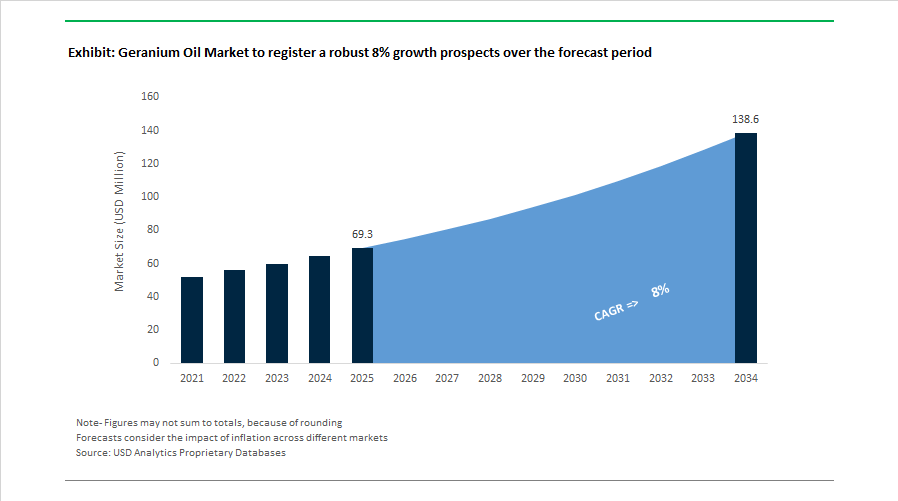
The Geranium Oil Market is projected to expand from $69.3 Million in 2025 to $138.5 Million by 2034, registering a CAGR of 8% over the forecast period. Market growth is supported by increasing integration of geranium essential oil in premium skincare formulations, fine fragrances, aromatherapy-grade products, pet wellness solutions, and functional personal care. Demand for Pelargonium graveolens oil is rising across luxury cosmetics, hormonal wellness supplements, mood-balancing aromatherapy, and natural insect-repellent applications, reinforcing its position as a high-value botanical extract in the global essential oils industry.
In March 2024, Augustinus Bader launched its Geranium Rose Body Oil, signaling the migration of geranium oil into ultra-luxury skincare segments. The formulation leverages the oil’s anti-inflammatory and skin-repair properties to complement proprietary bioactive complexes, strengthening demand for high-purity, therapeutic-grade geranium extracts. In 2024, Shiseido Company Limited reported investments in automated harvesting systems on Reunion Island to secure sustainable Bourbon geranium supply through 2026. The initiative improves labor efficiency while ensuring stable raw material procurement for fragrance portfolios. In October 2024, Indian market data recorded geranium oil prices reaching approximately 20,000 rupees per liter due to supply deficits and previous years’ low farmer returns, triggering renewed industrial interest in expanding domestic cultivation.
Agricultural innovation and supply chain diversification accelerated in 2024–2025. In late 2024, CSIR-Central Institute of Medicinal and Aromatic Plants introduced a cost-effective polyhouse cultivation technology, replacing expensive glasshouse systems to improve sapling survival rates during monsoon cycles. This advancement enhances year-round geranium farming accessibility for smallholders in India. In 2025, Aromatic and Allied Chemicals expanded its sustainable geranium cultivation project in Meghalaya, emphasizing pesticide-free, high-altitude Pelargonium graveolens production. In early 2025, AG Organica Private Limited strengthened sourcing agreements with Egyptian growers to ensure traceable Geranium Egypt Oil supply despite regional production contraction. Export analytics from March 2025 indicated record shipments from India to France, reinforcing India’s strategic role as a key supplier to global fine fragrance houses.
Brand repositioning and regulatory-grade transparency are shaping premiumization. In July 2025, Blossom Kochhar Aroma Magic relaunched its therapeutic essential oil range with eco-friendly packaging and aromatherapy-grade transparency standards to counter synthetic adulteration in retail markets. In 2025, multiple manufacturers adopted supercritical CO2 extraction technologies at commercial scale, eliminating solvent residues and positioning CO2-extracted geranium oil as a benchmark for medical-grade skincare and ingestible flavor applications in 2026. These advancements elevate purity standards and support regulatory compliance in cosmetic and nutraceutical segments.
Emerging application segments expanded in 2026. In January 2026, niche wellness brands introduced pet-safe geranium oil diffusions targeting natural flea and tick repellency and anxiety reduction in companion animals, creating a new functional vertical within the aromatherapy market. In 2025, Shiseido confirmed progress toward achieving 100% traceability of key fragrance ingredients, including geranium, by the end of 2026, supported by third-party social and environmental audits.
The Geranium Oil Market outlook reflects expansion into luxury skincare, traceable and audited supply chains, sustainable high-altitude cultivation, CO2 extraction adoption, and diversification into pet wellness applications. Competitive differentiation increasingly centers on origin certification such as Bourbon and Egyptian varieties, purity verification, pesticide-free cultivation, sustainable farming technology, and premium fragrance integration across cosmetics and aromatherapy industries.
Geranium Oil Market Trends and Strategic Growth Opportunities
Geographic Supply Diversification and Sustainability-Led Sourcing Models
The global geranium oil market is undergoing a structural realignment as buyers reduce overdependence on legacy origins and intensify sustainability and traceability requirements. Historically concentrated around Egyptian and Bourbon or Réunion supply, procurement strategies are now diversifying to improve resilience against climate volatility, geopolitical risk, and certification bottlenecks. South Africa has emerged as a quality-first production hub, transitioning from niche volumes to globally benchmarked supply. By December 2025, producers in the region had widely adopted Good Agricultural and Collection Practices and organic certification frameworks, enabling premium pricing in pharmaceutical and clean beauty channels. Capital investment patterns underscore this shift, with modern distillation infrastructure exceeding R2.5 million per commercial unit, reflecting a move from artisanal production to industrial-scale, standards-driven operations.
India is simultaneously strengthening its export competitiveness through policy-backed cultivation and processing programs. During 2024 and 2025, initiatives led by the Ministry of AYUSH and the National Medicinal Plants Board accelerated certified organic production and Atmanirbhar self-reliance models, aligning domestic output with global demand for natural skincare ingredients. This has positioned India as a reliable supplier for multinational buyers seeking scalable, ethically sourced essential oils. Corporate buyers are embedding these sourcing strategies into enterprise ESG roadmaps. In its 2025 sustainability disclosures, dsm-firmenich reported deep workforce engagement in biodiversity protection and net-zero sourcing programs, translating into long-term procurement commitments in regions such as Egypt and China. As ESG compliance becomes a purchasing prerequisite, sustainability-certified geranium oil is increasingly favored over spot-market supply.
Functional Chemotype Differentiation and Precision Quality Analytics
Demand for geranium oil is shifting from generic botanical labeling toward functional chemotype positioning, reflecting the growing sophistication of cosmetics, aromatherapy, and pharmaceutical formulators. Buyers are increasingly specifying oils based on precise chemical composition rather than botanical origin alone. Rose geranium varieties rich in citronellol and geraniol have seen the strongest uptake in 2025, particularly within luxury skincare and premium aromatherapy applications. These compounds are associated with antimicrobial activity, skin regeneration, and anti-aging efficacy, making rose geranium a preferred input for high-margin formulations within the premium essential oil segment.
Quality assurance practices are also evolving. By late 2025, batch-specific gas chromatography mass spectrometry profiling had become a de facto standard for business-to-business transactions. This level of analytical transparency allows buyers to tailor ingredient selection for targeted outcomes, such as selecting oils with higher citronellyl formate content for hormonal balance or linalool-rich profiles for calming and sleep-support applications. Digital traceability combined with chemotype marketing is reducing formulation risk, strengthening supplier differentiation, and elevating geranium oil from a commodity fragrance input to a functionally positioned bioactive ingredient.
Advanced Skincare Actives and Anti-Inflammaging Formulations
Geranium oil is increasingly being repositioned as a high-performance cosmeceutical active rather than a simple aromatic additive. Advances in delivery technology are unlocking new efficacy profiles by improving stability and transdermal penetration. Research published in 2025 demonstrated that nanoemulsified geranium oil systems achieve droplet sizes below 100 nanometers, significantly enhancing bioavailability and oxidative stability compared with bulk oil. These formulations enable consistent delivery of active metabolites into deeper skin layers, supporting use in acne management, pigmentation control, and age-related skin degradation.
Clinical reviews conducted during 2024 and 2025 further reinforced geranium oil’s role in barrier repair and skin regeneration protocols. Its ability to support moisture retention, elasticity, and inflammatory response modulation has driven adoption in formulations targeting rosacea, atopic dermatitis, and sensitive skin conditions. As the global skincare industry continues to prioritize clinically substantiated botanicals, geranium oil is becoming a core ingredient within premium serums and dermocosmetic lines focused on anti-inflammaging and long-term skin health.
Green Pest Control and Biocontrol Applications in Veterinary and Agriculture
Beyond personal care, geranium oil is unlocking significant opportunities in functional pest management as regulatory pressure mounts against synthetic pesticides. The documented acaricidal and repellent properties of geranium oil and its key constituent geraniol are driving adoption in veterinary applications, particularly within non-toxic pet care and equine management products. Studies conducted in early 2025 demonstrated a strong dose-dependent protection profile against biting insects, supporting its use in flea and tick repellents positioned as clean-label alternatives to pyrethroid-based formulations.
In agriculture, nanoemulsified geranium oil is gaining traction as a biodegradable fumigant for organic grain storage. Industrial trials in October 2025 showed that nanoemulsion formats maintained meaningful pest mortality rates for extended periods, outperforming conventional oil applications in stored-grain environments. This positions geranium oil as a viable bio-pesticide aligned with organic certification standards and residue-free storage requirements. Collectively, these applications broaden the addressable market for geranium oil, reinforcing its evolution into a multifunctional, sustainability-aligned ingredient across personal care, animal health, and agriculture.
Geranium Oil Market Share and Segmentation Insights
Bourbon Geranium Oil Leads Premium Essential Oil Supply in the Geranium Oil Market
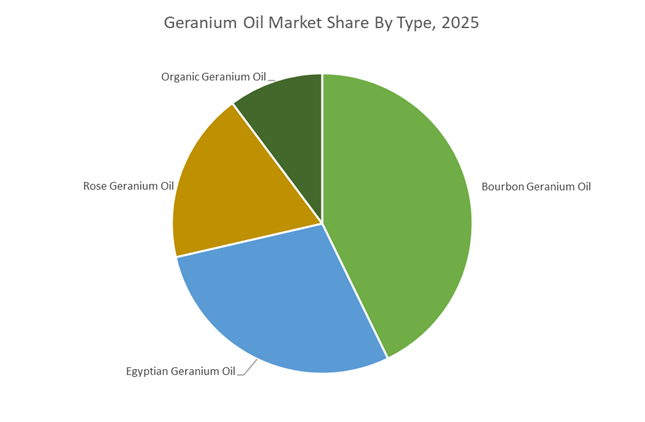
Bourbon Geranium Oil accounted for 42.80% of the Geranium Oil Market share in 2025, making it the most commercially valued variety within the global geranium essential oil industry. Sourced primarily from Madagascar and Réunion Island, Bourbon geranium oil is highly prized for its complex rosy-green aromatic profile combined with subtle minty and fruity undertones, characteristics that make it particularly desirable in fine fragrance formulation and aromatherapy blends. Perfumers often prefer Bourbon geranium oil because it delivers a balanced natural rose-like scent with enhanced depth and longevity, allowing it to function effectively as both a middle note and blending component in perfume compositions. In 2025, the segment is gaining additional market strength through geographic indication (GI) protection initiatives that authenticate the origin of Bourbon geranium oil. Producers in Madagascar and Réunion have implemented traceability systems, origin certification programs, and anti-adulteration verification technologies, helping ensure product authenticity and protect regional reputation. These measures enable suppliers to command premium pricing for certified Bourbon geranium oil, reinforcing its leadership in the global geranium oil market.
Skincare and Cosmetics Drive the Largest Demand for Geranium Oil in Botanical Beauty Formulations
Skincare and Cosmetics represented 38.60% of the Geranium Oil Market share in 2025, establishing this sector as the leading application segment for geranium essential oil. Geranium oil is widely used in facial oils, moisturizers, serums, lotions, and botanical cosmetic formulations, where it provides both functional skincare benefits and natural fragrance enhancement. The oil is valued for its perceived skin-balancing properties, making it suitable for formulations designed for both dry and oily skin types, while its rose-like aroma aligns well with consumer demand for plant-derived fragrance ingredients in clean beauty products. In 2025, the skincare segment is expanding further through growing adoption in men’s grooming and male skincare products, a rapidly developing category within the cosmetics industry. Geranium oil’s fresh herbaceous-rose scent profile allows formulators to create fragrances that avoid the overly floral characteristics associated with traditional rose oils. As a result, the ingredient is increasingly incorporated into beard oils, shaving creams, aftershave balms, and men’s facial care products, supporting the development of sophisticated botanical grooming formulations.
Competitive Landscape in Geranium Oil Market
Robertet Group Leads Premium Natural Geranium Oil Supply
Robertet Group remains a benchmark supplier for European fine fragrance houses. Through its Source-to-Scent integration model, the company maintains direct partnerships with farming cooperatives in Egypt and China to secure high-citronellol geranium feedstocks with full traceability. Its Geranium Bourbon and Geranium Egypt oils are recognized for purity consistency and compliance with high-end perfumery specifications. In late 2025, Robertet expanded its Natural and Sustainable portfolio with standardized organic geranium fractions aligned with the EU Green Claims Directive requirements entering force in 2026. Leveraging its Grasse heritage, the company continues to dominate the premium olfactory segment through technical distillation precision and responsible sourcing audits.
doTERRA International captures roughly 9.2% of the global geranium oil market through its direct-to-consumer aromatherapy model. Its Co-Impact Sourcing initiative in Kenya and Ethiopia supports thousands of smallholder farmers, enhancing supply resilience while reinforcing ethical sourcing credentials. In February 2026, the company expanded its Zero-Waste Ingredients program, incorporating geranium oil into mood-oriented fragrance systems positioned for stress relief and hormonal balance. Each batch undergoes CPTG testing, a multi-phase quality protocol that has become a recognized benchmark in the retail essential oil segment. The company markets geranium oil as a functional wellness ingredient, emphasizing emotional modulation and post-pandemic consumer demand for natural therapeutic solutions.
Symrise Integrates Circular Distillation and Organic Sourcing
Symrise AG continues to strengthen its Scent and Care portfolio through circular economy innovation and premium natural extracts. In March 2026, the company expanded its Millesime collection with a certified organic geranium oil sourced near Antananarivo, Madagascar. Through its patented Symtrap process, Symrise upcycles aqueous side-streams from distillation to recover additional aromatic molecules, reducing emissions and maximizing yield efficiency. The company is progressively replacing legacy catalog materials with cleaner, fully biodegradable geranium variants to meet evolving sustainability expectations. A 2026 white paper on full side-stream valorization reinforces its commitment to integrating natural essential oils into a closed-loop production model.
Albert Vieille Strengthens Regenerative and Climate-Verified Supply Chains
Albert Vieille SAS, operating under Givaudan ownership, remains a specialist in 100% natural aromatic ingredients for professional perfumery and aromatherapy. Its Geranium Essential Oil Egypt is standardized for high citronellol and geraniol concentrations, ensuring performance in masking and perfuming systems. Under Givaudan’s 2030 strategy framework commencing in 2026, Albert Vieille is transitioning toward fully responsible agricultural sourcing without ecosystem conversion. In January 2026, sustainability audits of African geranium supply chains contributed to Givaudan securing its seventh consecutive CDP A climate score, reinforcing environmental leadership credentials.
Young Living Reinforces Therapeutic-Grade Certification Standards
Young Living Essential Oils remains a pioneer in the Seed to Seal quality assurance model, targeting therapeutic-grade essential oil consumers. Its Geranium de la Reunion product, sourced from Réunion Island, is positioned for distinctive aromatic performance in personal care and wellness formulations. In 2026, the company intensified third-party testing initiatives to address greenwashing concerns in the retail aromatherapy sector. Scheduled participation at its European Convention in Greece highlights expanded partnerships with geranium farms and high-concentration product launches. Marketing emphasis includes antioxidant positioning supported by an ORAC value of approximately 1,010,011 TE per liter, reinforcing claims of high oxidative defense potential.
Biolandes Expands Certified Organic and Inclusive Ingredient Portfolio
Biolandes operates in 35 countries with integrated farms and distilleries, ensuring field-to-drum traceability across more than 700 essential oil products. In late 2025, the company announced participation in Cosme Tech 2026, targeting Asian clean beauty formulators with certified organic geranium extracts. Its portfolio includes conventional and organic geranium oils as well as geraniol fractions derived from palmarosa to provide nuanced dried leaf notes for perfumery. In January 2026, Biolandes updated its digital product lists to incorporate Halal and Kosher certifications, broadening access to inclusive global markets. The company’s technical precision and on-site processing capabilities maintain chemical integrity and oxidation stability critical for premium fragrance applications.
Egypt: Yield Maximization, Price Volatility, and Bulk Supply Leadership
Egypt continues to anchor the global geranium oil value chain as the dominant commercial producer of Pelargonium graveolens, with 2025 marking a decisive shift toward yield optimization and supply-chain control. In September 2025, producers across Beni-Suef and El-Sadat City institutionalized double-cut distillation protocols, enabling two harvest-extraction cycles annually. This agronomic adjustment has materially increased biomass utilization rates while maintaining the characteristic rosy-citrus profile demanded by European fragrance houses. Parallel government-backed climate adaptation programs in Upper Egypt introduced calibrated irrigation schedules and sandy-loam soil enrichment to stabilize oil composition under intensifying summer heat stress, preserving citronellol-to-geraniol ratios critical for export acceptance.
However, structural tightness has driven pronounced pricing volatility. By late 2025, Egyptian geranium oil prices reached USD 120 per kg, driven by speculative crop buy-outs and acreage contraction following weaker farmer returns in earlier cycles. In response, leading exporters such as AG Organica implemented farmer-to-factory traceability frameworks to counter adulteration risks and reassure buyers on purity. Egypt’s industrial strategy remains centered on bulk conventional geranium oil logistics, reinforcing its position as the primary upstream supplier for European fine fragrance compounding and holistic wellness formulations.
India: Cost-Efficient Cultivation, Policy Support, and Export-Grade Authentication
India’s geranium oil industry is transitioning from a fragmented cultivation base to a policy-backed, quality-assured export platform. In 2025, scientists at CSIR-CIMAP introduced protected shed technology as a low-cost alternative to glasshouse propagation, reducing sapling preparation costs by over 30%. This innovation has materially lowered entry barriers for small and marginal farmers participating in the expanded Aroma Mission Phase III, which now includes high-altitude clusters focused on rose-scented geranium for domestic aromatherapy demand.
Financial incentives have accelerated adoption. Under the 2025–26 National Mission, farmers receive planting material subsidies ranging from ₹20,000 per hectare for local varieties to ₹29,000 per hectare for imported high-yield cultivars. Regional distillation hubs in Pune and Kannauj became operational in 2025, enabling domestic production of Bourbon-type profiles and reducing reliance on Reunion Island imports. To support premium exports, India has institutionalized GC-MS testing at the farm gate, issuing batch-level purity certifications tailored for North American buyers seeking authenticated, natural essential oils.
China: Industrial Efficiency and Digitized Trade Channels
China’s geranium oil industry is positioned as a volume-driven, industrial-grade supplier optimized for detergents, soaps, and functional fragrances. The 2025 production strategy prioritizes high-citronellol and citronellyl-formate-rich cultivars, accepting lower geraniol content relative to Bourbon types in exchange for consistency and scalability. Continuous steam distillation units deployed across large plantations have reduced energy consumption per kilogram of oil by approximately 15% compared with batch systems, improving cost efficiency and emissions performance.
Commercially, China has accelerated B2B digital integration. By mid-2025, around 60% of wholesale geranium oil transactions migrated to dedicated digital platforms offering real-time batch analytics and traceability data. This shift has shortened procurement cycles for international buyers and strengthened China’s role as a reliable supplier for mass-market fragrance applications where standardization and price stability outweigh artisanal profiles.
South Africa: Organic Recovery and Niche Differentiation
South Africa’s geranium oil sector is rebuilding after a severe 2024–2025 downturn marked by drought and thrip infestations that cut output by 44%. For the 2026 harvest cycle, producers have implemented integrated pest management systems and expanded organically certified acreage to align with forthcoming EU Green Deal clean-label requirements. This recovery strategy emphasizes agronomic resilience and certification rather than volume expansion.
Concurrently, research programs in the Western Cape are exploring the therapeutic attributes of indigenous Pelargonium species. These initiatives aim to create differentiated Cape Geranium oils positioned for medical-grade aromatherapy and clinical wellness niches, allowing South African producers to command premiums independent of global commodity price swings.
France: Refinement, Compliance, and Biosynthetic Hedging
France remains the downstream nerve center of the geranium oil industry, with limited domestic cultivation but unmatched capabilities in refinement and regulatory alignment. In 2025, laboratories in the Grasse region advanced molecular fractionation techniques to isolate rose-like facets from Egyptian crude oil, enabling perfumers to achieve precise olfactory signatures while optimizing raw material utilization.
French distributors have also led early compliance with the 2025 IFRA Standards, ensuring geranium oil blends meet stringent dermal sensitization thresholds required for luxury natural perfumery. Beyond traditional sourcing, French startups began pilot-scale testing of biosynthetic pathways for geranium-like aroma molecules in early 2025. These efforts are designed to hedge agricultural supply volatility and secure continuity for high-volume cosmetic lines without displacing natural oil demand in premium segments.
Comparative Snapshot: Geranium Oil Industry by Country
Geranium Oil Market County Level Snapshot
Country
Strategic Focus
Industry Implication
Egypt
Yield maximization and bulk logistics
Global anchor supplier with price volatility exposure
India
Cost-efficient cultivation and certification
Rising exporter of authenticated Bourbon-type oils
China
Industrial efficiency and digital trade
Reliable supplier for mass-market fragrance uses
South Africa
Organic recovery and niche species
Premium positioning through differentiation
France
Refinement, compliance, and biotech
Value capture through downstream innovation
Geranium Oil Market Report Scope
Geranium Oil Market
Parameter
Details
Market Size (2025)
$69.3 Million
Market Size (2034)
$138.5 Million
Market Growth Rate
8%
Segments
By Type (Rose Geranium Oil, Bourbon Geranium Oil, Egyptian Geranium Oil, Organic Geranium Oil), By Application (Aromatherapy, Skincare and Cosmetics, Fine Fragrances, Nutraceuticals and Food Flavors, Industrial and Household Products), By Distribution Channel (B2B, Online Retail, Specialty Stores and Pharmacies)
Study Period
2019- 2025 and 2026-2034
Units
Revenue (USD)
Qualitative Analysis
Porter’s Five Forces, SWOT Profile, Market Share, Scenario Forecasts, Market Ecosystem, Company Ranking, Market Dynamics, Industry Benchmarking
Companies
Firmenich SA, doTERRA International, Young Living Essential Oils, Symrise AG, Robertet Group, Givaudan SA, Berjé, Inc., Albert Vieille SAS, Ultra International B.V., Ernesto Ventós S.A., Biolandes, A.G. Industries, Floral Essential Oil, De Monchy Aromatics, SVA Organics
Countries
US, Canada, Mexico, Germany, France, Spain, Italy, UK, Russia, China, India, Japan, South Korea, Australia, South East Asia, Brazil, Argentina, Middle East, Africa
Geranium Oil Market Segmentation
By Type
Rose Geranium Oil
Bourbon Geranium Oil
Egyptian Geranium Oil
Organic Geranium Oil
By Application
Aromatherapy
Skincare and Cosmetics
Fine Fragrances
Nutraceuticals and Food Flavors
Industrial and Household Products
By Distribution Channel
B2B
Online Retail
Specialty Stores and Pharmacies
By Region
North America (United States, Canada, Mexico)
Europe (Germany, France, United Kingdom, Spain, Italy, Rest of Europe)
Asia Pacific (China, India, Japan, South Korea, Australia, Rest of APAC)
South and Central America (Brazil, Argentina, Rest of SCA)
Middle East and Africa (Saudi Arabia, UAE, South Africa, Rest of Middle East, Rest of Africa)
2. Geranium Oil Market Landscape & Outlook (2026–2034)
2.1. Introduction to Geranium Oil Market
2.2. Market Valuation and Growth Projections (2026–2034)
2.3. Expansion of Geranium Oil in Luxury Skincare and Fine Fragrance Applications
2.4. Supply Chain Diversification and Sustainable Cultivation Initiatives
2.5. Traceability Standards and CO2 Extraction Advancements in Essential Oil Processing
3. Innovations Reshaping the Geranium Oil Market
3.1. Trend: Geographic Supply Diversification and Sustainability-Led Sourcing Models
3.2. Trend: Functional Chemotype Differentiation and Precision Quality Analytics
3.3. Opportunity: Advanced Skincare Actives and Anti-Inflammaging Formulations
3.4. Opportunity: Green Pest Control and Biocontrol Applications in Veterinary and Agriculture
4. Competitive Landscape and Strategic Initiatives
4.1. Mergers and Acquisitions
4.2. R&D and Extraction Technology Innovation
4.3. Sustainability and ESG-Oriented Sourcing Strategies
4.4. Market Expansion and Regional Supply Chain Development
5. Market Share and Segmentation Insights: Geranium Oil Market
5.1. By Type
5.1.1. Rose Geranium Oil
5.1.2. Bourbon Geranium Oil
5.1.3. Egyptian Geranium Oil
5.1.4. Organic Geranium Oil
5.2. By Application
5.2.1. Aromatherapy
5.2.2. Skincare and Cosmetics
5.2.3. Fine Fragrances
5.2.4. Nutraceuticals and Food Flavors
5.2.5. Industrial and Household Products
5.3. By Distribution Channel
5.3.1. B2B
5.3.2. Online Retail
5.3.3. Specialty Stores and Pharmacies
5.4. By Region
5.4.1. North America
5.4.2. Europe
5.4.3. Asia Pacific
5.4.4. South and Central America
5.4.5. Middle East and Africa
6. Country Analysis and Outlook of Geranium Oil Market
6.1. United States
6.2. Canada
6.3. Mexico
6.4. Germany
6.5. France
6.6. Spain
6.7. Italy
6.8. UK
6.9. Russia
6.10. China
6.11. India
6.12. Japan
6.13. South Korea
6.14. Australia
6.15. South East Asia
6.16. Brazil
6.17. Argentina
6.18. Middle East
6.19. Africa
7. Geranium Oil Market Size Outlook by Region (2026–2034)
7.1. North America Geranium Oil Market Size Outlook to 2034
7.1.1. By Type
7.1.2. By Application
7.1.3. By Distribution Channel
7.1.4. By Region
7.2. Europe Geranium Oil Market Size Outlook to 2034
7.2.1. By Type
7.2.2. By Application
7.2.3. By Distribution Channel
7.2.4. By Region
7.3. Asia Pacific Geranium Oil Market Size Outlook to 2034
7.3.1. By Type
7.3.2. By Application
7.3.3. By Distribution Channel
7.3.4. By Region
7.4. South America Geranium Oil Market Size Outlook to 2034
7.4.1. By Type
7.4.2. By Application
7.4.3. By Distribution Channel
7.4.4. By Region
7.5. Middle East and Africa Geranium Oil Market Size Outlook to 2034
7.5.1. By Type
7.5.2. By Application
7.5.3. By Distribution Channel
7.5.4. By Region
8. Company Profiles: Leading Players in the Geranium Oil Market
8.1. Firmenich SA
8.2. doTERRA International
8.3. Young Living Essential Oils
8.4. Symrise AG
8.5. Robertet Group
8.6. Givaudan SA
8.7. Berjé, Inc.
8.8. Albert Vieille SAS
8.9. Ultra International B.V.
8.10. Ernesto Ventós S.A.
8.11. Biolandes
8.12. A.G. Industries
8.13. Floral Essential Oil
8.14. De Monchy Aromatics
8.15. SVA Organics
9. Methodology
9.1. Research Scope
9.2. Market Research Approach
9.3. Market Sizing and Forecasting Model
9.4. Research Coverage
9.5. Data Horizon
9.6. Deliverables
10. Appendix
10.1. Acronyms and Abbreviations
10.2. List of Tables
10.3. List of Figures
Geranium Oil Market Segmentation
By Type
Rose Geranium Oil
Bourbon Geranium Oil
Egyptian Geranium Oil
Organic Geranium Oil
By Application
Aromatherapy
Skincare and Cosmetics
Fine Fragrances
Nutraceuticals and Food Flavors
Industrial and Household Products
By Distribution Channel
B2B
Online Retail
Specialty Stores and Pharmacies
By Region
North America (United States, Canada, Mexico)
Europe (Germany, France, United Kingdom, Spain, Italy, Rest of Europe)
Asia Pacific (China, India, Japan, South Korea, Australia, Rest of APAC)
South and Central America (Brazil, Argentina, Rest of SCA)
Middle East and Africa (Saudi Arabia, UAE, South Africa, Rest of Middle East, Rest of Africa)
The Geranium Oil Market is expected to grow from $69.3 million in 2025 to $138.5 million by 2034, registering a CAGR of 8%. Growth is driven by expanding use of Pelargonium graveolens oil in luxury cosmetics, aromatherapy formulations, and natural fragrance systems. Increasing consumer demand for traceable botanical extracts and premium essential oils is also strengthening market momentum.
Global fragrance and cosmetics companies are increasingly prioritizing fully traceable and sustainability-certified geranium oil supply chains. Producers in regions such as Egypt, India, South Africa, and Réunion Island are implementing Good Agricultural and Collection Practices along with digital traceability systems. These initiatives ensure authenticity, pesticide-free cultivation, and ESG-compliant sourcing, which are becoming mandatory procurement requirements for luxury skincare and fragrance brands.
Geranium oil is increasingly recognized as a bioactive skincare ingredient due to its anti-inflammatory, antimicrobial, and skin-regenerating properties. Advances in nanoemulsion delivery systems are improving bioavailability and enabling deeper skin penetration. As a result, cosmetic formulators are incorporating geranium oil into anti-aging serums, barrier-repair creams, and sensitive skin treatments, positioning it as a high-performance botanical active.
Beyond cosmetics and fragrances, geranium oil is expanding into pet wellness products, natural insect repellents, and agricultural biocontrol solutions. Veterinary formulations use geranium-derived compounds such as geraniol for flea and tick repellency, while nanoemulsified oils are being evaluated as organic grain-storage fumigants and eco-friendly pesticides. These diversified applications are broadening the ingredient’s addressable market.
Key companies operating in the Geranium Oil Market include Robertet Group, Symrise AG, Firmenich SA, Givaudan SA, doTERRA International, Young Living Essential Oils, Albert Vieille SAS, Biolandes, Berjé Inc., and Ultra International B.V. These companies focus on traceable sourcing, advanced distillation technologies, sustainable cultivation partnerships, and premium fragrance integration to strengthen their position in the global essential oils industry.