Graphene in Water Purification & Desalination Market Overview: Accelerating Towards a Water-Secure Future (2025–2034)
Market Projection: Robust Growth Driven by Global Water Scarcity & Energy Efficiency Demands
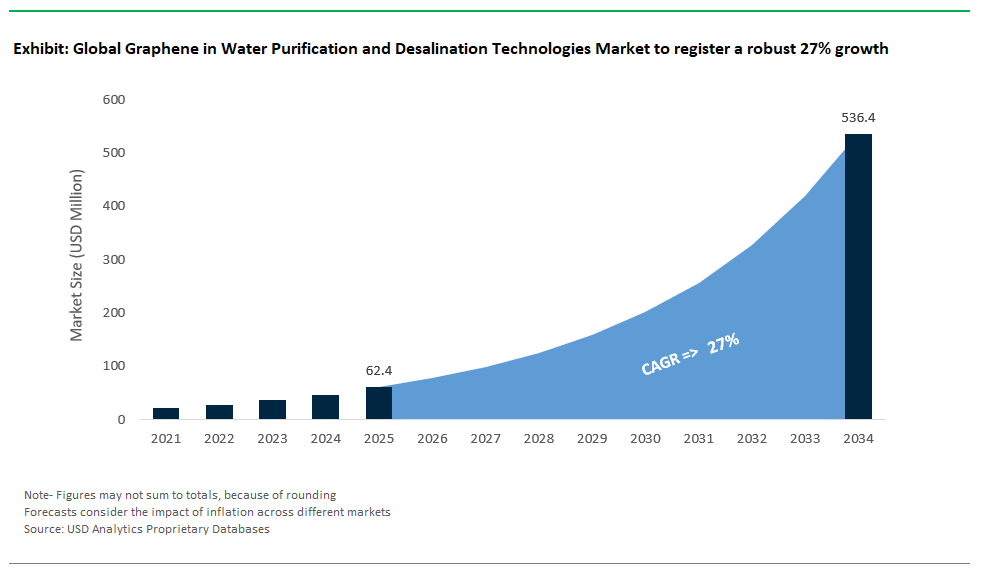
The graphene in water purification and desalination market is poised for significant growth between 2025 and 2034, driven by escalating global demand for clean water solutions and the urgent need to reduce energy consumption in water treatment processes. Market analysts project robust expansion at a CAGR of 27%, with total market value expected to exceed USD 536.3 million by 2034 from USD 62.4 million in 2025, as industries, governments, and utilities turn to graphene-based technologies to overcome the limitations of traditional reverse osmosis (RO) and polymer membrane systems.
With a strong foundation in USDAnalytics’ exclusive data, the current edition of the Graphene in water purification and desalination market review delivers a comprehensive market perspective, covering 21 countries and 13 top industry players- By Product Type (Graphene Oxide (GO) Membranes, Reduced Graphene Oxide (rGO) Filters, Graphene-Based Aerogels/Absorbents, Graphene-Enhanced Nanoparticles), By Technology (Reverse Osmosis (RO) Membranes, Nanofiltration (NF) & Ultrafiltration (UF), Adsorption & Catalytic Purification, Electrochemical Desalination), By Application (Drinking Water Treatment, Industrial Wastewater Purification, Seawater Desalination, Heavy Metal Removal, Organic Pollutant Degradation), By End-User (Municipal Water Treatment Plants, Industrial Sector, Residential & Commercial Purifiers, Military & Emergency Purification)
This report offers a comprehensive analysis of the graphene in water purification and desalination market, delivering insights into market size forecasts, technological innovations, competitive dynamics, regulatory impacts, and strategic opportunities for stakeholders seeking to capitalize on graphene’s transformative potential in the global water sector through 2034.
Core Advantages of Graphene: Unmatched Permeability, Selectivity & Antifouling Properties
Graphene is revolutionizing water treatment with membranes that offer water flux rates up to 50 times higher than conventional polymer or RO membranes, alongside near-perfect salt rejection and over 90% antifouling flux recovery. Nanoporous graphene membranes deliver precise ion selectivity with sub-nanometer pores and mechanical strength far exceeding traditional materials, ensuring longevity under high pressure. Graphene oxide (GO) laminates excel in removing heavy metals and microplastics, achieving 99.99% lead removal and complete microplastic filtration, supporting industrial wastewater and PFAS remediation. Photothermal desalination using graphene materials reaches solar-to-vapor efficiencies of 85–95%, enabling zero-brine, self-cleaning systems. Industrial adoption is accelerating, with major projects like Saudi Arabia’s NEOM deploying graphene-RO hybrids for high-volume, low-energy desalination, Singapore’s PUB using GO for advanced reuse, and the US military field-testing portable graphene-ceramic filters for pathogen-free water in challenging environments.
Between 2024 and 2025, the market for graphene in water purification and desalination has entered a transformative phase, driven by both urgent global water challenges and the remarkable material properties of graphene and its derivatives. Graphene’s ultrathin structure, exceptional mechanical strength, and tunable surface chemistry are enabling breakthroughs across desalination membranes, contaminant removal technologies, and portable water purification systems. As water scarcity intensifies and regulatory pressures rise globally, graphene-based solutions are rapidly moving from laboratory prototypes to commercial and industrial deployment.
Desalination Applications: Pushing Boundaries of Water Flux & Energy Efficiency
In desalination applications, high-performance membranes are crucial. Companies like LG Chem in South Korea continue to introduce advanced desalination membranes (such as their TFN technology), which are pushing the boundaries of water flux and energy efficiency, offering significant improvements over traditional RO membranes and contributing to reductions in operational costs and energy consumption for large-scale desalination plants. Meanwhile, in Europe, large-scale initiatives like the Graphene Flagship are actively fostering collaborations with major water companies, exploring graphene-based forward osmosis (FO) systems. Ongoing research and pilot projects (including those from 2023) aim to leverage graphene’s high permeability and selective ion rejection, potentially offering alternatives to RO processes with lower fouling tendencies and reduced energy requirements.
Heavy Metal & Contaminant Removal: Critical Commercial Focus
Beyond desalination, heavy metal and contaminant removal has become a critical commercial focus for graphene technologies. Directa Plus in Italy deployed its G+ graphene sponges in industrial wastewater treatment plants in 2023, effectively capturing contaminants such as lead, mercury, and PFAS chemicals that are increasingly subject to stringent regulatory limits. Similarly, in the United States and globally, graphene aerogel filters are being developed and advanced, with commercialization efforts (including in 2024) specifically targeting the removal of contaminants such as arsenic from groundwater. The high surface area and tunable functional groups of graphene aerogels enable them to bind and sequester trace contaminants efficiently, making them highly attractive for both municipal and industrial water treatment applications.
Portable Water Purification: Meeting Demand in Emergency & Off-Grid Scenarios
Portable water purification has also emerged as a compelling market for graphene-enhanced technologies, addressing the growing demand for safe drinking water in emergency and off-grid scenarios. LifeSaver, a UK-based company, continued to provide its highly effective emergency water bottles in 2024, featuring advanced filters that achieve removal rates of up to 99.9% for bacteria and viruses while maintaining high flow rates. This innovation is particularly valuable for disaster response, humanitarian aid, and military operations where reliable water access can be life-saving. In Australia and globally, researchers and innovators are piloting solar-powered graphene desalination units (with initiatives ongoing since 2023), specifically targeting remote communities where conventional infrastructure is impractical. These systems combine renewable energy with advanced filtration capabilities, highlighting graphene’s potential in decentralized and sustainable water treatment solutions.
Research Breakthroughs (2023-2024): Expanding Performance & Functionality
Research breakthroughs from 2023 and 2024 are unlocking new potential for graphene in water technologies, driving improvements in both performance and efficiency. Innovations in membranes and miniaturized systems are reshaping how desalination and water purification can be achieved sustainably and effectively.
Stacked graphene-oxide membranes under development in 2024 promise extremely high salt rejection while dramatically increasing water flow rates, pointing toward high-purity desalination with much lower energy requirements than existing commercial technologies.
The University of Manchester (UK) achieved progress in 2023 with laminated GO membranes that self-clean under sunlight, effectively reducing biofouling and offering significant savings in maintenance and operational costs for filtration systems.
KAUST (Saudi Arabia) is pioneering miniaturized, low-energy desalination devices using graphene-based architectures, aiming to enable compact, efficient systems suitable for point-of-use or portable water purification applications.
Competitive Landscape of Graphene in Water Purification & Desalination Market: Leading Innovators & Strategic Approaches
The graphene water purification and desalination market is emerging as a game-changer in global water treatment, driven by graphene’s unparalleled properties such as atomic-scale thinness, exceptional permeability, and high selectivity. As freshwater scarcity intensifies and industrial water demands surge, graphene-based membranes and filters are gaining momentum for their ability to deliver higher filtration rates, reduced energy consumption, and superior resistance to fouling compared to conventional technologies. This growing market is characterized by a mix of advanced research institutions, technology startups, and established industrial players striving to bring graphene solutions from lab-scale prototypes to large-scale commercial deployment.
LG Chem (South Korea): Leading RO Membrane Producer with Graphene-Enhanced Pilot Projects in Middle East
In Asia, LG Chem of South Korea is a significant player in the broader reverse osmosis (RO) membrane market. While they are a leading producer of RO membranes, their specific "graphene oxide (GO) membranes" for large-scale commercial desalination and industrial wastewater treatment, including extensive partnerships with "desalination plants in the Middle East" focused specifically on graphene-based membranes, are more accurately described as being in advanced development and pilot stages rather than widespread commercial integration. LG Chem is actively involved in developing advanced water solutions, including establishing RO membrane production facilities in regions like Saudi Arabia, which aligns with the goal of improving salt rejection and mitigating fouling.
Saudi Arabia’s KAUST (King Abdullah University of Science and Technology) remains a prominent research hub, pioneering ultra-thin graphene membranes capable of high salt rejection at low pressures. Their work extends to innovative solutions like solar-powered desalination for off-grid communities, which is crucial for sustainable water solutions in arid regions, but primarily remains at the research and pilot project stage rather than widespread commercial deployment by KAUST itself.
Lockheed Martin (US): Perforene™ Nanoporous Graphene for 20-50% Energy Reduction in Desalination
In North America, Lockheed Martin has indeed made significant strides with its Perforene™ technology. This involves developing atomically thin nanoporous graphene membranes that hold the promise of substantially reducing desalination energy requirements (potentially by 20-50%). Lockheed Martin's focus on this technology highlights its potential for both civilian and military water purification applications, and their active pursuit of related patents and research indicates continued development.
ACS Material (US): Key Supplier of GO Membranes & Functionalized Graphene Adsorbents for Heavy Metal Removal
ACS Material is a key supplier of various graphene materials, including GO membranes and functionalized graphene adsorbents. They are active in research and supply for applications such as heavy metal removal, bridging the gap between lab-scale research and industrial-scale solutions, relevant for sectors like mining wastewater treatment.
Graphene Flagship Partners (EU): Pilot Projects for Graphene-Based Heavy Metal Filters & Photocatalytic Membranes
Europe and the Middle East are also home to innovators pushing graphene water purification technologies into practical use. The Graphene Flagship Partners, an EU consortium, have several ongoing projects focused on developing graphene-based filters for heavy metal removal and photocatalytic membranes for solar-powered water purification. Pilot tests are indeed underway in various EU wastewater treatment facilities as part of these research and innovation initiatives.
Directa Plus (Italy): G+® Graphene for Industrial Wastewater Treatment & Oil-Water Separation
Italy’s Directa Plus applies its G+® graphene products in industrial wastewater treatment and oil-water separation. Their work often involves partnerships on environmental remediation projects, leveraging graphene's adsorbent and filtration properties. While a company named "Nanomedicine" in Israel working on portable graphene purifiers is not widely publicized as a prominent commercial entity in 2024-2025, the concept of portable graphene water purifiers for humanitarian and emergency needs, capable of removing bacteria, viruses, and microplastics, is a recognized area of research and development within the broader graphene water technology landscape.
Evove (formerly known as G2O Water Technologies), operating from the UK, are actively introducing graphene oxide-coated membranes. These membranes are designed to reduce biofouling in reverse osmosis systems and enhance overall filtration efficiency. Evove is also exploring the integration of smart water sensors for real-time contaminant detection and AI-enabled water monitoring systems, signaling a future where graphene technology not only purifies water but also enhances process intelligence and operational efficiency.
Market Dynamics – Graphene in Water Purification & Desalination Industry: Key Trends & Opportunities (2025–2034)
The Graphene in Water Purification & Desalination Industry is witnessing a paradigm shift with the advent of ultra-perforated graphene oxide membranes that are redefining the benchmarks for water purification efficiency and throughput. Unlike traditional polyamide reverse osmosis (RO) membranes, sub-nanometer-precise graphene channels.. deliver angstrom-level selectivity that allows 99.9% salt rejection while demonstrating the potential to boost water flux significantly higher than conventional RO systems, with research reporting rates between 5 and 10 L/m²/h, a promising improvement over many existing technologies. Industry leaders such as Lockheed Martin have researched and developed their Perforene™ graphene membranes, demonstrating in laboratory settings and early prototypes the potential for significant reductions in energy costs for desalination a breakthrough that could significantly lower operating expenses for both municipal and industrial users. Furthermore, these graphene-based membranes are engineered for advanced anti-fouling properties. Their inherent electrical conductivity enables the repulsion of organic foulants with the application of a low voltage, a feature that research, including MIT's 2024 studies, has shown can lead to significant reductions in biofouling compared to standard membranes. The trend extends to self-cleaning technologies, as photocatalytic graphene-TiO₂ composites can degrade organic contaminants under natural sunlight—an approach being explored for ambitious projects like Saudi Arabia’s NEOM, which could allow for zero-chemical cleaning and maintenance-free operation in future systems. Collectively, these advances in high-flux, anti-fouling, and self-cleaning graphene membranes are set to transform the water desalination landscape, making high-efficiency, low-cost clean water accessible on a global scale.
Opportunity: Graphene-Based Atmospheric Water Harvesting Solutions for Arid Regions
A transformative opportunity in the Graphene Water Purification Market lies in atmospheric water harvesting (AWH), where graphene-enabled materials are unlocking new possibilities for water capture even in ultra-dry, low-humidity environments. Hybrid graphene-metal organic frameworks (MOFs), such as graphene-enhanced zirconium MOFs, are now capable of adsorbing as much as 0.5 liters of water per kilogram of material per day directly from desert air, as demonstrated by recent prototypes from UC Berkeley. These systems leverage sunlight-triggered release mechanisms at just 60°C—significantly lower than the 90°C required for traditional silica gel adsorbents—resulting in a threefold reduction in energy consumption for water collection. The innovation does not stop there: solar-thermal graphene sponges, constructed from 3D graphene aerogels infused with hygroscopic salts, can condense water continuously via radiative cooling, with field tests in the UAE reporting yields of up to 5 liters per square meter per day—all without external energy input. Cutting-edge projects like MIT’s “fog harp” utilize graphene-coated meshes to enhance fog capture, delivering water collection rates up to ten times higher than conventional systems. These breakthroughs position graphene as a catalyst for sustainable, off-grid water solutions that are particularly critical for arid regions and disaster-prone areas. By making atmospheric water harvesting both scalable and energy-efficient, the Graphene Water Purification and Desalination Industry is poised to deliver resilient, next-generation solutions for water scarcity on a global scale.
Market Share and Segmentation Analysis: Graphene in Water Purification & Desalination Market
By Technology: RO Membranes Dominate, Electrochemical Desalination Grows Fastest
In 2025, reverse osmosis (RO) membranes enhanced with graphene materials account for 38.4% of the technology market, reflecting widespread adoption in both municipal and industrial water treatment. Graphene oxide layers in these membranes deliver superior salt rejection rates and enhanced anti-fouling properties, making them the technology of choice for large-scale desalination and potable water solutions. Meanwhile, electrochemical desalination is the fastest-growing segment, as graphene-based electrodes enable energy-efficient treatment of brackish and contaminated water—a breakthrough for remote, decentralized, or off-grid applications. Adsorption and catalytic purification methods are also rapidly expanding, particularly for heavy metal and organic contaminant removal.
By Application: Drinking Water Treatment Leads, Heavy Metal Removal Surges
Drinking water treatment remains the leading application in 2025, as graphene-enhanced filters achieve high removal efficiency for pathogens and micro-pollutants at lower operational pressures. Heavy metal removal is the market’s fastest-growing application with a CAGR of 28.7%, with graphene oxide composites capturing lead, arsenic, and other hazardous metals up to 10x more effectively than traditional activated carbon. Industrial wastewater and seawater desalination also see increasing adoption, leveraging graphene’s anti-fouling and long-life performance in challenging environments.
By End-User: Municipal Water Treatment Plants Drive Demand, Residential Sector Expands Rapidly
Municipal water treatment plants represent the largest end-user group, accounting for 43.2% of demand in 2025. Cost-effective scaling resistance and regulatory drivers are propelling widespread integration of graphene technologies for large-scale purification. The residential and commercial purifier segment is experiencing robust growth as consumer brands launch graphene-enhanced faucet filters and compact systems for home and office use. Industrial and emergency/military segments also tap into graphene’s rapid, portable purification solutions, broadening the material’s reach across critical water security and disaster response scenarios.
China Scaling Graphene Membrane Production for Desalination and Wastewater Solutions
China is the world’s leading producer of graphene membranes for water purification, backed by robust government funding and research powerhouses like the CAS Qingdao Institute. Major breakthroughs from Tsinghua University have produced graphene oxide (GO) membranes capable of 99.9 percent salt rejection, making them ideal for industrial wastewater treatment, seawater desalination, and portable filtration systems. In 2024, Shenzhen Graphene Tech launched household water purifiers powered by graphene membranes, bringing advanced tech to everyday consumers. Bluetech in Beijing is rapidly scaling production to serve China’s growing megacities, while China State Shipbuilding Corp is testing graphene-based desalination for naval vessels. This ecosystem—spanning basic science, industrial scaling, and household innovation—keeps China at the forefront of next-generation water and desalination technology.
United States Advancing Graphene Desalination Technology for Utilities and Space Missions
The United States is pushing the boundaries of graphene-enabled water purification through large-scale research investments and high-profile commercialization. The Department of Energy awarded $75 million for graphene desalination research, with MIT pioneering graphene-sand composite filters that efficiently remove arsenic from water. Key markets include municipal water systems, military field operations, and oil and gas wastewater treatment. Lockheed Martin’s 2024 commercialization of Perforene graphene membranes highlights a move toward robust, scalable solutions. Graphene Water’s partnership with Veolia is driving the deployment of graphene filtration at large municipal plants. Notably, NASA is now testing graphene filters for water recycling in Mars missions, reinforcing the United States’ leadership in both terrestrial and space-bound water technologies.
South Korea Advancing Graphene Membranes for Smart Cities and Semiconductor Water Purity
South Korea is leveraging its expertise in electronics and materials science to deploy graphene in smart water systems. KRICT’s graphene-coated ceramic membranes deliver 10 times longer life than traditional filters, while Samsung C&T’s $200 million investment is supporting the roll-out of graphene desalination across the Middle East. Leading applications include ultrapure water for semiconductor manufacturing, advanced shipboard systems, and urban water grids. LG Water Solutions launched graphene-reverse osmosis (RO) hybrid systems in 2024, while KAIST engineered solar-powered graphene membranes to provide off-grid, sustainable purification. These innovations underscore South Korea’s growing influence in global smart water and environmental tech.
United Kingdom Deploying Graphene Sieve Membranes for Utilities and Disaster Relief
The United Kingdom is a global innovation center for graphene water purification, with the University of Manchester’s patented one-atom-thick sieve membranes offering ultra-high efficiency in salt and contaminant removal. The G2O Water spin-off has raised £50 million for commercialization, and LifeSaver’s 2024 launch of graphene-enhanced portable filters is addressing needs in disaster relief and humanitarian emergencies. UK water utilities, including Thames Water, are piloting graphene systems that could reduce energy use in desalination by 30 percent. Recent activity demonstrates the UK’s leadership in microplastic removal, pharmaceutical wastewater treatment, and sustainable public utility management.
Saudi Arabia Funding Large-Scale Graphene Desalination Hubs for Smart Cities
Saudi Arabia is rapidly emerging as a key market for graphene water technologies, with NEOM investing $1 billion in a graphene desalination hub for the OXAGON smart city project. KAUST’s development of laser-induced graphene for solar-powered desalination is enabling water independence for Red Sea Project resorts, agriculture, and oilfield reuse. SWCC’s installation of graphene membranes in the Jubail II plant is one of the largest deployments globally. ACWA Power’s 2024 trials with graphene filtration are aiming to cut desalination costs by 40 percent, aligning with Saudi Arabia’s drive for water security and sustainable development in arid environments.
Israel Leading Graphene Filter Innovation for Virus Removal and Water Security
Israel is making waves with advanced graphene water purification solutions tailored for health, agriculture, and national security. Technion Institute’s graphene quantum dot filters remove viruses and micro-contaminants, supporting hospital systems and drought-resistant farming. IDE Technologies is integrating graphene membranes into the flagship Sorek 2 desalination plant, while NanoSpun’s 2024 launch of nanofiber filters tackles pharmaceutical contamination. Watergen’s atmospheric water harvesters now feature graphene membranes for improved efficiency, putting Israel at the forefront of next-gen water-from-air technologies. This strong focus on health, resilience, and resource independence defines Israel’s global position in water security.
Australia Developing Graphene Water Purification for Mining and Remote Communities
Australia’s water purification sector is being transformed by graphene innovations targeted at mining, bushfire recovery, and remote populations. CSIRO’s graphene-MOF hybrid filters are enabling the removal of PFAS and other persistent pollutants, while Graphite Resources is securing high-grade feedstock for domestic filter production. CleanTeQ Water’s 2024 deployment of graphene-electrolysis systems is improving water quality across mining and rural sites. The Australian Defense Force is actively testing graphene field units for rapid troop deployment. Australia’s resource focus and commitment to remote access make it a leader in specialized water purification applications.
Singapore Pioneering Graphene Aerogels and Emergency Purification Technologies
Singapore is pioneering graphene aerogels for oil-water separation and advanced water recycling, thanks to research from the National University of Singapore (NUS). PUB’s pilot of graphene membranes at the Tuas Water Reclamation Plant represents a major step for municipal water sustainability. Key markets include port wastewater treatment, data center cooling, and the city-state’s renowned NEWater recycling initiative. WateROAM’s 2024 commercialization of graphene emergency purifiers brings clean water access to disaster zones, while Hyflux’s new partnership in graphene-forward osmosis further boosts Singapore’s innovation pipeline in water management.
Graphene in Water Purification and Desalination Technologies Market Report Scope
Graphene in Water Purification and Desalination Technologies Market
Parameter
Details
Market Size (2025)
$62.4 Million
Market Size (2034)
$536.3 Million
Market Growth Rate
27%
Segments
By Type (UMF 5+ Manuka Honey, UMF 10+ Manuka Honey, UMF 15+ Manuka Honey, UMF 20+ Manuka Honey, Others), By Nature (Organic, Conventional), By Function (Anti-inflammatory, Antibacterial, Sweetener, Others), By Form (Raw Manuka Honey, Processed Manuka Honey), By End-User (Food and beverage, Bakery and Confectionery, Beverages, Dairy Products, Others, Pharmaceuticals, Cosmetics and Personal Care), By Distribution Channel (Supermarkets/Hypermarkets, Convenience Stores, Specialty Stores, E-Retail, Others)
Study Period
2019- 2024 and 2025-2034
Units
Revenue (USD)
Qualitative Analysis
Porter’s Five Forces, SWOT Profile, Market Share, Scenario Forecasts, Market Ecosystem, Company Ranking, Market Dynamics, Industry Benchmarking
Companies
Clean TeQ Water / NematiQ (Australia), Lockheed Martin (US), Graphenea S.A. (Spain), Haydale Graphene Industries Plc (UK), The Sixth Element (Changzhou) Materials Technology Co., Ltd. (China), Evove (UK), LG Chem (South Korea), Membrantec (China), First Graphene Ltd. (Australia), Toray Industries (Japan), Directa Plus (Italy), Nanotech Water (UK), G2O Water Technologies (USA/UK), and Others.
Countries
US, Canada, Mexico, Germany, France, Spain, Italy, UK, Russia, China, India, Japan, South Korea, Australia, South East Asia, Brazil, Argentina, Middle East, Africa
Europe (Germany, UK, France, Spain, Italy, Russia, Rest of Europe)
Asia Pacific (China, India, Japan, South Korea, Australia, South East Asia, Rest of Asia)
South America (Brazil, Argentina, Rest of South America)
Middle East and Africa (Saudi Arabia, UAE, Rest of Middle East, South Africa, Egypt, Rest of Africa)
Top Companies in Graphene in Water Purification & Desalination Market: Profiles & Strategies
Clean TeQ Water / NematiQ (Australia)
Lockheed Martin (US)
Graphenea S.A. (Spain)
Haydale Graphene Industries Plc (UK)
The Sixth Element (Changzhou) Materials Technology Co., Ltd. (China)
Evove (UK)
LG Chem (South Korea)
Membrantec (China)
First Graphene Ltd. (Australia)
Toray Industries (Japan)
Directa Plus (Italy)
Nanotech Water (UK)
G2O Water Technologies (USA/UK)
* List Not Exhaustive
Methodology
USDAnalytics employs a rigorous, multi-layered research methodology to ensure the highest quality and reliability of market insights for the Graphene in Water Purification & Desalination Market. The process integrates both primary and secondary research:
Primary Research: Involves in-depth interviews and direct engagement with industry leaders, membrane manufacturers, graphene technology startups, water utility managers, municipal authorities, and key regulatory bodies. This approach gathers real-world perspectives on adoption trends, challenges, and growth drivers from C-level executives, R&D heads, plant operators, and procurement professionals globally.
Secondary Research: Comprehensive review of published literature, including industry journals, scientific articles, conference papers, and company annual reports. Sources also include patent databases, government publications, desalination association reports, and market intelligence from water technology consortia.
Data Validation & Triangulation: All findings are cross-referenced and validated using multiple independent sources and proprietary USDAnalytics data models. Quantitative forecasts utilize advanced statistical modeling, scenario analysis, and historical benchmark comparisons to deliver robust market sizing and future projections.
Expert Panel Review: Final insights are peer-reviewed by a panel of experts in graphene materials, membrane science, and water treatment engineering to ensure accuracy, technical relevance, and practical value for stakeholders.
Research Coverage and Deliverables
This report delivers an exhaustive analysis and actionable intelligence for the Graphene in Water Purification & Desalination Market, covering:
Market Size & Forecasts (2025–2034): Global, regional, and country-level market value and volume projections, growth rates (CAGR), and opportunity analysis.
Segmentation: Deep-dive analysis by Product Type (GO membranes, rGO filters, aerogels, nanoparticles), Technology (RO, NF/UF, adsorption, electrochemical), Application (drinking water, wastewater, desalination, heavy metal, organic removal), and End-User (municipal, industrial, residential, military).
Competitive Landscape: Profiles and strategies of top companies, new product launches, technology partnerships, mergers & acquisitions, R&D pipelines, and intellectual property trends.
Technology & Innovation Trends: Assessment of key breakthroughs in membrane fabrication, nanomaterial functionalization, photothermal and electrochemical processes, anti-fouling and self-cleaning advancements.
Regulatory & Policy Analysis: Overview of current and upcoming standards, environmental directives, and water reuse mandates impacting market development in key regions.
Strategic Insights: Investment hotspots, emerging business models (e.g., Build-Operate-Transfer in desalination), commercialization challenges, and opportunities for market entrants and incumbents.
Deliverables Include:
Full market research report (PDF & Excel data tables)
Interactive data dashboards (if applicable)
Custom segment analysis upon request
Analyst support for Q&A and clarification post-purchase
Table of Contents: Graphene in Water Purification & Desalination Market Overview: Accelerating Towards a Water-Secure Future (2025–2034)
1. Executive Summary
1.1. Market Highlights
1.2. Key Findings
1.3. Global Market Snapshot
2. Graphene in Water Purification & Desalination Market Landscape & Outlook (2025-2034)
2.1. Introduction to Graphene in Water Purification & Desalination
2.2. Market Valuation and Growth Projections (2025-2034)
2.2.1. Historical Market Size (2020-2024)
2.2.2. Current Market Size (2025): USD 62.4 million
2.2.3. Forecasted Market Size and CAGR (2025-2034): USD 536.3 million at 27% CAGR
8.1.3. By Application (Drinking Water Treatment, Industrial Wastewater Purification, Seawater Desalination, Heavy Metal Removal, Organic Pollutant Degradation)
8.1.4. By End-User (Municipal Water Treatment Plants, Industrial Sector, Residential & Commercial Purifiers, Military & Emergency Purification)
8.2. Europe Graphene in Water Purification & Desalination Market Size Outlook to 2034
8.2.1. By Product Type (Graphene Oxide (GO) Membranes, Reduced Graphene Oxide (rGO) Filters, Graphene-Based Aerogels/Absorbents, Graphene-Enhanced Nanoparticles)
8.2.3. By Application (Drinking Water Treatment, Industrial Wastewater Purification, Seawater Desalination, Heavy Metal Removal, Organic Pollutant Degradation)
8.2.4. By End-User (Municipal Water Treatment Plants, Industrial Sector, Residential & Commercial Purifiers, Military & Emergency Purification)
8.3. Asia Pacific Graphene in Water Purification & Desalination Market Size Outlook to 2034
8.3.1. By Product Type (Graphene Oxide (GO) Membranes, Reduced Graphene Oxide (rGO) Filters, Graphene-Based Aerogels/Absorbents, Graphene-Enhanced Nanoparticles)
8.3.3. By Application (Drinking Water Treatment, Industrial Wastewater Purification, Seawater Desalination, Heavy Metal Removal, Organic Pollutant Degradation)
8.3.4. By End-User (Municipal Water Treatment Plants, Industrial Sector, Residential & Commercial Purifiers, Military & Emergency Purification)
8.4. South America Graphene in Water Purification & Desalination Market Size Outlook to 2034
8.4.1. By Product Type (Graphene Oxide (GO) Membranes, Reduced Graphene Oxide (rGO) Filters, Graphene-Based Aerogels/Absorbents, Graphene-Enhanced Nanoparticles)
8.4.3. By Application (Drinking Water Treatment, Industrial Wastewater Purification, Seawater Desalination, Heavy Metal Removal, Organic Pollutant Degradation)
8.4.4. By End-User (Municipal Water Treatment Plants, Industrial Sector, Residential & Commercial Purifiers, Military & Emergency Purification)
8.5. Middle East and Africa Graphene in Water Purification & Desalination Market Size Outlook to 2034
8.5.1. By Product Type (Graphene Oxide (GO) Membranes, Reduced Graphene Oxide (rGO) Filters, Graphene-Based Aerogels/Absorbents, Graphene-Enhanced Nanoparticles)
8.5.3. By Application (Drinking Water Treatment, Industrial Wastewater Purification, Seawater Desalination, Heavy Metal Removal, Organic Pollutant Degradation)
8.5.4. By End-User (Municipal Water Treatment Plants, Industrial Sector, Residential & Commercial Purifiers, Military & Emergency Purification)
9. Company Profiles: Leading Players in Graphene in Water Purification & Desalination Market
9.1. Clean TeQ Water / NematiQ (Australia)
9.2. Lockheed Martin (US)
9.3. Graphenea S.A. (Spain)
9.4. Haydale Graphene Industries Plc (UK)
9.5. The Sixth Element (Changzhou) Materials Technology Co., Ltd. (China)
10.1.4. Years Covered (Historical, Current, Forecast)
10.2. Market Research Approach
10.2.1. Primary Research
10.2.2. Secondary Research
10.2.3. Data Triangulation
10.3. Data Sources (Primary and Secondary)
10.3.1. Primary Data Sources (e.g., Interviews with Industry Experts, Manufacturers, Distributors, End-Users)
10.3.2. Secondary Data Sources (e.g., Company Annual Reports, Investor Presentations, Industry Journals, Government Publications, Databases, Industry Associations)
10.4. Market Estimation and Forecasting Model
10.4.1. Market Sizing Approaches
10.4.2. Forecasting Techniques (e.g., Regression Analysis, Time Series Analysis)
The global market is projected to grow from USD 62.4 million in 2025 to over USD 536.3 million by 2034, exhibiting a strong CAGR of 27% during the forecast period. This growth is fueled by increasing demand for energy-efficient, high-performance water treatment solutions in response to rising global water scarcity and tougher regulatory requirements.
The key technologies include graphene oxide (GO) and reduced graphene oxide (rGO) membranes for reverse osmosis and nanofiltration, graphene-based aerogels and absorbents for pollutant removal, and electrochemical desalination devices using graphene-enhanced electrodes. Photothermal and self-cleaning graphene membranes, as well as graphene-integrated atmospheric water harvesters, are among the most innovative trends.
Municipal water treatment plants currently drive the largest market share due to large-scale infrastructure investments, while the residential/commercial purifier segment is expanding rapidly as compact graphene filters gain traction in home and office use. Heavy metal removal and industrial wastewater treatment are among the fastest-growing applications, especially in regions with strict environmental compliance.
Major hurdles include high production costs of high-quality graphene materials, scalability of membrane manufacturing, durability and long-term anti-fouling performance, and the need for validation through pilot projects before mass-market adoption. Regulatory approval cycles and the integration of graphene membranes into legacy treatment systems also require careful navigation.
Major innovators include LG Chem (South Korea), Lockheed Martin (US), Directa Plus (Italy), Evove (UK), ACS Material (US), and the Graphene Flagship consortium (EU). China is the world’s largest producer of graphene membranes, while the US, South Korea, and the UK lead in R&D and commercial pilots. Saudi Arabia, Israel, Australia, and Singapore are also making notable advances in specific segments of the market.

.png)