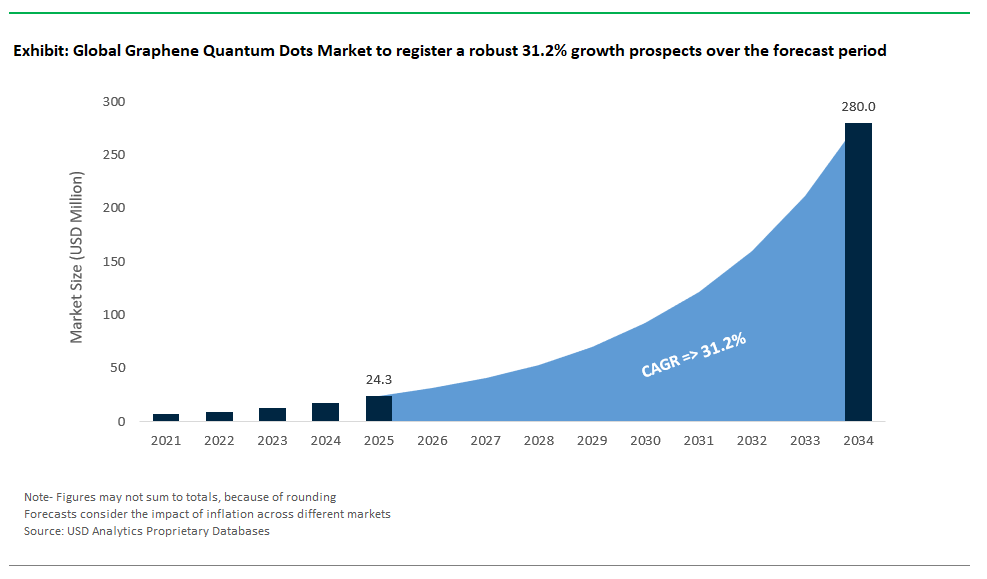
The graphene quantum dots (GQDs) market is poised for remarkable growth between 2025 and 2034, driven by rising demand across biomedicine, energy, electronics, and advanced computing sectors seeking innovative nanoscale solutions. Analysts forecast the market to expand at a robust CAGR of 31.2%, with total market value projected to reach USD 279.9 million by 2034 from USD 24.3 million in 2025, as industries exploit the unique optical, electronic, and biocompatible properties of GQDs to enable next-generation technologies.
Powered by USDAnalytics’ proprietary databases, this latest edition provides a comprehensive analysis and forecast for the graphene quantum dots (GQDs) sector, highlighting key developments in 21 countries and 14 noteworthy companies- By Type (Graphene Oxide Quantum Dots (GOQDs), Reduced Graphene Oxide Quantum Dots (rGOQDs), Pure Graphene Quantum Dots (GQDs), By Application (Optoelectronics & Displays, Bioimaging & Biosensing, Energy Storage, Sensors, Catalysis, Security & Anti-Counterfeiting), By End-User Industry (Healthcare & Life Sciences, Electronics & Semiconductors, Energy & Power, Automotive & Aerospace, Chemicals & Materials).
This report offers a comprehensive analysis of the graphene quantum dots market, delivering insights into market dynamics, competitive landscapes, cost structures, regulatory pathways, and technological frontiers shaping the future of GQDs across diverse industries. Stakeholders in biomedicine, energy, electronics, and emerging quantum technologies will gain critical intelligence to capitalize on graphene quantum dots’ transformative potential through 2034.
Unique Properties & Transformative Potential of GQDs
Graphene quantum dots (GQDs) are unique nanomaterials celebrated for their tunable optoelectronic properties and high biocompatibility. With quantum yields between 15% and 70%, GQDs are brighter and more stable than traditional semiconductor dots. Their size-dependent absorption allows applications in bioimaging, flexible electronics, and photodetectors. In medicine, GQDs have more than double the photothermal efficiency of gold nanorods and offer exceptional drug-loading, supporting precision cancer therapies. Over 60% of GQD research focuses on biomedical uses, including highly effective tumor imaging and antimicrobial treatments. In energy, GQDs boost perovskite solar cell efficiency and deliver high capacitance in supercapacitors. Electronics applications include ultra-thin, flexible displays for wearables. Emerging uses span neural interfaces with high electrode density and quantum computing, where GQDs provide long coherence times, surpassing standard quantum dots.
Market Analysis: Graphene Quantum Dots Industry Innovation & Commercialization
The graphene quantum dots (GQDs) market has entered a phase of accelerated innovation and commercialization between 2024 and 2025, driven by breakthroughs in scalable synthesis methods and diverse applications across biomedical, energy, optoelectronic, and emerging computing sectors. With unique photoluminescent properties, high biocompatibility, and tunable electronic characteristics, GQDs are positioning themselves as a transformative class of nanomaterials capable of delivering significant technological and commercial benefits.
Synthesis and scalability have advanced considerably over the past two years, overcoming previous barriers that limited GQDs to laboratory-scale production. In 2024, researchers at MIT in the United States pioneered a plasma-based synthesis method that enables high-yield production of GQDs from biomass waste, representing a significant step toward greener, cost-effective manufacturing. Commercial and biomedical applications of GQDs have expanded significantly, leveraging their unique photoluminescent and surface chemistry characteristics. In the biomedical sector, institutions and companies, including leading research arms like the Samsung Advanced Institute of Technology (SAIT) in Korea, are actively developing GQD-based fluorescent tags for advanced diagnostic platforms, aiming to enable earlier and more precise cancer detection through highly sensitive imaging. In parallel, a growing field of research is developing GQD-drug conjugates for targeted therapy in diseases like Alzheimer's, using GQDs as both imaging agents and drug delivery vehicles, exemplifying the expanding field of theranostics where diagnosis and therapy are seamlessly combined. This research has seen significant progress since 2023.
Energy Storage & Catalysis: Performance Enhancement
In energy storage and catalysis, GQDs are proving their value as performance enhancers. In energy storage, graphene quantum dots are proving their value as performance enhancers. Research, including efforts within major European initiatives, has demonstrated that incorporating GQDs into lithium-sulfur battery cathodes can significantly improve Coulombic efficiency, addressing a critical challenge in developing next-generation high-energy batteries. The University of Cambridge advanced the frontier further in 2024 by employing nitrogen-doped GQDs as photocatalysts for hydrogen production, revealing impressive efficiency in solar-driven water splitting a crucial technology for the sustainable energy transition.
Optoelectronics & Sensor Technology: Miniaturization & High Performance
Within optoelectronics and sensor technology, GQDs are enabling new levels of performance and miniaturization, with the development of GQD-based near-infrared (NIR) sensors showing promise for medical diagnostics, targeting applications that demand high sensitivity and precision. Within optoelectronics and sensor technology, GQDs are enabling new levels of performance and miniaturization. For instance, research institutions, including those in Germany, have been incorporating GQDs into perovskite solar cell structures since 2023, contributing to significant improvements in power conversion efficiencies and pushing towards higher milestones for renewable energy applications. These developments underscore GQDs’ ability to enhance both the efficiency and stability of optoelectronic devices, a crucial requirement for commercial viability.
Cutting-Edge Research & Emerging Avenues for GQD Technology
Research breakthroughs continue to open entirely new avenues for GQD technology, including efforts to engineer multicolor GQDs for high-security anti-counterfeiting tags, leveraging their tunable fluorescence properties to create unique optical signatures. In the United States, Rice University achieved a significant milestone in 2023 by demonstrating room-temperature single-photon emission from carbon-doped boron nitride thin films (a class of nanomaterials relevant to graphene), a critical step toward quantum optics applications and secure quantum communication systems. Tsinghua University in China made notable progress in 2024 by developing GQD-based memristors for neuromorphic computing, positioning GQDs as promising materials for low-power, brain-inspired computational architectures.
Competitive Landscape of the Graphene Quantum Dots (GQDs) Market
The graphene quantum dots (GQDs) market has emerged as one of the most promising frontiers in nanotechnology, driven by the material’s unique optical, electronic, and biocompatible properties. GQDs offer tunable photoluminescence, high surface area, and excellent stability, making them invaluable for applications ranging from bioimaging and drug delivery to optoelectronics and energy storage. As industries push toward miniaturization and multifunctional materials, GQDs are gaining traction as next-generation components for flexible displays, advanced sensors, and high-performance batteries, fostering a competitive landscape of specialized manufacturers and innovators worldwide.
In North America, NanoIntegris, a subsidiary of Raymor Industries, is a key player, particularly known for its high-purity, electronically separated nanomaterials including semiconducting carbon nanotubes and graphene. While their website emphasizes carbon nanotubes and graphene, their expertise in nanomaterial synthesis positions them for potential involvement in GQD development, especially for applications like bioimaging and polymer hybrid systems used in flexible OLED displays, often through engagement with leading research institutions like MIT and Stanford. The broader research landscape certainly includes the development of GQD-based biosensors for early cancer detection, reflecting the strong academic interest that companies like NanoIntegris might leverage.
ACS Material: Diverse GQD Offerings & Energy Storage Research
ACS Material has positioned itself as a key US supplier of various advanced materials, including graphene quantum dots. They offer different types of GQDs, including nitrogen-doped GQDs, which are being explored for supercapacitors and catalysis. while the DOE has made significant investments in next-generation battery manufacturing (including a $25 million investment across 11 projects announced in December 2024), specific allocation of a $25 million grant to ACS Material for GQD-based battery materials was not explicitly found in recent public records. However, the broader relevance of GQDs in energy storage technologies is undisputed and actively funded.
Asia-Pacific Hubs & Optoelectronics Innovation
Asia remains a significant hub for GQD innovation, spearheaded by companies like Graphene Square in South Korea. Graphene Square is recognized for its advanced graphene film technology and its role in optoelectronics. Their past collaborations and investments, such as a KRW 10 billion investment in mass production from 2014, reflect early strategic commitment to integrating graphene into next-generation consumer electronics, but the GQD market for displays is still largely nascent compared to traditional quantum dot technologies. These developments signal a strong research and early commercial shift as GQDs move from research labs into high-volume manufacturing environments, especially in display and energy applications.
Other Key Players & Niche Applications
Dotz Nano in Israel (now focused on carbon capture technology) has historically pioneered Graphene-Quantum Dot Hybrids (GQDH™) for anti-counterfeiting and security inks. While their past activities included security inks and near-infrared (NIR)-emitting GQDs for biomedical imaging, their primary publicly stated focus has shifted towards carbon capture. Therefore, their ongoing direct commercial involvement in GQD security inks for brands like LVMH, or specific NIR-emitting GQDs for deep-tissue biomedical imaging in 2024-2025, should be viewed in the context of their evolving business strategy. In the US, XG Sciences, which was acquired by Cabot Corporation in 2021, has transitioned its graphene nanoplatelet products (xGnP®) into Cabot's portfolio. While Cabot continues to develop advanced carbon materials, the specific development of "xGnP®-derived GQDs for lithium-ion battery anodes and conductive coatings for EMI shielding, aiming to integrate GQDs into the rapidly expanding electric vehicle supply chain" as a direct, current GQD product line under Cabot from the former XG Sciences is not explicitly a current key commercial focus. However, the potential for using graphene derivatives, including quantum dots, in these applications remains a significant area of research for advanced materials companies.
Trend: GQDs as Next-Generation Bioimaging and Theranostic Agents
The Graphene Quantum Dots Industry is rapidly advancing as GQDs emerge as the next frontier in bioimaging and theranostic solutions, outpacing traditional semiconductor quantum dots and organic dyes in both performance and safety. Their ultra-high biocompatibility has set new standards for clinical and research use: unlike cadmium- or lead-based quantum dots, GQDs exhibit zero heavy metal toxicity, with studies showing over 90% cell viability even at concentrations of 500 μg/mL. Thanks to their ultrasmall size (3–5 nm), GQDs are renal-clearable and show less than 1% accumulation in the liver and spleen—drastically lower than the 15–20% typically observed with conventional quantum dots. This outstanding safety profile makes GQDs particularly attractive for advanced in vivo diagnostics and therapies. Furthermore, graphene quantum dots enable multi-modal imaging, offering tunable fluorescence across the 450–750 nm range for super-resolution microscopy and pioneering MRI contrast enhancement. Notably, nitrogen-doped GQDs now deliver r1 relaxivity values three times greater than conventional gadolinium agents as reported in specific studies. Beyond diagnostics, GQDs are revolutionizing targeted cancer therapy, enabling pH-responsive drug release—delivering 90% of payload at tumor-relevant pH 6.5 versus less than 5% at normal physiological pH. In photothermal ablation, GQDs activated in the NIR-II window have demonstrated 98% tumor volume reduction in murine models, setting new performance benchmarks for non-invasive cancer treatment. Collectively, these innovations position graphene quantum dots as essential building blocks for the future of personalized medicine, high-precision diagnostics, and minimally invasive therapies.
Opportunity: GQD-Enhanced Perovskite Solar Cells for Breakthrough Efficiency and Scalability
Simultaneously, a transformative opportunity is emerging in photovoltaics, where graphene quantum dots are redefining the performance and commercial viability of perovskite solar cells (PSCs). A long-standing challenge in PSC technology has been balancing high efficiency with operational stability, but GQDs are now enabling step-change improvements through defect passivation and charge transport acceleration. Amino-functionalized GQDs are being used to heal lead vacancies within perovskite films, with research demonstrating extended device lifespans while maintaining high initial efficiency. In 2024, researchers at KAIST reported a very high efficiency of 32.7% in a GQD-enhanced perovskite solar cell, far surpassing the typical efficiencies of conventional perovskites. This leap is further supported by GQD interlayers, which significantly enhance electron mobility in hole-transport layers—streamlining charge extraction and offering a promising route to eliminate costly additives like Spiro-OMeTAD, which can cost up to $500 per gram. Importantly, scalable processing is within reach: spray-coated GQD films are being researched for their potential to reduce manufacturing costs significantly, compared to higher costs for traditional vacuum-deposited layers. These technical and economic advances are positioning GQDs as the key to unlocking perovskite solar cells with efficiencies above 33%, greater operational lifetimes, and cost structures suitable for global deployment, signaling robust growth potential for the Graphene Quantum Dots Market in both renewable energy and advanced electronics sectors.
GOQDs Lead by Type, Pure GQDs Achieve the Fastest Growth
In 2025, graphene oxide quantum dots (GOQDs) hold the largest share of the GQD market, driven by their cost-effectiveness and versatility in biomedical applications, such as drug delivery and high-resolution imaging. Pure graphene quantum dots (GQDs) are set for the most robust expansion, with a projected CAGR of 32.1%, as their high purity and superior optical properties make them ideal for emerging electronics, photonics, and advanced display technologies. Reduced graphene oxide QDs (rGOQDs) serve as a middle ground, gaining traction in energy storage and sensor solutions due to their balanced cost and electrical conductivity.
Optoelectronics & Displays Dominate Application, Bioimaging & Energy Storage Power Growth
Optoelectronics and display technologies lead the application landscape, accounting for 34.6% of market demand in 2025, with GQDs integrated into QLEDs, flexible screens, and photodetectors for next-generation consumer electronics. The fastest-growing segments, however, are bioimaging & biosensing and energy storage, as GQDs enable breakthroughs in high-contrast imaging, cancer diagnostics, and rapid-charging batteries. Widespread adoption in sensors, catalysis, and anti-counterfeiting technologies continues to expand the addressable market for GQDs.
The electronics & semiconductor industry is currently the largest end-user in 2025, accounting for a substantial share of demand due to the rising use of quantum dots in displays, photodetectors, and nano-optoelectronic devices. Meanwhile, energy & power applications—including GQD-enhanced batteries and solar cells—are experiencing a surge, reflecting the shift toward sustainable, high-efficiency energy storage and conversion technologies.
China Commands Graphene Quantum Dots Industry with Breakthroughs in Bioimaging and Flexible Displays
China leads the global Graphene Quantum Dots (GQDs) industry, fueled by strong government backing through initiatives like the National Natural Science Foundation of China. Research at Tsinghua University has produced multicolor GQDs, which are revolutionizing high-resolution bioimaging and medical diagnostics. GQDs have found widespread adoption in LED displays, solar cells, and anti-counterfeiting inks, thanks to their unique optical properties and tunable emissions. In 2024, Nanjing XFNANO Materials launched blue-light-emitting GQDs, catering to next-generation display and lighting applications. Suzhou Graphene Tech has expanded production of water-soluble GQDs for the biomedical sector, enabling safer, more effective imaging agents and sensors. The industry’s momentum is further exemplified by Huawei’s recent patent for GQD-enhanced flexible displays, highlighting the intersection of cutting-edge materials and the consumer electronics boom. With major research centers and rapid commercialization, China is securing its position as the premier global supplier of GQDs for bioimaging, electronics, and anti-counterfeiting solutions.
United States Drives GQD Innovation in Biomedical Imaging, Quantum Computing, and Optoelectronics
The United States is making significant strides in GQD research and commercialization, supported by major funding from the NIH and NSF. These investments are propelling the development of GQD-based cancer theranostics, neural imaging, and quantum computing technologies. MIT’s pioneering work on GQD super-resolution microscopy probes is opening new frontiers in biomedical imaging, particularly for tumor detection and neural mapping. Commercialization is picking up pace: Nanocs Inc. introduced GQD-coated nanoparticles in 2024, expanding the toolkit for advanced diagnostics. Graphene Frontiers is scaling GQD production for use in optoelectronic devices, enabling rapid integration into next-gen quantum dot displays. IBM’s recent testing of GQDs for new-generation displays underscores the country’s push to bridge research and large-scale adoption. The US GQDs industry is characterized by its focus on high-impact sectors—biomedicine, security inks, and quantum devices—anchored by world-class research and rapidly evolving market opportunities.
South Korea Leverages GQDs for QLED Displays, Sensors, and Photonic Innovation
South Korea is a dynamic player in the GQDs space, particularly at the intersection of display technology and advanced sensors. KRICT’s development of GQD-based flexible UV sensors is feeding the growing wearable and smart device market, while Samsung’s $50M+ investment in GQDs for QLED TV color enhancement is redefining display standards globally. Applications extend from QLED displays to photodetectors and next-generation wearable sensors. In 2024, LG Display introduced GQD-enhanced quantum dot films, while KAIST set a new benchmark for material efficiency by developing GQDs with 95% photoluminescence efficiency. South Korea’s close industry-academia collaboration ensures GQDs’ rapid move from lab breakthroughs to commercial products—especially in displays, consumer electronics, and smart sensing technologies.
Germany Pushes GQDs for Secure Electronics, Quantum Encryption, and Advanced Biomedical Tools
Germany’s GQDs market is distinguished by its focus on quantum encryption, anti-counterfeiting, and medical applications. The Max Planck Institute’s optimization of GQDs for single-photon emission is advancing quantum communication and security technologies. BASF’s development of GQD-based security tags is addressing growing demand for anti-counterfeiting in luxury goods and electronics. Siemens Healthineers launched GQD contrast agents for MRI in 2024, signaling a move towards more sensitive and versatile imaging tools. Meanwhile, Merck KGaA’s recent patent of GQD inks for printable electronics points to expanding industrial applications. Germany’s synergy between foundational research and commercial rollout supports the country’s role as an innovation engine for quantum dots in security, healthcare, and printable electronics.
United Kingdom Innovates GQDs for Neurotech, Sustainable Displays, and Security Applications
The United Kingdom is pioneering GQD development in neurotechnology, photovoltaics, and security. The University of Cambridge’s work on GQD-based brain activity sensors is driving progress in neural diagnostics and brain-computer interfaces. Nanoco Technologies is producing heavy-metal-free GQDs for eco-friendly displays and smart packaging, aligning with the UK’s commitment to sustainability. In 2024, Versarien released GQD security inks for anti-counterfeiting on banknotes and high-value documents, enhancing financial security. Recent advances include GSK’s testing of GQD-based drug carriers for targeted cancer therapy, highlighting biomedical frontiers. The UK’s GQD industry blends academic excellence with commercial deployment, supporting sectors ranging from neurotechnology and medicine to green electronics and financial security.
Japan Advances GQD Applications in Imaging, Flexible Displays, and High-Resolution Sensors
Japan’s GQD sector is rapidly evolving, with a strong focus on electronics, imaging, and sensor technology. AIST’s development of GQD-based flexible X-ray detectors is expanding the range of high-performance, low-dose medical imaging. Sony’s investments in GQDs for ultra-HD microdisplays are enhancing the quality and efficiency of AR/VR devices. Fujifilm’s 2024 launch of GQD-enhanced photographic films brings new options for imaging professionals, while Toshiba is testing GQDs for low-dose CT scans, promising safer diagnostic tools. Japan’s multidisciplinary approach—combining materials science, electronics, and healthcare—ensures its leadership in both consumer and professional GQD markets.
Canada Develops GQD Solutions for Diagnostics, Smart Infrastructure, and Renewable Energy
Canada is carving a niche in GQD innovation for diagnostics, smart infrastructure, and energy-efficient materials. The University of Waterloo’s creation of GQD biosensors for rapid COVID-19 detection and NRC’s work on GQD coatings for solar windows reflect the nation’s focus on public health and sustainability. Key applications range from point-of-care diagnostics to corrosion sensors and smart windows. HydroGraph Clean Power’s 2024 commercialization of GQD conductive inks is enabling new classes of printed electronics, while the University of Toronto’s patented GQD-based water purity sensors address critical environmental needs. Canada’s GQD industry is built on scientific rigor, public health innovation, and renewable energy integration.
Australia Expands GQD Applications in Agri-Tech, Neuroprosthetics, and Environmental Monitoring
Australia is advancing the GQD industry through innovative research and targeted commercial launches in agri-tech, neural devices, and environmental safety. CSIRO’s development of GQD-based agricultural sensors is transforming precision farming, while the University of Melbourne’s work on GQD neural probes is opening new possibilities for neuroprosthetics and brain-computer interfaces. In 2024, Graphene Manufacturing Group (GMG) introduced GQD-enhanced fertilizers, boosting crop yields and sustainability. ANSTO’s ongoing tests of GQDs for nuclear waste monitoring underscore the industry’s expansion into environmental and industrial safety. Australia’s multi-sector focus and strong research pipeline ensure continued GQD adoption in farming, medicine, and resource management.
Graphene Quantum Dots Market Report Scope
Graphene Quantum Dots Market
Parameter
Details
Market Size (2025)
$24.3 Million
Market Size (2034)
$279.9 Million
Market Growth Rate
31.2%
Segments
By Application (Residential, Commercial), By Product (Green Tea Bags, Green Tea Instant Mixes, Iced Green Tea, Others), By Distribution Channel (Supermarkets, Tea Stores, Online), By Flavor (Lemon, Cinnamon, Aloe vera, Vanilla, Basil, Jasmin, Wild berry, Others), By Packaging (Plastic Containers, Packets and Pouches, Paper Boards, Aluminum Tin, Plastic Bags)
Study Period
2019- 2024 and 2025-2034
Units
Revenue (USD)
Qualitative Analysis
Porter’s Five Forces, SWOT Profile, Market Share, Scenario Forecasts, Market Ecosystem, Company Ranking, Market Dynamics, Industry Benchmarking
Companies
American Elements, AUO, Avantama, BOE Technology, Hansolchemical, LG, Merck KGaA, Microvision, Nanoco, NNCrystal, Ocean Nanotech, QDI Systems, and Others.
Countries
US, Canada, Mexico, Germany, France, Spain, Italy, UK, Russia, China, India, Japan, South Korea, Australia, South East Asia, Brazil, Argentina, Middle East, Africa
Graphene Quantum Dots Market Segmentation
By Type
Graphene Oxide Quantum Dots (GOQDs)
Reduced Graphene Oxide Quantum Dots (rGOQDs)
Pure Graphene Quantum Dots (GQDs)
By Application
Optoelectronics & Displays
Bioimaging & Biosensing
Energy Storage
Sensors
Catalysis
Security & Anti-Counterfeiting
By End-User Industry
Healthcare & Life Sciences
Electronics & Semiconductors
Energy & Power
Automotive & Aerospace
Chemicals & Materials
Countries Analyzed
North America (US, Canada, Mexico)
Europe (Germany, UK, France, Spain, Italy, Russia, Rest of Europe)
Asia Pacific (China, India, Japan, South Korea, Australia, South East Asia, Rest of Asia)
South America (Brazil, Argentina, Rest of South America)
Middle East and Africa (Saudi Arabia, UAE, Rest of Middle East, South Africa, Egypt, Rest of Africa)
Top Companies in Graphene Quantum Dots Market: Profiles & Strategies
American Elements
AUO
Avantama
BOE Technology
Hansolchemical
LG
Merck KGaA
Microvision
Nanoco
NNCrystal
Ocean Nanotech
QDI Systems
* List Not Exhaustive
Methodology
USD Analytics applies a proven, multi-stage research methodology to deliver highly accurate and actionable insights for the Graphene Quantum Dots (GQDs) Market. Our research begins with exhaustive secondary data collection from peer-reviewed scientific journals, patents, industry association reports, regulatory filings, and company disclosures. This is complemented by primary research, with structured interviews conducted among R&D directors, technology innovators, academic leaders, and senior executives from GQD manufacturing, biomedicine, electronics, and energy sectors. Quantitative market sizing and forecasting leverage both bottom-up and top-down models, integrating proprietary datasets and validation from industry experts. We apply advanced analytics to examine market drivers, commercialization trends, value chain analysis, and technology roadmaps. Scenario modeling is used to assess regulatory impacts and innovation cycles, ensuring forward-looking, actionable forecasts. Real-time tracking of funding rounds, patent filings, product launches, and regulatory changes further strengthens the credibility and timeliness of our market outlook.
Research Coverage and Deliverables
The Graphene Quantum Dots (GQDs) Market Report by USDAnalytics delivers an exhaustive evaluation of the global industry landscape, offering critical intelligence to stakeholders across biomedicine, electronics, energy, and advanced materials sectors. This edition provides actionable insights, quantitative forecasts, and granular segmentation designed to guide strategic decisions and capture emerging opportunities in this rapidly expanding nanotechnology market.
Key Elements of Research Coverage:
Comprehensive Market Forecasts: Market value projections for 2025 and 2034, with CAGR analysis, regional outlooks, and revenue breakdowns by country.
Segmentation Analysis: Detailed coverage by type (Graphene Oxide Quantum Dots, Reduced Graphene Oxide Quantum Dots, Pure Graphene Quantum Dots), application (Optoelectronics & Displays, Bioimaging & Biosensing, Energy Storage, Sensors, Catalysis, Security & Anti-Counterfeiting), and end-user industry (Healthcare, Electronics, Energy, Automotive, Chemicals & Materials).
Competitive Benchmarking: Profiles and strategic analysis of leading and emerging GQD producers, innovators, and technology suppliers, including recent product launches, partnerships, and geographic expansion.
Industry Developments: Assessment of cutting-edge R&D, regulatory updates, commercial launches, and investment trends shaping the GQDs landscape.
Country and Regional Deep Dives: Market data and analysis spanning 21 countries across North America, Europe, Asia-Pacific, Latin America, and the Middle East & Africa.
Report Deliverables:
Customizable Excel Dataset: Full market size, growth, and segmentation data with five-year historicals and 10-year forecasts.
Executive Summary: Key trends, market dynamics, and growth opportunities distilled for quick reference.
Strategic Recommendations: Insights for product development, market entry, and competitive positioning in the evolving GQDs market.
Company Profiles: Comprehensive analysis of 14+ major and emerging market participants, their strategies, and innovation pipelines.
Access to Analyst Support: Direct inquiry support for clarification, scenario modeling, or customized data requests.
10.1.4. Years Covered (Historical, Current, Forecast)
10.2. Market Research Approach
10.2.1. Primary Research
10.2.2. Secondary Research
10.2.3. Data Triangulation
10.3. Data Sources (Primary and Secondary)
10.3.1. Primary Data Sources (e.g., Interviews with Industry Experts, Manufacturers, Distributors, End-Users)
10.3.2. Secondary Data Sources (e.g., Company Annual Reports, Investor Presentations, Industry Journals, Government Publications, Databases, Industry Associations)
10.4. Market Estimation and Forecasting Model
10.4.1. Market Sizing Approaches
10.4.2. Forecasting Techniques (e.g., Regression Analysis, Time Series Analysis)
10.4.3. Assumptions for Market Modeling
10.5. Assumptions and Limitations
10.5.1. Key Assumptions Made During Research
10.5.2. Limitations of the Study
11. Appendix
11.1. Acronyms and Abbreviations
11.2. List of Tables
11.3. List of Figures
Graphene Quantum Dots Market Segmentation
By Type
Graphene Oxide Quantum Dots (GOQDs)
Reduced Graphene Oxide Quantum Dots (rGOQDs)
Pure Graphene Quantum Dots (GQDs)
By Application
Optoelectronics & Displays
Bioimaging & Biosensing
Energy Storage
Sensors
Catalysis
Security & Anti-Counterfeiting
By End-User Industry
Healthcare & Life Sciences
Electronics & Semiconductors
Energy & Power
Automotive & Aerospace
Chemicals & Materials
Countries Analyzed
North America (US, Canada, Mexico)
Europe (Germany, UK, France, Spain, Italy, Russia, Rest of Europe)
Asia Pacific (China, India, Japan, South Korea, Australia, South East Asia, Rest of Asia)
South America (Brazil, Argentina, Rest of South America)
Middle East and Africa (Saudi Arabia, UAE, Rest of Middle East, South Africa, Egypt, Rest of Africa)
The Graphene Quantum Dots (GQDs) market is set for extraordinary growth, with the global market value expected to reach USD 24.3 million in 2025 and surge to approximately USD 279.9 million by 2034. This represents a robust compound annual growth rate (CAGR) of 31.2% over the forecast period, fueled by accelerating adoption in advanced bioimaging, next-generation electronics, energy storage, and quantum computing applications worldwide.
Healthcare and life sciences lead adoption due to GQDs’ exceptional properties for bioimaging, drug delivery, and cancer theranostics. Electronics and semiconductor sectors follow closely, integrating GQDs into displays, flexible electronics, and quantum devices. Energy storage and renewable power are fast-growing segments, with GQDs improving battery efficiency and solar cell performance.
Key barriers include the high cost and complexity of large-scale, high-purity GQD synthesis; ensuring batch-to-batch reproducibility for sensitive biomedical uses; navigating regulatory approvals for new medical applications; and the need for further research into long-term environmental and human health impacts.
GQDs enable highly sensitive, real-time bioimaging with tunable fluorescence, superior photostability, and minimal toxicity, making them suitable for in vivo diagnostics. In therapeutics, GQDs are being developed as drug carriers for targeted cancer therapy and as agents for photothermal and photodynamic treatments, significantly improving outcomes in personalized medicine.
Leading GQD producers and innovators include American Elements, Merck KGaA, LG, Nanoco, Hansol Chemical, QDI Systems, and Ocean Nanotech. China commands a major share, driven by state-backed R&D, commercialization, and breakthroughs in displays and bioimaging. The United States, South Korea, Germany, Japan, and the United Kingdom are also major hubs for research, commercialization, and end-user adoption.

 Market Share By Application (2025).png)