High Heat Melamine Foam Market to Reach $28.7 Billion by 2034 at 9% CAGR Driven by Low-VOC Fire Safety, EV Thermal Barriers, and Sustainable Basotect Innovations
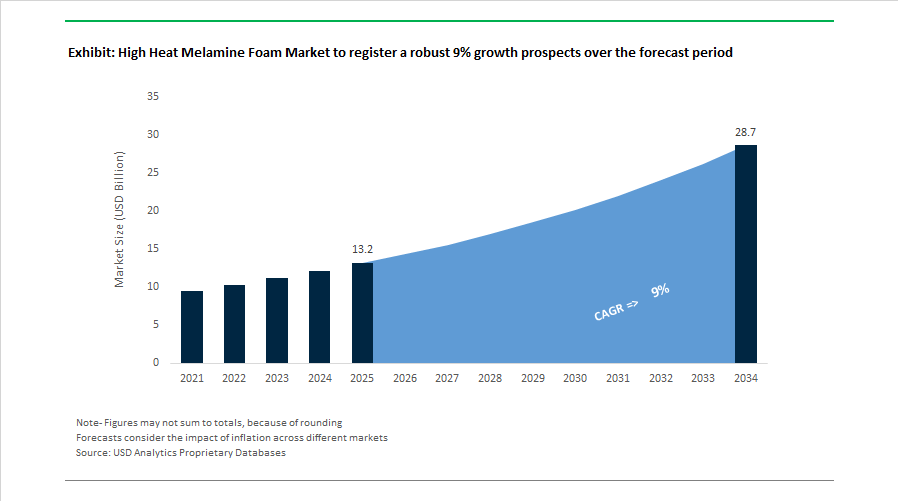
The High Heat Melamine Foam Market is projected to expand from $13.2 billion in 2025 to $28.7 billion by 2034, registering a CAGR of 9%. Growth is underpinned by escalating demand for fire-resistant acoustic insulation, lightweight thermal runaway barriers for electric vehicles, and low-VOC construction materials aligned with LEED and BREEAM certification frameworks. The market is characterized by increasing penetration in aerospace, rail, HVAC insulation, automotive battery protection, and industrial filtration, where high heat resistance, Class A fire performance, and low smoke density are mandatory performance criteria.
In 2024, capacity and compliance upgrades reshaped the competitive landscape. In May 2024, Recticel inaugurated a new production line in Belgium dedicated to high-density acoustic melamine foam, responding to rising European commercial infrastructure investments. In 2024, Zotefoams plc introduced a high-temperature filtration grade designed for industrial airflow systems and automotive thermal management, expanding melamine foam beyond traditional soundproofing. In December 2024, SINOYQX (Yarun), the world’s second-largest producer, secured Business Social Compliance Initiative certification, strengthening its eligibility as a supplier to global automotive and appliance OEMs requiring strict ESG auditing. The alliance formed in late 2023 between SINOYQX and Junhua Group delivered new EV battery-pack melamine foam solutions in 2024, positioning the material as a lightweight thermal runaway mitigation barrier. Earlier, in October 2023 for 2024 procurement cycles, Beijing Guojian Anke introduced an industrial-grade chemically resistant melamine foam tailored for power plants and heavy manufacturing environments.
Sustainability and carbon-reduction initiatives intensified in 2025. In March 2025, BASF introduced Basotect® EcoBalanced for transportation applications, reducing product carbon footprint by 50% via renewable feedstock mass balance and green electricity integration. In February 2025, manufacturers including Puyang Green Foam launched fire-resistant low-VOC melamine foam variants designed to meet California Section 01350 indoor air quality standards. In early 2025, Puren introduced pre-formed melamine HVAC insulation tubes, targeting industrial piping and commercial kitchen installations requiring condensation control and thermal efficiency. In November 2025, BASF launched Basotect® Dark EcoBalanced, the first dark-colored melamine resin foam engineered for visible architectural installations, eliminating secondary dyeing processes and aligning with sustainable building design trends. During 2025, SINOYQX commercialized ultra-flexible curved foam sheets for aerospace fuselage wrapping and engine nacelle insulation, reducing installation time in the MRO sector.
Regulatory and trade developments further influenced procurement patterns. In 2025, new U.S. tariffs on specialty chemical imports from China triggered supply chain diversification and regional reshoring strategies, benefiting producers with European and North American manufacturing bases such as BASF and Huntsman. In late 2024, Armacell International entered a strategic collaboration with BASF to co-develop hybrid acoustic-thermal insulation systems combining flexible elastomeric technology with Basotect performance attributes.
The High Heat Melamine Foam Market is increasingly defined by EV battery fire containment solutions, sustainable mass-balanced feedstock adoption, low-emission building material standards, advanced acoustic engineering for commercial infrastructure, and tariff-driven regional production realignment. Competitive differentiation centers on carbon footprint reduction, ESG-certified supply chains, aerospace-grade flexibility, and next-generation filtration and industrial thermal protection capabilities.
High Heat Melamine Foam Market Trends and Opportunities
Mandatory Adoption of High Heat Melamine Foam for EN 45545-2 Rail Fire Safety Compliance
Global rail operators and rolling stock manufacturers are rapidly standardizing on high heat melamine foam as legacy polyurethane and fiberglass insulation systems fail to meet modern fire, smoke, and toxicity benchmarks. The EN 45545-2 fire safety standard has effectively become the global reference framework during 2024 and 2025, extending beyond Europe into Asia-Pacific, the Middle East, and Latin America through procurement alignment by metro and high-speed rail authorities. Under this regulation, materials are classified from Hazard Level HL1 to HL3, with HL3 representing the strictest limits for smoke density, heat release, and toxic gas emissions. High heat melamine foam remains the only lightweight organic insulation material capable of consistently achieving HL3 compliance for acoustic and thermal insulation in tunnel-operating metros and high-speed rail corridors.
From a performance standpoint, rail-certified melamine foam delivers a compelling balance of safety and lifecycle efficiency. Technical submissions from leading Asian suppliers indicate thermal conductivity values at or below 0.035 W/m·K combined with a Noise Reduction Coefficient exceeding 0.85, enabling simultaneous thermal insulation and acoustic damping. Unlike polymeric alternatives, the foam maintains dimensional stability and structural integrity after extended exposure to 120°C for over 500 hours, aligning with the 30-year service life expectations of modern rolling stock. Weight reduction is a further strategic driver. With densities ranging between 4 and 12 kg/m3, replacing conventional insulation systems can remove several hundred kilograms from a single rail car. Under the EU Green Rail framework, this translates into estimated traction energy savings of 3 to 5% for every 10% reduction in vehicle mass, reinforcing melamine foam adoption as both a safety and energy efficiency solution.
Aerospace Interior Programs Driving Supplier Consolidation and Long-Term Contracts
The aerospace sector is entering a new production upcycle as OEMs work through record aircraft backlogs in 2025, prompting a consolidation of qualified material suppliers for cabin and fuselage insulation. High heat melamine foam has emerged as the preferred acoustic and thermal insulation for aircraft interiors, environmental control system ducting, and fuselage lining due to its exceptional fire resistance, low smoke generation, and acoustic tuning for jet engine frequencies. Aircraft manufacturers are increasingly favoring long-term supply agreements with a limited number of certified producers to ensure consistency, quality control, and supply security across multi-year production schedules.
This consolidation trend is visible in supplier recognition and qualification programs. In September 2025, BASF received the Airbus SQIP Award for the tenth consecutive year, underscoring the strategic importance of stable, high-performance materials within Airbus quality frameworks. Material innovation is reinforcing this position. Hydrophobic grades introduced during 2024 and 2025, including advanced variants of Basotect, demonstrate water absorption below 5%, addressing the long-standing challenge of moisture uptake and corrosion under insulation in aircraft fuselages. By preventing condensation-driven weight gain, airlines can reduce parasitic fuel consumption and maintenance costs over the aircraft lifecycle.
Acoustic performance remains a decisive factor. The open-cell morphology of melamine foam is optimized to attenuate mid- to high-frequency noise typical of turbofan engines. Forward-looking aerospace programs, including quiet cabin initiatives associated with the Lockheed Martin X-59 demonstrator, are specifying melamine foam composites to achieve cruise cabin noise levels below 65 dB. Similar acoustic targets are shaping material selection across next-generation narrow-body and wide-body aircraft platforms.
Multi-Functional Thermal and Fire Protection Systems for Electric Vehicle Battery Packs
The shift toward 800V and higher electric vehicle architectures is opening a high-growth opportunity for high heat melamine foam as a multifunctional battery safety material. Beyond conventional insulation, the foam is increasingly engineered into integrated thermal barriers designed to mitigate thermal runaway propagation in lithium-ion battery modules. Unlike thermoplastic foams that soften or melt under extreme heat, melamine foam forms a stable char layer, creating a physical firewall that delays heat and flame transfer between adjacent cells.
Industry safety evaluations conducted in late 2025 demonstrated that strategically placed melamine foam layers can delay cell-to-cell thermal propagation by several minutes, exceeding minimum evacuation time requirements defined under UN R136. This fire containment capability is complemented by an exceptional weight-to-performance ratio. With typical densities near 9 kg/m3, melamine foam is approximately 90% lighter than silicone-based thermal pads, enabling thicker protective layers without compromising vehicle range. Medium-density grades are also gaining traction as compressible spacers within battery modules. These materials accommodate the expansion and contraction of pouch cells during charge and discharge cycles, maintaining consistent mechanical pressure and contributing to estimated battery cycle life improvements of 10 to 12% in long-duration testing.
Cleanroom-Grade Insulation for Semiconductor and Biopharmaceutical Manufacturing
Rapid expansion of semiconductor fabrication and biopharmaceutical production capacity is creating sustained demand for insulation materials that meet stringent cleanliness and chemical resistance requirements. High heat melamine foam is increasingly specified in ISO Class 5 and 6 cleanrooms because it is fiber-free, non-shedding, and resistant to aggressive sterilization chemistries. In April 2025, Armacell highlighted melamine foam as a core material within its energy efficiency strategy for technical facilities, reflecting broader adoption across high-purity environments.
In semiconductor fabs, HVAC duct lining represents a critical application. Traditional mineral wool insulation can release particulates that contaminate wafers, while melamine foam’s thermoset structure inherently resists fiber release. During 2025, several large-scale fabrication projects in Asia-Pacific specified melamine-based duct liners to maintain ultra-low particle counts while reducing noise from high-velocity air handling systems. These specifications are increasingly aligned with expansions by leading foundries such as TSMC, where contamination control directly impacts yield and profitability.
Sustainability objectives further reinforce this opportunity. Semiconductor and bio-pharma facilities are among the most energy-intensive building types, with cooling loads representing a major share of operational emissions. Melamine foam’s stable performance across a temperature range from minus 180°C to plus 240°C enables its use in both cryogenic process lines and high-temperature exhaust systems. By improving thermal efficiency and reducing cooling demand, the material supports Net Zero roadmaps for advanced manufacturing campuses while delivering compliance, safety, and long-term operating cost benefits.
High Heat Melamine Foam Market Share and Segmentation Insights
Flexible Melamine Foam Leads the High Heat Melamine Foam Market Through Acoustic and Thermal Insulation Performance
Flexible Melamine Foam accounted for 48.60% of the High Heat Melamine Foam Market share in 2025, making it the dominant product type across global melamine foam applications. Flexible melamine foam is widely used because it combines lightweight structure, high thermal resistance, and open-cell acoustic absorption properties, enabling it to perform effectively in both insulation and sound control applications. The material’s open-cell structure allows efficient sound wave absorption, making it particularly suitable for acoustic insulation panels, building interior treatments, and transportation noise control systems. Additionally, melamine foam maintains excellent heat resistance and flame retardancy, which distinguishes it from conventional polymer foams used in thermal insulation. In 2025, the flexible foam segment is increasingly influenced by noise, vibration, and harshness (NVH) optimization in transportation systems. Automotive manufacturers are using engineered melamine foam structures with customized cell density and pore geometry to absorb sound across specific frequency ranges. These advanced acoustic materials are particularly important for electric vehicles, where reduced engine noise makes cabin sound insulation more critical for passenger comfort.
Construction and Real Estate Sector Drives the Largest Demand for High Heat Melamine Foam
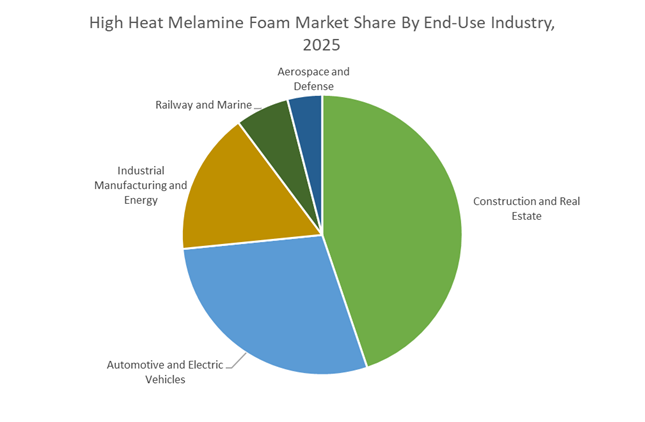
Construction and Real Estate represented 44.80% of the High Heat Melamine Foam Market share in 2025, establishing it as the largest end-use industry for high heat melamine foam insulation materials. The construction sector extensively utilizes melamine foam for acoustic insulation, thermal insulation, and fire-resistant building materials used in modern infrastructure projects. Applications include wall acoustic panels, ceiling insulation systems, HVAC duct insulation, and soundproof interior architectural structures in commercial buildings, educational institutions, residential complexes, and public infrastructure. Melamine foam’s excellent fire resistance, low smoke generation, and high acoustic absorption performance make it particularly valuable in environments requiring strict building safety standards. In 2025, demand from the construction sector is being influenced by the rapid adoption of green building certifications such as LEED and BREEAM, which prioritize materials that contribute to energy efficiency and indoor environmental quality. Melamine foam products with low volatile organic compound (VOC) emissions, recyclable material composition, and high thermal efficiency are increasingly specified in sustainable building projects, strengthening their role in advanced building envelope and acoustic engineering solutions.
Competitive Landscape in High Heat Melamine Foam Market
BASF SE Dominates Through Basotect Innovation and Carbon Transparency
BASF SE remains the original inventor and largest global producer of melamine resin foam. In November 2025, BASF introduced Basotect Dark EcoBalanced, the first high-quality dark melamine foam engineered for exposed HVAC systems and ceiling baffles requiring high heat resistance and improved aesthetic durability. Earlier in 2025, the company launched Basotect EcoBalanced, delivering approximately 50% lower product carbon footprint via renewable feedstock and green electricity under a mass-balance model. Specialized grades such as Basotect UL for aerospace and Basotect B for automotive under-hood insulation strengthen its premium positioning. In 2026, BASF is leveraging digital platforms to provide cradle-to-gate PCF data across its portfolio, reinforcing melamine foam’s role in NetZero construction and transit programs.
SGL Carbon Integrates Melamine Foam into Advanced Thermal Composites
SGL Carbon focuses on high-performance composite systems where melamine foam functions as a core thermal and acoustic layer. Under its Energy Transition roadmap, the company is expanding applications in EV battery compartments to mitigate thermal runaway and improve heat dissipation efficiency. In early 2026, SGL Carbon secured a long-term supply agreement with X-energy for graphite technologies, supporting broader thermal management integration across nuclear and industrial energy systems. The company received the 2026 JEC Innovation Award for natural fiber composite collaboration with BMW Group, reflecting a hybrid approach combining lightweight structural fibers with high-heat insulation materials. Melamine foam is embedded within its specialty graphite and composite solutions for semiconductor fabrication and chemical processing industries requiring stable performance at elevated temperatures.
Vicoustic Expands Global Acoustic Applications Through UniVicoustic
Vicoustic has strengthened its global footprint through the formation of UniVicoustic in February 2026, a joint venture with United Group that establishes a major manufacturing hub in India. The company specializes in architectural acoustic panels utilizing high-heat-resistant melamine foam cores designed for fire safety compliance in public spaces. Its VMT Virtual Material Technology enables high-definition surface printing without clogging acoustic pores or compromising thermal stability. In November 2025, Vicoustic received Most Innovative Product recognition at ORGATEC India for integrated acoustic panels tailored for commercial interiors. By combining European design expertise with scaled production capacity, Vicoustic distributes certified sustainable melamine foam acoustic solutions to more than 70 countries.
Linyi Huamei Drives Industrial-Scale Melamine Foam Production
Linyi Huamei Foam Co., Ltd is primarily serving industrial cleaning and infrastructure segments. The company capitalizes on a 62% adoption rate of melamine foam in industrial cleaning products, optimizing extrusion and cutting technologies for high-volume manufacturing. In late 2025, Linyi Huamei expanded production of compressed melamine foam offering double the density of standard grades for high-heat gaskets and heavy-duty cleaning applications. Its semi-rigid and flexible foam blocks are widely used in HVAC duct insulation, delivering strong thermal stability and effective noise attenuation. Rapid urban rail expansion and infrastructure projects in China continue to support large-scale domestic demand.
Pritex Targets EV Lightweighting and Automotive Thermal Management
Pritex, part of Saint-Gobain, focuses on thermo-acoustic melamine foam systems for automotive and transportation markets. Its AcuZorb portfolio is engineered for harsh environments such as under-hood compartments and under-chassis assemblies where elevated temperature resistance is mandatory. In 2026, Pritex is prioritizing vehicle-wide lightweighting strategies, particularly EV battery insulation systems capable of reducing weight by up to 18% compared with mineral wool and fiberglass alternatives. The company is advancing end-of-life recyclability initiatives and reducing production-related CO2 emissions to align with OEM sustainability targets. As a tier supplier to major European manufacturers, Pritex specializes in engine-side dash and chassis acoustic blockers designed for sustained high-temperature operation.
Recticel Expands High-Heat Insulation Through Strategic Transformation
Recticel is repositioning itself as a pure-player in high-performance insulation under its Elevate 2030 strategy. The company reported 7.4% revenue growth in 2025 to €655.1 million, with advanced products accounting for over 20% of group revenue. Recticel is integrating melamine-based cores into premium mineral wool and PIR insulation boards to enhance fire resistance and thermal performance. In April 2026, the company will open a recycling facility in Wevelgem, Belgium, designed to recover construction waste including specialty foam residues. Expansion into the United States through a new Tennessee greenfield facility, expected to begin production in Q4 2026, strengthens its ability to supply high-heat insulation systems to the North American construction market.
Germany: Bio-Based Innovation, Rail Compliance, and Carbon-Optimized Manufacturing
Germany continues to define the technology and compliance benchmark for the high heat melamine foam industry, combining bio-based feedstock strategies with strict fire safety and decarbonization mandates. In November 2025, BASF expanded its premium portfolio with the launch of Basotect Dark EcoBalanced, the world’s first dark-colored melamine resin foam produced using the Biomass Balance approach. By substituting fossil feedstocks with renewable inputs at the beginning of the value chain, BASF has enabled downstream users to lower Scope 3 emissions without altering material performance, a key requirement for HVAC, transportation, and industrial customers under EU sustainability reporting frameworks.
Product innovation is closely tied to application-specific performance. At Foam Expo Europe 2025 in Messe Stuttgart, German manufacturers showcased drop-in high heat melamine foam solutions that eliminate the need for secondary dyes or surface coverings. These materials are optimized for HVAC components and industrial air filtration systems where dirt visibility directly affects maintenance cycles. Manufacturing transformation underpins these advances. By late 2025, German production facilities had transitioned melamine polymerization processes to 100% green electricity, achieving up to a 50% reduction in product carbon footprint compared to standard grades. Regulatory pull remains strong in transportation. Following the 2025 update to EN 45545-2 fire testing protocols, German rail OEMs prioritized Basotect UF ultra-flexible grades for ceiling and wall panels in high-speed trains, driven by their HL3-rated flame, smoke, and toxicity performance.
China: Fire Engineering Integration and Export-Led Capacity Absorption
China’s high heat melamine foam industry is undergoing a structural repositioning from commodity insulation toward system-level fire safety engineering. Leading producers such as SINOYQX and Ya Dina New Material Technology have shifted toward integrated fire engineering solutions that pair A-Class non-combustible substrates with B1-Class melamine functional layers. This approach directly addresses firefall and molten dripping risks associated with legacy EPS and XPS insulation in high-rise buildings, aligning with stricter urban fire safety expectations.
Regulation and exports are shaping utilization rates. Despite a global oversupply of raw melamine in 2025, operating rates for high heat melamine foam plants in China remained between 65 and 70%. By early 2026, export demand from the Middle East and Southeast Asia emerged as the primary mechanism for absorbing excess capacity. Enforcement of GB 8624-2025 building material standards has further accelerated domestic substitution of B2 and B3 combustible foams with high heat melamine in mechanical and electrical shaft openings, reducing chimney-effect fire propagation. Automotive electrification is an additional growth vector. Chinese suppliers integrated with battery manufacturers such as CATL increasingly specify compressed melamine foam for lithium-ion battery pack insulation. In 2025, this application became a leading demand driver due to the foam’s ability to withstand short-term thermal exposure up to 240°C during thermal runaway events.
United States: Aerospace Lightweighting and Indoor Emissions Compliance
The United States high heat melamine foam market is being shaped by aerospace lightweighting requirements, indoor air quality regulation, and data center infrastructure growth. In late 2025, U.S. aerospace manufacturers accelerated adoption of Basotect UL ultra-light grades for aircraft cabin acoustics. These materials are being integrated into next-generation wide-body airframes to support Federal Aviation Administration 2026 fuel efficiency objectives, where mass reduction directly contributes to lower fuel burn compared to conventional fiberglass insulation.
Regulatory preference is also shifting material selection in construction and interiors. The U.S. Environmental Protection Agency updated its 2026 guidance on formaldehyde emissions, favoring high heat melamine foam grades that comply with Japan’s Law 112 testing thresholds, widely regarded as the most stringent global standard for indoor emissions. This has strengthened the material’s position in green building acoustics and commercial interiors. Industrial demand is expanding in parallel. Ongoing data center build-outs through 2025 increased the use of melamine foam as sound gasketing within server racks, where open-cell structures dampen high-frequency acoustic resonance while maintaining dimensional stability in high-heat-density operating environments.
South Korea: Semiconductor Purity and Cryogenic Energy Applications
South Korea’s high heat melamine foam industry is increasingly defined by precision environments and extreme temperature performance. Electronics manufacturers have commercialized ultra-low VOC melamine foam solutions for 2026 semiconductor cleanroom deployment. These materials are engineered to minimize chemical outgassing that can disrupt high-resolution lithography and wafer processing, supporting South Korea’s position in advanced semiconductor manufacturing.
Energy infrastructure represents a second strategic pillar. Leveraging its leadership in shipbuilding, South Korea has deployed specialized melamine foam insulation in liquefied natural gas carriers and related infrastructure. The foam maintains flexibility and thermal integrity at temperatures as low as minus 196 degrees Celsius, making it suitable for cryogenic pipe insulation in LNG vessels. This capability is particularly relevant for the 2025 to 2026 energy export cycle, where material reliability under extreme thermal stress is a critical operational requirement.
Summary Table: Country-Level Strategic Signals in the High Heat Melamine Foam Industry
High Heat Melamine Foam Market County Level Snapshot
Country
Strategic Driver
Core Application Focus
Industry Implication
Germany
Bio-based feedstocks, rail fire standards
HVAC, rail interiors, low-carbon materials
Sustainability-led premium positioning
China
Fire engineering mandates, export demand
High-rise buildings, EV batteries
System-level safety and capacity absorption
United States
Aerospace efficiency, indoor air quality
Aircraft cabins, data centers
Lightweighting and emissions compliance
South Korea
Semiconductor purity, LNG logistics
Cleanrooms, cryogenic insulation
High-specification niche leadership
High Heat Melamine Foam Market Report Scope
High Heat Melamine Foam Market
Parameter
Details
Market Size (2025)
$13.2 Billion
Market Size (2034)
$28.7 Billion
Market Growth Rate
9%
Segments
By Product Type (Rigid Melamine Foam, Semi-Rigid Melamine Foam, Flexible Melamine Foam, High-Density Melamine Foam), By Foam Grade (Standard Grade, High-Heat Resistant Grade, Fire-Retardant Grade, Sustainable Grade), By Application (Sound Absorption, Thermal Insulation, Transportation NVH, Abrasive Cleaning, Gasketing and Sealing), By End-Use Industry (Construction and Real Estate, Automotive and Electric Vehicles, Aerospace and Defense, Railway and Marine, Industrial Manufacturing and Energy)
Study Period
2019- 2025 and 2026-2034
Units
Revenue (USD)
Qualitative Analysis
Porter’s Five Forces, SWOT Profile, Market Share, Scenario Forecasts, Market Ecosystem, Company Ranking, Market Dynamics, Industry Benchmarking
Companies
BASF SE, Sichuan Zhonglan New Material Co., Ltd., Zhejiang Ya Dina New Material Technology Co., Ltd., Puyang Green Foam Metal Co., Ltd., Beijing Guojian Anke, Evonik Industries AG, Linyi Yingke Chemistry Co., Ltd., Asian Glory Chemical Company Limited, Wilhams Insulation Group, Clark Foam Products Corporation, Recticel NV, Acme Foam, Huntsman Corporation, Sinopec Group, Dongtai City Meihua Foam
Countries
US, Canada, Mexico, Germany, France, Spain, Italy, UK, Russia, China, India, Japan, South Korea, Australia, South East Asia, Brazil, Argentina, Middle East, Africa
High Heat Melamine Foam Market Segmentation
By Product Type
Rigid Melamine Foam
Semi-Rigid Melamine Foam
Flexible Melamine Foam
High-Density Melamine Foam
By Foam Grade
Standard Grade
High-Heat Resistant Grade
Fire-Retardant Grade
Sustainable Grade
By Application
Sound Absorption
Thermal Insulation
Transportation NVH
Abrasive Cleaning
Gasketing and Sealing
By End-Use Industry
Construction and Real Estate
Automotive and Electric Vehicles
Aerospace and Defense
Railway and Marine
Industrial Manufacturing and Energy
By Region
North America (United States, Canada, Mexico)
Europe (Germany, France, United Kingdom, Spain, Italy, Rest of Europe)
Asia Pacific (China, India, Japan, South Korea, Australia, Rest of APAC)
South and Central America (Brazil, Argentina, Rest of SCA)
Middle East and Africa (Saudi Arabia, UAE, South Africa, Rest of Middle East, Rest of Africa)
Top Companies in the High Heat Melamine Foam Industry
BASF SE
Sichuan Zhonglan New Material Co., Ltd.
Zhejiang Ya Dina New Material Technology Co., Ltd.
2. High Heat Melamine Foam Market Landscape & Outlook (2026–2034)
2.1. Introduction to High Heat Melamine Foam Market
2.2. Market Valuation and Growth Projections (2026–2034)
2.3. Key Growth Drivers: Fire-Resistant Insulation, EV Thermal Barriers, and Sustainable Building Materials
2.4. Industry Transformation Through Low-VOC Construction Standards and Green Building Certifications
2.5. Strategic Developments in Basotect Innovation, Production Expansion, and Global Supply Chain Realignment
3. Innovations Reshaping the High Heat Melamine Foam Market
3.1. Trend: Rail Fire Safety Compliance and EN 45545-2 Standard Adoption
3.2. Trend: Aerospace Interior Programs Driving High-Performance Acoustic Insulation Demand
3.3. Opportunity: Thermal Runaway Protection Systems for Electric Vehicle Battery Packs
3.4. Opportunity: Cleanroom-Grade Thermal Insulation for Semiconductor and Biopharmaceutical Manufacturing
4. Competitive Landscape and Strategic Initiatives
4.1. Mergers and Acquisitions
4.2. R&D and Advanced Melamine Foam Material Innovation
4.3. Sustainability and ESG Strategies
4.4. Market Expansion and Regional Production Strategies
5. Market Share and Segmentation Insights: High Heat Melamine Foam Market
5.1. By Product Type
5.1.1. Rigid Melamine Foam
5.1.2. Semi-Rigid Melamine Foam
5.1.3. Flexible Melamine Foam
5.1.4. High-Density Melamine Foam
5.2. By Foam Grade
5.2.1. Standard Grade
5.2.2. High-Heat Resistant Grade
5.2.3. Fire-Retardant Grade
5.2.4. Sustainable Grade
5.3. By Application
5.3.1. Sound Absorption
5.3.2. Thermal Insulation
5.3.3. Transportation NVH
5.3.4. Abrasive Cleaning
5.3.5. Gasketing and Sealing
5.4. By End-Use Industry
5.4.1. Construction and Real Estate
5.4.2. Automotive and Electric Vehicles
5.4.3. Aerospace and Defense
5.4.4. Railway and Marine
5.4.5. Industrial Manufacturing and Energy
5.5. By Region
5.5.1. North America
5.5.2. Europe
5.5.3. Asia Pacific
5.5.4. South and Central America
5.5.5. Middle East and Africa
6. Country Analysis and Outlook of High Heat Melamine Foam Market
6.1. United States
6.2. Canada
6.3. Mexico
6.4. Germany
6.5. France
6.6. Spain
6.7. Italy
6.8. UK
6.9. Russia
6.10. China
6.11. India
6.12. Japan
6.13. South Korea
6.14. Australia
6.15. South East Asia
6.16. Brazil
6.17. Argentina
6.18. Middle East
6.19. Africa
7. High Heat Melamine Foam Market Size Outlook by Region (2026–2034)
7.1. North America High Heat Melamine Foam Market Size Outlook to 2034
7.1.1. By Product Type
7.1.2. By Foam Grade
7.1.3. By Application
7.1.4. By End-Use Industry
7.1.5. By Region
7.2. Europe High Heat Melamine Foam Market Size Outlook to 2034
7.2.1. By Product Type
7.2.2. By Foam Grade
7.2.3. By Application
7.2.4. By End-Use Industry
7.2.5. By Region
7.3. Asia Pacific High Heat Melamine Foam Market Size Outlook to 2034
7.3.1. By Product Type
7.3.2. By Foam Grade
7.3.3. By Application
7.3.4. By End-Use Industry
7.3.5. By Region
7.4. South America High Heat Melamine Foam Market Size Outlook to 2034
7.4.1. By Product Type
7.4.2. By Foam Grade
7.4.3. By Application
7.4.4. By End-Use Industry
7.4.5. By Region
7.5. Middle East and Africa High Heat Melamine Foam Market Size Outlook to 2034
7.5.1. By Product Type
7.5.2. By Foam Grade
7.5.3. By Application
7.5.4. By End-Use Industry
7.5.5. By Region
8. Company Profiles: Leading Players in the High Heat Melamine Foam Market
8.1. BASF SE
8.2. Sichuan Zhonglan New Material Co., Ltd.
8.3. Zhejiang Ya Dina New Material Technology Co., Ltd.
8.4. Puyang Green Foam Metal Co., Ltd.
8.5. Beijing Guojian Anke
8.6. Evonik Industries AG
8.7. Linyi Yingke Chemistry Co., Ltd.
8.8. Asian Glory Chemical Company Limited
8.9. Wilhams Insulation Group
8.10. Clark Foam Products Corporation
8.11. Recticel NV
8.12. Acme Foam
8.13. Huntsman Corporation
8.14. Sinopec Group
8.15. Dongtai City Meihua Foam
9. Methodology
9.1. Research Scope
9.2. Market Research Approach
9.3. Market Sizing and Forecasting Model
9.4. Research Coverage
9.5. Data Horizon
9.6. Deliverables
10. Appendix
10.1. Acronyms and Abbreviations
10.2. List of Tables
10.3. List of Figures
High Heat Melamine Foam Market Segmentation
By Product Type
Rigid Melamine Foam
Semi-Rigid Melamine Foam
Flexible Melamine Foam
High-Density Melamine Foam
By Foam Grade
Standard Grade
High-Heat Resistant Grade
Fire-Retardant Grade
Sustainable Grade
By Application
Sound Absorption
Thermal Insulation
Transportation NVH
Abrasive Cleaning
Gasketing and Sealing
By End-Use Industry
Construction and Real Estate
Automotive and Electric Vehicles
Aerospace and Defense
Railway and Marine
Industrial Manufacturing and Energy
By Region
North America (United States, Canada, Mexico)
Europe (Germany, France, United Kingdom, Spain, Italy, Rest of Europe)
Asia Pacific (China, India, Japan, South Korea, Australia, Rest of APAC)
South and Central America (Brazil, Argentina, Rest of SCA)
Middle East and Africa (Saudi Arabia, UAE, South Africa, Rest of Middle East, Rest of Africa)
The High Heat Melamine Foam Market is expected to grow from $13.2 billion in 2025 to $28.7 billion by 2034, registering a CAGR of 9%. Growth is driven by rising demand for fire-resistant acoustic insulation, EV battery thermal protection materials, and low-VOC construction solutions. Increasing adoption across transportation, infrastructure, and advanced manufacturing sectors is accelerating market expansion.
Electric vehicle manufacturers are adopting melamine foam as a lightweight thermal runaway barrier in lithium-ion battery packs. The material forms a stable char layer under extreme heat, slowing flame propagation between cells and improving passenger safety. Its low density also allows thicker insulation layers without compromising vehicle range or weight targets.
The construction and real estate sector accounted for 44.80% of market demand in 2025. Melamine foam is widely used for acoustic panels, HVAC duct insulation, ceiling systems, and fire-resistant building materials. Demand is increasing due to green building certifications such as LEED and BREEAM, which prioritize low-VOC, energy-efficient insulation materials.
Stricter fire safety standards such as EN 45545-2 rail regulations and low-emission building material standards are accelerating adoption. Innovations include bio-based melamine foam production, ultra-flexible aerospace insulation grades, and high-temperature filtration foams for industrial airflow systems. Sustainability initiatives and carbon-reduction targets are also influencing product development.
Key players in the High Heat Melamine Foam Market include BASF SE, Recticel NV, Huntsman Corporation, Evonik Industries AG, Sichuan Zhonglan New Material Co., Ltd., Zhejiang Ya Dina New Material Technology Co., Ltd., Puyang Green Foam Metal Co., Ltd., Beijing Guojian Anke, Clark Foam Products Corporation, and Sinopec Group. These companies focus on sustainable melamine foam innovations, EV battery insulation solutions, and advanced acoustic materials for transportation and construction sectors.