High Heels Market Overview – Valuation, Growth Outlook, and Strategic Insights
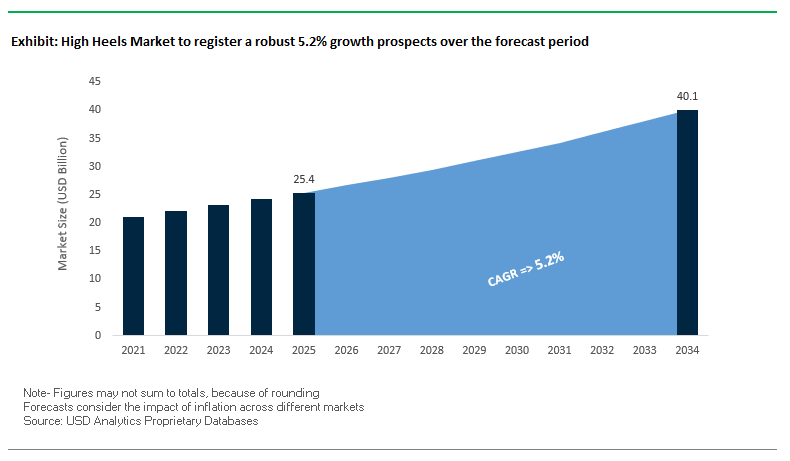
The global high heels market is expected to grow from USD 25.4 billion in 2025 to USD 40.1 billion in 2034, at a CAGR of 5.2% over this period. Fashion innovation, luxury branding, and customer demand for products that are fashionable, comfortable, and carry cultural significance propel the segment of the global footwear market. Industry players and investors are following the market closely as established luxury brands continue to solidify their positions and new entrants bring their disruptive design concepts. High heels are still a cultural icon, no longer just influencing consumer fashion but shaping wider lifestyle and status debate.
Key Insights for Industry Professionals
- Concentrated Manufacturing Hubs – High-end production is clustered in artisanal shoemaking centers, such as Elda, Spain, which manufactures a significant share of Stuart Weitzman’s collections.
- Global Retail Expansion – Jimmy Choo’s 200+ store network reflects the sector’s aggressive luxury retail footprint strategy.
- Digital Influence on Demand – Online searches and brand engagement, as seen when Christian Louboutin topped global search rankings in 2011, remain critical to brand dominance.
- Product Innovation Trends – Convertible heels (e.g., Pashion Footwear’s modular designs) are redefining versatility in the luxury footwear space.
- Cultural Relevance – From red carpet events to corporate boardrooms, high heels are a symbol of elegance, empowerment, and prestige.
High Heels Market Analysis – Strategic Developments and Industry Momentum
High heels sector is undergoing brand consolidation, regionalization, and design innovation, with 2025 being pivotal inflection points for most top players. Manolo Blahnik's launch of its Autumn 2025 Collection in July 2025 featured Ancient Greek and European inspirations, reaffirming its heritage positioning while engaging fashion-leading Asian markets with a Shanghai preview event. This aligns with the wider industry trend of localized product strategies, whereby brands launch region-specific collections to leverage relevance in priority luxury markets.
In August 2025, Caleres' buyout of Stuart Weitzman was not only a strategic move in the competitive arena. The buyout will increase Stuart Weitzman's global reach and operational efficiency through Caleres' corporate platform. The transaction is a consolidation trend in the footwear industry, where large conglomerates buy up niche luxury brands to diversify portfolios and target high-margin segments. Also in August, Pashion Footwear launched "The Bootie," a two-kit high heel with stiletto and block heel versions, reflecting consumer appetite for modular, utilitarian fashion.
Regional expansion plans also accelerated in 2025. Manolo Blahnik expanded in Japan with a tweed capsule collection offered exclusively to a limited number of retailers, and Jimmy Choo emphasized Italian craftsmanship with word-of-mouth campaigns centered around fine Florentine leather sourcing. Christian Louboutin's Fall 2025 collection, debuted in August 2025, stayed true to its red sole signature identity while experimenting with materials and silhouettes while staying on trend to evolving luxury consumer sensibilities.
Key Trends and Growth Opportunities Transforming the High Heels Market
Biomechanically Engineered Comfort Technology Reinventing Luxury High Heels
The high-heels market is experiencing a technology revolution, with biomechanically designed comfort technology leading the way. Through the integration of orthopedic science into shoe technology, high-end shoe brands are moving away from aesthetics and towards the health of the foot and all-day comfort. Research, including that of the Journal of the American Podiatric Medical Association, has shown that features like metatarsal pads have the ability to widen the forefoot and pressure-reduce, directly enhancing comfort on long-term wear. This evidence base is inspiring brands like Christian Louboutin and Jimmy Choo to trial dynamic gait analysis, pressure mapping, and arch-supportive insole technology. The move is also backed by evidence from the U.S. National Institutes of Health, citing the biomechanical stress of classical high heels, which is inspiring high-end footwear designers to integrate solutions that minimize joint stress and stability without sacrificing on style.
Eco-Friendly Luxury Materials Pioneering Ethical Fashion in Stiletto Heels
Sustainability has emerged as the cornerstone of the luxury high heels category, and eco-friendly materials, vegan collections, and bio-based leathers are increasingly being added to high-end collections. Luxury brands such as Veerah LLC and AERA Shoes are taking the lead by using new materials like recycled plastic and apple leather, proving that luxury and sustainability can coexist. Consumer behavior studies confirm that green-awareness is shaping purchasing patterns, especially in Europe and North America, where non-sports sustainable footwear already accounts for over 60% of sales in the market. With the market for bio-based leather poised to grow more than two times from $107 million in 2023 to $216 million in 2028, premium high heel brands have a strong incentive to capitalize on both luxury appeal and ethical production.
Medical-Approved Wedding Heels Merging Comfort and Elegance
The bridal shoe market presents a profitable niche in the high heels market, with comfort-oriented but high-quality wedding heels becoming increasingly popular. Consumer research indicates "all-day wear" as the deal-breaker for brides, and the top brands are reacting with cushioned insoles, height-adjustable heels, and wider toe boxes for swelling on longer occasions. By combining orthopedic intelligence with couture-grade design, high-quality shoemakers can build a luxury category of medically intelligent wedding heels, surfing the worldwide wellness trend while still offering aspirational designs.
Emerging Markets' Aspirational Buyers Fuel Luxury Growth
Growing incomes in emerging markets are producing a new wave of aspirational luxury high-heeled footwear consumers. In markets such as India, the cultural connection between the high shoe and social status based on long-established status symbols such as the paduka provide fertile ground for brand growth. Global luxury brands are evolving their marketing to position it within local cultural sensitivities, aligning with local celebrities, and expanding store footprints in Asia, the Middle East, and Latin America. Social media influencers drive the trend further, as younger consumers in these markets look to follow global fashion icons and thereby build a robust pipeline of brand-loyal consumers.
Market Share Insights of the Global High Heels Industry
High Heels Market Share by Type: Stilettos Maintain Luxury Dominance
Stilettos command a leading 32% share of the high heels market in 2025, driven by their timeless association with elegance, nightlife, and luxury occasions. Premium brands such as Louboutin and Jimmy Choo dominate this segment, catering to special event buyers despite practicality limitations for daily wear. Pumps hold a strong 28% share, favored for professional environments and versatility, with fast-fashion retailers like Zara and H&M contributing to high-volume sales. Wedges and platforms are on an upward trajectory, appealing to comfort-focused consumers, including professionals and travelers, while platforms also benefit from the Y2K revival and streetwear collaborations embraced by Gen Z. The “Others” category including block heels, kitten heels, and mules is emerging as a fast-growth segment, blending style and comfort for hybrid casual-formal occasions.
.png)
High Heels Market Share by Material: Leather Retains Prestige Amid Sustainable Disruption
Leather remains the most valued material in high heels, holding 42% of the market due to its durability, breathability, and luxurious appeal. However, it faces increasing competition from synthetic materials, which account for 33% of the market, propelled by lower costs, vegan consumer preferences, and high-quality PU-based eco-leather alternatives. Textile-based designs, such as satin and velvet, continue to thrive in seasonal and special-occasion collections, particularly in bridal and holiday footwear. The “Others” category which includes recycled plastics, cork, and plant-based fabrics is gaining traction in both North America and Europe, driven by eco-conscious legislation and sustainability-focused branding.
Competitive Landscape – Leading Brands Driving the High Heels Industry
Heritage luxury brands dominate the high heels market by using craftsmanship, brand heritage, and targeted expansion strategies for competitive advantage. Belle, Nine West, Salvatore Ferragamo, Kering Group, ECCO, C.banner, Clarks, Red Dragonfly, Christian Louboutin, Daphne, Steve Madden, Geox, Manolo Blahnik, Jimmy Choo, Stuart Weitzman, and Others are the market leaders.
Christian Louboutin – Icon of the Red Sole
Christian Louboutin's red-lacquered sole (Pantone 18-1663 TPX) is the height of luxury footwear today. Famous for stiletto heights of over 120 mm, the brand has expanded into luxury accessories and cosmetics and leverages its celebrity fan base. With an international chain of boutiques and a permanent affinity for high glamour, Louboutin is able to maintain heritage in ideal harmony with creative innovation.
Jimmy Choo – Red Carpet and Retail Expansion Pioneering
Jimmy Choo revolutionized luxury fashion shoe marketing through celebrity dressing strategies, establishing brand equity through Hollywood visibility. It now produces lines of shoes, handbags, sunglasses, and menswear, all made with Italian craftsmanship. Under the guidance of Creative Director Sandra Choi, the brand maintains a streamlined, glamorous aesthetic that will appeal to an international luxury consumer market.
Manolo Blahnik – Timeless Style and Handmade Excellence
Renowned for hand-stitched shoes and traditional silhouettes like the Hangisi and BB pumps, Manolo Blahnik blends heritage with contemporary elegance. Its Jul 2025 tweed collection for Japan and Shanghai preview of Autumn 2025 Collection reflect its region-based strategy. Its focus on social responsibility assists it in its prestige positioning.
Stuart Weitzman – Comfort Meets Couture
Stuart Weitzman marries trend-right fashion with wearability, with the backing of Spanish craftsmanship. Classics such as the NUDIST sandal and 5050 boot are familiar household names. The August 2025 Caleres acquisition sets the brand up for even broader international growth, fueled by its past record of high-profile celebrity endorsement.
United States: Innovation-Driven Customization and Retail Transformation in the High Heels Industry
The United States high heels market is advancing rapidly through the adoption of cutting-edge footwear technologies and consumer-centric retail strategies. Leading brands are integrating 3D printing into design and production workflows, enabling the creation of custom-fit heels tailored to individual measurements. This not only enhances wearer comfort but also aligns with the growing demand for ergonomic designs and cushioned insoles that address foot health concerns. Material innovation is another defining aspect, with U.S. manufacturers pioneering the use of biodegradable fabrics and recycled plastics, reducing the industry’s environmental footprint while meeting the expectations of sustainability-conscious consumers.
The retail landscape is also evolving with a strong push toward omnichannel integration, where brands seamlessly connect physical stores with online platforms. Technologies like virtual try-on tools are being leveraged to improve fit accuracy, reduce return rates, and elevate the customer experience. Meanwhile, automation is streamlining production, with AI-powered quality control systems detecting defects in real-time to ensure consistent product quality. These advancements position the U.S. market as a global leader in blending style, comfort, and sustainability, while maintaining high operational efficiency.
Italy: Heritage-Backed Luxury and Digital Competitiveness in the High Heels Sector
Italy remains a dominant force in the luxury high heels market, supported by government-backed initiatives reinforcing the "Made in Italy" label. This designation ensures that the final transformation of products occurs within the country, safeguarding its tradition of craftsmanship and premium quality. In parallel, Italy is adopting EU-driven sustainability policies that require clear labeling for footwear disposal and recycling, supporting the transition to a circular economy and encouraging the use of eco-friendly materials.
Industry associations such as Assocalzaturifici are playing a key role in digitizing small and medium-sized enterprises (SMEs), enabling them to boost productivity and remain competitive in global markets. Italy’s export strength remains solid, particularly within the luxury and high-end segment, with the European Union serving as its primary buyer. This combination of heritage, sustainability, and technological adaptation ensures that Italian high heels maintain a strong foothold in the global marketplace.
Spain: Sustainable Manufacturing and High-End Footwear Growth
Spain is making strategic advances in sustainable manufacturing through initiatives like the ECOFAP Project, funded by the Ministry of Science, Innovation and Universities. This project aims to develop 3D printing materials derived from tanned leather waste for use in soles and heels, effectively turning industrial waste into a valuable resource. Such R&D efforts strengthen Spain’s position as a leader in circular economy practices within footwear production.
The Spanish footwear industry is also experiencing employment growth, with staffing levels approaching pre-2018 figures a positive indicator of recovery and expansion. Key manufacturers, such as Pablosky and Bertuchi, are introducing sustainable product lines featuring recycled and naturally sourced materials. Spain’s production hubs are increasingly focused on medium-to-high quality and luxury heels, catering to export markets where craftsmanship and quality remain paramount.
China: Manufacturing Strength and Technological Modernization in Footwear Production
China’s high heels market benefits from its unmatched manufacturing capacity and robust supply chain infrastructure, supported by heavy government investment in transportation, utilities, and industrial networks. This extensive infrastructure facilitates both domestic distribution and international exports, cementing China’s role as a production powerhouse.
Beyond manufacturing volume, China is intensifying its investment in high-tech integration across footwear production. Advanced R&D initiatives are modernizing processes, improving efficiency, and enabling greater customization. Coupled with the country’s rapidly growing domestic consumer market, which fuels steady demand alongside strong exports, China’s footwear sector is positioned for sustained growth and competitive dominance.
France: Balancing Luxury Heritage with Modern Comfort and Sustainability
France has long been synonymous with luxury high heels, with renowned brands such as Christian Louboutin and Roger Vivier shaping global fashion standards. However, shifting lifestyle patterns driven by remote work and evolving cultural norms are influencing a move towards more comfortable and casual footwear without compromising on elegance. Luxury houses are responding with designs that merge style and practicality, incorporating softer materials and ergonomic fits.
Sustainability is emerging as a key design focus for a new wave of French footwear brands. These companies are creating collections that maintain the aesthetic appeal of high heels while integrating eco-friendly materials and responsible production methods. This transition reflects France’s adaptability in preserving its luxury legacy while meeting the needs of the modern consumer.
Brazil: Domestic Recovery and Industry-Led Growth in the Footwear Market
Brazil’s high heels market is witnessing a domestic market-driven rebound, supported by rising household incomes and declining unemployment rates. This economic uplift is driving consumer demand, enabling local manufacturers to increase production. Events like BFSHOW, Brazil’s largest footwear trade show, are accelerating this momentum by connecting domestic and international buyers with ready-to-ship inventory, fostering both local sales and export opportunities.
The Brazilian Association of Footwear Industries (Abicalçados) anticipates a full recovery to pre-2019 production levels, with output projected to rise in the coming years. The country’s focus on domestic consumption, paired with active participation in industry events, positions Brazil as a steadily growing player in the high heels segment, with potential to expand its international presence.
High Heels Market Report Scope
High Heels Market
|
Parameter
|
Details
|
|
Market Size (2025)
|
$25.4 Billion
|
|
Market Size (2034)
|
$40.1 Billion
|
|
Market Growth Rate
|
5.2%
|
|
Segments
|
By Type (Stilettos, Pumps, Wedges, Platforms, Others), By Material (Leather, Synthetic, Textile, Others), By Distribution Channel (Online Stores, Hypermarkets/Supermarkets, Specialty Stores, Others), By Application (Daily Wear, Performance, Work Wear), By Pricing (Economical, Medium, Fine, Luxury)
|
|
Study Period
|
2019- 2024 and 2025-2034
|
|
Units
|
Revenue (USD)
|
|
Qualitative Analysis
|
Porter’s Five Forces, SWOT Profile, Market Share, Scenario Forecasts, Market Ecosystem, Company Ranking, Market Dynamics, Industry Benchmarking
|
|
Companies
|
Belle, Nine West, Salvatore Ferragamo, Kering Group, ECCO, C.banner, Clarks, Red Dragonfly, Christian Louboutin, Daphne, Steve Madden, Geox, Manolo Blahnik, Jimmy Choo, Stuart Weitzman, Others.
|
|
Countries
|
US, Canada, Mexico, Germany, France, Spain, Italy, UK, Russia, China, India, Japan, South Korea, Australia, South East Asia, Brazil, Argentina, Middle East, Africa
|
High Heels Market Segmentation
By Type
- Stilettos
- Pumps
- Wedges
- Platforms
- Others
By Material
- Leather
- Synthetic
- Textile
- Others
By Distribution Channel
- Online Stores
- Hypermarkets/Supermarkets
- Specialty Stores
- Others
By Application
- Daily Wear
- Performance
- Work Wear
By Pricing
- Economical
- Medium
- Fine
- Luxury
Countries Analyzed
- North America (US, Canada, Mexico)
- Europe (Germany, UK, France, Spain, Italy, Russia, Rest of Europe)
- Asia Pacific (China, India, Japan, South Korea, Australia, South East Asia, Rest of Asia)
- South America (Brazil, Argentina, Rest of South America)
- Middle East and Africa (Saudi Arabia, UAE, Rest of Middle East, South Africa, Egypt, Rest of Africa)
Top Companies in High Heels Market
- Belle
- Nine West
- Salvatore Ferragamo
- Kering Group
- ECCO
- C.banner
- Clarks
- Red Dragonfly
- Christian Louboutin
- Daphne
- Steve Madden
- Geox
- Manolo Blahnik
- Jimmy Choo
- Stuart Weitzman
* List Not Exhaustive
Research Coverage
This report investigates the global high heels market in depth, delivering strategic breakthroughs, analysis reviews, and highlights that cater to the needs of industry professionals and decision-makers. Compiled by USDAnalytics, it examines the evolving interplay of fashion innovation, sustainability trends, and luxury brand positioning, while mapping competitive strategies of top-tier manufacturers. This report is an essential resource for executives, investors, designers, and supply chain leaders seeking to understand the dynamic trajectory of the market from both a global and regional perspective. It provides fact-based insights into technological advancements, product diversification, and consumer behavior shifts, supported by detailed segmentation, country-level evaluations, and company profiles. The findings highlight the alignment of market momentum with socio-cultural trends, enabling stakeholders to identify growth opportunities, mitigate risks, and optimize strategic planning.
Scope Highlights
- Segmentation:
- By Type: Stilettos, Pumps, Wedges, Platforms, Others
- By Material: Leather, Synthetic, Textile, Others
- By Distribution Channel: Online Stores, Hypermarkets/Supermarkets, Specialty Stores, Others
- By Application: Daily Wear, Performance, Work Wear
- By Pricing: Economical, Medium, Fine, Luxury
- Geographic Scope: Analysis spans 25+ countries across North America, Europe, Asia Pacific, Latin America, the Middle East & Africa.
- Timeframe: Historic data from 2021 to 2024 and forecast data from 2025 to 2034.
- Companies: Analysis and profiles of 15+ key market players.
Methodology
The research methodology integrates a multi-layered approach combining primary and secondary data collection to ensure comprehensive market coverage and accuracy. Primary research involved in-depth interviews with footwear industry executives, luxury brand strategists, retail managers, material suppliers, and fashion influencers to gather qualitative and quantitative insights. Secondary research leveraged credible sources such as trade publications, patent databases, government export/import data, and sustainability reports to validate market trends and forecast assumptions. Analytical models, including market attractiveness analysis, Porter’s Five Forces, and value chain assessment, were applied to identify competitive dynamics and growth opportunities. Data triangulation ensured that every statistic and projection was corroborated from multiple angles, resulting in a fact-driven, actionable, and industry-relevant market report.
Deliverables:
- Comprehensive Market Research Report (PDF and Excel) with detailed tables, charts, and interactive visualizations.
- Country-Specific Forecasts & Analysis.
- Segment-Wise Revenue Forecasts (2025–2034).
- Competitive Analysis, Benchmarking, and SWOT Profiles.
- Recent Developments & Innovation Tracker.
- Executive Summary & Analyst Commentary.
- Post-Purchase Analyst Support for Client-Specific Questions and Custom Data Requirements.
Table of Contents: High Heels Market
1. Executive Summary
1.1. Market Highlights
1.2. Key Findings
1.3. Global Market Snapshot
2. High Heels Market Landscape & Outlook (2025–2034)
2.1. Introduction to High Heels Market
2.2. Market Valuation and Growth Projections (2025–2034)
2.2.1. Current Market Size (2025): $25.4 Billion
2.2.2. Forecasted Market Size and CAGR (2034): $40.1 Billion at 5.2% CAGR
2.3. Strategic Acquisitions and Brand Consolidation
2.3.1. Caleres’ Acquisition of Stuart Weitzman (August 2025)
2.4. Innovation in Product Design and Functionality
2.4.1. Manolo Blahnik’s Autumn 2025 Collection Launch in Asia (July 2025)
2.4.2. Pashion Footwear’s Introduction of “The Bootie” with Dual-Kit Heels (August 2025)
2.5. Advancements in Comfort and Sustainability
2.5.1. Biomechanically Engineered Comfort Tech
2.5.2. Sustainable Luxury Materials (e.g., Apple Leather, Recycled Plastics)
3. Breakthrough Innovations in the High Heels Market
3.1. Trend: Biomechanically Engineered Comfort Tech Redefining Luxury High Heels
3.1.1. Integration of Orthopedic Science for Foot Health
3.1.2. Dynamic Gait Analysis and Arch-Supportive Insole Technology
3.1.3. Shift from Purely Aesthetic Appeal to All-Day Comfort
3.2. Trend: Sustainable Luxury Materials Driving Ethical Fashion in High Heels
3.2.1. Pioneer Brands: Veerah LLC and AERA Shoes
3.2.2. Use of Bio-Based Leathers, Vegan Alternatives, and Eco-Friendly Fabrics
3.2.3. Eco-Consciousness Reshaping Consumer Buying Patterns
3.3. Opportunity: Medical-Approved Wedding Heels Bridging Comfort and Elegance
3.3.1. All-Day Wear as a Decisive Factor for Brides
3.3.2. Merging Orthopedic Insights with Couture-Level Design
3.4. Opportunity: Emerging Market Aspirational Buyers Fueling Luxury Growth
3.4.1. Rising Disposable Incomes in Emerging Economies
3.4.2. Cultural Association of Elevated Footwear with Social Prestige
3.4.3. Social Media and Celebrity Influence
4. Competitive Landscape: High Heels Market
4.1. Overview of Market Dynamics and Drivers
4.2. Christian Louboutin – Icon of the Red Sole
4.2.1. Trademark Red-Lacquered Sole (Pantone 18-1663 TPX)
4.2.2. Global Boutique Network and Celebrity Clientele
4.3. Jimmy Choo – Red Carpet and Retail Expansion Pioneer
4.3.1. Celebrity Dressing Strategies and Brand Equity via Hollywood
4.3.2. Expansion into Handbags, Eyewear, and Men’s Collections
4.4. Manolo Blahnik – Artisanal Excellence and Timeless Design
4.4.1. Handcrafted Shoes and Elegant Silhouettes (e.g., Hangisi, BB pumps)
4.4.2. Targeted Regional Approach (e.g., July 2025 Japan-exclusive collection)
4.5. Stuart Weitzman – Comfort Meets Couture
4.5.1. Spanish Craftsmanship and Signature Pieces (e.g., NUDIST sandal, 5050 boot)
4.5.2. Acquisition by Caleres for Expanded Global Reach
4.6. Other Key Players
5. Market Share and Segmentation Insights: High Heels Market
5.1. By Type
5.1.1. Stilettos: Dominant Market Share (32%)
5.1.2. Pumps
5.1.3. Wedges
5.1.4. Platforms
5.1.5. Others (Block Heels, Kitten Heels, Mules)
5.2. By Material
5.2.1. Leather: Largest Market Share (42%)
5.2.2. Synthetic
5.2.3. Textile
5.2.4. Others (Recycled Plastics, Cork, Plant-Based Fabrics)
5.3. By Distribution Channel
5.3.1. Online Stores
5.3.2. Hypermarkets/Supermarkets
5.3.3. Specialty Stores
5.3.4. Others
5.4. By Application
5.4.1. Daily Wear
5.4.2. Performance
5.4.3. Work Wear
5.5. By Pricing
5.5.1. Economical
5.5.2. Medium
5.5.3. Fine
5.5.4. Luxury
6. Country Analysis and Outlook of High Heels Market
6.1. United States: Innovation-Driven Customization and Retail Transformation
6.2. Italy: Heritage-Backed Luxury and Digital Competitiveness
6.3. Spain: Sustainable Manufacturing and High-End Footwear Growth
6.4. China: Manufacturing Strength and Technological Modernization
6.5. France: Balancing Luxury Heritage with Modern Comfort and Sustainability
6.6. Brazil: Domestic Recovery and Industry-Led Growth
6.7. Canada: Technological Integration and Consumer-Centric Strategies
6.8. Mexico: Rising Consumer Demand and E-commerce Expansion
6.9. Germany: Demand for Sustainable and High-Quality Products
6.10. UK: Shifting Consumer Preferences and Evolving Retail
6.11. Russia: E-commerce Growth and Increasing Disposable Incomes
6.12. Japan: Focus on Comfort, Craftsmanship, and Evolving Trends
6.13. South Korea: Sustainability and Technology Adoption
6.14. Australia: Growth in Luxury and Sustainable Footwear
6.15. India: Aspirational Buyers and Cultural Influences
6.16. Saudi Arabia: Luxury Spending and Fashion-Conscious Consumers
6.17. UAE: Tourism-Driven Retail and Luxury Fashion Hub
6.18. South Africa: Expanding Affluent Class and Urbanization
6.19. Egypt: Rising Urbanization and Western Fashion Influence
7. High Heels Market Size Outlook by Region (2025–2034)
7.1. North America High Heels Market Size Outlook to 2034
7.1.1. By Type
7.1.2. By Material
7.1.3. By Distribution Channel
7.1.4. By Application
7.1.5. By Pricing
7.2. Europe High Heels Market Size Outlook to 2034
7.2.1. By Type
7.2.2. By Material
7.2.3. By Distribution Channel
7.2.4. By Application
7.2.5. By Pricing
7.3. Asia Pacific High Heels Market Size Outlook to 2034
7.3.1. By Type
7.3.2. By Material
7.3.3. By Distribution Channel
7.3.4. By Application
7.3.5. By Pricing
7.4. South America High Heels Market Size Outlook to 2034
7.4.1. By Type
7.4.2. By Material
7.4.3. By Distribution Channel
7.4.4. By Application
7.4.5. By Pricing
7.5. Middle East and Africa High Heels Market Size Outlook to 2034
7.5.1. By Type
7.5.2. By Material
7.5.3. By Distribution Channel
7.5.4. By Application
7.5.5. By Pricing
8. Company Profiles: Leading Players in High Heels Market
8.1. Belle
8.2. Nine West
8.3. Salvatore Ferragamo
8.4. Kering Group
8.5. ECCO
8.6. C.banner
8.7. Clarks
8.8. Red Dragonfly
8.9. Christian Louboutin
8.10. Daphne
8.11. Steve Madden
8.12. Geox
8.13. Manolo Blahnik
8.14. Jimmy Choo
8.15. Stuart Weitzman
8.16. (List Not Exhaustive)
9. Methodology
9.1. Research Scope
9.2. Market Research Approach
9.3. Market Sizing and Forecasting Model
9.4. Research Coverage
9.5. Data Horizon
9.6. Deliverables
10. Appendix
10.1. Acronyms and Abbreviations
10.2. List of Tables
10.3. List of Figures
