Hot Stamping Foils Market to Reach $1.7 Billion by 2034 at 3.3% CAGR Driven by Sustainable PET Carriers, Digital Authentication, and Luxury Packaging Innovation
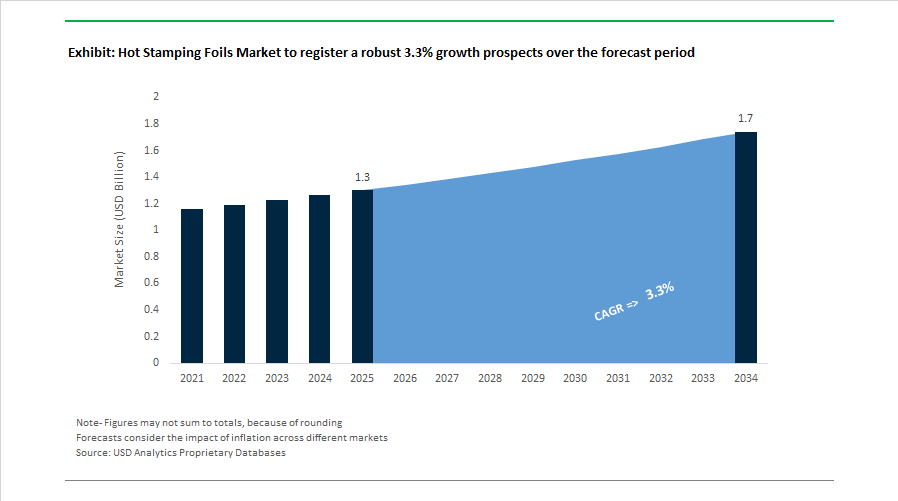
The Hot Stamping Foils Market is projected to grow from $1.3 billion in 2025 to $1.7 billion by 2034, registering a CAGR of 3.3%. Growth is being supported by rising demand for premium packaging, anti-counterfeiting solutions, decorative labeling, and high-end book and automotive interior applications. The industry is transitioning toward recyclable PET carriers, solvent-free metallic pigments, digital foiling integration, and reduced-plastic substrates. Sustainability compliance, supply chain traceability, and hybrid digital-hot stamping technologies are emerging as primary competitive differentiators across cosmetics, spirits, pharmaceuticals, and luxury consumer goods.
Industry consolidation and sustainability investments accelerated in 2024. In May 2024, API Foilmakers, an Aldus Company, finalized the acquisition of United Foils Europe BV, including Starfoil Technology and Newfoil Machines, forming API Transfer Technologies and significantly expanding its UK manufacturing base and European distribution network. During 2024, Starfoil Technology Netherlands completed the full integration of Newfoil Machines Ltd, combining advanced roll-to-roll slitting and winding capabilities with precision hot stamping and embossing machinery engineering. In parallel, ITW ShineMark manufacturing sites in Massachusetts and Connecticut secured EcoVadis Silver sustainability ratings effective for 2024 procurement cycles, positioning the company within the top quartile of global suppliers responding to ESG requirements from multinational brand owners.
Sustainability-driven innovation intensified through late 2024 and 2025. In late 2024, LEONHARD KURZ launched RECOSYS® 2.0, upgrading its PET carrier recycling system, and by 2025 integrated the platform with a solar-powered carport facility in Fürth, Germany to convert used transfer carriers into high-quality rPET pellets for industrial reuse. In February 2025, KURZ partnered with Columbia Sportswear under the "Mission to the Moon" initiative, deploying heat-repellent transfer technologies to support Omni-Shade Sun Deflector components used in the Athena lunar module. In early 2025, API Transfer Technologies introduced the MYTHOS collaboration, promoting compostable foil carriers and solvent-free metallic pigments for sustainable luxury packaging in spirits and cosmetics. In May 2025, CPI Books integrated the KURZ DM-MAXLINER 3D into UK series production, enabling single-pass 3D metallic foiling and UV coating for high-volume book cover decoration. In September 2025, UNIVACCO announced the first verified closed-loop recycling system for stamping foil waste and filed global patents for chemical recovery of polyester carriers contaminated with metallic layers.
Digital authentication, substrate reduction, and product portfolio expansion defined late 2025 into 2026. In September 2025 at FACHPACK, KURZ launched TRUSTSEAL® ID, integrating holographic security elements with digital authentication to address counterfeiting risks in pharmaceutical and premium food packaging. At Labelexpo 2025, KURZ updated its DREAMCOMPOSER® platform with a Free Basic Version that enables real-time 3D prototyping of hot-stamped labels, reducing physical sampling waste. In late 2025, KURZ expanded its SILVER LINE® diffractive and LUMAFIN® translucent foil ranges to 10-micron and 6-micron PET substrates, cutting plastic carrier usage by up to 40% while maintaining deep 3D metallic effects. Effective February 2026, Dr. Christian Hub assumed leadership of the Plastic Decoration Business Area at KURZ, signaling a strategic focus on digitalization of hot stamping for automotive interiors and consumer electronics. The market landscape is increasingly defined by closed-loop recycling technologies, hybrid digital-hot embellishment systems, thinner PET carriers, and advanced anti-counterfeiting foils aligned with global sustainability and circular economy mandates.
Hot Stamping Foils Market Trends and Opportunities Transforming Decorative Packaging Technologies
Premiumization in Luxury Spirits and Cosmetics Accelerating Demand for High-Brilliance Hot Stamping Foils
The hot stamping foils market is benefiting significantly from the global premiumization trend across luxury spirits, cosmetics, and high-end consumer packaging. As brands compete within the experience-driven retail environment, packaging aesthetics have become a critical differentiator. Hot stamping foils provide mirror-like metallic brilliance, tactile embossing compatibility, and superior visual depth, making them a preferred solution for premium packaging design. Luxury brands are increasingly adopting decorative hot foil stamping to create distinctive shelf presence while maintaining premium brand identity.
Industry developments highlight the growing adoption of high-performance decorative foils. In its 2025 environmental update, LVMH confirmed a shift toward thin-film hot stamping foils that maintain the recyclability of paper-based packaging while delivering premium metallic finishes, leading to a 15% increase in hot stamping usage in its spirits division. At the K 2025 trade fair in Düsseldorf, LEONHARD KURZ showcased its “Empowering Iconic Aesthetics” initiative, featuring a bio-based cosmetic jar produced with Weimako and decorated with COLORIT® hot stamping foils, demonstrating compatibility with recyclable second-generation wood substrates. In parallel, the recovery of global travel retail channels is encouraging premium wine and spirits brands to combine multi-level embossing with hot foil stamping, while foil manufacturers increasingly provide on-site technical support to bottling plants to ensure flawless foil transfer on complex packaging surfaces.
Sustainable and Transfer-Efficient Foil Technologies Reshaping the Decorative Packaging Value Chain
Sustainability regulations and circular packaging mandates are driving the transformation of hot stamping foil technologies. Increasing regulatory scrutiny, particularly across Europe, is forcing manufacturers to develop transfer-efficient decorative foils that minimize waste and support recyclability. As a result, hot stamping foils are evolving from purely decorative elements into functional packaging components aligned with circular economy principles.
A major regulatory catalyst is EU Regulation (EU) 2025/40 under the Packaging and Packaging Waste Regulation (PPWR), which requires all packaging placed on the EU market to be fully recyclable by design starting August 12, 2026. This regulation is accelerating the adoption of transfer-only hot stamping foils, where only the ultra-thin decorative layer remains on the substrate while the PET carrier film is recovered separately for recycling. Complementing this shift, LEONHARD KURZ expanded its RECOSYS® PET carrier recycling program in 2025, enabling used PET carrier films from the graphics industry to be converted into high-quality rPET granulate used in automotive interior textiles, establishing a verified closed-loop system. In addition, leading foil manufacturers are strengthening their EcoVadis ESG ratings, with companies such as KURZ ranking within the top 6% of its industry, enabling them to secure sustainability-driven contracts with global brands including Estée Lauder and Unilever that increasingly require de-inkable and recyclable decorative solutions.
Integration of Security and Functional Foils Unlocking High-Margin Opportunities in Smart Packaging
The convergence of decorative foil technology with brand protection and smart packaging solutions is creating a major growth opportunity in the hot stamping foils market. Brands are increasingly seeking packaging materials that combine aesthetics with anti-counterfeiting technologies, traceability features, and digital authentication tools. As a result, manufacturers are developing functional hot stamping foils embedded with digital identifiers, holographic security features, and conductive elements.
A key innovation in this segment is the TRUSTSEAL® ID system introduced at FACHPACK 2025, which integrates digital data carriers such as QR codes and NFC tags directly into holographic hot stamping foils, supporting the upcoming EU Digital Product Passport (DPP) requirements expected by 2027. In the pharmaceutical sector, regulatory mandates such as the Falsified Medicines Directive (FMD) are accelerating the adoption of tamper-evident holographic seals applied through high-speed hot stamping systems capable of exceeding 400 units per minute, increasing demand for zero-pinhole security foils. Additionally, research collaborations in 2025 have produced conductive hot stamping foils capable of integrating RFID antennas within decorative foil layers, reducing the bill of materials for smart labels by approximately 20% compared to conventional RFID inlay systems.
Hybrid Digital Foil Technologies Enabling Short-Run and Personalized Premium Packaging
The rapid growth of short-run packaging production and personalized branding is opening new opportunities for digital hybrid hot stamping technologies. Traditional foil stamping processes rely on fixed tooling and are optimized for high-volume production. However, the rise of limited-edition product launches, seasonal packaging, and direct-to-consumer personalization is encouraging manufacturers to adopt digital metallization systems that combine the speed of hot stamping with the flexibility of digital printing.
Technological innovation is already transforming this segment. In 2025, CPI Books in the United Kingdom integrated the DM-MAXLINER 3D system into commercial production, enabling 3D metallization and UV coating in a single pass for short-run luxury packaging and book covers. Meanwhile, EU PPWR regulations limiting empty parcel space to 40% by August 2026 are pushing brands toward right-sized packaging formats for e-commerce shipments, creating demand for digital hot stamping (sleeking) solutions that deliver premium decorative finishes without costly tooling. Supporting this trend, design platforms such as KURZ DREAMCOMPOSER®, launched in late 2025, allow packaging designers to simulate foil effects in real time, reducing concept-to-shelf development timelines for seasonal and localized packaging editions, particularly in the premium spirits and cosmetics sectors.
Hot Stamping Foils Market Share and Segmentation Insights
PET Carrier Films Lead the Hot Stamping Foils Market Through Superior Dimensional Stability and Heat Resistance
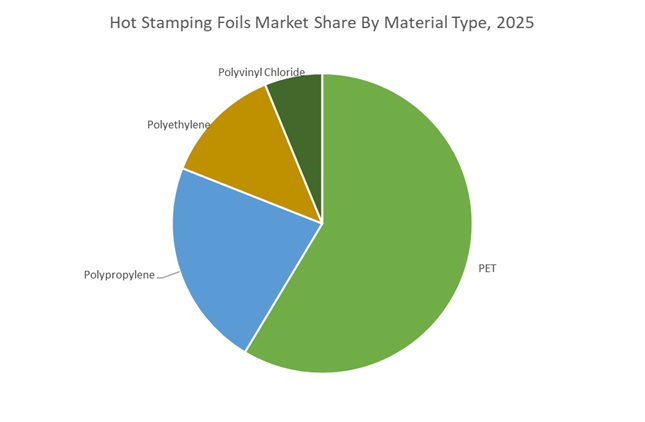
PET accounted for 58.60% of the Hot Stamping Foils Market share in 2025, making it the dominant carrier film material used in foil stamping technologies. Polyethylene terephthalate (PET) is widely used as the base carrier layer for hot stamping foils because it provides excellent dimensional stability, high tensile strength, and strong heat resistance, which are essential for maintaining consistent foil transfer during high-speed stamping processes. These properties ensure precise release of decorative layers onto substrates such as paperboard, plastic packaging, leather, and specialty surfaces, enabling high-quality decorative finishes and branding effects. PET films also offer reliable performance across a wide range of temperature conditions and stamping pressures, supporting efficient operation in industrial printing and packaging environments. In 2025, manufacturers are increasingly adopting ultra-thin PET carrier films ranging from 6–12 microns, compared with traditional films of 12–23 microns thickness. These thinner films reduce material consumption and waste generation while maintaining the mechanical performance required for high-speed production, supporting sustainability initiatives across the hot stamping foil industry.
Packaging Industry Drives the Largest Demand for Hot Stamping Foils
Packaging represented 48.60% of the Hot Stamping Foils Market share in 2025, making it the leading end-use sector for decorative foil stamping technologies. Hot stamping foils are widely used to enhance the visual appeal of premium packaging products including cosmetics, luxury spirits, confectionery, personal care items, and high-end consumer goods. Foil stamping allows manufacturers to create metallic finishes, holographic effects, embossed designs, and premium branding elements, which help products stand out on retail shelves and communicate brand quality. As brand owners increasingly compete on packaging aesthetics, decorative foil technologies play a critical role in elevating packaging design and perceived product value. In 2025, the packaging sector is increasingly influenced by sustainable packaging initiatives and circular economy principles. Foil manufacturers are developing recyclable and compostable foil constructions, including metallized films designed to separate during paper recycling processes and water-based release systems that minimize contamination of recycling streams. These innovations allow brands to maintain premium decorative packaging finishes while supporting recyclability and reduced environmental impact in packaging materials.
Competitive Landscape in Hot Stamping Foils Market
LEONHARD KURZ Stiftung & Co. KG Expands Functional and Sustainable Foil Technologies
LEONHARD KURZ Stiftung & Co. KG remains the global benchmark in thin-film and hot stamping foil technology, integrating decorative finishes with functional electronics and security features. In June 2025, KURZ launched the Rainbow Textile Demonstrator with PolyIC and MENTOR, combining hot stamping foils with embedded lighting and touch-sensitive interfaces for advanced automotive interiors. The company is executing its EcoBalanced initiative in 2026, transitioning toward recycled cardboard cores and lower carbon footprint foil constructions. Expansion of its Gia Lai facility in Vietnam strengthens supply to Asia-Pacific electronics and automotive markets. With more than 5,800 employees across over 50 sites, KURZ operates under standardized environmental and quality systems, reinforcing its leadership in high-performance decorative and security foils.
Univacco Foils Corporation Leads Closed-Loop and Digital Foil Integration
Univacco Foils Corporation has positioned itself as a sustainability-first manufacturer within the hot stamping foil industry. In February 2026, the company announced a strategic investment to lease 30 hectares of land in Dong Nai, Vietnam, creating an integrated manufacturing platform designed to mitigate tariff volatility and expand innovation capacity. Univacco pioneered closed-loop recycling for stamping foils and recently introduced foil systems incorporating recycled paper substrates. The company is advancing compatibility with digital printing presses, enabling short-run and variable-data foiling for serialized luxury packaging and anti-counterfeiting applications. Celebrating its 35th anniversary in 2026, Univacco continues to evolve from a regional vacuum metallizer into a global supplier of eco-friendly decorative transfer films.
API Foilmakers Strengthens Recyclable Luxury Packaging Solutions
API Foilmakers, under the Aldus Group, is focusing on premium metallic and holographic finishes tailored to luxury spirits, cosmetics, and high-end consumer goods. In 2026, the company is aligning its product portfolio with revised European packaging sustainability regulations by prioritizing recyclable and eco-friendly holographic foils. API increased market share in the United Kingdom and Europe following 2025 tariff adjustments by positioning itself as a reliable regional alternative to Asian imports. The Transmet plastic-free laminates line delivers metallic gloss while maintaining full paperboard recyclability within standard waste streams. Its Livingston, Scotland Center of Excellence develops high-speed foil formulations optimized for gravure and flexographic printing systems.
ITW Foils ShineMark Focuses on High-Durability and Digital Precision
ITW Foils, operating under the ShineMark brand within Illinois Tool Works, targets pharmaceutical packaging and e-commerce applications requiring superior abrasion resistance. Its facilities in Massachusetts and Connecticut maintain EcoVadis Silver status, reflecting strong sustainability performance. The company markets low-adhesive primer foils compatible with advanced digital finishing systems, delivering improved resolution and pattern accuracy. In 2026, ShineMark is emphasizing foils engineered to withstand shipping stress in online retail channels without scuffing or loss of metallic brilliance. Backed by a Fortune 200 parent company with more than $14 billion in annual revenue, ITW ShineMark maintains capital stability for continuous research into metal-free and high-precision transfer technologies.
Crown Roll Leaf Advances Holographic Security and Miniaturized Foils
Crown Roll Leaf, Inc. is a specialized provider of holographic and security hot stamping foils, known for rapid customization and short-run production capabilities. The company introduced holographic nano-structure technologies in 2025 and 2026, embedding blockchain-linked identifiers directly into foil layers to combat luxury goods counterfeiting. It is targeting the consumer electronics segment with ultra-thin foils designed for printed circuit boards and compact connectors. Global demand for holographic foil applications continues to accelerate as brand authentication becomes a strategic priority. Crown Roll Leaf recently upgraded its domestic production lines to enhance personalization capabilities for high-value packaging and serialized security applications.
Washin Chemical Industry Develops High-Durability Integrated Foil Systems
Washin Chemical Industry Co., Ltd. combines decades of coating expertise with high-performance transfer foil development under its KOMA FOIL brand. The company is recognized for half-metallization foil types used in electronics and premium Japanese packaging. In 2025 and 2026, Washin expanded its Special Paint coatings portfolio, increasingly integrating liquid coating and foil transfer technologies. Its strategic focus centers on durability, producing foils that offer double the resistance to abrasion, moisture, and scraping compared to standard grades. Leveraging over a century of materials science expertise, Washin designs high-adhesion primers suitable for challenging substrates such as engineered plastics and treated wood, targeting automotive and appliance applications requiring robust decorative finishes.
Germany: Precision Engineering, Energy Transition, and Security-Led Differentiation
Germany continues to set the global benchmark for hot stamping foils through precision machinery integration, low-carbon manufacturing, and advanced brand protection technologies. In March 2025, LEONHARD KURZ installed the NOVAFOIL 106 H hot stamping system at its Fürth application facility as part of a strategic collaboration with BOBST. The installation is engineered to optimize holographic embossing and ultra-precise foil finishing for large-format sheets up to 106 cm, strengthening Germany’s leadership in high-resolution decorative and security foils for premium packaging and graphics.
Energy transition initiatives are reinforcing competitiveness. By late 2025, KURZ integrated a 3 MW electric heater and a 12 MWh thermal energy storage unit at its Sulzbach-Rosenberg site, enabling a power-to-heat solution that covers more than 70% of heat demand for a major production line. This shift is saving approximately 3.5 GWh of natural gas annually and aligns foil manufacturing with Germany’s industrial decarbonization pathway. Circular economy execution is equally tangible. In September 2025, KURZ inaugurated its first solar carport, generating 1.15 million kWh per year to power an adjacent rPET recycling plant, establishing a closed-loop system for polyester foil carriers. On the product side, the launch of TRUSTSEAL ID at FACHPACK 2025 integrated advanced anti-counterfeiting optics directly into decorative foils, addressing rising luxury sector demand for embedded brand protection rather than applied security labels.
United States: Advanced Finishing Integration and Regulatory-Driven Reformulation
The United States hot stamping foils industry is evolving through advanced finishing integration, sustainability benchmarking, and regulatory compliance. In May 2025, CPI Books became the first UK-integrated U.S. partner to deploy the DM-MAXLINER 3D for serial production. This technology enables simultaneous 3D metallization and UV coating in a single pass, materially improving throughput and surface consistency for premium book covers and high-value print applications.
Sustainability performance is becoming a procurement differentiator. ITW ShineMark received the EcoVadis Silver Medal in 2025 for its Massachusetts and Connecticut manufacturing sites, reflecting a transition toward solvent-free adhesives and biodegradable foil substrates. Cross-sector applications are also expanding. In February 2025, heat-repellent transfer products from the U.S. hot stamping ecosystem were utilized in NASA CLPS missions to protect sensitive components of the Athena lunar module against extreme thermal exposure. Regulatory pressure is accelerating formulation change. The U.S. Environmental Protection Agency 2026 VOC guidance has hastened the shift toward water-based hot stamping foils, particularly in automotive interior branding and consumer electronics.
China: Industrial Policy Alignment and Intelligent Packaging Scale-Up
China’s hot stamping foils industry is scaling through policy-backed industrial growth, recycling infrastructure, and intelligent packaging innovation. Under the 2025–2026 Work Plan for Stable Growth, the Ministry of Industry and Information Technology set a 5% annual added-value growth target for non-ferrous and high-end materials, explicitly encompassing high-purity metallization layers used in stamping foils. This directive is driving investment into metallized films, vacuum deposition, and precision coating lines across major manufacturing clusters.
Capacity expansion is increasingly circular. In late 2025, China prioritized recycling bases for waste aluminum and PET, supporting the green transformation of foil manufacturing hubs in Guangdong and Zhejiang. Downstream innovation is most visible in packaging security. Manufacturers such as Henan Foils are embedding QR codes and NFC tags within hot-stamped layers for the domestic Baijiu and cigarette markets, integrating authentication directly into decorative surfaces. At the high end, producers are targeting ultra-thin metallized layers for semiconductor-adjacent protective packaging, with a strategic objective to reach G5-grade purity by late 2026, indicating convergence between decorative foils and electronics-grade material standards.
South Korea: Digitalization, Cosmetics Precision, and Variable Data Leadership
South Korea’s hot stamping foils sector is advancing through Industry 4.0 investment, cosmetic packaging innovation, and digital stamping leadership. In 2025, the government allocated approximately USD 8 billion to Industry 4.0 initiatives, with funding streams supporting AI-driven color matching and automated quality inspection systems in foil production. These capabilities are improving yield consistency and enabling rapid customization for short production runs.
Product innovation is tightly aligned with cosmetics and electronics. Korean manufacturers commercialized “Second Skin” foils in 2025, ultra-thin decorative layers engineered for complex curves on premium cosmetic containers, eliminating seam visibility and improving tactile appeal. The digital segment is expanding rapidly. With an 8.7% growth rate, South Korean firms are leading variable data hot stamping for limited-edition electronic device skins, enabling serialized designs and rapid design refresh cycles without tooling changes.
India: Infrastructure Enablement and Security-Led Standardization
India’s hot stamping foils industry is transitioning toward standardized quality and security-driven applications, supported by logistics infrastructure investment. In 2025, the Ministry of Shipping and Chemicals allocated over INR 4.32 lakh crore to industrial corridors, facilitating port-side chemical hubs that reduce lead times for imported specialty resins and metallization inputs used in foil production. This infrastructure is lowering supply chain friction for domestic converters and printers.
Regulatory clarity is formalizing demand. Effective May 2026, the Bureau of Indian Standards implemented mandatory quality certification for industrial stamping materials, standardizing durability, toxicity thresholds, and performance for pharmaceutical blister packaging. Looking ahead, Indian specialists are collaborating on smart hologram concepts for 2026, embedding invisible security features within hot-stamped layers to address rising counterfeit risks in regional e-commerce, particularly across fast-moving consumer goods and branded pharmaceuticals.
Summary Table: Country-Level Strategic Signals in the Hot Stamping Foils Industry
Hot Stamping Foils Market County Level Snapshot
Country
Strategic Driver
Key Application Focus
Structural Implication
Germany
Precision machinery, energy transition
Luxury packaging, security foils
Low-carbon, high-security leadership
United States
Advanced finishing, VOC compliance
Publishing, automotive interiors
Integrated processes and reformulation
China
Industrial policy, recycling scale
Intelligent packaging, spirits
Policy-led scale and embedded security
South Korea
Industry 4.0, digital stamping
Cosmetics, electronics
Variable data and design agility
India
Infrastructure corridors, BIS mandates
Pharma packaging, e-commerce
Standardization and security adoption
Hot Stamping Foils Market Report Scope
Hot Stamping Foils Market
Parameter
Details
Market Size (2025)
$1.3 Billion
Market Size (2034)
$1.7 Billion
Market Growth Rate
3.3%
Segments
By Material Type (PET, Polypropylene, Polyethylene, Polyvinyl Chloride), By Foil Type (Metallic Foils, Pigment Foils, Holographic Foils, Effects Foils, Scratch-Off Foils), By Application Method (Traditional Hot Stamping, Digital Hot Stamping, Roll-to-Roll Transfer, Sheet-Fed Offset Transfer), By End-Use Industry (Packaging, Security and Authentication, Automotive, Consumer Electronics, Textiles and Leather, Publishing)
Study Period
2019- 2025 and 2026-2034
Units
Revenue (USD)
Qualitative Analysis
Porter’s Five Forces, SWOT Profile, Market Share, Scenario Forecasts, Market Ecosystem, Company Ranking, Market Dynamics, Industry Benchmarking
Companies
Leonhard Kurz Stiftung & Co. KG, ITW ShineMark, CFC International, Univacco Technology Inc., API Group, Nakajima Metal Leaf, Powder Co., Ltd., Crown Roll Leaf, Inc., Henan Foils, Murata Kimpaku Co., Ltd., Katani Co., Ltd., K Laser Technology Inc., Kolon Industries, Inc., Zhejiang Yushi High-Tech Material Co., Ltd., General Roll Leaf Manufacturing Co., Astroll
Countries
US, Canada, Mexico, Germany, France, Spain, Italy, UK, Russia, China, India, Japan, South Korea, Australia, South East Asia, Brazil, Argentina, Middle East, Africa
Hot Stamping Foils Market Segmentation
By Material Type
PET
Polypropylene
Polyethylene
Polyvinyl Chloride
By Foil Type
Metallic Foils
Pigment Foils
Holographic Foils
Effects Foils
Scratch-Off Foils
By Application Method
Traditional Hot Stamping
Digital Hot Stamping
Roll-to-Roll Transfer
Sheet-Fed Offset Transfer
By End-Use Industry
Packaging
Security and Authentication
Automotive
Consumer Electronics
Textiles and Leather
Publishing
By Region
North America (United States, Canada, Mexico)
Europe (Germany, France, United Kingdom, Spain, Italy, Rest of Europe)
Asia Pacific (China, India, Japan, South Korea, Australia, Rest of APAC)
South and Central America (Brazil, Argentina, Rest of SCA)
Middle East and Africa (Saudi Arabia, UAE, South Africa, Rest of Middle East, Rest of Africa)
2. Hot Stamping Foils Market Landscape and Outlook (2026–2034)
2.1 Introduction to the Hot Stamping Foils Market
2.2 Market Size, Valuation, and Growth Forecast (2026–2034)
2.3 Role of Decorative Foil Technologies in Premium Packaging and Brand Differentiation
2.4 Sustainability Transition in Decorative Packaging Materials
2.5 Digitalization and Smart Packaging Integration in Foil Stamping Technologies
3. Innovations Reshaping the Hot Stamping Foils Market
3.1 Trend: Premiumization in Luxury Spirits and Cosmetics Packaging
3.2 Trend: Sustainable and Transfer-Efficient Foil Technologies
3.3 Opportunity: Integration of Security and Functional Foils in Smart Packaging
3.4 Opportunity: Hybrid Digital Foil Technologies for Short-Run and Personalized Packaging
4. Competitive Landscape and Strategic Developments
4.1 Mergers and Acquisitions in Decorative Foil Manufacturing
4.2 Sustainability Strategies and Circular Economy Initiatives
4.3 Technology Innovation in Digital and Hybrid Foiling Systems
4.4 Regional Expansion and Supply Chain Localization
5. Market Share and Segmentation Analysis: Hot Stamping Foils Market
5.1 By Material Type
5.1.1 PET
5.1.2 Polypropylene
5.1.3 Polyethylene
5.1.4 Polyvinyl Chloride
5.2 By Foil Type
5.2.1 Metallic Foils
5.2.2 Pigment Foils
5.2.3 Holographic Foils
5.2.4 Effects Foils
5.2.5 Scratch-Off Foils
5.3 By Application Method
5.3.1 Traditional Hot Stamping
5.3.2 Digital Hot Stamping
5.3.3 Roll-to-Roll Transfer
5.3.4 Sheet-Fed Offset Transfer
5.4 By End-Use Industry
5.4.1 Packaging
5.4.2 Security and Authentication
5.4.3 Automotive
5.4.4 Consumer Electronics
5.4.5 Textiles and Leather
5.4.6 Publishing
5.5 By Region
5.5.1 North America
5.5.2 Europe
5.5.3 Asia Pacific
5.5.4 South and Central America
5.5.5 Middle East and Africa
6. Country-Level Analysis and Outlook for the Hot Stamping Foils Market
6.1 United States
6.2 Canada
6.3 Mexico
6.4 Germany
6.5 France
6.6 Spain
6.7 Italy
6.8 United Kingdom
6.9 Russia
6.10 China
6.11 India
6.12 Japan
6.13 South Korea
6.14 Australia
6.15 Southeast Asia
6.16 Brazil
6.17 Argentina
6.18 Middle East
6.19 Africa
7. Hot Stamping Foils Market Size Outlook by Region (2026–2034)
7.1 North America Hot Stamping Foils Market Size Outlook
7.1.1 By Material Type
7.1.2 By Foil Type
7.1.3 By Application Method
7.1.4 By End-Use Industry
7.1.5 By Country
7.2 Europe Hot Stamping Foils Market Size Outlook
7.2.1 By Material Type
7.2.2 By Foil Type
7.2.3 By Application Method
7.2.4 By End-Use Industry
7.2.5 By Country
7.3 Asia Pacific Hot Stamping Foils Market Size Outlook
7.3.1 By Material Type
7.3.2 By Foil Type
7.3.3 By Application Method
7.3.4 By End-Use Industry
7.3.5 By Country
7.4 South America Hot Stamping Foils Market Size Outlook
7.4.1 By Material Type
7.4.2 By Foil Type
7.4.3 By Application Method
7.4.4 By End-Use Industry
7.4.5 By Country
7.5 Middle East and Africa Hot Stamping Foils Market Size Outlook
7.5.1 By Material Type
7.5.2 By Foil Type
7.5.3 By Application Method
7.5.4 By End-Use Industry
7.5.5 By Country
8. Company Profiles: Leading Players in the Hot Stamping Foils Market
8.1 Leonhard Kurz Stiftung & Co. KG
8.2 ITW ShineMark
8.3 CFC International
8.4 Univacco Technology Inc.
8.5 API Group
8.6 Nakajima Metal Leaf, Powder Co., Ltd.
8.7 Crown Roll Leaf, Inc.
8.8 Henan Foils
8.9 Murata Kimpaku Co., Ltd.
8.10 Katani Co., Ltd.
8.11 K Laser Technology Inc.
8.12 Kolon Industries, Inc.
8.13 Zhejiang Yushi High-Tech Material Co., Ltd.
8.14 General Roll Leaf Manufacturing Co.
8.15 Astroll
9. Research Methodology
9.1 Research Scope
9.2 Data Collection Methodology
9.3 Market Size Estimation and Forecasting Model
9.4 Research Coverage
9.5 Time Horizon
9.6 Deliverables
10. Appendix
10.1 Acronyms and Abbreviations
10.2 List of Tables
10.3 List of Figures
Hot Stamping Foils Market Segmentation
By Material Type
PET
Polypropylene
Polyethylene
Polyvinyl Chloride
By Foil Type
Metallic Foils
Pigment Foils
Holographic Foils
Effects Foils
Scratch-Off Foils
By Application Method
Traditional Hot Stamping
Digital Hot Stamping
Roll-to-Roll Transfer
Sheet-Fed Offset Transfer
By End-Use Industry
Packaging
Security and Authentication
Automotive
Consumer Electronics
Textiles and Leather
Publishing
By Region
North America (United States, Canada, Mexico)
Europe (Germany, France, United Kingdom, Spain, Italy, Rest of Europe)
Asia Pacific (China, India, Japan, South Korea, Australia, Rest of APAC)
South and Central America (Brazil, Argentina, Rest of SCA)
Middle East and Africa (Saudi Arabia, UAE, South Africa, Rest of Middle East, Rest of Africa)
The Hot Stamping Foils Market is expected to grow from $1.3 billion in 2025 to $1.7 billion by 2034, registering a CAGR of 3.3%. Market growth is supported by increasing demand for premium decorative packaging, anti-counterfeiting foil technologies, and sustainability-driven innovations such as recyclable PET carrier films and solvent-free metallic pigments.
The packaging industry accounted for 48.60% of market demand in 2025, making it the largest end-use sector. Luxury cosmetics, premium spirits, pharmaceuticals, and high-end consumer goods are increasingly using metallic and holographic foil stamping to enhance shelf appeal, brand differentiation, and premium product positioning in competitive retail environments.
Sustainability policies such as the EU Packaging and Packaging Waste Regulation (PPWR) are accelerating the development of recyclable foil technologies. Manufacturers are introducing transfer-efficient foils, thinner PET carrier films, solvent-free pigments, and closed-loop recycling systems that allow foil layers to separate during paper recycling while reducing plastic consumption.
Advanced technologies such as digital-hot stamping integration, holographic authentication foils, and smart packaging solutions are transforming the market. Innovations like TRUSTSEAL® ID combine decorative foils with digital identifiers and QR/NFC elements, enabling traceability and anti-counterfeiting features for pharmaceutical, luxury goods, and premium food packaging.
Key companies operating in the Hot Stamping Foils Market include Leonhard Kurz Stiftung & Co. KG, ITW ShineMark, Univacco Technology Inc., API Group, Crown Roll Leaf Inc., CFC International, Nakajima Metal Leaf Powder Co. Ltd., Murata Kimpaku Co. Ltd., Katani Co. Ltd., Henan Foils, K Laser Technology Inc., Kolon Industries Inc., Zhejiang Yushi High-Tech Material Co. Ltd., General Roll Leaf Manufacturing Co., and Astroll. These companies focus on sustainable foil technologies, digital embellishment systems, and advanced anti-counterfeiting solutions for premium packaging.