The global Inorganic Color Pigments Market is poised to register a 5.4% CAGR from $26.4 Billion in 2024 to $36.2 Billion in 2030.
The global Inorganic Color Pigments Market Study analyzes and forecasts the market size across 6 regions and 24 countries for diverse segments -By Product (Iron Oxide, Carbon and Vegetable Black, Ultramarine Blue, Chrome Green, Others), By Application (Plastics, Paints & Coatings, Printing Inks, Others).
An Introduction to Global Inorganic Color Pigments Market in 2024
Inorganic color pigments are mineral-based substances used to impart color, opacity, and UV stability to various industrial products such as paints, coatings, plastics, and ceramics. One key trend shaping the future of inorganic color pigments is the development of high-performance pigment formulations and dispersion technologies to meet the growing demand for vibrant colors, durability, and weatherability in diverse applications while complying with regulatory standards for safety, toxicity, and environmental impact. Pigment manufacturers are innovating new pigment chemistries, such as metal oxides, sulfides, and silicates, with improved color strength, lightfastness, and chemical resistance, ensuring long-lasting color retention and aesthetic appeal in architectural coatings, automotive finishes, and consumer goods. Additionally, advancements in pigment processing techniques, such as micronization, surface treatment, and encapsulation, are enhancing pigment dispersion, stability, and compatibility with various resin systems and application methods, enabling uniform color distribution and superior performance in coatings and plastics formulations. Moreover, the integration of sustainable sourcing practices, such as recycled materials, eco-friendly production processes, and closed-loop recycling systems, is promoting environmental stewardship and circular economy initiatives in the pigment industry, reducing resource consumption, waste generation, and carbon footprint associated with pigment manufacturing and usage. As industries seek to innovate and differentiate their products with superior color aesthetics and performance, the market for inorganic color pigments is poised for innovation and growth, with opportunities for collaboration, research, and market expansion to meet the evolving needs of pigment manufacturers, formulators, and end-users.
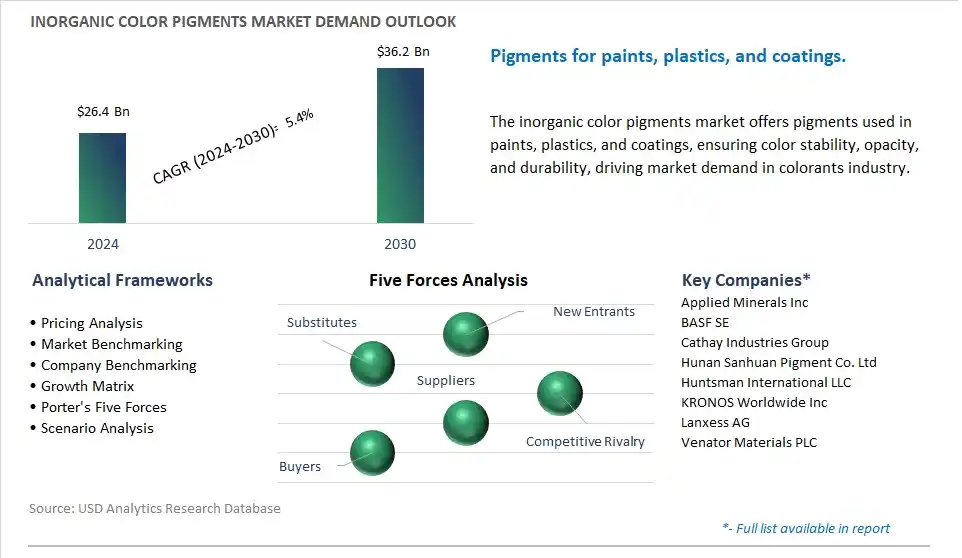
Inorganic Color Pigments Market Competitive Landscape
The market report analyses the leading companies in the industry including Applied Minerals Inc, BASF SE, Cathay Industries Group, Hunan Sanhuan Pigment Co. Ltd, Huntsman International LLC, KRONOS Worldwide Inc, Lanxess AG, Venator Materials PLC.
Inorganic Color Pigments Market Dynamics
Inorganic Color Pigments Market Trend: Shift towards High-Performance and Sustainable Pigment Solutions
A prominent trend in the inorganic color pigments market is the shift towards high-performance and sustainable pigment solutions. Industries such as coatings, plastics, printing inks, and cosmetics are increasingly demanding color pigments that offer vibrant hues, excellent lightfastness, and compatibility with environmentally friendly formulations. Inorganic color pigments, including iron oxides, titanium dioxide, and chromium oxide greens, are favored for their durability, chemical stability, and non-toxic nature. The trend towards sustainability involves the development of eco-friendly pigment manufacturing processes, recycling initiatives, and the use of renewable resources, aligning with the growing consumer preference for sustainable and responsibly sourced products. This is driving the commitment to environmental stewardship and the adoption of pigments that meet stringent performance and sustainability requirements across diverse applications.
Inorganic Color Pigments Market Driver: Growth in Construction and Infrastructure Development
A key driver propelling the inorganic color pigments market is the growth in construction and infrastructure development projects worldwide. Inorganic color pigments are widely used in construction materials such as paints, coatings, concrete, and tiles to impart color, enhance aesthetics, and improve durability. The increasing urbanization, population growth, and investments in infrastructure projects, particularly in emerging economies, are driving the demand for inorganic color pigments as essential additives for construction materials. Additionally, stringent regulations governing architectural coatings and building materials, along with consumer preferences for long-lasting and aesthetically pleasing finishes, are fueling the adoption of high-quality color pigments in the construction industry. This driver underscores the pivotal role of inorganic color pigments in shaping the visual landscape of modern cities and infrastructure projects worldwide.
Inorganic Color Pigments Market Opportunity: Innovation in Specialty Pigments for High-Value Applications
An opportunity for growth in the inorganic color pigments market lies in innovation in specialty pigments for high-value applications. While traditional inorganic pigments cater to mainstream applications such as architectural coatings and plastics, there is a growing demand for specialized pigments tailored to specific industry needs and niche markets. For example, specialty pigments are developed for applications such as automotive coatings, aerospace coatings, electronics packaging, and high-performance plastics, where stringent performance requirements and unique color effects are needed. By leveraging advancements in pigment chemistry, particle engineering, and surface treatment technologies, manufacturers can innovate and develop novel pigment formulations optimized for these high-value applications, thereby capturing new market opportunities and expanding their presence in specialized segments. Additionally, partnerships with end-users, research institutions, and technology providers can facilitate collaborative product development and accelerate the commercialization of specialty pigment solutions, enhancing market competitiveness and growth potential.
Inorganic Color Pigments Market Ecosystem
In the inorganic color pigments market, raw material acquisition involves sourcing minerals including iron ore and titanium dioxide feedstocks from mining companies including Rio Tinto Group and BHP Group Ltd. Additionally, base chemicals including chromium compounds and lead compounds (depending on regulations) are manufactured by chemical companies including Dow Chemical Company and BASF SE, which are used in pigments.
These raw materials undergo processing and beneficiation at mineral processing plants including those operated by Imerys SA to achieve desired particle size and purity levels. Chemical pigment producers including Kronos Worldwide Inc. and Tronox Limited then manufacture a variety of inorganic color pigments through chemical processes including precipitation, oxidation, or salt formation. Distribution of these pigments is facilitated by pigment distributors including LANXESS AG and Brenntag AG, with producers offering direct sales and technical support.
End-users span industries including paints and coatings, plastics, construction materials, textiles, cosmetics, and paper, where inorganic color pigments are crucial for adding color and opacity to various products.
Inorganic Color Pigments Market Share Analysis: Iron Oxide held the dominant revenue share in 2024
The iron oxide segment is the largest sector in the Inorganic Color Pigments Market, driven by diverse pivotal factors contributing to its dominance. Iron oxide pigments, including red, yellow, black, and brown variants, are among the most widely used inorganic color pigments due to their versatility, stability, and vibrant color properties. Iron oxide pigments offer diverse advantages, including excellent lightfastness, weather resistance, chemical stability, and opacity, making them suitable for a wide range of applications across various industries. In addition, iron oxide pigments exhibit good dispersibility, compatibility with various binders and substrates, and ease of incorporation into formulations, allowing for efficient and cost-effective coloration of paints, coatings, plastics, ceramics, and construction materials. Additionally, iron oxide pigments are environmentally friendly and non-toxic, making them suitable for use in products intended for indoor and outdoor applications, such as architectural coatings, automotive paints, plastic masterbatches, and concrete pigments. Further, iron oxide pigments offer a wide range of color shades and hues, enabling manufacturers to achieve desired color effects, shades, and intensities to meet market preferences and customer requirements. In addition, the growing demand for infrastructure development, construction activities, and consumer goods drives the consumption of iron oxide pigments in applications such as architectural coatings, concrete coloring, pavers, roofing tiles, and ceramics, further fueling the growth of the segment. As industries continue to prioritize performance, durability, and aesthetics in their products and materials, the iron oxide segment of the inorganic color pigments market is expected to maintain its leading position and witness sustained growth in the foreseeable future.
Inorganic Color Pigments Market Share Analysis: Plastics is the fastest growing market segment over the forecast period to 2030
The plastics segment is the fastest-growing sector in the Inorganic Color Pigments Market, driven by diverse critical factors propelling its rapid expansion. Inorganic color pigments play a crucial role in the plastics industry, where they are used for coloration and enhancement of plastic materials and products. Plastics manufacturers rely on inorganic color pigments to achieve vibrant, long-lasting colors in a wide range of plastic applications, including packaging, automotive components, consumer goods, construction materials, and electrical appliances. In addition, the increasing demand for aesthetically appealing and visually distinctive plastic products, coupled with the growing trend toward customization and product differentiation, drives the adoption of inorganic color pigments in plastics manufacturing. Additionally, inorganic color pigments offer diverse advantages in plastic applications, including excellent heat stability, lightfastness, weather resistance, chemical inertness, and compatibility with various polymer matrices, additives, and processing techniques. Further, advancements in pigment dispersion technology, masterbatch formulations, and color matching capabilities enhance the efficiency, consistency, and versatility of inorganic color pigments in plastics processing. In addition, the expanding plastics industry, driven by rising demand from sectors such as packaging, automotive, construction, and consumer goods, fuels the growth of the segment. Additionally, stringent regulations and consumer preferences for sustainable, eco-friendly plastics drive the adoption of inorganic color pigments that comply with regulatory requirements and sustainability standards. As plastics manufacturers continue to innovate and invest in coloration solutions to meet market demands for high-performance, visually appealing plastic products, the plastics segment of the inorganic color pigments market is poised for significant growth, presenting lucrative opportunities for pigment manufacturers and suppliers catering to the plastics industry.
Inorganic Color Pigments Market Report Scope-
By Product
Iron Oxide
Carbon and Vegetable Black
Ultramarine Blue
Chrome Green
Others
By Application
Plastics
Paints & Coatings
Printing Inks
Others
Inorganic Color Pigments Market Companies Profiled
Applied Minerals Inc
BASF SE
Cathay Industries Group
Hunan Sanhuan Pigment Co. Ltd
Huntsman International LLC
KRONOS Worldwide Inc
Lanxess AG
Venator Materials PLC
*- List Not Exhaustive
TABLE OF CONTENTS
1 Introduction to 2024 Inorganic Color Pigments Market
1.1 Market Overview
1.2 Quick Facts
1.3 Scope/Objective of the Study
1.4 Market Definition
1.5 Countries and Regions Covered
1.6 Units, Currency, and Conversions
1.7 Industry Value Chain
2 Research Methodology
2.1 Market Size Estimation
2.2 Sources and Research Methodology
2.3 Data Triangulation
2.4 Assumptions and Limitations
3 Executive Summary
3.1 Global Inorganic Color Pigments Market Size Outlook, $ Million, 2021 to 2030
3.2 Inorganic Color Pigments Market Outlook by Type, $ Million, 2021 to 2030
3.3 Inorganic Color Pigments Market Outlook by Product, $ Million, 2021 to 2030
3.4 Inorganic Color Pigments Market Outlook by Application, $ Million, 2021 to 2030
3.5 Inorganic Color Pigments Market Outlook by Key Countries, $ Million, 2021 to 2030
4 Market Dynamics
4.1 Key Driving Forces of Inorganic Color Pigments Industry
4.2 Key Market Trends in Inorganic Color Pigments Industry
4.3 Potential Opportunities in Inorganic Color Pigments Industry
4.4 Key Challenges in Inorganic Color Pigments Industry
5 Market Factor Analysis
5.1 Value Chain Analysis
5.2 Competitive Landscape
5.2.1 Global Inorganic Color Pigments Market Share by Company (%), 2023
5.2.2 Product Offerings by Company
5.3 Porter’s Five Forces Analysis
5.4 Pricing Analysis and Outlook
6 Growth Outlook Across Scenarios
6.1 Growth Analysis-Case Scenario Definitions
6.2 Low Growth Scenario Forecasts
6.3 Reference Growth Scenario Forecasts
6.4 High Growth Scenario Forecasts
7 Global Inorganic Color Pigments Market Outlook by Segments
7.1 Inorganic Color Pigments Market Outlook by Segments, $ Million, 2021- 2030
By Product
Iron Oxide
Carbon and Vegetable Black
Ultramarine Blue
Chrome Green
Others
By Application
Plastics
Paints & Coatings
Printing Inks
Others
8 North America Inorganic Color Pigments Market Analysis and Outlook To 2030
8.1 Introduction to North America Inorganic Color Pigments Markets in 2024
8.2 North America Inorganic Color Pigments Market Size Outlook by Country, 2021-2030
8.2.1 United States
8.2.2 Canada
8.2.3 Mexico
8.3 North America Inorganic Color Pigments Market size Outlook by Segments, 2021-2030
By Product
Iron Oxide
Carbon and Vegetable Black
Ultramarine Blue
Chrome Green
Others
By Application
Plastics
Paints & Coatings
Printing Inks
Others
9 Europe Inorganic Color Pigments Market Analysis and Outlook To 2030
9.1 Introduction to Europe Inorganic Color Pigments Markets in 2024
9.2 Europe Inorganic Color Pigments Market Size Outlook by Country, 2021-2030
9.2.1 Germany
9.2.2 France
9.2.3 Spain
9.2.4 United Kingdom
9.2.4 Italy
9.2.5 Russia
9.2.6 Norway
9.2.7 Rest of Europe
9.3 Europe Inorganic Color Pigments Market Size Outlook by Segments, 2021-2030
By Product
Iron Oxide
Carbon and Vegetable Black
Ultramarine Blue
Chrome Green
Others
By Application
Plastics
Paints & Coatings
Printing Inks
Others
10 Asia Pacific Inorganic Color Pigments Market Analysis and Outlook To 2030
10.1 Introduction to Asia Pacific Inorganic Color Pigments Markets in 2024
10.2 Asia Pacific Inorganic Color Pigments Market Size Outlook by Country, 2021-2030
10.2.1 China
10.2.2 India
10.2.3 Japan
10.2.4 South Korea
10.2.5 Indonesia
10.2.6 Malaysia
10.2.7 Australia
10.2.8 Rest of Asia Pacific
10.3 Asia Pacific Inorganic Color Pigments Market size Outlook by Segments, 2021-2030
By Product
Iron Oxide
Carbon and Vegetable Black
Ultramarine Blue
Chrome Green
Others
By Application
Plastics
Paints & Coatings
Printing Inks
Others
11 South America Inorganic Color Pigments Market Analysis and Outlook To 2030
11.1 Introduction to South America Inorganic Color Pigments Markets in 2024
11.2 South America Inorganic Color Pigments Market Size Outlook by Country, 2021-2030
11.2.1 Brazil
11.2.2 Argentina
11.2.3 Rest of South America
11.3 South America Inorganic Color Pigments Market size Outlook by Segments, 2021-2030
By Product
Iron Oxide
Carbon and Vegetable Black
Ultramarine Blue
Chrome Green
Others
By Application
Plastics
Paints & Coatings
Printing Inks
Others
12 Middle East and Africa Inorganic Color Pigments Market Analysis and Outlook To 2030
12.1 Introduction to Middle East and Africa Inorganic Color Pigments Markets in 2024
12.2 Middle East and Africa Inorganic Color Pigments Market Size Outlook by Country, 2021-2030
12.2.1 Saudi Arabia
12.2.2 UAE
12.2.3 Oman
12.2.4 Rest of Middle East
12.2.5 Egypt
12.2.6 Nigeria
12.2.7 South Africa
12.2.8 Rest of Africa
12.3 Middle East and Africa Inorganic Color Pigments Market size Outlook by Segments, 2021-2030
By Product
Iron Oxide
Carbon and Vegetable Black
Ultramarine Blue
Chrome Green
Others
By Application
Plastics
Paints & Coatings
Printing Inks
Others
13 Company Profiles
13.1 Company Snapshot
13.2 SWOT Profiles
13.3 Products and Services
13.4 Recent Developments
13.5 Financial Profile
Applied Minerals Inc
BASF SE
Cathay Industries Group
Hunan Sanhuan Pigment Co. Ltd
Huntsman International LLC
KRONOS Worldwide Inc
Lanxess AG
Venator Materials PLC
14 Appendix
14.1 Customization Offerings
14.2 Subscription Services
14.3 Related Reports
14.4 Publisher Expertise
By Product
Iron Oxide
Carbon and Vegetable Black
Ultramarine Blue
Chrome Green
Others
By Application
Plastics
Paints & Coatings
Printing Inks
Others
Countries Analyzed
North America (US, Canada, Mexico)
Europe (Germany, UK, France, Spain, Italy, Russia, Rest of Europe)
Asia Pacific (China, India, Japan, South Korea, Australia, South East Asia, Rest of Asia)
South America (Brazil, Argentina, Rest of South America)
Middle East and Africa (Saudi Arabia, UAE, Rest of Middle East, South Africa, Egypt, Rest of Africa)
