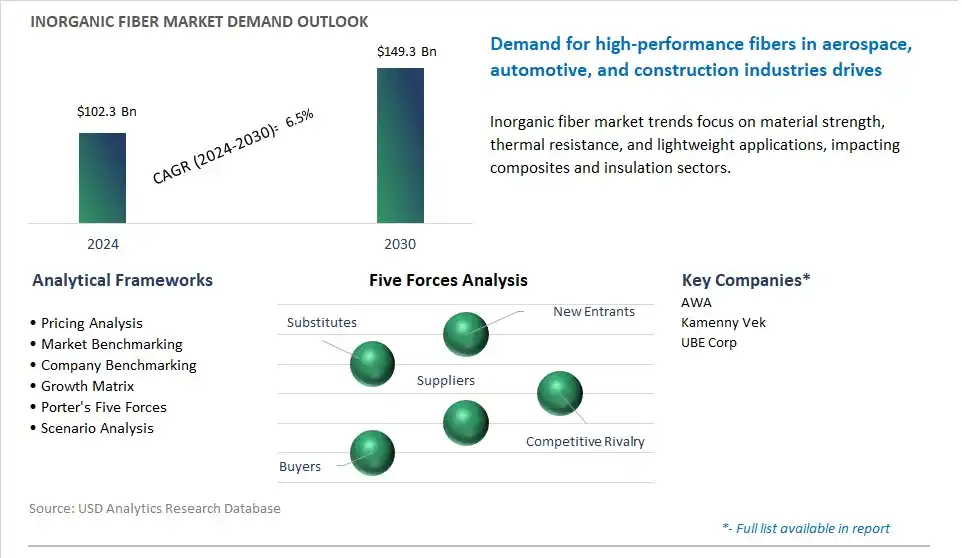
The global Inorganic Fiber Market is poised to register a 6.5% CAGR from $102.3 Billion in 2024 to $149.3 Billion in 2030.
The global Inorganic Fiber Market Study analyzes and forecasts the market size across 6 regions and 24 countries for diverse segments -By Type (Glass, Boron, Ceramics, Metal, Others), By Application (Aerospace, Industrial, Construction, Power).
An Introduction to Global Inorganic Fiber Market in 2024
The market for inorganic fibers is experiencing growth driven by their wide-ranging applications in industries such as construction, automotive, aerospace, and insulation. Key trends shaping the future of the industry include innovations in fiber manufacturing processes, material compositions, and functional properties to meet the demands for lightweighting, thermal insulation, fire resistance, and mechanical strength. Advanced inorganic fibers offer benefits such as high temperature resistance, corrosion resistance, electrical insulation, and durability, making them suitable for use in composite materials, insulation products, reinforcement fabrics, and filtration media. Moreover, the integration of advanced ceramics, glass, and mineral fibers enables the customization of fiber properties to meet specific application requirements and performance criteria. Additionally, the growing emphasis on energy efficiency, sustainability, and safety drives market demand for inorganic fibers that enable manufacturers to improve product performance, reduce environmental impact, and enhance end-user safety. As industries seek solutions for lightweighting, thermal management, and structural reinforcement, the inorganic fiber market is poised for continued growth and innovation as a versatile and valuable material solution across various sectors.
Inorganic Fiber Market Competitive Landscape
The market report analyses the leading companies in the industry including AWA, Kamenny Vek, UBE Corp.
Inorganic Fiber Market Dynamics
Inorganic Fiber Market Trend: Growing Demand for Lightweight and High-Strength Materials
A prominent trend in the inorganic fiber market is the increasing demand for lightweight and high-strength materials across various industries. With the emphasis on fuel efficiency, sustainability, and performance optimization, there is a growing preference for inorganic fibers such as fiberglass, carbon fiber, and aramid fiber in applications where strength-to-weight ratio is critical. Industries such as automotive, aerospace, construction, and sports equipment are driving this trend as they seek materials that offer superior mechanical properties while reducing overall weight. Additionally, advancements in manufacturing technologies are enabling the production of inorganic fibers with enhanced properties, further fueling their adoption in a wide range of applications.
Inorganic Fiber Market Driver: Industrialization and Infrastructure Development
The primary driver behind the growth of the inorganic fiber market is the rapid pace of industrialization and infrastructure development worldwide. As emerging economies continue to urbanize and invest in infrastructure projects such as transportation networks, utilities, and construction, there is a significant demand for durable, corrosion-resistant, and high-performance materials like inorganic fibers. These materials find applications in various infrastructure projects, including bridges, tunnels, pipelines, and industrial facilities, where they offer advantages such as longevity, structural integrity, and resistance to environmental factors. Moreover, the expansion of manufacturing industries and the increasing adoption of advanced composites in industrial applications further contribute to the demand for inorganic fibers.
Inorganic Fiber Market Opportunity: Innovations in Sustainable Fibers and Recycling
An opportunity for market growth within the inorganic fiber sector lies in innovations focused on sustainable fibers and recycling technologies. With growing environmental concerns and regulatory pressures, there is a heightened emphasis on developing eco-friendly alternatives to traditional inorganic fibers that minimize environmental impact throughout their lifecycle. Manufacturers are exploring renewable and recyclable sources for inorganic fibers, as well as investing in processes that enable efficient recycling and reuse of fiber-based materials. Additionally, advancements in bio-based fibers, bio-composites, and circular economy initiatives present opportunities for companies to differentiate themselves in the market by offering sustainable solutions that meet the evolving needs of environmentally conscious consumers and industries. By embracing sustainability and innovation, companies can capitalize on this opportunity to expand their market presence and drive industry-wide change towards more sustainable practices.
Inorganic Fiber Market Share Analysis: Glass segment generated the highest revenue in the industry
The largest segment in the Inorganic Fiber Market is the Glass segment. This dominance is primarily due to diverse factors. The glass fibers are one of the most widely used types of inorganic fibers due to their versatility, strength, and excellent performance characteristics. Glass fibers are extensively used in various industries, including construction, automotive, aerospace, electronics, and healthcare, for applications such as reinforcement, insulation, filtration, and composites manufacturing. Additionally, glass fibers offer exceptional mechanical properties, including high tensile strength, stiffness, and resistance to corrosion, chemicals, and temperature extremes, making them suitable for demanding engineering and structural applications. In addition, glass fibers are cost-effective and readily available, with established manufacturing processes and infrastructure supporting their production on a large scale. Further, advancements in glass fiber technology, such as the development of specialty glass compositions, surface treatments, and fiber sizing, continue to expand the range of applications and performance capabilities of glass fibers, further solidifying their dominance in the Inorganic Fiber Market. Over the forecast period, the combination of versatility, performance, availability, and ongoing innovation positions the Glass segment as the largest and most significant segment in the Inorganic Fiber Market.
Inorganic Fiber Market Share Analysis: Aerospace Segment is poised to register the fastest growth rate (CAGR) over the forecast period to 2030
The fastest-growing segment in the Inorganic Fiber Market is the Aerospace segment. The rapid growth is driven by there is a growing demand for lightweight, high-performance materials in the aerospace industry to improve fuel efficiency, reduce emissions, and enhance aircraft performance. Inorganic fibers, such as glass and carbon fibers, offer exceptional strength-to-weight ratios, stiffness, and thermal stability, making them ideal materials for aerospace applications, including aircraft structures, components, and interiors. Additionally, advancements in composite materials and manufacturing processes have expanded the use of inorganic fibers in aerospace composites, enabling the production of complex, lightweight, and durable aerospace components with superior mechanical properties and performance characteristics. In addition, the increasing adoption of unmanned aerial vehicles (UAVs), drones, and space exploration missions further drives the demand for inorganic fibers in aerospace applications, as these platforms require lightweight and resilient materials to withstand harsh operating conditions and extreme environments. Further, the aerospace industry's focus on sustainability, environmental impact, and regulatory compliance drives the development and adoption of advanced materials, including inorganic fibers, to meet stringent safety and performance standards. Over the forecast period, the combination of technological advancements, market demand, and industry trends positions the Aerospace segment as the fastest-growing segment in the Inorganic Fiber Market.
Inorganic Fiber Market Report Segmentation
By Type
Glass
Boron
Ceramics
Metal
Others
By Application
Aerospace
Industrial
Construction
Power
Regions Included
North America (US, Canada, Mexico)
Europe (Germany, UK, France, Spain, Italy, Russia, Rest of Europe)
Asia Pacific (China, India, Japan, South Korea, Australia, South East Asia, Rest of Asia)
South America (Brazil, Argentina, Rest of South America)
Middle East and Africa (Saudi Arabia, UAE, Rest of Middle East, South Africa, Egypt, Rest of Africa)
Inorganic Fiber Companies Profiled in the Market Study
AWA
Kamenny Vek
UBE Corp
*- List Not Exhaustive
TABLE OF CONTENTS
1 Introduction to 2024 Inorganic Fiber Market
1.1 Market Overview
1.2 Quick Facts
1.3 Scope/Objective of the Study
1.4 Market Definition
1.5 Countries and Regions Covered
1.6 Units, Currency, and Conversions
1.7 Industry Value Chain
2 Research Methodology
2.1 Market Size Estimation
2.2 Sources and Research Methodology
2.3 Data Triangulation
2.4 Assumptions and Limitations
3 Executive Summary
3.1 Global Inorganic Fiber Market Size Outlook, $ Million, 2021 to 2030
3.2 Inorganic Fiber Market Outlook by Type, $ Million, 2021 to 2030
3.3 Inorganic Fiber Market Outlook by Product, $ Million, 2021 to 2030
3.4 Inorganic Fiber Market Outlook by Application, $ Million, 2021 to 2030
3.5 Inorganic Fiber Market Outlook by Key Countries, $ Million, 2021 to 2030
4 Market Dynamics
4.1 Key Driving Forces of Inorganic Fiber Industry
4.2 Key Market Trends in Inorganic Fiber Industry
4.3 Potential Opportunities in Inorganic Fiber Industry
4.4 Key Challenges in Inorganic Fiber Industry
5 Market Factor Analysis
5.1 Value Chain Analysis
5.2 Competitive Landscape
5.2.1 Global Inorganic Fiber Market Share by Company (%), 2023
5.2.2 Product Offerings by Company
5.3 Porter’s Five Forces Analysis
5.4 Pricing Analysis and Outlook
6 Growth Outlook Across Scenarios
6.1 Growth Analysis-Case Scenario Definitions
6.2 Low Growth Scenario Forecasts
6.3 Reference Growth Scenario Forecasts
6.4 High Growth Scenario Forecasts
7 Global Inorganic Fiber Market Outlook by Segments
7.1 Inorganic Fiber Market Outlook by Segments, $ Million, 2021- 2030
By Type
Glass
Boron
Ceramics
Metal
Others
By Application
Aerospace
Industrial
Construction
Power
8 North America Inorganic Fiber Market Analysis and Outlook To 2030
8.1 Introduction to North America Inorganic Fiber Markets in 2024
8.2 North America Inorganic Fiber Market Size Outlook by Country, 2021-2030
8.2.1 United States
8.2.2 Canada
8.2.3 Mexico
8.3 North America Inorganic Fiber Market size Outlook by Segments, 2021-2030
By Type
Glass
Boron
Ceramics
Metal
Others
By Application
Aerospace
Industrial
Construction
Power
9 Europe Inorganic Fiber Market Analysis and Outlook To 2030
9.1 Introduction to Europe Inorganic Fiber Markets in 2024
9.2 Europe Inorganic Fiber Market Size Outlook by Country, 2021-2030
9.2.1 Germany
9.2.2 France
9.2.3 Spain
9.2.4 United Kingdom
9.2.4 Italy
9.2.5 Russia
9.2.6 Norway
9.2.7 Rest of Europe
9.3 Europe Inorganic Fiber Market Size Outlook by Segments, 2021-2030
By Type
Glass
Boron
Ceramics
Metal
Others
By Application
Aerospace
Industrial
Construction
Power
10 Asia Pacific Inorganic Fiber Market Analysis and Outlook To 2030
10.1 Introduction to Asia Pacific Inorganic Fiber Markets in 2024
10.2 Asia Pacific Inorganic Fiber Market Size Outlook by Country, 2021-2030
10.2.1 China
10.2.2 India
10.2.3 Japan
10.2.4 South Korea
10.2.5 Indonesia
10.2.6 Malaysia
10.2.7 Australia
10.2.8 Rest of Asia Pacific
10.3 Asia Pacific Inorganic Fiber Market size Outlook by Segments, 2021-2030
By Type
Glass
Boron
Ceramics
Metal
Others
By Application
Aerospace
Industrial
Construction
Power
11 South America Inorganic Fiber Market Analysis and Outlook To 2030
11.1 Introduction to South America Inorganic Fiber Markets in 2024
11.2 South America Inorganic Fiber Market Size Outlook by Country, 2021-2030
11.2.1 Brazil
11.2.2 Argentina
11.2.3 Rest of South America
11.3 South America Inorganic Fiber Market size Outlook by Segments, 2021-2030
By Type
Glass
Boron
Ceramics
Metal
Others
By Application
Aerospace
Industrial
Construction
Power
12 Middle East and Africa Inorganic Fiber Market Analysis and Outlook To 2030
12.1 Introduction to Middle East and Africa Inorganic Fiber Markets in 2024
12.2 Middle East and Africa Inorganic Fiber Market Size Outlook by Country, 2021-2030
12.2.1 Saudi Arabia
12.2.2 UAE
12.2.3 Oman
12.2.4 Rest of Middle East
12.2.5 Egypt
12.2.6 Nigeria
12.2.7 South Africa
12.2.8 Rest of Africa
12.3 Middle East and Africa Inorganic Fiber Market size Outlook by Segments, 2021-2030
By Type
Glass
Boron
Ceramics
Metal
Others
By Application
Aerospace
Industrial
Construction
Power
13 Company Profiles
13.1 Company Snapshot
13.2 SWOT Profiles
13.3 Products and Services
13.4 Recent Developments
13.5 Financial Profile
AWA
Kamenny Vek
UBE Corp
14 Appendix
14.1 Customization Offerings
14.2 Subscription Services
14.3 Related Reports
14.4 Publisher Expertise
By Type
Glass
Boron
Ceramics
Metal
Others
By Application
Aerospace
Industrial
Construction
Power
Countries Analyzed
North America (US, Canada, Mexico)
Europe (Germany, UK, France, Spain, Italy, Russia, Rest of Europe)
Asia Pacific (China, India, Japan, South Korea, Australia, South East Asia, Rest of Asia)
South America (Brazil, Argentina, Rest of South America)
Middle East and Africa (Saudi Arabia, UAE, Rest of Middle East, South Africa, Egypt, Rest of Africa)
