The global Isobutene Market is poised to register a 4.9% CAGR from $29.2 Billion in 2024 to $38.9 Billion in 2030.
The global Isobutene Market Study analyzes and forecasts the market size across 6 regions and 24 countries for diverse segments -By Product (Methyl Tert-Butyl Ether (MTBE), Ethyl Tert-Butyl Ether (ETBE)), By Application (Automotive, Aerospace, Antioxidants, Pharmaceuticals, Others).
An Introduction to Global Isobutene Market in 2024
Isobutene, also known as isobutylene, is a key building block chemical used in the production of various polymers, elastomers, and specialty chemicals in industries such as plastics, rubber, and petrochemicals. One key trend shaping the future of isobutene is the development of sustainable production methods and diversified applications to meet the growing demand for bio-based and eco-friendly alternatives to conventional petrochemical feedstocks. Isobutene producers are exploring innovative pathways, such as bio-based fermentation, catalytic conversion of renewable feedstocks, and carbon capture utilization (CCU) technologies, to produce isobutene from biomass-derived sugars, industrial off-gases, and carbon dioxide emissions, reducing reliance on fossil resources and mitigating environmental impact. Additionally, advancements in catalytic processes, separation techniques, and purification methods are improving process efficiency, selectivity, and purity of bio-based isobutene, enabling its integration into existing petrochemical value chains and downstream applications without compromising performance or product quality. Moreover, the development of new bio-based polymers, elastomers, and specialty chemicals derived from isobutene is expanding the market opportunities for sustainable materials in packaging, automotive, construction, and consumer goods sectors, promoting circular economy principles and reducing dependency on finite fossil resources. As industries transition towards a more sustainable and circular economy, driven by regulatory mandates, consumer preferences, and corporate sustainability goals, the market for bio-based isobutene is poised for innovation and growth, with opportunities for collaboration, research, and market expansion to meet the evolving needs of chemical producers, material suppliers, and end-users seeking sustainable solutions for their products and processes.
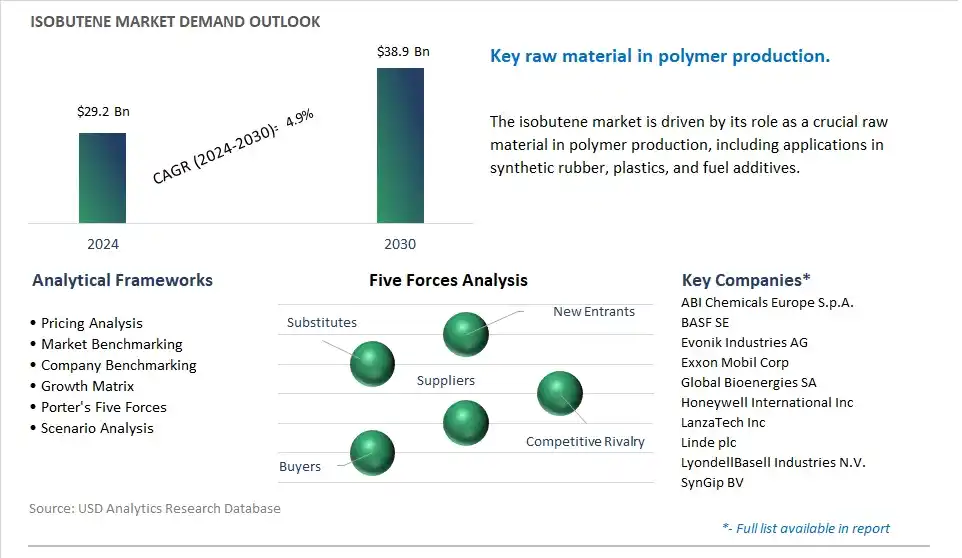
Isobutene Market Competitive Landscape
The market report analyses the leading companies in the industry including ABI Chemicals Europe S.p.A., BASF SE, Evonik Industries AG, Exxon Mobil Corp, Global Bioenergies SA, Honeywell International Inc, LanzaTech Inc, Linde plc, LyondellBasell Industries N.V., SynGip BV.
Isobutene Market Dynamics
Isobutene Market Trend: Increasing Demand for Polyolefins and Synthetic Rubber
A prominent trend in the isobutene market is the increasing demand for polyolefins and synthetic rubber. Isobutene, also known as isobutylene, is a key building block chemical used in the production of polybutylene (PB), polyisobutylene (PIB), and butyl rubber, which find extensive applications in industries such as automotive, construction, packaging, and healthcare. The trend towards lightweight materials, enhanced performance, and sustainability drives the demand for polyolefins and synthetic rubber, fueling the growth of the isobutene market globally.
Isobutene Market Driver: Growth in End-User Industries and Applications
A key driver propelling the isobutene market is the growth in end-user industries and applications. Isobutene serves as a crucial intermediate in the production of various downstream products such as lubricants, antioxidants, adhesives, and fuel additives, which are used across diverse industries. The expansion of industries such as automotive, construction, cosmetics, and pharmaceuticals, coupled with advancements in technology and innovation, drives the demand for isobutene as a versatile chemical feedstock, supporting the growth of the market.
Isobutene Market Opportunity: Development of Bio-Based Isobutene
An opportunity for growth in the isobutene market lies in the development of bio-based isobutene. With increasing emphasis on sustainability and renewable resources, there is growing interest in bio-based alternatives to traditional petrochemicals. Bio-based isobutene can be produced from renewable feedstocks such as biomass, agricultural residues, and waste materials through fermentation or enzymatic processes. By leveraging biotechnology, green chemistry, and process optimization, companies can develop bio-based isobutene that offers similar performance and functionality to its petroleum-derived counterpart. The development of bio-based isobutene presents an opportunity to reduce reliance on fossil fuels, lower carbon emissions, and meet the sustainability goals of end-user industries, creating new market opportunities and driving the growth of the isobutene market.
Isobutene Market Ecosystem
The Isobutene market encompasses diverse pivotal stages, with production as the initial step. Oil and gas companies including Exxon Mobil and Royal Dutch Shell, along with refineries including Marathon Petroleum and Valero Energy, play a significant role in extracting crude oil and utilizing cracking processes to produce isobutene as a by-product. Additionally, chemical companies including BASF and LyondellBasell employ dehydrogenation processes to convert isobutane into isobutene.
Following production, chemical processing companies including Dow Chemical and LyondellBasell facilitate purification and separation to obtain high-purity isobutene. Distribution channels are managed by chemical distributors including Brenntag AG and Ashland Global Holdings, ensuring isobutene reaches industrial users efficiently. In terms of end users, the chemical industry remains the dominant application, utilizing isobutene as a key feedstock for various products including polybutylene rubber, MTBE, BHT, and isooctane. The fuels industry also presents a potential future application, considering isobutene as a feedstock for high-performance biofuels.
Isobutene Market Share Analysis: Methyl Tert-Butyl Ether (MTBE) held the dominant revenue share in 2024
The Methyl Tert-Butyl Ether (MTBE) segment is the largest in the Isobutene Market due to diverse key reasons. Firstly, MTBE is primarily used as an octane booster in gasoline, where it enhances fuel performance by improving combustion efficiency and reducing engine knock. This application accounts for the majority of isobutene consumption globally, particularly in regions where gasoline blending regulations mandate the use of oxygenates such as MTBE to meet environmental standards. Additionally, MTBE is a cost-effective and efficient additive for gasoline production, offering benefits such as increased fuel octane rating, reduced emissions, and improved engine performance. In addition, the widespread adoption of MTBE in gasoline blending operations and the established infrastructure for its production and distribution further reinforce its dominance in the Isobutene Market. Further, despite environmental concerns related to groundwater contamination and air pollution associated with MTBE, its continued use in gasoline blending persists in many regions due to its cost-effectiveness and regulatory requirements. With its essential role in gasoline production and blending, MTBE remains the largest segment in the Isobutene Market, driving the overall demand for isobutene globally.
Isobutene Market Share Analysis: Antioxidants is the fastest growing market segment over the forecast period to 2030
The Antioxidants segment is the fastest-growing in the Isobutene Market due to diverse compelling reasons. Firstly, isobutene is widely used as a feedstock in the production of antioxidants, which play a crucial role in various industries such as plastics, rubber, food, and cosmetics. Antioxidants help prevent the degradation of materials caused by oxidative reactions, thereby extending the shelf life of products and enhancing their durability and performance. Additionally, the growing awareness of the detrimental effects of oxidation on materials, such as polymer degradation, food spoilage, and cosmetic instability, drives the demand for effective antioxidant solutions. In addition, advancements in polymer technology and the increasing use of synthetic materials in various applications further fuel the demand for antioxidants to protect against degradation and extend the lifespan of products. Further, the expanding scope of applications for antioxidants in industries such as packaging, automotive, and healthcare drives the growth of the Antioxidants segment in the Isobutene Market. With its essential role in preserving the quality and integrity of materials, the Antioxidants segment is poised to experience rapid growth, meeting the evolving needs of industries worldwide.
Isobutene Market Report Scope-
By Product
Methyl Tert-Butyl Ether (MTBE)
Ethyl Tert-Butyl Ether (ETBE)
By Application
Automotive
Aerospace
Antioxidants
Pharmaceuticals
Others
Isobutene Market Companies Profiled
ABI Chemicals Europe S.p.A.
BASF SE
Evonik Industries AG
Exxon Mobil Corp
Global Bioenergies SA
Honeywell International Inc
LanzaTech Inc
Linde plc
LyondellBasell Industries N.V.
SynGip BV
*- List Not Exhaustive
TABLE OF CONTENTS
1 Introduction to 2024 Isobutene Market
1.1 Market Overview
1.2 Quick Facts
1.3 Scope/Objective of the Study
1.4 Market Definition
1.5 Countries and Regions Covered
1.6 Units, Currency, and Conversions
1.7 Industry Value Chain
2 Research Methodology
2.1 Market Size Estimation
2.2 Sources and Research Methodology
2.3 Data Triangulation
2.4 Assumptions and Limitations
3 Executive Summary
3.1 Global Isobutene Market Size Outlook, $ Million, 2021 to 2030
3.2 Isobutene Market Outlook by Type, $ Million, 2021 to 2030
3.3 Isobutene Market Outlook by Product, $ Million, 2021 to 2030
3.4 Isobutene Market Outlook by Application, $ Million, 2021 to 2030
3.5 Isobutene Market Outlook by Key Countries, $ Million, 2021 to 2030
4 Market Dynamics
4.1 Key Driving Forces of Isobutene Industry
4.2 Key Market Trends in Isobutene Industry
4.3 Potential Opportunities in Isobutene Industry
4.4 Key Challenges in Isobutene Industry
5 Market Factor Analysis
5.1 Value Chain Analysis
5.2 Competitive Landscape
5.2.1 Global Isobutene Market Share by Company (%), 2023
5.2.2 Product Offerings by Company
5.3 Porter’s Five Forces Analysis
5.4 Pricing Analysis and Outlook
6 Growth Outlook Across Scenarios
6.1 Growth Analysis-Case Scenario Definitions
6.2 Low Growth Scenario Forecasts
6.3 Reference Growth Scenario Forecasts
6.4 High Growth Scenario Forecasts
7 Global Isobutene Market Outlook by Segments
7.1 Isobutene Market Outlook by Segments, $ Million, 2021- 2030
By Product
Methyl Tert-Butyl Ether (MTBE)
Ethyl Tert-Butyl Ether (ETBE)
By Application
Automotive
Aerospace
Antioxidants
Pharmaceuticals
Others
8 North America Isobutene Market Analysis and Outlook To 2030
8.1 Introduction to North America Isobutene Markets in 2024
8.2 North America Isobutene Market Size Outlook by Country, 2021-2030
8.2.1 United States
8.2.2 Canada
8.2.3 Mexico
8.3 North America Isobutene Market size Outlook by Segments, 2021-2030
By Product
Methyl Tert-Butyl Ether (MTBE)
Ethyl Tert-Butyl Ether (ETBE)
By Application
Automotive
Aerospace
Antioxidants
Pharmaceuticals
Others
9 Europe Isobutene Market Analysis and Outlook To 2030
9.1 Introduction to Europe Isobutene Markets in 2024
9.2 Europe Isobutene Market Size Outlook by Country, 2021-2030
9.2.1 Germany
9.2.2 France
9.2.3 Spain
9.2.4 United Kingdom
9.2.4 Italy
9.2.5 Russia
9.2.6 Norway
9.2.7 Rest of Europe
9.3 Europe Isobutene Market Size Outlook by Segments, 2021-2030
By Product
Methyl Tert-Butyl Ether (MTBE)
Ethyl Tert-Butyl Ether (ETBE)
By Application
Automotive
Aerospace
Antioxidants
Pharmaceuticals
Others
10 Asia Pacific Isobutene Market Analysis and Outlook To 2030
10.1 Introduction to Asia Pacific Isobutene Markets in 2024
10.2 Asia Pacific Isobutene Market Size Outlook by Country, 2021-2030
10.2.1 China
10.2.2 India
10.2.3 Japan
10.2.4 South Korea
10.2.5 Indonesia
10.2.6 Malaysia
10.2.7 Australia
10.2.8 Rest of Asia Pacific
10.3 Asia Pacific Isobutene Market size Outlook by Segments, 2021-2030
By Product
Methyl Tert-Butyl Ether (MTBE)
Ethyl Tert-Butyl Ether (ETBE)
By Application
Automotive
Aerospace
Antioxidants
Pharmaceuticals
Others
11 South America Isobutene Market Analysis and Outlook To 2030
11.1 Introduction to South America Isobutene Markets in 2024
11.2 South America Isobutene Market Size Outlook by Country, 2021-2030
11.2.1 Brazil
11.2.2 Argentina
11.2.3 Rest of South America
11.3 South America Isobutene Market size Outlook by Segments, 2021-2030
By Product
Methyl Tert-Butyl Ether (MTBE)
Ethyl Tert-Butyl Ether (ETBE)
By Application
Automotive
Aerospace
Antioxidants
Pharmaceuticals
Others
12 Middle East and Africa Isobutene Market Analysis and Outlook To 2030
12.1 Introduction to Middle East and Africa Isobutene Markets in 2024
12.2 Middle East and Africa Isobutene Market Size Outlook by Country, 2021-2030
12.2.1 Saudi Arabia
12.2.2 UAE
12.2.3 Oman
12.2.4 Rest of Middle East
12.2.5 Egypt
12.2.6 Nigeria
12.2.7 South Africa
12.2.8 Rest of Africa
12.3 Middle East and Africa Isobutene Market size Outlook by Segments, 2021-2030
By Product
Methyl Tert-Butyl Ether (MTBE)
Ethyl Tert-Butyl Ether (ETBE)
By Application
Automotive
Aerospace
Antioxidants
Pharmaceuticals
Others
13 Company Profiles
13.1 Company Snapshot
13.2 SWOT Profiles
13.3 Products and Services
13.4 Recent Developments
13.5 Financial Profile
ABI Chemicals Europe S.p.A.
BASF SE
Evonik Industries AG
Exxon Mobil Corp
Global Bioenergies SA
Honeywell International Inc
LanzaTech Inc
Linde plc
LyondellBasell Industries N.V.
SynGip BV
14 Appendix
14.1 Customization Offerings
14.2 Subscription Services
14.3 Related Reports
14.4 Publisher Expertise
By Product
Methyl Tert-Butyl Ether (MTBE)
Ethyl Tert-Butyl Ether (ETBE)
By Application
Automotive
Aerospace
Antioxidants
Pharmaceuticals
Others
Countries Analyzed
North America (US, Canada, Mexico)
Europe (Germany, UK, France, Spain, Italy, Russia, Rest of Europe)
Asia Pacific (China, India, Japan, South Korea, Australia, South East Asia, Rest of Asia)
South America (Brazil, Argentina, Rest of South America)
Middle East and Africa (Saudi Arabia, UAE, Rest of Middle East, South Africa, Egypt, Rest of Africa)
