Living Room Cleaning Services Market Overview– Growth Outlook and Strategic Insights
The global living room cleaning services market is projected to increase from USD 19.8 billion in 2025 to USD 34.6 billion by 2034, at a CAGR of 6.4%. It is being driven by increasing hygiene awareness, urbanization, and increasing adoption of professional, on-demand home cleaning services. The sector is witnessing a major transformation toward green cleaning products, AI-driven cleaning machines, and online platforms for booking. The demand is particularly high from dual-income families, urban residents, and families with young children or pets.
Key Insights for Industry Professionals
- Deep Cleaning Dominance – Over 41% of service bookings are for deep cleaning, with recurring schedules becoming common.
- Eco-Conscious Consumer Base – 57%+ of customers prefer companies using non-toxic, eco-friendly cleaning agents.
- Tech-Enabled Efficiency – AI-driven cleaning robots and HEPA-filter vacuums are enhancing quality and speed.
- Digital Booking Shift – 52% of customers use mobile apps or online platforms for scheduling, communication, and payments.
- Lifestyle-Driven Demand – The rise in dual-income households is fueling outsourcing of home cleaning tasks.
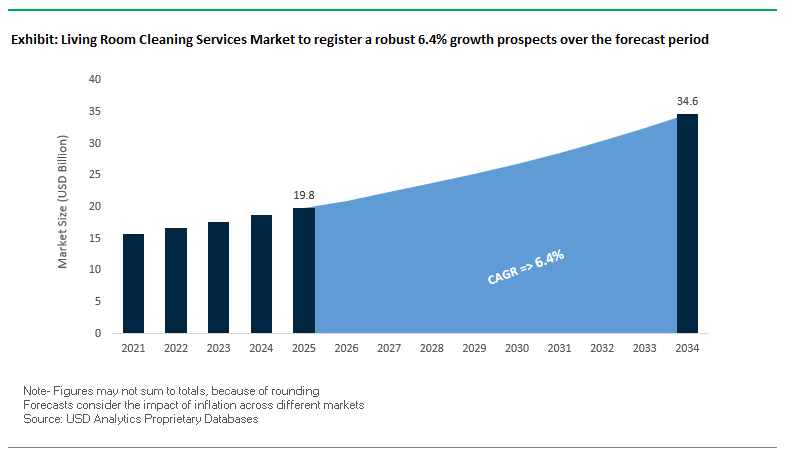
Living Room Cleaning Services Market Analysis – Technological Integration and Sustainability Shaping Industry Dynamics
The residential cleaning services market is evolving with sustainability, automation, and consumer convenience in focus. Principle Cleaning Services partnered with Skyline Robotics in October 2023 to introduce AI-enabled window-cleaning robots in London, which is the future of the industry in terms of AI-driven efficiency solutions. Similarly, the introduction of the YEEDI M14 PLUS in January 2025 with "Temperature-Controlled Mop Washing 2.0" also shows a direction towards more intelligent, hygiene-focused home cleaning devices.
Partnerships and software integration are also becoming key competitive levers. In July 2023, The ServiceMaster Company aligned with Aspire Software to advance cutting-edge business management technology, driving operational excellence across its commercial cleaning franchises. Green branding is also a strategic necessity, with April 2025 naming of Zurn Elkay Water Solutions as one of America's Climate Leaders that demonstrates how sustainability credentials can be leveraged to create market strength.
Cross-industry trends also drive the industry. United Global's Perth Glory sponsorship in September 2023 is merely one of the ways sporting alliances are being used by cleaning companies for brand growth. OCS Group International's September 2022 release of AI-powered OSCA floor scrubber, meanwhile, illustrates how robotics technology innovation for commercial cleaning can be adapted for home cleaning. There is going to be more tech and service model innovation with urbanization, pet ownership, and more sanitation issues driving demand.
Trends and Opportunities in the Global Living Room Cleaning Services Industry
Robotic Upholstery and Carpet Deep-Cleaning Systems Transforming Service Efficiency
Deployment of AI-powered robotic cleaning systems is revolutionizing the international living room cleaning services market by replacing hand-labor-intensive, repetitive cleaning with precision automation. In contrast to conventional robotic vacuum cleaners, these advanced systems are designed to focus on deep-cleaning high-value living room furniture such as upholstery, drapery, and thick-pile carpets. Equipped with high-resolution sensors, actuators, and smart mapping technologies such as SLAM (Simultaneous Localization and Mapping), these devices offer comprehensive cleaning coverage without collision or spot omission. Their capability to locate and target embedded grime guarantees uniform, high-quality results, critical for high-end service providers. Achieved labor efficiency allows cleaning companies to deploy human labor for more challenging tasks, reducing operation cost while increasing throughput. With hospitality, luxury apartments, and high-net-worth homes demanding more sophisticated cleaning solutions, these robotic systems are becoming a strategic differentiator in high-end residential maintenance contracts.
Nano-Photocatalytic Surface and Air Purification for Continuous Hygiene
Nano-photocatalytic coatings are bringing the possibility of long-term, self-cleaning living room space to reality. Light-activated, the coatings employ titanium dioxide (TiO₂) nanoparticles to create photocatalytic oxidation that breaks down airborne VOCs, odors, and disease-causing microorganisms. Applied to living room surfaces such as coffee tables, entertainment centers, and walls, they break down organic stains and matter, reducing chemical-based cleaning. Superhydrophobic surface technology, emulating lotus leaves, is also enhancing resistance to dirt and spills, facilitating maintenance between service calls. For cleaning professionals, the technology enables the delivery of preventative cleaning programs that space out service calls while still satisfying hygiene needs. With growing consumer demand for earth-friendly, chemical-free cleaning and indoor air quality concerns in the post-pandemic era, nano-photocatalytic solutions establish providers as leaders in sustainable and health-focused residential care.
Luxury Real Estate “White-Glove” Cleaning and Maintenance Contracts
The international luxury real estate boom is making a profitable niche for white-glove living room cleaning services bundled into high-end maintenance agreements. High-net-worth homeowners demand impeccable presentation, customized cleaning regimens, and use of eco-luxury cleaning products that preserve fine furnishings and artwork. Services can extend beyond cleaning, including fabric protection treatments, special handling for antiques, and ongoing preventive maintenance for high-value interiors. Real estate management firms are increasingly subcontracting to specialty cleaning firms that have the ability to deliver concierge-level, customized services as part of full-service maintenance packages. Beyond appearance, such services deliver asset value protection by preventing long-term wear and tear. In competitive real estate markets especially in global luxury centers like New York, London, Dubai, and Singapore including specialized living room care in maintenance packages can be a significant service differentiator for winning and retaining high-net-worth clients.
Specialized Post-Renovation Heavy Metal and Dust Decontamination
Remodeling in older homes puts toxic particles, including lead dust, asbestos fibers, and heavy metal residues, into living areas. Regular cleaning will not eliminate these health risks, and the door is open to certified post-renovation decontamination services. These services employ HEPA-filter vacuums, negative pressure equipment, and chemical neutralization agents to eliminate pollutants from living room surfaces, upholstery, and air systems in an efficient and safe manner. Operators using EPA-approved lead-safe practices can target safety-conscious homeowners as well as renovation professionals who wish to comply with regulations. The service is more than routine cleaning and involves extensive environmental testing, multi-stage remediation, and clearance certification. As urban renewal fuels more renovation in heritage buildings, the need for specialty hazardous material cleaning will increase, making this a profitable, expertise-based market niche.
Market Share Insights of the Global Living Room Cleaning Services Market
Market Share by Service Type: Regular Cleaning Dominates but Specialized Services Accelerate
Daily cleaning is 50% of the market, fueled by hectic urban lifestyles and the necessity of frequent maintenance of high-traffic residential areas. These customers are lured by regular, repeat cleaning with guaranteed outcomes. Deep cleaning services are 25% of the market, with seasonal fluctuations over holidays, moving seasons, and special life occasions. Move-in/move-out cleaning is riding the wave of increased urban mobility, especially in high-rent cities. Specialized upholstery cleaning, carpet shampooing, green chemical application, and allergen extraction is a rapidly growing niche, supported by increasing health consciousness and premiumization of home care services. Service providers entering the specialist segments can command higher margins and customer loyalty as customers seek tailored solutions.
.png)
Market Share by Frequency: Weekly and Bi-Weekly Subscriptions Drive Recurring Revenue
Weekly is the most frequent band with a 40% market share, followed by bi-weekly at 30%, indicating strong demand for recurring, subscription-type services. The regular schedules give providers stable cash flow and operational predictability. One-time services peak in rental turnovers and seasonal deep-cleaning spikes, and frequency-specific plans designed to suit customers are becoming popular among high-income households with smart home systems for automated scheduling. Monthly services are a small niche but appeal to customers requiring light maintenance between deep cleans. With digital booking platforms and service apps becoming popular, dynamic scheduling and on-demand availability are poised to further change frequency preferences, putting agile providers at the forefront of customer retention.
Competitive Landscape – Leading Brands Driving Quality, Innovation in Living Room Cleaning Services Industry
The global living room cleaning services market features established franchise networks, fast-growing tech-based platforms, and eco-focused brands competing on service quality, convenience, and environmental responsibility. Key players included are Merry Maids, The Cleaning Authority, Molly Maid, ServiceMaster Clean, Maid Brigade, Handy, Helpling, Urban Company, Housekeeper, Cleanwhale, H-Care, Fantastic Services, TidyMe, MOOVICK, Others.
The ServiceMaster Company, LLC – Franchise Powerhouse with Technology Integration
ServiceMaster boasts a large franchise base under brands like Merry Maids, offering professional deep cleaning and maintenance services on a regular basis. Along with its partnership with Aspire Software in July 2023, its commercial cleaning franchises were able to automate payment, scheduling, and performance tracking. With a past of reliability and national presence, ServiceMaster's strategic focus is to grow market reach and leverage technology to enhance customer satisfaction.
Urban Company – The Home Services Tech Leader
Urban Company is a leading digital platform in India and overseas markets, bringing consumers in touch with vetted professionals for living room deep cleaning, sofa and carpet cleaning, and move-in/move-out. The brand was praised in 2025 for its easy-to-use app and high standards of hygiene, drawing in intelligent consumers. Its platform streamlines booking, price, and feedback management, allowing service delivery to be transparent and consistent.
ecomaids – Green and Non-Toxic Cleaning Champion
ecomaids leads the way with strict adherence to green cleaning, using Green Seal and EPA Safer Choice-approved products. Color-coded cleaning prevents the spread of disease and cross-contamination from room to room. Standard and specialty cleaning is offered by the company for green homes. Franchising enables ecomaids to grow while it continues to adhere to its green philosophy and high standards of service.
Nakoda Urban Services – Deep Cleaning Specialist in Indian Urban Scenes
Nakoda Urban Services is among the leading deep cleaning service providers of India, offering customized packages for home, kitchen, and living room cleaning. Reputed in 2025 as one of the top brands, Nakoda uses technology and professionally trained cleaning staff to deliver consistent quality. Its transparent pricing, professional staff, and locality-based approach enhance its position as a first choice for homes seeking high-end, professional-level cleaning service.
United States: Tech-Driven Service Models and Sustainability Adoption
The United States leads the living room cleaning services market in technological integration, with app-based platforms enabling consumers to easily schedule, customize, and pay for services. Many companies are leveraging AI-driven recommendation systems that analyze household needs to suggest tailored cleaning packages, while IoT-enabled equipment ensures precision and efficiency in service delivery. The growth of dual-income households and rising disposable incomes are fueling demand, as busy consumers increasingly outsource high-traffic area maintenance to professionals. This is complemented by a heightened health and hygiene focus in the post-pandemic era, driving adoption of deep-cleaning packages and hospital-grade sanitization solutions.
Sustainability has also emerged as a key differentiator in the U.S. market, with providers offering eco-friendly cleaning options using non-toxic, biodegradable products and energy-efficient equipment. Brands are marketing green cleaning not just as an environmental benefit but also as a health safeguard, appealing to families with children, pets, and individuals sensitive to harsh chemicals. Together, these factors technology adoption, demand for hygiene, and sustainable solutions are setting the tone for competitive service offerings and market expansion.
Germany: Sustainability-First Cleaning Solutions and Digital Service Platforms
Germany’s living room cleaning services industry is shaped by a strong cultural and regulatory focus on sustainability. Service providers such as HappyMaids Berlin and Cleanagents emphasize EU Ecolabel-certified biodegradable cleaning agents to minimize environmental impact. This eco-conscious approach resonates with consumers who place high value on sustainable living. Additionally, Germany’s market thrives on the convenience and trust offered by online platforms like Helpling and Putzfrau.de, which provide transparent pricing, verified professionals, and flexible booking options.
High-quality service is a defining feature of the German market, with many providers directly employing and insuring their cleaning staff to ensure reliability and professionalism. Customizable service packages, including add-ons like window washing, upholstery cleaning, or ironing, allow clients to tailor offerings to their specific needs. This blend of sustainability, quality assurance, and digital accessibility positions Germany as a highly competitive market for premium cleaning services.
Japan: High-Tech Cleaning Integration and Multi-Service Efficiency
Japan’s living room cleaning services market is heavily influenced by technological innovation, with high consumer adoption of robotic vacuums, AI-based cleaning systems, and smart home integration. Many cleaning companies now sync services with home automation platforms, offering greater convenience to tech-savvy households. The aging population is also driving demand for professional services that reduce physical effort, making high-tech appliances and outsourced cleaning an increasingly practical choice for elderly residents.
Efficiency is central to Japanese service models, with companies like Sunny Maid Service deploying two-person teams to complete cleaning tasks quickly and thoroughly. Many providers offer multi-functional packages that combine cleaning with other domestic tasks such as laundry or grocery shopping. This, combined with Japan’s cultural emphasis on meticulous cleanliness, ensures that services deliver both surface appeal and deep sanitization for a healthier living environment.
India: Rapid Urban Growth and Tech-Enabled Market Penetration
India’s living room cleaning services industry is expanding rapidly due to urbanization, rising disposable incomes, and an increasing number of dual-income households. The shift towards professional cleaning is further supported by broader government initiatives like Startup India and MSME schemes, which indirectly benefit cleaning service startups by providing funding, training, and infrastructural support. Technology-enabled marketplaces dominate, making it simple for consumers to connect with vetted service providers via mobile apps and online platforms.
Public awareness initiatives such as the Swachh Bharat Abhiyan (Clean India Mission) have significantly influenced hygiene consciousness among urban residents. This cultural shift, coupled with competitive pricing and the growing availability of customized cleaning packages, is creating sustained demand in metropolitan areas. With rising expectations for both quality and convenience, India’s market is poised for strong growth, especially in premium service segments targeting health-conscious and time-constrained households.
Living Room Cleaning Services Market Report Scope
Living Room Cleaning Services Market
|
Parameter
|
Details
|
|
Market Size (2025)
|
$19.8 Billion
|
|
Market Size (2034)
|
$34.6 Billion
|
|
Market Growth Rate
|
6.4%
|
|
Segments
|
By Service Type (Regular Cleaning, Deep Cleaning, Move-in/Move-out Cleaning, Specialized Cleaning (e.g., Upholstery, Carpet, Window)), By Frequency (One-Time Service, Weekly, Bi-Weekly, Monthly, Custom Frequency), By End-User (Residential, Commercial), By Booking Channel (Online Platforms/Apps, Direct Company Website, In-person/Phone Booking)
|
|
Study Period
|
2019- 2024 and 2025-2034
|
|
Units
|
Revenue (USD)
|
|
Qualitative Analysis
|
Porter’s Five Forces, SWOT Profile, Market Share, Scenario Forecasts, Market Ecosystem, Company Ranking, Market Dynamics, Industry Benchmarking
|
|
Companies
|
Merry Maids, The Cleaning Authority, Molly Maid, ServiceMaster Clean, Maid Brigade, Handy, Helpling, Urban Company, Housekeeper, Cleanwhale, H-Care, Fantastic Services, TidyMe, MOOVICK, Others.
|
|
Countries
|
US, Canada, Mexico, Germany, France, Spain, Italy, UK, Russia, China, India, Japan, South Korea, Australia, South East Asia, Brazil, Argentina, Middle East, Africa
|
Living Room Cleaning Services Market Segmentation
By Service
- Regular Cleaning
- Deep Cleaning
- Move-in/Move-out Cleaning
- Specialized Cleaning
By Frequency
- One-Time Service
- Weekly
- Bi-Weekly
- Monthly
- Custom Frequency
By End-User
By Booking Channel
- Online Platforms/Apps
- Direct Company Website
- In-person/Phone Booking
Countries Analyzed
- North America (US, Canada, Mexico)
- Europe (Germany, UK, France, Spain, Italy, Russia, Rest of Europe)
- Asia Pacific (China, India, Japan, South Korea, Australia, South East Asia, Rest of Asia)
- South America (Brazil, Argentina, Rest of South America)
- Middle East and Africa (Saudi Arabia, UAE, Rest of Middle East, South Africa, Egypt, Rest of Africa)
Top Companies in Living Room Cleaning Services Market
- Merry Maids
- The Cleaning Authority
- Molly Maid
- ServiceMaster Clean
- Maid Brigade
- Handy
- Helpling
- Urban Company
- Housekeeper
- Cleanwhale
- H-Care
- Fantastic Services
- TidyMe
- MOOVICK
* List Not Exhaustive
Research Coverage
Prepared by USDAnalytics, this report investigates the global Living Room Cleaning Services Market from 2025 to 2034, delivering an in-depth analysis of growth drivers, competitive strategies, and emerging service innovations. It reviews technological breakthroughs such as AI-powered upholstery cleaning robots, nano-photocatalytic surface treatments, and UV-C-enabled sanitization, while also exploring eco-conscious cleaning solutions and digital service platforms. The study highlights the evolving role of app-based booking channels, sustainability certifications, and cross-industry partnerships in shaping customer loyalty. Covering over 25 countries, this report is an essential resource for residential cleaning service providers, franchise operators, facility managers, and investors aiming to capture opportunities in this fast-evolving, high-demand sector. Scope includes-
- Segmentation:
- By Service – Regular Cleaning, Deep Cleaning, Move-in/Move-out Cleaning, Specialized Cleaning
- By Frequency – One-Time Service, Weekly, Bi-Weekly, Monthly, Custom Frequency
- By End-User – Residential, Commercial
- By Booking Channel – Online Platforms/Apps, Direct Company Website, In-person/Phone Booking
- Geographic Scope: Analysis spans 25+ countries across North America, Europe, Asia Pacific, Latin America, and Middle East & Africa
- Time Frame: Historic data 2021–2024 and forecast data 2025–2034
- Companies: Profiles and analysis of 15+ companies including Merry Maids, The Cleaning Authority, Molly Maid, ServiceMaster Clean, Maid Brigade, Handy, Helpling, Urban Company, Housekeeper, Cleanwhale, H-Care, Fantastic Services, TidyMe, MOOVICK, and others
Methodology
USDAnalytics applies a multi-pronged research methodology combining primary interviews with cleaning service operators, franchise owners, and technology vendors, alongside secondary research from industry reports, regulatory filings, and equipment manufacturer data. Market size and growth projections (2025–203are developed using demand-side adoption rates, service frequency patterns, and regional penetration metrics. Scenario modeling considers factors like urbanization trends, technology adoption rates (AI cleaning robots, nano-coatings), sustainability legislation, and economic shifts influencing outsourcing demand. Final estimates are validated via data triangulation, ensuring high accuracy for stakeholders making investment, operational, and expansion decisions.
Deliverables:
- Comprehensive Market Research Report (PDF and Excel) with detailed tables, charts, and interactive visualizations.
- Country-Specific Forecasts & Analysis.
- Segment-Wise Revenue Forecasts (2025–2034).
- Competitive Analysis, Benchmarking, and SWOT Profiles.
- Recent Developments & Innovation Tracker.
- Executive Summary & Analyst Commentary.
- Post-Purchase Analyst Support for Client-Specific Questions and Custom Data Requirements.
