Mannan Oligosaccharide Market 2025–2034: Antibiotic-Free Aquaculture, Companion Animal Gut Health, and Pharma-Grade Prebiotics Driving $3.6 Billion Outlook at 5% CAGR
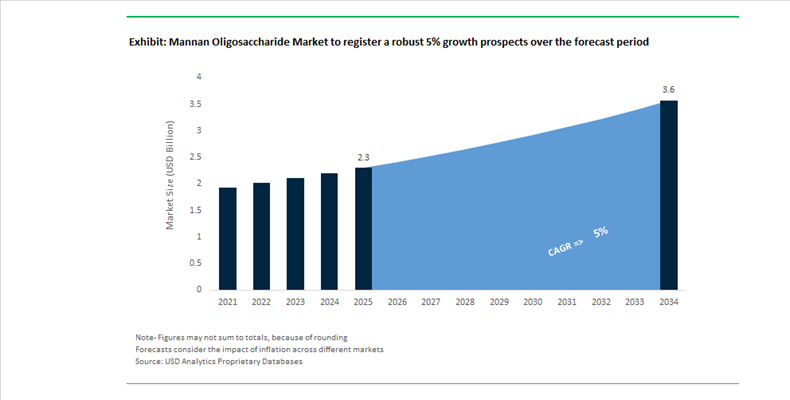
The Mannan Oligosaccharide (MOS) Market is projected to expand from $2.3 billion in 2025 to $3.6 billion by 2034, registering a CAGR of 5%. Growth is underpinned by rising demand for antibiotic-free animal feed additives, yeast-derived prebiotic ingredients, and functional gut health solutions across aquaculture, poultry, swine, dairy, and companion animal nutrition. MOS, primarily extracted from Saccharomyces cerevisiae yeast cell walls, is increasingly recognized for its pathogen-binding properties, immune modulation capacity, and ability to enhance intestinal integrity. Regulatory tightening on antibiotic growth promoters, particularly within the European Union and parts of Asia, is accelerating structural substitution toward MOS-based feed technologies and standardized prebiotic blends.
In 2024, the European Commission’s continued antibiotic restrictions triggered a surge in MOS product registrations in aquaculture, with companies such as Bio-Origin and ICC Brazil expanding capacity to serve Mediterranean and Southeast Asian fish farming markets. In June 2024, Kerry Group partnered with Herbafood Ingredients to co-develop standardized MOS formulations for poultry and swine sectors aimed at improving gut barrier function and reducing antibiotic dependence. In September 2024, Leiber GmbH marked 70 years of brewer’s yeast upcycling and in early 2025 announced strategic expansion into companion animal nutrition through refined MOS extraction from brewing byproducts. In January 2025, DuPont finalized acquisition of Sensus MOS production assets to strengthen its Health and Biosciences portfolio and secure high-purity global supply. Throughout 2025, companies including Ohly and Associated British Foods reported increased demand for pharma-grade MOS in human dietary supplements targeting immune support and metabolic health.
Product innovation accelerated through late 2025 and early 2026. In July 2025, Phileo by Lesaffre expanded into companion animal care via partnership with CanBiocin, combining MOS with probiotic strains for advanced canine and feline gut health formulations. In September 2025, Alltech introduced a comprehensive resilience strategy for Asian shrimp aquaculture, integrating MOS technologies to mitigate Vibrio outbreaks and improve survival rates. In October 2025, Lallemand launched LEVUCELL Trivantage in North America, combining live yeast with MOS and β-glucans to enhance rumen function and immune resilience in dairy cattle. Later in 2025, Lallemand introduced OPTIWALL, a structurally optimized yeast cell wall ingredient characterized by long-chain MOS profiles for consistent pathogen-binding performance validated with the Toulouse Biotechnology Institute. In January 2026, Lallemand reinforced long-term microbial innovation through its LAN Scholarship program, prioritizing research into next-generation MOS and probiotic solutions for sustainable agriculture.
Strategic Trends and High-Growth Opportunities in the Mannan Oligosaccharide (MOS) Market
Trend: Vertical Integration to Secure Precision Supply for High-Value Aquaculture Nutrition
The mannan oligosaccharide market is experiencing accelerated vertical integration as aquaculture overtakes capture fisheries, now accounting for approximately 51% of global aquatic animal production. In intensive shrimp and fish farming systems, MOS quality consistency and bioactivity are directly linked to immune modulation, gut barrier integrity, and survival rates, making supply reliability a strategic priority rather than a procurement consideration. As a result, leading animal nutrition companies are internalizing MOS production to control yeast strain selection, cell wall extraction efficiency, and purity standards.
In January 2025, DuPont finalized the acquisition of specialized production assets to reinforce its global MOS supply chain. This move enables tighter integration of high-purity yeast cell wall derivatives into its broader animal nutrition portfolio, particularly for intensive aquaculture systems where feed conversion efficiency and disease resistance are critical economic levers. Scientific validation is reinforcing this trend. Peer-reviewed studies published in MDPI in 2025 demonstrated that a 0.60% dietary inclusion of MOS in juvenile GIFT tilapia significantly improved anti-inflammatory gene expression and antioxidant capacity, providing data-backed justification for precision dosing strategies. These outcomes are pushing feed manufacturers toward proprietary sourcing models and sustainability-linked initiatives such as Alltech’s Safeguard Our Soils program, which connects regenerative agriculture with high-performance aquatic feed. Regional supply security is also gaining prominence. In December 2025, Mukka Proteins acquired a majority stake in United Gulf Fishery Products, strengthening localized MOS and feed production capabilities in the Middle East as the region prioritizes aquaculture self-sufficiency.
Trend: Shift Toward Species-Specific and Synergistic Prebiotic Formulations
The traditional one-size-fits-all approach to MOS supplementation is rapidly being replaced by species-specific and function-targeted formulations. Advances in metagenomic sequencing and microbiome analytics are enabling suppliers to design synergistic blends that combine MOS with beta-glucans, organic acids, and probiotics tailored to the distinct gut ecosystems of poultry, swine, aquaculture species, and companion animals. This precision nutrition approach is transforming MOS from a commodity prebiotic into a platform ingredient embedded within differentiated health solutions.
Controlled trials conducted in early 2025 showed that next-generation synbiotic systems achieved up to 45% higher pathogen exclusion compared with conventional MOS products. These formulations also delivered an 18% increase in intestinal villi height density, directly improving nutrient absorption and reducing feed costs. Microbiome-driven innovation is expanding beyond livestock. In May 2025, ADM released clinical findings on PRIOME MH, a heat-treated postbiotic derived from microbial fermentation, demonstrating measurable benefits in pet metabolic health. This signals a strategic expansion pathway for MOS suppliers into premium, high-margin functional pet nutrition, where demand is increasingly driven by clinically substantiated gut and immune health claims.
Opportunity: MOS as a Core Enabler of Antibiotic-Free Poultry Production
Regulatory pressure and consumer demand are making antibiotic-free and no-antibiotics-ever poultry production a structural growth driver for the MOS market. In developed markets, more than 60% of consumers actively prefer poultry raised without antibiotics, while producers face tightening restrictions on prophylactic antimicrobial use. Under these conditions, MOS has emerged as a non-discretionary gut health tool to manage enteric challenges such as necrotic enteritis, which can otherwise reduce flock performance by up to 15%.
The poultry gut health solutions segment, valued at approximately USD 4.88 billion in 2025 across North America and Europe, is increasingly dependent on MOS as a natural alternative to in-feed antibiotics. Commercial programs are moving toward standardized, multi-strain gut health solutions that combine prebiotics and probiotics to deliver predictable outcomes at scale. In April 2025, Evonik expanded the commercial rollout of its Ecobiol probiotic platform in China, targeting improved feed efficiency and emission reduction in broiler systems. This launch illustrates how MOS-compatible programs are being globally scaled to support antibiotic-free production models while maintaining productivity and regulatory compliance.
Opportunity: Human Nutrition-Grade MOS for Synbiotic and Postbiotic Applications
Beyond animal nutrition, the MOS market is entering a high-growth phase in human wellness, driven by rising clinical interest in the gut-brain axis, immune resilience, and microbiome-supported mental health. Human nutrition-grade MOS is being positioned as a selective fermentable fiber that enhances probiotic survival, supports beneficial microbial metabolites, and enables next-generation synbiotic and postbiotic formulations.
Clinical momentum is building rapidly. In November 2025, ADM partnered with the University of Oxford to launch a clinical trial examining the effects of biotic mixtures on emotional and cognitive health in perimenopausal women. This initiative reflects a broader shift toward leveraging prebiotics as functional modulators of mental wellbeing through microbiome pathways. Regulatory conditions are also becoming more favorable. In the third quarter of 2025, the U.S. Food and Drug Administration updated its GRAS inventory, granting no-questions status to a significant number of microorganism-derived materials and prebiotic fibers. This regulatory clarity lowers barriers for MOS integration into premium functional foods, clean-label supplements, and infant nutrition. With European active nutrition categories expanding by more than 150% since late 2024, MOS is well positioned to capture demand as a pro-immunity and gut health ingredient within the rapidly evolving human nutrition landscape.
Mannan Oligosaccharide Market Share and Segmentation Insights
Feed Grade Mannan Oligosaccharide Leads the Market Through Large-Scale Animal Feed Applications
Feed grade mannan oligosaccharide (MOS) accounted for 68.40% of the Mannan Oligosaccharide Market share in 2025, making it the dominant grade used across global animal feed production systems. Feed grade MOS is widely incorporated into livestock feed formulations for poultry, swine, and aquaculture, where it functions as a prebiotic feed additive that supports gut health, improves nutrient absorption, and enhances immune response in animals. Derived primarily from yeast cell wall components such as Saccharomyces cerevisiae, MOS is valued for its ability to bind harmful pathogens in the digestive tract and promote beneficial gut microflora. These properties have made feed grade MOS a widely adopted ingredient in antibiotic-free livestock production systems, where producers require effective alternatives to antibiotic growth promoters. In 2025, tightening regulations on antibiotic use in animal feed across North America, Europe, and parts of Asia have accelerated the adoption of functional feed additives such as MOS, linking feed grade demand closely with the rapid expansion of antibiotic-free meat and sustainable livestock production programs worldwide.
Animal Nutrition Sector Drives the Largest Share of Mannan Oligosaccharide Demand
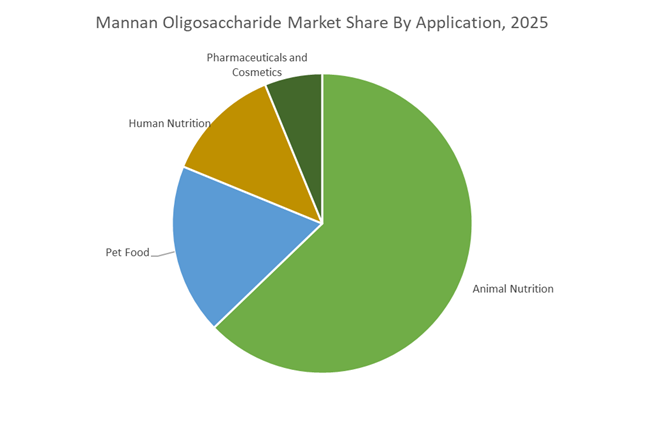
Animal nutrition accounted for 62.80% of the Mannan Oligosaccharide Market share in 2025, establishing it as the primary application segment for MOS-based feed additives. Livestock producers utilize MOS extensively in poultry, swine, aquaculture, and ruminant feed formulations to enhance digestive health, improve feed conversion efficiency, and strengthen immune function. The additive works by preventing pathogen attachment in the gastrointestinal tract and supporting beneficial bacterial populations, which improves animal performance and reduces the risk of disease outbreaks in intensive farming environments. The large scale of global poultry and livestock production ensures sustained demand for MOS as part of routine feed supplementation programs. In 2025, the emergence of precision livestock nutrition strategies has further shaped MOS usage patterns. Feed formulators increasingly tailor MOS inclusion rates based on animal species, growth stage, gut microbiome health, and farm management practices, enabling more targeted gut health management programs that improve feed efficiency while controlling feed additive costs in modern commercial animal production systems.
The mannan oligosaccharide (MOS) market in 2026 is driven by precision gut-health modulation, phosphorylated glucomannan technologies, and AI-enabled feed optimization. Competitive intensity is centered on mycotoxin binding efficiency, antibiotic-free livestock production, and fermentation-integrated supply chains ensuring consistent biological activity across global animal nutrition systems.
Alltech leads MOS innovation with nutrigenomics and mycotoxin risk intelligence
Alltech, Inc. maintains leadership through its Bio-Mos® and Actigen® platforms, which enhance gut microbiota balance and feed efficiency across livestock and aquaculture. Its integration of nutrigenomics and global mycotoxin surveillance, including the Asia Import Risk Analysis, enables targeted nutritional interventions against Fusarium toxins. Expansion into Agolin® solutions aligns MOS applications with greenhouse gas reduction goals, while investments in advanced testing facilities strengthen biological consistency and innovation in yeast-derived feed additives.
Phileo advances fermentation-derived MOS with heat-stress resilience and circular production models
Phileo by Lesaffre is leveraging advanced fermentation to produce high-functionality MOS and related yeast derivatives, focusing on gut integrity under climate-induced stress conditions. Its joint venture with Zilor expands circular production of yeast-based ingredients, while EFSA validation of Microsaf® reinforces regulatory credibility. Expansion into companion animal nutrition and development of animal-free specialty ingredients position Phileo as a diversified player in sustainable feed additives and prebiotic solutions.
ADM integrates MOS into vertically scaled nutrition systems with strong feedstock control
Archer Daniels Midland (ADM) is strengthening its MOS positioning through its vertically integrated “Seed-to-Feed” model, ensuring stable supply of carbohydrate-based feed additives. With an 8% increase in Nutrition segment profits and up to $1.5 billion CAPEX planned, ADM is optimizing production efficiency and expanding raw material sourcing. Its global processing infrastructure supports consistent MOS availability while enabling integration into broader functional feed and prebiotic formulations targeting livestock performance and gut health.
Cargill deploys AI-driven feed optimization to enhance MOS efficacy and toxin management
Cargill, Incorporated is differentiating through digitalization, combining MOS-based feed strategies with AI-powered analytics and real-time monitoring systems. Its Global Mycotoxin Report, covering 390,000+ analyses, provides actionable insights for toxin mitigation strategies. Expansion of feed production capacity in Asia-Pacific and deployment of robotics and AI tools enhance precision in additive dosing and feed formulation. Cargill’s focus on aquaculture and alternative proteins further strengthens MOS adoption in high-growth protein production systems.
Nutreco advances precision MOS applications with predictive mycotoxin modeling and spray-drying upgrades
Nutreco (Trouw Nutrition) is integrating MOS into precision nutrition frameworks supported by predictive mycotoxin modeling and advanced NIR analytics. Modernization of its Bützow spray-drying facility ensures consistent quality of yeast cell wall components, while its research campus enables validation of functional carbohydrate impacts on livestock productivity. Government-backed sustainability initiatives further align MOS applications with nitrogen reduction and environmental compliance in dairy and livestock systems.
AB Vista strengthens MOS performance through stimbiotic synergy and real-time feed intelligence
AB Vista is enhancing MOS functionality through its AB MOS product, a high-concentration phosphorylated glucomannan designed for pathogen binding and toxin sequestration. Its stimbiotic platform integrates MOS with fiber-degrading microbiome activation, improving overall gut efficiency. Acquisition of Progres® intellectual property adds anti-inflammatory capabilities, while its NIR Service enables real-time feed quality monitoring, ensuring optimized MOS inclusion rates and consistent performance across variable raw material inputs.
United States: Regulatory-Driven Antibiotic Replacement and Premium Nutrition Expansion
The United States Mannan Oligosaccharide market is being reshaped by structural regulatory change and accelerating demand for antibiotic alternatives in animal nutrition. Following the full implementation of FDA Guidance for Industry 263 during 2024–2025, livestock producers have moved rapidly away from antibiotic growth promoters toward MOS-based prebiotics that support gut health and immune modulation. By late 2025, an estimated 40% of U.S. livestock producers had incorporated MOS solutions into feed programs, reflecting compliance-led demand rather than discretionary adoption. This regulatory shift is reinforcing MOS as a core component of modern feed formulations across poultry, swine, and ruminants.
Capital allocation trends further validate this transition. During October 2025 investor briefings, H.B. Fuller and peer industrial suppliers highlighted targeted investments in high-margin, bio-based feed modifiers, with MOS positioned as a priority subsegment through 2026. Technological integration is also accelerating. In January 2025, a major nutrition player completed the acquisition of specialized MOS production assets to integrate yeast-derived prebiotics into a broader nutritional portfolio, addressing rising North American demand for gut-health additives across livestock and companion animals. Pet nutrition has emerged as a high-growth application, with U.S. pet food manufacturers increasing MOS inclusion rates by an average of 6% in 2025 to support clean-label immune health claims. On the supply side, manufacturers are increasingly sourcing MOS from bio-based ethanol byproducts, although supply tightness persists due to competing demand from renewable fuels.
China: High-End Feed Strategy, Poultry Innovation, and Aquaculture Integration
China’s Mannan Oligosaccharide market is evolving under a policy-led shift toward quality, functionality, and export-grade production. In September 2025, the Ministry of Industry and Information Technology released a work plan targeting growth across chemical and biochemical sectors, with explicit prioritization of high-end feed-grade prebiotics such as MOS. This mandate has accelerated investments in purification technologies and process optimization, reinforcing MOS as a strategic ingredient within China’s feed additive ecosystem.
Scientific validation is translating directly into commercial protocols. Research published in 2025 by the Chinese Academy of Agricultural Sciences demonstrated that in ovo delivery of MOS significantly improves early broiler growth performance, with benefits sustained through 42 days. These findings are being embedded into large-scale poultry production standards scheduled for rollout in 2026. China has also consolidated its export leadership, producing more than 55% of global feed-grade MOS by late 2025, while strategically shifting toward high-purity grades exceeding 85% to meet European and North American requirements. In aquaculture, policy endorsement from the Ministry of Agriculture and Rural Affairs has driven MOS adoption in tilapia and carp farming, where 2025 field data showed measurable improvements in antioxidant capacity and anti-inflammatory gene expression, supporting environmental and productivity goals in intensive systems.
India: Capacity Build-Out, Localization of Formulations, and Regional Market Customization
India’s Mannan Oligosaccharide market is transitioning from import dependence toward localized production and formulation capability. A defining milestone occurred in September 2025, when De Heus Animal Nutrition inaugurated a USD 17 million feed manufacturing facility in Punjab. The plant, with an annual capacity of 180,000 metric tons, includes dedicated prebiotic production lines, signaling long-term commitment to MOS integration within Indian livestock nutrition. This expansion aligns with rising domestic demand for antibiotic-free poultry and dairy production.
Policy incentives are reinforcing this momentum. Under the Production-Linked Incentive scheme for specialty chemicals, realized investments in bio-additives reached a critical threshold in mid-2025, supporting yeast-derived immune enhancers and prebiotics. Multinational players are deepening their localization strategies through Global Capability Centers. In 2025, Lubrizol and AB Vista expanded R&D operations in Pune and Navi Mumbai to adapt MOS formulations for high-temperature and high-humidity livestock environments. Product customization is translating into regional launches, with AB Vista introducing its AB MOS platform for India, Bangladesh, and Nepal in late 2025, targeting measurable reductions in Salmonella and E. coli prevalence in poultry production.
Brazil: Sugarcane-Based MOS Leadership and Protein Export Alignment
Brazil occupies a structurally advantaged position in the global Mannan Oligosaccharide market due to its integration of yeast-derived prebiotics within the sugarcane ethanol value chain. Strategic consolidation has accelerated market penetration. In July 2025, Cargill announced the acquisition of Mig-Plus, expanding its MOS-based additive portfolio across Latin America to support sustainable beef and poultry production systems. This move aligns with Brazil’s export-driven protein industry, where feed efficiency and antibiotic reduction are increasingly critical for market access.
Domestic research continues to strengthen MOS credibility. Studies conducted in 2025 in Viçosa, Minas Gerais, validated the performance of Maximos, a MOS and beta-glucan blend, demonstrating improved productivity indexes in broilers even under reused litter conditions, a standard operational constraint for Brazilian exporters in 2026. Brazil also remains the global leader in MOS derived from sugarcane yeast cell walls, specifically Saccharomyces cerevisiae. Exports to the European Union increased by 12% in 2025, supported by the low-carbon footprint of the sugarcane-based production cycle, positioning Brazilian MOS favorably under sustainability-focused procurement frameworks.
Netherlands and European Union: Antibiotic-Free Mandates and Transparent Functional Feed Labeling
The Netherlands and broader European Union represent a regulation-intensive but innovation-forward environment for Mannan Oligosaccharide adoption. Antibiotic-free livestock mandates effective in 2025 have driven a structural shift in producer preferences, with an estimated 40% transition toward MOS-based feed solutions to maintain performance without medicinal inputs. This regulatory environment is accelerating demand for functionally validated prebiotics with documented immune and gut-health benefits.
Investment activity underscores Europe’s commitment to advanced oligosaccharides. In August 2025, DSM-Firmenich committed USD 50 million to expand XOS and MOS production capacity at its Delft facility, targeting aquaculture and livestock applications through enzymatic manufacturing routes. Regulatory transparency will further influence supplier selection. From January 2026, new EU functional feed labeling rules will require detailed disclosure of prebiotic fractions, favoring MOS products produced under ISCC PLUS-certified sustainable supply chains. This shift is expected to advantage suppliers with traceable yeast-based inputs and robust lifecycle documentation.
Country-Level Strategic Positioning in the Mannan Oligosaccharide Market
Mannan Oligosaccharide Market County Level Snapshot
Region
Primary Strategic Driver
Key Application Focus
Policy and Regulatory Influence
Supply Chain Orientation
United States
Antibiotic reduction and clean-label nutrition
Livestock feed, pet nutrition
FDA GFI 263 enforcement
Bio-based sourcing with capacity upgrades
China
High-end feed and export-grade purity
Poultry, aquaculture
MIIT and agricultural ministry mandates
Large-scale production with purity upgrades
India
Localization and formulation customization
Poultry and dairy feed
PLI incentives for bio-additives
Domestic blending with R&D expansion
Brazil
Low-carbon sugarcane-based MOS
Poultry and beef exports
Sustainability-driven export standards
Integrated ethanol-yeast value chain
Netherlands and EU
Antibiotic-free compliance and transparency
Livestock and aquaculture
Functional feed labeling from 2026
Certified sustainable production chains
Mannan Oligosaccharide Market Report Scope
Mannan Oligosaccharide Market
Parameter
Details
Market Size (2025)
$2.3 Billion
Market Size (2034)
$3.6 Billion
Market Growth Rate
5%
Segments
By Grade (Feed Grade, Food Grade, Pharmaceutical Grade), By Source (Yeast Cell Wall, Botanical Sources), By Form (Powder, Liquid), By Application (Animal Nutrition, Pet Food, Human Nutrition, Pharmaceuticals and Cosmetics)
Study Period
2019- 2025 and 2026-2034
Units
Revenue (USD)
Qualitative Analysis
Porter’s Five Forces, SWOT Profile, Market Share, Scenario Forecasts, Market Ecosystem, Company Ranking, Market Dynamics, Industry Benchmarking
US, Canada, Mexico, Germany, France, Spain, Italy, UK, Russia, China, India, Japan, South Korea, Australia, South East Asia, Brazil, Argentina, Middle East, Africa
Mannan Oligosaccharide Market Segmentation
By Grade
Feed Grade
Food Grade
Pharmaceutical Grade
By Source
Yeast Cell Wall
Botanical Sources
By Form
Powder
Liquid
By Application
Animal Nutrition
Pet Food
Human Nutrition
Pharmaceuticals and Cosmetics
By Region
North America (United States, Canada, Mexico)
Europe (Germany, France, United Kingdom, Spain, Italy, Rest of Europe)
Asia Pacific (China, India, Japan, South Korea, Australia, Rest of APAC)
South and Central America (Brazil, Argentina, Rest of SCA)
Middle East and Africa (Saudi Arabia, UAE, South Africa, Rest of Middle East, Rest of Africa)
Top Companies in the Mannan Oligosaccharide Market
2. Mannan Oligosaccharide Market Landscape & Outlook (2025–2034)
2.1. Introduction to Mannan Oligosaccharide Market
2.2. Market Valuation and Growth Projections (2025–2034)
2.3. Antibiotic-Free Feed Additive Adoption Across Livestock and Aquaculture
2.4. Expansion of Yeast-Derived Prebiotics in Animal and Human Nutrition
2.5. Regulatory Shifts and Supply Chain Integration in MOS Production
3. Innovations Reshaping the Mannan Oligosaccharide Market
3.1. Trend: Vertical Integration for Precision Aquaculture Nutrition Supply
3.2. Trend: Species-Specific and Synbiotic Prebiotic Formulations
3.3. Opportunity: MOS as a Core Solution for Antibiotic-Free Poultry Production
3.4. Opportunity: Human Nutrition-Grade MOS in Synbiotic and Postbiotic Applications
4. Competitive Landscape and Strategic Initiatives
4.1. Mergers and Acquisitions
4.2. R&D in Fermentation-Derived Prebiotics and Microbiome Solutions
4.3. Sustainability and Circular Yeast-Based Production Strategies
4.4. Market Expansion and Regional Feed Additive Supply Networks
5. Market Share and Segmentation Insights: Mannan Oligosaccharide Market
5.1. By Grade
5.1.1. Feed Grade
5.1.2. Food Grade
5.1.3. Pharmaceutical Grade
5.2. By Source
5.2.1. Yeast Cell Wall
5.2.2. Botanical Sources
5.3. By Form
5.3.1. Powder
5.3.2. Liquid
5.4. By Application
5.4.1. Animal Nutrition
5.4.2. Pet Food
5.4.3. Human Nutrition
5.4.4. Pharmaceuticals and Cosmetics
5.5. By Region
5.5.1. North America
5.5.2. Europe
5.5.3. Asia Pacific
5.5.4. South and Central America
5.5.5. Middle East and Africa
6. Country Analysis and Outlook of Mannan Oligosaccharide Market
6.1. United States
6.2. Canada
6.3. Mexico
6.4. Germany
6.5. France
6.6. Spain
6.7. Italy
6.8. UK
6.9. Russia
6.10. China
6.11. India
6.12. Japan
6.13. South Korea
6.14. Australia
6.15. South East Asia
6.16. Brazil
6.17. Argentina
6.18. Middle East
6.19. Africa
7. Mannan Oligosaccharide Market Size Outlook by Region (2025–2034)
7.1. North America Mannan Oligosaccharide Market Size Outlook to 2034
7.1.1. By Grade
7.1.2. By Source
7.1.3. By Form
7.1.4. By Application
7.1.5. By Region
7.2. Europe Mannan Oligosaccharide Market Size Outlook to 2034
7.2.1. By Grade
7.2.2. By Source
7.2.3. By Form
7.2.4. By Application
7.2.5. By Region
7.3. Asia Pacific Mannan Oligosaccharide Market Size Outlook to 2034
7.3.1. By Grade
7.3.2. By Source
7.3.3. By Form
7.3.4. By Application
7.3.5. By Region
7.4. South America Mannan Oligosaccharide Market Size Outlook to 2034
7.4.1. By Grade
7.4.2. By Source
7.4.3. By Form
7.4.4. By Application
7.4.5. By Region
7.5. Middle East and Africa Mannan Oligosaccharide Market Size Outlook to 2034
7.5.1. By Grade
7.5.2. By Source
7.5.3. By Form
7.5.4. By Application
7.5.5. By Region
8. Company Profiles: Leading Players in the Mannan Oligosaccharide Market
8.1. Alltech
8.2. Archer Daniels Midland
8.3. Cargill
8.4. DSM-Firmenich
8.5. Associated British Foods
8.6. Lallemand
8.7. Lesaffre
8.8. Nutreco
8.9. Kemin Industries
8.10. Novonesis
8.11. Lubrizol
8.12. Biorigin
8.13. Vetanco
8.14. Angel Yeast
8.15. Biochem Zusatzstoffe
9. Methodology
9.1. Research Scope
9.2. Market Research Approach
9.3. Market Sizing and Forecasting Model
9.4. Research Coverage
9.5. Data Horizon
9.6. Deliverables
10. Appendix
10.1. Acronyms and Abbreviations
10.2. List of Tables
10.3. List of Figures
Mannan Oligosaccharide Market Segmentation
By Grade
Feed Grade
Food Grade
Pharmaceutical Grade
By Source
Yeast Cell Wall
Botanical Sources
By Form
Powder
Liquid
By Application
Animal Nutrition
Pet Food
Human Nutrition
Pharmaceuticals and Cosmetics
By Region
North America (United States, Canada, Mexico)
Europe (Germany, France, United Kingdom, Spain, Italy, Rest of Europe)
Asia Pacific (China, India, Japan, South Korea, Australia, Rest of APAC)
South and Central America (Brazil, Argentina, Rest of SCA)
Middle East and Africa (Saudi Arabia, UAE, South Africa, Rest of Middle East, Rest of Africa)
The Mannan Oligosaccharide Market was valued at $2.3 billion in 2025 and is expected to reach $3.6 billion by 2034, growing at a CAGR of 5%. Expansion is structurally linked to antibiotic replacement in livestock and aquaculture. Regulatory bans in the EU and Asia are accelerating MOS adoption. Growth is also supported by rising demand for yeast-derived prebiotics in both animal and human nutrition.
The market is witnessing upstream consolidation as companies secure yeast cell wall sourcing and extraction capabilities. Strategic moves such as DuPont’s acquisition of MOS production assets highlight the importance of supply control. In aquaculture, consistency in MOS purity directly impacts survival rates and feed efficiency. Regional investments, including Middle East feed integration, are strengthening localized supply chains.
MOS is transitioning from a standalone additive to a component within precision nutrition systems. Advanced formulations combining MOS with beta-glucans, probiotics, and organic acids are delivering up to 45% higher pathogen exclusion. These blends are tailored to species-specific gut microbiomes in poultry, swine, aquaculture, and pets. This shift is enabling premium pricing and differentiation in feed and pet nutrition markets.
Global restrictions on antibiotic growth promoters and consumer preference for antibiotic-free meat are making MOS a core feed additive. In poultry, MOS supports gut health and reduces diseases such as necrotic enteritis, improving productivity. In human nutrition, FDA GRAS updates and clinical trials are enabling MOS use in synbiotic and postbiotic formulations. This is expanding MOS into immune health and gut-brain axis applications.
Key players include Alltech, ADM, Cargill, DSM-Firmenich, Lallemand, Lesaffre, and Nutreco. These companies are investing in fermentation-based production, vertical integration, and microbiome-driven product development. Strategic partnerships, such as Kerry with Herbafood and Phileo with CanBiocin, are expanding application scope. Focus areas include aquaculture resilience, companion animal nutrition, and pharma-grade MOS for high-margin segments.
More Nutraceutical and Functional Ingredients Reports