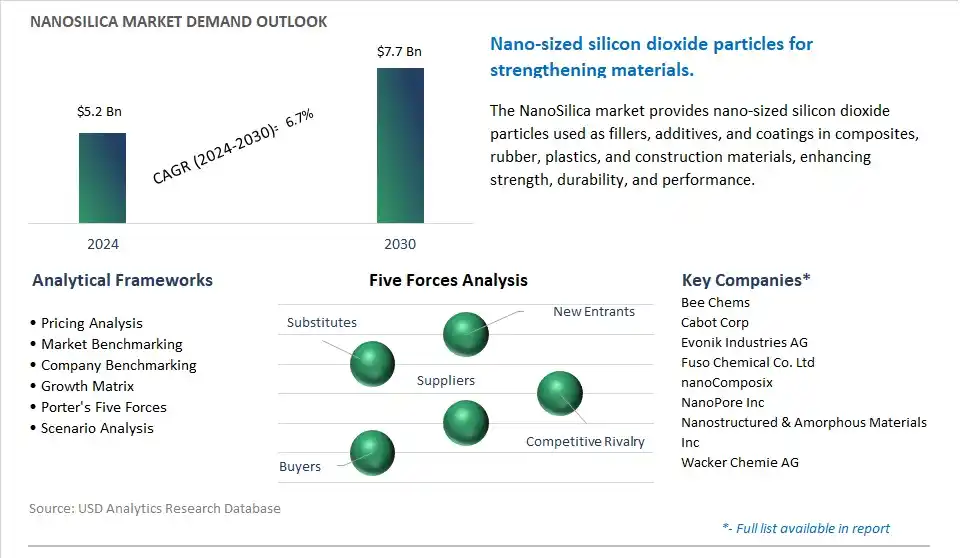
The global NanoSilica Market is poised to register a 6.7% CAGR from $5.2 Billion in 2024 to $7.7 Billion in 2030.
The global NanoSilica Market Study analyzes and forecasts the market size across 6 regions and 24 countries for diverse segments -By Product (P Type, S Type, Others), By Application (Rubber, Healthcare, Food, Coatings, Plastics, Concrete, Gypsum, Battery, Electronics, Others).
An Introduction to Global NanoSilica Market in 2024
The future of nanosilica is characterized by its wide-ranging applications across industries such as construction, electronics, healthcare, and automotive. Key trends include the development of nanosilica particles with precise control over size, morphology, and surface properties to enhance mechanical strength, durability, and performance in various materials and products. Manufacturers are exploring innovative synthesis methods such as sol-gel processing, precipitation, and hydrothermal synthesis to produce nanosilica with high purity, uniformity, and dispersibility. Additionally, there's a growing interest in surface-modified nanosilica particles that offer improved compatibility and dispersion in polymer matrices, enabling enhancements in mechanical, thermal, and barrier properties in composite materials. Furthermore, nanosilica is being integrated into advanced applications such as high-performance concrete, scratch-resistant coatings, transparent films, and dental composites, where its unique properties provide significant performance advantages. As research continues to advance our understanding of nanosilica structure-property relationships and processing techniques, collaboration between academia, industry, and regulatory agencies will be essential to address challenges related to safety, environmental impact, and commercial scalability, ensuring the responsible and beneficial deployment of nanosilica in diverse applications and shaping the future of materials science and technology.
NanoSilica Market Competitive Landscape
The market report analyses the leading companies in the industry including Bee Chems, Cabot Corp, Evonik Industries AG, Fuso Chemical Co. Ltd, nanoComposix, NanoPore Inc, Nanostructured & Amorphous Materials Inc, Wacker Chemie AG.
NanoSilica Market Dynamics
NanoSilica Market Trend: Growing Demand for High-Performance Construction Materials
One of the most prominent trends in the NanoSilica market is the growing demand for high-performance construction materials across the building and infrastructure sectors. NanoSilica, also known as nanostructured silica or silica nanoparticles, is being increasingly utilized as an additive in cement, concrete, and other construction materials to enhance their mechanical properties, durability, and sustainability. With the increasing focus on infrastructure development, urbanization, and sustainable building practices, there's a growing interest in NanoSilica as a key ingredient in the development of advanced construction materials that offer superior strength, reduced environmental impact, and extended service life. The trend is driving the adoption of NanoSilica in construction applications, reshaping the market landscape and driving innovation in the construction industry.
NanoSilica Market Driver: Need for Sustainable and Environmentally Friendly Solutions
A significant driver propelling the NanoSilica market is the growing need for sustainable and environmentally friendly solutions in construction and infrastructure projects. NanoSilica, derived from naturally occurring silica sources or produced synthetically using green chemistry methods, offers environmental benefits such as reduced carbon footprint, improved resource efficiency, and enhanced durability of construction materials. As governments, architects, and developers prioritize sustainable building practices and seek to minimize the environmental impact of construction activities, there's an increasing demand for NanoSilica-based materials that contribute to energy efficiency, waste reduction, and lower greenhouse gas emissions. This demand for sustainable solutions drives market growth and adoption of NanoSilica in the construction sector.
NanoSilica Market Opportunity: Integration into High-Performance Coatings and Composites
An exciting opportunity within the NanoSilica market lies in its integration into high-performance coatings and composites for various industrial applications. NanoSilica can be incorporated into coatings, paints, and composites to improve adhesion, abrasion resistance, corrosion resistance, and thermal stability. Additionally, NanoSilica-filled composites offer lightweight and high-strength properties, making them suitable for applications in aerospace, automotive, marine, and sporting goods industries. By leveraging NanoSilica in the development of advanced coatings and composites, manufacturers can offer customers solutions that enhance product performance, reduce maintenance costs, and extend service life. This opportunity to integrate NanoSilica into high-performance coatings and composites presents a potential avenue for market growth and differentiation, as industries seek innovative materials that meet stringent performance requirements and environmental standards.
NanoSilica Market Share Analysis: S Type generated the highest revenue in 2024
The largest segment in the NanoSilica Market is the S Type segment. The market growth is driven by S Type Nano silica, also known as fumed silica or pyrogenic silica, which is one of the most widely used forms of Nano silica due to its exceptional properties and versatility. S-type nano silica particles have a high surface area, in the range of 50-400 m²/g, and a unique nanostructure characterized by small particle size and high porosity. These properties make S Type Nano silica suitable for various applications, including rubber reinforcement, coatings, adhesives, sealants, composites, and pharmaceuticals. Further, S Type Nano silica exhibits excellent reinforcing and thickening capabilities when incorporated into polymer matrices, improving mechanical strength, abrasion resistance, and dimensional stability of the final products. In rubber applications, S Type Nano silica enhances the tensile strength, tear resistance, and dynamic properties of rubber compounds, making it a preferred filler for tire tread, automotive parts, and industrial rubber products. Additionally, in coatings, adhesives, and sealants, S Type Nano silica acts as a rheology modifier, anti-settling agent, and thixotropic additive, enhancing viscosity control, sag resistance, and film formation properties. In addition, advancements in nanotechnology and manufacturing processes enable the production of S Type Nano silica with precise particle size distribution, surface chemistry, and surface area tailored for specific applications and performance requirements. Techniques such as flame hydrolysis, chemical vapor deposition, and aerosol pyrolysis enable the synthesis of high-purity S Type Nano silica particles with controlled morphology and surface functionalization. Further, the growing demand for eco-friendly, high-performance materials drives the adoption of S Type Nano silica as a sustainable alternative to conventional fillers and additives in various industries. S Type Nano silica offers advantages such as improved processability, reduced material consumption, and enhanced product performance, contributing to its widespread acceptance and utilization across diverse applications. Over the forecast period, the combination of unique properties, versatile applications, and market demand positions the S Type segment as the largest in the NanoSilica Market.
NanoSilica Market Share Analysis: Battery application segment is poised to register the fastest growth rate (CAGR) over the forecast period to 2030
The fastest-growing segment in the NanoSilica Market is the Battery application segment. Nano silica, particularly S Type Nano silica, offers significant benefits for battery applications, especially in lithium-ion batteries (LIBs) and other advanced energy storage systems. Nano silica particles can be used as additives in battery electrode materials to improve their performance, efficiency, and safety. For instance, Nano silica enhances the conductivity, mechanical stability, and structural integrity of electrode materials, such as cathodes and anodes, leading to higher charge/discharge rates, increased energy density, and longer cycle life of batteries. Further, the growing demand for high-performance batteries across various industries, including automotive, electronics, renewable energy, and portable devices, drives the adoption of Nano silica as a key ingredient in battery manufacturing. As the automotive industry shifts towards electric vehicles (EVs) and hybrid vehicles, there is a rising need for advanced battery technologies capable of delivering higher energy density, faster charging, and improved durability. Nano silica-enabled batteries address these requirements by enabling the development of next-generation LIBs with enhanced performance and reliability. In addition, advancements in nanotechnology and materials science enable the design and synthesis of Nano silica particles with tailored properties optimized for battery applications. Nanoparticles with controlled size, morphology, surface chemistry, and porosity can be engineered to meet specific performance targets, such as high conductivity, ion diffusion, and electrochemical stability. Further, research and development initiatives, government funding, and industry collaborations support the innovation and commercialization of Nano silica-based battery technologies, accelerating their market adoption and growth. Additionally, regulatory incentives, environmental regulations, and sustainability initiatives drive the transition towards cleaner, more efficient energy storage solutions, further fueling the demand for Nano silica in battery applications. Over the forecast period, the combination of technological advancements, market demand, and industry trends positions the Battery application segment as the fastest-growing in the NanoSilica Market.
NanoSilica Market Report Segmentation
By Product
P Type
S Type
Others
By Application
Rubber
Healthcare
Food
Coatings
Plastics
Concrete
Gypsum
Battery
Electronics
Others
Regions Included
North America (US, Canada, Mexico)
Europe (Germany, UK, France, Spain, Italy, Russia, Rest of Europe)
Asia Pacific (China, India, Japan, South Korea, Australia, South East Asia, Rest of Asia)
South America (Brazil, Argentina, Rest of South America)
Middle East and Africa (Saudi Arabia, UAE, Rest of Middle East, South Africa, Egypt, Rest of Africa)
NanoSilica Companies Profiled in the Market Study
Bee Chems
Cabot Corp
Evonik Industries AG
Fuso Chemical Co. Ltd
nanoComposix
NanoPore Inc
Nanostructured & Amorphous Materials Inc
Wacker Chemie AG
*- List Not Exhaustive
TABLE OF CONTENTS
1 Introduction to 2024 NanoSilica Market
1.1 Market Overview
1.2 Quick Facts
1.3 Scope/Objective of the Study
1.4 Market Definition
1.5 Countries and Regions Covered
1.6 Units, Currency, and Conversions
1.7 Industry Value Chain
2 Research Methodology
2.1 Market Size Estimation
2.2 Sources and Research Methodology
2.3 Data Triangulation
2.4 Assumptions and Limitations
3 Executive Summary
3.1 Global NanoSilica Market Size Outlook, $ Million, 2021 to 2030
3.2 NanoSilica Market Outlook by Type, $ Million, 2021 to 2030
3.3 NanoSilica Market Outlook by Product, $ Million, 2021 to 2030
3.4 NanoSilica Market Outlook by Application, $ Million, 2021 to 2030
3.5 NanoSilica Market Outlook by Key Countries, $ Million, 2021 to 2030
4 Market Dynamics
4.1 Key Driving Forces of NanoSilica Industry
4.2 Key Market Trends in NanoSilica Industry
4.3 Potential Opportunities in NanoSilica Industry
4.4 Key Challenges in NanoSilica Industry
5 Market Factor Analysis
5.1 Value Chain Analysis
5.2 Competitive Landscape
5.2.1 Global NanoSilica Market Share by Company (%), 2023
5.2.2 Product Offerings by Company
5.3 Porter’s Five Forces Analysis
5.4 Pricing Analysis and Outlook
6 Growth Outlook Across Scenarios
6.1 Growth Analysis-Case Scenario Definitions
6.2 Low Growth Scenario Forecasts
6.3 Reference Growth Scenario Forecasts
6.4 High Growth Scenario Forecasts
7 Global NanoSilica Market Outlook by Segments
7.1 NanoSilica Market Outlook by Segments, $ Million, 2021- 2030
By Product
P Type
S Type
Others
By Application
Rubber
Healthcare
Food
Coatings
Plastics
Concrete
Gypsum
Battery
Electronics
Others
8 North America NanoSilica Market Analysis and Outlook To 2030
8.1 Introduction to North America NanoSilica Markets in 2024
8.2 North America NanoSilica Market Size Outlook by Country, 2021-2030
8.2.1 United States
8.2.2 Canada
8.2.3 Mexico
8.3 North America NanoSilica Market size Outlook by Segments, 2021-2030
By Product
P Type
S Type
Others
By Application
Rubber
Healthcare
Food
Coatings
Plastics
Concrete
Gypsum
Battery
Electronics
Others
9 Europe NanoSilica Market Analysis and Outlook To 2030
9.1 Introduction to Europe NanoSilica Markets in 2024
9.2 Europe NanoSilica Market Size Outlook by Country, 2021-2030
9.2.1 Germany
9.2.2 France
9.2.3 Spain
9.2.4 United Kingdom
9.2.4 Italy
9.2.5 Russia
9.2.6 Norway
9.2.7 Rest of Europe
9.3 Europe NanoSilica Market Size Outlook by Segments, 2021-2030
By Product
P Type
S Type
Others
By Application
Rubber
Healthcare
Food
Coatings
Plastics
Concrete
Gypsum
Battery
Electronics
Others
10 Asia Pacific NanoSilica Market Analysis and Outlook To 2030
10.1 Introduction to Asia Pacific NanoSilica Markets in 2024
10.2 Asia Pacific NanoSilica Market Size Outlook by Country, 2021-2030
10.2.1 China
10.2.2 India
10.2.3 Japan
10.2.4 South Korea
10.2.5 Indonesia
10.2.6 Malaysia
10.2.7 Australia
10.2.8 Rest of Asia Pacific
10.3 Asia Pacific NanoSilica Market size Outlook by Segments, 2021-2030
By Product
P Type
S Type
Others
By Application
Rubber
Healthcare
Food
Coatings
Plastics
Concrete
Gypsum
Battery
Electronics
Others
11 South America NanoSilica Market Analysis and Outlook To 2030
11.1 Introduction to South America NanoSilica Markets in 2024
11.2 South America NanoSilica Market Size Outlook by Country, 2021-2030
11.2.1 Brazil
11.2.2 Argentina
11.2.3 Rest of South America
11.3 South America NanoSilica Market size Outlook by Segments, 2021-2030
By Product
P Type
S Type
Others
By Application
Rubber
Healthcare
Food
Coatings
Plastics
Concrete
Gypsum
Battery
Electronics
Others
12 Middle East and Africa NanoSilica Market Analysis and Outlook To 2030
12.1 Introduction to Middle East and Africa NanoSilica Markets in 2024
12.2 Middle East and Africa NanoSilica Market Size Outlook by Country, 2021-2030
12.2.1 Saudi Arabia
12.2.2 UAE
12.2.3 Oman
12.2.4 Rest of Middle East
12.2.5 Egypt
12.2.6 Nigeria
12.2.7 South Africa
12.2.8 Rest of Africa
12.3 Middle East and Africa NanoSilica Market size Outlook by Segments, 2021-2030
By Product
P Type
S Type
Others
By Application
Rubber
Healthcare
Food
Coatings
Plastics
Concrete
Gypsum
Battery
Electronics
Others
13 Company Profiles
13.1 Company Snapshot
13.2 SWOT Profiles
13.3 Products and Services
13.4 Recent Developments
13.5 Financial Profile
Bee Chems
Cabot Corp
Evonik Industries AG
Fuso Chemical Co. Ltd
nanoComposix
NanoPore Inc
Nanostructured & Amorphous Materials Inc
Wacker Chemie AG
14 Appendix
14.1 Customization Offerings
14.2 Subscription Services
14.3 Related Reports
14.4 Publisher Expertise
By Product
P Type
S Type
Others
By Application
Rubber
Healthcare
Food
Coatings
Plastics
Concrete
Gypsum
Battery
Electronics
Others
Countries Analyzed
North America (US, Canada, Mexico)
Europe (Germany, UK, France, Spain, Italy, Russia, Rest of Europe)
Asia Pacific (China, India, Japan, South Korea, Australia, South East Asia, Rest of Asia)
South America (Brazil, Argentina, Rest of South America)
Middle East and Africa (Saudi Arabia, UAE, Rest of Middle East, South Africa, Egypt, Rest of Africa)
