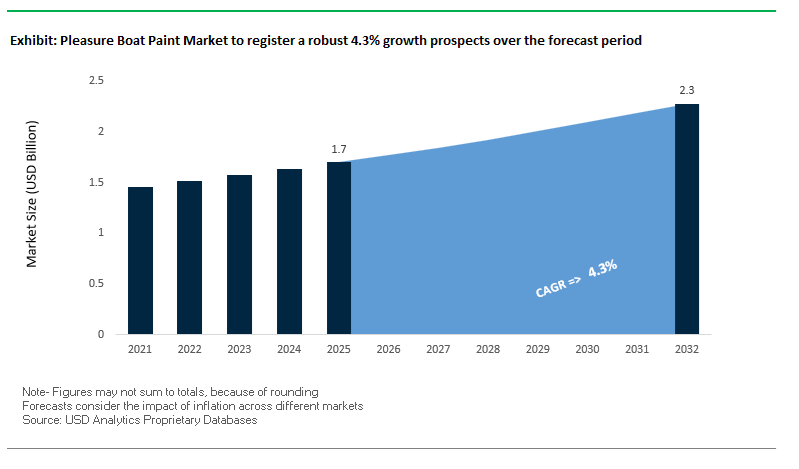
The global Pleasure Boat Paint Market was valued at $1.7 billion in 2025 and is projected to grow at a CAGR of 4.3% through 2032, reaching $2.3 billion by 2032. This growth is driven by increasing demand for recreational boating, luxury yachts, and high-performance marine coatings that deliver both aesthetic appeal and long-term protection in harsh marine environments.
A key structural driver is the expansion of the global leisure boating industry, particularly in regions such as North America, Europe, and emerging luxury markets in Asia-Pacific and the Middle East. Boat owners and manufacturers are increasingly prioritizing high-gloss finishes, UV resistance, corrosion protection, and antifouling performance, as vessels are exposed to saltwater, sunlight, and biological fouling. This has led to strong demand for polyurethane topcoats, epoxy primers, and advanced antifouling systems tailored for both new builds and refit applications.
Sustainability is becoming a defining factor in marine coatings innovation. Regulatory pressure to reduce toxic biocides and copper-based antifouling coatings is accelerating the adoption of biocide-free and low-emission technologies, such as silicone-based foul-release systems. These coatings not only minimize environmental impact but also improve fuel efficiency by reducing hull drag, aligning with broader decarbonization goals in the marine sector.
Additionally, the market is witnessing a shift toward customization and digital design tools, as yacht owners increasingly seek bespoke colors, textures, and finishes. This trend is particularly prominent in the superyacht segment, where coatings are expected to deliver both visual differentiation and long-term durability under extreme conditions.
Market Analysis: High-Gloss Yacht Innovations, Biocide-Free Antifouling, and Digital Customization Driving Market Evolution
Recent developments in the Pleasure Boat Paint Market highlight a strong focus on premium product innovation, sustainability-driven formulations, and customer-centric digital tools. In March 2026, AkzoNobel’s International® brand launched Intergard 6788, a high-performance primer designed to enhance corrosion protection and substrate adhesion for leisure boats, providing a stable foundation for premium topcoats on steel and aluminum hulls.
Product innovation in the high-end segment is accelerating. Jotun Yachting’s Megagloss AC, introduced at the Genoa Boat Show in September 2025, delivers a mirror-like high-gloss finish with improved ease of application and repair. This product is specifically engineered for UV-intensive marine environments, addressing the durability requirements of luxury yachts operating in regions such as the Mediterranean and Caribbean.
Sustainability is reshaping antifouling technologies. AkzoNobel’s Intersleek® slime-release coatings, successfully deployed in large-scale marine projects, are increasingly being adopted in the pleasure boat segment as biocide-free alternatives to traditional antifouling systems. Additionally, International®’s participation in the Zero Harm Program (January 2026) reflects a broader industry commitment to reducing hazardous materials and improving supply chain transparency.
Digitalization is enhancing customer engagement and product customization. Alexseal’s Digital Color Configurator (April 2025) allows yacht owners and designers to visualize bespoke coating finishes, supporting the growing demand for personalized aesthetics in the superyacht market. Meanwhile, Alexseal’s manufacturing expansion in the United States ensures faster delivery and localized production for North American shipyards and refinish operations.
Market expansion is also supported by strong performance from major players. Hempel’s record marine segment growth (March 2026) highlights increasing adoption of sustainability-focused coatings, while Sherwin-Williams’ expansion in marine coatings, supported by the integration of Suvinil, strengthens its presence in emerging leisure boating markets.
Finally, strategic partnerships such as AkzoNobel’s extended agreement with Winning Shipping (December 2025) for antifouling coatings underscore the importance of high-performance solutions for vessels with variable usage patterns, a common characteristic in the pleasure boating segment.
The pleasure boat paint industry is undergoing a structural transition toward copper-free antifouling coatings as regulatory frameworks tighten around marine pollution and heavy metal discharge. Traditional copper-based antifouling paints, long considered the industry standard, are increasingly restricted due to their environmental persistence and contribution to coastal water contamination. This shift is accelerating the adoption of alternative biocides such as tralopyril and zinc pyrithione, alongside non-biocidal silicone-based foul-release coatings.
Regulatory pressure is a primary driver. By 2026, multiple coastal jurisdictions have enforced maximum copper leach rates of 9.5 μg/cm²/day, significantly limiting the usability of conventional copper antifouling systems. In contrast, silicone-based foul-release coatings deliver a zero-discharge profile, eliminating biocide leaching entirely. This allows vessel owners to comply with stringent environmental mandates while avoiding operational restrictions such as in-water hull cleaning bans.
Performance improvements are reinforcing adoption. Advanced silicone antifouling coatings reduce hydrodynamic drag by 6% to 10%, directly improving fuel efficiency for high-speed pleasure craft. This reduction in friction translates into measurable operational cost savings, particularly in fuel-intensive segments such as luxury yachts and performance boats.
Durability has also reached parity with traditional systems. Modern copper-free coatings now deliver a service life of 3 to 5 years with minimal maintenance, matching the lifecycle performance of premium copper-based ablative paints. This combination of regulatory compliance, fuel efficiency, and long-term durability is positioning copper-free antifouling systems as the new standard in marine coatings technology.
Topside coatings in the pleasure boat segment are evolving toward high-solids polyurethane systems that deliver superior aesthetic performance while reducing environmental impact. These coatings, typically formulated with 70% to 80% volume solids, address the dual requirement of premium finish quality and compliance with tightening VOC emission standards.
Gloss retention remains a critical performance benchmark in high-end marine applications. Advanced polyurethane topcoats now maintain over 90% of initial gloss after 2,000 hours of accelerated QUV weathering exposure, significantly outperforming traditional low-solids acrylic coatings that often degrade to below 70% gloss retention under similar conditions. This ensures long-lasting visual appeal for luxury yachts exposed to harsh UV and marine environments.
VOC reduction is a key advantage. High-solids polyurethane coatings achieve emission levels below 150 g/L, enabling compliance with stringent regional regulations such as California’s marine coating standards. This allows shipyards and refinishers to maintain environmental compliance without compromising coating thickness or performance.
Application efficiency is another defining factor. Due to their high solids content, these coatings achieve a dry film thickness of 75 to 125 microns in fewer passes, reducing labor requirements by approximately 25% and minimizing material waste. This efficiency is particularly valuable in yacht refurbishment projects, where labor and downtime costs are significant. The combination of durability, aesthetics, and operational efficiency is driving widespread adoption of high-solids polyurethane systems across the pleasure boat coatings market.
Market Opportunity: California Regulatory Alignment Accelerating Demand for Low-Leach and Biocide-Free Marine Coatings
The regulatory landscape in California is creating a strong market opportunity for environmentally compliant antifouling coatings. The state is transitioning toward a unified regulatory framework governing copper-based marine paints, moving beyond localized harbor restrictions to a coordinated statewide system.
Existing Total Maximum Daily Load mandates in high-traffic marinas have already enforced a 76% reduction in allowable copper discharge, setting a precedent for broader regulatory expansion. The 2026 legislative and regulatory developments indicate a clear trajectory toward stricter limits on copper leaching, effectively narrowing the viability of traditional antifouling coatings.
This environment is generating immediate demand for certified low-leach and non-biocidal coating technologies. Manufacturers offering silicone-based foul-release systems and alternative biocide chemistries are gaining a competitive advantage, as vessel owners seek compliant solutions that maintain performance without triggering regulatory penalties.
The alignment between environmental agencies and regulatory bodies is also streamlining approval pathways for next-generation coatings. This is expected to accelerate product adoption cycles and create a favorable market environment for innovation in sustainable marine coating technologies.
Market Opportunity: EU Wastewater Directive Driving Adoption of Eco-Friendly Antifouling Systems Across Marinas
The implementation of the revised Urban Wastewater Treatment Directive in the European Union is creating a structural shift in antifouling coating requirements across the pleasure boat segment. The directive introduces stringent monitoring of micropollutants, including heavy metals such as copper, and applies a polluter-pays principle that directly impacts marina operations and vessel owners.
By 2026, European regulators are increasingly identifying marinas as concentrated sources of copper contamination, leading to the introduction of stricter discharge controls and environmental compliance requirements. This is driving marina operators to enforce the use of environmentally safe coatings as a condition for berthing access.
The upcoming national transposition deadline in 2027 is prompting early adoption of Green Marina certification programs, which prioritize the use of low-toxicity and biocide-free antifouling systems. Boat owners are therefore incentivized to transition toward compliant coating technologies to maintain access to premium marina infrastructure.
This regulatory framework is expected to accelerate the shift toward silicone-based foul-release coatings and other eco-friendly alternatives, creating a significant growth opportunity for manufacturers that can deliver high-performance, environmentally compliant marine coating solutions.
Pleasure Boat Paint Market Share and Segmentation Insights
Motorboats Capture 38.4% Share Driven by Recreational Usage and Performance Coating Needs
The pleasure boat paint market by boat type is dominated by motorboats and powerboats, accounting for 38.4% of global market share in 2025, due to their overwhelming presence in the recreational marine fleet. These vessels—including runabouts, center consoles, and bowriders under 30 feet—represent the highest unit volume globally, driving strong demand for marine coatings such as antifouling paints, topside polyurethane coatings, and deck coatings. Powerboat owners demand high-performance coatings that deliver high-gloss finishes, abrasion resistance, and chemical durability, especially for planing hulls exposed to high speeds and harsh marine conditions. Additionally, these boats typically undergo more frequent repainting compared to sailboats, further boosting coating consumption. With rising participation in recreational boating and water sports, motorboats continue to anchor growth in the marine paints and coatings market.
Aftermarket Holds 72.5% Share Driven by Maintenance Cycles and Independent Purchases
In the pleasure boat paint market by application type, the aftermarket segment leads with a commanding 72.5% market share in 2025, driven by the recurring maintenance cycle of recreational vessels. Boats are typically hauled out annually or biennially for essential maintenance, including antifouling repainting, topside refinishing, and gelcoat repairs, ensuring continuous demand for marine coatings. A significant portion of this demand comes from DIY boat owners and small independent boatyards, who purchase paints through marine supply stores, chandleries, and specialty retailers. Unlike OEM demand, which is concentrated among large boat manufacturers, the aftermarket is highly fragmented and volume-driven. As the global fleet of leisure boats continues to expand and age, the aftermarket segment remains the primary driver of growth in the pleasure boat coatings and marine maintenance paints market.
Competitive Landscape of the Pleasure Boat Paint Market
AkzoNobel Leads Luxury Yacht Coatings with Advanced Technologies and Sustainable Innovation
AkzoNobel N.V., through its International® and Awlgrip® brands, remains the dominant force in the pleasure boat paint market. In 2026, the company reported strong profitability growth driven by pricing strategies and premium product innovation. Its Awlgrip HDT technology continues to set the benchmark for high-gloss yacht finishes, while the introduction of repairable topcoats addresses maintenance challenges for large vessels. AkzoNobel has also deployed AI-driven drone inspection tools to ensure coating precision and detect defects in superyacht applications. With a 47% reduction in carbon emissions and increased use of bio-based resins, the company reinforces its leadership in sustainable marine coatings.
Hempel Drives Sustainable Marine Coatings with Biocide-Free Antifouling Technologies
Hempel A/S is a key innovator in the pleasure boat coatings market, focusing on efficiency and sustainability. Its Hempaguard® range, based on hydrogel-silicone technology, has achieved significant adoption due to its ability to reduce CO₂ emissions and improve vessel efficiency. The company reported strong financial performance with high EBITDA margins, enabling continued investment in R&D. Hempel’s “Accelerate to Win” strategy targets growth in newbuilding and drydock segments, particularly in high-performance racing boats. Its coatings are designed to minimize drag and maximize speed, strengthening its position in performance-driven marine coatings solutions.
PPG Expands Premium Yacht Coatings with Advanced Color Technologies and Fuel Efficiency Solutions
PPG Industries, Inc., through its Sigma Marine Coatings division, is a major player in the pleasure boat paint market, leveraging cross-industry expertise. In 2026, the company introduced premium finishes inspired by its automotive coatings portfolio, including advanced color technologies and PVD-hybrid coatings. Its Sigma Glide® 650 silicone-based coating reduces friction, enabling 5% to 8% fuel savings for motor yachts. PPG has also expanded its digital color customization capabilities through the PPG LINQ™ platform, allowing precise replication of custom finishes. These innovations position PPG as a leader in high-performance and aesthetically advanced marine coatings.
Jotun Strengthens Global Presence with Integrated Hull Performance and Cleaning Solutions
Jotun Group is a leading player in the pleasure boat coatings market, particularly in the Middle East and Asia-Pacific regions. Its Jotun Yachting range, including Megayacht Imperial antifouling coatings, is widely used in high-end marine applications. The company has integrated Hull Skating Solutions technology, a robotic cleaning system that enhances coating performance and reduces maintenance requirements. Jotun reported strong growth in its marine segment, driven by increased demand for new vessel construction and maintenance services. Its “factory-to-marina” service model ensures comprehensive support, reinforcing its leadership in integrated marine coating solutions.
Nippon Paint Leads APAC Market with Biomimetic and Eco-Friendly Marine Coatings
Nippon Paint Holdings is a dominant player in the Asia-Pacific pleasure boat paint market, with strong market share in Japan and South Korea. The company has developed A-LF-Sea technology, inspired by biomimetic “tuna-skin” surfaces, which reduces water resistance by up to 10%. Its focus on ultra-low VOC waterborne coatings aligns with stringent environmental regulations. Nippon Paint’s integration of regional brands under a unified global strategy strengthens its ability to compete in international markets. Its expertise in hydrophilic-hydrophobic surfaces enables effective antifouling without harmful biocides, reinforcing its position in sustainable marine coatings innovation.
Sherwin-Williams Expands Market Reach with Fast-Curing and DIY-Friendly Marine Coatings
The Sherwin-Williams Company is expanding its presence in the pleasure boat paint market, particularly in North America’s DIY and professional boatyard segments. Its SeaGuard® and Macropoxy® product lines offer durable coatings for marine environments, while new water-based acrylic urethane coatings provide non-skid properties and UV stability with low odor. The company is focusing on reducing application time, with formulations offering a 2-hour recoat window, enabling faster project completion. Its investment in automated tinting systems allows customized finishes for boat owners, strengthening its position in consumer-friendly and high-performance marine coatings.
Italy stands as the global epicenter of the pleasure boat paint market, driven by its dominance in luxury yacht manufacturing and high-end marine coatings innovation. Italian suppliers are leading advancements in bio-based gelcoats, incorporating renewable feedstocks while maintaining the high-gloss, UV-resistant finishes demanded by Mediterranean superyachts.
Major shipbuilding hubs such as Genoa and Viareggio have expanded their infrastructure with climate-controlled PVD coating chambers, enabling metallic-effect finishes on large composite hulls. The market is also witnessing innovation in self-healing polyurethane topcoats, which utilize micro-encapsulation to repair minor scratches, enhancing durability and lifecycle performance. Growing demand for pearlescent and shifting-color finishes reflects increasing aesthetic personalization in the luxury segment. Additionally, strict adherence to EU REACH regulations is accelerating the transition to silicone-based foul-release coatings, while antimicrobial interior coatings are becoming standard in modern yacht cabins.
United States Pleasure Boat Paint Market: Sustainability and Smart Coating Technologies
The U.S. pleasure boat paint market is evolving toward eco-friendly marine coatings and high-performance surface technologies, supported by regulatory pressure and increasing boating participation. The transition to PFAS-free marine varnishes is reshaping product development, ensuring compliance without compromising performance.
Technological advancements include the integration of PVD-based smart sensor coatings, enabling real-time monitoring of salinity and temperature for predictive maintenance. U.S. shipyards are also adopting UV-LED curing systems, significantly reducing energy consumption during coating processes. The introduction of silver-ion antimicrobial marine enamels is improving hygiene in high-touch areas, particularly in commercial charter fleets. Additionally, federal support for waterborne coating systems and initiatives promoting recycled pigment technologies are strengthening the sustainability profile of the U.S. marine coatings sector.
The Netherlands is a global leader in low-friction and hydrogen-compatible marine coatings, aligning closely with European Green Deal objectives. The market is witnessing a strong shift toward silicone hydrogel foul-release coatings, which reduce drag and improve fuel efficiency in long-range cruising yachts.
Innovation is also focused on hydrogen barrier coatings for zero-emission vessels, supporting the country’s National Hydrogen Program. The integration of digital hull monitoring platforms using drone-based imaging is enabling predictive maintenance and performance optimization. Additionally, Dutch manufacturers are advancing VOC-free varnish formulations and leveraging offshore wind coating technologies for high-corrosion marine environments. These developments position the Netherlands as a leader in sustainable and technologically advanced pleasure boat coatings.
China Pleasure Boat Paint Market: Nanotechnology Integration and Infrastructure Expansion
China is rapidly expanding its footprint in the pleasure boat coatings market, transitioning toward nanotechnology-enhanced marine paints and large-scale production capabilities. Facility expansions, such as the increased capacity in Yantai, are supporting rising demand across the Asia-Pacific region.
Chinese innovation is centered on graphene-reinforced epoxy coatings, offering significantly improved salt-spray resistance for marine applications. Regulatory enforcement under GB 30981.1-2025 is driving a shift toward water-based and high-solid coatings, improving environmental compliance. Advanced technologies such as photocatalytic self-cleaning coatings are reducing maintenance requirements for fiberglass hulls, while infrared-reflective deck coatings are improving thermal comfort on luxury vessels. The introduction of digital coating traceability systems further strengthens China’s position in next-generation marine coating solutions.
France Pleasure Boat Paint Market: Biocide-Free Innovation and Blue Economy Strategy
France is at the forefront of eco-friendly marine coatings, driven by its strong Blue Economy strategy and regulatory push toward sustainability. The adoption of biocide-free silicone foul-release coatings has become standard in new yacht builds, particularly across Atlantic and Mediterranean marinas.
French innovation is also leveraging cross-industry expertise, including the use of PVD-based anti-glare coatings derived from medical technology to enhance navigation safety. Research into marine bio-polymer coatings derived from seaweed is providing environmentally safe alternatives to traditional anti-fouling systems. Government initiatives such as eco-vouchers are encouraging the transition to sustainable coatings, while advancements from offshore racing technologies are being adapted for high-performance recreational vessels. Additionally, the use of PVD-on-plastic finishes for interior yacht fixtures is gaining traction in the luxury segment.
Japan Pleasure Boat Paint Market: Precision Coatings and Anti-Fogging Technologies
Japan’s pleasure boat coatings market is characterized by precision engineering and advanced functional coatings. Innovations such as hydrophilic PVD topcoats are improving visibility by preventing fogging on yacht windshields, ensuring safety in challenging marine environments.
The country is also advancing in low-voltage curing technologies, enabling coating applications on flexible carbon-fiber hulls without thermal damage. Japanese manufacturers are leveraging semiconductor-grade purity standards to produce ultra-high-performance coatings for internal engine components, preventing corrosion. Updated standards like JIS R 1703:2024 are ensuring global competitiveness in self-cleaning marine coatings. Additionally, innovations in lubricious coatings are reducing mechanical wear on critical yacht components, while urban waterfront development projects are driving demand for high-durability coatings in marine infrastructure.
Germany Pleasure Boat Paint Market: Smart Marine Integration and Circular Coating Systems
Germany is emerging as a leader in smart and sustainable marine coating technologies, integrating PVD innovations with environmental compliance and digital traceability. Investments such as BASF’s Münster expansion are advancing aqueous-based dispersing agents for marine coatings, reducing reliance on solvent-heavy systems.
The country is also focusing on hydrogen infrastructure protection, developing PVD-based coatings for yacht valves that enhance durability and gas handling performance. Digital traceability systems embedded within coatings are supporting circular economy initiatives by enabling efficient recycling of coated materials. Germany’s Blue Angel eco-labeling standards are promoting recyclable marine coatings, while innovations in acoustic dampening coatings are improving passenger comfort and reducing underwater noise pollution. Additionally, high-gloss, long-life polyurethane coatings developed for zero-emission ferries are being adopted in luxury yacht applications, reinforcing Germany’s role in advanced marine coating solutions.
Pleasure Boat Paint Market Report Scope
Pleasure Boat Paint Market
Parameter
Details
Market Size (2025)
$1.7 Billion
Market Size (2032)
$2.3 Billion
Market Growth Rate
4.3%
Segments
By Functionality (Antifouling Coatings, Topside Paints, Anti-Corrosion Primers and Undercoats, Foul-Release Coatings, Varnishes and Teak Oils, Specialty Coatings), By Resin Type (Epoxy, Polyurethane, Acrylic, Alkyd, Silicone, Vinyl), By Technology (Solvent-borne Coatings, Water-borne Coatings, UV-Cured Coatings), By Boat Type (Motorboats and Powerboats, Sailboats, Luxury Yachts, Personal Watercraft, Fishing Boats), By Application Area (Underwater Hull, Topsides and Superstructure, Decks and Interiors), By Application Type (Aftermarket, OEM), By Substrate (Fiberglass, Aluminum, Steel, Wood)
Study Period
2019- 2025 and 2026-2032
Units
Revenue (USD)
Qualitative Analysis
Porter’s Five Forces, SWOT Profile, Market Share, Scenario Forecasts, Market Ecosystem, Company Ranking, Market Dynamics, Industry Benchmarking
US, Canada, Mexico, Germany, France, Spain, Italy, UK, Russia, China, India, Japan, South Korea, Australia, South East Asia, Brazil, Argentina, Middle East, Africa
Pleasure Boat Paint Market Segmentation
By Functionality
Antifouling Coatings
Topside Paints
Anti-Corrosion Primers and Undercoats
Foul-Release Coatings
Varnishes and Teak Oils
Specialty Coatings
By Resin Type
Epoxy
Polyurethane
Acrylic
Alkyd
Silicone
Vinyl
By Technology
Solvent-borne Coatings
Water-borne Coatings
UV-Cured Coatings
By Boat Type
Motorboats and Powerboats
Sailboats
Luxury Yachts
Personal Watercraft
Fishing Boats
By Application Area
Underwater Hull
Topsides and Superstructure
Decks and Interiors
By Application Type
Aftermarket
OEM
By Substrate
Fiberglass
Aluminum
Steel
Wood
Leading Countries in the Industry
North America (United States, Canada, Mexico)
Europe (Germany, France, Spain, United Kingdom, Italy, Russia, Rest of Europe)
Asia Pacific (China, India, Japan, South Korea, Australia, South East Asia, Rest of APAC)
South and Central America (Brazil, Argentina, Rest of SCA)
Middle East and Africa (Saudi Arabia, UAE, MENA, Sub-Saharan Africa)
Top Companies in Pleasure Boat Paint Industry
Akzo Nobel N.V.
Jotun A/S
PPG Industries, Inc.
Hempel A/S
The Sherwin-Williams Company
Kansai Paint Co., Ltd.
RPM International Inc.
Nippon Paint Holdings Co., Ltd.
Boero Bartolomeo S.p.A.
Chugoku Marine Paints, Ltd.
Epifanes Marine Paints
Mankiewicz Gebr. & Co.
TotalBoat
KCC Corporation
Wilckens Farben GmbH
*- List not Exhaustive
Table of Contents: Pleasure Boat Paint Market
1. Executive Summary
1.1. Market Highlights
1.2. Key Findings
1.3. Global Market Snapshot
2. Pleasure Boat Paint Market Landscape and Outlook (2025–2034)
2.1. Introduction to the Pleasure Boat Paint Market
2.2. Market Valuation and Growth Projections (2025–2034)
2.3. Market Dynamics and Growth Drivers
2.4. Regulatory and Sustainability Landscape
2.5. Strategic Industry Developments and Future Outlook
3. Innovations Reshaping the Pleasure Boat Paint Market
3.1. Trend: Copper-Free Antifouling Coatings Reshaping Environmental Compliance and Hull Performance
3.2. Trend: High-Solids Polyurethane Topcoats Elevating Yacht Aesthetics and Application Efficiency
3.3. Opportunity: California Regulatory Alignment Accelerating Low-Leach Marine Coating Demand
3.4. Opportunity: EU Wastewater Directive Driving Eco-Friendly Antifouling Adoption
4. Competitive Landscape and Strategic Initiatives
4.1. Mergers and Acquisitions
4.2. RandD and Product Innovation
4.3. Sustainability and ESG Strategies
4.4. Market Expansion and Regional Focus
5. Market Share and Segmentation Insights: Pleasure Boat Paint Market
5.1. By Functionality
5.1.1. Antifouling Coatings
5.1.2. Topside Paints
5.1.3. Anti-Corrosion Primers and Undercoats
5.1.4. Foul-Release Coatings
5.1.5. Varnishes and Teak Oils
5.1.6. Specialty Coatings
5.2. By Resin Type
5.2.1. Epoxy
5.2.2. Polyurethane
5.2.3. Acrylic
5.2.4. Alkyd
5.2.5. Silicone
5.2.6. Vinyl
5.3. By Technology
5.3.1. Solvent-borne Coatings
5.3.2. Water-borne Coatings
5.3.3. UV-Cured Coatings
5.4. By Boat Type
5.4.1. Motorboats and Powerboats
5.4.2. Sailboats
5.4.3. Luxury Yachts
5.4.4. Personal Watercraft
5.4.5. Fishing Boats
5.5. By Application Area
5.5.1. Underwater Hull
5.5.2. Topsides and Superstructure
5.5.3. Decks and Interiors
5.6. By Application Type
5.6.1. Aftermarket
5.6.2. OEM
5.7. By Substrate
5.7.1. Fiberglass
5.7.2. Aluminum
5.7.3. Steel
5.7.4. Wood
6. Country Analysis and Outlook of Pleasure Boat Paint Market
6.1. United States
6.2. Canada
6.3. Mexico
6.4. Germany
6.5. France
6.6. Spain
6.7. Italy
6.8. United Kingdom
6.9. Russia
6.10. China
6.11. India
6.12. Japan
6.13. South Korea
6.14. Australia
6.15. South East Asia
6.16. Brazil
6.17. Argentina
6.18. Middle East
6.19. Africa
7. Pleasure Boat Paint Market Size Outlook by Region (2025–2034)
7.1. North America Pleasure Boat Paint Market Size Outlook to 2034
7.1.1. By Functionality
7.1.2. By Resin Type
7.1.3. By Technology
7.1.4. By Boat Type
7.1.5. By Application Area
7.1.6. By Application Type
7.1.7. By Substrate
7.2. Europe Pleasure Boat Paint Market Size Outlook to 2034
7.2.1. By Functionality
7.2.2. By Resin Type
7.2.3. By Technology
7.2.4. By Boat Type
7.2.5. By Application Area
7.2.6. By Application Type
7.2.7. By Substrate
7.3. Asia Pacific Pleasure Boat Paint Market Size Outlook to 2034
7.3.1. By Functionality
7.3.2. By Resin Type
7.3.3. By Technology
7.3.4. By Boat Type
7.3.5. By Application Area
7.3.6. By Application Type
7.3.7. By Substrate
7.4. South America Pleasure Boat Paint Market Size Outlook to 2034
7.4.1. By Functionality
7.4.2. By Resin Type
7.4.3. By Technology
7.4.4. By Boat Type
7.4.5. By Application Area
7.4.6. By Application Type
7.4.7. By Substrate
7.5. Middle East and Africa Pleasure Boat Paint Market Size Outlook to 2034
7.5.1. By Functionality
7.5.2. By Resin Type
7.5.3. By Technology
7.5.4. By Boat Type
7.5.5. By Application Area
7.5.6. By Application Type
7.5.7. By Substrate
8. Company Profiles: Leading Players in the Pleasure Boat Paint Market
8.1. Akzo Nobel N.V.
8.2. Jotun A/S
8.3. PPG Industries, Inc.
8.4. Hempel A/S
8.5. The Sherwin-Williams Company
8.6. Kansai Paint Co., Ltd.
8.7. RPM International Inc.
8.8. Nippon Paint Holdings Co., Ltd.
8.9. Boero Bartolomeo S.p.A.
8.10. Chugoku Marine Paints, Ltd.
8.11. Epifanes Marine Paints
8.12. Mankiewicz Gebr. and Co.
8.13. TotalBoat
8.14. KCC Corporation
8.15. Wilckens Farben GmbH
9. Methodology
9.1. Research Scope
9.2. Market Research Approach
9.3. Market Sizing and Forecasting Model
9.4. Research Coverage
9.5. Data Horizon
9.6. Deliverables
10. Appendix
10.1. Acronyms and Abbreviations
10.2. List of Tables
10.3. List of Figures
Pleasure Boat Paint Market Segmentation
By Functionality
Antifouling Coatings
Topside Paints
Anti-Corrosion Primers and Undercoats
Foul-Release Coatings
Varnishes and Teak Oils
Specialty Coatings
By Resin Type
Epoxy
Polyurethane
Acrylic
Alkyd
Silicone
Vinyl
By Technology
Solvent-borne Coatings
Water-borne Coatings
UV-Cured Coatings
By Boat Type
Motorboats and Powerboats
Sailboats
Luxury Yachts
Personal Watercraft
Fishing Boats
By Application Area
Underwater Hull
Topsides and Superstructure
Decks and Interiors
By Application Type
Aftermarket
OEM
By Substrate
Fiberglass
Aluminum
Steel
Wood
Leading Countries in the Industry
North America (United States, Canada, Mexico)
Europe (Germany, France, Spain, United Kingdom, Italy, Russia, Rest of Europe)
Asia Pacific (China, India, Japan, South Korea, Australia, South East Asia, Rest of APAC)
South and Central America (Brazil, Argentina, Rest of SCA)
Middle East and Africa (Saudi Arabia, UAE, MENA, Sub-Saharan Africa)
The global Pleasure Boat Paint Market was valued at $1.7 billion in 2025 and is projected to reach $2.3 billion by 2032, expanding at a CAGR of 4.3%. Market growth is being driven by rising recreational boating participation, increasing luxury yacht ownership, and growing demand for high-performance marine coatings that provide corrosion protection, UV resistance, and long-term aesthetic durability.
Copper-free antifouling and silicone foul-release coatings are gaining strong adoption because they help boat owners comply with tightening environmental regulations while improving vessel performance. These coatings reduce biocide leaching, minimize marine ecosystem contamination, lower hydrodynamic drag, and improve fuel efficiency in high-speed pleasure craft and luxury yachts operating in environmentally regulated marinas and coastal waters.
High-solids polyurethane topcoats are transforming yacht finishing applications by delivering superior gloss retention, UV durability, chemical resistance, and application efficiency. These coatings maintain high-gloss appearance even after prolonged exposure to harsh marine environments while reducing VOC emissions and minimizing labor requirements during yacht refurbishment and refinishing operations.
Major companies operating in the pleasure boat paint market include Akzo Nobel N.V., Jotun A/S, PPG Industries, Inc., Hempel A/S, and The Sherwin-Williams Company. These companies are investing in biocide-free antifouling systems, high-gloss yacht coatings, AI-driven coating inspection tools, digital color customization platforms, and sustainable marine coating technologies to strengthen their competitive positions globally.
Motorboats and powerboats dominate the market with a 38.4% share due to their high global fleet volume and frequent repainting requirements. The aftermarket segment accounts for 72.5% market share because recurring maintenance cycles generate continuous demand for antifouling paints, topside coatings, and refinishing products. Regionally, the United States, Italy, China, France, Germany, Japan, and the Netherlands are emerging as major investment markets driven by luxury yacht manufacturing, marina expansion, recreational boating growth, and increasing adoption of sustainable marine coatings.