The global Refrigerated Air Dryer Market is poised to register a 5.9% CAGR from $1.8 Billion in 2024 to $2.5 Billion in 2030.
The global Refrigerated Air Dryer Market Study analyzes and forecasts the market size across 6 regions and 24 countries for diverse segments -By Product (Cycling, Non-cycling, Others), By Application (Chemical, Paper, Food & beverages, Pharmaceutical, Healthcare, Others).
An Introduction to Global Refrigerated Air Dryer Market in 2024
The future of the refrigerated air dryer market is influenced by key trends such as energy efficiency, sustainability, and technological advancements. Refrigerated air dryers are essential components in compressed air systems, removing moisture and contaminants from compressed air to prevent equipment damage and ensure product quality in various industrial applications. As industries seek to reduce energy consumption and operating costs while maintaining air quality standards, there is a growing demand for energy-efficient refrigerated air dryers with advanced controls, variable speed drives, and heat recovery systems. Moreover, sustainability initiatives drive the adoption of refrigerated air dryers that use eco-friendly refrigerants, minimize greenhouse gas emissions, and promote resource conservation throughout their lifecycle. Additionally, advancements in refrigeration technology, heat exchanger design, and moisture removal techniques improve the performance, reliability, and efficiency of refrigerated air dryers, enhancing their competitiveness and market acceptance. As industries prioritize energy efficiency, environmental responsibility, and operational reliability in compressed air systems, the refrigerated air dryer market will continue to innovate and expand with new technologies, product offerings, and market-driven solutions to meet diverse industry needs and sustainability goals.
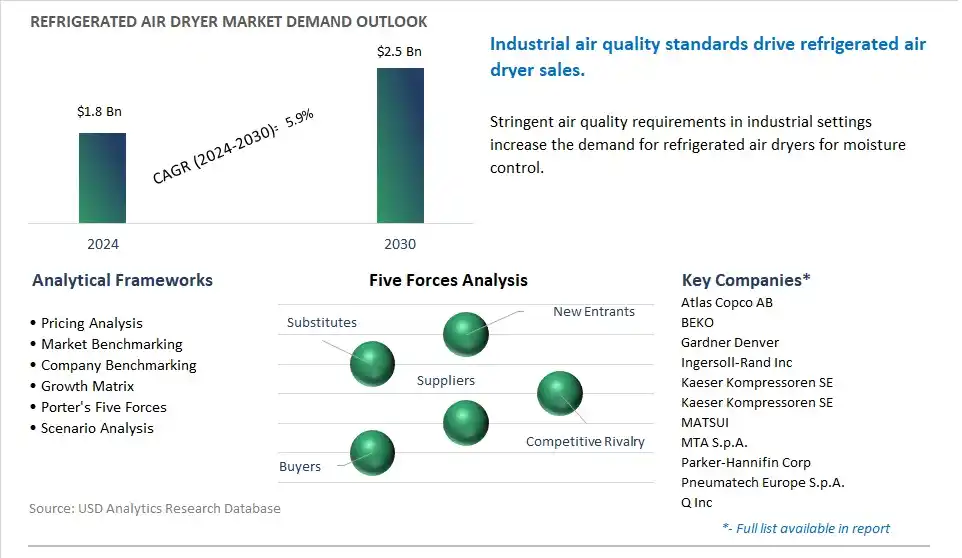
Refrigerated Air Dryer Market Competitive Landscape
The market report analyses the leading companies in the industry including Atlas Copco AB, BEKO, Gardner Denver, Ingersoll-Rand Inc, Kaeser Kompressoren SE, Kaeser Kompressoren SE, MATSUI, MTA S.p.A., Parker-Hannifin Corp, Pneumatech Europe S.p.A., Q Inc, RISHENG, Rotorcomp, SPX(Hankison), SULLAIR, Van Air.
Refrigerated Air Dryer Market Dynamics
Refrigerated Air Dryer Market Trend: Growing Demand for Energy-Efficient Solutions
One prominent trend in the refrigerated air dryer market is the growing demand for energy-efficient solutions. With increasing awareness of environmental sustainability and the need to reduce energy consumption, there is a rising preference for refrigerated air dryers that offer high efficiency and lower operating costs. Manufacturers are developing advanced technologies and designs to optimize energy usage, improve heat exchange efficiency, and enhance overall performance. Additionally, businesses are seeking energy-efficient solutions to comply with regulatory requirements, reduce carbon emissions, and lower operational expenses. The trend is driving innovation in refrigerated air dryer design and promoting the adoption of eco-friendly solutions in industrial air compression systems.
Refrigerated Air Dryer Market Driver: Industrial Expansion and Automation
The primary driver fueling the demand for refrigerated air dryers is industrial expansion and automation. With the growth of manufacturing, processing, and industrial sectors worldwide, there is a rising need for compressed air systems to support production processes and equipment operation. Refrigerated air dryers play a critical role in maintaining the quality and reliability of compressed air by removing moisture and contaminants, ensuring smooth operation of pneumatic tools, machinery, and instruments. Additionally, the trend towards automation and digitization in industrial settings increases the demand for reliable and consistent compressed air supply, driving investments in air treatment solutions such as refrigerated air dryers. The driver is propelled by industrial growth, infrastructure development, and the adoption of advanced manufacturing technologies, creating opportunities for suppliers of refrigerated air dryer systems and components.
Refrigerated Air Dryer Market Opportunity: Integration of Smart Technologies and IoT Connectivity
An attractive opportunity for the refrigerated air dryer market lies in the integration of smart technologies and IoT connectivity. By incorporating sensors, controls, and monitoring systems into refrigerated air dryer units, manufacturers can offer advanced features such as remote monitoring, predictive maintenance, and real-time performance optimization. Smart refrigerated air dryers can automatically adjust operating parameters based on air quality, temperature, and humidity levels, optimizing energy usage and minimizing downtime. Moreover, IoT connectivity enables data collection, analysis, and predictive insights, allowing businesses to proactively manage air dryer performance, identify potential issues, and optimize system efficiency. By embracing smart technologies, manufacturers can differentiate their products, improve customer value, and address the evolving needs of industrial users for reliable, energy-efficient air treatment solutions. This opportunity allows for innovation, market differentiation, and value creation in the competitive landscape of refrigerated air dryers, positioning companies as leaders in the era of Industry 4.0 and smart manufacturing.
Refrigerated Air Dryer Market Share Analysis: Non-cycling Refrigerated Air Dryers generated the highest revenue in 2024
In the refrigerated air dryer market, non-cycling refrigerated air dryers emerge as the largest segment, primarily. Non-cycling refrigerated air dryers operate continuously to remove moisture from compressed air systems, regardless of fluctuations in demand or load conditions. This continuous operation ensures consistent and reliable moisture removal, making non-cycling dryers suitable for applications where a steady supply of dry air is essential, such as manufacturing processes, pneumatic tools, and instrumentation. Additionally, non-cycling refrigerated air dryers are known for their simplicity, reliability, and energy efficiency compared to cycling dryers. They have lower initial costs and maintenance requirements, making them a preferred choice for a wide range of industrial and commercial applications. Further, advancements in refrigeration technology have improved the efficiency and performance of non-cycling dryers, further solidifying their dominance in the market. As industries prioritize energy efficiency and reliable air quality in compressed air systems, non-cycling refrigerated air dryers remain the preferred solution, positioning them as the largest segment in the refrigerated air dryer market.
Refrigerated Air Dryer Market Share Analysis: Food & Beverages segment is poised to register the fastest growth rate (CAGR) over the forecast period to 2030
Among the segments in the refrigerated air dryer market, the food and beverages sector is the fastest-growing segment. The food and beverages industry requires compressed air for various applications, including packaging, bottling, processing, and conveying. Moisture in compressed air can compromise the quality and safety of food and beverage products, leading to contamination, spoilage, and production downtime. Refrigerated air dryers play a critical role in removing moisture from compressed air systems, ensuring that the air used in food and beverage production remains clean, dry, and contaminant-free. Additionally, stringent regulations and quality standards in the food and beverages industry mandate the use of reliable air treatment solutions to maintain product integrity and compliance with hygiene standards. Further, the increasing demand for processed and packaged food products, driven by changing consumer lifestyles and preferences, has led to the expansion of production capacities in the food and beverages sector. As food and beverage manufacturers invest in modernizing their production facilities and enhancing product quality, the demand for refrigerated air dryers in this industry is expected to experience rapid growth, positioning it as a key driver of market expansion in the foreseeable future.
Refrigerated Air Dryer Market Report Segmentation
By Product
Cycling
Non-cycling
Others
By Application
Chemical
Paper
Food & beverages
Pharmaceutical
Healthcare
Others
Regions Included
North America (US, Canada, Mexico)
Europe (Germany, UK, France, Spain, Italy, Russia, Rest of Europe)
Asia Pacific (China, India, Japan, South Korea, Australia, South East Asia, Rest of Asia)
South America (Brazil, Argentina, Rest of South America)
Middle East and Africa (Saudi Arabia, UAE, Rest of Middle East, South Africa, Egypt, Rest of Africa)
Refrigerated Air Dryer Companies Profiled in the Market Study
Atlas Copco AB
BEKO
Gardner Denver
Ingersoll-Rand Inc
Kaeser Kompressoren SE
Kaeser Kompressoren SE
MATSUI
MTA S.p.A.
Parker-Hannifin Corp
Pneumatech Europe S.p.A.
Q Inc
RISHENG
Rotorcomp
SPX(Hankison)
SULLAIR
Van Air
*- List Not Exhaustive
TABLE OF CONTENTS
1 Introduction to 2024 Refrigerated Air Dryer Market
1.1 Market Overview
1.2 Quick Facts
1.3 Scope/Objective of the Study
1.4 Market Definition
1.5 Countries and Regions Covered
1.6 Units, Currency, and Conversions
1.7 Industry Value Chain
2 Research Methodology
2.1 Market Size Estimation
2.2 Sources and Research Methodology
2.3 Data Triangulation
2.4 Assumptions and Limitations
3 Executive Summary
3.1 Global Refrigerated Air Dryer Market Size Outlook, $ Million, 2021 to 2030
3.2 Refrigerated Air Dryer Market Outlook by Type, $ Million, 2021 to 2030
3.3 Refrigerated Air Dryer Market Outlook by Product, $ Million, 2021 to 2030
3.4 Refrigerated Air Dryer Market Outlook by Application, $ Million, 2021 to 2030
3.5 Refrigerated Air Dryer Market Outlook by Key Countries, $ Million, 2021 to 2030
4 Market Dynamics
4.1 Key Driving Forces of Refrigerated Air Dryer Industry
4.2 Key Market Trends in Refrigerated Air Dryer Industry
4.3 Potential Opportunities in Refrigerated Air Dryer Industry
4.4 Key Challenges in Refrigerated Air Dryer Industry
5 Market Factor Analysis
5.1 Value Chain Analysis
5.2 Competitive Landscape
5.2.1 Global Refrigerated Air Dryer Market Share by Company (%), 2023
5.2.2 Product Offerings by Company
5.3 Porter’s Five Forces Analysis
5.4 Pricing Analysis and Outlook
6 Growth Outlook Across Scenarios
6.1 Growth Analysis-Case Scenario Definitions
6.2 Low Growth Scenario Forecasts
6.3 Reference Growth Scenario Forecasts
6.4 High Growth Scenario Forecasts
7 Global Refrigerated Air Dryer Market Outlook by Segments
7.1 Refrigerated Air Dryer Market Outlook by Segments, $ Million, 2021- 2030
By Product
Cycling
Non-cycling
Others
By Application
Chemical
Paper
Food & beverages
Pharmaceutical
Healthcare
Others
8 North America Refrigerated Air Dryer Market Analysis and Outlook To 2030
8.1 Introduction to North America Refrigerated Air Dryer Markets in 2024
8.2 North America Refrigerated Air Dryer Market Size Outlook by Country, 2021-2030
8.2.1 United States
8.2.2 Canada
8.2.3 Mexico
8.3 North America Refrigerated Air Dryer Market size Outlook by Segments, 2021-2030
By Product
Cycling
Non-cycling
Others
By Application
Chemical
Paper
Food & beverages
Pharmaceutical
Healthcare
Others
9 Europe Refrigerated Air Dryer Market Analysis and Outlook To 2030
9.1 Introduction to Europe Refrigerated Air Dryer Markets in 2024
9.2 Europe Refrigerated Air Dryer Market Size Outlook by Country, 2021-2030
9.2.1 Germany
9.2.2 France
9.2.3 Spain
9.2.4 United Kingdom
9.2.4 Italy
9.2.5 Russia
9.2.6 Norway
9.2.7 Rest of Europe
9.3 Europe Refrigerated Air Dryer Market Size Outlook by Segments, 2021-2030
By Product
Cycling
Non-cycling
Others
By Application
Chemical
Paper
Food & beverages
Pharmaceutical
Healthcare
Others
10 Asia Pacific Refrigerated Air Dryer Market Analysis and Outlook To 2030
10.1 Introduction to Asia Pacific Refrigerated Air Dryer Markets in 2024
10.2 Asia Pacific Refrigerated Air Dryer Market Size Outlook by Country, 2021-2030
10.2.1 China
10.2.2 India
10.2.3 Japan
10.2.4 South Korea
10.2.5 Indonesia
10.2.6 Malaysia
10.2.7 Australia
10.2.8 Rest of Asia Pacific
10.3 Asia Pacific Refrigerated Air Dryer Market size Outlook by Segments, 2021-2030
By Product
Cycling
Non-cycling
Others
By Application
Chemical
Paper
Food & beverages
Pharmaceutical
Healthcare
Others
11 South America Refrigerated Air Dryer Market Analysis and Outlook To 2030
11.1 Introduction to South America Refrigerated Air Dryer Markets in 2024
11.2 South America Refrigerated Air Dryer Market Size Outlook by Country, 2021-2030
11.2.1 Brazil
11.2.2 Argentina
11.2.3 Rest of South America
11.3 South America Refrigerated Air Dryer Market size Outlook by Segments, 2021-2030
By Product
Cycling
Non-cycling
Others
By Application
Chemical
Paper
Food & beverages
Pharmaceutical
Healthcare
Others
12 Middle East and Africa Refrigerated Air Dryer Market Analysis and Outlook To 2030
12.1 Introduction to Middle East and Africa Refrigerated Air Dryer Markets in 2024
12.2 Middle East and Africa Refrigerated Air Dryer Market Size Outlook by Country, 2021-2030
12.2.1 Saudi Arabia
12.2.2 UAE
12.2.3 Oman
12.2.4 Rest of Middle East
12.2.5 Egypt
12.2.6 Nigeria
12.2.7 South Africa
12.2.8 Rest of Africa
12.3 Middle East and Africa Refrigerated Air Dryer Market size Outlook by Segments, 2021-2030
By Product
Cycling
Non-cycling
Others
By Application
Chemical
Paper
Food & beverages
Pharmaceutical
Healthcare
Others
13 Company Profiles
13.1 Company Snapshot
13.2 SWOT Profiles
13.3 Products and Services
13.4 Recent Developments
13.5 Financial Profile
Atlas Copco AB
BEKO
Gardner Denver
Ingersoll-Rand Inc
Kaeser Kompressoren SE
Kaeser Kompressoren SE
MATSUI
MTA S.p.A.
Parker-Hannifin Corp
Pneumatech Europe S.p.A.
Q Inc
RISHENG
Rotorcomp
SPX(Hankison)
SULLAIR
Van Air
14 Appendix
14.1 Customization Offerings
14.2 Subscription Services
14.3 Related Reports
14.4 Publisher Expertise
By Product
Cycling
Non-cycling
Others
By Application
Chemical
Paper
Food & beverages
Pharmaceutical
Healthcare
Others
Countries Analyzed
North America (US, Canada, Mexico)
Europe (Germany, UK, France, Spain, Italy, Russia, Rest of Europe)
Asia Pacific (China, India, Japan, South Korea, Australia, South East Asia, Rest of Asia)
South America (Brazil, Argentina, Rest of South America)
Middle East and Africa (Saudi Arabia, UAE, Rest of Middle East, South Africa, Egypt, Rest of Africa)
