The global Rubber Compound Market is poised to register a 6.2% CAGR from $9.5 Billion in 2024 to $13.6 Billion in 2030.
The global Rubber Compound Market Study analyzes and forecasts the market size across 6 regions and 24 countries for diverse segments -By Type (EPDM Compounding, SBR Compounding, BR Compounding, Natural Rubber Compounding, NBR Compounding, Others), By Application (Tires, Roofing and geomembranes, Wires and cables, Footwear, Hose and belting).
An Introduction to Global Rubber Compound Market in 2024
The rubber compound market is witnessing steady growth driven by increasing demand across various industries such as automotive, aerospace, construction, and consumer goods. Key trends shaping the future of the industry include the rising adoption of high-performance rubber compounds for their superior mechanical properties, chemical resistance, and durability in diverse applications such as tires, seals, gaskets, hoses, and industrial components. Moreover, there's a growing emphasis on sustainability, with manufacturers investing in bio-based and recycled rubber materials to reduce environmental impact and meet regulatory requirements for sustainable sourcing and manufacturing practices. Additionally, advancements in compounding technologies, polymer blending, and vulcanization processes are driving innovation in rubber compound formulations, enabling manufacturers to tailor material properties, optimize processing parameters, and enhance product performance while reducing production costs and time-to-market, thereby fueling market growth and competitiveness in the global rubber compound market.
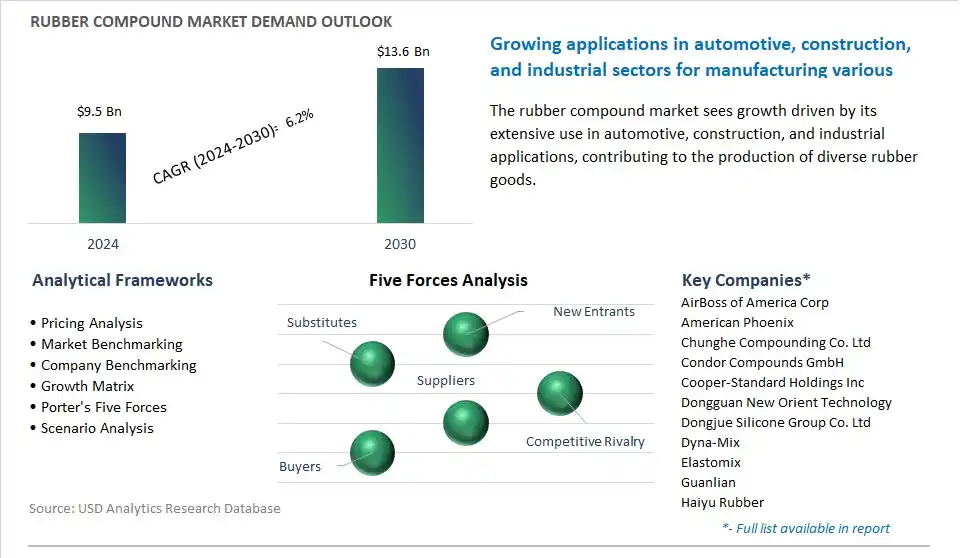
Rubber Compound Market Competitive Landscape
The market report analyses the leading companies in the industry including AirBoss of America Corp, American Phoenix, Chunghe Compounding Co. Ltd, Condor Compounds GmbH, Cooper-Standard Holdings Inc, Dongguan New Orient Technology, Dongjue Silicone Group Co. Ltd, Dyna-Mix, Elastomix, Guanlian, Haiyu Rubber, Hexpol Compounding LLC, Hutchinson S.A., Katosansho, KRAIBURG Holding GmbH, PHOENIX Compounding Technology GmbH & Co. KG, Polymer-Technik Elbe GmbH, Shin-Etsu, Siamnavakam, TSRC.
Rubber Compound Market Dynamics
Rubber Compound Market Trend: Rising Demand for High-Performance and Specialty Rubber Compounds
A prominent market trend in rubber compounds is the rising demand for high-performance and specialty formulations driven by the need for advanced materials in various industries. Rubber compounds, which consist of a blend of elastomers, fillers, plasticizers, and additives, play a crucial role in the manufacturing of rubber products such as tires, seals, gaskets, hoses, and industrial components. As end-users increasingly require rubber materials with specific properties such as enhanced durability, abrasion resistance, chemical resistance, and temperature stability, there is a growing demand for custom-formulated rubber compounds tailored to meet these stringent requirements. This trend is reshaping the rubber compound market, driving innovation in formulation technologies and the development of specialty compounds to address the evolving needs of diverse applications and industries.
Rubber Compound Market Driver: Growth in Automotive and Transportation Industries
The market for rubber compounds is being driven by the growth in the automotive and transportation industries, which are major consumers of rubber products for vehicle manufacturing and aftermarket applications. With increasing vehicle production, rising vehicle ownership rates, and growing demand for electric and autonomous vehicles, there is a steady demand for tires, automotive seals, hoses, and other rubber components. Rubber compounds are essential materials used in tire manufacturing to achieve optimal performance, safety, and longevity on the road. Additionally, the transportation sector relies on rubber products for various applications such as railway track pads, conveyor belts, and marine fender systems. As automotive and transportation industries continue to expand globally, the demand for rubber compounds is expected to remain strong, driving growth in the market.
Rubber Compound Market Opportunity: Development of Sustainable and Eco-Friendly Formulations
A potential opportunity for the rubber compound market lies in the development of sustainable and eco-friendly formulations to address environmental concerns and regulatory requirements. Opportunities exist for rubber compound manufacturers to innovate in material science and formulation technologies to reduce the environmental footprint of rubber products and enhance their sustainability credentials. This includes the use of bio-based elastomers, recycled rubber materials, and eco-friendly additives to create environmentally responsible rubber compounds with reduced carbon emissions and energy consumption throughout the product lifecycle. Additionally, there is growing demand for rubber compounds that meet eco-label certifications and comply with regulations related to hazardous substances and waste management. By investing in the development of sustainable formulations, rubber compound suppliers can differentiate their products, attract environmentally conscious customers, and capitalize on opportunities in the green materials market.
Rubber Compound Market Share Analysis: The NBR Compounding segment is poised to register the fastest growth rate (CAGR) over the forecast period to 2030
NBR (Nitrile Butadiene Rubber) Compounding stands out as one of the fastest-growing segments in the Rubber Compound Market. NBR is a synthetic rubber known for its excellent resistance to oil, fuel, and other chemicals, making it indispensable in industries such as automotive, oil and gas, and aerospace. The increasing demand for NBR compounds is driven by to its versatility, durability, and adaptability to various industrial applications. With the rise in automotive production, particularly in emerging economies, the demand for NBR compounds for manufacturing components such as hoses, seals, and gaskets is experiencing significant growth. Further, stringent regulations regarding automotive emissions and fuel efficiency are driving the adoption of NBR compounds in the production of fuel-resistant components. Additionally, the expanding oil and gas industry, coupled with the need for reliable sealing solutions in harsh operating environments, further fuels the demand for NBR compounds. As industries continue to prioritize performance, efficiency, and sustainability, the NBR Compounding segment is poised for continued rapid growth in the global Rubber Compound Market.
Rubber Compound Market Share Analysis: The Tires segment is poised to register the fastest growth rate (CAGR) over the forecast period to 2030
the fastest-growing segment in the Rubber Compound Market is the Tires segment. The tire industry is experiencing rapid growth. The automotive industry is expanding globally, especially in emerging markets where rising disposable incomes are increasing the demand for vehicles. This surge in automotive production directly translates into increased demand for tires. Additionally, there is a growing trend towards the adoption of electric vehicles (EVs), which require specialized tires for their unique performance requirements, contributing to the growth of the tire segment. Furthermore, there is an increasing focus on sustainability and environmental consciousness, leading to the development of eco-friendly tires with improved fuel efficiency and reduced carbon emissions. These factors, combined with advancements in tire technology such as the integration of sensors for smart tires, further propel the growth of the tire segment in the Rubber Compound Market.
Rubber Compound Market Report Segmentation
By Type
EPDM Compounding
SBR Compounding
BR Compounding
Natural Rubber Compounding
NBR Compounding
Others
By Application
Tires
Roofing and geomembranes
Wires and cables
Footwear
Hose and belting
Regions Included
North America (US, Canada, Mexico)
Europe (Germany, UK, France, Spain, Italy, Russia, Rest of Europe)
Asia Pacific (China, India, Japan, South Korea, Australia, South East Asia, Rest of Asia)
South America (Brazil, Argentina, Rest of South America)
Middle East and Africa (Saudi Arabia, UAE, Rest of Middle East, South Africa, Egypt, Rest of Africa)
Rubber Compound Companies Profiled in the Market Study
AirBoss of America Corp
American Phoenix
Chunghe Compounding Co. Ltd
Condor Compounds GmbH
Cooper-Standard Holdings Inc
Dongguan New Orient Technology
Dongjue Silicone Group Co. Ltd
Dyna-Mix
Elastomix
Guanlian
Haiyu Rubber
Hexpol Compounding LLC
Hutchinson S.A.
Katosansho
KRAIBURG Holding GmbH
PHOENIX Compounding Technology GmbH & Co. KG
Polymer-Technik Elbe GmbH
Shin-Etsu
Siamnavakam
TSRC
*- List Not Exhaustive
TABLE OF CONTENTS
1 Introduction to 2024 Rubber Compound Market
1.1 Market Overview
1.2 Quick Facts
1.3 Scope/Objective of the Study
1.4 Market Definition
1.5 Countries and Regions Covered
1.6 Units, Currency, and Conversions
1.7 Industry Value Chain
2 Research Methodology
2.1 Market Size Estimation
2.2 Sources and Research Methodology
2.3 Data Triangulation
2.4 Assumptions and Limitations
3 Executive Summary
3.1 Global Rubber Compound Market Size Outlook, $ Million, 2021 to 2030
3.2 Rubber Compound Market Outlook by Type, $ Million, 2021 to 2030
3.3 Rubber Compound Market Outlook by Product, $ Million, 2021 to 2030
3.4 Rubber Compound Market Outlook by Application, $ Million, 2021 to 2030
3.5 Rubber Compound Market Outlook by Key Countries, $ Million, 2021 to 2030
4 Market Dynamics
4.1 Key Driving Forces of Rubber Compound Industry
4.2 Key Market Trends in Rubber Compound Industry
4.3 Potential Opportunities in Rubber Compound Industry
4.4 Key Challenges in Rubber Compound Industry
5 Market Factor Analysis
5.1 Value Chain Analysis
5.2 Competitive Landscape
5.2.1 Global Rubber Compound Market Share by Company (%), 2023
5.2.2 Product Offerings by Company
5.3 Porter’s Five Forces Analysis
5.4 Pricing Analysis and Outlook
6 Growth Outlook Across Scenarios
6.1 Growth Analysis-Case Scenario Definitions
6.2 Low Growth Scenario Forecasts
6.3 Reference Growth Scenario Forecasts
6.4 High Growth Scenario Forecasts
7 Global Rubber Compound Market Outlook by Segments
7.1 Rubber Compound Market Outlook by Segments, $ Million, 2021- 2030
By Type
EPDM Compounding
SBR Compounding
BR Compounding
Natural Rubber Compounding
NBR Compounding
Others
By Application
Tires
Roofing and geomembranes
Wires and cables
Footwear
Hose and belting
8 North America Rubber Compound Market Analysis and Outlook To 2030
8.1 Introduction to North America Rubber Compound Markets in 2024
8.2 North America Rubber Compound Market Size Outlook by Country, 2021-2030
8.2.1 United States
8.2.2 Canada
8.2.3 Mexico
8.3 North America Rubber Compound Market size Outlook by Segments, 2021-2030
By Type
EPDM Compounding
SBR Compounding
BR Compounding
Natural Rubber Compounding
NBR Compounding
Others
By Application
Tires
Roofing and geomembranes
Wires and cables
Footwear
Hose and belting
9 Europe Rubber Compound Market Analysis and Outlook To 2030
9.1 Introduction to Europe Rubber Compound Markets in 2024
9.2 Europe Rubber Compound Market Size Outlook by Country, 2021-2030
9.2.1 Germany
9.2.2 France
9.2.3 Spain
9.2.4 United Kingdom
9.2.4 Italy
9.2.5 Russia
9.2.6 Norway
9.2.7 Rest of Europe
9.3 Europe Rubber Compound Market Size Outlook by Segments, 2021-2030
By Type
EPDM Compounding
SBR Compounding
BR Compounding
Natural Rubber Compounding
NBR Compounding
Others
By Application
Tires
Roofing and geomembranes
Wires and cables
Footwear
Hose and belting
10 Asia Pacific Rubber Compound Market Analysis and Outlook To 2030
10.1 Introduction to Asia Pacific Rubber Compound Markets in 2024
10.2 Asia Pacific Rubber Compound Market Size Outlook by Country, 2021-2030
10.2.1 China
10.2.2 India
10.2.3 Japan
10.2.4 South Korea
10.2.5 Indonesia
10.2.6 Malaysia
10.2.7 Australia
10.2.8 Rest of Asia Pacific
10.3 Asia Pacific Rubber Compound Market size Outlook by Segments, 2021-2030
By Type
EPDM Compounding
SBR Compounding
BR Compounding
Natural Rubber Compounding
NBR Compounding
Others
By Application
Tires
Roofing and geomembranes
Wires and cables
Footwear
Hose and belting
11 South America Rubber Compound Market Analysis and Outlook To 2030
11.1 Introduction to South America Rubber Compound Markets in 2024
11.2 South America Rubber Compound Market Size Outlook by Country, 2021-2030
11.2.1 Brazil
11.2.2 Argentina
11.2.3 Rest of South America
11.3 South America Rubber Compound Market size Outlook by Segments, 2021-2030
By Type
EPDM Compounding
SBR Compounding
BR Compounding
Natural Rubber Compounding
NBR Compounding
Others
By Application
Tires
Roofing and geomembranes
Wires and cables
Footwear
Hose and belting
12 Middle East and Africa Rubber Compound Market Analysis and Outlook To 2030
12.1 Introduction to Middle East and Africa Rubber Compound Markets in 2024
12.2 Middle East and Africa Rubber Compound Market Size Outlook by Country, 2021-2030
12.2.1 Saudi Arabia
12.2.2 UAE
12.2.3 Oman
12.2.4 Rest of Middle East
12.2.5 Egypt
12.2.6 Nigeria
12.2.7 South Africa
12.2.8 Rest of Africa
12.3 Middle East and Africa Rubber Compound Market size Outlook by Segments, 2021-2030
By Type
EPDM Compounding
SBR Compounding
BR Compounding
Natural Rubber Compounding
NBR Compounding
Others
By Application
Tires
Roofing and geomembranes
Wires and cables
Footwear
Hose and belting
13 Company Profiles
13.1 Company Snapshot
13.2 SWOT Profiles
13.3 Products and Services
13.4 Recent Developments
13.5 Financial Profile
AirBoss of America Corp
American Phoenix
Chunghe Compounding Co. Ltd
Condor Compounds GmbH
Cooper-Standard Holdings Inc
Dongguan New Orient Technology
Dongjue Silicone Group Co. Ltd
Dyna-Mix
Elastomix
Guanlian
Haiyu Rubber
Hexpol Compounding LLC
Hutchinson S.A.
Katosansho
KRAIBURG Holding GmbH
PHOENIX Compounding Technology GmbH & Co. KG
Polymer-Technik Elbe GmbH
Shin-Etsu
Siamnavakam
TSRC
14 Appendix
14.1 Customization Offerings
14.2 Subscription Services
14.3 Related Reports
14.4 Publisher Expertise
By Type
EPDM Compounding
SBR Compounding
BR Compounding
Natural Rubber Compounding
NBR Compounding
Others
By Application
Tires
Roofing and geomembranes
Wires and cables
Footwear
Hose and belting
Countries Analyzed
North America (US, Canada, Mexico)
Europe (Germany, UK, France, Spain, Italy, Russia, Rest of Europe)
Asia Pacific (China, India, Japan, South Korea, Australia, South East Asia, Rest of Asia)
South America (Brazil, Argentina, Rest of South America)
Middle East and Africa (Saudi Arabia, UAE, Rest of Middle East, South Africa, Egypt, Rest of Africa)
