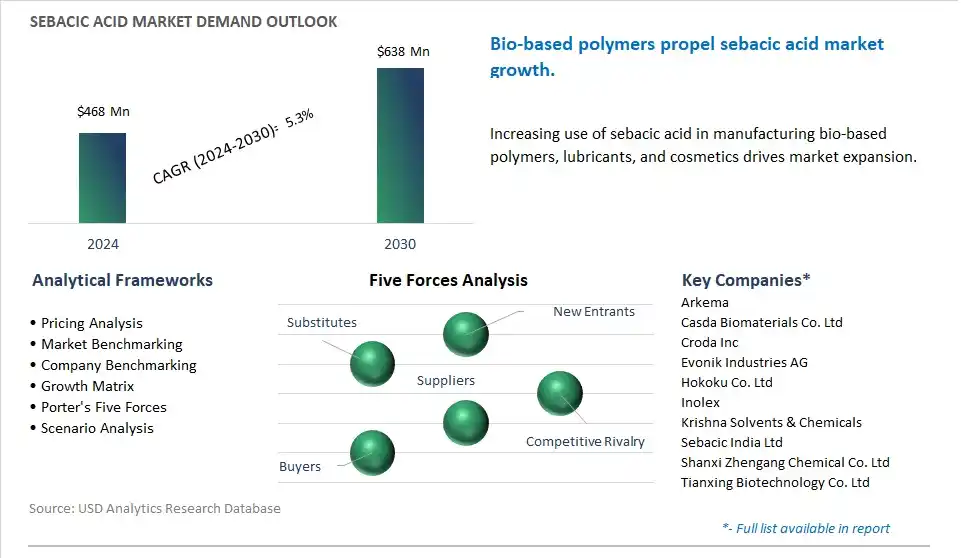
The global Sebacic Acid Market is poised to register a 5.3% CAGR from $468 Million in 2024 to $638 Million in 2030.
The global Sebacic Acid Market Study analyzes and forecasts the market size across 6 regions and 24 countries for diverse segments -By Source (Castor Oil, Adipic Acid ), By Application (Personal Care & Cosmetics, Lubricants & Greases, Metalworking Fluids).
An Introduction to Global Sebacic Acid Market in 2024
The future of sebacic acid is influenced by key trends such as green chemistry, renewable chemicals, and industrial applications in polymers, lubricants, and personal care products. Sebacic acid, a dicarboxylic acid derived from castor oil or adipic acid, is used as a monomer in the production of polyesters, polyamides, and specialty chemicals. With growing emphasis on sustainability and circular economy principles, there is an increasing demand for bio-based and renewable alternatives to petroleum-based chemicals in various industries. Sebacic acid offers a sustainable solution as a renewable building block for polymer synthesis, providing advantages such as biodegradability, non-toxicity, and compatibility with existing industrial processes. Moreover, sebacic acid derivatives find applications in lubricants, plasticizers, and corrosion inhibitors, offering performance benefits such as thermal stability, lubricity, and corrosion resistance in automotive, aerospace, and industrial applications. Additionally, sebacic acid is used in personal care products such as cosmetics, toiletries, and pharmaceuticals as an emollient, moisturizer, and film-forming agent, enhancing product texture, skin feel, and stability. Furthermore, as governments and industries worldwide prioritize sustainable development goals and reduce reliance on fossil fuels, the demand for sebacic acid and its derivatives is expected to grow, driving investment in bio-based chemical production, renewable feedstock sourcing, and green manufacturing technologies. As the chemical industry transitions towards a more sustainable and circular economy model, sebacic acid will play a significant role as a versatile and eco-friendly chemical building block with diverse applications across industrial sectors.
Sebacic Acid Market Competitive Landscape
The market report analyses the leading companies in the industry including Arkema, Casda Biomaterials Co. Ltd, Croda Inc, Evonik Industries AG, Hokoku Co. Ltd, Inolex, Krishna Solvents & Chemicals, Sebacic India Ltd, Shanxi Zhengang Chemical Co. Ltd, Tianxing Biotechnology Co. Ltd.
Sebacic Acid Market Dynamics
Sebacic Acid Market Trend: Growing Demand for Sustainable and Bio-based Chemicals
A significant trend in the market for sebacic acid is the growing demand for sustainable and bio-based chemicals. As industries seek to reduce their environmental footprint and transition towards greener alternatives, there is increasing interest in bio-derived chemicals such as sebacic acid, which can be produced from renewable feedstocks such as castor oil. Sebacic acid finds applications in various industries including polymers, textiles, lubricants, and cosmetics, offering a renewable and eco-friendly alternative to petroleum-based chemicals. The trend towards sustainability is driving the demand for sebacic acid as a key ingredient in the production of biodegradable polymers, sustainable lubricants, and green cosmetics formulations.
Sebacic Acid Market Driver: Expanding Applications in Polymers and Green Technologies
A primary driver for the market of sebacic acid is the expanding applications in polymers and green technologies. Sebacic acid is a versatile chemical intermediate used in the synthesis of various polymers such as polyamides, polyesters, and polyurethanes, where it imparts desirable properties such as flexibility, durability, and chemical resistance. With the growing demand for high-performance and sustainable materials in industries such as automotive, electronics, packaging, and construction, there is increasing use of sebacic acid-based polymers in applications such as automotive parts, electronic components, and biodegradable packaging materials. Additionally, sebacic acid serves as a precursor for the production of green technologies such as bio-based plastics, renewable lubricants, and eco-friendly additives, driving its demand in the green chemistry sector.
Sebacic Acid Market Opportunity: Innovation in Sustainable Product Development and Applications
An opportunity in the market for sebacic acid lies in innovation in sustainable product development and applications. Manufacturers can invest in research and development to explore new applications and formulations of sebacic acid-based products that meet the evolving needs of customers and address market trends towards sustainability. There is opportunity to develop novel biodegradable polymers, green lubricants, and eco-friendly additives using sebacic acid as a key building block, catering to industries seeking sustainable alternatives to conventional chemicals. By innovating with sustainable product solutions and applications, manufacturers aim to gain market shares in the market, capture new opportunities, and contribute to the transition towards a more sustainable and environmentally friendly future.
Sebacic Acid Market Share Analysis: Castor Oil source segment generated the highest revenue in 2024
castor oil is the primary source of sebacic acid production, accounting for the majority of global sebacic acid output. Sebacic acid is derived from the hydrolysis of castor oil, a renewable and abundant vegetable oil obtained from the seeds of the castor bean plant (Ricinus communis). Castor oil is widely available in many regions of the world, particularly in countries with suitable climates for castor bean cultivation. Additionally, castor oil offers potential advantages as a feedstock for sebacic acid production, including its high content of ricinoleic acid, which can be easily converted into sebacic acid through a series of chemical reactions. Further, castor oil-based sebacic acid is preferred by manufacturers and end-users due to its high purity, low cost, and favorable environmental profile. Furthermore, the versatility of castor oil as a feedstock allows for the production of a wide range of sebacic acid derivatives used in various industries, including plastics, textiles, lubricants, and cosmetics. These factors collectively contribute to the dominance of the Castor Oil source segment in the Sebacic Acid Market.
Sebacic Acid Market Share Analysis: Personal Care & Cosmetics application segment is poised to register the fastest growth rate (CAGR) over the forecast period to 2030
there is a growing consumer demand for natural and sustainable ingredients in personal care and cosmetic products, driving the adoption of sebacic acid as a key ingredient in formulations. Sebacic acid offers Diverse benefits for skincare and cosmetic applications, including its moisturizing and emollient properties, which help to hydrate and soften the skin. Additionally, sebacic acid can act as a sebum regulator, making it suitable for products targeting oily or acne-prone skin. Further, sebacic acid is non-toxic, non-irritating, and biodegradable, making it a preferred choice for manufacturers seeking eco-friendly alternatives to synthetic ingredients. Furthermore, the versatility of sebacic acid allows for its use in a wide range of personal care and cosmetic products, including moisturizers, creams, lotions, lipsticks, and hair care products. These factors, combined with increasing consumer awareness of the benefits of natural skincare ingredients, contribute to the rapid growth of the Personal Care & Cosmetics application segment in the Sebacic Acid Market.
Sebacic Acid Market Report Segmentation
By Source
Castor Oil
Adipic Acid
By Application
Personal Care & Cosmetics
Lubricants & Greases
Metalworking Fluids
Regions Included
North America (US, Canada, Mexico)
Europe (Germany, UK, France, Spain, Italy, Russia, Rest of Europe)
Asia Pacific (China, India, Japan, South Korea, Australia, South East Asia, Rest of Asia)
South America (Brazil, Argentina, Rest of South America)
Middle East and Africa (Saudi Arabia, UAE, Rest of Middle East, South Africa, Egypt, Rest of Africa)
Sebacic Acid Companies Profiled in the Market Study
Arkema
Casda Biomaterials Co. Ltd
Croda Inc
Evonik Industries AG
Hokoku Co. Ltd
Inolex
Krishna Solvents & Chemicals
Sebacic India Ltd
Shanxi Zhengang Chemical Co. Ltd
Tianxing Biotechnology Co. Ltd
*- List Not Exhaustive
TABLE OF CONTENTS
1 Introduction to 2024 Sebacic Acid Market
1.1 Market Overview
1.2 Quick Facts
1.3 Scope/Objective of the Study
1.4 Market Definition
1.5 Countries and Regions Covered
1.6 Units, Currency, and Conversions
1.7 Industry Value Chain
2 Research Methodology
2.1 Market Size Estimation
2.2 Sources and Research Methodology
2.3 Data Triangulation
2.4 Assumptions and Limitations
3 Executive Summary
3.1 Global Sebacic Acid Market Size Outlook, $ Million, 2021 to 2030
3.2 Sebacic Acid Market Outlook by Type, $ Million, 2021 to 2030
3.3 Sebacic Acid Market Outlook by Product, $ Million, 2021 to 2030
3.4 Sebacic Acid Market Outlook by Application, $ Million, 2021 to 2030
3.5 Sebacic Acid Market Outlook by Key Countries, $ Million, 2021 to 2030
4 Market Dynamics
4.1 Key Driving Forces of Sebacic Acid Industry
4.2 Key Market Trends in Sebacic Acid Industry
4.3 Potential Opportunities in Sebacic Acid Industry
4.4 Key Challenges in Sebacic Acid Industry
5 Market Factor Analysis
5.1 Value Chain Analysis
5.2 Competitive Landscape
5.2.1 Global Sebacic Acid Market Share by Company (%), 2023
5.2.2 Product Offerings by Company
5.3 Porter’s Five Forces Analysis
5.4 Pricing Analysis and Outlook
6 Growth Outlook Across Scenarios
6.1 Growth Analysis-Case Scenario Definitions
6.2 Low Growth Scenario Forecasts
6.3 Reference Growth Scenario Forecasts
6.4 High Growth Scenario Forecasts
7 Global Sebacic Acid Market Outlook by Segments
7.1 Sebacic Acid Market Outlook by Segments, $ Million, 2021- 2030
By Source
Castor Oil
Adipic Acid
By Application
Personal Care & Cosmetics
Lubricants & Greases
Metalworking Fluids
8 North America Sebacic Acid Market Analysis and Outlook To 2030
8.1 Introduction to North America Sebacic Acid Markets in 2024
8.2 North America Sebacic Acid Market Size Outlook by Country, 2021-2030
8.2.1 United States
8.2.2 Canada
8.2.3 Mexico
8.3 North America Sebacic Acid Market size Outlook by Segments, 2021-2030
By Source
Castor Oil
Adipic Acid
By Application
Personal Care & Cosmetics
Lubricants & Greases
Metalworking Fluids
9 Europe Sebacic Acid Market Analysis and Outlook To 2030
9.1 Introduction to Europe Sebacic Acid Markets in 2024
9.2 Europe Sebacic Acid Market Size Outlook by Country, 2021-2030
9.2.1 Germany
9.2.2 France
9.2.3 Spain
9.2.4 United Kingdom
9.2.4 Italy
9.2.5 Russia
9.2.6 Norway
9.2.7 Rest of Europe
9.3 Europe Sebacic Acid Market Size Outlook by Segments, 2021-2030
By Source
Castor Oil
Adipic Acid
By Application
Personal Care & Cosmetics
Lubricants & Greases
Metalworking Fluids
10 Asia Pacific Sebacic Acid Market Analysis and Outlook To 2030
10.1 Introduction to Asia Pacific Sebacic Acid Markets in 2024
10.2 Asia Pacific Sebacic Acid Market Size Outlook by Country, 2021-2030
10.2.1 China
10.2.2 India
10.2.3 Japan
10.2.4 South Korea
10.2.5 Indonesia
10.2.6 Malaysia
10.2.7 Australia
10.2.8 Rest of Asia Pacific
10.3 Asia Pacific Sebacic Acid Market size Outlook by Segments, 2021-2030
By Source
Castor Oil
Adipic Acid
By Application
Personal Care & Cosmetics
Lubricants & Greases
Metalworking Fluids
11 South America Sebacic Acid Market Analysis and Outlook To 2030
11.1 Introduction to South America Sebacic Acid Markets in 2024
11.2 South America Sebacic Acid Market Size Outlook by Country, 2021-2030
11.2.1 Brazil
11.2.2 Argentina
11.2.3 Rest of South America
11.3 South America Sebacic Acid Market size Outlook by Segments, 2021-2030
By Source
Castor Oil
Adipic Acid
By Application
Personal Care & Cosmetics
Lubricants & Greases
Metalworking Fluids
12 Middle East and Africa Sebacic Acid Market Analysis and Outlook To 2030
12.1 Introduction to Middle East and Africa Sebacic Acid Markets in 2024
12.2 Middle East and Africa Sebacic Acid Market Size Outlook by Country, 2021-2030
12.2.1 Saudi Arabia
12.2.2 UAE
12.2.3 Oman
12.2.4 Rest of Middle East
12.2.5 Egypt
12.2.6 Nigeria
12.2.7 South Africa
12.2.8 Rest of Africa
12.3 Middle East and Africa Sebacic Acid Market size Outlook by Segments, 2021-2030
By Source
Castor Oil
Adipic Acid
By Application
Personal Care & Cosmetics
Lubricants & Greases
Metalworking Fluids
13 Company Profiles
13.1 Company Snapshot
13.2 SWOT Profiles
13.3 Products and Services
13.4 Recent Developments
13.5 Financial Profile
Arkema
Casda Biomaterials Co. Ltd
Croda Inc
Evonik Industries AG
Hokoku Co. Ltd
Inolex
Krishna Solvents & Chemicals
Sebacic India Ltd
Shanxi Zhengang Chemical Co. Ltd
Tianxing Biotechnology Co. Ltd
14 Appendix
14.1 Customization Offerings
14.2 Subscription Services
14.3 Related Reports
14.4 Publisher Expertise
By Source
Castor Oil
Adipic Acid
By Application
Personal Care & Cosmetics
Lubricants & Greases
Metalworking Fluids
Countries Analyzed
North America (US, Canada, Mexico)
Europe (Germany, UK, France, Spain, Italy, Russia, Rest of Europe)
Asia Pacific (China, India, Japan, South Korea, Australia, South East Asia, Rest of Asia)
South America (Brazil, Argentina, Rest of South America)
Middle East and Africa (Saudi Arabia, UAE, Rest of Middle East, South Africa, Egypt, Rest of Africa)
