Ultra-High Growth Driven by Smart Materials, Lifecycle Durability, and Regulatory Shifts
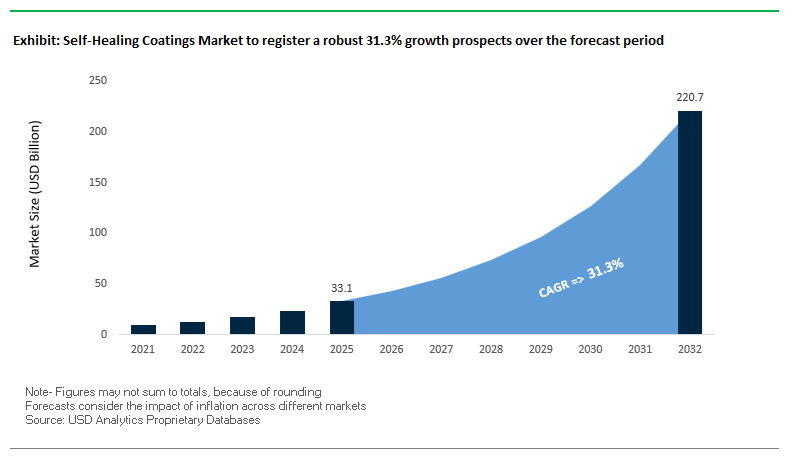
The global Self-Healing Coatings Market is entering a phase of exponential expansion, transitioning from niche innovation to mainstream industrial adoption across automotive, aerospace, marine, electronics, and infrastructure sectors. The market was valued at $33.1 billion in 2025 and is forecast to reach $222.7 billion by 2032, registering a remarkable CAGR of 31.3% during 2025–2032. This accelerated growth reflects a fundamental shift toward intelligent, autonomous material systems capable of repairing damage, extending asset life, and reducing maintenance costs.
A primary growth catalyst is the increasing demand for lifecycle durability and cost optimization. Self-healing coatings, enabled by technologies such as microencapsulation, reversible polymer networks, and intrinsic healing chemistries, allow materials to recover from scratches, corrosion, and mechanical stress without external intervention. This capability significantly reduces downtime, maintenance frequency, and total cost of ownership, making these coatings highly attractive for high-value assets such as aircraft, EV components, offshore infrastructure, and critical industrial equipment.
Regulatory frameworks are further accelerating adoption. The implementation of the ISO 14001:2026 “Life Cycle Perspective” update has positioned durability and environmental impact as central compliance metrics. Manufacturers are increasingly deploying self-healing formulations as a strategic response to lifecycle sustainability mandates, enabling longer service intervals and reduced material consumption. This aligns with broader ESG goals, including carbon footprint reduction and resource efficiency.
Another structural driver is the rapid electrification of transportation and the expansion of advanced electronics ecosystems, which require coatings capable of maintaining performance under extreme thermal, chemical, and mechanical conditions. Self-healing coatings are emerging as a critical solution for corrosion protection, thermal stability, and safety enhancement, particularly in EV batteries and semiconductor environments. Overall, the market is evolving toward high-performance, intelligent coatings that integrate durability, sustainability, and advanced functionality.
Market Analysis: Aerospace R&D Expansion, EV Battery Applications, and Microencapsulation Breakthroughs Accelerating Commercialization
The competitive landscape of the self-healing coatings market is defined by intensive R&D investments, strategic acquisitions, and rapid commercialization of advanced chemistries, signaling a transition from experimental technologies to scalable industrial solutions. In March 2026, AkzoNobel completed a €50 million upgrade to its aerospace coatings facility in Waukegan, Illinois, specifically aimed at accelerating the production of “smart” coatings, including self-healing systems for commercial aviation. This investment highlights the growing importance of self-healing technologies in high-value, safety-critical applications.
Material innovation is also advancing through bio-circular and high-performance polymer integration. BASF’s March 2026 expansion of its Ultrason® portfolio incorporates bio-based feedstocks compatible with self-healing additives, particularly targeting medical devices and electrical and electronics applications. This reflects a broader industry trend toward combining sustainability with advanced functional performance.
In the automotive and energy sectors, EV battery protection is emerging as a key application area. Jotun’s June 2025 launch of specialized powder coatings for EV batteries demonstrates the integration of mechanical resistance, corrosion protection, and damage mitigation, reducing risks such as thermal runaway. Complementing this, the U.S. Department of Energy’s $51.7 million funding allocation (December 2024) is accelerating collaborative research with major manufacturers to develop self-healing coatings that enhance vehicle durability and reduce lifecycle costs.
Technological breakthroughs in microencapsulation-based healing systems are driving commercialization. PPG’s expansion of its industrial epoxy portfolio in 2025 integrates advanced self-healing agents capable of autonomously repairing microcracks and corrosion pathways, particularly in heavy infrastructure and industrial environments. Similarly, Autonomic Materials’ January 2025 commercialization of low-VOC waterborne self-healing additives marks a critical advancement, enabling autonomous corrosion repair in environmentally compliant water-based systems, a segment historically limited by performance constraints.
Strategic consolidation and regional expansion are further strengthening market positioning. AkzoNobel’s March 2025 acquisition of its India-based powder coatings business and R&D center consolidates innovation capabilities in the Asia-Pacific region, with a focus on next-generation self-healing powder technologies. Meanwhile, Hempel’s “Accelerate to Win” strategy (January 2026) emphasizes low-emission, life-extending coatings, building on its success in reducing emissions in marine applications through durability-focused solutions.
Additionally, emerging chemistry paradigms such as autonomous activation systems, highlighted by Dalton Enterprises’ QuickPatch H2O (November 2024), are influencing coating innovation by leveraging environmental triggers like moisture to initiate repair mechanisms. This concept is increasingly being adopted in liquid self-healing coatings to enable on-demand, condition-responsive healing.
ASTM D8267-25 Standard Establishing Quantifiable Benchmarks for Self-Healing Coating Performance and Commercial Validation
The introduction of ASTM D8267-25 is a pivotal development in the self-healing coatings market, addressing one of the industry’s most critical bottlenecks: the lack of standardized performance validation. Finalized in late 2025 by ASTM International, this testing protocol provides a rigorous framework for quantifying healing efficiency through measurable parameters such as Percentage of Fracture Toughness Recovery. By enabling objective verification of autonomous repair capabilities, the standard is accelerating the transition of self-healing coatings from experimental materials science to scalable industrial solutions. This is particularly significant for sectors such as aerospace coatings, automotive OEM coatings, and protective coatings, where performance certification and repeatability are prerequisites for procurement.
Adoption of ASTM D8267-25 has gained rapid traction across Tier-1 automotive suppliers and certified testing laboratories since Q1 2026, reflecting a broader shift toward data-driven validation in advanced coating technologies. The move toward standardized testing is also a direct response to a 45% increase in patent litigation related to self-healing coating claims between 2022 and 2025, underscoring the need for a legal and technical benchmark. As a result, ASTM compliance is emerging as a key differentiator in the competitive landscape, enabling manufacturers to substantiate durability claims, reduce liability risks, and enhance market credibility in high-performance coating applications.
EU REACH Microplastic and Isocyanate Restrictions Reshaping Self-Healing Coating Formulation Strategies
Regulatory pressures under the European Union’s REACH framework are significantly influencing the formulation landscape of self-healing coatings, particularly those relying on microencapsulation technologies. The European Chemicals Agency (ECHA) has intensified scrutiny following the EU 2023/2055 restriction on synthetic polymer microparticles, with new disclosure requirements coming into force in 2026. These regulations mandate reporting on the volume and environmental release of microencapsulated healing agents, directly impacting extrinsic self-healing systems that utilize polymeric shell structures and reactive core chemistries.
The regulatory focus on isocyanate-based healing agents encapsulated within formaldehyde-derived shells is driving a structural shift toward safer and more sustainable alternatives. R&D pipelines are increasingly prioritizing intrinsic self-healing chemistries such as Diels-Alder reactions, moisture-triggered healing mechanisms, and UV-responsive vascular networks. According to 2025 academic research published in the Journal of Coatings Technology and Research, nearly 60% of new developments are now centered on microplastic-free systems, reflecting a decisive industry pivot. This transformation is reinforcing the importance of green chemistry, regulatory-compliant coatings, and sustainable material innovation in the global self-healing coatings market.
Automotive OEM and Refinish Demand Driving Commercialization of Heat-Activated Self-Healing Clearcoats for Premium EV Finishes
The convergence of electric vehicle (EV) adoption and premium automotive aesthetics is unlocking a high-growth opportunity for self-healing clearcoats in both OEM and refinish coatings markets. Leading manufacturers such as BASF Coatings GmbH are actively investing in this segment, exemplified by their strategic collaboration with NIO Inc. to develop next-generation EV coatings. These advanced systems incorporate heat-activated polymer networks capable of repairing micro-scratches and swirl marks at temperatures as low as 45°C, significantly enhancing vehicle surface durability and long-term visual appeal. This aligns with the growing demand for high-performance automotive clearcoats that deliver both aesthetic excellence and functional longevity.
In the automotive refinish and aftermarket segment, the adoption of self-healing technologies is accelerating through innovations in Paint Protection Films (PPF) and advanced coating layers. Companies such as RideWrap have introduced solutions like Lotus Pro, featuring ceramic-infused self-healing layers that maintain hydrophobicity even after repeated healing cycles. This trend is further supported by evolving consumer preferences highlighted in the 2025 BASF Automotive Color Report, which emphasizes the rising popularity of deep achromatic finishes such as high-gloss blacks and greys. These finishes are inherently prone to visible surface damage, thereby amplifying demand for scratch-resistant coatings, self-healing automotive paints, and advanced clearcoat technologies across both OEM and refinish applications.
Self-Healing Anti-Corrosion Coatings Transforming Lifecycle Economics of Pipelines and Infrastructure in Extreme Corrosive Environments
Self-healing anti-corrosion coatings are emerging as a transformative solution for infrastructure assets operating in extreme corrosivity (CX) environments, including offshore platforms, pipelines, and municipal water systems. Major energy companies such as Petrobras and Shell have collectively allocated over $150 million toward advanced coating technologies aimed at enabling autonomous crack sealing and corrosion prevention in offshore risers. These smart coatings systems are designed to respond to micro-cracks before corrosive agents penetrate the substrate, significantly extending asset lifespan and reducing unplanned maintenance events in critical infrastructure.
In parallel, industrial coating leaders like AkzoNobel are integrating self-healing functionalities into high-performance product lines such as the Interpon A5000 series, targeting applications in commercial vehicles and structural components exposed to mechanical stress and environmental degradation. The economic impact of these innovations is substantial, with studies from the Corrosion Institute (2026) indicating that self-healing anti-corrosion coatings can reduce leakage-related maintenance costs in municipal infrastructure by up to 22% over a 10-year lifecycle. This positions self-healing epoxy coatings, smart corrosion protection systems, and advanced infrastructure coatings as critical enablers of asset integrity, operational efficiency, and long-term sustainability in global industrial markets.
Self-Healing Coatings Market Share and Segmentation Insights: Extrinsic Technology Leadership and Automotive Demand Surge
By Form: Extrinsic Self-Healing Coatings Lead with Commercial Maturity and Enhanced Damage Repair
The extrinsic self-healing coatings segment dominated the market with a 57.4% share in 2025, driven by its proven commercial viability and advanced microcapsule-based healing mechanisms. These coatings incorporate microcapsules filled with healing agents such as dicyclopentadiene or linseed oil, which rupture upon mechanical damage and autonomously repair the affected area. This technology is widely adopted in automotive clearcoats, anti-corrosion primers, and protective coatings, where durability and maintenance reduction are critical. A key advantage of extrinsic systems is their ability to heal larger surface damages, including scratches up to 100–200 microns wide, significantly outperforming intrinsic systems that rely on reversible chemical bonds and are limited to micro-crack repair. This capability enhances coating lifespan, corrosion resistance, and surface aesthetics, making extrinsic self-healing coatings the preferred solution in high-performance applications, thereby reinforcing their dominance in the global self-healing coatings market.
By End-User Industry: Automotive and Transportation Segment Leads with Premium Durability Features
The automotive and transportation segment held a leading 42.6% share of the self-healing coatings market in 2025, fueled by increasing demand for scratch-resistant, high-durability automotive coatings. Automotive OEMs and refinish markets are rapidly adopting self-healing clearcoats that can repair minor surface damage such as swirl marks, abrasions, and car wash scratches, often activated by heat from sunlight or hot water exposure. This significantly reduces maintenance costs and warranty claims while maintaining vehicle aesthetics over time. Additionally, self-healing coatings are gaining traction in paint protection films (PPF) and luxury vehicle finishes, where they are marketed as a premium durability and performance feature. Despite higher formulation costs, consumer demand for long-lasting, high-gloss automotive finishes and reduced upkeep continues to drive adoption. As innovation advances in smart coatings and nanotechnology-based solutions, the automotive sector remains the primary growth engine for the global self-healing coatings market.
Competitive Landscape of the Self-Healing Coatings Market
PPG Leads Market with Smart Infrastructure Focus and UV-Responsive Self-Healing Systems
PPG Industries, Inc. is a dominant force in the self-healing coatings market, leveraging its strong R&D capabilities and industrial focus. The company divested its architectural coatings business to concentrate on high-growth segments, including self-healing protective coatings. Its recent investments include advanced testing infrastructure for radiation-curable and UV-responsive self-healing systems, particularly for automotive aftermarket applications. PPG is also integrating self-healing technologies into data center cooling pipe coatings, preventing micro-cracks and leakage. Its strong financial performance and innovation pipeline reinforce its leadership in smart infrastructure coatings.
AkzoNobel Strengthens Market Position with Advanced Polymer Science and Circular Economy Focus
AkzoNobel N.V. is a key innovator in the self-healing coatings market, focusing on advanced polymer chemistry and sustainability. The company has strengthened its R&D capabilities through acquisitions and investments in powder coating technologies. Its latest innovations include visible-light-responsive self-healing coatings integrated into its “Rhythm of Blues” product line. AkzoNobel’s focus on circular economy principles emphasizes durability and repairability, reducing the need for frequent recoating. Its potential merger with Axalta further enhances its position in the automotive self-healing coatings segment.
BASF Leads Intrinsic Self-Healing Innovation with Molecular-Level Coating Technologies
BASF SE is a major player in the self-healing coatings market, focusing on intrinsic self-healing systems based on reversible chemical bonds. Its innovations include waterborne coatings with micro-encapsulated healing agents, achieving up to 99% healing efficiency in laboratory conditions. BASF’s partnerships with EV manufacturers support the development of advanced automotive coatings with enhanced durability and aesthetics. Its vertically integrated production capabilities ensure consistent supply of specialized polymers for self-healing systems, reinforcing its leadership in advanced materials science.
Autonomic Materials Leads Extrinsic Self-Healing Technologies with Microencapsulation Expertise
Autonomic Materials, Inc. (AMI) is a specialized leader in the self-healing coatings market, particularly in extrinsic technologies. Its microencapsulated healing agents provide instant corrosion protection upon damage, making them ideal for harsh environments such as offshore infrastructure. The company’s solutions are widely used in oil & gas and marine sectors, where reducing maintenance cycles is critical. AMI is also collaborating with major coating manufacturers to integrate its technologies into mainstream products, expanding its influence across the industry.
NEI Corporation Advances Nanotechnology-Based Self-Healing Coatings for Specialized Applications
NEI Corporation is a pioneer in nanostructured self-healing coatings, offering tailored solutions for niche industrial applications. Its NANOMYTE® MEND platform enables thermally induced self-healing, allowing coatings to repair damage through heat exposure. The company also provides multifunctional coatings with additional properties such as anti-fog and anti-ice performance, particularly for autonomous vehicle sensors. NEI’s focus on lifecycle cost reduction and customization positions it strongly in specialized markets.
Sherwin-Williams Expands Market Reach with Aerospace and Wood Coating Applications
The Sherwin-Williams Company is a key player in the self-healing coatings market, leveraging its strong distribution network and acquisition strategy. Its integration of advanced wood coating technologies has enabled the development of self-healing polyurethane coatings for premium residential applications. The company is also a major supplier in the aerospace sector, providing coatings that recover from micro-damage during flight, reducing maintenance downtime. Its focus on high-performance and low-maintenance coatings strengthens its competitive position across multiple industries.
United States Leading Aerospace-Grade Self-Healing Coatings Innovation and EV Protection Applications
The United States dominates the self-healing coatings market, driven by cutting-edge advancements in aerospace, automotive, and infrastructure applications. The shift toward intrinsic self-healing polymers, particularly reversible covalent bond technologies such as Diels-Alder chemistry, is revolutionizing aircraft coatings by enabling multiple healing cycles and reducing maintenance downtime. Federal investments, including significant funding from the Department of Energy, are accelerating the development of autonomous crack-repair coatings for energy and transportation infrastructure.
Regulatory developments, particularly EPA mandates on VOC reduction, are pushing manufacturers toward waterborne self-healing polyurethane coatings, ensuring environmental compliance while maintaining high performance. The commercialization of self-healing automotive clearcoats using sunlight-activated reflow technologies is gaining traction in the automotive sector. Additionally, the rapid expansion of EV manufacturing hubs is driving demand for self-healing conformal coatings that protect sensitive electronic components. Infrastructure innovations, including bio-inspired vascular self-healing systems in bridge coatings, are enhancing durability and lifecycle performance across public assets.
China Scaling Industrial Self-Healing Coatings with Microcapsule Technology and Smart Infrastructure
China is emerging as a global leader in scaling self-healing coating technologies, leveraging its extensive manufacturing ecosystem. The country is investing heavily in microcapsule-based self-healing coatings, establishing large-scale production clusters to meet demand across consumer electronics and industrial sectors.
Technological advancements include the development of AI-optimized siloxane coatings with extremely high healing efficiency, particularly for premium smartphones and foldable devices. Government initiatives under the 14th Five-Year Plan are promoting the adoption of smart surface technologies to reduce industrial waste, accelerating the use of self-healing antifouling coatings in maritime applications. Key applications also include anti-corrosion coatings for offshore wind infrastructure and smart coatings integrated with sensors for predictive maintenance in high-speed rail networks. The expansion of aqueous self-healing dispersions is further strengthening China’s leadership in packaging and protective coating applications.
Germany Advancing Circular Economy with Self-Healing Coatings and Industry 4.0 Integration
Germany is at the forefront of integrating self-healing coatings with Industry 4.0 technologies and circular economy principles. The development of advanced materials such as vitrimers and reversible elastomers is enabling coatings that can be repaired on demand through thermal activation, significantly extending product lifecycles.
Strict regulatory frameworks, including compliance with EU REACH updates, are driving the development of low-migration UV-curable self-healing coatings. Sustainability is a major focus, with leading companies developing bio-attributed self-healing resins with substantial renewable content. High demand for anti-scratch and anti-fog coatings in the automotive sector, particularly for ADAS sensor protection, is driving innovation. Germany is also advancing digitalization through material passports, enabling lifecycle tracking of coating performance and healing cycles, enhancing predictive maintenance capabilities.
Japan Driving Precision Self-Healing Coating Technologies for Healthcare and Electronics
Japan is a key innovator in self-healing coatings, focusing on high-precision applications in healthcare, electronics, and advanced materials. Innovations such as oxygen-scavenging self-healing films are enhancing pharmaceutical packaging by maintaining product integrity while repairing structural damage.
Technological breakthroughs include the development of high-hardness siloxane coatings capable of repairing micro-cracks at room temperature, improving durability in high-performance applications. Japan is also expanding the use of ceramic-based self-healing coatings with high hardness and elasticity for industrial and consumer applications. Key sectors such as semiconductors are utilizing self-healing resist materials to maintain manufacturing precision, while consumer electronics benefit from anti-fingerprint self-repairing coatings. Government initiatives addressing urban heat challenges are also promoting the adoption of self-healing reflective roof coatings, enhancing energy efficiency in urban infrastructure.
India Emerging as a High-Growth Market for Self-Healing Coatings in Infrastructure and Smart Cities
India is witnessing rapid growth in the self-healing coatings market, driven by urbanization, infrastructure expansion, and sustainability initiatives. The increasing number of LEED-certified projects is creating strong demand for coatings that enhance durability and reduce maintenance costs.
Government programs such as Make in India 2.0 are supporting the development of microcapsule-based anti-corrosion coatings, particularly for logistics and transportation infrastructure. Investments in R&D are accelerating innovation in self-healing powder coatings for appliances and industrial applications. Key applications include solar-reflective self-healing coatings for railway infrastructure and self-healing asphalt technologies that repair micro-cracks in roads, reducing long-term maintenance costs. The development of pH-responsive coatings that activate under corrosive conditions is further enhancing performance in industrial environments, positioning India as a major growth market.
South Korea Leading Advanced Self-Healing Coatings for Maritime and Display Technologies
South Korea is a global leader in high-performance self-healing coatings, particularly in maritime, electronics, and display applications. The country’s shipbuilding industry is driving demand for self-healing anti-corrosive coatings, which significantly extend maintenance cycles for vessels operating in harsh marine environments.
Technological innovation is evident in the development of photo-curable polyimide coatings for foldable OLED displays, capable of repairing scratches and creases within seconds. The expansion of waterborne self-healing coatings is supporting the automotive refinishing sector, while regulatory compliance under K-REACH standards is ensuring product safety. Additionally, innovations in self-healing thermal packaging solutions for pharmaceutical logistics are enhancing cold-chain reliability, further expanding application areas for advanced coating technologies.
Saudi Arabia Driving Demand for Self-Healing Coatings in Extreme Environment Infrastructure
Saudi Arabia is emerging as a high-growth market for self-healing coatings, driven by large-scale infrastructure projects and extreme environmental conditions. Mega projects such as NEOM and “The Line” are creating demand for sand-resistant and heat-resistant coatings capable of autonomously repairing damage caused by harsh desert conditions.
Technological advancements include the development of solar-reflective self-healing coatings that maintain high reflectivity over extended periods, reducing cooling costs in infrastructure projects. The oil and gas sector is a key application area, utilizing self-healing epoxy linings to prevent corrosion in storage tanks and pipelines. Government regulations promoting lifecycle efficiency are encouraging the adoption of advanced coating solutions, while increased investment in local R&D facilities is strengthening domestic capabilities. Product innovations such as self-healing cool pavement coatings are also gaining traction, improving durability and thermal performance in urban environments.
Self-Healing Coatings Market Report Scope
Self-Healing Coatings Market
Parameter
Details
Market Size (2025)
$33.1 Billion
Market Size (2032)
$222.7 Billion
Market Growth Rate
31.3%
Segments
By Form (Intrinsic Self-Healing, Extrinsic Self-Healing), By Technology (Reversible Polymers, Microencapsulation, Shape Memory Materials, Biological Material Systems, Nanotechnology-enabled Systems), By Material (Polymers, Concrete and Cementitious, Metals and Alloys, Ceramics and Glass), By End-User Industry (Automotive and Transportation, Aerospace and Defense, Building and Construction, Electrical and Electronics, Marine, Energy and Power, Healthcare and Medical Devices)
Study Period
2019- 2025 and 2026-2032
Units
Revenue (USD)
Qualitative Analysis
Porter’s Five Forces, SWOT Profile, Market Share, Scenario Forecasts, Market Ecosystem, Company Ranking, Market Dynamics, Industry Benchmarking
Companies
PPG Industries, Inc., Akzo Nobel N.V., BASF SE, The Sherwin-Williams Company, Axalta Coating Systems Ltd., Covestro AG, Autonomic Materials, Inc., NEI Corporation, Arkema S.A., Evonik Industries AG, Hempel A/S, Jotun Group, Nippon Paint Holdings Co., Ltd., Kansai Paint Co., Ltd., 3M Company
Countries
US, Canada, Mexico, Germany, France, Spain, Italy, UK, Russia, China, India, Japan, South Korea, Australia, South East Asia, Brazil, Argentina, Middle East, Africa
Self Healing Coatings Market Segmentation
By Form
Intrinsic Self-Healing
Extrinsic Self-Healing
By Technology
Reversible Polymers
Microencapsulation
Shape Memory Materials
Biological Material Systems
Nanotechnology-enabled Systems
By Material
Polymers
Polyurethane
Epoxy
Acrylic
Fluoropolymers
Concrete and Cementitious
Metals and Alloys
Ceramics and Glass
By End-User Industry
Automotive and Transportation
Aerospace and Defense
Building and Construction
Electrical and Electronics
Marine
Energy and Power
Healthcare and Medical Devices
Leading Countries in the Industry
North America (United States, Canada, Mexico)
Europe (Germany, France, Spain, United Kingdom, Italy, Russia, Rest of Europe)
Asia Pacific (China, India, Japan, South Korea, Australia, South East Asia, Rest of APAC)
South and Central America (Brazil, Argentina, Rest of SCA)
Middle East and Africa (Saudi Arabia, UAE, MENA, Sub-Saharan Africa)
Top Companies in Self Healing Coatings Industry
PPG Industries, Inc.
Akzo Nobel N.V.
BASF SE
The Sherwin-Williams Company
Axalta Coating Systems Ltd.
Covestro AG
Autonomic Materials, Inc.
NEI Corporation
Arkema S.A.
Evonik Industries AG
Hempel A/S
Jotun Group
Nippon Paint Holdings Co., Ltd.
Kansai Paint Co., Ltd.
3M Company
*- List not Exhaustive
Table of Contents: Self-Healing Coatings Market
1. Executive Summary
1.1. Market Highlights
1.2. Key Findings
1.3. Global Market Snapshot
2. Self-Healing Coatings Market Landscape and Outlook (2025–2034)
2.1. Introduction to the Self-Healing Coatings Market
2.2. Market Valuation and Growth Projections (2025–2034)
2.3. Market Dynamics and Growth Drivers
2.4. Regulatory and Sustainability Landscape
2.5. Strategic Industry Developments and Future Outlook
3. Innovations Reshaping the Self-Healing Coatings Market
3.1. Trend: ASTM D8267-25 Establishing Quantifiable Benchmarks for Self-Healing Coating Performance and Commercial Validation
3.2. Trend: EU REACH Microplastic and Isocyanate Restrictions Reshaping Self-Healing Coating Formulation Strategies
3.3. Opportunity: Automotive OEM and Refinish Demand Driving Commercialization of Heat-Activated Self-Healing Clearcoats for Premium EV Finishes
3.4. Opportunity: Self-Healing Anti-Corrosion Coatings Transforming Lifecycle Economics of Pipelines and Infrastructure in Extreme Corrosive Environments
4. Competitive Landscape and Strategic Initiatives
4.1. Mergers and Acquisitions
4.2. RandD and Material Innovation
4.3. Sustainability and ESG Strategies
4.4. Market Expansion and Regional Focus
5. Market Share and Segmentation Insights: Self-Healing Coatings Market
5.1. By Form
5.1.1. Intrinsic Self-Healing
5.1.2. Extrinsic Self-Healing
5.2. By Technology
5.2.1. Reversible Polymers
5.2.2. Microencapsulation
5.2.3. Shape Memory Materials
5.2.4. Biological Material Systems
5.2.5. Nanotechnology-enabled Systems
5.3. By Material
5.3.1. Polymers
5.3.2. Polyurethane
5.3.3. Epoxy
5.3.4. Acrylic
5.3.5. Fluoropolymers
5.3.6. Concrete and Cementitious
5.3.7. Metals and Alloys
5.3.8. Ceramics and Glass
5.4. By End-User Industry
5.4.1. Automotive and Transportation
5.4.2. Aerospace and Defense
5.4.3. Building and Construction
5.4.4. Electrical and Electronics
5.4.5. Marine
5.4.6. Energy and Power
5.4.7. Healthcare and Medical Devices
6. Country Analysis and Outlook of Self-Healing Coatings Market
6.1. United States
6.2. Canada
6.3. Mexico
6.4. Germany
6.5. France
6.6. Spain
6.7. Italy
6.8. UK
6.9. Russia
6.10. China
6.11. India
6.12. Japan
6.13. South Korea
6.14. Australia
6.15. South East Asia
6.16. Brazil
6.17. Argentina
6.18. Middle East
6.19. Africa
7. Self-Healing Coatings Market Size Outlook by Region (2025–2034)
7.1. North America Self-Healing Coatings Market Size Outlook to 2034
7.1.1. By Form
7.1.2. By Technology
7.1.3. By Material
7.1.4. By End-User Industry
7.2. Europe Self-Healing Coatings Market Size Outlook to 2034
7.2.1. By Form
7.2.2. By Technology
7.2.3. By Material
7.2.4. By End-User Industry
7.3. Asia Pacific Self-Healing Coatings Market Size Outlook to 2034
7.3.1. By Form
7.3.2. By Technology
7.3.3. By Material
7.3.4. By End-User Industry
7.4. South America Self-Healing Coatings Market Size Outlook to 2034
7.4.1. By Form
7.4.2. By Technology
7.4.3. By Material
7.4.4. By End-User Industry
7.5. Middle East and Africa Self-Healing Coatings Market Size Outlook to 2034
7.5.1. By Form
7.5.2. By Technology
7.5.3. By Material
7.5.4. By End-User Industry
8. Company Profiles: Leading Players in the Self-Healing Coatings Market
8.1. PPG Industries, Inc.
8.2. Akzo Nobel N.V.
8.3. BASF SE
8.4. The Sherwin-Williams Company
8.5. Axalta Coating Systems Ltd.
8.6. Covestro AG
8.7. Autonomic Materials, Inc.
8.8. NEI Corporation
8.9. Arkema S.A.
8.10. Evonik Industries AG
8.11. Hempel A/S
8.12. Jotun Group
8.13. Nippon Paint Holdings Co., Ltd.
8.14. Kansai Paint Co., Ltd.
8.15. 3M Company
9. Methodology
9.1. Research Scope
9.2. Market Research Approach
9.3. Market Sizing and Forecasting Model
9.4. Research Coverage
9.5. Data Horizon
9.6. Deliverables
10. Appendix
10.1. Acronyms and Abbreviations
10.2. List of Tables
10.3. List of Figures
Self Healing Coatings Market Segmentation
By Form
Intrinsic Self-Healing
Extrinsic Self-Healing
By Technology
Reversible Polymers
Microencapsulation
Shape Memory Materials
Biological Material Systems
Nanotechnology-enabled Systems
By Material
Polymers
Polyurethane
Epoxy
Acrylic
Fluoropolymers
Concrete and Cementitious
Metals and Alloys
Ceramics and Glass
By End-User Industry
Automotive and Transportation
Aerospace and Defense
Building and Construction
Electrical and Electronics
Marine
Energy and Power
Healthcare and Medical Devices
Leading Countries in the Industry
North America (United States, Canada, Mexico)
Europe (Germany, France, Spain, United Kingdom, Italy, Russia, Rest of Europe)
Asia Pacific (China, India, Japan, South Korea, Australia, South East Asia, Rest of APAC)
South and Central America (Brazil, Argentina, Rest of SCA)
Middle East and Africa (Saudi Arabia, UAE, MENA, Sub-Saharan Africa)
The global Self Healing Coatings Market was valued at USD 33.1 billion in 2025 and is expected to reach USD 222.7 billion by 2032, registering a remarkable CAGR of 31.3%. Market growth is being driven by increasing demand for intelligent coatings that autonomously repair scratches, corrosion, and microcracks across automotive, aerospace, marine, electronics, and infrastructure applications.
Self-healing coatings are gaining traction because they significantly reduce maintenance frequency, improve corrosion resistance, and extend asset lifecycle performance without external intervention. Industries such as EV manufacturing, aerospace, offshore energy, and smart infrastructure are increasingly adopting these coatings to enhance durability, reduce downtime, and optimize long-term operational costs under harsh thermal, chemical, and mechanical environments.
Major companies shaping the competitive landscape include PPG Industries, Inc., Akzo Nobel N.V., BASF SE, The Sherwin-Williams Company, Covestro AG, and Autonomic Materials, Inc.. These companies are investing in reversible polymer chemistries, microencapsulation systems, UV-responsive coatings, anti-corrosion smart coatings, and EV battery protection technologies to strengthen their market position.
Regulatory frameworks such as EU REACH restrictions on microplastics and isocyanates are accelerating the transition toward sustainable intrinsic self-healing chemistries and low-emission coating systems. At the same time, ASTM D8267-25 is establishing standardized benchmarks for healing efficiency and fracture recovery performance, improving commercial validation and adoption of self-healing technologies across industrial applications.
North America, Europe, and Asia-Pacific are emerging as major growth regions due to rising investments in EV manufacturing, aerospace coatings, smart infrastructure, semiconductor production, and offshore energy systems. Significant opportunities are also developing in anti-corrosion pipeline coatings, self-healing automotive clearcoats, foldable electronics, smart rail infrastructure, and renewable energy applications requiring long-term durability and predictive maintenance capabilities.