The Synthetic Spider Silk market is transitioning from pilot-scale to early industrialization, with 2024–2026 marked by aggressive capacity expansion, process optimization, and downstream application development. In November 2025, Kraig Biocraft Labs announced a major hiring and production expansion initiative in Southeast Asia to support a new production center, signaling its readiness to supply larger volumes of recombinant spider silk for defense and performance textiles. Just a month earlier, in October 2025, the company launched its sixth 2025 production cycle featuring BAM-1 Alpha, the first large-scale deployment of a new recombinant silk platform engineered for higher yields and stronger performance per silkworm cycle, addressing both cost and scalability constraints. These developments were preceded by a March 2025 milestone where Kraig produced its largest single batch of BAM-1 silk, surpassing its entire 2024 output and demonstrating reproducible, industrial-scale sericulture-based production.
On the fermentation side, AMSilk and Evonik have pushed the precision-fermentation route into industrial territory. In September 2025, they commissioned a dedicated manufacturing line at Evonik’s Slovakian site to produce AMSilk silk proteins at industrial scale, strengthening the European supply chain for premium fashion, automotive interiors, and high-performance textiles. In June 2025, AMSilk entered the consumer care market with AMSilk4Shine and AMSilk4Care, positioning spider silk-based proteins as bio-based replacements for petroleum polymers in home and personal care formulations, broadening revenue streams beyond textiles. In parallel, Spiber has moved Brewed Protein™ deeper into luxury apparel; in June 2025, it announced strategic partnerships with Italian mills Manifattura Sesia and Achille Pinto to integrate Brewed Protein™ fibers into high-end European apparel, building on its December 2024 renewal of a 100% Brewed Protein™ worsted yarn collaboration with Botto Giuseppe. These deals validate spider silk as a commercially viable premium fiber rather than a lab-scale novelty.
The ecosystem is also tightening its supply chain integration and application engineering capabilities. In August 2024, AMSilk and Evonik extended their partnership to convert silk protein powder into high-performance yarns, creating a more robust value chain from fermentation to finished textile. Meanwhile, Spiber continues to refine its dual-continent manufacturing footprint, producing polymers in the U.S. and operating fermentation at commercial scale in Thailand, targeting both Asia-Pacific and Western premium markets. Taken together, these developments indicate that the synthetic spider silk market is entering a pre-mass-adoption phase where capacity, cost per kilogram, and application-specific performance (e.g., in ballistic fabrics, medical devices, and circular fashion) will determine which technology platforms achieve sustainable competitive advantage.
For industry professionals assessing new advanced materials, synthetic spider silk has moved from purely R&D curiosity to a credible industrial biopolymer platform for protective textiles, aerospace composites, medical devices, and eco-friendly performance fashion. Decision makers are increasingly comparing spider silk not just to Nylon and aramid (Kevlar) in terms of mechanical performance, but also to cashmere and silk in terms of sustainability, traceability, and climate impact, making it highly relevant for both technical and consumer-facing value chains.
Ultra-high toughness benchmark – Natural dragline spider silk exhibits average toughness of 354 MJ/m³, 2–3x higher than Nylon or Kevlar, positioning synthetic analogs as prime candidates for ballistic protection, impact-damping layers, and aerospace safety components.
Superior specific strength – With specific tensile strength often above 1,400 MPa, spider silk surpasses mild steel on a strength-to-weight basis, supporting lightweight structural designs in automotive, aviation, and high-performance sports equipment.
Medical-grade biocompatibility – Recombinant spider silk proteins (rSSP) demonstrate non-immunogenic and cytocompatible behavior in in vivo and in vitro tests, enabling internal medical applications including bioresorbable sutures, tissue engineering scaffolds, and wound dressings.
Sustainability and GHG reduction – Spiber’s Brewed Protein™ production model can deliver up to 79% lower greenhouse gas emissions and 99% lower land use than cashmere, aligning synthetic spider silk with net-zero roadmaps and sustainable textile procurement.
Platform material for multiple industries – With scalable fermentation and transgenic silkworm routes, synthetic spider silk is emerging as a multi-industry biopolymer platform serving defense, mobility, luxury fashion, personal care, and regenerative medicine from a single materials technology base.
Breakthrough Biomedical Validation, Sustainable Performance Fiber Adoption, and High-Tech Functionalization Drive the Synthetic Spider Silk Market
Trend 1 - Clinical Deployment of Synthetic Spider Silk as High-Performance Sutures and Regenerative Tissue Scaffolds
Synthetic spider silk is emerging as a clinically relevant biomaterial in advanced medicine due to its exceptional biocompatibility, mechanical strength, and precision tunability-properties that position it as a next-generation alternative to traditional surgical and regenerative materials. In controlled mechanical evaluations, braided synthetic spider silk sutures demonstrated tensile strengths equivalent to commercial 6-0 and 5-0 gauge sutures, while maintaining complete retention of mechanical integrity after more than 1,000 fatigue cycles. This fatigue resistance is particularly critical in dynamic anatomical sites such as flexor tendons, cardiovascular structures, and musculoskeletal repair zones, where high repetitive stress often degrades conventional polymer-based sutures.
In vivo implantation studies with recombinant spider silk fibers (e.g., 4RepCT constructs) reveal strong biological integration, showing robust fibroblast infiltration and neovascularization with minimal inflammatory response. This validates synthetic spider silk as a highly effective tissue engineering scaffold, suitable for nerve regeneration, skin repair, tendon reconstruction, and load-bearing soft tissue engineering. A key advantage is tunable biodegradation: molecular structural manipulation allows silk scaffolds to degrade in synchrony with natural tissue regrowth, eliminating the need for removal surgeries.
Furthermore, spider silk’s ability to be spun into ultra-fine fibers averaging ~2.0 μm in diameter (±0.37 μm) opens doors to microsurgical applications, where extreme precision is essential for ophthalmic, neural, and pediatric surgical procedures.
Trend 2 - Synthetic Spider Silk Becomes a Premium Sustainable Performance Fiber in Apparel and Outdoor Gear
In parallel to its biomedical expansion, synthetic spider silk is gaining commercial traction in the global performance apparel and outdoor equipment market, driven by brand partnerships and sustainability mandates. Leading biofabrication companies-Bolt Threads, Spiber, and others-have formed high-visibility collaborations with Stella McCartney, Adidas, and Goldwin, resulting in commercial product launches such as microbial silk neckties and tennis dresses. These deployments reflect the fiber’s successful qualification for premium apparel applications.
The environmental advantage is a defining competitive differentiator. Recombinant silk (Microsilk™, Brewed Protein™) is manufactured using fermentation-based biofabrication-yeast, sugar, and water-offering a biodegradable, low-impact alternative to petroleum-based polyester and nylon. Its reduced reliance on toxic dyeing chemicals aligns with sustainability frameworks such as the EU Green Deal, brand decarbonization targets, and NGO-led fashion sustainability certifications.
Scaling is accelerating: companies like Spiber are commissioning hundreds-of-tons-per-year manufacturing lines in Thailand, transitioning synthetic spider silk from pilot batches to industrial volumes. Performance metrics reinforce its premium positioning: spider silk’s tensile performance can be five times stronger than steel by weight, while maintaining high extensibility, making it ideal for ultralight jackets, technical gear, and high-strength textile composites.
Opportunity 1 - Ultra-Thin, Functional Spider Silk Coatings for Flexible Electronics, Sensors, and Implantable Devices
Synthetic spider silk’s molecular architecture enables processing into nanometer-scale, ultrathin films that are exceptionally stable, flexible, and biologically compatible-unlocking a high-value opportunity in emerging electronics and smart sensing systems. Silk-based films show self-healing properties under humidity, making them suitable for conformal coatings on flexible sensors operating in variable or harsh environments.
Spider silk’s dielectric strength enables its use as an insulating layer in thin-film transistors (TFTs), flexible circuit substrates, and implantable electronic devices requiring stable long-term electrical isolation. Furthermore, its tunable electrical conductivity-which increases linearly above ~40% relative humidity, or dramatically via gold sputter-coating-enables the design of micron-scale conductive spider silk wires for cryogenic sensors, bioelectronic interfaces, and stretchable electronics.
One of the most surprising and strategically significant material attributes is spider silk’s thermal conductivity (~340 W/m⋅K) in relaxed fibers, approaching that of copper. This positions synthetic spider silk as a dual-function structural and thermal management layer for miniaturized electronics, implantable neural interfaces, micro-sensors, and compact power devices where heat dissipation is critical.
Opportunity 2 - Breakthrough Applications in Ballistic, Cut-Resistant, and High-Toughness Protective Systems
Synthetic spider silk’s mechanical profile-high tensile strength, extreme extensibility, and exceptional toughness-creates one of the strongest technical opportunities in defense, law enforcement, and industrial protective equipment. Natural dragline spider silk demonstrates toughness levels ranging from 150–200 MJ/m³, surpassing industry-leading para-aramids such as Kevlar by a wide margin. This toughness reflects the material’s ability to absorb and dissipate energy prior to fracture, a fundamental mechanism for ballistic and impact protection.
Spider silk’s extensibility of up to 35%, compared to approximately 4% for Kevlar, allows it to deform without catastrophic failure, making it ideal for next-generation lightweight ballistic composites, stab-resistant fabrics, energy-absorbing panels, and anti-cut equipment for industrial safety.
The strength-to-density ratio of synthetic spider silk further reinforces its strategic positioning. Being lighter yet mechanically comparable to Kevlar, spider silk enables the development of low-weight protective gear that enhances mobility, reduces fatigue, and supports extended operational performance for defense personnel and first responders.
Synthetic Spider Silk Market Share Analysis
Market Share by Production Technology: Genetically Modified E. coli Fermentation Leads Through Scalability, Cost Efficiency, and High-Molecular-Weight Protein Expression
Genetically modified E. coli fermentation accounts for the dominant 45% share of the Synthetic Spider Silk Market, driven by its unmatched scalability, process maturity, and ability to express high-molecular-weight spidroins that are essential for producing commercially viable synthetic silk fibers. As the most established recombinant protein production system in industrial biotechnology, E. coli enables high-density culture in bioreactors, generating substantial protein yields per unit volume—an operational advantage that competing systems such as yeast, plants, or mammalian cells cannot match at comparable cost. Its extremely rapid replication cycle, with doubling times as short as 20 minutes, allows manufacturers to rapidly scale production, align output with rising global demand, and maintain competitive production economics. Historically, E. coli faced challenges in expressing the highly repetitive and ultra-large spidroin genes; however, breakthroughs in metabolic engineering and codon optimization now enable recombinant production of 250–320 kDa silk proteins, which closely mimic the molecular architecture of natural dragline silk. Producing these near-native, high-molecular-weight proteins is critical for achieving the signature combination of strength, elasticity, and toughness that differentiates synthetic spider silk from conventional biomaterials. As a result, E. coli fermentation remains the most commercially viable and scientifically validated pathway for large-scale spider silk production, securing its leadership position in the global market.
Market Share by Application: Medical & Biomedical Dominates Through High-Value Use Cases in Regenerative Medicine and Implantable Devices
The Medical & Biomedical sector, holding a commanding 40% share, is the largest application segment in the Synthetic Spider Silk Market because the material’s highly unique mechanical, biological, and degradability properties solve critical unmet needs in modern healthcare. Synthetic spider silk offers a rare mechanical profile—up to five times stronger than steel by weight and significantly tougher than Kevlar, while exhibiting exceptional elasticity with elongation at break reaching 35%–50%. This balance of strength and extensibility is ideal for clinical applications such as surgical sutures, artificial ligaments, load-bearing tissues, and flexible implant components that must securely withstand physiological motion without tearing or fatigue failure. Equally important is the silk’s biocompatibility and low immunogenicity, which enables implantable devices and regenerative scaffolds to integrate safely with human tissue without triggering inflammation or rejection, a critical requirement in orthopedics, reconstructive surgery, and neurosurgical repair.
The biodegradability of recombinant spider silk further amplifies its value in tissue engineering: the material naturally breaks down through enzymatic processes, leaving no toxic residues while supporting controlled tissue regeneration. This has driven strong adoption in developing scaffolds for bone, nerve, cartilage, and soft-tissue repair, where natural protein-based matrices encourage cell adhesion, proliferation, and extracellular matrix formation. As regenerative medicine, minimally invasive surgery, and biomedical implant technologies continue advancing, the superior performance and biological harmony of spider silk-based materials position the Medical & Biomedical segment as the primary driver of long-term market expansion.
Country Analysis: Global Synthetic Spider Silk Development Hubs
United States – Venture-Backed Biomaterials Leadership and Engineered Silk Integration into Cosmetics, Textiles, and Advanced Materials
The United States has emerged as the global epicenter of commercial synthetic spider silk development, driven by an ecosystem of venture-backed biomaterial companies, strong IP portfolios, and early adoption across high-volume consumer and specialty markets. The U.S. market’s momentum is anchored by Bolt Threads, which accelerated its commercialization roadmap in August 2024 following the closing of its business combination with Golden Arrow Merger Corp. The resulting entity, Bolt Projects Holdings Inc., is now positioned to trade publicly on the Nasdaq under the ticker “BSLK,” giving the Synthetic Spider Silk Market unprecedented visibility among institutional investors and sustainability-focused funds.
Bolt Threads continues to scale its b-silk™ polypeptide, a bio-based, biodegradable alternative to silicone elastomers, which has already been embedded in personal care launches by brands such as Vegamour. With 49 granted patents and 171 pending applications, the company holds one of the strongest biomaterials IP portfolios globally, reinforcing U.S. leadership in Engineered Silk™ technology. Its technology was initially validated through multiple early-stage NSF grants, underscoring the scientific depth and high regulatory confidence behind the sector. Beyond the beauty segment, the U.S. is also nurturing breakthroughs in advanced lightweighting applications. Spidey Tek Inc. has developed a supercar based on its proprietary SPIDEY material—claimed to be lighter and stronger than steel—demonstrating the strategic potential of synthetic spider silk in next-generation automotive and structural safety systems.
Japan – Precision Fermentation Pioneer Advancing Brewed Protein™ Fibers for Global Fashion and High-Performance Textiles
Japan remains the world leader in precision-fermented protein fibers, driving the next phase of sustainable textile innovation through Brewed Protein™ technologies. At the center of this ecosystem is Spiber, Inc., which has successfully positioned synthetic spider silk analogs as premium, functional materials for luxury and performance apparel. Spiber’s market expansion accelerated significantly in November 2025 when it partnered with New York-based brand IN HOUSE, marking the first adoption of Brewed Protein™ fiber in a U.S.-born suiting collection. This milestone highlights Japan’s ability to translate biofabrication breakthroughs into commercial fashion products with global reach.
Japan’s influence further expanded into China—one of the world's largest consumer apparel markets—when Spiber announced a major collaboration in October 2025 with the JNBY Group. The debut of outerwear pieces featuring 10% Brewed Protein™ blended with fine worsted wool illustrates the material’s compatibility with premium textile manufacturing. Importantly, this launch aligns with JNBY Group’s sustainability commitment to achieve 30% sustainable material usage, positioning Brewed Protein™ as a central enabler of regional decarbonization goals. With Japan continuing to refine fiber performance, dyeability, and supply chain scalability, the country remains a technical authority in the Synthetic Spider Silk Market’s textile innovation segment.
Germany / European Union – Biomedical Silk Proteins, Industrial Coatings, and Large-Scale Precision Fermentation Expansion
Germany and the broader EU bloc have positioned themselves as leaders in biomedical, industrial, and high-value specialty applications of synthetic spider silk. The region’s progress is propelled by AMSilk GmbH, a global pioneer in commercial silk protein biomanufacturing. AMSilk’s partnership announced in January 2024 with 21st.BIO aims to dramatically upscale fermentation capacity using advanced microbial strain engineering, enabling supply volumes suitable for industrial-scale textile, care, and medical applications. This scaling milestone is critical as the global demand for biofabricated performance materials grows across multiple sectors.
AMSilk’s entry into consumer care in June 2025 with AMSilk4Shine and AMSilk4Care demonstrates the viability of silk proteins as sustainable, high-performance alternatives to petrochemical polymers in personal care, home care, and rinse-off formulations. These biomaterials carry strong sustainability credentials, being biodegradable under OECD 301B standards while reducing carbon footprint by 53% and chemical footprint by 57%—a direct alignment with the EU Green Deal and circular economy legislation. The company’s continued involvement in MedTech applications, such as biocompatible coatings for surgical mesh and silicone implants, reinforces Europe’s dominance in regulated, high-precision Silk Protein technologies. Earlier collaborations with Mercedes-Benz on automotive interior materials further validate the potential of synthetic spider silk in high-end, engineering-intensive sectors.
United Kingdom – National Funding Backbone Supporting Synthetic Biology Scale-Up and Commercial Translation
The United Kingdom has distinguished itself as a foundational contributor to the global Synthetic Spider Silk market by creating one of the most well-funded synthetic biology and engineering biology ecosystems in the world. Through UK Research and Innovation (UKRI), the country has invested over £700 million since 2007 in synthetic biology infrastructure, academic research, and early-stage biomaterials development. The pivotal Synthetic Biology for Growth Programme (SBfG), with £115 million deployed from 2014 to 2022, catalyzed a wave of foundational research that now underpins commercial Engineered Silk and biofabrication technologies.
In November 2024, UKRI further strengthened the commercialization pipeline by deploying an additional £5.8 million to accelerate engineering biology ventures through SynbiCITE, the U.K.’s flagship innovation and knowledge center. This funding aims to help biomaterial firms progress from concept to commercial scale, supporting key activities such as strain engineering, bioprocess optimization, and early manufacturing partnerships. As synthetic spider silk companies increasingly seek global expansion, the U.K.’s strong policy backing and deep scientific expertise position it as an essential research and commercialization hub for next-generation biomaterials.
Competitive Landscape: Leading Synthetic Spider Silk Technology Platforms and Strategies
The competitive landscape of the Synthetic Spider Silk market is dominated by a small group of technology-intensive biomaterials companies that control core IP around fermentation, transgenic silkworms, and recombinant protein engineering. Their strategies converge on three axes: industrial-scale manufacturing, application specialization (defense, apparel, medical, consumer care), and sustainability positioning versus conventional fibers. For buyers in textiles, automotive, and medical sectors, vendor selection increasingly hinges on scale, traceability, and regulatory readiness of these synthetic spider silk platforms.
AMSilk leverages a patented precision fermentation platform using engineered microorganisms to produce BIOSILK™ silk protein powders with a 53% CO₂ reduction and 57% lower chemical footprint compared with non-bio-based ingredients, making it attractive for brands with science-based climate targets. Strategically, AMSilk focuses on medical device coatings and high-purity industrial applications, exploiting the intrinsic biocompatibility and surface cleanliness of spider silk proteins to reduce immune response on implants and improve performance in life-science equipment. The September 2025 commissioning of a dedicated manufacturing line with Evonik in Slovakia positions AMSilk as a reliable industrial-scale supplier to automotive, premium fashion, and high-performance textile customers. Its portfolio spans fibers/yarns, hydrogels, and silk powders, allowing cross-sector deployment from performance textiles and footwear to cosmetics and functional coatings.
Spiber’s competitive strength lies in its Brewed Protein™ fermentation platform, which converts plant-based sugars (including Bonsucro-certified sugarcane) into tailored protein polymers with a dramatically reduced environmental footprint—including up to 82% lower eutrophication impact and 97% lower water use than traditional animal protein fibers. Strategically, Spiber has focused on the high-end apparel and fashion market, delivering blends of 15–30% Brewed Protein™ with wool or silk to improve drape, softness, and weight while offering a powerful sustainability narrative. A commercial-scale plant in Thailand, combined with ongoing fiber deployment supported by U.S. polymer production, creates a dual-continent supply base that is attractive to global luxury brands. Partnerships announced in June 2025 with renowned Italian mills Manifattura Sesia and Achille Pinto, and the December 2024 renewal of 100% Brewed Protein™ yarn with Botto Giuseppe, underscore Spiber’s role as a front-runner in biofabricated luxury fibers and a key enabler of circular, low-impact fashion.
Kraig Biocraft Laboratories differentiates itself by using transgenic silkworm technology rather than fermentation, inserting spider silk genes into silkworms to produce recombinant fibers like BAM-1 via conventional reeling infrastructure. The approach offers a familiar processing route for existing silk supply chains while delivering spider-like mechanical performance. Strategically, Kraig focuses on defense, ballistic, and high-strength protective textiles, targeting U.S. defense programs and performance gear where tensile strength and elasticity of BAM-1 Alpha can be fully exploited. In October 2025, it launched its sixth 2025 production cycle featuring BAM-1 Alpha with 20–30% higher silk yields and improved mechanical properties, while March 2025 marked its largest single batch of recombinant silk to date, surpassing total 2024 output. With two operational facilities and a third in development in Southeast Asia, Kraig is executing a rapid scale-up strategy to become a high-volume supplier of ultra-lightweight, high-strength biopolymer fibers for defense, outdoor, and industrial applications.
Bolt Threads has built brand recognition around recombinant silk (B-silk™ vegan silk protein) while simultaneously diversifying into other biomaterials including Mylo™ mycelium-based leather alternatives, providing financial and strategic resilience in a still-maturing spider silk market. Historically, its primary focus has been on sustainable fashion and consumer brands, working with major global retailers to test and validate bioengineered fibers in real consumer products. Bolt Threads’ current strategy emphasizes process optimization and cost reduction to move from limited edition collaborations to mainstream fashion adoption by around 2026. B-silk™ is positioned as a cruelty-free, biotech-derived alternative to traditional silk and animal proteins for personal care and cosmetic formulations, aligning with the clean-beauty and vegan ingredients movement. Using an open innovation partnership model, the company collaborates closely with retailers and brands to accelerate market acceptance of synthetic spider silk and related biomaterials, solidifying its role as a platform provider in sustainable bio-based ingredients.
By Production Technology (Genetically Modified E. coli Fermentation, Genetically Modified Yeast Fermentation, Genetically Modified Silkworm, Artificial Spinning Techniques), By Product Form (Fibers/Yarns, Hydrogels, Silk Powder, Coatings/Solutions, Films/Membranes), By Application (Textiles & Apparel, Medical & Biomedical, Automotive & Aerospace, Personal Care & Cosmetics, Protective Gear), By Protein Type (Recombinant Spidroin 1 Analogs, Recombinant Spidroin 2 Analogs, Engineered Polypeptides, Hybrid Silk Proteins)
Study Period
2019- 2024 and 2025-2034
Units
Revenue (USD)
Qualitative Analysis
Porter’s Five Forces, SWOT Profile, Market Share, Scenario Forecasts, Market Ecosystem, Company Ranking, Market Dynamics, Industry Benchmarking
US, Canada, Mexico, Germany, France, Spain, Italy, UK, Russia, China, India, Japan, South Korea, Australia, South East Asia, Brazil, Argentina, Middle East, Africa
Synthetic Spider Silk Market Segmentation
By Production Technology
Genetically Modified E. coli Fermentation
Genetically Modified Yeast Fermentation
Genetically Modified Silkworm
Artificial Spinning Techniques
By Product Form
Fibers / Yarns
Hydrogels
Silk Powder
Coatings / Solutions
Films / Membranes
By Application
Textiles & Apparel
Medical & Biomedical
Automotive & Aerospace
Personal Care & Cosmetics
Protective Gear
By Protein Type
Recombinant Spidroin 1 (MaSp1) Analogs
Recombinant Spidroin 2 (MaSp2) Analogs
Engineered Polypeptides
Hybrid Silk Proteins
By Region
North America (United States, Canada, Mexico)
Europe (Germany, France, United Kingdom, Spain, Italy, Rest of Europe)
Asia Pacific (China, India, Japan, South Korea, Australia, Rest of APAC)
South and Central America (Brazil, Argentina, Rest of SCA)
Middle East and Africa (Saudi Arabia, UAE, South Africa, Rest of Middle East, Rest of Africa)
Top Companies: Key Synthetic Spider Silk Manufacturers
2. Synthetic Spider Silk Market Landscape & Outlook (2025–2035)
2.1. Introduction to the Synthetic Spider Silk Market
2.2. Market Valuation and Growth Projections (2025–2035)
2.3. Key Growth Drivers and Market Constraints
2.4. Industrial Scale-Up, Cost Reduction, and Capacity Expansion Trends
2.5. Sustainability, Biocompatibility, and Regulatory Considerations
3. Innovations Reshaping the Synthetic Spider Silk Market
3.1. Trend: Clinical Deployment of Synthetic Spider Silk in Sutures and Tissue Engineering
3.2. Trend: Synthetic Spider Silk as a Premium Sustainable Performance Fiber in Apparel
3.3. Opportunity: Ultra-Thin Functional Spider Silk Coatings for Electronics and Sensors
3.4. Opportunity: Ballistic, Cut-Resistant, and High-Toughness Protective Systems
4. Competitive Landscape and Strategic Initiatives
4.1. Industrial Manufacturing Scale-Up and Production Optimization
4.2. Strategic Partnerships with Textile, Automotive, and Medical OEMs
4.3. Technology Platforms: Fermentation vs. Transgenic Silkworm Routes
4.4. Sustainability Positioning and Circular Biomaterials Strategies
5. Market Share and Segmentation Insights: Synthetic Spider Silk Market
5.1. By Production Technology
5.1.1. Genetically Modified E. coli Fermentation
5.1.2. Genetically Modified Yeast Fermentation
5.1.3. Genetically Modified Silkworm
5.1.4. Artificial Spinning Techniques
5.2. By Product Form
5.2.1. Fibers and Yarns
5.2.2. Hydrogels
5.2.3. Silk Powder
5.2.4. Coatings and Solutions
5.2.5. Films and Membranes
5.3. By Application
5.3.1. Textiles and Apparel
5.3.2. Medical and Biomedical
5.3.3. Automotive and Aerospace
5.3.4. Personal Care and Cosmetics
5.3.5. Protective Gear
5.4. By Protein Type
5.4.1. Recombinant Spidroin 1 (MaSp1) Analogs
5.4.2. Recombinant Spidroin 2 (MaSp2) Analogs
5.4.3. Engineered Polypeptides
5.4.4. Hybrid Silk Proteins
6. Country Analysis and Outlook of the Synthetic Spider Silk Market
6.1. United States
6.2. Canada
6.3. Mexico
6.4. Germany
6.5. France
6.6. Spain
6.7. Italy
6.8. United Kingdom
6.9. Russia
6.10. China
6.11. India
6.12. Japan
6.13. South Korea
6.14. Australia
6.15. South East Asia
6.16. Brazil
6.17. Argentina
6.18. Middle East
6.19. Africa
7. Synthetic Spider Silk Market Size Outlook by Region (2025–2035)
7.1. North America Synthetic Spider Silk Market Size Outlook to 2035
7.1.1. By Production Technology
7.1.2. By Application
7.1.3. By Product Form
7.1.4. By Protein Type
7.2. Europe Synthetic Spider Silk Market Size Outlook to 2035
7.2.1. By Production Technology
7.2.2. By Application
7.2.3. By Product Form
7.2.4. By Protein Type
7.3. Asia Pacific Synthetic Spider Silk Market Size Outlook to 2035
7.3.1. By Production Technology
7.3.2. By Application
7.3.3. By Product Form
7.3.4. By Protein Type
7.4. South and Central America Synthetic Spider Silk Market Size Outlook to 2035
7.4.1. By Production Technology
7.4.2. By Application
7.4.3. By Product Form
7.4.4. By Protein Type
7.5. Middle East and Africa Synthetic Spider Silk Market Size Outlook to 2035
7.5.1. By Production Technology
7.5.2. By Application
7.5.3. By Product Form
7.5.4. By Protein Type
8. Company Profiles: Leading Players in the Synthetic Spider Silk Market
8.1. AMSilk GmbH
8.2. Spiber, Inc.
8.3. Bolt Threads, Inc.
8.4. Kraig Biocraft Laboratories, Inc.
8.5. Seevix Material Sciences Ltd.
8.6. Spiber Technologies AB
8.7. Inspidere BV
8.8. Spidey Tek, Inc.
8.9. 21st.BIO
9. Methodology
9.1. Research Scope
9.2. Market Research Approach
9.3. Market Sizing and Forecasting Model
9.4. Research Coverage
9.5. Data Horizon
9.6. Deliverables
10. Appendix
10.1. Acronyms and Abbreviations
10.2. List of Tables
10.3. List of Figures
Synthetic Spider Silk Market Segmentation
By Production Technology
Genetically Modified E. coli Fermentation
Genetically Modified Yeast Fermentation
Genetically Modified Silkworm
Artificial Spinning Techniques
By Product Form
Fibers / Yarns
Hydrogels
Silk Powder
Coatings / Solutions
Films / Membranes
By Application
Textiles & Apparel
Medical & Biomedical
Automotive & Aerospace
Personal Care & Cosmetics
Protective Gear
By Protein Type
Recombinant Spidroin 1 (MaSp1) Analogs
Recombinant Spidroin 2 (MaSp2) Analogs
Engineered Polypeptides
Hybrid Silk Proteins
By Region
North America (United States, Canada, Mexico)
Europe (Germany, France, United Kingdom, Spain, Italy, Rest of Europe)
Asia Pacific (China, India, Japan, South Korea, Australia, Rest of APAC)
South and Central America (Brazil, Argentina, Rest of SCA)
Middle East and Africa (Saudi Arabia, UAE, South Africa, Rest of Middle East, Rest of Africa)
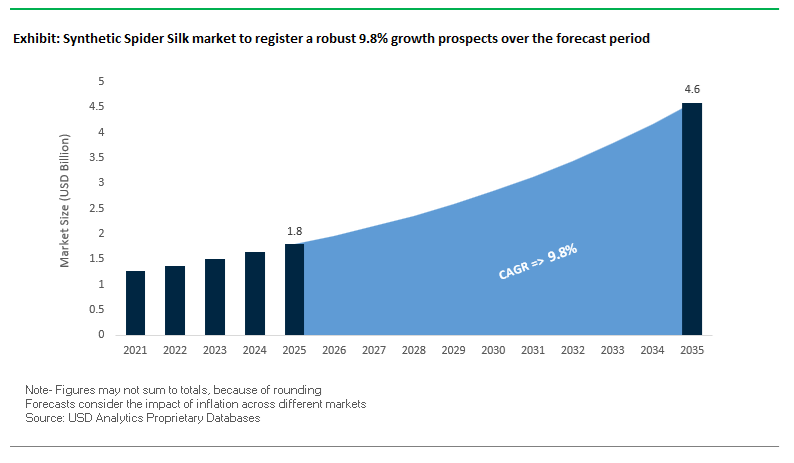
The Synthetic Spider Silk Market is valued at USD 1.8 billion in 2025 and is projected to reach USD 4.6 billion by 2035, growing at a strong CAGR of 9.8%. Growth is driven by industrial-scale biofabrication, expanding medical adoption, and premium sustainable textiles. Increasing cost competitiveness versus aramids and nylon further supports long-term scalability. The market is transitioning from pilot to early mass production.
Key drivers include exceptional toughness-to-weight ratio, biocompatibility, and sustainability advantages over petroleum-based fibers. Rising demand from medical devices, defense textiles, and premium apparel is accelerating adoption. Advances in fermentation and transgenic silkworm technologies are lowering cost per kilogram. Sustainability mandates and carbon reduction goals further strengthen demand.
Synthetic spider silk offers 2–3× higher toughness than nylon or Kevlar while remaining lighter and more extensible. Its elongation at break (up to ~35%) enables superior energy absorption in impact and ballistic applications. Unlike aramids, it is biodegradable and biocompatible. This combination makes it suitable for both high-performance and medical uses.
Medical & biomedical applications lead adoption due to sutures, tissue scaffolds, and implant coatings. Premium apparel and performance textiles follow, driven by sustainability and strength-to-weight benefits. Defense and protective gear segments are emerging rapidly due to ballistic and cut-resistant performance. Personal care and electronics coatings represent high-growth adjacent markets.
Major players include AMSilk GmbH, Spiber, Inc., Bolt Threads, Inc., and Kraig Biocraft Laboratories, Inc.. These companies lead through proprietary biofabrication platforms, scale-up capabilities, and diversified end-use strategies.