Functional Performance, Sustainable Chemistry, and Smart Textiles Driving Mid-Range Growth
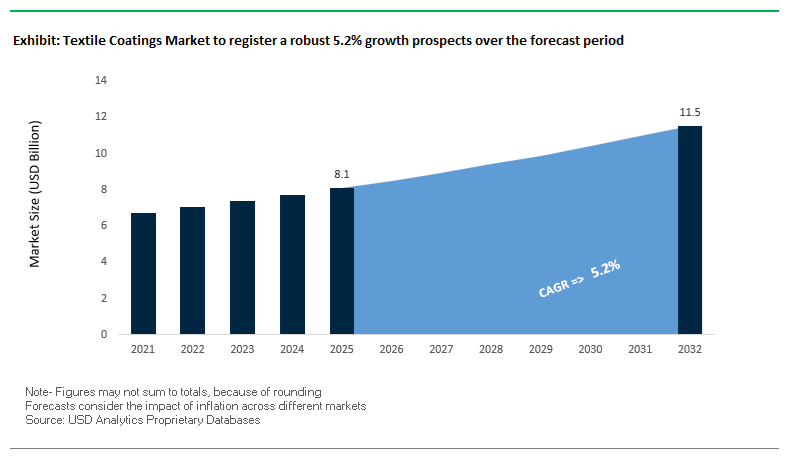
The global Textile Coatings Market is evolving steadily, supported by increasing demand for functional fabrics, performance apparel, and advanced technical textiles across automotive, healthcare, construction, and consumer sectors. The market was valued at $8.1 billion in 2025 and is projected to reach $11.6 billion by 2032, expanding at a CAGR of 5.2% during 2025–2032. Growth is primarily driven by the rising need for coatings that enhance durability, water resistance, antimicrobial protection, and aesthetic performance in textiles.
A key structural driver is the shift toward high-performance and multi-functional textile coatings, including polyurethane (PU), thermoplastic polyurethane (TPU), silicone, and acrylic systems. These coatings enable textiles to achieve properties such as breathability, abrasion resistance, UV protection, and chemical resistance, making them essential in sectors like sportswear, medical textiles, protective clothing, and automotive interiors. Additionally, the increasing penetration of technical textiles in infrastructure and industrial applications is expanding the demand base.
Sustainability is a central force shaping the market. The industry is rapidly transitioning toward PFAS-free water-repellent coatings, bio-based additives, and recyclable material systems, driven by regulatory pressure and consumer preference for eco-friendly products. Innovations in mono-material textile systems and circular coating technologies are enabling easier recycling and reduced environmental impact, aligning with global circular economy goals.
Another significant trend is the emergence of smart and interactive textiles, where coatings play a critical role in integrating functionalities such as conductivity, temperature responsiveness, and display capabilities. These innovations are opening new opportunities in wearable technology, automotive interiors, and advanced consumer applications, positioning textile coatings as a key enabler of next-generation material systems.
The textile coatings market is being reshaped by strategic acquisitions, advanced material innovation, and sustainability-driven partnerships, reflecting a shift toward high-value and environmentally compliant solutions. The February 2026 acquisition of Stahl by Henkel for €2.1 billion represents a major consolidation move, strengthening Henkel’s position in flexible substrate coatings, particularly in textile and leather applications. This transaction enhances access to high-growth specialty coating technologies and expands Henkel’s global footprint.
Innovation in smart and functional textiles is accelerating. Covestro’s April 2026 launch of INSQIN® with integrated e-paper technology demonstrates the convergence of textile coatings and digital display systems, enabling dynamic, color-changing surfaces in automotive interiors while maintaining durability and tactile quality.
Sustainability-led product development is a key competitive focus. Covestro’s Desmopan® AIR (April 2026) introduces a mono-material TPU coating system that allows both the textile and cushioning layer to be recycled together, addressing a major challenge in textile waste management. Similarly, Lubrizol’s PTFE-free Lanco™ additives (November 2025) support the transition toward PFAS-free water-repellent coatings, aligning with tightening environmental regulations.
Strategic partnerships are enhancing functional capabilities. Rudolf Group’s February 2026 exclusive global distribution of Sanitized® technologies enables the integration of antimicrobial, odor-control, and protective coatings into a unified supply chain, while Tanatex Chemicals’ June 2025 partnership with Fresche Bioscience introduces bio-based antimicrobial solutions for healthcare and home textiles.
Regional expansion is also strengthening market penetration. Archroma’s April 2026 expansion into Vietnam highlights the growing importance of Southeast Asia as a hub for high-performance garment production, with localized supply of sustainable coatings and dyes. Meanwhile, Stahl’s October 2025 reopening of its advanced coatings facility in India supports demand in automotive and footwear applications across South Asia.
Material innovation is further enhanced through acquisitions and collaborations. Covestro’s March 2025 integration of Pontacol enables the development of multilayer textile coatings and adhesive films, improving recyclability and reducing weight in technical textiles. Lubrizol’s November 2025 partnership with Fulai New Material focuses on co-developing high-performance functional coatings for consumer and industrial textile applications in Asia-Pacific.
Market Opportunity: France-Led PFAS Ban Establishes De-Facto European Compliance Standard for Textile Coatings
The textile coatings industry is undergoing a structural transformation following the enforcement of France’s national PFAS ban on January 1, 2026, which is effectively shaping compliance requirements across the broader European market. The regulation prohibits the sale and import of textiles containing intentionally added per- and polyfluoroalkyl substances, setting stringent residual thresholds of 25 ppb for individual PFAS and 50 ppm for total PFAS content. These limits effectively eliminate the use of conventional C6 and C8 fluorocarbon-based water-repellent coatings, forcing a rapid transition toward non-fluorinated alternatives. A transitional sell-off period extending to December 31, 2026, allows manufacturers to clear pre-existing inventory; however, the absence of long-term exemptions is compelling immediate reformulation efforts. The so-called “France Effect” is particularly significant, as global apparel brands are adopting universal low-PFAS coating strategies across all product lines to avoid the logistical complexity of market-specific compliance. This shift is accelerating innovation in silicone-based, hydrocarbon, and bio-derived textile coatings that deliver water repellency without environmental persistence. As regulatory momentum builds toward a broader EU-wide restriction, PFAS-free formulations are becoming a baseline requirement rather than a premium feature in textile coatings.
Market Opportunity: China GB/T 41650-2024 Mandates Heavy Metal Reduction and Catalyst Substitution in Textile Coatings
China’s transition from voluntary guidelines to mandatory enforcement under GB/T 41650-2024 is imposing stringent controls on hazardous substances used in textile coating formulations. The regulation establishes a total heavy metal limit of 100 mg/kg, covering elements such as lead, cadmium, and mercury, while imposing even stricter limits on soluble heavy metals like antimony and arsenic for skin-contact textiles. This regulatory tightening is driving a fundamental shift in raw material selection, particularly in pigments, stabilizers, and catalysts. A key area of impact is the phase-out of organotin-based catalysts traditionally used in polyurethane coatings, which are now restricted to levels below 1 mg/kg. Manufacturers are transitioning toward alternative catalyst systems based on bismuth and zinc, which offer lower toxicity profiles while maintaining catalytic efficiency. This shift is also influencing upstream chemical supply chains, as producers of coating intermediates adapt formulations to meet compliance requirements. As China remains a central hub for global textile manufacturing, the adoption of GB/T 41650-2024 is setting new international benchmarks for environmental safety and product compliance in textile coatings.
Graphene-Enhanced Polyurethane Coatings Transform Medical Textile Performance and Infection Control
Graphene-enhanced polyurethane coatings are emerging as a high-value innovation in medical textiles, addressing critical challenges related to infection control and material durability. These coatings leverage the unique physical properties of graphene, including its sharp nanoscale edges and high thermal conductivity, to deliver antimicrobial performance without relying on chemical leaching mechanisms. In 2026, graphene-PU coatings are demonstrating up to 99.9% reduction in bacterial load, including resistant strains such as MRSA, through mechanical disruption of microbial cell membranes. This non-leaching mechanism ensures sustained efficacy over repeated use cycles. Clinical evaluations have also shown that graphene-coated dressings can accelerate wound healing by approximately 30%, attributed to improved thermal regulation and far-infrared emission that enhances blood circulation. From a durability perspective, these coatings maintain more than 95% of their antimicrobial performance after over 50 industrial sterilization cycles, significantly outperforming traditional silver-ion coatings that degrade with washing. As healthcare systems prioritize infection prevention and cost efficiency, graphene-enhanced textile coatings are gaining traction as a next-generation solution in hospital linens, surgical textiles, and wound care products.
Microencapsulated Phase Change Material Coatings Enable Active Thermal Regulation in Smart Apparel
Microencapsulated phase change material coatings are driving the evolution of smart textiles by enabling passive thermal management capabilities. These coatings incorporate microcapsules containing paraffin or bio-based lipids that absorb and release thermal energy during phase transitions, maintaining a stable microclimate around the wearer. High-performance PCM coatings introduced in 2026 can store and release between 20 and 50 joules per gram of thermal energy, effectively stabilizing skin-adjacent temperatures within a range of 28°C to 32°C even under fluctuating ambient conditions. This capability is particularly valuable in workwear, military uniforms, and high-performance sports apparel, where thermal stress can impact both comfort and productivity. Studies indicate that PCM-coated textiles can reduce metabolic heat strain by approximately 15%, allowing for extended operational endurance without the need for active cooling systems. Advances in microencapsulation technology have also improved durability, with modern capsules featuring ethylcellulose or hybrid shell structures capable of withstanding more than 100,000 compression cycles without leakage. This ensures long-term performance under rigorous use conditions, including industrial laundering and high-intensity physical activity. As demand grows for functional, adaptive clothing, PCM-based textile coatings are emerging as a key innovation in the smart textiles market.
Textile Coatings Market Share and Segmentation Insights: Thermoplastic Polymer Dominance and Transportation Sector Driving High-Performance Coated Textiles
By Polymer Type: Thermoplastics Lead with 48.7% Share Driven by PU and PVC Performance Advantages and Circular Economy Alignment
Thermoplastics accounted for 48.7% of the textile coatings market share in 2025, led by widespread adoption of polyurethane (PU) and polyvinyl chloride (PVC) coatings across automotive textiles, outdoor fabrics, and industrial applications. These thermoplastic coatings deliver superior abrasion resistance, water repellency, and flexibility, making them the preferred choice for high-performance coated textiles. In addition, recyclability is emerging as a critical differentiator, as thermoplastics can be reprocessed and reused, unlike thermoset systems. Regulatory frameworks such as the European Commission Circular Economy Action Plan are accelerating this shift, reinforcing thermoplastics as a sustainable and scalable solution in advanced textile coating technologies.
By End-User Industry: Transportation Sector Leads with 27.6% Share Fueled by Automotive Interior Innovation and EV Lightweighting Trends
The transportation sector captured 27.6% of the textile coatings market in 2025, driven by increasing demand for coated textiles in automotive interiors such as seat covers, headliners, door panels, and floor systems. These applications require advanced properties including flame retardancy, stain resistance, and long-term durability, where thermoplastic polyurethane (TPU) coatings are gaining traction over PVC due to lower VOC emissions and improved environmental compliance. Furthermore, the rise of electric vehicles is accelerating the adoption of lightweight coated textiles as alternatives to traditional materials like leather and metal, enabling weight reduction and extended battery efficiency. This trend is positioning transportation as a key growth engine for high-performance textile coatings globally.
Competitive Landscape Analysis of the Textile Coatings Market
Covestro AG is a frontrunner in the textile coatings market, driven by its strong emphasis on bio-based polyurethane dispersions and sustainable coating solutions. Between 2025 and 2026, the company introduced a breakthrough PU dispersion containing nearly 34% plant-origin carbon, significantly lowering Scope 3 emissions for textile manufacturers. Its acquisition of Pontacol AG has expanded its capabilities in multilayer adhesive films for medical textiles and premium apparel coatings. Additionally, Covestro is strengthening its global footprint through new production sites in Thailand and the USA to enhance aliphatic isocyanates supply. Its flagship INSQIN® waterborne technology enables solvent-free, high-performance coatings widely used in sportswear and automotive synthetic leather applications.
Archroma Strengthening Sustainable Textile Finishes After Huntsman Acquisition
Archroma has emerged as a dominant force in the textile coatings market following its $718 million acquisition of Huntsman’s Textile Effects division. The company now leads in sustainable specialty chemicals and textile functional coatings, with a strong focus on PFC-free water repellents and biocompatible flame retardants aligned with strict EU and North American regulations. In 2026, Archroma launched its “Plan 360” initiative, aiming to reduce water consumption in the pad-dry-cure textile coating process by up to 25%. Its advanced ONE WAY Impact Calculator enables real-time environmental impact tracking, positioning Archroma as a leader in digitalized, eco-friendly textile coating solutions.
Arkema Expanding Specialty Coating Solutions for Technical Textiles
Arkema SA is strategically transforming into a pure Specialty Materials company, strengthening its presence in the textile coatings market with high-performance solutions. The company is expanding its PVDF (Kynar®) production capacity in China to meet increasing demand for technical textile coatings used in lithium-ion battery separators and EV interiors. Arkema’s commitment to sustainability is reflected in over 70% of its coating facilities achieving ISCC+ certification, enabling traceability of bio-based feedstocks. Its portfolio includes UV-curable coating resins that allow instant curing, improving production efficiency for industrial textiles. This positions Arkema as a key innovator in high-speed, energy-efficient textile coating technologies.
BASF Leading Binder and Coating Integration Technologies in Europe
BASF SE maintains a strong leadership position in the European textile coatings market, particularly in cross-linking agents and coating binders for non-woven and technical textiles. In 2025, the company introduced advanced Lurapret® coating binders, specifically designed for integration with digital printing technologies, enhancing color fastness and reducing ink bleeding. BASF is also investing in bio-mass balance (BMB) production systems for acrylic and polyurethane dispersions, targeting increased revenue from sustainable products by 2026. The company dominates applications in transportation textiles, offering flame-retardant and abrasion-resistant coatings for aerospace and public transit, reinforcing its leadership in high-performance industrial textile coatings.
Lubrizol Driving High-Performance TPU-Based Textile Coatings for PPE
The Lubrizol Corporation is a key player in the technical textile coatings market, specializing in flame-retardant coatings and high-durability solutions for PPE and military applications. Its enhanced Permax™ and Myflam™ product lines now feature breathable waterproof barriers that maintain high MVTR performance even after 50+ industrial wash cycles. Lubrizol’s solution-ready coating systems simplify manufacturing by integrating resins, additives, and cross-linkers into a single package, improving operational efficiency. With deep expertise in thermoplastic polyurethane (TPU) technology, the company delivers coatings with superior flexibility and soft-touch aesthetics, making it a preferred choice for high-end consumer textiles and protective gear applications.
China’s Dominance in Smart Textile Coatings and Functional Fabric Innovation
China continues to lead the global textile coatings market by transitioning from commodity coatings to advanced functional textile coatings, leveraging its strong synthetic fiber manufacturing ecosystem. The country is at the forefront of smart textile coatings, with a major breakthrough in 2026 involving nano-encapsulated phase-change materials (PCMs). These coatings enable garments to maintain a stable micro-climate for extended durations, significantly enhancing performance in extreme environments.
Infrastructure expansion is accelerating innovation, particularly with the Shaoxing Textile Innovation Cluster, which now houses the world’s largest robotic spray-coating line for industrial textiles. Government-backed initiatives such as the 14th Five-Year Plan for Technical Textiles are driving the development of anti-viral and anti-microbial coatings, especially for healthcare and public transport applications. China is also scaling production of bio-based polyurethane coatings, aligning with sustainability goals and reducing dependence on solvent-based systems. The growing adoption of multi-spectral camouflage coatings with infrared-reflective pigments in defense applications further reinforces China’s leadership in high-performance textile coatings. Regulatory updates mandating low-VOC textile finishing chemicals are pushing the industry toward greener solutions.
Germany Leading PFAS-Free Textile Coatings and Sustainable Innovation
Germany is emerging as a key hub for high-performance and sustainable textile coatings in Europe, driven by innovation and regulatory leadership. The country is pioneering PFAS-free textile coating technologies, with plasma-applied organosilicon layers offering permanent water repellency without harmful chemicals. This positions Germany at the forefront of the eco-friendly textile coatings market.
Technological advancements include the development of conductive textile coatings using carbon nanotubes (CNTs), enabling applications in electric vehicles and robotics. Significant investments by industry leaders like Covestro and BASF are accelerating the production of bio-based waterborne polyurethane dispersions, particularly for automotive interiors. Germany’s regulatory alignment with the EU’s Ecodesign for Sustainable Products Regulation (ESPR) is further shaping the market by introducing digital product tracking for coated textiles. The country also dominates in coated geotextiles for infrastructure, supported by flame-retardant and UV-resistant coatings. Additionally, the Aachen Smart Textile Hub is driving innovation in printed electronic coatings for wearable biosensors, strengthening Germany’s role in next-generation textile technologies.
United States Driving Technical Textile Coatings and Defense Applications
The United States textile coatings market is expanding through strong investments in technical textiles, defense modernization, and performance apparel coatings. Backed by initiatives like the Inflation Reduction Act, the market is witnessing increased adoption of high-durability and sustainable textile coatings.
Major investments include Lubrizol’s expansion of acrylic emulsion production for protective gear and apparel. The Department of Defense is advancing innovation with solar-harvesting coatings for military tents, transforming textiles into energy-generating surfaces. Technological progress is evident in the commercialization of self-healing polymer coatings, which enhance durability by repairing micro-tears under heat exposure.
Regulatory changes, including updated EPA emission standards, are accelerating the shift toward UV-cured and solvent-free textile coatings, reducing environmental impact. The U.S. also leads in cool-touch textile coatings for bedding and home furnishings, improving thermal comfort. High demand for anti-ballistic and flame-resistant coatings across law enforcement and fire safety sectors continues to drive market growth, reinforcing the country’s leadership in protective textile coatings.
India’s Emerging Role in Technical Textile Coatings and Infrastructure Applications
India is rapidly gaining traction in the textile coatings market, positioning itself as a competitive alternative to China through strong government support and industrial expansion. The National Technical Textiles Mission (NTTM) is driving innovation in low-cost coating technologies for agricultural and infrastructure applications.
The country is witnessing increased production of PVC and PVDF coated fabrics, particularly for tensile architecture projects such as airports and stadiums. Technological advancements include micro-encapsulated insect-repellent coatings, which extend the durability of agricultural textiles and improve crop protection. Strategic investments by Indian chemical companies in specialty resins are strengthening domestic capabilities in high-performance textile coatings.
Key applications include the use of coated fabrics in the Vande Bharat rail project, emphasizing durability and easy maintenance. Regulatory initiatives such as the Quality Control Order (QCO) 2026 are standardizing coating quality and performance across the domestic market. These developments are positioning India as a growing hub for industrial textile coatings and agrotech applications.
Japan’s Leadership in Nano-Coatings and High-Precision Textile Applications
Japan is a global leader in nano-functional textile coatings, focusing on precision, performance, and advanced material science. The country is driving innovation in ultra-thin hydrophobic coatings for wearable smart devices, ensuring optical clarity and maintaining sensor sensitivity.
Technological advancements include photocatalytic self-cleaning textile coatings, which help reduce environmental pollutants while maintaining fabric cleanliness. Japan is also expanding production of solvent-free synthetic leather coatings, catering to the growing demand for sustainable “vegan leather” in automotive and fashion industries.
Product innovations such as thermochromic textile inks are enhancing safety in industrial workwear by indicating heat stress through color changes. The widespread use of dielectric coatings in smart textiles is enabling the integration of flexible electronics into sportswear. Updated Japanese Industrial Standards (JIS) are setting global benchmarks for coating durability and performance, reinforcing Japan’s position in the high-end textile coatings market.
South Korea’s Advancements in Smart Wearable Coatings and E-Textiles
South Korea is emerging as a leader in smart textile coatings and e-textile technologies, leveraging its expertise in semiconductors and advanced materials. The commercialization of carbon nanotube-based conductive coatings has enabled fabrics to function as active electronic heaters, opening new possibilities in wearable technology.
The country is innovating in EMI shielding coatings, supporting next-generation 6G devices and wearable electronics. Significant investments, such as Hanwha Systems’ funding for radar-absorbent textile coatings, highlight South Korea’s role in defense and aerospace applications. Infrastructure expansion includes specialized clean-room facilities dedicated to producing anti-static and lint-free coated garments for semiconductor environments.
Regulatory frameworks like K-REACH updates are accelerating the adoption of UV-curable and eco-friendly textile coatings, ensuring compliance with global sustainability standards. South Korea is also integrating smart sensing coatings in automotive interiors, particularly in EVs, enhancing user interaction and comfort. These developments position the country as a key player in the next-generation textile coatings market.
Textile Coatings Market Report Scope
Textile Coatings Market
Parameter
Details
Market Size (2025)
$8.1 Billion
Market Size (2032)
$11.6 Billion
Market Growth Rate
5.2%
Segments
By Polymer (Thermoplastics, Thermosets, Rubber-based, Bio-based and Sustainable Polymers), By Coating Technology (Water-borne Coatings, Solvent-borne Coatings, Powder Coatings, Radiation-Cured, Nanocoatings), By Fabric (Woven Fabrics, Knitted Fabrics, Non-woven Fabrics), By Functionality (Waterproof and Breathable, Flame Retardant, Anti-microbial and Anti-viral, UV and Weather Resistant, Stain and Oil Repellent, Smart), By End-User Industry (Transportation, Building and Construction, Protective Clothing, Industrial, Clothing and Apparel, Home Furnishings, Medical and Healthcare, Agriculture), By Distribution Channel (Direct Sales, Contract Coating Service Providers, Industrial Distributors)
Study Period
2019- 2025 and 2026-2032
Units
Revenue (USD)
Qualitative Analysis
Porter’s Five Forces, SWOT Profile, Market Share, Scenario Forecasts, Market Ecosystem, Company Ranking, Market Dynamics, Industry Benchmarking
Companies
Covestro AG, BASF SE, The Lubrizol Corporation, Arkema S.A., Solvay S.A., Archroma Management GmbH, Tanatex Chemicals B.V., Wacker Chemie AG, Sumitomo Chemical Co., Ltd., Evonik Industries AG, Dow Inc., DIC Corporation, Rudolf GmbH, CHT Germany GmbH, Sioen Industries NV
Countries
US, Canada, Mexico, Germany, France, Spain, Italy, UK, Russia, China, India, Japan, South Korea, Australia, South East Asia, Brazil, Argentina, Middle East, Africa
Textile Coatings Market Segmentation
By Polymer
Thermoplastics
Polyurethane
Polyvinyl Chloride
Acrylics
Polyolefins
Others
Thermosets
Silicone
Epoxy
Rubber-based
Natural Rubber
Styrene-Butadiene Rubber
Nitrile
Bio-based and Sustainable Polymers
By Coating Technology
Water-borne Coatings
Solvent-borne Coatings
Powder Coatings
Radiation-Cured
Nanocoatings
By Fabric
Woven Fabrics
Knitted Fabrics
Non-woven Fabrics
By Functionality
Waterproof and Breathable
Flame Retardant
Anti-microbial and Anti-viral
UV and Weather Resistant
Stain and Oil Repellent
Smart
By End-User Industry
Transportation
Building and Construction
Protective Clothing
Industrial
Clothing and Apparel
Home Furnishings
Medical and Healthcare
Agriculture
By Distribution Channel
Direct Sales
Contract Coating Service Providers
Industrial Distributors
Leading Countries in the Industry
North America (United States, Canada, Mexico)
Europe (Germany, France, Spain, United Kingdom, Italy, Russia, Rest of Europe)
Asia Pacific (China, India, Japan, South Korea, Australia, South East Asia, Rest of APAC)
South and Central America (Brazil, Argentina, Rest of SCA)
Middle East and Africa (Saudi Arabia, UAE, MENA, Sub-Saharan Africa)
Top Companies in Textile Coatings Industry
Covestro AG
BASF SE
The Lubrizol Corporation
Arkema S.A.
Solvay S.A.
Archroma Management GmbH
Tanatex Chemicals B.V.
Wacker Chemie AG
Sumitomo Chemical Co., Ltd.
Evonik Industries AG
Dow Inc.
DIC Corporation
Rudolf GmbH
CHT Germany GmbH
Sioen Industries NV
*- List not Exhaustive
Table of Contents: Textile Coatings Market
1. Executive Summary
1.1. Market Highlights
1.2. Key Findings
1.3. Global Market Snapshot
2. Textile Coatings Market Landscape and Outlook (2025–2034)
2.1. Introduction to the Textile Coatings Market
2.2. Market Valuation and Growth Projections (2025–2034)
2.3. Functional Performance Drivers in Technical Textiles and Smart Fabrics
2.4. Sustainability Trends and PFAS-Free Regulatory Transition
2.5. Strategic Opportunities and Future Outlook
3. Innovations Reshaping the Textile Coatings Market
3.1. Trend: France-Led PFAS Ban Establishes a New Compliance Standard for Textile Coatings
3.2. Trend: China GB/T 41650-2024 Accelerates Heavy Metal Reduction and Catalyst Substitution
3.3. Opportunity: Graphene-Enhanced Polyurethane Coatings for Medical Textiles and Infection Control
3.4. Opportunity: Microencapsulated Phase Change Material Coatings for Active Thermal Regulation in Smart Apparel
4. Competitive Landscape and Strategic Initiatives
4.1. Mergers and Acquisitions
4.2. RandD and Material Innovation
4.3. Sustainability and ESG Strategies
4.4. Market Expansion and Regional Focus
5. Market Share and Segmentation Insights: Textile Coatings Market
5.1. By Polymer
5.1.1. Thermoplastics
5.1.2. Polyurethane
5.1.3. Polyvinyl Chloride
5.1.4. Acrylics
5.1.5. Polyolefins
5.1.6. Others
5.1.7. Thermosets
5.1.8. Silicone
5.1.9. Epoxy
5.1.10. Rubber-based
5.1.11. Natural Rubber
5.1.12. Styrene-Butadiene Rubber
5.1.13. Nitrile
5.1.14. Bio-based and Sustainable Polymers
5.2. By Coating Technology
5.2.1. Water-borne Coatings
5.2.2. Solvent-borne Coatings
5.2.3. Powder Coatings
5.2.4. Radiation-Cured
5.2.5. Nanocoatings
5.3. By Fabric
5.3.1. Woven Fabrics
5.3.2. Knitted Fabrics
5.3.3. Non-woven Fabrics
5.4. By Functionality
5.4.1. Waterproof and Breathable
5.4.2. Flame Retardant
5.4.3. Anti-microbial and Anti-viral
5.4.4. UV and Weather Resistant
5.4.5. Stain and Oil Repellent
5.4.6. Smart
5.5. By End-User Industry
5.5.1. Transportation
5.5.2. Building and Construction
5.5.3. Protective Clothing
5.5.4. Industrial
5.5.5. Clothing and Apparel
5.5.6. Home Furnishings
5.5.7. Medical and Healthcare
5.5.8. Agriculture
5.6. By Distribution Channel
5.6.1. Direct Sales
5.6.2. Contract Coating Service Providers
5.6.3. Industrial Distributors
6. Country Analysis and Outlook of Textile Coatings Market
6.1. United States
6.2. Canada
6.3. Mexico
6.4. Germany
6.5. France
6.6. Spain
6.7. Italy
6.8. United Kingdom
6.9. Russia
6.10. China
6.11. India
6.12. Japan
6.13. South Korea
6.14. Australia
6.15. South East Asia
6.16. Brazil
6.17. Argentina
6.18. Middle East
6.19. Africa
7. Textile Coatings Market Size Outlook by Region (2025–2034)
7.1. North America Textile Coatings Market Size Outlook to 2034
7.1.1. By Polymer
7.1.2. By Coating Technology
7.1.3. By Fabric
7.1.4. By Functionality
7.1.5. By End-User Industry
7.1.6. By Distribution Channel
7.2. Europe Textile Coatings Market Size Outlook to 2034
7.2.1. By Polymer
7.2.2. By Coating Technology
7.2.3. By Fabric
7.2.4. By Functionality
7.2.5. By End-User Industry
7.2.6. By Distribution Channel
7.3. Asia Pacific Textile Coatings Market Size Outlook to 2034
7.3.1. By Polymer
7.3.2. By Coating Technology
7.3.3. By Fabric
7.3.4. By Functionality
7.3.5. By End-User Industry
7.3.6. By Distribution Channel
7.4. South America Textile Coatings Market Size Outlook to 2034
7.4.1. By Polymer
7.4.2. By Coating Technology
7.4.3. By Fabric
7.4.4. By Functionality
7.4.5. By End-User Industry
7.4.6. By Distribution Channel
7.5. Middle East and Africa Textile Coatings Market Size Outlook to 2034
7.5.1. By Polymer
7.5.2. By Coating Technology
7.5.3. By Fabric
7.5.4. By Functionality
7.5.5. By End-User Industry
7.5.6. By Distribution Channel
8. Company Profiles: Leading Players in the Textile Coatings Market
8.1. Covestro AG
8.2. BASF SE
8.3. The Lubrizol Corporation
8.4. Arkema S.A.
8.5. Solvay S.A.
8.6. Archroma Management GmbH
8.7. Tanatex Chemicals B.V.
8.8. Wacker Chemie AG
8.9. Sumitomo Chemical Co., Ltd.
8.10. Evonik Industries AG
8.11. Dow Inc.
8.12. DIC Corporation
8.13. Rudolf GmbH
8.14. CHT Germany GmbH
8.15. Sioen Industries NV
9. Methodology
9.1. Research Scope
9.2. Market Research Approach
9.3. Market Sizing and Forecasting Model
9.4. Research Coverage
9.5. Data Horizon
9.6. Deliverables
10. Appendix
10.1. Acronyms and Abbreviations
10.2. List of Tables
10.3. List of Figures
Textile Coatings Market Segmentation
By Polymer
Thermoplastics
Polyurethane
Polyvinyl Chloride
Acrylics
Polyolefins
Others
Thermosets
Silicone
Epoxy
Rubber-based
Natural Rubber
Styrene-Butadiene Rubber
Nitrile
Bio-based and Sustainable Polymers
By Coating Technology
Water-borne Coatings
Solvent-borne Coatings
Powder Coatings
Radiation-Cured
Nanocoatings
By Fabric
Woven Fabrics
Knitted Fabrics
Non-woven Fabrics
By Functionality
Waterproof and Breathable
Flame Retardant
Anti-microbial and Anti-viral
UV and Weather Resistant
Stain and Oil Repellent
Smart
By End-User Industry
Transportation
Building and Construction
Protective Clothing
Industrial
Clothing and Apparel
Home Furnishings
Medical and Healthcare
Agriculture
By Distribution Channel
Direct Sales
Contract Coating Service Providers
Industrial Distributors
Leading Countries in the Industry
North America (United States, Canada, Mexico)
Europe (Germany, France, Spain, United Kingdom, Italy, Russia, Rest of Europe)
Asia Pacific (China, India, Japan, South Korea, Australia, South East Asia, Rest of APAC)
South and Central America (Brazil, Argentina, Rest of SCA)
Middle East and Africa (Saudi Arabia, UAE, MENA, Sub-Saharan Africa)
The global Textile Coatings Market was valued at USD 8.1 billion in 2025 and is expected to reach USD 11.6 billion by 2032, registering a CAGR of 5.2%. Market growth is being driven by rising demand for functional fabrics, technical textiles, smart apparel, and high-performance coated materials across transportation, healthcare, industrial, and consumer applications.
Smart textile coatings are gaining strong adoption because they integrate advanced functionalities such as thermal regulation, conductivity, antimicrobial protection, UV resistance, and interactive display capabilities into textiles without compromising flexibility or durability. Innovations in graphene-enhanced coatings, phase-change materials, and conductive nanocoatings are accelerating adoption in wearable electronics, defense uniforms, medical textiles, and EV interiors.
Major companies shaping the competitive landscape include Covestro AG, BASF SE, The Lubrizol Corporation, Arkema S.A., Archroma Management GmbH, and Evonik Industries AG. These companies are investing in PFAS-free water repellents, recyclable TPU coating systems, graphene-enhanced coatings, smart e-paper textiles, antimicrobial technologies, and bio-based polymer innovations to strengthen market competitiveness.
Major opportunities are emerging in graphene-enhanced antimicrobial coatings, microencapsulated phase change materials (PCM), conductive e-textile coatings, photocatalytic self-cleaning surfaces, and thermochromic smart coatings. Innovations in nano-coatings, solvent-free polyurethane dispersions, and adaptive thermal management textiles are also enabling next-generation applications in healthcare, sportswear, military gear, and smart infrastructure.
China, Germany, the United States, India, Japan, and South Korea are emerging as leading centers for textile coating innovation due to strong investments in smart textiles, technical fabrics, sustainable chemistry, and wearable technologies. These countries are driving advancements in PFAS-free coatings, conductive fabrics, anti-viral coatings, automotive interior textiles, and industrial performance fabrics across global supply chains.
More Floor, Roof and Specialty Building Coatings Reports