High-Temperature Protection, Energy Efficiency, and Aerospace Demand Driving Stable Growth
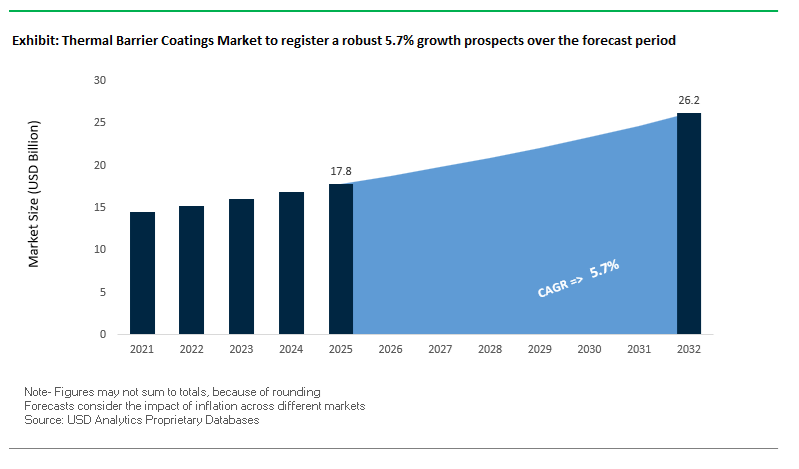
The global Thermal Barrier Coatings Market is witnessing steady expansion, supported by rising demand for high-temperature resistance, energy efficiency, and durability across aerospace, power generation, automotive, and industrial sectors. The market was valued at $17.8 billion in 2025 and is projected to reach $26.2 billion by 2032, growing at a CAGR of 5.7% during 2025–2032. This growth is driven by the increasing need to protect critical components operating under extreme thermal stress, particularly in gas turbines, jet engines, and industrial processing equipment.
A primary structural driver is the growing deployment of ceramic-based thermal barrier coatings (TBCs), typically composed of yttria-stabilized zirconia (YSZ) and advanced oxide materials. These coatings provide thermal insulation, oxidation resistance, and extended component life, enabling engines and turbines to operate at higher temperatures and improved efficiency. This is particularly critical in aerospace and energy sectors, where fuel efficiency and emission reduction targets are driving the need for advanced thermal management solutions.
Another major trend is the expansion of thermal barrier coatings into building and infrastructure applications, where coatings are used to reduce heat absorption and improve energy efficiency. Innovations such as radiative cooling coatings and aerogel-based insulation systems are transforming building surfaces into active thermal management systems, contributing to reduced cooling loads and improved sustainability.
The market is also benefiting from advancements in thin-film deposition technologies, additive manufacturing, and IIoT-enabled coating processes, which enhance coating precision, uniformity, and performance consistency. Additionally, the increasing integration of multi-functional coatings—combining thermal insulation with corrosion resistance, moisture protection, and even stealth capabilities—is expanding the application scope of thermal barrier technologies.
The thermal barrier coatings market is being reshaped by advanced material innovation, digital manufacturing platforms, and strategic capacity investments, reflecting the increasing complexity of high-temperature applications. In March 2026, AkzoNobel completed the large-scale rollout of its passive radiative cooling “Sunscreen” coating, which utilizes aerogel-based thermal barrier technology to reduce building surface temperatures by up to 10%. This development highlights the growing role of TBCs in urban energy efficiency and climate-responsive construction.
Digitalization is transforming coating processes. Oerlikon Metco’s Surface Two™ platform (July 2025) introduces an IIoT-enabled thermal spray system designed for high-volume aerospace production, offering real-time monitoring and enhanced process control. This is complemented by ATL Turbine Services’ November 2025 investment in the platform, which expands its capacity to deliver high-performance coatings for turbine components.
Material innovation is also advancing across specialized applications. Oerlikon Metco’s March 2026 expansion of its MetcoMed™ portfolio supports the supply of high-purity thermal spray materials for medical and industrial applications, while HZO’s Guardian Series Parylene coatings (February 2025) provide ultra-thin thermal and moisture barriers for sensitive electronic components in aerospace and drone systems.
In industrial environments, high-performance coatings are addressing extreme thermal cycling challenges. Sherwin-Williams’ Heat-Flex® AEB scaling (August 2025) delivers thermal barrier protection for autoclaves, preventing corrosion under insulation (CUI) and enhancing durability in heavy manufacturing processes.
Sustainability-driven innovation is also influencing product development. Henkel’s April 2026 launch of water-based thermal barrier coatings for packaging applications enables low-temperature heat sealing and recyclable material structures, reducing reliance on multi-layer plastics while maintaining heat resistance.
The aerospace sector remains a dominant demand driver. The Oerlikon–MTU Aero Engines partnership (July 2024) to establish a smart thermal spray factory underscores the push toward standardized, high-efficiency production of advanced TBCs for next-generation engines. Additionally, Howmet Aerospace’s October 2024 capacity expansion targets increasing demand for ceramic TBCs used in high-temperature engine programs such as LEAP and GE9X, which require coatings capable of withstanding extreme combustion conditions.
Cross-functional innovation is also emerging. Nippon Paint’s November 2025 hybrid coating for amphibious aircraft integrates thermal barrier and stealth properties, reflecting the growing convergence of thermal management with advanced defense technologies.
Market Trend: FAA and EASA Certification Standards Drive Thermal Barrier Coating Performance for Next-Generation Aero-Engines
The thermal barrier coatings industry is being reshaped by increasingly stringent certification requirements from aviation regulators, particularly for next-generation engines such as the GE9X and UltraFan platforms. Under updated FAA and EASA certification frameworks in 2026, the emphasis has shifted toward thermal fatigue resistance under extreme cyclic loading conditions in turbine hot sections. Advanced ceramic TBC systems are now required to enable turbine inlet temperatures in the range of 1,650°C to 1,750°C, significantly exceeding the melting point of the underlying nickel-based superalloys. This capability is critical for achieving higher engine efficiency and reducing fuel consumption. Empirical data indicates that each incremental increase of 55°C in turbine inlet temperature enabled by TBC performance corresponds to approximately a 1% gain in overall thermal efficiency. This relationship is directly linked to the aviation sector’s long-term decarbonization objectives, including net-zero emissions targets by 2050. As a result, coating durability, thermal cycling resistance, and oxidation stability are becoming central parameters in certification processes, driving continuous innovation in ceramic composition and deposition techniques.
Market Trend: DOE Advanced Turbines Program Accelerates Development of Hydrogen-Compatible TBC Systems
The U.S. Department of Energy’s Advanced Turbines Program is playing a pivotal role in advancing thermal barrier coating technologies for industrial gas turbines, particularly in the context of hydrogen-based energy systems. The program targets combined-cycle efficiencies of up to 65% by enabling turbine operation at surface temperatures approaching 1,650°C, while maintaining substrate temperatures below 950°C at the bond coat interface. This thermal gradient requirement places significant demands on TBC performance, particularly in terms of insulation efficiency and long-term stability. The transition toward hydrogen combustion further intensifies these requirements, as hydrogen produces higher adiabatic flame temperatures compared to natural gas. This necessitates a 15% to 20% improvement in thermal insulation performance relative to conventional ceramic coatings. As energy systems shift toward low-carbon fuels, TBC technologies are becoming a critical enabler of high-efficiency, hydrogen-ready turbine architectures, supporting both power generation and industrial decarbonization strategies.
Market Opportunity: EB-PVD Columnar TBCs Enhance Strain Tolerance and Lifecycle Performance in Aerospace Applications
Electron Beam Physical Vapor Deposition remains the preferred method for applying thermal barrier coatings on high-pressure turbine blades in aerospace engines, offering unique advantages in microstructural design. The columnar grain structure characteristic of EB-PVD coatings provides exceptional strain tolerance, allowing the coating to accommodate thermal expansion and contraction during rapid engine cycles. In 2026 operational testing, these columnar TBCs have demonstrated up to four times greater cyclic life compared to conventional plasma-sprayed coatings under high-frequency flight conditions. This enhanced durability is particularly valuable for commercial aviation, where engines are subjected to frequent start-stop cycles. A key area of innovation lies in the engineering of porosity within the columnar structure to further improve compliance and thermal insulation. Additionally, mitigation of calcium-magnesium-alumino-silicate infiltration is emerging as a critical performance requirement, especially for aircraft operating in environments with high particulate exposure. The development of specialized seal-coat layers to protect EB-PVD structures from CMAS-related degradation represents a significant opportunity for extending coating lifespan and maintaining engine efficiency.
Market Opportunity: Dense Vertically Cracked TBCs Deliver Cost-Effective Thermal Protection for Industrial Gas Turbines
Dense vertically cracked thermal barrier coatings, typically applied using air plasma spray techniques, are gaining traction in industrial gas turbine applications where cost efficiency and long-term durability are key considerations. These coatings incorporate engineered vertical cracks that provide strain tolerance similar to columnar EB-PVD systems while enabling significantly lower application costs, typically 30% to 50% less. The ability to apply these coatings at greater thicknesses, up to 2.0 millimeters, allows for the creation of substantial thermal gradients, often exceeding 300°C between the coating surface and the underlying substrate. This enhanced insulation capability is critical for protecting turbine components operating under continuous high-temperature conditions. As a result, dense vertically cracked coatings are contributing to extended maintenance intervals, with mean time between overhaul improvements ranging from 15,000 to 25,000 hours in large-frame industrial turbines. As global energy demand grows and operators seek to optimize lifecycle costs, these coatings are emerging as a key solution for balancing performance, durability, and economic efficiency in power generation systems.
Gas Turbines (Aero & Industrial) Dominate with 48.5% Share Driven by Extreme Temperature Efficiency Needs
The gas turbines (aero & industrial) segment leads the thermal barrier coatings (TBC) market with a commanding 48.5% market share in 2025, reflecting its critical role in high-temperature energy and aerospace applications. Within the advanced coatings and high-temperature ceramics market, yttria-stabilized zirconia (YSZ) thermal barrier coatings are essential for enabling turbine inlet temperatures exceeding 1500°C—well above the melting point of superalloys—thereby improving fuel efficiency and power output by 10–15%. This performance advantage is a major driver in both aero-engine manufacturing and industrial gas turbine power generation sectors. TBCs are extensively applied to turbine blades, vanes, and combustion chambers, protecting high-value components from oxidation, thermal fatigue, and corrosion. Given the extremely high replacement costs of turbine components, TBC application offers a highly cost-effective lifecycle solution, strengthening demand across aviation, energy, and heavy industrial markets focused on durability, efficiency, and emissions reduction.
Direct Sales Channel Leads with 46.7% Share Through OEM Collaborations and Long-Term Contracts
In the thermal barrier coatings market by sales channel, direct sales dominate with a 46.7% market share in 2025, primarily driven by strong partnerships between aero-engine OEMs and TBC material suppliers. Leading manufacturers such as GE Aviation, Rolls-Royce, Pratt & Whitney, and Safran rely on direct procurement to develop customized coating systems, including proprietary bond coats and ceramic topcoats tailored to specific turbine models. This direct engagement ensures precision engineering, quality control, and performance optimization within the aerospace coatings and turbine protection market. Additionally, the prevalence of long-term supply agreements secures consistent access to TBC powders and formulation stability, which is critical for high-volume production and regulatory compliance. The direct sales model also facilitates co-development, innovation, and faster integration of next-generation coating technologies, reinforcing its dominance in the global thermal barrier coatings supply chain while supporting scalability and reliability across aerospace and industrial applications.
Competitive Landscape Analysis of the Thermal Barrier Coatings Market
Oerlikon Metco (Oerlikon Group) has solidified its position in the thermal barrier coatings market following its 2026 “pure-play transformation,” focusing exclusively on surface technologies and advanced materials. The company reported CHF 1.6 billion in sales in 2025 and is targeting stable growth with an EBITDA margin of 17.5%. Its pioneering Digital Twin coating diagnostics technology enables real-time monitoring of particle temperature and velocity, significantly reducing scrap rates in plasma spray coating applications. Operating across 38 countries, Oerlikon offers a fully integrated portfolio including HVOF, plasma, and cold spray technologies, along with proprietary ceramic powders, reinforcing its leadership in high-performance thermal coating systems.
Linde Advancing EB-PVD Coatings for Aerospace and EV Applications
Linde plc, through Praxair Surface Technologies, plays a critical role in the thermal barrier coatings market, particularly in the aerospace and defense segment, which holds a 34.5% industry share as of 2026. The company specializes in EB-PVD coatings, delivering strain-tolerant, columnar grain structures essential for high-performance turbine blades in next-generation engines like GE9X. Recently, Linde introduced ultra-thin thermal barrier coatings for EV lithium-ion batteries, addressing thermal runaway challenges in electric vehicles. Additionally, it is expanding service centers across Asia-Pacific to support growing aircraft demand, strengthening its position in high-temperature coatings and advanced thermal protection solutions.
Chromalloy Gas Turbine LLC is a dominant player in the thermal barrier coatings market, particularly within the MRO (Maintenance, Repair, and Operations) segment. The company’s latest innovation includes second-generation low-thermal-conductivity (low-k) TBCs, designed to withstand moisture and phase instability in hydrogen combustion turbines. Chromalloy offers comprehensive life-cycle management services, integrating casting, machining, and coating under a single certification, ensuring operational efficiency. Its focus on improving oxidation resistance for stationary gas turbines supports high-efficiency power generation, reinforcing its expertise in durable and performance-driven thermal barrier coating technologies.
Bodycote Expanding Aerospace Thermal Processing and Low-Carbon Coating Solutions
Bodycote plc is strengthening its presence in the thermal barrier coatings market through strategic portfolio optimization and global expansion. In 2026, the company completed a major aerospace acquisition following the divestment of non-core assets, sharpening its focus on high-margin specialist technologies. With over 150 facilities worldwide, Bodycote offers unmatched scalability for thermal processing and coating services to aerospace OEMs. The company reported FY2025 revenue of £727.1 million, with significant profit growth driven by advanced coating solutions. Its innovation in low-carbon furnace technologies, reducing CO₂ emissions by up to 90%, positions Bodycote as a leader in sustainable thermal coating processes.
H.C. Starck Delivering Advanced Materials for High-Performance Thermal Coatings
H.C. Starck Solutions plays a crucial role in the thermal barrier coatings market as a leading supplier of high-purity ceramic powders and refractory materials. The company is part of a top-five group controlling 60% of the specialized thermal spray materials market as of 2025. Its portfolio includes alumina, zirconia, and titania precursors, essential for high-performance TBC topcoats. Recent developments focus on nanostructured coating materials that enhance adhesion and thermal shock resistance during rapid engine cycles. With deep expertise in chemical vapor deposition (CVD) technologies for tantalum and tungsten coatings, H.C. Starck supports extreme-environment applications, reinforcing its position in advanced thermal barrier material innovation.
United States Leading Advanced Aerospace Thermal Barrier Coatings and Defense Innovations
The United States remains the global leader in the thermal barrier coatings market, driven by cutting-edge advancements in aerospace propulsion, defense systems, and high-performance materials. The country is accelerating innovation in ceramic matrix composites (CMCs) and environmental barrier coatings (EBCs), capable of withstanding extreme temperatures up to 1,650°C. This progress is critical for next-generation aircraft engines and high-Mach platforms, reinforcing the U.S.'s dominance in aerospace-grade coatings.
Significant investments, including facility expansions by Chromalloy, are addressing the growing demand for low thermal conductivity (Low-K) coatings amid a large global aircraft backlog. Breakthrough innovations such as aerogel-based thermal barriers are also gaining traction in electric vehicle battery systems, enhancing safety by preventing thermal runaway. Government programs like the Adaptive Engine Transition Program (AETP) are driving the development of adaptive thermal skins that dynamically adjust heat emissivity. Additionally, the adoption of rare-earth zirconate coatings in advanced fighter jet engines and compliance with EPA environmental standards are pushing the industry toward more sustainable, high-performance coating technologies.
China’s Industrial Scale Expansion in Power Generation and Hypersonic Coatings
China is rapidly expanding its footprint in the thermal barrier coatings market, transitioning toward high-performance ceramic coatings for energy security and aerospace applications. The establishment of the world’s largest HVOF and air plasma spray coating hub in the Yangtze River Delta is a major milestone, supporting domestic aero-engine production and reducing reliance on imports.
Technological breakthroughs include the development of high entropy ceramic (HEC) coatings, offering significantly lower thermal conductivity than traditional materials, making them ideal for high-temperature engine components. The mandatory application of thermal barrier coatings in new gas-fired power plants is improving operational efficiency while reducing emissions, aligning with national sustainability goals.
China is also innovating in stealth thermal coatings for naval turbines, combining thermal insulation with microwave absorption capabilities. Government subsidies under the extended 14th Five-Year Plan for High-End Equipment are promoting advanced coating technologies such as Plasma Spray-PVD. Additionally, the widespread adoption of graded and intermetallic coatings in ultra-supercritical boilers highlights China’s leadership in industrial-scale thermal protection solutions.
Germany Driving Sustainable Thermal Barrier Coatings and Hydrogen-Ready Technologies
Germany is positioning itself as a global leader in sustainable thermal barrier coatings, with a strong focus on decarbonization and hydrogen-based energy systems. The development of water-vapor-resistant coatings for hydrogen-fired turbines is a major breakthrough, addressing the challenges of oxidation in high-steam environments.
Innovation is also evident in self-healing polyurethane-ceramic hybrid coatings, which significantly enhance durability in offshore wind infrastructure. Investments in renewable energy-powered production facilities, such as BASF’s automated bond-coat plant, are reducing the carbon footprint of coating manufacturing.
Regulatory frameworks like the EU’s Ecodesign standards are ensuring transparency through digital product passports, promoting sustainable sourcing and lifecycle tracking. Germany’s expertise extends to automotive applications, where yttria-stabilized zirconia coatings are used to improve corrosion resistance in turbochargers. Expansion by companies like Wacker Chemie is strengthening the supply of advanced binder materials, further supporting the growth of eco-friendly thermal barrier coatings.
India’s Growing Focus on Indigenous Thermal Barrier Coatings and Defense Applications
India is emerging as a key player in the thermal barrier coatings market, driven by increasing investments in defense, rail infrastructure, and energy efficiency. The government-backed Advanced Medium Combat Aircraft (AMCA) program is prioritizing the development of multispectral thermal barrier coatings that reduce both thermal and radar signatures, enhancing stealth capabilities.
Infrastructure investments include the establishment of a national high-temperature materials testing center, supporting the certification of indigenous coating technologies. Innovations such as mullite-based coatings for high-speed rail brake systems are improving thermal stability in transportation infrastructure.
India is also advancing research in high entropy oxide ceramics for nuclear applications, demonstrating strong potential in energy sectors. The adoption of thermochromic thermal coatings in industrial furnaces is improving workplace safety by providing visual overheating indicators. Additionally, the expansion of PVDF-based thermal barrier films for industrial roofing is addressing urban heat challenges, positioning India as a growing hub for cost-effective and high-performance thermal coatings.
Japan’s Nano-Precision Thermal Barrier Coatings for Electronics and Medical Devices
Japan continues to lead in nano-engineered thermal barrier coatings, focusing on precision applications in electronics, optics, and medical devices. The development of ultra-thin thermoresistive dielectric coatings for high-density electronic components highlights Japan’s expertise in miniaturization and advanced materials.
Product innovations such as nano-porous silica aerogel coatings are enhancing thermal insulation and anti-fogging capabilities in medical devices, improving performance in surgical environments. Technological advancements in electron-beam PVD (EB-PVD) processes are enabling highly controlled microstructures for turbine blade coatings, ensuring superior efficiency and durability.
Regulatory updates under Japanese Industrial Standards are strengthening quality control for thermal coatings, particularly in high-temperature and chemically aggressive environments. Investments by companies like Hoya are expanding the global reach of thermal-resistant optical coatings, while Japan’s dominance in wearable technology applications continues to drive demand for conformal thermal barrier coatings.
United Arab Emirates Advancing Thermal Barrier Coatings for Extreme Climate and Energy Infrastructure
The United Arab Emirates is emerging as a critical market for thermal barrier coatings in extreme environments, driven by the need to protect energy infrastructure from high temperatures and corrosive conditions. Significant investments in gas turbine retrofitting are improving efficiency under extreme ambient heat, strengthening the country’s energy resilience.
Technological advancements include the development of super-hydrophobic thermal coatings for concentrated solar power (CSP) systems, which prevent sand abrasion and maintain reflectivity in desert conditions. Government initiatives under the Green Agenda 2026 are promoting the adoption of nanotechnology-enhanced coatings through tax incentives.
Innovations such as rare-earth zirconate coatings for desalination plants are addressing scaling challenges at high temperatures, while nanostructured coatings for solar panel frames are extending operational lifespan by reducing heat-induced degradation. Regulatory compliance with ESMA standards is ensuring safety and durability across public infrastructure. These developments position the UAE as a growing hub for climate-resilient thermal barrier coatings and energy-efficient solutions.
Thermal Barrier Coatings Market Report Scope
Thermal Barrier Coatings Market
Parameter
Details
Market Size (2025)
$17.8 Billion
Market Size (2032)
$26.2 Billion
Market Growth Rate
5.7%
Segments
By Product Type (Ceramic Coatings, Metallic Coatings, Intermetallic Coatings, Other Products), By Coating Material (Yttria-Stabilized Zirconia, Rare-Earth Zirconates, Alumina, MCrAlY Bond Coats, High-Entropy Alloy Coats), By Technology (Air Plasma Spray, High-Velocity Oxygen Fuel, Electron-Beam Physical Vapor Deposition, Chemical Vapor Deposition, Plasma Spray-PVD, Solution Precursor Plasma Spray, Electrostatic Spray Assisted Vapor Deposition), By Application Environment (Gas Turbines, Internal Combustion Engines, Boilers and Heat Exchangers, Rocket Engines and Hypersonic Platforms), By End-User Industry (Aerospace, Power Generation, Automotive, Oil and Gas, Marine, Industrial), By Sales Channel (Direct Sales, Specialized Coating Service Providers, Industrial Distributors, Aftermarket)
Study Period
2019- 2025 and 2026-2032
Units
Revenue (USD)
Qualitative Analysis
Porter’s Five Forces, SWOT Profile, Market Share, Scenario Forecasts, Market Ecosystem, Company Ranking, Market Dynamics, Industry Benchmarking
US, Canada, Mexico, Germany, France, Spain, Italy, UK, Russia, China, India, Japan, South Korea, Australia, South East Asia, Brazil, Argentina, Middle East, Africa
Thermal Barrier Coatings Market Segmentation
By Product Type
Ceramic Coatings
Metallic Coatings
Intermetallic Coatings
Other Products
By Coating Material
Yttria-Stabilized Zirconia
Rare-Earth Zirconates
Alumina
MCrAlY Bond Coats
High-Entropy Alloy Coats
By Technology
Air Plasma Spray
High-Velocity Oxygen Fuel
Electron-Beam Physical Vapor Deposition
Chemical Vapor Deposition
Plasma Spray-PVD
Solution Precursor Plasma Spray
Electrostatic Spray Assisted Vapor Deposition
By Application Environment
Gas Turbines
Internal Combustion Engines
Boilers and Heat Exchangers
Rocket Engines and Hypersonic Platforms
By End-User Industry
Aerospace
Power Generation
Automotive
Oil and Gas
Marine
Industrial
By Sales Channel
Direct Sales
Specialized Coating Service Providers
Industrial Distributors
Aftermarket
Leading Countries in the Industry
North America (United States, Canada, Mexico)
Europe (Germany, France, Spain, United Kingdom, Italy, Russia, Rest of Europe)
Asia Pacific (China, India, Japan, South Korea, Australia, South East Asia, Rest of APAC)
South and Central America (Brazil, Argentina, Rest of SCA)
Middle East and Africa (Saudi Arabia, UAE, MENA, Sub-Saharan Africa)
Top Companies in Thermal Barrier Coatings Industry
Oerlikon Metco
Praxair Surface Technologies, Inc.
Saint-Gobain S.A.
Bodycote plc
Honeywell International Inc.
TOCALO Co., Ltd.
Howmet Aerospace Inc.
H.C. Starck Solutions
Treibacher Industrie AG
Höganäs AB
Chromalloy Gas Turbine LLC
Sulzer Ltd.
Tosoh Corporation
IHI Corporation
Cincinnati Thermal Spray, Inc.
*- List not Exhaustive
Table of Contents: Thermal Barrier Coatings Market
1. Executive Summary
1.1. Market Highlights
1.2. Key Findings
1.3. Global Market Snapshot
2. Thermal Barrier Coatings Market Landscape and Outlook (2025–2034)
2.1. Introduction to the Thermal Barrier Coatings Market
2.2. Market Valuation and Growth Projections (2025–2034)
2.3. Demand Drivers in High-Temperature Protection, Energy Efficiency, and Component Durability
2.4. Regulatory Standards and Sustainability Trends in Advanced Thermal Coatings
2.5. Strategic Opportunities and Future Outlook
3. Innovations Reshaping the Thermal Barrier Coatings Market
3.1. Trend: FAA and EASA Certification Standards Drive Next-Generation Aero-Engine TBC Performance
3.2. Trend: DOE Advanced Turbines Program Accelerates Hydrogen-Compatible Thermal Barrier Coatings
3.3. Opportunity: EB-PVD Columnar TBCs Enhance Strain Tolerance and Lifecycle Performance
3.4. Opportunity: Dense Vertically Cracked TBCs Deliver Cost-Effective Thermal Protection for Industrial Gas Turbines
4. Competitive Landscape and Strategic Initiatives
4.1. Mergers and Acquisitions
4.2. RandD and Material Innovation
4.3. Sustainability and ESG Strategies
4.4. Market Expansion and Regional Focus
5. Market Share and Segmentation Insights: Thermal Barrier Coatings Market
5.1. By Product Type
5.1.1. Ceramic Coatings
5.1.2. Metallic Coatings
5.1.3. Intermetallic Coatings
5.1.4. Other Products
5.2. By Coating Material
5.2.1. Yttria-Stabilized Zirconia
5.2.2. Rare-Earth Zirconates
5.2.3. Alumina
5.2.4. MCrAlY Bond Coats
5.2.5. High-Entropy Alloy Coats
5.3. By Technology
5.3.1. Air Plasma Spray
5.3.2. High-Velocity Oxygen Fuel
5.3.3. Electron-Beam Physical Vapor Deposition
5.3.4. Chemical Vapor Deposition
5.3.5. Plasma Spray-PVD
5.3.6. Solution Precursor Plasma Spray
5.3.7. Electrostatic Spray Assisted Vapor Deposition
5.4. By Application Environment
5.4.1. Gas Turbines
5.4.2. Internal Combustion Engines
5.4.3. Boilers and Heat Exchangers
5.4.4. Rocket Engines and Hypersonic Platforms
5.5. By End-User Industry
5.5.1. Aerospace
5.5.2. Power Generation
5.5.3. Automotive
5.5.4. Oil and Gas
5.5.5. Marine
5.5.6. Industrial
5.6. By Sales Channel
5.6.1. Direct Sales
5.6.2. Specialized Coating Service Providers
5.6.3. Industrial Distributors
5.6.4. Aftermarket
6. Country Analysis and Outlook of Thermal Barrier Coatings Market
6.1. United States
6.2. Canada
6.3. Mexico
6.4. Germany
6.5. France
6.6. Spain
6.7. Italy
6.8. United Kingdom
6.9. Russia
6.10. China
6.11. India
6.12. Japan
6.13. South Korea
6.14. Australia
6.15. South East Asia
6.16. Brazil
6.17. Argentina
6.18. Middle East
6.19. Africa
7. Thermal Barrier Coatings Market Size Outlook by Region (2025–2034)
7.1. North America Thermal Barrier Coatings Market Size Outlook to 2034
7.1.1. By Product Type
7.1.2. By Coating Material
7.1.3. By Technology
7.1.4. By Application Environment
7.1.5. By End-User Industry
7.1.6. By Sales Channel
7.2. Europe Thermal Barrier Coatings Market Size Outlook to 2034
7.2.1. By Product Type
7.2.2. By Coating Material
7.2.3. By Technology
7.2.4. By Application Environment
7.2.5. By End-User Industry
7.2.6. By Sales Channel
7.3. Asia Pacific Thermal Barrier Coatings Market Size Outlook to 2034
7.3.1. By Product Type
7.3.2. By Coating Material
7.3.3. By Technology
7.3.4. By Application Environment
7.3.5. By End-User Industry
7.3.6. By Sales Channel
7.4. South America Thermal Barrier Coatings Market Size Outlook to 2034
7.4.1. By Product Type
7.4.2. By Coating Material
7.4.3. By Technology
7.4.4. By Application Environment
7.4.5. By End-User Industry
7.4.6. By Sales Channel
7.5. Middle East and Africa Thermal Barrier Coatings Market Size Outlook to 2034
7.5.1. By Product Type
7.5.2. By Coating Material
7.5.3. By Technology
7.5.4. By Application Environment
7.5.5. By End-User Industry
7.5.6. By Sales Channel
8. Company Profiles: Leading Players in the Thermal Barrier Coatings Market
8.1. Oerlikon Metco
8.2. Praxair Surface Technologies, Inc.
8.3. Saint-Gobain S.A.
8.4. Bodycote plc
8.5. Honeywell International Inc.
8.6. TOCALO Co., Ltd.
8.7. Howmet Aerospace Inc.
8.8. H.C. Starck Solutions
8.9. Treibacher Industrie AG
8.10. Höganäs AB
8.11. Chromalloy Gas Turbine LLC
8.12. Sulzer Ltd.
8.13. Tosoh Corporation
8.14. IHI Corporation
8.15. Cincinnati Thermal Spray, Inc.
9. Methodology
9.1. Research Scope
9.2. Market Research Approach
9.3. Market Sizing and Forecasting Model
9.4. Research Coverage
9.5. Data Horizon
9.6. Deliverables
10. Appendix
10.1. Acronyms and Abbreviations
10.2. List of Tables
10.3. List of Figures
Thermal Barrier Coatings Market Segmentation
By Product Type
Ceramic Coatings
Metallic Coatings
Intermetallic Coatings
Other Products
By Coating Material
Yttria-Stabilized Zirconia
Rare-Earth Zirconates
Alumina
MCrAlY Bond Coats
High-Entropy Alloy Coats
By Technology
Air Plasma Spray
High-Velocity Oxygen Fuel
Electron-Beam Physical Vapor Deposition
Chemical Vapor Deposition
Plasma Spray-PVD
Solution Precursor Plasma Spray
Electrostatic Spray Assisted Vapor Deposition
By Application Environment
Gas Turbines
Internal Combustion Engines
Boilers and Heat Exchangers
Rocket Engines and Hypersonic Platforms
By End-User Industry
Aerospace
Power Generation
Automotive
Oil and Gas
Marine
Industrial
By Sales Channel
Direct Sales
Specialized Coating Service Providers
Industrial Distributors
Aftermarket
Leading Countries in the Industry
North America (United States, Canada, Mexico)
Europe (Germany, France, Spain, United Kingdom, Italy, Russia, Rest of Europe)
Asia Pacific (China, India, Japan, South Korea, Australia, South East Asia, Rest of APAC)
South and Central America (Brazil, Argentina, Rest of SCA)
Middle East and Africa (Saudi Arabia, UAE, MENA, Sub-Saharan Africa)
The global Thermal Barrier Coatings Market was valued at $17.8 billion in 2025 and is expected to reach $26.2 billion by 2032, expanding at a CAGR of 5.7% during the forecast period. Growth is primarily driven by increasing demand for high-temperature protection solutions in aerospace engines, industrial gas turbines, and advanced power generation systems. Rising investments in energy-efficient and hydrogen-compatible coating technologies are also accelerating market expansion.
Aerospace and industrial gas turbines account for the largest market share due to the need for coatings that can withstand extreme operating temperatures above 1500°C. Thermal barrier coatings help improve fuel efficiency, reduce emissions, extend turbine component lifespan, and enhance engine reliability. Increasing production of next-generation aircraft engines such as GE9X and UltraFan is further strengthening demand for advanced ceramic coating systems.
Technologies such as Electron-Beam Physical Vapor Deposition (EB-PVD), Plasma Spray-PVD, additive manufacturing, IIoT-enabled thermal spray systems, and digital twin coating diagnostics are significantly improving coating precision and lifecycle performance. Smart coating platforms are enabling real-time monitoring, enhanced process control, and better thermal fatigue resistance, particularly for aerospace and hydrogen-based turbine applications.
The United States continues to lead the market through aerospace innovation, defense investments, and advanced ceramic matrix composite technologies. China is rapidly expanding industrial-scale coating production for power generation and hypersonic systems, while Germany is focusing on hydrogen-ready sustainable coating technologies. India and the UAE are also emerging as high-potential markets due to growing defense, infrastructure, and energy-efficiency initiatives.
Major companies operating in the Thermal Barrier Coatings Market include Oerlikon Metco, Praxair Surface Technologies, Inc., Saint-Gobain S.A., Bodycote plc, Honeywell International Inc., Howmet Aerospace Inc., and Chromalloy Gas Turbine LLC. These companies are investing heavily in digitalized thermal spray systems, advanced ceramic powders, low-carbon coating technologies, and aerospace-grade thermal protection solutions.