Temperature-Responsive Materials and Smart Visual Indicators Driving Steady Growth
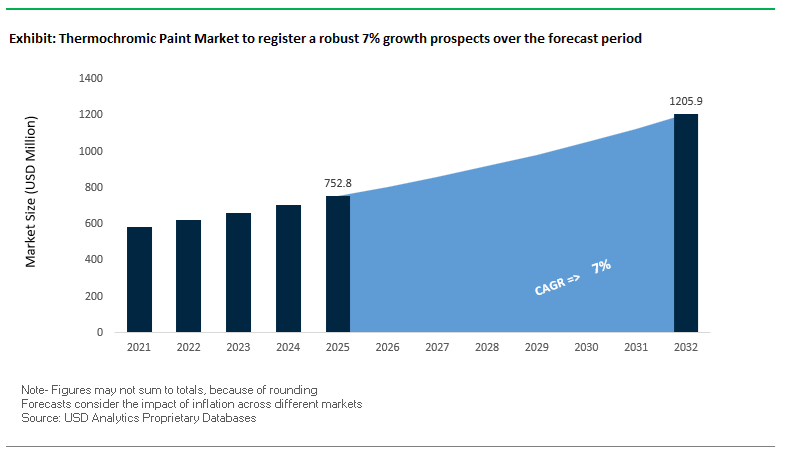
The global Thermochromic Paint Market is expanding steadily, supported by increasing adoption of temperature-responsive coatings across automotive, construction, packaging, and industrial safety applications. The market was valued at $752.8 million in 2025 and is projected to reach $1,208.8 million by 2032, growing at a CAGR of 7% during 2025–2032. This growth is driven by the rising demand for coatings that provide real-time visual feedback based on temperature changes, enhancing safety, efficiency, and user interaction.
A key structural driver is the increasing use of thermochromic pigments and microcapsule technologies, which enable coatings to reversibly change color in response to heat variations. These materials are widely used in industrial safety systems, food packaging, automotive coatings, and smart consumer products, where temperature monitoring is critical. In industrial environments, thermochromic coatings are increasingly replacing or complementing electronic sensors, offering low-cost, passive monitoring solutions for pipelines, machinery, and equipment.
Another major trend is the growing integration of interactive and aesthetic applications, particularly in architecture and consumer goods. Thermochromic paints are being used to create dynamic surfaces that respond to environmental conditions or human touch, enhancing user engagement and design differentiation. Additionally, the expansion of smart packaging solutions, including temperature indicators for beverages and perishable goods, is creating new growth opportunities.
Sustainability is also shaping the market, with manufacturers focusing on water-based, low-VOC thermochromic systems and bio-based resin integration. Advances in pigment stability, particularly resistance to UV degradation, are addressing historical limitations and enabling broader outdoor applications. Overall, the market is evolving toward durable, multifunctional, and environmentally compliant smart coating systems.
The thermochromic paint market is being transformed by material innovation, strategic consolidation, and expanding application areas, reflecting the growing importance of smart coatings in both industrial and consumer markets. The March 2026 proposed merger between AkzoNobel and Axalta is expected to consolidate R&D capabilities in smart materials, including thermochromic and heat-reflective coatings, strengthening their position in high-value automotive and industrial segments.
A major technological breakthrough is the improvement of pigment durability. Anhui iSuoChem’s April 2026 launch of high-durability thermochromic pigments demonstrates significant progress in overcoming UV fading, with the new formulations retaining 90% color vibrancy after extended outdoor exposure. This advancement enables the use of thermochromic coatings in road markings, architectural safety systems, and outdoor infrastructure.
Industrial safety applications are rapidly expanding. OliKrom’s January 2026 scale-up of “Smart Safety” coatings introduces solutions that provide visual alerts when equipment reaches critical temperatures, enhancing safety in high-risk industrial environments without relying solely on electronic monitoring systems.
Microencapsulation technology is also advancing performance capabilities. Matsui International’s May 2025 launch of industrial-grade thermochromic microcapsules enables integration into heavy-duty protective coatings, while Good Life Innovations’ June 2025 food-contact certified microcapsules open opportunities in smart food packaging and cold-chain monitoring.
Smart packaging is emerging as a high-growth segment. LCR Hallcrest’s September 2025 partnership with a global beverage manufacturer introduces thermochromic “perfect serve” indicators, enhancing consumer experience by signaling optimal product temperature.
Consumer-facing applications are also evolving. OliKrom’s March 2025 home decor thermochromic coatings enable interactive furniture and lighting surfaces, while Chromatic Technologies Inc.’s November 2024 expansion into anti-counterfeiting coatings utilizes multi-transition color-changing technology to secure pharmaceutical packaging and high-value documents.
Sustainability-driven innovation is further shaping the market. iSuoChem’s October 2024 water-based thermochromic pigment series significantly reduces VOC emissions, aligning with stricter environmental regulations and supporting broader adoption in consumer and industrial applications. Additionally, AkzoNobel’s February 2026 portfolio restructuring reflects a strategic focus on high-margin specialty coatings, including thermochromic and bio-based resin systems.
Regulatory pressure from the European Chemicals Agency is fundamentally altering the chemistry of reversible thermochromic paints. Under updated REACH Annex XVII provisions effective in early 2026, developers used in leuco dye systems must comply with a stringent 0.02% by weight limit for bisphenol-based compounds such as BPA and BPS in consumer-facing applications. This effectively enforces a “zero-bisphenol” formulation strategy across segments including food packaging, consumer goods, and children’s products. As a result, coating manufacturers are accelerating the transition toward bio-based developers and long-chain phenolic substitutes that maintain reversible color-change functionality while eliminating endocrine-disrupting risks. The regulatory impact is substantial, with projections indicating a 90% reduction in bisphenol-related leaching across thermochromic applications by the end of 2026. This shift is not only compliance-driven but is also influencing brand positioning, as manufacturers increasingly market bisphenol-free thermochromic coatings as safer and more sustainable alternatives. However, reformulation introduces technical challenges related to color intensity, transition sharpness, and long-term stability, making advanced material engineering a key competitive factor in the evolving thermochromic paint market.
Market Trend: ASTM D8265-25 Establishes Quantitative Standards for Color-Temperature Mapping and Hysteresis Control
The introduction of ASTM D8265-25 represents a major step toward the industrial standardization of thermochromic coatings, transitioning the technology from qualitative visual indicators to quantitative thermal measurement tools. The standard defines strict requirements for temperature indication accuracy, mandating a tolerance of ±2.5°C for industrial-grade coatings. This level of precision enables thermochromic paints to be used in safety-critical environments such as power plants, refineries, and process industries, where accurate thermal monitoring is essential. Additionally, ASTM D8265-25 addresses the issue of hysteresis, requiring manufacturers to disclose and minimize the temperature discrepancy between heating and cooling color transitions. Historically, this discrepancy could reach 10°C to 15°C, limiting reliability in dynamic thermal environments. By enforcing standardized reporting of color transition intervals, the new framework enhances comparability between products and supports integration with digital monitoring systems. As industries adopt more data-driven maintenance and inspection practices, standardized thermochromic coatings are becoming a viable alternative to traditional temperature sensing technologies.
Market Opportunity: Irreversible Thermochromic Paints Enable Passive Thermal Monitoring and Forensic Analysis in EV Batteries
The rapid evolution of electric vehicle battery technologies is creating a strong demand for passive, high-resolution thermal monitoring solutions. Irreversible thermochromic paints are emerging as a critical tool by providing a permanent visual record of temperature excursions that may not be captured by localized sensors. Applied directly to battery cell casings, these coatings can register peak temperatures of 70°C or higher, enabling comprehensive post-event analysis of thermal runaway incidents. Unlike conventional thermocouples, which measure temperature at discrete points, thermochromic coatings offer full-surface coverage, allowing detection of localized hot spots as small as 2 millimeters. This capability is particularly valuable for identifying early-stage defects such as internal short circuits or electrolyte degradation. Advanced formulations introduced in 2026 feature multi-stage color transitions, enabling detailed thermal mapping across different temperature thresholds. For example, coatings can transition sequentially from white to orange, red, and black as temperature increases, providing a visual gradient of heat distribution. This approach enhances diagnostic accuracy without adding weight or electronic complexity, making it highly suitable for next-generation battery safety systems.
Market Opportunity: Reversible Thermochromic Coatings Enhance Energy Efficiency and Diagnostics in Smart Building Envelopes
Reversible thermochromic coatings are gaining traction in the construction sector as part of smart building and energy efficiency strategies. These coatings dynamically alter their optical properties in response to temperature changes, enabling passive regulation of solar heat gain. Exterior thermochromic paints designed to transition at approximately 25°C can shift from heat-absorbing dark states to reflective light states, reducing peak cooling loads by up to 22% in temperate climates. This functionality supports compliance with green building standards and reduces reliance on active cooling systems. In addition to energy management, thermochromic coatings are being used as diagnostic tools for identifying thermal inefficiencies within building envelopes. Interior applications can detect temperature variations as small as 0.5°C, allowing facility managers to visualize thermal bridges and insulation defects in real time. This capability enables targeted retrofitting, reducing energy waste by an estimated 15%. Advances in inorganic pigment technology have also addressed durability concerns, with modern coatings capable of withstanding more than 5,000 hours of UV exposure without significant degradation. As urban infrastructure evolves toward greater sustainability and intelligence, reversible thermochromic coatings are emerging as a multifunctional solution for both energy optimization and building diagnostics.
Thermochromic Paint Market Share and Segmentation Insights: Type Segment Driving Smart Coating Innovation
Reversible Thermochromic Paints Dominate with 66.7% Share Due to Repeatable Color Functionality
The reversible thermochromic paint segment leads the global thermochromic coatings market with a dominant 66.7% market share in 2025, driven by its repeatable color-changing capability across temperature cycles. Unlike irreversible alternatives, these advanced smart coatings transition from cold to warm and back again without degradation, making them highly valuable in temperature-sensitive applications such as beverage packaging, food labeling, and ambient condition indicators. A key growth driver within the functional coatings and smart materials market is the use of microencapsulation technology, where leuco dyes are encapsulated in polymer shells, ensuring durability, stability, and compatibility with screen printing, spray coating, and flexographic processes. This technological advantage supports widespread adoption across consumer packaging, branding solutions, and temperature monitoring systems. As demand rises for interactive packaging and intelligent coatings, reversible thermochromic paints continue to outperform other types, reinforcing their leadership in the global thermochromic paint industry.
Packaging Industry Leads with 31.4% Share Fueled by Smart Branding and Food Safety Applications
The packaging segment, particularly beverage and food packaging, holds the largest share at 31.4% in the thermochromic paint market in 2025, driven by increasing demand for innovative, interactive, and safety-enhancing packaging solutions. Within the smart packaging and temperature-sensitive labeling market, thermochromic coatings are widely used in beverage cans such as beer, soft drinks, and energy drinks, where cold-activated color changes enhance consumer engagement and enable premium branding strategies, especially for limited-edition products. Additionally, thermochromic paints play a critical role in food safety compliance, as temperature-indicating labels alert consumers and retailers to unsafe conditions, such as thawed frozen foods or improper storage temperatures. This functionality aligns with growing regulatory focus on food quality assurance and cold chain monitoring systems. As brands increasingly invest in value-added packaging technologies, the packaging segment continues to drive strong growth within the global thermochromic coatings and smart materials market.
Competitive Landscape Analysis of the Thermochromic Paint Market
Chromatic Technologies Driving Smart Packaging and Cold-Chain Thermochromic Solutions
Chromatic Technologies Inc. (CTI) holds a dominant position in the thermochromic paint market, particularly within the consumer packaged goods (CPG) segment, where thermochromic inks are widely used as freshness indicators in food and beverage packaging. Between 2025 and 2026, CTI achieved a major milestone by receiving recognition from the Association of Plastic Recyclers (APR), ensuring its smart thermochromic labels remain compatible with recycling streams. Its proprietary Reveal technology enables multi-stage color transitions, communicating precise temperature thresholds such as “cold” or “optimal.” Expanding into healthcare, CTI is introducing power-activated irreversible thermochromic coatings for vaccine cold-chain monitoring, strengthening its leadership in smart packaging and temperature-sensitive coating solutions.
OliKrom Advancing Industrial Safety and Smart Material Thermochromic Coatings
OliKrom (France) is emerging as a high-growth innovator in the thermochromic coatings market, holding 13% share in the specialized smart-pigment segment as of 2026. The company has introduced industrial safety coatings that act as visual heat alerts, changing color at precise thresholds such as 60°C or 240°C to prevent equipment damage and workplace injuries. Its latest development includes reversible thermochromic microcapsules for interior design and smart textiles, enabling dynamic color changes based on ambient temperature. OliKrom’s strategic focus on material intelligence aims to replace electronic sensors with chemical-based indicators, offering energy-efficient and cost-effective temperature monitoring solutions.
LCR Hallcrest Leading High-Precision Thermochromic Paints for Medical and Aerospace Use
LCR Hallcrest LLC (TMC Hallcrest) is a global leader in the thermochromic paint market, particularly known for its advanced liquid crystal (LC) technology, which delivers temperature sensitivity within 0.1°C precision. In 2026, the company is focusing on expanding its thermographic product line for medical and life sciences applications, including non-invasive fever detection and diagnostic strips. It also dominates aerospace and wind energy sectors for surface temperature mapping, enabling visualization of thermal hotspots and airflow friction on turbine blades. With a 30% improvement in UV resistance in its latest formulations, LCR Hallcrest is addressing durability challenges in outdoor thermochromic coating applications.
Matsui Shikiso Expanding Thermochromic Applications in Plastics and Smart Consumer Goods
Matsui Shikiso Chemical Co., Ltd. is strengthening its position in the thermochromic coatings market through innovation in high-heat microcapsule technology. In 2025, the company launched thermochromic additives capable of withstanding injection molding temperatures, expanding applications in industrial plastics. Its Chromicolor series is widely used in smart kitchenware and automotive interiors, providing visual heat safety feedback. With a strong presence in the Asia-Pacific region—the fastest-growing market for thermochromic textiles and electronics—Matsui continues to scale its influence. Its 2026 eco-friendly initiative introduces solvent-free, water-based thermochromic dispersions that comply with upcoming VOC regulations, reinforcing its leadership in sustainable smart coatings.
AkzoNobel Integrating Thermochromic Intelligence into Sustainable Architectural Coatings
AkzoNobel N.V. is advancing the thermochromic paint market by integrating aesthetic intelligence and energy-efficient smart coatings into its product portfolio. In 2026, the company introduced thermochromic elements in its “Rhythm of Blues” collection, with technologies like Mellow Flow™ and Slow Swing™ that dynamically adjust color depth based on temperature and lighting conditions. Through collaboration with IPG Photonics, AkzoNobel is developing laser-curing processes that reduce the carbon footprint of applying thermochromic coatings, particularly in automotive manufacturing. With an adjusted EBITDA margin of 14.2% in 2025, the company is focusing on energy-saving façade solutions, including cool-roof coatings that adapt to seasonal temperature changes, reinforcing its position in sustainable smart paint technologies.
United States Driving PFAS-Free Thermochromic Innovation and Defense Applications
The United States is a frontrunner in the thermochromic paint market, driven by stringent environmental regulations and strong demand across defense, infrastructure, and cold-chain logistics. Following the EPA’s phase-out of fluorinated compounds, manufacturers have transitioned toward PFAS-free thermochromic coatings, utilizing advanced silane-based microencapsulation technologies to deliver durability without environmental risk.
Technological advancements are accelerating adoption, particularly with the Department of Energy’s deployment of smart thermochromic roof coatings that dynamically change color at specific temperatures (around 22°C) to optimize solar heat management. Strategic collaborations, such as the partnership between Chromatic Technologies Inc. and Sherwin-Williams, are expanding the use of irreversible thermochromic indicators for industrial safety applications, especially in monitoring transformer overheating.
Defense modernization remains a key driver, with the integration of multispectral thermochromic camouflage coatings in next-generation air dominance programs. Investments in intelligent labeling technologies are also fueling growth in temperature-sensitive packaging, particularly for biologics and vaccine logistics. High-temperature irreversible coatings are increasingly used in aerospace MRO cycles, providing clear visual indicators of overheating in jet engine housings.
China’s Large-Scale Deployment of Thermochromic Coatings in Smart Infrastructure
China is rapidly scaling its presence in the thermochromic coatings market, integrating advanced materials into urban infrastructure, energy systems, and packaging industries. Government initiatives such as the New Material Industry Standard (2025–2026) are incentivizing the use of thermotropic coatings in buildings to reduce HVAC loads, enhancing energy efficiency in rapidly urbanizing regions.
Infrastructure investments are driving widespread adoption of thermochromic safety coatings across ultra-high-voltage substations, enabling real-time visual alerts for overheating and improving grid reliability. Technological advancements include the development of nano-clay reinforced thermochromic binders, which significantly enhance UV stability for outdoor applications.
Industrial expansion is evident with new high-purity liquid crystal coating lines targeting semiconductor thermal mapping applications. China is also innovating in color-changing safety paints for high-speed rail systems, enabling rapid inspection and maintenance. Additionally, the use of thermochromic indicators in food and beverage packaging is ensuring compliance with stringent freshness tracking regulations, strengthening China’s position as a global leader in functional thermochromic coatings.
Germany’s Leadership in Sustainable Thermochromic Coatings and Circular Economy Compliance
Germany is a key player in the European thermochromic paint market, focusing on sustainability, precision engineering, and compliance with circular economy regulations. The country’s alignment with the EU’s Ecodesign standards is driving the shift toward waterborne and solvent-free thermochromic coatings, ensuring environmental compliance without compromising performance.
Product innovation includes the development of thermal insulation coatings with dynamic color-shifting properties, capable of reducing roof surface temperatures significantly. Investments in smart sol-gel technologies are enabling coatings with embedded corrosion indicators, enhancing predictive maintenance capabilities.
Technological advancements are also evident in antimicrobial thermochromic coatings for healthcare environments, which visually confirm the completion of thermal disinfection processes. Infrastructure applications include thermochromic road markings that enhance safety in cold climates by indicating icy conditions. Germany’s dominance in precision liquid crystal coatings for automotive applications further underscores its leadership in high-performance thermochromic solutions.
India’s Growth Driven by Cold-Chain Expansion and Agricultural Applications
India is emerging as a high-growth market in the thermochromic paint industry, supported by government initiatives and increasing demand for cost-effective temperature monitoring solutions. Programs under the National Logistics Policy 2026 are promoting the adoption of thermochromic labels in agricultural supply chains, particularly in the Kisan Rail network, ensuring the thermal integrity of perishable goods.
Infrastructure expansion, including the establishment of microencapsulation facilities, is enabling local production of thermochromic pigments, reducing costs and import dependency. Technological breakthroughs in low-cost irreversible thermochromic inks are empowering small-scale dairy producers to verify cold-chain compliance.
Product innovation is focused on UV-stable thermochromic coatings for cool roof applications, addressing urban heat challenges in cities like Ahmedabad. Regulatory frameworks such as the Quality Control Order (QCO) 2026 are standardizing performance metrics, ensuring reliability of color-shifting coatings. The adoption of thermochromic security inks in pharmaceutical packaging is also playing a crucial role in combating counterfeit drugs, strengthening India’s position in the global market.
Japan continues to lead in nano-engineered thermochromic coatings, particularly in electronics, medical devices, and high-performance materials. The commercialization of ultra-thin thermoresistive layers for electronic components is enabling precise thermal monitoring in advanced devices such as multi-layer ceramic capacitors.
Innovation is also evident in photocatalytic self-cleaning thermochromic coatings, which combine environmental benefits with dynamic thermal management for high-rise buildings. Strategic investments by major chemical companies are expanding the production of high-sensitivity leuco-dye systems, supporting applications in medical and industrial sectors.
Regulatory updates under Japanese Industrial Standards are ensuring durability and performance in challenging environments, including resistance to moisture and salt exposure. Japan also dominates in consumer applications, particularly in reversible thermochromic pigments used in smart stationery and interactive products, highlighting its leadership in both industrial and consumer-driven thermochromic innovations.
Saudi Arabia’s Expansion in Thermochromic Coatings for Extreme Climate Applications
Saudi Arabia is rapidly advancing in the thermochromic paint market, driven by large-scale infrastructure projects and extreme climate requirements under Vision 2030. The deployment of thermochromic façade coatings in projects like NEOM’s “The Line” is enhancing energy efficiency by dynamically managing heat absorption in desert conditions.
Government mandates such as the SASO durability standards are ensuring long-term performance of smart coatings, requiring consistent color-shift functionality over extended periods. Product innovation includes sand-abrasion resistant thermochromic paints, designed to withstand harsh desert environments.
Investments in specialized production facilities are supporting the development of heat-switchable architectural coatings, while applications in industrial sectors include thermochromic indicators for pipelines and fuel storage systems to detect thermal anomalies. The integration of phase-change materials (PCMs) into coatings is further enhancing thermal regulation in residential buildings, positioning Saudi Arabia as a key market for climate-adaptive thermochromic technologies.
Thermochromic Paint Market Report Scope
Thermochromic Paint Market
Parameter
Details
Market Size (2025)
$752.8 Million
Market Size (2032)
$1208.8 Million
Market Growth Rate
7%
Segments
By Type (Reversible, Irreversible, Semi-Reversible), By Material Chemistry (Leuco Dyes, Liquid Crystals, Inorganic Pigments, Hybrid Systems), By Activation Temperature Range (Low Temperature, Ambient Temperature, High Temperature), By Technology (Water-borne, Solvent-borne, UV-Curable, Powder Coatings, Slurry and Concentrates), By Application Method (Spray Coating, Screen Printing, Flexographic and Gravure Printing, Roll and Dip Coating, Brushing), By End-User Industry (Packaging, Automotive and Transportation, Building and Construction, Industrial and Manufacturing, Consumer Goods, Textiles and Fashion, Aerospace and Defense, Healthcare and Medical)
Study Period
2019- 2025 and 2026-2032
Units
Revenue (USD)
Qualitative Analysis
Porter’s Five Forces, SWOT Profile, Market Share, Scenario Forecasts, Market Ecosystem, Company Ranking, Market Dynamics, Industry Benchmarking
Companies
Chromatic Technologies Inc., LCR Hallcrest, Inc., OliKrom, Matsui Shikiso Chemical Co., Ltd., PPG Industries, Inc., Akzo Nobel N.V., The Sherwin-Williams Company, RPM International Inc., BASF SE, New Prismatic Enterprise Co., Ltd., Smarol Industry Co., Ltd., GEM'INNOV, Indestructible Paint Limited, Kolortek Co., Ltd., SpotSee
Countries
US, Canada, Mexico, Germany, France, Spain, Italy, UK, Russia, China, India, Japan, South Korea, Australia, South East Asia, Brazil, Argentina, Middle East, Africa
Thermochromic Paint Market Segmentation
By Type
Reversible
Irreversible
Semi-Reversible
By Material Chemistry
Leuco Dyes
Liquid Crystals
Inorganic Pigments
Hybrid Systems
By Activation Temperature Range
Low Temperature
Ambient Temperature
High Temperature
By Technology
Water-borne
Solvent-borne
UV-Curable
Powder Coatings
Slurry and Concentrates
By Application Method
Spray Coating
Screen Printing
Flexographic and Gravure Printing
Roll and Dip Coating
Brushing
By End-User Industry
Packaging
Food and Beverage
Pharmaceuticals
Automotive and Transportation
Building and Construction
Industrial and Manufacturing
Consumer Goods
Textiles and Fashion
Aerospace and Defense
Healthcare and Medical
Leading Countries in the Industry
North America (United States, Canada, Mexico)
Europe (Germany, France, Spain, United Kingdom, Italy, Russia, Rest of Europe)
Asia Pacific (China, India, Japan, South Korea, Australia, South East Asia, Rest of APAC)
South and Central America (Brazil, Argentina, Rest of SCA)
Middle East and Africa (Saudi Arabia, UAE, MENA, Sub-Saharan Africa)
Leading Countries in the Industry
North America (United States, Canada, Mexico)
Europe (Germany, France, Spain, United Kingdom, Italy, Russia, Rest of Europe)
Asia Pacific (China, India, Japan, South Korea, Australia, South East Asia, Rest of APAC)
South and Central America (Brazil, Argentina, Rest of SCA)
Middle East and Africa (Saudi Arabia, UAE, MENA, Sub-Saharan Africa)
Top Companies in Thermochromic Paint Industry
Chromatic Technologies Inc.
LCR Hallcrest, Inc.
OliKrom
Matsui Shikiso Chemical Co., Ltd.
PPG Industries, Inc.
Akzo Nobel N.V.
The Sherwin-Williams Company
RPM International Inc.
BASF SE
New Prismatic Enterprise Co., Ltd.
Smarol Industry Co., Ltd.
GEM'INNOV
Indestructible Paint Limited
Kolortek Co., Ltd.
SpotSee
*- List not Exhaustive
Table of Contents: Thermochromic Paint Market
1. Executive Summary
1.1. Market Highlights
1.2. Key Findings
1.3. Global Market Snapshot
2. Thermochromic Paint Market Landscape and Outlook (2025–2034)
2.1. Introduction to the Thermochromic Paint Market
2.2. Market Valuation and Growth Projections (2025–2034)
2.3. Demand Drivers in Temperature-Responsive Coatings, Smart Packaging, and Industrial Safety
2.4. Regulatory Trends and Sustainability Standards in Smart Coating Formulations
2.5. Strategic Opportunities and Future Outlook
3. Innovations Reshaping the Thermochromic Paint Market
3.1. Trend: EU REACH 2026 Zero-Bisphenol Mandate Reshapes Leuco Dye-Based Thermochromic Formulations
3.2. Trend: ASTM D8265-25 Establishes Quantitative Standards for Color-Temperature Mapping and Hysteresis Control
3.3. Opportunity: Irreversible Thermochromic Paints Enable Passive Thermal Monitoring and Forensic Analysis in EV Batteries
3.4. Opportunity: Reversible Thermochromic Coatings Enhance Energy Efficiency and Diagnostics in Smart Building Envelopes
4. Competitive Landscape and Strategic Initiatives
4.1. Mergers and Acquisitions
4.2. RandD and Material Innovation
4.3. Sustainability and ESG Strategies
4.4. Market Expansion and Regional Focus
5. Market Share and Segmentation Insights: Thermochromic Paint Market
5.1. By Type
5.1.1. Reversible
5.1.2. Irreversible
5.1.3. Semi-Reversible
5.2. By Material Chemistry
5.2.1. Leuco Dyes
5.2.2. Liquid Crystals
5.2.3. Inorganic Pigments
5.2.4. Hybrid Systems
5.3. By Activation Temperature Range
5.3.1. Low Temperature
5.3.2. Ambient Temperature
5.3.3. High Temperature
5.4. By Technology
5.4.1. Water-borne
5.4.2. Solvent-borne
5.4.3. UV-Curable
5.4.4. Powder Coatings
5.4.5. Slurry and Concentrates
5.5. By Application Method
5.5.1. Spray Coating
5.5.2. Screen Printing
5.5.3. Flexographic and Gravure Printing
5.5.4. Roll and Dip Coating
5.5.5. Brushing
5.6. By End-User Industry
5.6.1. Packaging
5.6.2. Food and Beverage
5.6.3. Pharmaceuticals
5.6.4. Automotive and Transportation
5.6.5. Building and Construction
5.6.6. Industrial and Manufacturing
5.6.7. Consumer Goods
5.6.8. Textiles and Fashion
5.6.9. Aerospace and Defense
5.6.10. Healthcare and Medical
6. Country Analysis and Outlook of Thermochromic Paint Market
6.1. United States
6.2. Canada
6.3. Mexico
6.4. Germany
6.5. France
6.6. Spain
6.7. Italy
6.8. United Kingdom
6.9. Russia
6.10. China
6.11. India
6.12. Japan
6.13. South Korea
6.14. Australia
6.15. South East Asia
6.16. Brazil
6.17. Argentina
6.18. Middle East
6.19. Africa
7. Thermochromic Paint Market Size Outlook by Region (2025–2034)
7.1. North America Thermochromic Paint Market Size Outlook to 2034
7.1.1. By Type
7.1.2. By Material Chemistry
7.1.3. By Activation Temperature Range
7.1.4. By Technology
7.1.5. By Application Method
7.1.6. By End-User Industry
7.2. Europe Thermochromic Paint Market Size Outlook to 2034
7.2.1. By Type
7.2.2. By Material Chemistry
7.2.3. By Activation Temperature Range
7.2.4. By Technology
7.2.5. By Application Method
7.2.6. By End-User Industry
7.3. Asia Pacific Thermochromic Paint Market Size Outlook to 2034
7.3.1. By Type
7.3.2. By Material Chemistry
7.3.3. By Activation Temperature Range
7.3.4. By Technology
7.3.5. By Application Method
7.3.6. By End-User Industry
7.4. South America Thermochromic Paint Market Size Outlook to 2034
7.4.1. By Type
7.4.2. By Material Chemistry
7.4.3. By Activation Temperature Range
7.4.4. By Technology
7.4.5. By Application Method
7.4.6. By End-User Industry
7.5. Middle East and Africa Thermochromic Paint Market Size Outlook to 2034
7.5.1. By Type
7.5.2. By Material Chemistry
7.5.3. By Activation Temperature Range
7.5.4. By Technology
7.5.5. By Application Method
7.5.6. By End-User Industry
8. Company Profiles: Leading Players in the Thermochromic Paint Market
8.1. Chromatic Technologies Inc.
8.2. LCR Hallcrest, Inc.
8.3. OliKrom
8.4. Matsui Shikiso Chemical Co., Ltd.
8.5. PPG Industries, Inc.
8.6. Akzo Nobel N.V.
8.7. The Sherwin-Williams Company
8.8. RPM International Inc.
8.9. BASF SE
8.10. New Prismatic Enterprise Co., Ltd.
8.11. Smarol Industry Co., Ltd.
8.12. GEM'INNOV
8.13. Indestructible Paint Limited
8.14. Kolortek Co., Ltd.
8.15. SpotSee
9. Methodology
9.1. Research Scope
9.2. Market Research Approach
9.3. Market Sizing and Forecasting Model
9.4. Research Coverage
9.5. Data Horizon
9.6. Deliverables
10. Appendix
10.1. Acronyms and Abbreviations
10.2. List of Tables
10.3. List of Figures
Thermochromic Paint Market Segmentation
By Type
Reversible
Irreversible
Semi-Reversible
By Material Chemistry
Leuco Dyes
Liquid Crystals
Inorganic Pigments
Hybrid Systems
By Activation Temperature Range
Low Temperature
Ambient Temperature
High Temperature
By Technology
Water-borne
Solvent-borne
UV-Curable
Powder Coatings
Slurry and Concentrates
By Application Method
Spray Coating
Screen Printing
Flexographic and Gravure Printing
Roll and Dip Coating
Brushing
By End-User Industry
Packaging
Food and Beverage
Pharmaceuticals
Automotive and Transportation
Building and Construction
Industrial and Manufacturing
Consumer Goods
Textiles and Fashion
Aerospace and Defense
Healthcare and Medical
Leading Countries in the Industry
North America (United States, Canada, Mexico)
Europe (Germany, France, Spain, United Kingdom, Italy, Russia, Rest of Europe)
Asia Pacific (China, India, Japan, South Korea, Australia, South East Asia, Rest of APAC)
South and Central America (Brazil, Argentina, Rest of SCA)
Middle East and Africa (Saudi Arabia, UAE, MENA, Sub-Saharan Africa)
The global Thermochromic Paint Market was valued at $752.8 million in 2025 and is projected to reach $1,208.8 million by 2032, growing at a CAGR of 7% during the forecast period. Rising demand for smart coatings, temperature-sensitive packaging, and industrial safety monitoring systems is accelerating global market expansion.
Reversible thermochromic paints dominate the market because they can repeatedly change color with temperature fluctuations without losing performance. Their strong adoption in smart packaging, beverage labeling, consumer products, and building applications is supported by advances in microencapsulation technology, durability, and UV resistance.
Thermochromic paints are increasingly used in smart packaging to indicate product freshness, optimal serving temperature, and cold-chain compliance for food, beverages, and pharmaceuticals. In industrial environments, these coatings provide passive visual alerts for overheating equipment, pipelines, transformers, and machinery, reducing dependence on electronic sensors.
Key market trends include the development of UV-stable pigments, water-based low-VOC coatings, bio-based thermochromic systems, and irreversible thermal mapping paints for EV batteries. Regulatory changes such as the EU REACH “Zero-Bisphenol” mandate and ASTM D8265-25 standards are also driving safer formulations and improved temperature indication accuracy.
Major companies operating in the Thermochromic Paint Market include Akzo Nobel N.V., PPG Industries, Inc., The Sherwin-Williams Company, BASF SE, RPM International Inc., and Chromatic Technologies Inc.. These companies are investing in smart packaging technologies, UV-resistant pigments, sustainable thermochromic formulations, and advanced industrial safety coatings.