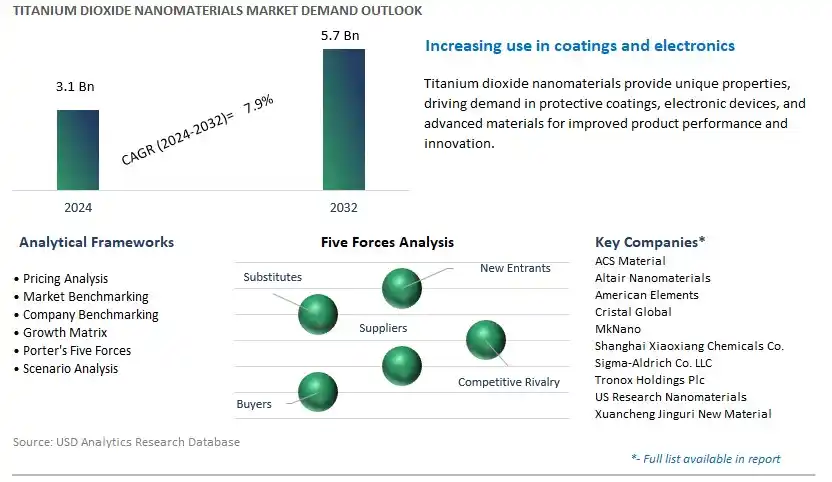
Global Titanium Dioxide Nanomaterials Market Size is valued at $3.1 Billion in 2024 and is forecast to register a growth rate (CAGR) of 7.9% to reach $5.7 Billion by 2032.
The global Titanium Dioxide Nanomaterials Market Study analyzes and forecasts the market size across 6 regions and 24 countries for diverse segments -By Type (Rutile Nanoparticles, Anatase Nanoparticles, Combination of Rutile and Anatase Nanoparticles, Nanowires and Nanotubes, Others), By Application (Personal Care Products, Paints and Coatings, Paper and Ink, Catalysts, Others).
An Introduction to Titanium Dioxide Nanomaterials Market in 2024
Titanium dioxide (TiO2) nanomaterials represent a class of engineered nanoparticles with unique optical, electronic, and catalytic properties, finding applications across diverse industries such as cosmetics, electronics, and environmental remediation. With exceptional photocatalytic activity and biocompatibility, TiO2 nanomaterials offer promising solutions for air and water purification, self-cleaning surfaces, and medical diagnostics. Further, their ability to enhance the optical properties of paints, coatings, and textiles makes them indispensable in achieving desired aesthetic effects and functional performance. As research in nanotechnology advances and regulatory frameworks evolve, titanium dioxide nanomaterials to drive innovation in material science, catalysis, and sustainable technology development, shaping the future of various industrial sectors.
Titanium Dioxide Nanomaterials Market Competitive Landscape
The market report analyses the leading companies in the industry including ACS Material, Altair Nanomaterials, American Elements, Cristal Global, MkNano, Shanghai Xiaoxiang Chemicals Co., Sigma-Aldrich Co. LLC, Tronox Holdings Plc, US Research Nanomaterials, Xuancheng Jinguri New Material, and others.
Titanium Dioxide Nanomaterials Market Dynamics
Market Trend: Increasing Demand for High-Performance Nanomaterials in Various Industries
A prominent trend in the titanium dioxide nanomaterials market is the rising demand for high-performance nanomaterials across diverse industries. Titanium dioxide nanoparticles exhibit unique properties such as high surface area, enhanced reactivity, and optical characteristics, making them attractive for a wide range of applications including coatings, pigments, cosmetics, electronics, and healthcare. As industries seek innovative solutions to enhance product performance, durability, and efficiency, there is growing interest in utilizing titanium dioxide nanomaterials for their advanced properties. This trend is driving research and development efforts to explore novel applications and optimize the synthesis and functionalization of titanium dioxide nanoparticles to meet the evolving needs of various industries.
Market Driver: Advancements in Nanotechnology and Material Science
The primary driver behind the growth of the titanium dioxide nanomaterials market is advancements in nanotechnology and material science. With continuous progress in nanomaterial synthesis, characterization, and application techniques, there has been a significant improvement in the production scalability, quality control, and performance optimization of titanium dioxide nanoparticles. Researchers and manufacturers are leveraging cutting-edge technologies such as sol-gel processes, hydrothermal synthesis, and atomic layer deposition to produce titanium dioxide nanomaterials with tailored properties and functionalities. Moreover, advancements in surface modification and nanoparticle engineering enable the customization of titanium dioxide nanoparticles for specific applications, enhancing their compatibility, stability, and performance in various systems. These advancements in nanotechnology and material science drive innovation and expansion in the titanium dioxide nanomaterials market, fueling the development of new products and applications across industries.
Market Opportunity: Integration of Titanium Dioxide Nanomaterials in Sustainable Technologies
An opportunity for the titanium dioxide nanomaterials market lies in the integration of these nanoparticles in sustainable technologies to address environmental and societal challenges. Titanium dioxide nanoparticles exhibit photocatalytic properties, making them effective catalysts for environmental remediation, air purification, and water treatment applications. By harnessing the photocatalytic activity of titanium dioxide nanomaterials, innovative technologies can be developed for air and water purification systems, pollutant degradation, and renewable energy generation. Additionally, titanium dioxide nanoparticles can be incorporated into sustainable building materials, coatings, and textiles to impart self-cleaning, antimicrobial, and UV-resistant properties, contributing to energy efficiency, indoor air quality, and public health. As industries and governments worldwide prioritize sustainability and environmental stewardship, the demand for titanium dioxide nanomaterials in sustainable technologies presents a significant opportunity for market growth and differentiation. By focusing on eco-friendly applications and solutions, the titanium dioxide nanomaterials market can align with sustainability goals and capture emerging opportunities in the green technology sector.
Titanium Dioxide Nanomaterials Market Share Analysis: Rutile Nanoparticles segment generated the highest revenue in 2024
Within the titanium dioxide nanomaterials market segmented by type, rutile nanoparticles emerge as the largest segment, commanding a significant share due to their unique properties and versatile applications. Rutile nanoparticles are characterized by their high refractive index, excellent UV absorption capacity, and photocatalytic activity, making them highly desirable in various industries. They are widely used in paints and coatings, cosmetics, sunscreens, photocatalysts, and biomedical applications due to their ability to enhance product performance and functionality. Additionally, rutile nanoparticles offer superior stability and durability compared to other titanium dioxide nanomaterials, making them preferred choices for long-term applications. The growing demand for high-quality pigments, UV filters, and photocatalysts across industries drives the demand for rutile nanoparticles, solidifying their position as the largest segment in the titanium dioxide nanomaterials market.
Titanium Dioxide Nanomaterials Market Share Analysis: Personal Care Products is poised to register the fastest CAGR over the forecast period
Among the segments delineated within the titanium dioxide nanomaterials market by application, personal care products emerge as the fastest-growing segment, fuelling significant advancements in cosmetic formulations and skincare products. Titanium dioxide nanoparticles are widely used in personal care products such as sunscreens, cosmetics, and skincare formulations due to their excellent UV-blocking properties and photo-stability. These nanoparticles provide effective protection against harmful UV radiation, preventing sunburn, skin damage, and premature aging. The growing awareness of the harmful effects of UV radiation on skin health, coupled with increasing consumer preferences for sunscreen and skincare products with high SPF ratings, drives the demand for titanium dioxide nanoparticles in the personal care industry. Additionally, advancements in nanotechnology and formulation techniques enable the incorporation of titanium dioxide nanoparticles into a wide range of cosmetic products, enhancing their efficacy and market appeal. As consumers continue to prioritize sun protection and skincare, the demand for titanium dioxide nanoparticles in personal care products is expected to witness rapid growth, solidifying the segment's position as the fastest-growing segment in the titanium dioxide nanomaterials market.
Titanium Dioxide Nanomaterials Market
By Type
Rutile Nanoparticles
Anatase Nanoparticles
Combination of Rutile and Anatase Nanoparticles
Nanowires and Nanotubes
Others
By Application
Personal Care Products
Paints and Coatings
Paper and Ink
Catalysts
Others
Countries Analyzed
North America (US, Canada, Mexico)
Europe (Germany, UK, France, Spain, Italy, Russia, Rest of Europe)
Asia Pacific (China, India, Japan, South Korea, Australia, South East Asia, Rest of Asia)
South America (Brazil, Argentina, Rest of South America)
Middle East and Africa (Saudi Arabia, UAE, Rest of Middle East, South Africa, Egypt, Rest of Africa)
Titanium Dioxide Nanomaterials Companies Profiled in the Study
ACS Material
Altair Nanomaterials
American Elements
Cristal Global
MkNano
Shanghai Xiaoxiang Chemicals Co.
Sigma-Aldrich Co. LLC
Tronox Holdings Plc
US Research Nanomaterials
Xuancheng Jinguri New Material
*- List Not Exhaustive
TABLE OF CONTENTS
1 Introduction to 2024 Titanium Dioxide Nanomaterials Market
1.1 Market Overview
1.2 Quick Facts
1.3 Scope/Objective of the Study
1.4 Market Definition
1.5 Countries and Regions Covered
1.6 Units, Currency, and Conversions
1.7 Industry Value Chain
2 Research Methodology
2.1 Market Size Estimation
2.2 Sources and Research Methodology
2.3 Data Triangulation
2.4 Assumptions and Limitations
3 Executive Summary
3.1 Global Titanium Dioxide Nanomaterials Market Size Outlook, $ Million, 2021 to 2032
3.2 Titanium Dioxide Nanomaterials Market Outlook by Type, $ Million, 2021 to 2032
3.3 Titanium Dioxide Nanomaterials Market Outlook by Product, $ Million, 2021 to 2032
3.4 Titanium Dioxide Nanomaterials Market Outlook by Application, $ Million, 2021 to 2032
3.5 Titanium Dioxide Nanomaterials Market Outlook by Key Countries, $ Million, 2021 to 2032
4 Market Dynamics
4.1 Key Driving Forces of Titanium Dioxide Nanomaterials Industry
4.2 Key Market Trends in Titanium Dioxide Nanomaterials Industry
4.3 Potential Opportunities in Titanium Dioxide Nanomaterials Industry
4.4 Key Challenges in Titanium Dioxide Nanomaterials Industry
5 Market Factor Analysis
5.1 Value Chain Analysis
5.2 Competitive Landscape
5.2.1 Global Titanium Dioxide Nanomaterials Market Share by Company (%), 2023
5.2.2 Product Offerings by Company
5.3 Porter’s Five Forces Analysis
5.4 Pricing Analysis and Outlook
6 Growth Outlook Across Scenarios
6.1 Growth Analysis-Case Scenario Definitions
6.2 Low Growth Scenario Forecasts
6.3 Reference Growth Scenario Forecasts
6.4 High Growth Scenario Forecasts
7 Global Titanium Dioxide Nanomaterials Market Outlook by Segments
7.1 Titanium Dioxide Nanomaterials Market Outlook by Segments, $ Million, 2021- 2032
By Type
Rutile Nanoparticles
Anatase Nanoparticles
Combination of Rutile and Anatase Nanoparticles
Nanowires and Nanotubes
Others
By Application
Personal Care Products
Paints and Coatings
Paper and Ink
Catalysts
Others
8 North America Titanium Dioxide Nanomaterials Market Analysis and Outlook To 2032
8.1 Introduction to North America Titanium Dioxide Nanomaterials Markets in 2024
8.2 North America Titanium Dioxide Nanomaterials Market Size Outlook by Country, 2021-2032
8.2.1 United States
8.2.2 Canada
8.2.3 Mexico
8.3 North America Titanium Dioxide Nanomaterials Market size Outlook by Segments, 2021-2032
By Type
Rutile Nanoparticles
Anatase Nanoparticles
Combination of Rutile and Anatase Nanoparticles
Nanowires and Nanotubes
Others
By Application
Personal Care Products
Paints and Coatings
Paper and Ink
Catalysts
Others
9 Europe Titanium Dioxide Nanomaterials Market Analysis and Outlook To 2032
9.1 Introduction to Europe Titanium Dioxide Nanomaterials Markets in 2024
9.2 Europe Titanium Dioxide Nanomaterials Market Size Outlook by Country, 2021-2032
9.2.1 Germany
9.2.2 France
9.2.3 Spain
9.2.4 United Kingdom
9.2.4 Italy
9.2.5 Russia
9.2.6 Norway
9.2.7 Rest of Europe
9.3 Europe Titanium Dioxide Nanomaterials Market Size Outlook by Segments, 2021-2032
By Type
Rutile Nanoparticles
Anatase Nanoparticles
Combination of Rutile and Anatase Nanoparticles
Nanowires and Nanotubes
Others
By Application
Personal Care Products
Paints and Coatings
Paper and Ink
Catalysts
Others
10 Asia Pacific Titanium Dioxide Nanomaterials Market Analysis and Outlook To 2032
10.1 Introduction to Asia Pacific Titanium Dioxide Nanomaterials Markets in 2024
10.2 Asia Pacific Titanium Dioxide Nanomaterials Market Size Outlook by Country, 2021-2032
10.2.1 China
10.2.2 India
10.2.3 Japan
10.2.4 South Korea
10.2.5 Indonesia
10.2.6 Malaysia
10.2.7 Australia
10.2.8 Rest of Asia Pacific
10.3 Asia Pacific Titanium Dioxide Nanomaterials Market size Outlook by Segments, 2021-2032
By Type
Rutile Nanoparticles
Anatase Nanoparticles
Combination of Rutile and Anatase Nanoparticles
Nanowires and Nanotubes
Others
By Application
Personal Care Products
Paints and Coatings
Paper and Ink
Catalysts
Others
11 South America Titanium Dioxide Nanomaterials Market Analysis and Outlook To 2032
11.1 Introduction to South America Titanium Dioxide Nanomaterials Markets in 2024
11.2 South America Titanium Dioxide Nanomaterials Market Size Outlook by Country, 2021-2032
11.2.1 Brazil
11.2.2 Argentina
11.2.3 Rest of South America
11.3 South America Titanium Dioxide Nanomaterials Market size Outlook by Segments, 2021-2032
By Type
Rutile Nanoparticles
Anatase Nanoparticles
Combination of Rutile and Anatase Nanoparticles
Nanowires and Nanotubes
Others
By Application
Personal Care Products
Paints and Coatings
Paper and Ink
Catalysts
Others
12 Middle East and Africa Titanium Dioxide Nanomaterials Market Analysis and Outlook To 2032
12.1 Introduction to Middle East and Africa Titanium Dioxide Nanomaterials Markets in 2024
12.2 Middle East and Africa Titanium Dioxide Nanomaterials Market Size Outlook by Country, 2021-2032
12.2.1 Saudi Arabia
12.2.2 UAE
12.2.3 Oman
12.2.4 Rest of Middle East
12.2.5 Egypt
12.2.6 Nigeria
12.2.7 South Africa
12.2.8 Rest of Africa
12.3 Middle East and Africa Titanium Dioxide Nanomaterials Market size Outlook by Segments, 2021-2032
By Type
Rutile Nanoparticles
Anatase Nanoparticles
Combination of Rutile and Anatase Nanoparticles
Nanowires and Nanotubes
Others
By Application
Personal Care Products
Paints and Coatings
Paper and Ink
Catalysts
Others
13 Company Profiles
13.1 Company Snapshot
13.2 SWOT Profiles
13.3 Products and Services
13.4 Recent Developments
13.5 Financial Profile
ACS Material
Altair Nanomaterials
American Elements
Cristal Global
MkNano
Shanghai Xiaoxiang Chemicals Co.
Sigma-Aldrich Co. LLC
Tronox Holdings Plc
US Research Nanomaterials
Xuancheng Jinguri New Material
14 Appendix
14.1 Customization Offerings
14.2 Subscription Services
14.3 Related Reports
14.4 Publisher Expertise
By Type
Rutile Nanoparticles
Anatase Nanoparticles
Combination of Rutile and Anatase Nanoparticles
Nanowires and Nanotubes
Others
By Application
Personal Care Products
Paints and Coatings
Paper and Ink
Catalysts
Others
Countries Analyzed
North America (US, Canada, Mexico)
Europe (Germany, UK, France, Spain, Italy, Russia, Rest of Europe)
Asia Pacific (China, India, Japan, South Korea, Australia, South East Asia, Rest of Asia)
South America (Brazil, Argentina, Rest of South America)
Middle East and Africa (Saudi Arabia, UAE, Rest of Middle East, South Africa, Egypt, Rest of Africa)
