Infrastructure Expansion, Safety Regulations, and Smart Mobility Driving Growth
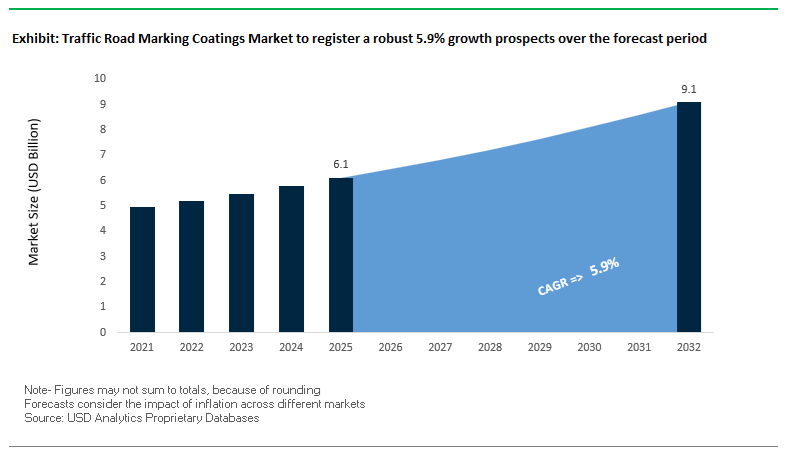
The global Traffic Road Marking Coatings Market is expanding steadily, supported by increasing investments in transport infrastructure, road safety regulations, and smart mobility systems. The market was valued at $6.1 billion in 2025 and is projected to reach $9.1 billion by 2032, growing at a CAGR of 5.9% during 2025–2032. This growth is driven by the rising need for high-visibility, durable, and fast-curing road marking solutions that enhance traffic management and reduce accident risks.
A primary structural driver is the global push toward road safety standardization, particularly in urban and high-speed highway environments. Governments are mandating the use of retroreflective coatings, thermoplastic markings, and high-performance paints to improve nighttime visibility and lane discipline. The increasing adoption of autonomous and connected vehicles is further elevating the importance of consistent, machine-readable road markings, as these systems rely on clear lane detection for navigation.
Another key trend is the transition toward environmentally sustainable marking systems, including waterborne paints, bio-based binders, and low-VOC formulations. Regulatory pressure, especially in Europe and North America, is accelerating the phase-out of traditional solvent-based coatings in favor of greener alternatives. At the same time, the demand for longer-lasting thermoplastic and cold plastic systems is increasing, as municipalities seek to reduce maintenance frequency and lifecycle costs.
Digitalization and smart infrastructure integration are also reshaping the market. Road marking coatings are evolving to support sensor-based traffic systems, LiDAR detection, and intelligent transportation networks, making them a critical component of next-generation mobility ecosystems.
The traffic road marking coatings market is being transformed by material innovation, digital supply chain integration, and smart mobility advancements, reflecting the growing complexity of modern transportation systems. In March 2026, KANSAI HELIOS showcased its expanded portfolio at Intertraffic Amsterdam, highlighting advanced solvent-borne and waterborne marking solutions designed for high-traffic European corridors, with a focus on durability and rapid curing to minimize road closure times.
Supply chain digitization is emerging as a key competitive differentiator. Geveko Markings’ February 2026 integration of Microsoft Dynamics 365 across global production sites enhances operational efficiency and transparency, while its expansion of thermoplastic production in Norway strengthens supply for northern European infrastructure projects.
The rise of autonomous vehicles is influencing coating innovation. Axalta’s “Solar Boost” technology (January 2026), originally developed for automotive coatings, is being adapted to improve road surface detectability by LiDAR and camera systems, highlighting the convergence of coatings and smart mobility technologies.
Regulatory compliance is shaping product strategies. 3M Transportation Safety’s October 2025 alignment with the Build America, Buy America Act (BABAA) ensures that its road marking products meet local sourcing requirements, positioning the company strongly for federally funded infrastructure projects in the United States.
Strategic acquisitions are expanding regional capabilities. Geveko Markings’ February 2025 acquisition of Farby Maestria Polska significantly increases its production capacity in Central and Eastern Europe, supporting the growing demand for liquid paints and cold plastic markings.
Sustainability initiatives are accelerating across the market. Swarco’s development of Environmental Product Declarations (June 2025) establishes standardized lifecycle assessment methods, while PPG Traffic Solutions’ expansion of waterborne production aligns with global sustainability targets. Additionally, Geveko’s shift toward bio-attributed binders aims to reduce the carbon footprint of thermoplastic markings by 25% by 2026.
Innovation in visibility and safety is also advancing. Swarco’s SolidPlus high-performance glass beads (April 2024) significantly improve retroreflectivity, enhancing nighttime driving safety. Meanwhile, Dalton Enterprises’ digital platform launch (June 2025) streamlines procurement for contractors, improving accessibility to professional-grade marking solutions.
The enforcement phase of the updated Manual on Uniform Traffic Control Devices is redefining performance requirements for traffic road marking coatings in the United States. The 2025/2026 revision aligns with the “safe system” approach, emphasizing enhanced visibility not only for human drivers but also for autonomous and semi-autonomous vehicle systems. For roadways with speed limits of 35 mph and above, the standard mandates minimum maintained retroreflectivity levels of 150 mcd/m²/lx for white markings and 100 mcd/m²/lx for yellow markings. These thresholds significantly exceed previous benchmarks and are driving the adoption of high-performance reflective materials. In parallel, the regulatory framework now requires state Departments of Transportation to implement measurement-based inspection protocols using mobile retroreflectivity units capable of scanning markings at operational traffic speeds. This shift from subjective visual inspection to data-driven assessment is increasing demand for consistent, high-durability coatings. Additionally, compliance with these standards is necessitating the use of high-refractive-index glass beads, typically Type 3 or Type 4 with refractive indices of 1.9 or higher, particularly in thermoplastic systems. As road infrastructure evolves to support advanced driver assistance systems and autonomous mobility, retroreflectivity performance is becoming a critical design parameter in traffic marking coatings.
Market Trend: EU REACH 2026 Restrictions Eliminate Lead-Based Pigments in Road Marking Applications
The European regulatory landscape is undergoing a decisive shift with the full enforcement of REACH Annex XVII restrictions on heavy metals in road marking coatings. The use of lead chromate pigments, historically valued for their brightness and durability in yellow markings, is now effectively banned, with permissible lead concentrations limited to 0.1% by weight. This zero-exemption policy extends even to safety-critical infrastructure, forcing a complete transition to alternative pigment technologies. Organic yellow pigments such as diarylide and isoindoline are now the primary substitutes, although they present challenges in achieving the same opacity and color stability as lead-based systems. To address this performance gap, manufacturers are incorporating titanium dioxide into formulations to enhance brightness and maintain compliance with chromaticity standards for safety markings. This transition is also influencing coating durability and weathering performance, requiring additional formulation optimization to ensure long-term visibility under UV exposure and traffic wear. As environmental and health considerations take precedence, the shift toward heavy-metal-free road marking coatings is becoming a global trend, influencing both European markets and international export standards.
The integration of smart technologies into road marking systems is emerging as a transformative opportunity, positioning coatings as active components of intelligent transportation infrastructure. Advanced thermoplastic formulations now enable the embedding of passive ultra-high-frequency RFID tags directly within the marking layer. These tags can be read by maintenance vehicles at speeds up to 60 mph, providing real-time data on parameters such as installation date, material composition, and maintenance history. This capability supports predictive maintenance strategies and reduces reliance on manual inspection and inventory tracking. In terms of durability, smart thermoplastic systems are engineered with a Shore D hardness of 50 or higher, ensuring that embedded sensors remain protected under mechanical stress from heavy traffic and snow removal operations. Pilot implementations in smart city environments indicate that such systems can reduce municipal audit and asset management costs by approximately 40%, highlighting their economic and operational benefits. As transportation networks become increasingly digitized, smart road marking coatings are evolving into critical enablers of vehicle-to-infrastructure communication and data-driven infrastructure management.
Market Opportunity: Fast-Cure MMA Coatings Enable Rapid Deployment and Long-Life Performance in Urban Traffic Zones
Methyl methacrylate-based road marking coatings are gaining strong traction in high-density urban environments where minimizing traffic disruption is a key priority. Unlike traditional thermoplastic or waterborne systems, MMA coatings cure through a chemical reaction, enabling extremely rapid setting times. In 2026, advanced MMA formulations achieve no-track conditions within 8 minutes at standard ambient temperatures, allowing roadways and intersections to reopen within approximately 15 minutes. This represents a significant reduction in lane closure durations, improving traffic flow and reducing economic losses associated with congestion. Beyond curing speed, MMA coatings offer superior adhesion performance, with pull-off strengths exceeding 2.0 MPa on concrete substrates. This ensures durability in high-stress applications such as bus lanes and bicycle corridors, where shear forces are substantial. Additionally, MMA systems demonstrate extended service life, withstanding 3 to 5 million vehicle passes before requiring maintenance. This longevity, combined with reduced downtime during application, delivers a strong lifecycle cost advantage despite higher initial material costs. As urban mobility systems continue to expand, fast-cure MMA coatings are emerging as a preferred solution for high-performance, high-efficiency road marking applications.
Traffic Road Marking Coatings Market Share and Segmentation Insights
Thermoplastic Road Marking Coatings Lead with 40.5% Share Due to Long Lifespan and High Visibility
The thermoplastic coatings segment dominates the traffic road marking coatings market with a 40.5% market share in 2025, driven by its superior durability, retroreflectivity, and performance in high-traffic environments. Widely used in the highway road marking, urban infrastructure coatings, and transportation safety solutions market, thermoplastic coatings offer a service life of 3–5 years, significantly outperforming conventional waterborne and solventborne paints, which typically last only 1–2 years. A key advantage lies in the integration of glass beads, which enhances night-time visibility and retroreflective performance, making them essential for highways, arterial roads, and pedestrian crossings. Additionally, thermoplastic coatings are applied at 150–200°C and cure rapidly within minutes, enabling faster lane reopening and reduced traffic disruption compared to epoxy or cold plastic systems. This combination of long-term cost efficiency, safety compliance, and rapid application solidifies thermoplastic coatings as the leading product segment in the global road marking coatings market.
Government and Municipal Authorities Dominate with 56.9% Share Driven by Public Infrastructure Investments
The government and municipal authorities segment leads the traffic road marking coatings market with a dominant 56.9% market share in 2025, reflecting their central role in managing public road networks, highway infrastructure, and urban transportation systems. These entities represent the largest buyers within the road safety coatings and traffic management solutions market, overseeing projects across federal highways, state roads, and local streets. A key growth driver is strict adherence to regulatory standards such as the FHWA 2009 retroreflectivity mandate and UNECE guidelines, which require specific color visibility, reflectivity levels, and approved coating formulations, particularly for thermoplastic and advanced paint systems. Governments also prioritize long-lasting, cost-efficient marking solutions to reduce maintenance cycles and enhance road safety. With increasing investments in smart infrastructure, road modernization, and urban mobility, this segment continues to drive demand in the global traffic road marking coatings market, reinforcing its leadership position.
Competitive Landscape Analysis of the Traffic Road Marking Coatings Market
PPG Industries Leads High-Durability Traffic Coatings with Advanced Multipolymer Technology
PPG Industries, Inc., through its Ennis-Flint division, holds a dominant position in the traffic road marking coatings market, servicing 30% of North American infrastructure demand in 2026. The company’s HPS®-8 Integrated Multipolymer technology, launched in 2025, delivers 3–5 years of service life, doubling the durability of conventional waterborne traffic paints. Its expanded ENNIS-FLINT® MMA coatings line now includes extended-season formulations that can be applied at temperatures as low as 35°F (2°C), enhancing project flexibility. Additionally, PPG’s USD 380 million resin facility supports the production of specialized binders for thermoplastic signage, strengthening its leadership in high-performance road marking solutions.
Sherwin-Williams Strengthens Municipal Traffic Paint Supply and Fast-Dry Solutions
The Sherwin-Williams Company is a key competitor in the traffic marking coatings market, supported by strong financial performance, with Q1 2026 net sales reaching USD 5.67 billion and significant contributions from its Performance Coatings Group. The company dominates the U.S. municipal and state DOT segments, offering high-build waterborne traffic paints compliant with March 2026 MUTCD retroreflectivity mandates. Its extensive network of over 4,800 stores enables just-in-time delivery of fast-drying traffic coatings, reducing work-zone occupancy times by up to 20%. Sherwin-Williams is also focusing on high-hide temporary road markings, designed for easy removal in large-scale infrastructure projects under the U.S. Infrastructure Act.
3M Advances System-Integrated Reflective Markings and Smart Traffic Solutions
3M Company, through its Transportation Safety Division, leads innovation in system-integrated traffic road marking coatings, combining high-index ceramic beads with 3M™ Stamark™ tapes to achieve wet-retroreflectivity levels exceeding 150 mcd/m²/lx. In 2026, the company aligned its manufacturing with the Build America, Buy America Act (BABAA), ensuring 55% domestic sourcing to secure federal infrastructure contracts. Its Digital Print Solution for road signage and pavement markings, launched in late 2025, utilizes UV-curable inks backed by the industry-leading 3M™ MCS™ Warranty. Additionally, 3M’s research indicates that contrast markings can reduce lane-departure accidents by up to 44%, driving adoption of advanced safety coatings.
SWARCO Drives Innovation in Glass Bead Technology and Sustainable Road Markings
SWARCO AG is a global benchmark in the traffic road marking coatings market, particularly in glass bead retroreflective technology. In 2026, the company introduced SWARCO AQUALINE ECO 2-C, the first 2-component water-based paint for tunnels and indoor environments, offering a one-day pot life and rapid 50-minute curing. Its SOLIDPLUS glass beads, with a refractive index above 1.9, enable high-visibility “smart road” applications. SWARCO is also investing in green bike lane coatings using DURATRACK™ 2K systems, supporting urban micro-mobility. With strong presence in the DACH region and Eastern Europe, the company emphasizes resource-efficient and eco-friendly traffic coating solutions.
Geveko Markings Expands Cold-Plastic Systems and Eco-Labeled Infrastructure Coatings
Geveko Markings, following its integration with Oré Peinture, has emerged as a leading force in the European traffic marking coatings market, particularly in cold-plastic (MMA) systems growing at a 5.82% CAGR. The company holds a majority share in the airport marking segment, delivering high-performance, non-slip coatings resistant to jet fuel degradation for runways and taxiways. Its development of eco-label road markings meets stringent Blue Angel and M1 emission standards, aligning with EU sustainability regulations. By 2026, 80% of its EU revenue is generated from performance-based coatings such as thermoplastics and MMA, highlighting its strategic shift away from traditional solvent-based paints.
China Accelerating Smart Road Infrastructure with Machine-Readable Coatings
China is rapidly transforming the traffic road marking coatings market by advancing toward autonomous-ready and smart road infrastructure. Under the “Digital Transportation Construction Plan 2026,” the government is deploying high-retroreflectivity road marking coatings across extensive expressway networks, ensuring enhanced visibility and safety for both human drivers and machine-based navigation systems.
Technological advancements include the development of near-infrared (NIR) reflective road markings, specifically designed to be detected by LiDAR and camera systems in Level 4 autonomous vehicles. Strategic investments by global and domestic players are scaling the production of structured thermoplastic coatings, ensuring durability and visibility even during heavy rainfall. Infrastructure projects such as the Sichuan Smart Highway are integrating self-cleaning nano-coatings, significantly reducing maintenance cycles. Regulatory updates mandating improved wet-night visibility standards are further driving adoption of advanced coatings. Additionally, photoluminescent road markings are being deployed in remote regions to improve safety without reliance on electrical lighting systems.
United States Driving Infrastructure-Led Demand and Sustainable Road Marking Innovations
The United States is experiencing significant growth in the road marking coatings market, fueled by infrastructure investments under the Infrastructure Investment and Jobs Act (IIJA). Large-scale funding is driving demand for high-durability epoxy-based road markings, particularly for pavement preservation and highway upgrades.
Product innovation is focused on sustainability, with the introduction of bio-renewable alkyd resins derived from soybean oil, reducing dependence on petroleum-based binders. Technological advancements such as UV-cured pavement markings are enabling faster application and minimizing traffic disruption, particularly in high-traffic corridors.
Government initiatives like Vision Zero are increasing the use of high-friction colored coatings for bicycle lanes and pedestrian safety. Regulatory changes are accelerating the transition toward waterborne acrylic traffic paints, reducing VOC emissions in residential areas. Additionally, the integration of embedded micro-sensor markings is enabling real-time monitoring of road conditions, including temperature and ice formation, positioning the U.S. as a leader in smart mobility coating solutions.
India is emerging as one of the fastest-growing markets in the traffic marking coatings industry, driven by large-scale infrastructure expansion and government-backed initiatives. Record highway construction rates are significantly increasing demand for hot-applied thermoplastic road markings, making them the dominant coating type across national highways.
Government funding allocations for road development are supporting widespread adoption of retroreflective glass bead-infused coatings, enhancing nighttime visibility and road safety. Strategic investments by leading companies are strengthening domestic production capabilities for critical raw materials such as intermix glass beads.
Technological advancements include the introduction of cool-road marking coatings, designed to reduce surface temperatures and mitigate urban heat island effects. Expansion of training centers is standardizing the application of advanced coatings, particularly in challenging terrains like Himalayan roads. Key applications such as rumble-strip textured markings are improving road safety by reducing accident rates in high-risk zones, positioning India as a high-growth hub for durable and safety-focused road marking coatings.
Germany Leading Eco-Friendly Road Marking Coatings and High-Performance Autobahn Solutions
Germany is a leader in the European road marking coatings market, focusing on sustainability, durability, and high-performance solutions for high-speed road networks. Regulatory frameworks such as the “Blue Angel” certification are driving the adoption of ultra-low VOC coatings, effectively eliminating harmful substances like lead-based pigments.
Innovations include the development of water-vapor-permeable road markings, ensuring compatibility with porous asphalt surfaces designed for noise reduction. Infrastructure upgrades on major highways such as the Autobahn are utilizing two-component cold plastic coatings, offering extended service life under extreme mechanical stress.
Technological advancements such as laser-guided automated marking systems are improving efficiency and reducing labor costs. Investments in advanced resin production are supporting the shift toward durable cold-applied coatings. Germany also leads in the adoption of anti-skid colored coatings for pedestrian zones and transit hubs, reinforcing its position as a hub for eco-friendly and high-performance traffic coatings.
Saudi Arabia Driving High-Temperature and Desert-Resilient Road Marking Coatings
Saudi Arabia is a key growth market in the traffic road marking coatings sector, driven by extreme climate conditions and large-scale infrastructure development under Vision 2030. The deployment of polysiloxane-based road markings in projects like NEOM highlights the need for coatings that can withstand high surface temperatures and intense UV exposure.
Government mandates requiring high solar reflectance index (SRI) coatings are addressing urban heat challenges, improving environmental sustainability. Product innovation includes sand-resistant and anti-adhesion coatings, designed to maintain visibility in desert environments with frequent sandstorms.
Local production expansions are strengthening supply chains for thermoplastic coatings, supporting the country’s large construction pipeline. Key applications such as high-build epoxy road markings in metro and urban transport systems are enhancing durability and safety. Regulatory standards under SASO are ensuring long-term performance, positioning Saudi Arabia as a major market for climate-resilient road marking coatings.
Brazil’s Innovation in Smart and Sustainable Traffic Marking Solutions
Brazil is advancing in the traffic road marking coatings market, driven by infrastructure modernization and a focus on safety and sustainability. Government initiatives under the National Road Safety Plan are promoting the adoption of high-performance reflective road marking systems, improving visibility across highways.
Product innovation includes the development of solar-powered LED-integrated road markings, providing active illumination in challenging environments such as mountainous regions with poor visibility. Technological advancements are also evident in the use of recycled glass materials in thermoplastic coatings, reducing environmental impact and supporting sustainability goals.
Industrial expansion by key players is enhancing production of fast-drying waterborne traffic paints, catering to urban road maintenance needs. Regulatory updates mandating the use of active road reflectors are further improving safety in critical zones. Additionally, the adoption of audible and vibration-inducing road markings is helping reduce driver fatigue-related accidents, positioning Brazil as a growing market for innovative and safety-driven road marking coatings.
Traffic Road Marking Coatings Market Report Scope
Traffic Road Marking Coatings Market
Parameter
Details
Market Size (2025)
$6.1 Billion
Market Size (2032)
$9.1 Billion
Market Growth Rate
5.9%
Segments
By Product (Thermoplastic Coatings, Paints, Epoxy Coatings, Cold Plastic, Polyurethane and Polyurea, Preformed Polymer Tapes and Sheets, Field-Reacted Systems), By Technology (Water-borne, Solvent-borne, 100% Solids), By Type of Marking (Permanent Markings, Removable, High-Contrast Markings), By Marking Profile (Flat Markings, Structured, Extruded Markings, Ribbed Markings), By Application (Roads and Highways, Urban Streets and Municipal Roads, Parking Lots and Garages, Airports, Industrial and Logistics, Sports Facilities and Playgrounds, Bike Lanes and Pedestrian Zones), By End-User (Government and Municipal Authorities, Airport Authorities, Private Infrastructure Contractors, Property Management Firms), By Component (Reflective Glass Beads, Anti-skid Aggregates, Pigments and Binders)
Study Period
2019- 2025 and 2026-2032
Units
Revenue (USD)
Qualitative Analysis
Porter’s Five Forces, SWOT Profile, Market Share, Scenario Forecasts, Market Ecosystem, Company Ranking, Market Dynamics, Industry Benchmarking
US, Canada, Mexico, Germany, France, Spain, Italy, UK, Russia, China, India, Japan, South Korea, Australia, South East Asia, Brazil, Argentina, Middle East, Africa
Traffic Road Marking Coatings Market Segmentation
By Product
Thermoplastic Coatings
Paints
Epoxy Coatings
Cold Plastic
Polyurethane and Polyurea
Preformed Polymer Tapes and Sheets
Field-Reacted Systems
By Technology
Water-borne
Solvent-borne
100% Solids
By Type of Marking
Permanent Markings
Removable
High-Contrast Markings
By Marking Profile
Flat Markings
Structured
Extruded Markings
Ribbed Markings
By Application
Roads and Highways
Urban Streets and Municipal Roads
Parking Lots and Garages
Airports
Industrial and Logistics
Sports Facilities and Playgrounds
Bike Lanes and Pedestrian Zones
By End-User
Government and Municipal Authorities
Airport Authorities
Private Infrastructure Contractors
Property Management Firms
By Component
Reflective Glass Beads
Anti-skid Aggregates
Pigments and Binders
Leading Countries in the Industry
North America (United States, Canada, Mexico)
Europe (Germany, France, Spain, United Kingdom, Italy, Russia, Rest of Europe)
Asia Pacific (China, India, Japan, South Korea, Australia, South East Asia, Rest of APAC)
South and Central America (Brazil, Argentina, Rest of SCA)
Middle East and Africa (Saudi Arabia, UAE, MENA, Sub-Saharan Africa)
Top Companies in Traffic Road Marking Coatings Industry
2. Traffic Road Marking Coatings Market Landscape and Outlook (2025–2034)
2.1. Introduction to the Traffic Road Marking Coatings Market
2.2. Market Valuation and Growth Projections (2025–2034)
2.3. Demand Drivers in Infrastructure Expansion, Road Safety, and Smart Mobility
2.4. Regulatory Trends and Sustainability Standards in Traffic Marking Materials
2.5. Strategic Opportunities and Future Outlook
3. Innovations Reshaping the Traffic Road Marking Coatings Market
3.1. Trend: FHWA MUTCD 11th Edition Enforcement Elevates Retroreflectivity Standards for Machine Vision Compatibility
3.2. Trend: EU REACH 2026 Restrictions Eliminate Lead-Based Pigments in Road Marking Applications
3.3. Opportunity: Smart Thermoplastic Markings Transform Road Infrastructure into Data-Enabled Assets
3.4. Opportunity: Fast-Cure MMA Coatings Enable Rapid Deployment and Long-Life Performance in Urban Traffic Zones
4. Competitive Landscape and Strategic Initiatives
4.1. Mergers and Acquisitions
4.2. RandD and Material Innovation
4.3. Sustainability and Regulatory Compliance Strategies
4.4. Capacity Expansion and Regional Market Development
5. Market Share and Segmentation Insights: Traffic Road Marking Coatings Market
5.1. By Product
5.1.1. Thermoplastic Coatings
5.1.2. Paints
5.1.3. Epoxy Coatings
5.1.4. Cold Plastic
5.1.5. Polyurethane and Polyurea
5.1.6. Preformed Polymer Tapes and Sheets
5.1.7. Field-Reacted Systems
5.2. By Technology
5.2.1. Water-borne
5.2.2. Solvent-borne
5.2.3. 100% Solids
5.3. By Type of Marking
5.3.1. Permanent Markings
5.3.2. Removable
5.3.3. High-Contrast Markings
5.4. By Marking Profile
5.4.1. Flat Markings
5.4.2. Structured
5.4.3. Extruded Markings
5.4.4. Ribbed Markings
5.5. By Application
5.5.1. Roads and Highways
5.5.2. Urban Streets and Municipal Roads
5.5.3. Parking Lots and Garages
5.5.4. Airports
5.5.5. Industrial and Logistics
5.5.6. Sports Facilities and Playgrounds
5.5.7. Bike Lanes and Pedestrian Zones
5.6. By End-User
5.6.1. Government and Municipal Authorities
5.6.2. Airport Authorities
5.6.3. Private Infrastructure Contractors
5.6.4. Property Management Firms
5.7. By Component
5.7.1. Reflective Glass Beads
5.7.2. Anti-skid Aggregates
5.7.3. Pigments and Binders
6. Country Analysis and Outlook of Traffic Road Marking Coatings Market
6.1. United States
6.2. Canada
6.3. Mexico
6.4. Germany
6.5. France
6.6. Spain
6.7. Italy
6.8. United Kingdom
6.9. Russia
6.10. China
6.11. India
6.12. Japan
6.13. South Korea
6.14. Australia
6.15. South East Asia
6.16. Brazil
6.17. Argentina
6.18. Middle East
6.19. Africa
7. Traffic Road Marking Coatings Market Size Outlook by Region (2025–2034)
7.1. North America Traffic Road Marking Coatings Market Size Outlook to 2034
7.1.1. By Product
7.1.2. By Technology
7.1.3. By Type of Marking
7.1.4. By Marking Profile
7.1.5. By Application
7.1.6. By End-User
7.1.7. By Component
7.2. Europe Traffic Road Marking Coatings Market Size Outlook to 2034
7.2.1. By Product
7.2.2. By Technology
7.2.3. By Type of Marking
7.2.4. By Marking Profile
7.2.5. By Application
7.2.6. By End-User
7.2.7. By Component
7.3. Asia Pacific Traffic Road Marking Coatings Market Size Outlook to 2034
7.3.1. By Product
7.3.2. By Technology
7.3.3. By Type of Marking
7.3.4. By Marking Profile
7.3.5. By Application
7.3.6. By End-User
7.3.7. By Component
7.4. South America Traffic Road Marking Coatings Market Size Outlook to 2034
7.4.1. By Product
7.4.2. By Technology
7.4.3. By Type of Marking
7.4.4. By Marking Profile
7.4.5. By Application
7.4.6. By End-User
7.4.7. By Component
7.5. Middle East and Africa Traffic Road Marking Coatings Market Size Outlook to 2034
7.5.1. By Product
7.5.2. By Technology
7.5.3. By Type of Marking
7.5.4. By Marking Profile
7.5.5. By Application
7.5.6. By End-User
7.5.7. By Component
8. Company Profiles: Leading Players in the Traffic Road Marking Coatings Market
8.1. The Sherwin-Williams Company
8.2. PPG Industries, Inc.
8.3. 3M Company
8.4. SWARCO AG
8.5. Aximum
8.6. Akzo Nobel N.V.
8.7. Nippon Paint Holdings Co., Ltd.
8.8. Kansai Paint Co., Ltd.
8.9. Asian Paints PPG Pvt. Ltd.
8.10. Hempel A/S
8.11. Berger Paints India Limited
8.12. SealMaster
8.13. Dow Inc.
8.14. Crown Technology, LLC
8.15. Ozark Materials LLC
9. Methodology
9.1. Research Scope
9.2. Market Research Approach
9.3. Market Sizing and Forecasting Model
9.4. Research Coverage
9.5. Data Horizon
9.6. Deliverables
10. Appendix
10.1. Acronyms and Abbreviations
10.2. List of Tables
10.3. List of Figures
Traffic Road Marking Coatings Market Segmentation
By Product
Thermoplastic Coatings
Paints
Epoxy Coatings
Cold Plastic
Polyurethane and Polyurea
Preformed Polymer Tapes and Sheets
Field-Reacted Systems
By Technology
Water-borne
Solvent-borne
100% Solids
By Type of Marking
Permanent Markings
Removable
High-Contrast Markings
By Marking Profile
Flat Markings
Structured
Extruded Markings
Ribbed Markings
By Application
Roads and Highways
Urban Streets and Municipal Roads
Parking Lots and Garages
Airports
Industrial and Logistics
Sports Facilities and Playgrounds
Bike Lanes and Pedestrian Zones
By End-User
Government and Municipal Authorities
Airport Authorities
Private Infrastructure Contractors
Property Management Firms
By Component
Reflective Glass Beads
Anti-skid Aggregates
Pigments and Binders
Leading Countries in the Industry
North America (United States, Canada, Mexico)
Europe (Germany, France, Spain, United Kingdom, Italy, Russia, Rest of Europe)
Asia Pacific (China, India, Japan, South Korea, Australia, South East Asia, Rest of APAC)
South and Central America (Brazil, Argentina, Rest of SCA)
Middle East and Africa (Saudi Arabia, UAE, MENA, Sub-Saharan Africa)
The global Traffic Road Marking Coatings Market was valued at $6.1 billion in 2025 and is projected to reach $9.1 billion by 2032, growing at a CAGR of 5.9% during the forecast period. Increasing investments in highway modernization, urban mobility systems, and road safety infrastructure are driving strong market expansion globally.
Thermoplastic coatings dominate the market due to their superior durability, retroreflectivity, and long operational lifespan compared to traditional paints. These coatings provide excellent night-time visibility, rapid curing, and lower maintenance frequency, making them highly preferred for highways, arterial roads, airports, and smart transportation infrastructure projects.
The rise of autonomous and connected vehicles is increasing demand for machine-readable road markings with enhanced retroreflectivity and LiDAR detectability. Manufacturers are developing advanced coatings integrated with high-refractive-index glass beads, smart thermoplastic systems, and sensor-compatible technologies to support intelligent transportation networks and vehicle-to-infrastructure communication.
Environmental regulations in Europe and North America are accelerating the adoption of waterborne paints, bio-based binders, low-VOC formulations, and lead-free pigments. Standards such as FHWA MUTCD and EU REACH are also driving innovation in high-performance reflective materials, eco-friendly road markings, and long-lasting cold plastic systems.
Major companies operating in the market include PPG Industries, Inc., The Sherwin-Williams Company, 3M Company, SWARCO AG, Akzo Nobel N.V., and Nippon Paint Holdings Co., Ltd.. These companies are investing in smart mobility coatings, thermoplastic technologies, retroreflective systems, and sustainable traffic safety solutions.