Trans-Cinnamic Acid Market Overview 2025–2034: $666.1 Million to $1,214.3 Million at 6.9% CAGR Driven by Biocatalytic Synthesis, Pharmaceutical Breakthroughs, and High-Purity Demand
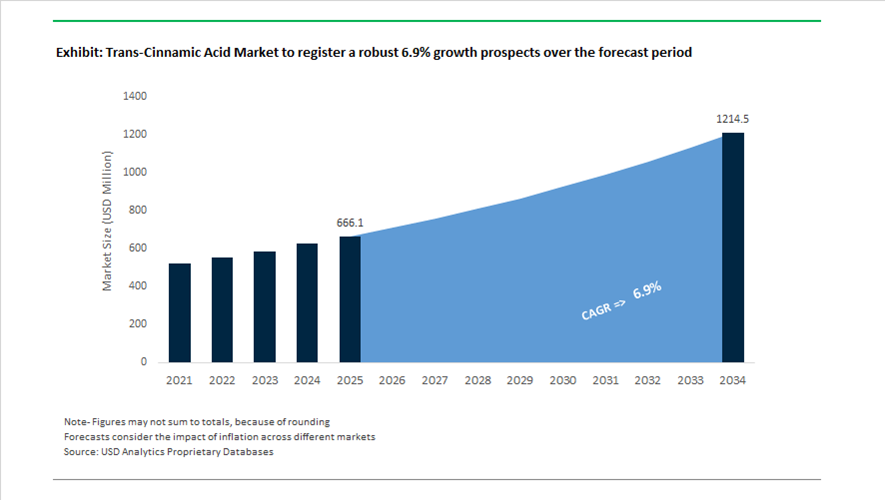
The global Trans-Cinnamic Acid market is valued at $666.1 million in 2025 and is projected to reach $1,214.3 million by 2034, registering a CAGR of 6.9%. Trans-cinnamic acid, an aromatic unsaturated carboxylic acid derived traditionally from petrochemical or plant-based precursors, is a critical intermediate in flavors and fragrances, pharmaceuticals, agrochemicals, polymer additives, and fine chemical synthesis. Market expansion is being accelerated by rapid advancements in metabolic engineering, increasing pharmaceutical validation, and rising industrial preference for high-purity (>99%) grades to reduce downstream processing costs. The value chain is transitioning from coal- and petroleum-based feedstocks toward renewable biosynthetic platforms using engineered microbes and enzymatic pathways.
In 2024, engineered Escherichia coli strains achieved laboratory-scale production titers of up to 6.9 g/L, marking a significant step toward industrial fermentation viability using renewable substrates such as glucose and glycerol. During the same year, researchers optimized Zea mays phenylalanine ammonia-lyase enzymes to enhance catalytic efficiency in the biosynthesis of trans-cinnamic and p-coumaric acids, targeting higher-yield production for agrochemical and flavoring applications. Regulatory shifts in 2024 aimed at reducing synthetic pesticide usage prompted agrochemical companies to evaluate trans-cinnamic acid derivatives as natural plant growth regulators and antimicrobial agents. In 2025, R&D investment in green cinnamic acid synthesis increased by approximately 25%, with biocatalytic pathways reaching nearly 30% adoption in pilot-scale programs among major chemical manufacturers. In May 2025, a landmark study published in mBio introduced a consensus-designed decarboxylase enzyme, PSC1, capable of efficiently converting trans-cinnamic acid into styrene at temperatures up to 50°C. This biosynthetic route offers a lower-carbon pathway for polymer precursor production, reinforcing the molecule’s strategic role in sustainable materials chemistry. By early 2026, engineered Synechocystis cyanobacteria strains demonstrated a four-fold increase in trans-cinnamic acid output, validating sunlight- and CO₂-based renewable production models that reduce reliance on fossil feedstocks.
Pharmaceutical and biomedical validation is emerging as a high-margin growth engine. In July 2025, a comprehensive review published in Pharmaceuticals consolidated over a decade of research confirming trans-cinnamic acid’s anti-tumor, antibacterial, and antidepressant properties, prompting several biotech firms to initiate formal safety and dosage evaluations. In July 2025, researchers reported the synthesis of a Ruthenium(II)-trans-cinnamic acid complex capable of inducing apoptosis and cell cycle arrest in non-small cell lung cancer cells, demonstrating improved solubility and biological selectivity. In February 2026, the Journal of Natural Medicines published findings highlighting the compound’s capacity to reduce leukocyte recruitment and vascular permeability, positioning it as a candidate for anti-inflammatory drug development. Market structure is also shifting toward premium-grade supply. By mid-2025, ≥99% purity variants accounted for more than 55% of industrial buyer preference, particularly in fragrance and pharmaceutical manufacturing where impurity control reduces purification costs and regulatory risk. In January 2025, Transchem Ltd. signaled strategic restructuring and share acquisition activity, indicating a pivot toward higher-growth organic synthesis segments aligned with specialty cinnamic acid derivatives.
Regulatory-Driven Purity Escalation, Functional Reformulation, and Bio-Based Expansion in the Trans-Cinnamic Acid Market
High-Purity Trans-Cinnamic Acid Becomes a Strategic Chiral Intermediate in Anti-Inflammatory and Metabolic Drug Pipelines
The Trans-Cinnamic Acid market is undergoing a structural upgrade driven by the pharmaceutical sector’s shift toward highly selective, mechanism-driven APIs targeting chronic inflammatory and metabolic disorders. Once treated as a commodity aromatic acid, trans-cinnamic acid is now increasingly specified as a high-purity (≥99%) chiral intermediate due to its proven role in modulating TLR4 and NF-κB signaling pathways, which are central to insulin resistance, systemic inflammation, and autoimmune responses. This biochemical relevance is pushing CDMOs and innovator pharma companies to lock in pharmaceutical-grade supply rather than rely on multi-grade sourcing.
Process efficiency data from 2024–2025 demonstrates that the use of HPLC-grade trans-cinnamic acid reduces downstream purification costs by up to 25% in sulfur-containing API synthesis, particularly in multi-step esterification and hydrogenation routes. Facilities implementing inline purity monitoring and tighter impurity thresholds reported a 20% reduction in batch deviations, enabling faster campaign changeovers and improved asset utilization. This is particularly relevant as cinnamic acid derivatives advance into Phase II and Phase III clinical development for metabolic health indications. A major 2025 review in Pharmaceuticals confirms that cinnamic scaffolds are no longer confined to discovery chemistry but are now embedded in translational drug pipelines, signaling sustained medium-term demand for GMP-compliant trans-cinnamic acid across regulated markets.
Clean Beauty Reformulation Accelerates Adoption as a Multifunctional Preservative and Tyrosinase Inhibitor
In personal care, trans-cinnamic acid has transitioned from a niche botanical derivative to a multifunctional active ingredient aligned with clean beauty, minimalism, and ingredient transparency mandates. As regulatory and consumer pressure intensifies against parabens, hydroquinone, and aggressive synthetic preservatives, formulators are turning to cinnamic acid for its dual antimicrobial and skin-brightening performance. Laboratory evaluations published in MDPI Molecules in 2025 demonstrated that trans-cinnamic acid achieved a 90.9% reduction in Staphylococcus epidermidis biofilm growth, positioning it as an effective preservative booster that allows brands to lower total preservative load without compromising shelf stability.
Simultaneously, the compound’s role as a natural tyrosinase inhibitor is reshaping skin-brightening formulations. Clinical data presented at the IFSCC 2025 Congress showed that cinnamic-acid-inspired actives delivered a 17% reduction in hyperpigmentation over 12 weeks at concentrations as low as 0.01%, significantly outperforming traditional botanical extracts while avoiding irritation risks associated with hydroquinone. This performance threshold is accelerating adoption among premium and mass-market brands alike, as trans-cinnamic acid derivatives support claims around “non-irritating,” “plant-derived,” and “clinically proven” efficacy. For suppliers, this trend elevates the importance of cosmetic-grade consistency, odor control, and trace impurity management to meet global regulatory expectations.
Opportunities in Sustainable Polymers and UV-Functional Coatings Using Cinnamic-Based Monomers
Beyond life sciences and cosmetics, trans-cinnamic acid is emerging as a high-value monomer for next-generation bio-based polyesters and functional coatings. Research published in Polymer in May 2024 confirmed that polyesters synthesized from 3,4-dimethoxycinnamic acid exhibit inherent UV-absorption and photodeformability while maintaining optical clarity and mechanical strength. These attributes are driving interest in smart packaging films capable of protecting light-sensitive food, pharmaceuticals, and cosmetics without additional stabilizer additives.
More importantly, late-2024 advances in lignin valorization have enabled the synthesis of cinnamic moieties directly from biomass, feeding into fully bio-based poly(amide-thioether)s. These materials demonstrate higher glass transition temperatures than conventional bio-plastics, addressing a longstanding limitation of sustainable polymers in high-heat and durable coating applications. As regulatory frameworks in Europe and Asia tighten around fossil-derived aromatics, trans-cinnamic-acid-based polymers offer a rare combination of performance parity and renewable content, creating a differentiated growth pathway for specialty chemical producers.
Agricultural Biostimulants and Post-Harvest Preservation Create a Regulated Growth Channel
In agriculture, trans-cinnamic acid is moving decisively from experimental biostimulant to regulated input, supported by formal policy recognition and validated bioefficacy data. India’s Ministry of Agriculture & Farmers Welfare incorporated 101 new biostimulants into the Fertilizer Control Order in September 2025, imposing stringent requirements for toxicity, efficacy, and consistency. This regulatory milestone favors suppliers capable of delivering standardized, high-purity trans-cinnamic acid suitable for large-scale formulation rather than variable botanical extracts.
Post-harvest applications further strengthen the commercial case. Studies conducted between 2024 and 2025 show that cinnamic-acid-based composite preservatives, when combined with pullulan, achieved an 82.1% inhibition rate against Trichoderma harzianum in mushrooms. This level of fungal control significantly extends shelf life during transport and cold storage, addressing food waste reduction targets that are increasingly embedded in national agricultural strategies. As governments and exporters prioritize residue-safe, plant-derived preservation systems, trans-cinnamic acid is positioned as a scalable, compliant solution across high-value perishables.
Trans-Cinnamic Acid Market Share and Segmentation Insights
Grade Market Share: Pharmaceutical Grade Dominates with High-Purity Drug Manufacturing Requirements
Pharmaceutical grade trans-cinnamic acid holds the largest share at 42.80% in 2025, driven by its role as a key intermediate in the synthesis of anticoagulants, anti-tuberculosis drugs, and other therapeutic compounds. The stringent purity standards of pharmaceutical manufacturing support strong demand for this premium-grade material. Other grades including food and cosmetic grade, technical grade, and analytical grade serve applications across flavoring, industrial synthesis, and laboratory use. A key market dynamic is the strong linkage to generic drug manufacturing, particularly in major production hubs, where cost efficiency and consistent quality are critical factors influencing procurement of pharmaceutical intermediates.
Application Market Share: Pharmaceuticals Segment Leads with Strong Anticoagulant Production Demand
Pharmaceuticals account for 38.60% of the trans-cinnamic acid market in 2025, supported by its widespread use in drug synthesis and active pharmaceutical ingredient production. Flavors and fragrances, organic synthesis, food additives, cosmetics and personal care, and agrochemicals represent additional application areas with diversified demand. A key growth driver is the rising demand for anticoagulant drugs, supported by aging populations and increasing prevalence of cardiovascular conditions. This trend continues to sustain demand for trans-cinnamic acid as a critical intermediate, particularly in the production of generic formulations where consistent supply and cost-effective manufacturing remain essential.
Trans-Cinnamic Acid Market Competitive Landscape
The trans-cinnamic acid market in 2026 is defined by bio-aromatic integration and enzymatic production of high-purity trans-isomers. Industry leaders are prioritizing renewable feedstocks, HPLC-grade purity, and REACH-compliant synthesis to serve pharmaceutical intermediates, analytical standards, and natural-identical flavor and fragrance applications.
BASF Leverages Verbund Integration to Scale Bio-Based Cinnamic Intermediates and Agrochemical Applications
BASF maintains cost leadership in trans-cinnamic acid derivatives through its Verbund integration and global production scale. The Zhanjiang site ramp-up supports high-growth Nutrition & Care and Chemicals segments, contributing to projected €6.2–€7.0 billion EBITDA in 2026. Its cinnamic-based chemistry is actively deployed in crop protection, including innovations like Zorina™ fungicide. BASF is advancing bio-based aromatic intermediates aligned with its "Winning Ways" strategy. CO2 reduction targets of 17.2–18.2 million metric tons reinforce its sustainable synthesis focus. The company continues to commercialize renewable cinnamic derivatives for flavors, fragrances, and agricultural chemicals.
dsm-firmenich Expands Aroma Innovation with Biotech-Derived Cinnamic Scaffolds and Portfolio Restructuring
dsm-firmenich is a leading innovator in flavor and fragrance chemistry, utilizing trans-cinnamic acid as a core aromatic building block. The €2.2 billion divestment of its Animal Nutrition & Health business enables strategic focus on high-margin human nutrition and fragrance segments. Its 2026 “Frosted Star Anise” flavor concept demonstrates advanced use of cinnamic derivatives for trigeminal sensory effects. The company is transitioning to an "Essential Products" model, ensuring integrated and compliant ingredient supply chains. A €0.5 billion share buyback reflects strong financial positioning. Its biotechnology-driven platform supports scalable production of natural-identical cinnamic ingredients.
Merck Strengthens High-Purity Segment with Analytical-Grade Cinnamic Acid for Pharma and Semiconductor Use
Merck KGaA dominates the high-purity trans-cinnamic acid segment through its Life Science division and Sigma-Aldrich portfolio. Its ≥98% HPLC-grade product (CAS 140-10-3) is a global benchmark for analytical and pharmaceutical applications. The 2026 business restructuring emphasizes Process Solutions, supporting biopharma and cell culture applications. Cinnamic derivatives are increasingly explored in medicinal chemistry for ion channel modulation and antimicrobial activity. Divestment of Surface Solutions sharpens focus on semiconductor and specialty chemical markets. Merck’s precision-grade cinnamic acid supports QC labs, drug development, and advanced material processing.
Syngenta Drives Bio-Pesticide Innovation with Cinnamic-Based Antiviral Crop Protection Technologies
Syngenta is pioneering the use of trans-cinnamic acid derivatives in next-generation bio-pesticides. Its 2026 research identified Compound B7, a cinnamic-based molecule that enhances plant immunity and disrupts viral pathogens. The company is advancing dual-action mechanisms combining direct antiviral effects with systemic resistance activation. Collaborations with global research institutions strengthen its pipeline of biodegradable agrochemicals. Syngenta is focusing on multimodal pesticide strategies to combat resistance development. Its cinnamic-based innovations align with global demand for low-toxicity, sustainable crop protection solutions.
Emerald Kalama Expands Benzenoid Integration for High-Purity Cinnamic Derivatives and Fragrance Supply Chains
Emerald Kalama, under LANXESS, is a global leader in benzenoid chemistry and cinnamic derivative production. The expansion of its Rotterdam facility enhances capacity for benzaldehyde and benzoic acid, key precursors for trans-cinnamic acid synthesis. Investments in digital logistics hubs ensure reliable supply of fragrance intermediates like ACA and HCA. The company is aligning its portfolio with European Green Deal requirements, focusing on high-purity and compliant ingredients. Its Kalama® brand supports applications in corrosion inhibition and electroplating. Integration within LANXESS strengthens its position in sustainable aromatic intermediates.
Sinopec Scales Industrial Production with Integrated Chemical Infrastructure and Cinnamate Material Development
Sinopec anchors the high-volume segment of the trans-cinnamic acid market through its massive integrated petrochemical infrastructure. Strategic procurement agreements worth $40.9 billion support modernization of fine chemical production systems. The company is advancing low-carbon and intelligent manufacturing under China’s 15th Five-Year Plan. Collaboration with Syensqo is driving innovation in cinnamate-based UV stabilizers for automotive and solar materials. Sinopec’s scale ensures competitive pricing and consistent supply for industrial-grade cinnamic acid. Its growing focus on sustainability and advanced materials strengthens its role in global chemical value chains.
China Trans-cinnamic Acid Market Anchored in Enzymatic Manufacturing and Export Upgrading
China’s trans-cinnamic acid market is undergoing a structural transition from traditional chemical synthesis toward bio-industrial production aligned with national green manufacturing priorities. Under the MIIT Bio-Industrial Blueprint for 2025–2026, phenylpropanoid compounds, including trans-cinnamic acid, have been formally prioritized for transition away from Perkins reaction routes that generate heavy metal residues. This policy push has accelerated investment in enzymatic deamination and immobilized enzyme systems across major chemical clusters. In Shandong Province, large-scale producers integrated online HPLC monitoring in early 2025, reducing batch-to-batch impurity variability by roughly 25% and directly addressing the ≥99.5% purity thresholds demanded by pharmaceutical and nutraceutical buyers in regulated markets.
Export strategy has also evolved materially. Rather than shipping crude trans-cinnamic acid, Chinese manufacturers are increasingly converting output into higher-margin derivatives such as cinnamaldehyde and methyl cinnamate for the European fragrance and flavor industry. This downstream orientation is supported by domestic R&D breakthroughs. Research institutes in Shanghai reported successful reuse of immobilized phenylalanine ammonia-lyase on electrospun nanofibers for at least six cycles with more than 80% activity retention, significantly lowering enzyme cost per kilogram of product. Beyond chemicals, application diversification is expanding. Large agricultural trials in Hebei during late 2025 validated trans-cinnamic acid derivatives as antimicrobial components in eco-friendly pest management systems, while 2026 zero-carbon pilot projects are exploring cyanobacteria-based biological production routes using atmospheric CO₂ as a primary carbon source.
India Trans-cinnamic Acid Market Driven by Import Substitution and Quality Upgrading
India’s trans-cinnamic acid market is being reshaped by pharmaceutical self-reliance and quality-driven downstream demand. Under the Production Linked Incentive scheme for bulk drugs, domestic manufacturers have expanded trans-cinnamic acid synthesis as a core intermediate for cephalosporin antibiotics and HIV protease inhibitors, targeting reduced dependence on imported precursors by 2026. This has led to capacity additions and process refinement within the Mumbai–Vapi chemical corridor, where producers such as A.B. Enterprises and Joshi Agrochem expanded thiol-free production lines in 2025 to eliminate sulfur-related odor contamination in cosmetic and personal care applications.
Regulatory tightening has reinforced this shift. The 2025 update by the Food Safety and Standards Authority of India mandated higher purity thresholds for food-grade trans-cinnamic acid used as preservatives, accelerating the transition from industrial-grade material to ≥99% analytical-grade output. Parallel demand growth is visible in fragrances and agriculture. The Fragrance and Flavour Development Centre in Kannauj launched a 2025 program enabling MSMEs to supply natural-identical trans-cinnamic acid to the US and EU markets, while government-backed organic farming schemes have supported its use as a plant growth regulator in cotton and spice cultivation to improve yield stability under variable climatic conditions.
United States Trans-cinnamic Acid Market Shaped by Regulatory Certainty and Biotech Scaling
The United States market for trans-cinnamic acid is characterized by strong regulatory clarity and rapid adoption of precision fermentation. In 2025, the US FDA reaffirmed the Generally Recognized as Safe status of trans-cinnamic acid for food applications, reinforcing its role as a sugar-free flavor enhancer in plant-based dairy and functional beverages. This regulatory certainty has encouraged food and beverage formulators to integrate high-purity material into clean-label product lines.
On the production side, biotech startups, often in collaboration with ADM, have scaled rhamnose-inducible microbial systems capable of achieving laboratory titers approaching 6.9 g/L in 2025. These developments significantly improve the economics of fermentation-based routes compared to petrochemical synthesis. Regulatory reform in cosmetics has further influenced demand. Under the Modernization of Cosmetics Regulation Act, US brands now require detailed purity certification for trans-cinnamic acid used in sunscreens and anti-aging formulations due to its UV-absorbing properties. At the research frontier, grants from the National Science Foundation are supporting exploration of trans-cinnamic acid-derived biopolymers as biodegradable substitutes for petroleum-based plastics.
Germany Trans-cinnamic Acid Market Centered on Clean-Label Aroma and Pharma Precision
Germany remains a high-purity and innovation-led market for trans-cinnamic acid, with demand concentrated in aroma chemicals and pharmaceutical intermediates. Flavor and fragrance specialists such as Axxence Aromatic expanded their natural cinnamic acid portfolios in 2025 to meet accelerating clean-label requirements across the European food and beverage sector. These products emphasize traceability and bio-based sourcing, aligning with evolving EU consumer and regulatory expectations.
At the production level, Germany is aligning trans-cinnamic acid synthesis with long-term climate objectives. To support the EU Green Deal targets, chemical clusters have begun adopting solvent-tolerant Pseudomonas strains capable of producing trans-cinnamic acid at ambient temperatures, potentially reducing energy consumption by up to 90% compared with conventional routes. Pharmaceutical applications continue to anchor premium demand. Germany remains the primary European hub for ultra-high-purity trans-cinnamic acid exceeding 99.9%, used in the synthesis of local anesthetics such as Novocaine, with new AI-driven quality control lines commissioned in late 2025 to ensure consistency and regulatory compliance.
Comparative Snapshot: Trans-cinnamic Acid Market by Country
Trans-Cinnamic Acid Market County Level Snapshot
Country
Primary Demand Driver
Technology or Policy Lever
Strategic Positioning
China
Pharma, fragrance derivatives
MIIT bio-industrial policy, enzymatic routes
Cost-efficient scale with value-added exports
India
Bulk drugs, food and fragrance
PLI scheme, FSSAI purity mandates
Import substitution with quality upgrading
United States
Food, cosmetics, biopolymers
FDA GRAS clarity, biotech fermentation
Innovation-led, regulation-driven demand
Germany
Aroma chemicals, pharma
Green Deal compliance, microbial synthesis
High-purity niche leadership
Trans-Cinnamic Acid Market Report Scope
Trans-Cinnamic Acid Market
Parameter
Details
Market Size (2025)
$666.1 Million
Market Size (2034)
$1214.3 Million
Market Growth Rate
6.9%
Segments
By Grade (Analytical Grade, Pharmaceutical Grade, Food and Cosmetic Grade, Technical Grade), By Form (Crystalline Powder, Liquid), By Production Method (Chemical Synthesis, Biological Synthesis), By Application (Pharmaceuticals, Flavors and Fragrances, Food Additives, Cosmetics and Personal Care, Agrochemicals, Organic Synthesis)
Study Period
2019- 2025 and 2026-2034
Units
Revenue (USD)
Qualitative Analysis
Porter’s Five Forces, SWOT Profile, Market Share, Scenario Forecasts, Market Ecosystem, Company Ranking, Market Dynamics, Industry Benchmarking
US, Canada, Mexico, Germany, France, Spain, Italy, UK, Russia, China, India, Japan, South Korea, Australia, South East Asia, Brazil, Argentina, Middle East, Africa
Trans-Cinnamic Acid Market Segmentation
By Grade
Analytical Grade
Pharmaceutical Grade
Food and Cosmetic Grade
Technical Grade
By Form
Crystalline Powder
Liquid
By Production Method
Chemical Synthesis
Biological Synthesis
By Application
Pharmaceuticals
Flavors and Fragrances
Food Additives
Cosmetics and Personal Care
Agrochemicals
Organic Synthesis
By Region
North America (United States, Canada, Mexico)
Europe (Germany, France, United Kingdom, Spain, Italy, Rest of Europe)
Asia Pacific (China, India, Japan, South Korea, Australia, Rest of APAC)
South and Central America (Brazil, Argentina, Rest of SCA)
Middle East and Africa (Saudi Arabia, UAE, South Africa, Rest of Middle East, Rest of Africa)
2. Trans-Cinnamic Acid Market Landscape & Outlook (2025–2034)
2.1. Introduction to Trans-Cinnamic Acid Market
2.2. Market Valuation and Growth Projections (2025–2034)
2.3. Biocatalytic Synthesis and Metabolic Engineering Advancements
2.4. Pharmaceutical Validation and High-Purity Demand
2.5. Transition Toward Renewable Biosynthetic Production Platforms
3. Innovations Reshaping the Trans-Cinnamic Acid Market
3.1. Trend: High-Purity Trans-Cinnamic Acid as a Chiral Intermediate in Drug Development
3.2. Trend: Clean Beauty Reformulation with Multifunctional Preservative and Tyrosinase Inhibitor
3.3. Opportunity: Sustainable Polymers and UV-Functional Coatings Using Cinnamic-Based Monomers
3.4. Opportunity: Agricultural Biostimulants and Post-Harvest Preservation Applications
4. Competitive Landscape and Strategic Initiatives
4.1. Mergers and Acquisitions
4.2. R&D and Material Innovation
4.3. Sustainability and ESG Strategies
4.4. Market Expansion and Regional Focus
5. Market Share and Segmentation Insights: Trans-Cinnamic Acid Market
5.1. By Grade
5.1.1. Analytical Grade
5.1.2. Pharmaceutical Grade
5.1.3. Food and Cosmetic Grade
5.1.4. Technical Grade
5.2. By Form
5.2.1. Crystalline Powder
5.2.2. Liquid
5.3. By Production Method
5.3.1. Chemical Synthesis
5.3.2. Biological Synthesis
5.4. By Application
5.4.1. Pharmaceuticals
5.4.2. Flavors and Fragrances
5.4.3. Food Additives
5.4.4. Cosmetics and Personal Care
5.4.5. Agrochemicals
5.4.6. Organic Synthesis
5.5. By Region
5.5.1. North America
5.5.2. Europe
5.5.3. Asia Pacific
5.5.4. South and Central America
5.5.5. Middle East and Africa
6. Country Analysis and Outlook of Trans-Cinnamic Acid Market
6.1. United States
6.2. Canada
6.3. Mexico
6.4. Germany
6.5. France
6.6. Spain
6.7. Italy
6.8. UK
6.9. Russia
6.10. China
6.11. India
6.12. Japan
6.13. South Korea
6.14. Australia
6.15. South East Asia
6.16. Brazil
6.17. Argentina
6.18. Middle East
6.19. Africa
7. Trans-Cinnamic Acid Market Size Outlook by Region (2025-2034)
7.1. North America Trans-Cinnamic Acid Market Size Outlook to 2034
7.1.1. By Grade
7.1.2. By Form
7.1.3. By Production Method
7.1.4. By Application
7.1.5. By Region
7.2. Europe Trans-Cinnamic Acid Market Size Outlook to 2034
7.2.1. By Grade
7.2.2. By Form
7.2.3. By Production Method
7.2.4. By Application
7.2.5. By Region
7.3. Asia Pacific Trans-Cinnamic Acid Market Size Outlook to 2034
7.3.1. By Grade
7.3.2. By Form
7.3.3. By Production Method
7.3.4. By Application
7.3.5. By Region
7.4. South America Trans-Cinnamic Acid Market Size Outlook to 2034
7.4.1. By Grade
7.4.2. By Form
7.4.3. By Production Method
7.4.4. By Application
7.4.5. By Region
7.5. Middle East and Africa Trans-Cinnamic Acid Market Size Outlook to 2034
7.5.1. By Grade
7.5.2. By Form
7.5.3. By Production Method
7.5.4. By Application
7.5.5. By Region
8. Company Profiles: Leading Players in the Trans-Cinnamic Acid Market
8.1. BASF SE
8.2. Archer Daniels Midland Company
8.3. Axxence Aromatic GmbH
8.4. Advanced Biotech
8.5. Augustus Oils Ltd.
8.6. Sasaki Chemical Co. Ltd.
8.7. Beijing Lys Chemicals Co. Ltd.
8.8. Hebei Yanuo Bioscience Co. Ltd.
8.9. A.B. Enterprises
8.10. Vinipul Inorganics Pvt. Ltd.
8.11. Shanghai Worldyang Chemical Co. Ltd.
8.12. Joshi Agrochem Pharma Pvt. Ltd.
8.13. Ernesto Ventós S.A.
8.14. Merck KGaA
8.15. Triveni Interchem Pvt. Ltd.
9. Methodology
9.1. Research Scope
9.2. Market Research Approach
9.3. Market Sizing and Forecasting Model
9.4. Research Coverage
9.5. Data Horizon
9.6. Deliverables
10. Appendix
10.1. Acronyms and Abbreviations
10.2. List of Tables
10.3. List of Figures
Trans-Cinnamic Acid Market Segmentation
By Grade
Analytical Grade
Pharmaceutical Grade
Food and Cosmetic Grade
Technical Grade
By Form
Crystalline Powder
Liquid
By Production Method
Chemical Synthesis
Biological Synthesis
By Application
Pharmaceuticals
Flavors and Fragrances
Food Additives
Cosmetics and Personal Care
Agrochemicals
Organic Synthesis
By Region
North America (United States, Canada, Mexico)
Europe (Germany, France, United Kingdom, Spain, Italy, Rest of Europe)
Asia Pacific (China, India, Japan, South Korea, Australia, Rest of APAC)
South and Central America (Brazil, Argentina, Rest of SCA)
Middle East and Africa (Saudi Arabia, UAE, South Africa, Rest of Middle East, Rest of Africa)
The global trans-cinnamic acid market is valued at $666.1 million in 2025 and is projected to reach $1,214.3 million by 2034, growing at a CAGR of 6.9%. Growth is driven by rising pharmaceutical applications, bio-based production technologies, and demand for high-purity grades. Increasing adoption in flavors, agrochemicals, and polymers further supports expansion.
Pharmaceutical manufacturers are increasingly specifying ≥99% purity trans-cinnamic acid as a chiral intermediate in drug synthesis. It supports anti-inflammatory, metabolic, and antimicrobial drug pipelines while reducing downstream purification costs. Improved batch consistency and regulatory compliance are key procurement drivers for CDMOs and innovators.
Biocatalytic synthesis using engineered microbes such as E. coli and cyanobacteria is reducing dependence on petrochemical feedstocks. These methods enable lower-carbon production and higher selectivity. With ~30% adoption in pilot-scale programs by 2025, bio-based pathways are emerging as a scalable and cost-efficient alternative.
Beyond conventional uses, trans-cinnamic acid is gaining traction in bio-based polymers, UV-functional coatings, and agricultural biostimulants. It is also being explored for antimicrobial preservatives and skin-brightening cosmetics. In materials science, cinnamic derivatives are enabling smart packaging and sustainable polymer innovations.
Key players include BASF SE, Archer Daniels Midland Company, Merck KGaA, dsm-firmenich, and Sinopec. Companies like Syngenta and Emerald Kalama are advancing agrochemical and fragrance applications. These firms are focusing on bio-based synthesis, high-purity production, and specialty derivatives to strengthen market positioning.