Translucent Concrete Market Overview: Optical Fiber Integration Driving a 41.6% CAGR Through 2035
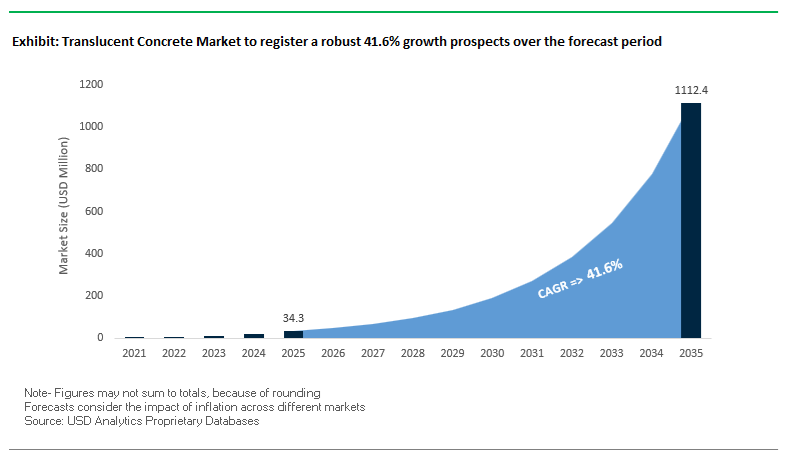
The Translucent Concrete Market is forecast to grow rapidly from USD 34.3 million in 2025 to USD 1,111.5 million by 2035, representing an exceptional CAGR of 41.6%. This acceleration is driven by the widespread adoption of light-transmitting concrete (LTC) in facades, interior architectural features, infrastructure lighting, energy-efficient buildings, and luxury commercial spaces. For manufacturers and vendors, the market’s trajectory is largely shaped by advancements in optical fiber integration, fine-matrix concrete engineering, and the growing demand for aesthetic, functional, and energy-saving construction materials.
High-performance Translucent Concrete systems leverage 3–5% optical fiber volume ratios, enabling light transmission without compromising structural capacity. Premium panels incorporating 200,000+ fibers per square meter deliver high-definition light diffusion and uniformity, supporting applications in facade cladding, public installations, wayfinding systems, and interior partitions. Structural properties remain robust, with high-quality LTC formulations regularly achieving compressive strengths up to 50 MPa, comparable or superior to traditional structural concrete.
Because optical fibers retain total internal reflection, light transmission remains consistent even in thicknesses from 25 mm to 500 mm, empowering architects and engineers to design load-bearing walls that offer both illumination and structural performance. This combination is accelerating adoption across high-rise developments, government infrastructure upgrades, design-forward commercial spaces, and luxury residential projects.
Key Market Insights for Vendors and Engineers
Optimal fiber ratio (3–5%) enables structural stability while maximizing light transmission.
Light transmittance levels of 3–10% allow clear projection of shadows, patterns, and illumination through thick concrete sections.
Compressive strength of up to 50 MPa ensures LTC remains viable for structural applications.
High-density fiber packing (200,000+ fibers/m²) supports consistent aesthetic output for façade cladding and large-format architectural panels.
Thickness-independent optical performance offers design flexibility across structural and decorative applications.
The market is undergoing transformative growth driven by technology commercialization, sustainability improvements, and strategic government programs. In October 2025, a leading U.S. manufacturer launched energy-efficient translucent concrete panels featuring micro-optics technology engineered to enhance passive daylighting, directly reducing artificial lighting loads in commercial real estate. These innovations reinforce LTC’s role as a next-generation green building material.
Sustainability is a major R&D focus. In September 2025, research teams developed a biodegradable polymer fiber suitable for embedding into light-transmitting concrete. This milestone addresses the construction sector’s rising need for eco-friendly, temporary architectural materials used in events, exhibitions, and modular structures. Earlier, in March 2024, Litracon Ltd. introduced lightweight translucent concrete panels, leveraging a proprietary matrix for easier transportation and installation—expanding adoption in interior walls, decorative partitions, and small-scale design projects.
Large-scale deployment is accelerating across Asia and Europe. In July 2025, a European construction group partnered with a technology provider to unveil a mobile translucent concrete batching unit, empowering on-site panel production for remote infrastructure projects, reducing logistics complexity and material waste. In June 2024, Lucem GmbH expanded its presence in commercial high-rise projects through a partnership with a leading construction firm, promoting the adoption of LUCCON façade systems in premium developments. Meanwhile, a Japanese government initiative (October 2025) is driving the integration of translucent concrete into public infrastructure—subways, pedestrian walkways, and tunnels—enhancing safety, visibility, and aesthetic quality.
Technological advancement remains a critical growth enabler. Dupont Lightstone’s September 2024 launch of new translucent concrete solutions utilizing high-refractive-index materials demonstrates rising interest in luxury interior applications for hotels, corporate headquarters, and high-end residential environments. In August 2025, a pilot demonstration project in Asia validated LTC’s effectiveness in earthquake-resistant structures, retaining both structural and optical performance under dynamic loads. This breakthrough expands the market’s credibility for seismic zones and advanced structural engineering applications.
A major trend reshaping the Translucent Concrete (TC) market is the engineering breakthrough that allows optical fibers to be incorporated without compromising structural strength, a challenge that previously limited TC to decorative applications. Studies show that TC containing 0.1%–1% POFs (Plastic Optical Fibers) maintains compressive strength values equivalent to or even slightly higher than plain concrete—sufficient to satisfy structural requirements such as M20-grade concrete with its minimum 20 MPa threshold. This finding accelerates the adoption of TC in load-bearing architectural components and high-strength façade systems.
TC’s defining performance advantage—light transmission efficiency—remains intact even at low fiber loading. Panels with 0.38%–6% POFs achieve 8%–14.8% transmission, enough to create visible internal illumination patterns and directly reduce dependence on artificial lighting. Operational studies confirm that TC can cut lighting energy consumption by up to 50%, demonstrating compelling ROI for green building certifications and energy-efficient design mandates. The fiber diameter range of 0.25–2 mm allows seamless embedding with minimal visual disruption to the concrete matrix while optimizing internal refraction paths. Collectively, these advancements position TC as both a structural and aesthetic building material, capable of combining mechanical reliability with daylight harvesting.
Market Trend 2: Emergence of Nano-Optical and PV-Integrated Systems for Smart, Energy-Generating Translucent Facades
A second transformative trend is the development of micro- and nanoscale optical systems that enhance TC’s role in dynamic daylight control and renewable energy harvesting. Advanced façade simulations demonstrate that dynamic optical systems can achieve a 43% improvement in Daylighting Performance (FDPI) over static façade scenarios, enabling responsive interior illumination that reduces artificial lighting loads and supports human-centric architectural design.
Dynamic shading systems integrated into light-transmitting concrete can reduce solar heat gain by ~50%, dramatically lowering building cooling loads—an essential capability for hot climatic regions and high-performance building envelopes. Meanwhile, the integration of PV elements into non-visible TC surfaces has shown promising power-generation metrics, including 0.17 kWh/m²/day, positioning TC as a hybrid structural–solar material. Further technological advancements, such as transparent solar cells and Luminescent Solar Concentrators (LSCs), already achieving 3%–5% efficiency, highlight a near-term opportunity to develop energy-generating translucent building skins that combine structural reinforcement, daylighting, shading, and renewable electricity production.
Market Opportunity 1: Translucent Concrete for Safety-Critical Infrastructure with Integrated Wayfinding and Illumination
One of the clearest commercial opportunities is the application of TC in tunnels, subways, and transportation corridors, where passive illumination enhances safety and reduces operating costs. Light-transmitting systems using 0.1%–0.2% POFs can deliver illumination levels of up to 2,122 lux, dramatically exceeding the 50 lux minimum requirement for public road tunnels. This capability allows TC walls to function as passive lighting systems for wayfinding, emergency escape routes, and ambient illumination—reducing the reliance on energy-intensive artificial lighting installations.
Embedding LED elements and optical fibers directly into the concrete matrix adds further value: the concrete provides impact, abrasion, and moisture resistance, ensuring long-term protection of the illumination system even in high-vibration and corrosive environments. TC also enhances mechanical performance, with correctly deployed optical fibers increasing tensile strength up to 7 N/mm², compared to 3–4 N/mm² typical of conventional concrete. This strengthens tunnel linings, subway walls, and underground walkways while adding visibility and safety functionality.
Market Opportunity 2: Production of Sustainable Translucent Concrete Using Recycled Glass Aggregates and Waste-Derived Fillers
A second major opportunity is the use of recycled glass materials to create environmentally responsible translucent concrete formulations without sacrificing structural integrity. Foamed Glass Aggregates (FGAs), manufactured from 99% recycled glass, serve as lightweight, light-transmitting aggregates that significantly reduce raw material consumption and improve thermal performance. When blended with conventional aggregates, FGA-based concrete achieves compressive strengths of ~31 MPa, enabling semi-structural applications such as façade panels, pavers, partition walls, and landscape features.
Sustainability is further boosted by substituting cement with waste glass powder, which has been shown to lower chloride ion content—a key indicator of improved durability and corrosion resistance. These properties position recycled glass–enhanced TC as a desirable material for outdoor installations, coastal infrastructure, and landscaping products requiring long-term resilience. As governments increase pressure on construction sectors to reduce carbon footprints and incorporate circular materials, sustainable translucent concrete composite systems represent one of the most commercially scalable pathways for market expansion.
Translucent Concrete Market Share Analysis
Market Share by Light-Transmitting Element: Optical Fiber Concrete Leads Owing to Superior Light Transmission and Established Commercial Adoption
Optical Fiber Concrete accounts for the largest share of the global translucent concrete market—approximately 60%—because it remains the most technically advanced, commercially proven, and architecturally preferred method for enabling high-quality light transmission through structural concrete. This dominance is rooted in its reliance on thousands of embedded optical fibers leveraging the principle of Total Internal Reflection, allowing exceptionally efficient transmission of natural or artificial light with minimal attenuation even through thick concrete panels. The consistent, uniform illumination created by optical fibers delivers superior visual fidelity compared with resin-infused or glass-based alternatives, making it the premium choice for high-end architectural applications that demand both aesthetic precision and structural integrity. Moreover, optical fiber–based translucent concrete was the first technology to gain global recognition following the introduction of LiTraCon in 2001, giving it a strong early-mover advantage, well-established manufacturing processes, and widespread use in signature projects. Although the cost of optical fibers represents a large portion of total production costs—up to 60%—this also elevates the segment’s revenue share, as it continues to dominate high-value installations where design impact, durability, and light performance cannot be compromised. As architects increasingly adopt innovative façade and daylighting materials to meet sustainability and brand differentiation objectives, optical fiber concrete remains the benchmark for premium translucent concrete solutions.
Market Share by Application Type: Architectural Façades Dominate Driven by Demand for Sustainable, Aesthetic Building Envelopes
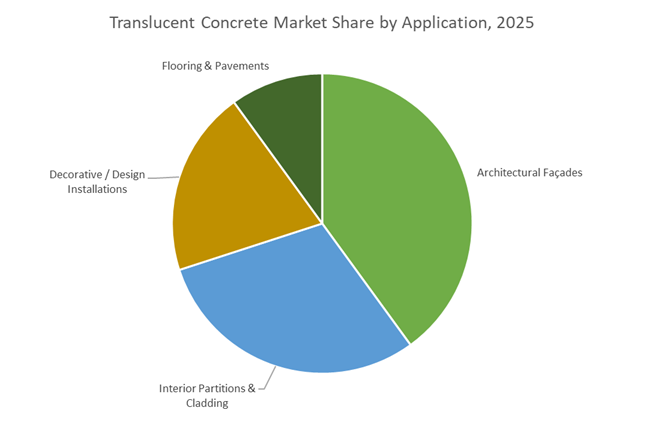
Architectural Façades represent the largest application segment for translucent concrete—holding roughly 40% of the global market—because the material provides a unique combination of aesthetic distinction, structural durability, and daylighting efficiency, making it ideal for exterior building envelopes. Translucent concrete façades enable architects to create iconic visual identities, with buildings appearing solid and monolithic during the day while emitting patterned or diffused light at night—an effect highly sought after in commercial, cultural, and luxury residential projects. This design-driven adoption is reinforced by a growing global emphasis on energy-efficient building materials: façade-integrated translucent concrete allows natural daylight to penetrate deep into interior spaces, significantly reducing daytime reliance on artificial lighting and supporting LEED and other green-building certification goals. Unlike conventional glass façades, translucent concrete offers enhanced thermal mass, weather resistance, impact durability, and security, making it suitable for high-traffic urban environments and long-lifespan infrastructure. Its ability to integrate into structural or semi-structural exterior walls further accelerates adoption in modern architectural envelopes seeking both performance and artistic expression. With increasing investment in sustainable architecture, landmark structures, and premium urban developments, the façade segment continues to anchor demand and lead the revenue share of the global translucent concrete market.
Country Analysis: Global Translucent Concrete Market Hotspots and Architectural Innovation Drivers
Germany/European Union: Digitalized Façade Innovation and Commercial-Scale Translucent Concrete Deployment
Germany and the broader European Union continue to anchor global innovation in Light-Transmitting Concrete (LTC), driven by ambitious sustainable construction mandates, rapid digitalization of architectural materials, and a strong shift toward energy-efficient building envelopes. Companies like LUCEM GmbH (Aachen) are accelerating market maturity through a suite of prestigious commercial projects completed in 2024–2025, including backlit LTC structures at Hamburg Central Station and the MASH Bar Steakhouse, validating the durability and visual impact of LTC in both public infrastructure and premium hospitality environments. The region’s push toward high-performance building materials—aligned with EU ESG and climate objectives—has amplified demand for translucent concrete panels capable of merging aesthetics with measurable operational efficiency.
European R&D continues to drive global benchmarks in energy modeling for LTC. Academic evaluations show that LTC mixes incorporating 5.6% optical fiber content can reduce building heating and cooling energy consumption by up to 18%, highlighting the material’s dual structural–thermal advantage. LUCEM’s introduction of Starlight Cubes (July 2024) expands the application landscape into modular decorative installations, retail interiors, and urban lighting, demonstrating how the European market is transitioning translucent concrete from a niche architectural statement to a scalable, multifunctional smart-building component. Regulatory alignment through the Construction Products Regulation (CPR) revisions further supports commercialization by encouraging digital product passports and sustainable material transparency.
China: Urban Infrastructure Illumination and High-Translucence Composite Engineering
China is rapidly emerging as a high-volume adopter of translucent concrete, particularly in urban infrastructure, public buildings, pedestrian walkways, tunnels, and cultural landmarks where enhanced visibility, energy reduction, and aesthetic impact are critical. Companies such as Translight Structures Pvt. Ltd., alongside large domestic construction contractors, are increasingly integrating LTC into high-footfall public environments to reduce reliance on artificial lighting while enhancing architectural expression. Flagship cultural developments such as the Hanzhong Han Culture Expo Park utilize translucent concrete panels extensively across top surfaces and internal partitions, demonstrating the material’s growing role in immersive cultural architecture.
China’s material science community is simultaneously advancing innovative LTC formulations, with leading institutes experimenting with epoxy resin matrices to replace traditional cement mortar. These resin-based translucent composites offer significantly higher translucence, greater compressive strength, and improved long-term optical clarity—positioning China at the forefront of next-generation LTC technology. This convergence of large-scale infrastructure demand and rapid R&D progress is allowing China to scale production faster than most global markets, reinforcing its competitive position in both domestic adoption and future export capability.
Japan: Precision Engineering and Light-Diffusing Architectural Interiors
Japan’s translucent concrete market is shaped by its architectural culture of minimalism, spatial dynamics, and precise control of natural light. Projects such as the Studio Hibiya wall installation in Tokyo have demonstrated the power of LTC to create dynamic, light-responsive interior environments, enabling designers to mimic natural daylight transitions and enhance occupant well-being. This design philosophy aligns perfectly with LTC’s ability to diffuse and modulate light through embedded optical fibers, making it a preferred material for high-end commercial interiors, boutique spaces, and studios.
Japanese researchers are further advancing the field through long-term durability studies focused on the fiber–cement interface, ensuring that Plastic Optical Fiber (POF) placement remains structurally stable and visually consistent over decades. Optimization of fiber alignment, density, and interface bonding is a key R&D priority, supporting Japan’s reputation for precision material engineering. These innovations ensure that Japanese LTC installations maintain uniform luminosity, structural integrity, and resistance to microcracking—critical for applications exposed to variable humidity and seismic activity.
United States: Premium Commercial Cladding and LEED-Driven Daylighting Integration
The United States is adopting translucent concrete primarily within premium commercial buildings, corporate headquarters, museums, and art installations that prioritize sustainability and design innovation. Architects increasingly specify Light-Transmitting Concrete as a daylight-maximizing component that supports LEED certification, particularly under categories related to energy optimization, natural lighting, and innovative building materials. By reducing reliance on artificial lighting, LTC contributes directly to achieving higher energy performance ratings and occupant comfort metrics.
U.S. engineering and architectural firms also lead in the use of simulation-driven material optimization, leveraging ray-tracing models to refine optical pathways and maximize the efficiency of LTC façades. Studies indicate that a 6% optical fiber ratio can reduce artificial lighting requirements by up to 50% in targeted office zones, underscoring the value proposition for high-value commercial and mixed-use buildings. As sustainability-driven design accelerates across the U.S. construction sector, translucent concrete is gaining traction as both a technical and aesthetic differentiator in next-generation façade systems.
Hungary: Originator of Light-Transmitting Concrete and Specialist Production Hub
Hungary holds a unique position in the global market as the birthplace of modern translucent concrete, pioneered by architect Áron Losonczi through his trademarked LiTraCon® material. While the country is not a high-volume producer, its manufacturing base remains highly specialized, focusing on precision LTC panels and bespoke installations for international architectural projects. Hungary’s expertise lies in maintaining craftsmanship in fiber arrangement, panel casting techniques, and material uniformity—capabilities that continue to anchor its role as a premium supplier for designers seeking high-end, artisanal LTC applications.
Switzerland: Early Adoption in Modern Architecture and Institutional Design
Switzerland was one of the earliest adopters of translucent concrete, which has been featured in numerous architectural projects, especially garden pavilions, research institutions, and contemporary academic buildings such as installations associated with the Karolinska Institute. These early deployments demonstrated the long-term structural durability and aesthetic consistency of LTC, helping validate the material for broader international use. Switzerland’s emphasis on modern minimalist design, environmental performance, and durable construction aligns well with translucent concrete’s functional properties, supporting persistent niche demand in premium architectural applications.
Translucent Concrete Competitive Landscape: Global Leaders in Fiber-Dense Architectural Materials
The competitive landscape of the Translucent Concrete Industry features a mix of pioneering innovators, premium façade specialists, large-scale construction material suppliers, and integrated architectural composite manufacturers. Market leadership is defined by optical fiber formulation technology, high-density panel engineering, custom architectural capabilities, and regional deployment scale. Most companies focus on expanding their offerings into commercial façades, branded architectural features, and infrastructure lighting projects, reflecting strong demand for Aesthetic + Performance construction systems.
Litracon Ltd. – Pioneer of the Original Light-Transmitting Concrete Technology
Litracon Ltd. remains the most recognized name in the translucent concrete space, holding the original commercialization credibility since its founding by Áron Losonczi in 2004. Its flagship LiTraCon® blocks and LiTraCon pXL panels are engineered for high-definition light-shadow projection, making them central to iconic architectural installations and luxury interior design. Litracon’s strategic transformation includes expanding beyond glass-fiber systems into pXL plastic light-unit technologies, significantly lowering production costs while increasing scalability and market accessibility. The company also produces LiTraCube lamps, showcasing material versatility in lighting applications. Litracon’s global reputation stems from its commitment to fiber density optimization, structural integrity, and aesthetic precision, ensuring consistent performance across projects requiring both architectural impact and engineering reliability.
Lucem GmbH – High-Density Optical Fiber Specialist for Premium Facades
Lucem GmbH is a market leader in large-format translucent concrete façade systems, offering premium product lines such as LUCCON®, STARLIGHT, LABEL, and PURE. With panels reaching 1200×600 mm, Lucem emphasizes high-density optical fiber packing (up to 300,000 fibers/m²) to ensure exceptional uniformity and image clarity. Its exclusive use of mineral-based materials, including glass fibers and fine concrete, ensures superior UV stability, weather resistance, and long-term performance for outdoor applications. Lucem’s strategic focus is on custom façade engineering, enabling large commercial projects and high-rise buildings to integrate translucent concrete as a core design and sustainability feature. Its partnerships across Europe support rapid adoption in commercial real estate and landmark architecture.
Pan-United Corporation – Regional Leader for Infrastructure-Ready Translucent Concrete
Pan-United Corporation Ltd. leverages its extensive footprint in Asia-Pacific construction materials to supply translucent concrete mixes and hybrid LTC-UHPC solutions across high-rise and infrastructure projects. Its strategic advantage lies in its integrated readymix and logistics network, ensuring consistent quality at scale for developers in Southeast Asia. Pan-United positions translucent concrete as part of its broader portfolio of sustainable, functional, and aesthetic concrete solutions, supporting governments and private developers pursuing next-generation urban design. Its proprietary formulations enable both structural and architectural applications, making it a significant market driver in fast-growing metropolitan regions.
Fapinex LLC – U.S. Leader in Decorative and LED-Integrated Translucent Concrete
Fapinex LLC specializes in interior and decorative translucent concrete products, frequently integrating embedded LED lighting systems for dynamic visual effects. Its offerings include custom countertops, flooring, feature walls, and retail/hospitality installations requiring unique architectural signatures. The company focuses on the North American design and construction market, providing solutions for premium commercial interiors where lighting, aesthetics, and material innovation converge. Fapinex differentiates itself through custom fabrication, LED compatibility, and high-resolution optical patterns, allowing designers to achieve fully personalized lighting environments.
Premier Composite Technologies (PCT) – Global Engineering Specialist for Complex Architectural Structures
Premier Composite Technologies (PCT) operates at the intersection of UHPC, composite engineering, and light-transmitting materials, offering turnkey façade packages for grand mosques, Expo pavilions, luxury hotels, and large cultural landmarks. The company excels at integrating translucent concrete elements into highly complex geometries, relying on advanced off-site manufacturing and precision engineering. With a strong presence in Middle Eastern and Asian luxury construction, PCT is recognized for delivering bespoke, high-performance architectural solutions that combine aesthetics, structural performance, and durability. Its ability to merge UHPC strength with integrated optical fibers positions it as a preferred partner for monumental design projects.
Translucent Concrete Market Report Scope
Translucent Concrete Market
Parameter
Details
Market Size (2025)
$34.3 Million
Market Size (2035)
$1111.5 Million
Market Growth Rate
41.6%
Segments
By Light-Transmitting Element (Optical Fiber Concrete, Resin/Polymeric Concrete, Photoluminescent or Glass-Based Systems), By Product Form (Precast Panels & Slabs, Blocks & Bricks, Custom Architectural Elements), By Application Type (Architectural Façades, Interior Partitions & Cladding, Flooring & Pavements, Decorative/Design Installations)
Study Period
2019- 2024 and 2025-2034
Units
Revenue (USD)
Qualitative Analysis
Porter’s Five Forces, SWOT Profile, Market Share, Scenario Forecasts, Market Ecosystem, Company Ranking, Market Dynamics, Industry Benchmarking
US, Canada, Mexico, Germany, France, Spain, Italy, UK, Russia, China, India, Japan, South Korea, Australia, South East Asia, Brazil, Argentina, Middle East, Africa
Translucent Concrete Market Segmentation
By Light-Transmitting Element
Optical Fiber Concrete
Resin / Polymeric Concrete
Photoluminescent or Glass-Based Systems
By Product Form
Precast Panels & Slabs
Blocks & Bricks
Custom Architectural Elements
By Application
Architectural Façades
Interior Partitions & Cladding
Flooring & Pavements
Decorative / Design Installations
By Region
North America (United States, Canada, Mexico)
Europe (Germany, France, United Kingdom, Spain, Italy, Rest of Europe)
Asia Pacific (China, India, Japan, South Korea, Australia, Rest of APAC)
South and Central America (Brazil, Argentina, Rest of SCA)
Middle East and Africa (Saudi Arabia, UAE, South Africa, Rest of Middle East, Rest of Africa)
Top Companies in Translucent Concrete Market
LUCEM
LiTraCon
Translight Structures
Luccon Lichtbeton
Glas Beton
Heidelberg Materials
Sika
CEMEX
Italcementi
LiCrete (Gravelli)
Florak Bauunternehmung
Translucent Concrete Ltd.
Vicat
*- List not Exhaustive
Research Coverage
The latest Translucent Concrete Market study from USDAnalytics provides an in-depth strategic assessment of how light-transmitting concrete is moving from niche design concept to scalable building-envelope and infrastructure solution. This report investigates the interplay between optical fiber loading, matrix engineering, energy-efficiency targets, and evolving building codes, while carefully benchmarking compressive strength retention, light transmittance ranges, and façade durability under real-world conditions. It highlights technology breakthroughs in fiber-dense panels, nano-optical enhancements, PV-integrated façades, and recycled glass–based systems that are reshaping specification criteria for architects, structural engineers, and EPC contractors. The study delivers granular analysis reviews covering market sizing, CAGR dynamics, application mix, and regional adoption patterns, along with a deep dive into supply chain maturity, production economics, and premium pricing drivers in façade and infrastructure lighting projects. With comprehensive coverage of architectural façades, interior cladding, flooring, tunnels, subways, wayfinding structures, and decorative/light-art installations, this report is an essential resource for stakeholders seeking to understand where translucent concrete will create the highest value, how competing light-transmitting technologies compare, and which material and design strategies will secure long-term competitiveness in this rapidly scaling market.
Scope Highlights
Segmentation
By Light-Transmitting Element: Optical Fiber Concrete, Resin / Polymeric Concrete, Photoluminescent or Glass-Based Systems
By Product Form: Precast Panels & Slabs, Blocks & Bricks, Custom Architectural Elements
2. Translucent Concrete Market Landscape & Outlook (2025–2035)
2.1. Introduction to Translucent Concrete Market
2.2. Market Valuation and Growth Projections (2025–2035)
2.3. Optical Fiber Integration and Light-Transmission Performance
2.4. Structural Strength, Thickness Flexibility, and Mechanical Properties
2.5. Adoption Across Architecture, Infrastructure, and Energy-Efficient Buildings
3. Innovations Reshaping the Translucent Concrete Market
3.1. Trend: Structural Integration of Optical Fibers in Load-Bearing Concrete
3.2. Trend: Nano-Optical, PV-Integrated, and Dynamic Façade Systems
3.3. Opportunity: Safety-Critical Infrastructure Lighting and Wayfinding Applications
3.4. Opportunity: Sustainable Translucent Concrete Using Recycled Glass Aggregates
4. Competitive Landscape and Strategic Initiatives
4.1. Partnerships and Project-Based Deployments
4.2. R&D in Optical Fiber Density, Nano-Optics, and Lightweight Panels
4.3. Sustainability and Recycled Material Integration Strategies
4.4. Market Expansion Across Commercial, Infrastructure, and Public Projects
5. Market Share and Segmentation Insights: Translucent Concrete Market
5.1. By Light-Transmitting Element
5.1.1. Optical Fiber Concrete
5.1.2. Resin / Polymeric Translucent Concrete
5.1.3. Photoluminescent or Glass-Based Systems
5.2. By Product Form
5.2.1. Precast Panels and Slabs
5.2.2. Blocks and Bricks
5.2.3. Custom Architectural Elements
5.3. By Application Type
5.3.1. Architectural Façades
5.3.2. Interior Partitions and Cladding
5.3.3. Flooring and Pavements
5.3.4. Decorative and Design Installations
6. Country Analysis and Outlook of Translucent Concrete Market
6.1. United States
6.2. Canada
6.3. Mexico
6.4. Germany
6.5. France
6.6. Spain
6.7. Italy
6.8. United Kingdom
6.9. Russia
6.10. China
6.11. India
6.12. Japan
6.13. South Korea
6.14. Australia
6.15. South East Asia
6.16. Brazil
6.17. Argentina
6.18. Middle East
6.19. Africa
7. Translucent Concrete Market Size Outlook by Region (2025–2035)
7.1. North America Translucent Concrete Market Size Outlook to 2035
7.1.1. By Light-Transmitting Element
7.1.2. By Product Form
7.1.3. By Application Type
7.2. Europe Translucent Concrete Market Size Outlook to 2035
7.2.1. By Light-Transmitting Element
7.2.2. By Product Form
7.2.3. By Application Type
7.3. Asia Pacific Translucent Concrete Market Size Outlook to 2035
7.3.1. By Light-Transmitting Element
7.3.2. By Product Form
7.3.3. By Application Type
7.4. South and Central America Translucent Concrete Market Size Outlook to 2035
7.4.1. By Product Form
7.4.2. By Application Type
7.5. Middle East and Africa Translucent Concrete Market Size Outlook to 2035
7.5.1. By Light-Transmitting Element
7.5.2. By Product Form
7.5.3. By Application Type
8. Company Profiles: Leading Players in the Translucent Concrete Market
8.1. Litracon Ltd.
8.2. Lucem GmbH
8.3. Pan-United Corporation Ltd.
8.4. Fapinex LLC
8.5. Premier Composite Technologies
8.6. Heidelberg Materials
8.7. Sika AG
8.8. CEMEX S.A.B. de C.V.
8.9. Vicat Group
8.10. Italcementi
8.11. Translight Structures
8.12. Luccon Lichtbeton
8.13. Glas Beton
8.14. LiCrete (Gravelli)
8.15. Translucent Concrete Ltd.
9. Methodology
9.1. Research Scope
9.2. Market Research Approach
9.3. Market Sizing and Forecasting Model
9.4. Research Coverage
9.5. Data Horizon
9.6. Deliverables
10. Appendix
10.1. Acronyms and Abbreviations
10.2. List of Tables
10.3. List of Figures
Translucent Concrete Market Segmentation
By Light-Transmitting Element
Optical Fiber Concrete
Resin / Polymeric Concrete
Photoluminescent or Glass-Based Systems
By Product Form
Precast Panels & Slabs
Blocks & Bricks
Custom Architectural Elements
By Application
Architectural Façades
Interior Partitions & Cladding
Flooring & Pavements
Decorative / Design Installations
By Region
North America (United States, Canada, Mexico)
Europe (Germany, France, United Kingdom, Spain, Italy, Rest of Europe)
Asia Pacific (China, India, Japan, South Korea, Australia, Rest of APAC)
South and Central America (Brazil, Argentina, Rest of SCA)
Middle East and Africa (Saudi Arabia, UAE, South Africa, Rest of Middle East, Rest of Africa)
The Translucent Concrete Market is valued at USD 34.3 million in 2025 and is forecast to reach USD 1,111.5 million by 2035, registering a very high CAGR of 41.6% during 2025–2035. Growth is driven by rapid adoption in architectural facades, public infrastructure lighting, luxury interiors, and energy-efficient buildings. Advancements in optical fiber integration are accelerating large-scale commercialization.
Architectural facades dominate demand, accounting for around 40% of the market, followed by interior partitions, decorative installations, and infrastructure lighting. Translucent concrete is increasingly specified for tunnels, subways, pedestrian walkways, and commercial buildings where passive daylighting improves safety and reduces energy costs. Luxury real estate and landmark projects are key demand generators.
Commercial translucent concrete typically integrates 3–5% optical fiber volume, delivering light transmittance levels of 3–10% without compromising structural integrity. High-quality systems achieve compressive strengths up to 50 MPa and maintain consistent light transmission across thicknesses ranging from 25 mm to 500 mm. High-density fiber layouts exceeding 200,000 fibers per square meter ensure uniform visual output.
Key trends include load-bearing translucent concrete walls, nano-optical and PV-integrated facades, and safety-focused infrastructure applications with embedded illumination. Major opportunities lie in tunnels and transport corridors for passive lighting, as well as sustainable translucent concrete using recycled glass aggregates. Energy-saving potential of up to 50% in lighting loads strengthens adoption in green buildings.
Leading players include Litracon, Lucem GmbH, Pan-United Corporation, Fapinex, and Premier Composite Technologies. These companies compete through optical fiber density innovation, large-format facade panels, and premium architectural solutions.