Tray Sealing Machinery Market Size, Overview, and Growth Outlook (2025–2034)
Tray Sealing Machinery Market Poised for Steady Growth to $8.7 Billion by 2034 as Automation and Sustainability Drive Food Packaging Efficiency
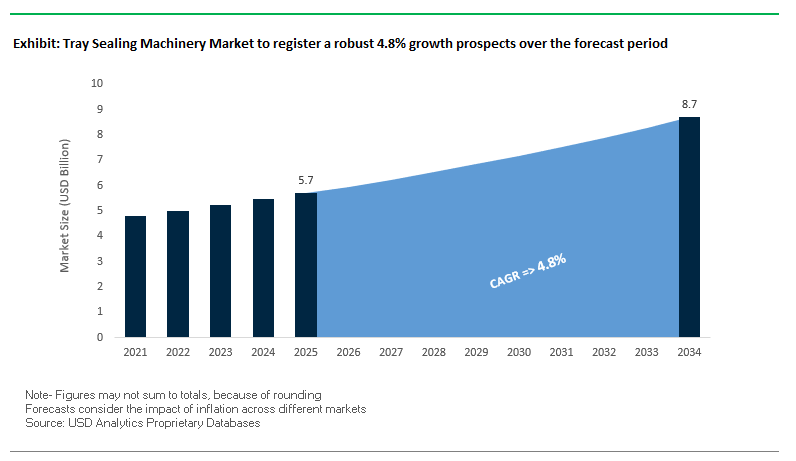
The global tray sealing machinery market is projected to grow from $5.7 billion in 2025 to $8.7 billion by 2034, at a CAGR of 4.8%. This industry is critical for food safety, operational efficiency, and shelf-life extension, meeting the rising demand for packaged convenience and ready-to-eat meals. Tray sealing machinery now integrates automation, MAP, and VSP technologies, delivering high throughput and reliable sealing for diverse packaging formats.
Key Insights for industry professionals and buyers:
Operational efficiency is paramount, with fully automatic tray sealing machines reducing labor costs and enhancing consistency in high-volume production.
Shelf-life extension technologies such as Modified Atmosphere Packaging (MAP) and Vacuum Skin Packaging (VSP) are increasingly integrated into modern machinery.
Sustainable packaging integration allows sealing of recycled, bioplastic, and fiber-based trays, aligning with environmental regulations and consumer expectations.
Industry 4.0 adoption equips machines with IoT sensors, predictive maintenance, and real-time performance monitoring, enhancing overall equipment effectiveness (OEE).
Cross-sector applications extend beyond food into pharmaceuticals, healthcare, and high-value industrial packaging.
These trends suggest continuous innovation opportunities, cost efficiencies, and environmental compliance for both machinery manufacturers and food processors.
Market Analysis: Technological Advancements and Strategic Consolidations Are Accelerating Tray Sealing Machinery Market Growth
The tray sealing machinery industry is experiencing rapid evolution, driven by automation, sustainability, and strategic acquisitions. In January 2025, JBT Proseal installed its 8000th machine at Bakkavor Group, demonstrating high adoption of automated sealing solutions. August 2025 saw Investindustrial acquire Kiremko, Idaho Steel Products, and Reyco Systems, expanding its footprint in custom food processing machinery. Meanwhile, December 2024 marked a private firm’s majority stake acquisition in Eutecma, a developer of modular, reusable temperature-controlled packaging, highlighting sustainability-focused innovation.
In October 2024, JBT Proseal introduced its XTRS tray sealing technology, offering compact, high-output, flexible production for medium- to high-volume lines. September 2024 brought Harpak-ULMA’s high-throughput tray sealing solution, designed for reduced labor and smaller footprints. The same period witnessed the Smurfit Kappa and WestRock merger, creating a global leader in paper-based packaging, enhancing compatibility with sustainable tray sealing solutions.
Earlier developments also underscore the industry’s focus on recyclable packaging integration and product efficiency. March 2024 saw TOPPAN Holdings launch GL-SP transparent barrier film, while September 2023 marked JBT Proseal’s CP4 case packing machine launch, delivering unmatched efficiency and flexibility. These milestones illustrate a market that combines technological innovation, operational excellence, and sustainability commitments.
Trends and Opportunities in the Tray Sealing Machinery Market
Integration of Industry 4.0 and IoT for Predictive Maintenance and OEE Optimization
The tray sealing machinery market is witnessing a rapid transition toward Industry 4.0 and IoT-enabled solutions designed to maximize overall equipment effectiveness (OEE). Traditional reactive maintenance models are being replaced by predictive systems powered by IoT sensors that continuously track variables such as sealing jaw temperature, pressure, and vibration. A 2025 predictive maintenance study revealed that such systems can reduce unplanned downtime by up to 50% and cut maintenance costs by 10–40%, significantly improving cost efficiency for high-throughput food and beverage manufacturers.
The integration of AI-driven predictive models allows operators to forecast potential failures and schedule maintenance during low-demand periods, ensuring uninterrupted performance during peak operations. For high-speed lines packaging thousands of trays per minute, this is a critical advancement in minimizing production losses. Furthermore, the emergence of cloud-based tray sealing platforms enables remote diagnostics and monitoring, eliminating the need for on-site inspections and empowering global enterprises with real-time visibility across multiple production facilities.
Rapid Adoption of Robotic Auto-Loading and Palletizing Cells
Labor shortages, rising costs, and hygiene demands are accelerating the adoption of robotic tray loading and palletizing systems. Robotics manufacturers such as FANUC are deploying high-speed pick-and-place systems capable of handling delicate food and pharmaceutical products with exceptional repeatability and accuracy. These robots surpass manual labor in both efficiency and consistency, while simultaneously improving food safety by reducing human contact.
The trend is shifting from stand-alone robotic arms to fully integrated end-to-end automation cells. Providers like Harpak-ULMA and JLS Automation are designing modular lines where robots equipped with vision systems pick, orient, and place items into trays before passing them seamlessly to case packers and palletizers. These automated lines offer unmatched flexibility, handling multiple SKUs with minimal downtime during changeovers, a feature particularly valuable for FMCG manufacturers running diverse product portfolios.
Retrofitting and Upgrading Legacy Machinery for Sustainability Compliance
The industry faces an urgent need to adapt to sustainable packaging regulations and brand commitments to circular economy targets. Many legacy tray sealing machines were not engineered for mono-material films, rPET trays, or paper-based solutions, which require precise control of sealing temperature, pressure, and dwell time. This gap presents a major retrofit opportunity.
Machinery builders are developing retrofit kits that upgrade legacy machines with advanced sealing jaws, improved heat control, and adaptive software to handle new materials. For example, Syntegon’s retrofit kits for horizontal flow wrappers enable older lines to process recyclable paper-based films at high speeds, offering a blueprint for tray sealing machinery upgrades. These solutions extend the lifespan of existing assets while ensuring compliance with regulatory frameworks and brand-level sustainability goals without requiring full equipment replacement.
Expansion into the Pharmaceutical and Medical Device Packaging Sector
The pharmaceutical and medical device sectors represent a high-value growth opportunity for tray sealing machinery manufacturers. Unlike food packaging, these applications demand validated sterile barrier systems, traceability, and compliance with regulatory standards. Manufacturers such as Nelipak are building tray sealers specifically engineered for ISO Class 7 cleanroom environments, ensuring they meet stringent IQ, OQ, and PQ validation protocols for process repeatability.
In this segment, constant heat sealing technology is preferred for creating hermetic seals that withstand sterilization and distribution stresses. Testing protocols, including ASTM F88 peel tests and ASTM F1140 burst tests, validate the integrity of sterile barriers. Additionally, regulatory requirements for Unique Device Identification (UDI) are pushing machinery suppliers to integrate serialization, RFID readers, and barcode verification systems directly into tray sealers. These digital enhancements not only provide complete audit trails but also guarantee compliance with evolving healthcare packaging regulations, making this sector a critical area of expansion.
Competitive Landscape: Key Players in Tray Sealing Machinery Drive Innovation, Sustainability, and Operational Efficiency Across Food and Packaging Industries
The tray sealing machinery market is shaped by global players leveraging automation expertise, material innovation, and digital integration to deliver high-performance, sustainable packaging solutions.
JBT Proseal offers a range of manual, semi-automatic, and fully automatic tray sealing machines for diverse applications, from fresh produce to ready meals. In January 2025, it installed its 8000th machine at Bakkavor Group. Proseal’s Better Planet 2050 plan focuses on reducing environmental footprint and developing circular economy technologies, reinforcing its global leadership in food processing machinery.
MULTIVAC: Delivering Sustainable, Flexible, and High-Performance Packaging Solutions
MULTIVAC specializes in thermoforming packaging machines, including tray sealers tailored to food and medical sectors. Its Innovations for a Sustainable World strategy emphasizes environmentally friendly materials and technology, ensuring high-quality, sustainable packaging. MULTIVAC’s vertically integrated model enables efficient production and innovation across global markets.
ULMA Packaging, S. Coop.: Compact, High-Throughput Solutions for Diverse End-Use Applications
ULMA offers tray sealing machines designed for food, medical, and pharmaceutical industries. In September 2024, Harpak-ULMA launched a new high-throughput solution that requires fewer staff and less space. ULMA’s global presence and vertically integrated operations allow it to deliver innovative, compliant, and efficient packaging solutions worldwide.
Ishida Co., Ltd.: Maximizing Output and Flexibility with Smart Tray Sealing Technology
Ishida provides QX Flex tray sealers designed for medium- to high-volume production lines, prioritizing compact size, high performance, and flexibility. The company’s Ishida Way strategy integrates sustainable materials and circular economy initiatives, supporting the delivery of reliable and efficient food packaging machinery globally.
Ossid LLC: Advancing Circular Economy Initiatives in Meat, Poultry, and Seafood Packaging
Ossid, a ProMach brand, offers tray sealers and overwrappers for the meat, poultry, and seafood sectors. Its ProMach Way strategy emphasizes environmental footprint reduction and recycled content integration, delivering high-performance, compliant solutions that enable food processors to meet sustainability and operational efficiency goals.
MAP Technology Dominates Tray Sealing Machinery Market by Technology
Modified Atmosphere Packaging (MAP) technology leads the tray sealing machinery industry with a 45% market share, establishing itself as the gold standard for preserving freshness and extending the shelf life of perishable foods. By replacing headspace air with controlled gas compositions such as nitrogen, carbon dioxide, or oxygen blends, MAP significantly reduces microbial growth and preserves product color and texture without chemical preservatives. This makes it indispensable for fresh meat, poultry, seafood, and prepared meals—sectors that rely heavily on packaging integrity to minimize waste and maximize consumer confidence. The ability of MAP to balance regulatory requirements for food safety, consumer demand for freshness, and retailer needs for extended distribution timelines ensures its strong market leadership. Ongoing developments in tray sealing equipment, such as improved gas-flush accuracy and real-time seal integrity monitoring, further strengthen MAP’s position as the dominant tray sealing technology.
Food & Beverages Dominate Tray Sealing Machinery Market by Application
Food and beverages account for an overwhelming 80% of the tray sealing machinery market, underscoring the industry’s dependence on sealed trays for portion control, safety, and shelf appeal. This application spans ready-to-eat meals, fresh produce, dairy, meat, and bakery products, all of which require packaging solutions that combine barrier integrity with tamper evidence and convenience. Growth in urban lifestyles, rising demand for on-the-go meals, and the expansion of cold-chain infrastructure have amplified the reliance on tray sealing systems to deliver safe and visually appealing products. The segment also benefits from the rapid shift towards sustainable trays and recyclable lidding films, as food companies respond to both regulatory mandates and consumer expectations. Given its volume intensity and critical reliance on seal integrity, the food and beverage sector will remain the primary demand center for tray sealing machinery well into the next decade.
United States: Automation, IoT Integration, and Sustainable Packaging Driving Adoption
The United States tray sealing machinery market is strongly influenced by the U.S. Food and Drug Administration’s (FDA) stringent food safety and medical packaging regulations, which are pushing manufacturers toward high-precision sealing solutions. With the rise of automation and robotics in food processing facilities, companies are increasingly adopting automatic tray sealing systems to improve efficiency, reduce labor dependency, and ensure compliance with strict hygiene standards. The surge of e-commerce and meal kit delivery services has further accelerated demand for durable, tamper-evident sealed trays that preserve freshness and prevent contamination during last-mile delivery.
Sustainability is a major driver in the U.S. market, with companies investing in tray sealing machinery that can process recyclable mono-materials, fiber-based trays, and compostable films. Technological innovation is also shaping the industry, as manufacturers deploy IoT-enabled and real-time monitoring systems to track seal integrity, temperature, and hygiene—features critical for pharmaceutical and ready-to-eat food applications. Organizations like AMERIPEN (American Institute for Packaging and the Environment) are also influencing machine design by advocating for eco-friendly practices, ensuring that tray sealing aligns with the country’s long-term sustainability goals.
European Union: PPWR-Driven Circular Economy and Breakthrough Machinery Designs
The European tray sealing machinery market is undergoing rapid transformation under the Packaging and Packaging Waste Regulation (PPWR), which became effective in February 2025. This regulation requires manufacturers to design packaging that integrates recycled content and recyclability, prompting investments in advanced sealing machines capable of handling bio-based and reusable materials. The EU’s Good Distribution Practice (GDP) guidelines for medicinal products are another key driver, as they necessitate validated cold chain solutions where tray sealing plays a pivotal role in ensuring product safety and compliance.
Innovations in the region are being spearheaded by leading companies like JBT Proseal and SEALPAC, which have introduced machines capable of reducing plastic content by up to 96% using hybrid cardboard trays with thin recyclable plastic inlays. These solutions address both regulatory pressure and consumer demand for sustainable packaging. Additionally, the European Chips Act and Chips Joint Undertaking (JU) are mobilizing large-scale investments in semiconductor production, indirectly boosting demand for sterile tray sealing machinery used in electronic and medical device applications. In January 2025, JBT Proseal achieved a milestone by installing its 8000th machine at Bakkavor Group, underscoring the robust demand in Europe’s prepared food sector.
China: Intelligent Manufacturing and MAP Solutions Supporting Food Security
China’s tray sealing machinery market is expanding rapidly under the government’s “14th Five-Year” plan, which emphasizes digital and intelligent manufacturing. Investments in AI, big data, and 5G-enabled production lines are revolutionizing packaging machinery, with tray sealing systems becoming more versatile, agile, and compact to serve diverse applications. The introduction of new regulations in June 2025 that require express delivery companies to prioritize eco-friendly and reusable packaging is further accelerating demand, particularly in China’s booming e-commerce logistics sector.
The enactment of the Anti-Food Waste Law (2021) has also boosted adoption of Modified Atmosphere Packaging (MAP) tray sealing systems, which extend product shelf life and reduce food wastage across the distribution chain. Domestic manufacturers are scaling up R&D to produce flexible and cost-efficient sealing machines that cater to both local and export markets. With traceability and cold chain efficiency becoming key concerns, China is also integrating real-time monitoring technologies into tray sealing solutions, supporting its vision of a modernized and sustainable packaging industry.
India: Food Safety Standards and Domestic Manufacturing Boosting Growth
The India tray sealing machinery market is being shaped by stringent guidelines from the Food Safety and Standards Authority of India (FSSAI), which emphasize hygienic, tamper-evident food packaging. With the growth of retail and e-commerce, demand is rising for sustainable trays with enhanced security and traceability, further driving investments in machinery that supports recyclable and biodegradable materials. The National Centre for Cold-chain Development (NCCD) is also leading programs for technology adoption and standards, making tray sealing machinery essential in maintaining food quality throughout the cold chain.
Government initiatives, such as the National Programme on Advanced Chemistry Cell (ACC) Battery Storage, are extending demand beyond food into battery and high-value product packaging, requiring precision sealing solutions. India’s food processing industry, one of the largest organized employers, is supported by favorable policies to enhance domestic manufacturing of tray sealing equipment. These trends are positioning India as a major growth market for both local machinery manufacturers and international players seeking expansion.
Japan: Sustainable Plastics Policy and Precision Sealing for High-Value Products
Japan’s tray sealing machinery market is advancing under the Plastic Resource Circulation Strategy, which mandates that all plastic packaging must be reusable or recyclable by 2025. This is pushing manufacturers to adopt tray sealing systems compatible with compostable and recyclable alternatives. The Plastic Resource Circulation Promotion Law (2025) further strengthens this transition by requiring the redesign of 12 categories of single-use plastic products, which directly impacts packaging machinery requirements.
Japan also stands out for its high-value packaging applications, particularly in sectors like heated tobacco units (HTUs) and premium consumer goods. Companies like Japan Tobacco International (JTI) and Philip Morris International (PMI) are heavily investing in precision tray sealing technologies that ensure airtightness, tamper evidence, and aesthetic appeal. This dual focus on sustainability and precision packaging makes Japan a leader in advanced tray sealing machinery development.
Brazil: Reverse Logistics and Solid Waste Policy Strengthening Demand
The Brazil tray sealing machinery market is evolving under the National Solid Waste Policy (PNRS), which emphasizes responsible waste management, recycling, and reuse. A major boost came with the enforcement of Law No. 15,088 (January 2025), which bans the import of plastic waste, thereby promoting the domestic use of recyclable and compostable materials in tray packaging. This is driving demand for tray sealing machinery that can process sustainable substrates while meeting performance requirements.
The government’s promotion of a reverse logistics system is also shaping packaging practices by making producers accountable for post-consumer waste collection and recycling. With the growth of the food and pharmaceutical sectors, Brazil is witnessing rising adoption of tray sealing machinery designed for ready-to-eat meals, fresh produce, and clinical supplies. International equipment suppliers and local manufacturers alike are capitalizing on Brazil’s policy-driven sustainability agenda, which continues to foster demand for innovative sealing technologies.
Tray Sealing Machinery Market Report Scope
Tray Sealing Machinery Market
Parameter
Details
Market Size (2025)
$5.7 Billion
Market Size (2034)
$8.7 Billion
Market Growth Rate
4.8%
Segments
By Machine Type (Manual, Semi-Automatic, Automatic, Fully-Automatic), By Technology (Heat Sealing, MAP, VSP, Vacuum Sealing), By Application (Food & Beverages, Pharmaceuticals & Medical Devices, Cosmetics & Personal Care, Consumer Goods), By End-Use Industry (Food Processing Companies, Co-Packers, Supermarkets & Retail, Pharmaceutical & Medical, Catering & Food Service)
Study Period
2019- 2024 and 2025-2034
Units
Revenue (USD)
Qualitative Analysis
Porter’s Five Forces, SWOT Profile, Market Share, Scenario Forecasts, Market Ecosystem, Company Ranking, Market Dynamics, Industry Benchmarking
US, Canada, Mexico, Germany, France, Spain, Italy, UK, Russia, China, India, Japan, South Korea, Australia, South East Asia, Brazil, Argentina, Middle East, Africa
Tray Sealing Machinery Market Segmentation
By Machine Type
Manual
Semi-Automatic
Automatic
Fully-Automatic
By Technology
Heat Sealing
MAP
VSP
Vacuum Sealing
By Application
Food & Beverages
Pharmaceuticals & Medical Devices
Cosmetics & Personal Care
Consumer Goods
By End-Use Industry
Food Processing Companies
Co-Packers
Supermarkets & Retail
Pharmaceutical & Medical
Catering & Food Service
Countries Analyzed
North America (US, Canada, Mexico)
Europe (Germany, UK, France, Spain, Italy, Russia, Rest of Europe)
Asia Pacific (China, India, Japan, South Korea, Australia, South East Asia, Rest of Asia)
South America (Brazil, Argentina, Rest of South America)
Middle East and Africa (Saudi Arabia, UAE, Rest of Middle East, South Africa, Egypt, Rest of Africa)
Top Companies in Tray Sealing Machinery Market
MULTIVAC
JBT Corporation (Proseal)
ILPRA S.p.A.
G. Mondini S.p.A.
SEALPAC International
Packaging Automation Ltd.
Omori Machinery Co., Ltd.
Reepack Srl
WEBOMATIC
SencorpWhite
Ossid, LLC
Belco Packaging Systems
Nelipak Healthcare Packaging
Starview Packaging Machinery, Inc.
Ishida Co., Ltd.
* List Not Exhaustive
Methodology
USDAnalytics employs a rigorous and industry-centric methodology to evaluate the global tray sealing machinery market, integrating both qualitative and quantitative research approaches. Our analysis combines primary research—including interviews with machinery manufacturers, food processors, co-packers, and regulatory authorities—with secondary research from company reports, industry publications, and government data. USDAnalytics assesses market drivers such as automation, IoT-enabled predictive maintenance, MAP and VSP integration, robotic loading, and sustainability-focused upgrades, while evaluating technological trends in retrofitting legacy machinery, sterilization compliance, and high-throughput production. The methodology encompasses market sizing, forecast modeling, and segmentation by machine type, technology, application, and end-use industry, alongside regional analysis covering North America, Europe, Asia-Pacific, and Latin America. Regulatory frameworks, environmental compliance, and the adoption of recyclable or biodegradable tray materials are also factored into growth projections. This comprehensive approach provides actionable insights for equipment manufacturers, food processors, co-packers, and investors seeking opportunities in high-performance, sustainable, and technologically advanced tray sealing solutions.
Deliverables:
Comprehensive Market Research Report (PDF and Excel) with detailed tables, charts, and interactive visualizations.
Country-Specific Forecasts & Analysis.
Segment-Wise Revenue Forecasts (2025–2034).
Competitive Analysis, Benchmarking, and SWOT Profiles.
Recent Developments & Innovation Tracker.
Executive Summary & Analyst Commentary.
Post-Purchase Analyst Support for Client-Specific Questions and Custom Data Requirements.
Table of Contents: Tray Sealing Machinery Market
1. Executive Summary
1.1. Market Highlights
1.2. Key Findings
1.3. Global Market Snapshot
2. Tray Sealing Machinery Market Landscape & Outlook (2025–2034)
2.1. Introduction to Tray Sealing Machinery Market
2.2. Market Valuation and Growth Projections (2025–2034)
2.3. Market Analysis: Technological Advancements and Strategic Consolidations
2.4. Regulatory and Sustainability Drivers
2.5. Cross-Sector Applications and Market Potential
3. Innovations Reshaping the Tray Sealing Machinery Market
3.1. Trend: Integration of Industry 4.0 and IoT for Predictive Maintenance and OEE Optimization
3.2. Trend: Rapid Adoption of Robotic Auto-Loading and Palletizing Cells
3.3. Opportunity: Retrofitting and Upgrading Legacy Machinery for Sustainability Compliance
3.4. Opportunity: Expansion into the Pharmaceutical and Medical Device Packaging Sector
4. Competitive Landscape and Strategic Initiatives
4.1. Mergers, Acquisitions and Strategic Alliances
4.2. R&D and Material Innovation
4.3. Sustainability and Strategies
4.4. Market Expansion and Regional Focus
5. Market Share and Segmentation Insights: Tray Sealing Machinery Market
5.1. By Machine Type
5.1.1. Manual
5.1.2. Semi-Automatic
5.1.3. Automatic
5.1.4. Fully-Automatic
5.2. By Technology
5.2.1. Heat Sealing
5.2.2. Modified Atmosphere Packaging (MAP)
5.2.3. Vacuum Skin Packaging (VSP)
5.2.4. Vacuum Sealing
5.3. By Application
5.3.1. Food & Beverages
5.3.2. Pharmaceuticals & Medical Devices
5.3.3. Cosmetics & Personal Care
5.3.4. Consumer Goods
5.4. By End-Use Industry
5.4.1. Food Processing Companies
5.4.2. Co-Packers
5.4.3. Supermarkets & Retail
5.4.4. Pharmaceutical & Medical
5.4.5. Catering & Food Service
6. Country Analysis and Outlook of Tray Sealing Machinery Market
6.1. United States
6.2. Canada
6.3. Mexico
6.4. Germany
6.5. France
6.6. Spain
6.7. Italy
6.8. UK
6.9. Russia
6.10. China
6.11. India
6.12. Japan
6.13. South Korea
6.14. Australia
6.15. South East Asia
6.16. Brazil
6.17. Argentina
6.18. Middle East
6.19. Africa
7. Tray Sealing Machinery Market Size Outlook by Region (2025–2034)
7.1. North America Tray Sealing Machinery Market Size Outlook to 2034
7.1.1. By Machine Type
7.1.2. By Technology
7.1.3. By Application
7.1.4. By End-Use Industry
7.2. Europe Tray Sealing Machinery Market Size Outlook to 2034
7.2.1. By Machine Type
7.2.2. By Technology
7.2.3. By Application
7.2.4. By End-Use Industry
7.3. Asia Pacific Tray Sealing Machinery Market Size Outlook to 2034
7.3.1. By Machine Type
7.3.2. By Technology
7.3.3. By Application
7.3.4. By End-Use Industry
7.4. South America Tray Sealing Machinery Market Size Outlook to 2034
7.4.1. By Machine Type
7.4.2. By Technology
7.4.3. By Application
7.4.4. By End-Use Industry
7.5. Middle East and Africa Tray Sealing Machinery Market Size Outlook to 2034
7.5.1. By Machine Type
7.5.2. By Technology
7.5.3. By Application
7.5.4. By End-Use Industry
8. Company Profiles: Leading Players in the Tray Sealing Machinery Market
8.1. MULTIVAC
8.2. JBT Corporation (Proseal)
8.3. ILPRA S.p.A.
8.4. G. Mondini S.p.A.
8.5. SEALPAC International
8.6. Packaging Automation Ltd.
8.7. Omori Machinery Co., Ltd.
8.8. Reepack Srl
8.9. WEBOMATIC
8.10. SencorpWhite
8.11. Ossid, LLC
8.12. Belco Packaging Systems
8.13. Nelipak Healthcare Packaging
8.14. Starview Packaging Machinery, Inc.
8.15. Ishida Co., Ltd.
9. Methodology
9.1. Research Scope
9.2. Market Research Approach
9.3. Market Sizing and Forecasting Model
9.4. Research Coverage
9.5. Data Horizon
9.6. Deliverables
10. Appendix
10.1. Acronyms and Abbreviations
10.2. List of Tables
10.3. List of Figures
Tray Sealing Machinery Market Segmentation
By Machine Type
Manual
Semi-Automatic
Automatic
Fully-Automatic
By Technology
Heat Sealing
MAP
VSP
Vacuum Sealing
By Application
Food & Beverages
Pharmaceuticals & Medical Devices
Cosmetics & Personal Care
Consumer Goods
By End-Use Industry
Food Processing Companies
Co-Packers
Supermarkets & Retail
Pharmaceutical & Medical
Catering & Food Service
Countries Analyzed
North America (US, Canada, Mexico)
Europe (Germany, UK, France, Spain, Italy, Russia, Rest of Europe)
Asia Pacific (China, India, Japan, South Korea, Australia, South East Asia, Rest of Asia)
South America (Brazil, Argentina, Rest of South America)
Middle East and Africa (Saudi Arabia, UAE, Rest of Middle East, South Africa, Egypt, Rest of Africa)
The global tray sealing machinery market is expected to grow from USD 5.7 billion in 2025 to USD 8.7 billion by 2034, at a CAGR of 4.8%. Growth is driven by automation, sustainability mandates, and rising demand for ready-to-eat meals and perishable food packaging solutions across food, pharmaceutical, and medical sectors.
Integration of IoT sensors, AI-driven predictive maintenance, and real-time monitoring allows manufacturers to optimize overall equipment effectiveness (OEE), reduce unplanned downtime by up to 50%, and lower maintenance costs by 10–40%. These technologies ensure high throughput and consistent sealing for diverse packaging lines.
Sustainable packaging integration is critical, with machines now capable of sealing rPET, fiber-based, and compostable trays. Retrofit kits and advanced sealing technologies help legacy equipment handle recyclable materials, enabling compliance with circular economy mandates and global environmental regulations.
Modified Atmosphere Packaging (MAP) leads with 45% market share due to its ability to extend shelf life and preserve product quality. Other key technologies include Vacuum Skin Packaging (VSP), heat sealing, and vacuum sealing, widely adopted across food, pharmaceutical, and healthcare applications.
Food and beverages account for 80% of demand, particularly in ready-to-eat meals, fresh produce, and dairy. Key growth regions include the U.S. and Europe due to automation and sustainability mandates, Asia-Pacific for intelligent manufacturing and e-commerce logistics, and Brazil and India driven by reverse logistics, regulatory compliance, and domestic production expansion.
More Equipment, Services and End-use Products Reports