Modified Atmosphere Packaging Market to Reach $28.3 Billion by 2034 at 8.2% CAGR
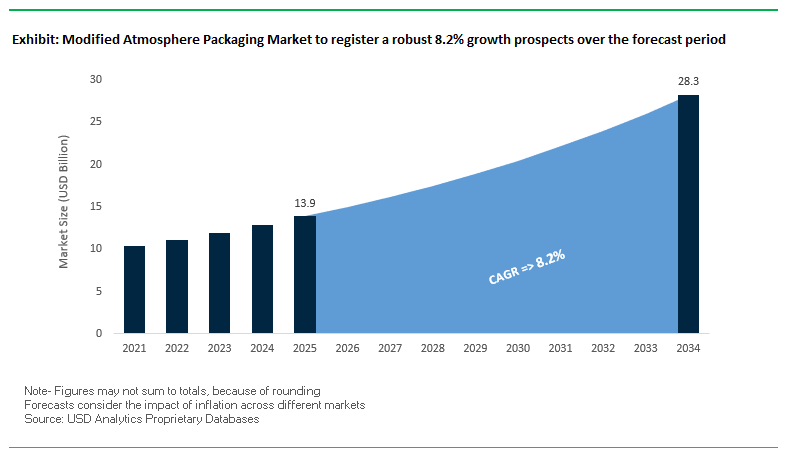
The global Modified Atmosphere Packaging (MAP) market is projected to grow from $13.9 billion in 2025 to $28.3 billion by 2034, representing a CAGR of 8.2%. This growth is propelled by demand for extended shelf life, enhanced food safety, and automation in packaging lines. MAP technology has become essential for fresh and perishable foods, providing tailored gas compositions that slow spoilage and reduce waste.
Key Insights for Industry Stakeholders
Shelf-life extension: MAP can extend the shelf life of fresh pasta (6 → 21 days), raw red meat (2-4 → 5-8 days), and fresh pizza (7-10 → 14-28 days), optimizing supply chains and inventory management.
Precision gas control: Tailored N₂, CO₂, and O₂ mixtures allow optimal preservation for various food types, such as 85-90% N₂ and 8-10% CO₂ for salads.
Tray sealing dominance: Tray sealing is expected to account for 42.9% of equipment market share in 2025 due to its application in meat, seafood, and ready-to-eat meals.
Automation surge: Automated MAP lines are anticipated to generate over half of market revenue, driven by the need for faster throughput, consistent sealing, and inspection integration.
Sustainability push: Industry focus is shifting toward eco-friendly films, bio-based barrier coatings, and recyclable packaging, aligning with regulatory and consumer demands.
Recent Innovations and Material Trends Shaping the MAP Industry
The MAP market has witnessed a series of technological and material innovations enhancing food preservation and operational efficiency. In August 2025, Nano Letters reported a breakthrough ALD inhibitor-modified film strategy, potentially impacting future MAP film formulations for superior gas retention. The same month, EIN Presswire projected the MAP equipment market to reach $3.8 billion by 2035, reflecting global demand for freshness, food safety, and waste reduction. Consumer trends are driving the adoption of MAP trays, especially for perishable items, highlighting the importance of controlled atmospheres in modern food supply chains.
July 2025 studies emphasized the eco-friendly packaging trend, with materials such as PLA and bio-based barrier coatings replacing multilayer plastics. Automation continues to transform the market, exemplified by May 2025’s launch of Harpak’s FM400 horizontal flow warp machine, capable of 150 packets per minute, supporting high-volume food production. Investment in metallized films and wider coating lines further strengthens material performance and supply for MAP applications.
Infrastructure and product innovations also contributed significantly. In March 2025, ULMA Packaging invested over $13 million in a 10,000 sqm facility to boost production capacity and service efficiency. Similarly, January 2025 saw PerfoTec develop laser micro-perforated bags, extending spinach shelf life to 21 days and bananas to three weeks, highlighting the ongoing focus on precision preservation technologies.
Trends and Opportunities Shaping the Modified Atmosphere Packaging (MAP) Market
Precision Gas Mixture Optimization through Integrated Sensor Technology
The modified atmosphere packaging (MAP) market is moving beyond traditional, standardized gas blends toward precision-controlled gas atmospheres tailored to specific product types, ripeness stages, and shelf-life needs. This transformation is enabled by the integration of low-cost, printable gas sensors directly into packaging films, allowing real-time monitoring of O₂ and CO₂ levels throughout the supply chain.
A study published on ResearchGate highlights that these sensors can detect spoilage-related gases like carbon dioxide spikes in packaged meat or ethylene release from fresh produce, enabling early interventions to reduce waste. According to the UNEP 2024 Food Waste Index Report, 19% of consumer-level food is wasted annually, while the FAO reports an additional 13.2% lost between harvest and retail. Intelligent MAP with embedded sensors provides actionable data to minimize these losses.
The rise of flexible printed electronics has made these solutions commercially viable, as cost-effective, scalable sensors can now be printed directly onto MAP films. This technology not only enhances freshness monitoring and food safety but also positions MAP as a core tool in global strategies to fight food waste and support sustainability goals.
Shift Towards Sustainable and Recyclable Mono-Material MAP Structures
Sustainability regulations and retailer commitments are accelerating a transition from multi-material laminates to mono-material MAP packaging, particularly polyolefin-based (PE or PP) films. Traditional laminates offer excellent barrier properties but are difficult to recycle, often ending up in landfill.
The EU Packaging and Packaging Waste Regulation (PPWR), approved in late 2024, mandates that all packaging must be recyclable by 2030, forcing companies to re-engineer MAP films into mono-material structures while retaining the required oxygen and moisture barrier. Technical guides confirm that single-polymer films simplify recycling, improve processing efficiency, and deliver high-quality recycled outputs.
Leading retailers are already pushing suppliers toward recyclable formats to meet corporate circular economy targets. As sustainability expectations rise, the adoption of high-barrier, mono-material MAP solutions is set to become a cornerstone of compliance and brand competitiveness.
Development of Low-Oxygen and Ultra-Low-Oxygen MAP for Fresh Pasta and Prepared Foods
The fast-growing ready-to-cook and fresh meal segment is creating a high-value opportunity for specialized MAP solutions designed to operate at ultra-low oxygen levels (≤0.5%). Products such as fresh pasta, deli meals, and prepared entrees are highly susceptible to microbial growth and fat oxidation.
Technical data from industrial gas suppliers shows that a 50% nitrogen and 50% CO₂ mixture can extend fresh pasta shelf life from 6 days to 21 days, reducing reliance on preservatives. Similarly, prepared meals packaged under low O₂ MAP demonstrate significantly reduced microbial activity, enabling a 30+ day shelf life that meets consumer demand for freshness without compromising safety.
As the market for premium convenience foods continues to expand globally, packaging companies that can engineer gas blends and film technologies tailored to fresh pasta and ready-to-eat meals stand to capture substantial growth in this niche.
MAP for Controlled Ripening and Quality Management of Fresh Produce
A second major opportunity lies in applying MAP as an active ripening management tool for climacteric fruits such as bananas, avocados, mangoes, and stone fruits. By manipulating O₂:CO₂ ratios, MAP can delay or synchronize ripening, reducing waste and improving market timing.
Research on mangoes shows that MAP packaging with polyethylene films slowed softening and color changes, effectively delaying ripening. A study on bananas published in the American Journal of Food Technology found that flushing MAP with 3% O₂ and 5% CO₂ doubled shelf life to 24 days compared to 12 days for controls, with ethylene scrubbers further enhancing results.
Competitive Landscape of Global Modified Atmosphere Packaging Industry
The global MAP market is highly competitive, driven by companies that combine innovative materials, automation technologies, and sustainability strategies. Leading players differentiate through high-performance films, automated machinery, and circular-economy solutions, enabling efficient preservation of perishable foods while meeting regulatory and consumer demands.
Amcor plc: Global Leader in Sustainable MAP Films and Laminates
Amcor is a global packaging leader offering a broad portfolio of MAP films, trays, and laminates that provide superior barriers against oxygen and moisture. In July 2025, Amcor upgraded its Heanor, UK recycling facility, enhancing infrastructure for flexible plastics recycling. Its strategy emphasizes sustainability, lightweighting, and innovation, targeting recyclable or reusable packaging by 2025. Amcor MAP solutions are widely used in fresh produce, ready-to-eat meals, processed meats, and bakery products, ensuring extended shelf life and product integrity.
Sealed Air Corporation: Expert in High-Barrier MAP Solutions
Sealed Air specializes in high-barrier films and MAP equipment that extend the shelf life of perishable goods. Leveraging materials science expertise, the company focuses on reducing food waste while improving supply chain efficiency. With a history of strategic expansions in Europe and the Far East, Sealed Air maintains a strong global presence, offering solutions that address sustainability, efficiency, and food safety challenges in modern packaging.
Mondi Group: Innovating Paper-Based and Functional Barrier Packaging
Mondi offers innovative MAP films and paper-based solutions, including FunctionalBarrier Paper Ultimate, providing ultra-high barriers against oxygen and water vapor. In August 2025, Mondi scaled up production of these sustainable alternatives to multi-layer plastics, enhancing circular economy adoption. Its portfolio includes stand-up pouches and fiber-based packaging, increasingly replacing traditional plastic MAP for fresh and processed foods.
MULTIVAC Group: Pioneering Automated MAP Equipment for High-Volume Food Production
MULTIVAC provides thermoforming machines, tray sealers, and vacuum chamber machines designed for MAP applications. Its strength lies in offering complete integrated solutions, from individual equipment to full production lines. MULTIVAC invests heavily in automation and precision technologies, ensuring high performance, reliability, and seamless integration with filling, labeling, and inspection systems.
Berry Global Inc.: Advancing High-Performance Plastic MAP Solutions
Berry Global produces a wide range of films, trays, and containers for MAP applications across the food, medical, and pharmaceutical sectors. In June 2025, Berry acquired Poly-Tainer Recycling Solutions, enhancing recycling capabilities and supporting the circular economy. The company focuses on innovative, sustainable plastic packaging and invests in technologies that improve recyclability and reduce environmental impact, maintaining leadership in MAP solutions globally.
Trays Hold the Leading Market Share by Packaging Type in the Modified Atmosphere Packaging (MAP) Industry
Trays command 35% of the MAP market share in 2025, establishing themselves as the preferred format for perishable products such as fresh meat, poultry, seafood, and ready meals. Their structural rigidity, stackability, and ability to integrate with high-speed sealing equipment make them indispensable for both retailers and processors. Materials such as APET, PET, and rPET are increasingly favored for trays, aligning with recyclability mandates while maintaining high-barrier performance. Films and liners, representing the second-largest share, play a critical role as sealing webs and barrier layers, while bags, pouches, and clamshells expand into niche categories with lightweighting benefits and retail visibility advantages. The dominance of trays reflects the demand for durable, protective, and visually appealing formats that also meet sustainability and automation requirements.
Meat, Poultry, and Seafood Dominate Market Share by Application in the Modified Atmosphere Packaging (MAP) Industry
The meat, poultry, and seafood segment accounts for 40% of MAP demand in 2025, making it the largest and most established application. These proteins are highly perishable, requiring precise atmosphere control to preserve color, texture, and safety throughout extended supply chains. High-barrier trays and films have become the gold standard, supported by innovations in modified gas blends to maintain freshness and reduce spoilage. Fresh fruits and vegetables, at 25% share, represent the fastest-growing application as pre-cut, convenience-focused produce becomes mainstream. Ready-to-eat meals leverage MAP to support the chilled convenience food boom, while dairy and bakery products rely on tailored solutions to prevent mold, moisture loss, or staling. Although smaller, bakery & confectionery, coffee, and pet food fall into high-value niches. Ultimately, the dominance of meat and seafood reflects MAP’s irreplaceable role in extending shelf life for perishable proteins, a driver that continues to underpin market expansion.
United States: Regulatory Momentum and Smart Packaging Technologies Fuel MAP Growth
The United States modified atmosphere packaging market is undergoing rapid transformation due to tightening regulatory frameworks and growing sustainability mandates. State-level Extended Producer Responsibility (EPR) laws in California and Maryland, combined with federal measures such as the Food Date Labeling Act of 2025 and the Reduce Food Loss and Waste Act of 2025, are pushing food producers and retailers to adopt MAP solutions that extend shelf life and reduce spoilage. These policies directly accelerate the adoption of MAP films and trays that combat food waste and align with sustainable packaging practices.
Technological innovation is another defining factor, with precision laser perforation emerging as a breakthrough, allowing packaging tailored to the respiration rate of fresh produce. The integration of smart sensors for real-time monitoring of gas composition, humidity, and temperature is further enhancing product safety and supply chain efficiency. Corporate investments remain strong, with U.S.-based players launching metallized polyester films offering superior oxygen barriers and Klöckner Pentaplast (kp) pioneering the Tray2Tray recycling program to manufacture food trays entirely from recycled material. Demand is particularly robust across fresh fruits, vegetables, bakery, and ready-to-eat meals, amplified by the surge in e-commerce and home delivery services that require durable and efficient MAP solutions.
Germany: Circular Economy Regulations and High-Tech Innovations Shape MAP Adoption
Germany’s modified atmosphere packaging market is deeply influenced by the European Union’s Packaging and Packaging Waste Regulation (PPWR) adopted in January 2025, which emphasizes recyclability and sustainable materials. This stringent regulatory framework has pushed companies to prioritize mono-material trays and fiber-based MAP formats that seamlessly fit into circular economy systems. Germany’s strong recycling infrastructure further accelerates adoption of sustainable packaging innovations.
The country is a hub for advanced film-coating and printing technologies, with innovations like AluBond improving barrier properties and adhesion, thereby reducing reliance on extra surface treatments. German companies are integrating high levels of recycled content into MAP production, aligning with consumer expectations and EU mandates. Corporate investments, such as Borealis’ €100 million expansion in Burghausen to produce recyclable foam-based polypropylene, are expanding material options that enhance lightweighting and durability for both food and industrial applications. Demand is strongest in fresh produce and protein packaging, where Germany leads in adopting advanced MAP formats that combine sustainability with high-performance preservation.
China: Dual-Carbon Policies and E-Commerce Expansion Accelerate MAP Market
China’s modified atmosphere packaging market is expanding under the influence of governmental initiatives tied to its dual-carbon targets, which are driving sustainable manufacturing across high-performance films and packaging materials. The government’s focus on strengthening cold chain logistics to reduce food waste directly supports MAP adoption, particularly for perishable products transported over long distances.
Chinese manufacturers are rapidly integrating automation and AI-based quality control systems into production lines, with AI algorithms optimizing gas composition in MAP packs to improve shelf life and food safety. Rising urbanization, coupled with growing disposable incomes, is fueling consumer demand for packaged fresh foods, bakery products, and ready-to-eat meals. The boom in e-commerce platforms like JD Fresh and Alibaba’s Freshippo has created a massive demand for durable MAP solutions that maintain food quality through extended logistics cycles. As a result, China is emerging as a global leader in MAP consumption and innovation, driven by both government support and market forces.
India: Make in India and Recycling Initiatives Boost MAP Adoption
India’s modified atmosphere packaging market is benefitting from proactive government policies such as “Make in India” and the Production Linked Incentive (PLI) scheme, which are promoting domestic manufacturing of advanced packaging solutions. The government’s circular economy vision is accelerating the adoption of recyclable MAP materials, while the National Medical Devices Policy 2023 is fostering micro-packaging innovations that overlap with MAP technologies for healthcare and food industries.
The Indian market is witnessing strong technological advancements in MAP for fresh produce and processed food packaging. In June 2024, Uflex Ltd. introduced a new line of barrier-coated, paper-based micro-perforated packaging formats for single-serve sachets, reducing reliance on plastics. Investment momentum is also rising, with the Huhtamaki Foundation’s CloseTheLoop initiative tackling post-consumer plastic waste by building advanced recycling plants, including a Rs. 10 crore (US$ 1.18 million) facility. The combined effect of government backing, corporate R&D, and booming e-commerce and food processing industries positions India as one of the fastest-growing markets for sustainable MAP solutions.
United Kingdom: Sustainable Packaging Programs and Retail Adoption Driving MAP Growth
The United Kingdom modified atmosphere packaging market is aligning closely with EU sustainability directives while implementing domestic programs like the Smart Sustainable Plastic Packaging (SSPP) challenge, which funds over 70 innovation projects focused on next-generation MAP solutions. The UK government’s policies against single-use plastics are pushing manufacturers to adopt biodegradable and plant-based MAP films made from renewable feedstocks like corn starch and sugarcane.
Corporate investments are reshaping the industry, with Coveris upgrading production facilities to deliver eco-friendly perforated packaging, and food manufacturers collaborating with packaging players to accelerate sustainable adoption. Retailers such as Tesco are taking a lead role in introducing MAP solutions to reduce food waste, while Moy Park’s partnership with Klöckner Pentaplast in March 2024 resulted in the kp Elite tray, a breakthrough in sustainable poultry packaging. Demand is particularly high in fresh produce, bakery, and meat packaging, reflecting the UK’s focus on combining food waste reduction with sustainability compliance.
Modified Atmosphere Packaging Market Report Scope
Modified Atmosphere Packaging Market
Parameter
Details
Market Size (2025)
$13.9 Billion
Market Size (2034)
$28.3 Billion
Market Growth Rate
8.2%
Segments
By Material (PE, PP, PET, EVOH, Polyamide, Others), By Packaging Type (Films and Liners, Trays, Bags and Pouches, Clamshells, Others), By Application (Meat, Poultry & Seafood, Fresh Fruits & Vegetables, Bakery & Confectionery, Dairy Products, Ready-to-Eat Food, Others), By Atmosphere/Gas (Carbon Dioxide, Nitrogen, Oxygen, Others)
Study Period
2019- 2024 and 2025-2034
Units
Revenue (USD)
Qualitative Analysis
Porter’s Five Forces, SWOT Profile, Market Share, Scenario Forecasts, Market Ecosystem, Company Ranking, Market Dynamics, Industry Benchmarking
Companies
Amcor plc, Sealed Air Corporation, Uflex Ltd., Jindal Poly Films Ltd., Huhtamaki, Mondi Group, M.J. Maillis S.A., Coveris, A-ROO Company, ProAmpac, Winpak Ltd., LINPAC Packaging Limited, Sonoco Products Company, Sirane Ltd., Berry Global Inc.
Countries
US, Canada, Mexico, Germany, France, Spain, Italy, UK, Russia, China, India, Japan, South Korea, Australia, South East Asia, Brazil, Argentina, Middle East, Africa
Modified Atmosphere Packaging Market Segmentation
By Material
PE
PP
PET
EVOH
Polyamide
Others
By Packaging Type
Films and Liners
Trays
Bags and Pouches
Clamshells
Others
By Application
Meat
Poultry & Seafood
Fresh Fruits & Vegetables
Bakery & Confectionery
Dairy Products
Ready-to-Eat Food
Others
By Atmosphere/Gas
Carbon Dioxide
Nitrogen
Oxygen
Others
Countries Analyzed
North America (US, Canada, Mexico)
Europe (Germany, UK, France, Spain, Italy, Russia, Rest of Europe)
Asia Pacific (China, India, Japan, South Korea, Australia, South East Asia, Rest of Asia)
South America (Brazil, Argentina, Rest of South America)
Middle East and Africa (Saudi Arabia, UAE, Rest of Middle East, South Africa, Egypt, Rest of Africa)
Top Companies in Modified Atmosphere Packaging Market
Amcor plc
Sealed Air Corporation
Uflex Ltd.
Jindal Poly Films Ltd.
Huhtamaki
Mondi Group
M.J. Maillis S.A.
Coveris
A-ROO Company
ProAmpac
Winpak Ltd.
LINPAC Packaging Limited
Sonoco Products Company
Sirane Ltd.
Berry Global Inc.
* List Not Exhaustive
Methodology
USDAnalytics employs a comprehensive research methodology to deliver precise insights into the global Modified Atmosphere Packaging (MAP) market. Our approach combines primary research, including interviews with packaging engineers, food safety experts, supply chain professionals, and industry stakeholders, with extensive secondary research from corporate filings, trade publications, regulatory frameworks, patent databases, and scientific literature. We analyze key growth drivers such as precision gas control, shelf-life extension, automation, and sustainability initiatives, while evaluating the adoption of mono-material films, bio-based coatings, and recyclable trays. Quantitative analysis incorporates historical market data, CAGR projections, regional trends, and application-specific demand across meat, seafood, fresh produce, bakery, dairy, and ready-to-eat foods. Competitive intelligence examines technological innovations, automated MAP equipment, and strategic investments by leading companies including Amcor, Sealed Air, Mondi, MULTIVAC, and Berry Global, with emphasis on eco-friendly materials, high-barrier films, and integrated sensor solutions. This methodology ensures USDAnalytics provides actionable, data-driven insights that support strategic decision-making, operational efficiency, and sustainability adoption for industry professionals in the rapidly evolving MAP sector.
Deliverables:
Comprehensive Market Research Report (PDF and Excel) with detailed tables, charts, and interactive visualizations.
Country-Specific Forecasts & Analysis.
Segment-Wise Revenue Forecasts (2025–2034).
Competitive Analysis, Benchmarking, and SWOT Profiles.
Recent Developments & Innovation Tracker.
Executive Summary & Analyst Commentary.
Post-Purchase Analyst Support for Client-Specific Questions and Custom Data Requirements.
Table of Contents: Modified Atmosphere Packaging (MAP) Market
1. Executive Summary
1.1. Market Highlights
1.2. Key Findings
1.3. Global Market Snapshot
2. Modified Atmosphere Packaging (MAP) Market Landscape & Outlook (2025–2034)
2.1. Introduction to MAP Market
2.2. Market Valuation and Growth Projections (2025–2034)
2.3. Market Drivers: Shelf-Life Extension, Automation, Sustainability
2.4. Market Challenges: Regulatory Compliance, Material Constraints
2.5. Future Outlook and Opportunities
3. Innovations Reshaping the MAP Market
3.1. Trend: Embedded Low-Cost Gas Sensors for Real-Time Monitoring
3.2. Trend: Automation in Tray Sealing and Packaging Lines
3.3. Opportunity: Sustainable Mono-Material MAP Structures
3.4. Opportunity: Low-Oxygen and Ultra-Low-Oxygen Packaging for Fresh Pasta & Prepared Foods
3.5. Opportunity: Controlled Ripening and Quality Management of Fresh Produce
4. Competitive Landscape and Strategic Initiatives
4.1. Mergers, Acquisitions and Strategic Alliances
4.2. R&D and Material Innovation
4.3. Sustainability and Strategies
4.4. Market Expansion and Regional Focus
5. Market Share and Segmentation Insights: MAP Market
5.1. By Material
5.1.1. PE
5.1.2. PP
5.1.3. PET
5.1.4. EVOH
5.1.5. Polyamide
5.1.6. Others
5.2. By Packaging Type
5.2.1. Films and Liners
5.2.2. Trays
5.2.3. Bags and Pouches
5.2.4. Clamshells
5.2.5. Others
5.3. By Application
5.3.1. Meat
5.3.2. Poultry & Seafood
5.3.3. Fresh Fruits & Vegetables
5.3.4. Bakery & Confectionery
5.3.5. Dairy Products
5.3.6. Ready-to-Eat Food
5.3.7. Others
5.4. By Atmosphere/Gas
5.4.1. Carbon Dioxide
5.4.2. Nitrogen
5.4.3. Oxygen
5.4.4. Others
6. Country Analysis and Outlook of MAP Market
6.1. United States
6.2. Canada
6.3. Mexico
6.4. Germany
6.5. France
6.6. Spain
6.7. Italy
6.8. UK
6.9. Russia
6.10. China
6.11. India
6.12. Japan
6.13. South Korea
6.14. Australia
6.15. South East Asia
6.16. Brazil
6.17. Argentina
6.18. Middle East
6.19. Africa
7. MAP Market Size Outlook by Region (2025–2034)
7.1. North America MAP Market Size Outlook to 2034
7.1.1. By Material
7.1.2. By Packaging Type
7.1.3. By Application
7.2. Europe MAP Market Size Outlook to 2034
7.2.1. By Material
7.2.2. By Packaging Type
7.2.3. By Application
7.3. Asia Pacific MAP Market Size Outlook to 2034
7.3.1. By Material
7.3.2. By Packaging Type
7.3.3. By Application
7.4. South America MAP Market Size Outlook to 2034
7.4.1. By Material
7.4.2. By Packaging Type
7.4.3. By Application
7.5. Middle East and Africa MAP Market Size Outlook to 2034
7.5.1. By Material
7.5.2. By Packaging Type
7.5.3. By Application
8. Company Profiles: Leading Players in the MAP Market
8.1. Amcor plc
8.2. Sealed Air Corporation
8.3. Uflex Ltd.
8.4. Jindal Poly Films Ltd.
8.5. Huhtamaki
8.6. Mondi Group
8.7. M.J. Maillis S.A.
8.8. Coveris
8.9. A-ROO Company
8.10. ProAmpac
8.11. Winpak Ltd.
8.12. LINPAC Packaging Limited
8.13. Sonoco Products Company
8.14. Sirane Ltd.
8.15. Berry Global Inc.
9. Methodology
9.1. Research Scope
9.2. Market Research Approach
9.3. Market Sizing and Forecasting Model
9.4. Research Coverage
9.5. Data Horizon
9.6. Deliverables
10. Appendix
10.1. Acronyms and Abbreviations
10.2. List of Tables
10.3. List of Figures
Modified Atmosphere Packaging Market Segmentation
By Material
PE
PP
PET
EVOH
Polyamide
Others
By Packaging Type
Films and Liners
Trays
Bags and Pouches
Clamshells
Others
By Application
Meat
Poultry & Seafood
Fresh Fruits & Vegetables
Bakery & Confectionery
Dairy Products
Ready-to-Eat Food
Others
By Atmosphere/Gas
Carbon Dioxide
Nitrogen
Oxygen
Others
Countries Analyzed
North America (US, Canada, Mexico)
Europe (Germany, UK, France, Spain, Italy, Russia, Rest of Europe)
Asia Pacific (China, India, Japan, South Korea, Australia, South East Asia, Rest of Asia)
South America (Brazil, Argentina, Rest of South America)
Middle East and Africa (Saudi Arabia, UAE, Rest of Middle East, South Africa, Egypt, Rest of Africa)
MAP uses precise gas mixtures, such as nitrogen, carbon dioxide, and oxygen, to slow microbial growth and oxidation. For example, fresh pasta shelf life can increase from 6 to 21 days, while fresh pizza can last up to 28 days, optimizing supply chains and reducing food waste.
Recent innovations include embedded low-cost gas sensors, laser micro-perforation, automated tray sealing, and functional barrier films. These advances enhance food safety, monitor spoilage, and enable real-time freshness control while supporting high-volume, automated production lines.
Sustainability regulations like the EU PPWR are driving the adoption of single-polymer films such as PE and PP. Mono-material MAP structures simplify recycling, reduce environmental impact, and align with corporate circular economy initiatives while maintaining required barrier properties.
Meat, poultry, and seafood represent the largest share at 40% due to their high perishability and need for oxygen-controlled environments. Fresh fruits and vegetables, ready-to-eat meals, bakery, and dairy products are also significant, reflecting growing convenience food trends.
The U.S. emphasizes smart sensor integration and EPR compliance, Germany leads in circular economy-compliant mono-material packaging, China excels in automation and e-commerce-driven solutions, India benefits from Make in India and recycling initiatives, and the UK focuses on sustainable films and food waste reduction programs.