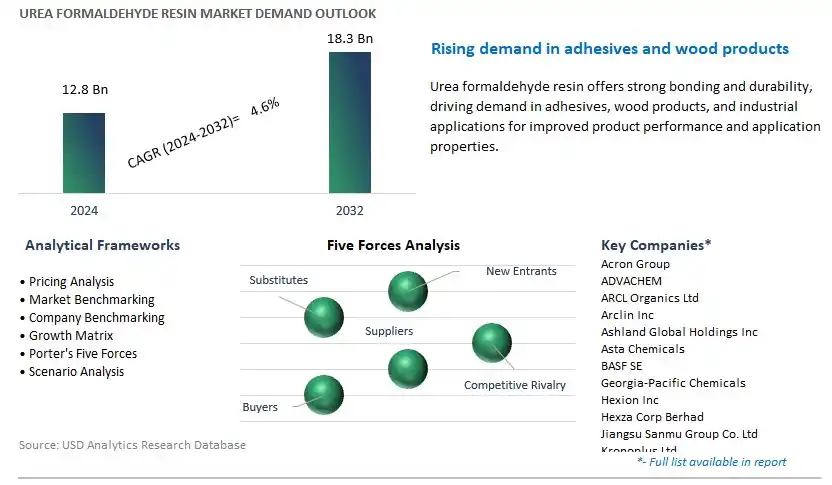
Global Urea Formaldehyde Resin Market Size is valued at $12.8 Billion in 2024 and is forecast to register a growth rate (CAGR) of 4.6% to reach $18.3 Billion by 2032.
The global Urea Formaldehyde Resin Market Study analyzes and forecasts the market size across 6 regions and 24 countries for diverse segments -By Application (Particle Board, Wood Adhesives, Plywood, Medium Density Fiberboard, Others), By End-User (Automotive, Electrical Appliances, Agriculture, Building and Construction, Others).
An Introduction to Urea Formaldehyde Resin Market in 2024
Urea formaldehyde (UF) resin is a thermosetting polymer widely used in wood adhesives, particleboard, and plywood manufacturing due to its fast curing, high bonding strength, and moisture resistance properties. Formulated by reacting urea and formaldehyde under controlled conditions, UF resin undergoes crosslinking upon curing, forming durable bonds between wood fibers or particles. With its affordability, versatility, and performance, UF resin remains a preferred adhesive in the wood products industry, contributing to the production of furniture, cabinetry, and construction materials. Despite concerns over formaldehyde emissions and environmental impact, research efforts focus on developing low-emission formulations and alternative bio-based resins, balancing performance requirements with sustainability considerations in wood adhesive technology.
Urea Formaldehyde Resin Market Competitive Landscape
The market report analyses the leading companies in the industry including Acron Group, ADVACHEM, ARCL Organics Ltd, Arclin Inc, Ashland Global Holdings Inc, Asta Chemicals, BASF SE, Georgia-Pacific Chemicals, Hexion Inc, Hexza Corp Berhad, Jiangsu Sanmu Group Co. Ltd, Kronoplus Ltd, Melamin kemicna tovarna d.d. Kocevje, Metadynea Metafrax Group, QAFCO, SABIC, and others.
Urea Formaldehyde Resin Market Dynamics
Market Trend: Shift Towards Eco-Friendly and Sustainable Materials
In the market for Urea Formaldehyde Resin, a prominent trend is the increasing shift towards eco-friendly and sustainable materials. With growing environmental concerns and stricter regulations on emissions and chemical usage, industries are seeking alternatives to traditional formaldehyde-based resins. This trend is driving the development and adoption of bio-based or formaldehyde-free urea formaldehyde resins, which offer comparable performance while reducing environmental impact. Companies investing in research and innovation to offer greener solutions are poised to capitalize on this evolving trend and gain a competitive edge in the market.
Market Driver: Growing Demand from Construction and Woodworking Industries
A significant driver in the Urea Formaldehyde Resin market is the robust demand from the construction and woodworking industries. Urea formaldehyde resin finds extensive use as an adhesive in the manufacturing of wood-based composite materials such as plywood, particleboard, and medium-density fiberboard (MDF). The booming construction sector, coupled with increasing urbanization and infrastructure projects worldwide, is fueling the demand for these materials. Additionally, the versatility and cost-effectiveness of urea formaldehyde resin make it a preferred choice for bonding wood products, further driving market growth.
Market Opportunity: Diversification into New Applications and Geographies
Amidst the evolving market dynamics for Urea Formaldehyde Resin, there exists a promising opportunity for companies to diversify into new applications and geographies. While the construction and woodworking sectors remain key demand drivers, expanding into niche applications such as automotive interiors, insulation materials, and textile treatments can unlock new revenue streams. Furthermore, tapping into emerging markets in Asia-Pacific, particularly in countries experiencing rapid industrialization and infrastructure development, presents significant growth opportunities. By leveraging technological advancements and strategic partnerships, companies can penetrate new market segments and geographical regions, thereby enhancing their market presence and driving long-term profitability.
Urea Formaldehyde Resin Market Share Analysis: Particle Board segment generated the highest revenue in 2024
Among the segments delineated within the urea formaldehyde resin market by application, particle board is the largest segment, commanding a significant share due to the widespread use of urea formaldehyde resin in the production of particle board panels. Particle board, also known as chipboard or low-density fiberboard, is a versatile engineered wood product made from wood particles, such as wood chips, sawmill shavings, or sawdust, bonded together with adhesive resins. Urea formaldehyde resin is one of the most commonly used adhesive resins in particle board manufacturing due to its excellent bonding properties, cost-effectiveness, and ability to form strong and durable bonds with wood particles under heat and pressure. The resin imparts dimensional stability, moisture resistance, and structural strength to particle board panels, making them suitable for a wide range of applications in furniture, cabinetry, construction, and interior design. The particle board segment dominates the urea formaldehyde resin market as the demand for affordable and sustainable wood-based products continues to grow globally. Additionally, the versatility and ease of processing offered by urea formaldehyde resins make them ideal for bonding wood particles of varying sizes and qualities, facilitating the production of high-quality particle board panels with consistent performance characteristics. As the construction and furniture industries continue to expand, driven by urbanization, population growth, and housing demand, the demand for particle board and urea formaldehyde resin is expected to remain robust, solidifying the particle board segment's position as the largest in the urea formaldehyde resin market.
Urea Formaldehyde Resin Market Share Analysis: Building and Construction is poised to register the fastest CAGR over the forecast period
Among the segments delineated within the urea formaldehyde resin market by end-user, the building and construction sector is the fastest-growing segment, driving significant advancements in construction materials and wood-based products. Urea formaldehyde resin finds extensive use in the building and construction industry for manufacturing various wood-based products, including plywood, particle board, medium-density fiberboard (MDF), and laminated veneer lumber (LVL). These engineered wood products are widely utilized in residential, commercial, and industrial construction projects for applications such as structural framing, flooring, roofing, interior panelling, and furniture manufacturing. The growing global population, rapid urbanization, and increasing construction activities, particularly in emerging economies, are fuelling the demand for cost-effective, sustainable, and durable construction materials. Urea formaldehyde resin offers potential advantages in construction applications, including excellent bonding strength, dimensional stability, moisture resistance, and affordability, making it a preferred choice for composite wood products used in building structures. Additionally, stringent building codes and regulations aimed at promoting energy efficiency, environmental sustainability, and occupant safety drive the adoption of engineered wood products bonded with urea formaldehyde resin. As the construction industry continues to evolve and innovate, with a growing emphasis on green building practices and eco-friendly materials, the demand for urea formaldehyde resin in the building and construction sector is expected to witness rapid growth, solidifying its position as the fastest-growing segment in the urea formaldehyde resin market.
Urea Formaldehyde Resin Market
By Application
Particle Board
Wood Adhesives
Plywood
Medium Density Fiberboard
Others
By End-User
Automotive
Electrical Appliances
Agriculture
Building and Construction
Others
Countries Analyzed
North America (US, Canada, Mexico)
Europe (Germany, UK, France, Spain, Italy, Russia, Rest of Europe)
Asia Pacific (China, India, Japan, South Korea, Australia, South East Asia, Rest of Asia)
South America (Brazil, Argentina, Rest of South America)
Middle East and Africa (Saudi Arabia, UAE, Rest of Middle East, South Africa, Egypt, Rest of Africa)
Urea Formaldehyde Resin Companies Profiled in the Study
Acron Group
ADVACHEM
ARCL Organics Ltd
Arclin Inc
Ashland Global Holdings Inc
Asta Chemicals
BASF SE
Georgia-Pacific Chemicals
Hexion Inc
Hexza Corp Berhad
Jiangsu Sanmu Group Co. Ltd
Kronoplus Ltd
Melamin kemicna tovarna d.d. Kocevje
Metadynea Metafrax Group
QAFCO
SABIC
*- List Not Exhaustive
TABLE OF CONTENTS
1 Introduction to 2024 Urea Formaldehyde Resin Market
1.1 Market Overview
1.2 Quick Facts
1.3 Scope/Objective of the Study
1.4 Market Definition
1.5 Countries and Regions Covered
1.6 Units, Currency, and Conversions
1.7 Industry Value Chain
2 Research Methodology
2.1 Market Size Estimation
2.2 Sources and Research Methodology
2.3 Data Triangulation
2.4 Assumptions and Limitations
3 Executive Summary
3.1 Global Urea Formaldehyde Resin Market Size Outlook, $ Million, 2021 to 2032
3.2 Urea Formaldehyde Resin Market Outlook by Type, $ Million, 2021 to 2032
3.3 Urea Formaldehyde Resin Market Outlook by Product, $ Million, 2021 to 2032
3.4 Urea Formaldehyde Resin Market Outlook by Application, $ Million, 2021 to 2032
3.5 Urea Formaldehyde Resin Market Outlook by Key Countries, $ Million, 2021 to 2032
4 Market Dynamics
4.1 Key Driving Forces of Urea Formaldehyde Resin Industry
4.2 Key Market Trends in Urea Formaldehyde Resin Industry
4.3 Potential Opportunities in Urea Formaldehyde Resin Industry
4.4 Key Challenges in Urea Formaldehyde Resin Industry
5 Market Factor Analysis
5.1 Value Chain Analysis
5.2 Competitive Landscape
5.2.1 Global Urea Formaldehyde Resin Market Share by Company (%), 2023
5.2.2 Product Offerings by Company
5.3 Porter’s Five Forces Analysis
5.4 Pricing Analysis and Outlook
6 Growth Outlook Across Scenarios
6.1 Growth Analysis-Case Scenario Definitions
6.2 Low Growth Scenario Forecasts
6.3 Reference Growth Scenario Forecasts
6.4 High Growth Scenario Forecasts
7 Global Urea Formaldehyde Resin Market Outlook by Segments
7.1 Urea Formaldehyde Resin Market Outlook by Segments, $ Million, 2021- 2032
By Application
Particle Board
Wood Adhesives
Plywood
Medium Density Fiberboard
Others
By End-User
Automotive
Electrical Appliances
Agriculture
Building and Construction
Others
8 North America Urea Formaldehyde Resin Market Analysis and Outlook To 2032
8.1 Introduction to North America Urea Formaldehyde Resin Markets in 2024
8.2 North America Urea Formaldehyde Resin Market Size Outlook by Country, 2021-2032
8.2.1 United States
8.2.2 Canada
8.2.3 Mexico
8.3 North America Urea Formaldehyde Resin Market size Outlook by Segments, 2021-2032
By Application
Particle Board
Wood Adhesives
Plywood
Medium Density Fiberboard
Others
By End-User
Automotive
Electrical Appliances
Agriculture
Building and Construction
Others
9 Europe Urea Formaldehyde Resin Market Analysis and Outlook To 2032
9.1 Introduction to Europe Urea Formaldehyde Resin Markets in 2024
9.2 Europe Urea Formaldehyde Resin Market Size Outlook by Country, 2021-2032
9.2.1 Germany
9.2.2 France
9.2.3 Spain
9.2.4 United Kingdom
9.2.4 Italy
9.2.5 Russia
9.2.6 Norway
9.2.7 Rest of Europe
9.3 Europe Urea Formaldehyde Resin Market Size Outlook by Segments, 2021-2032
By Application
Particle Board
Wood Adhesives
Plywood
Medium Density Fiberboard
Others
By End-User
Automotive
Electrical Appliances
Agriculture
Building and Construction
Others
10 Asia Pacific Urea Formaldehyde Resin Market Analysis and Outlook To 2032
10.1 Introduction to Asia Pacific Urea Formaldehyde Resin Markets in 2024
10.2 Asia Pacific Urea Formaldehyde Resin Market Size Outlook by Country, 2021-2032
10.2.1 China
10.2.2 India
10.2.3 Japan
10.2.4 South Korea
10.2.5 Indonesia
10.2.6 Malaysia
10.2.7 Australia
10.2.8 Rest of Asia Pacific
10.3 Asia Pacific Urea Formaldehyde Resin Market size Outlook by Segments, 2021-2032
By Application
Particle Board
Wood Adhesives
Plywood
Medium Density Fiberboard
Others
By End-User
Automotive
Electrical Appliances
Agriculture
Building and Construction
Others
11 South America Urea Formaldehyde Resin Market Analysis and Outlook To 2032
11.1 Introduction to South America Urea Formaldehyde Resin Markets in 2024
11.2 South America Urea Formaldehyde Resin Market Size Outlook by Country, 2021-2032
11.2.1 Brazil
11.2.2 Argentina
11.2.3 Rest of South America
11.3 South America Urea Formaldehyde Resin Market size Outlook by Segments, 2021-2032
By Application
Particle Board
Wood Adhesives
Plywood
Medium Density Fiberboard
Others
By End-User
Automotive
Electrical Appliances
Agriculture
Building and Construction
Others
12 Middle East and Africa Urea Formaldehyde Resin Market Analysis and Outlook To 2032
12.1 Introduction to Middle East and Africa Urea Formaldehyde Resin Markets in 2024
12.2 Middle East and Africa Urea Formaldehyde Resin Market Size Outlook by Country, 2021-2032
12.2.1 Saudi Arabia
12.2.2 UAE
12.2.3 Oman
12.2.4 Rest of Middle East
12.2.5 Egypt
12.2.6 Nigeria
12.2.7 South Africa
12.2.8 Rest of Africa
12.3 Middle East and Africa Urea Formaldehyde Resin Market size Outlook by Segments, 2021-2032
By Application
Particle Board
Wood Adhesives
Plywood
Medium Density Fiberboard
Others
By End-User
Automotive
Electrical Appliances
Agriculture
Building and Construction
Others
13 Company Profiles
13.1 Company Snapshot
13.2 SWOT Profiles
13.3 Products and Services
13.4 Recent Developments
13.5 Financial Profile
Acron Group
ADVACHEM
ARCL Organics Ltd
Arclin Inc
Ashland Global Holdings Inc
Asta Chemicals
BASF SE
Georgia-Pacific Chemicals
Hexion Inc
Hexza Corp Berhad
Jiangsu Sanmu Group Co. Ltd
Kronoplus Ltd
Melamin kemicna tovarna d.d. Kocevje
Metadynea Metafrax Group
QAFCO
SABIC
14 Appendix
14.1 Customization Offerings
14.2 Subscription Services
14.3 Related Reports
14.4 Publisher Expertise
By Application
Particle Board
Wood Adhesives
Plywood
Medium Density Fiberboard
Others
By End-User
Automotive
Electrical Appliances
Agriculture
Building and Construction
Others
Countries Analyzed
North America (US, Canada, Mexico)
Europe (Germany, UK, France, Spain, Italy, Russia, Rest of Europe)
Asia Pacific (China, India, Japan, South Korea, Australia, South East Asia, Rest of Asia)
South America (Brazil, Argentina, Rest of South America)
Middle East and Africa (Saudi Arabia, UAE, Rest of Middle East, South Africa, Egypt, Rest of Africa)
