Hybrid Resin Innovation, Low-VOC Transition, and Industrial Demand Driving Growth
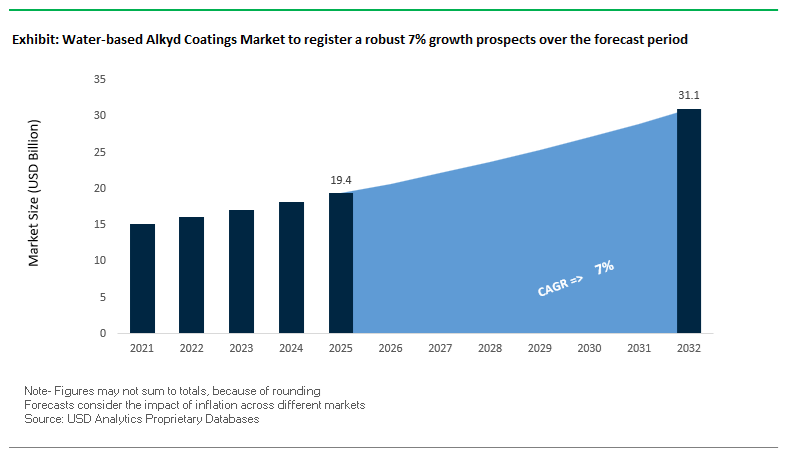
The global Water-Based Alkyd Coatings Market is experiencing steady expansion, supported by the ongoing transition from solvent-borne systems to low-VOC, environmentally compliant coating technologies. The market was valued at $19.4 billion in 2025 and is projected to reach $31.2 billion by 2032, growing at a CAGR of 7% during 2025–2032. Growth is driven by rising demand across architectural, marine, automotive, and industrial maintenance applications, where performance and sustainability must be balanced.
A key structural driver is the evolution of alkyd resin chemistry into waterborne hybrid systems, combining the traditional benefits of alkyds—such as excellent flow, leveling, and adhesion—with the environmental advantages of water-based formulations. These coatings are widely used in decorative paints, metal protection, wood coatings, and marine maintenance, particularly where durability, gloss retention, and corrosion resistance are critical.
Another major trend is the increasing adoption of alkyd-acrylic and alkyd-emulsion hybrid technologies, which deliver faster drying times, improved hardness, and reduced odor compared to conventional oil-based coatings. These systems are gaining traction in premium decorative and industrial segments, especially in regions with stringent environmental regulations.
Sustainability is a central growth catalyst. Water-based alkyd coatings significantly reduce volatile organic compound (VOC) emissions, improve indoor air quality, and align with global regulatory frameworks. Additionally, the integration of bio-based raw materials and mass-balance production methods is enabling manufacturers to reduce carbon footprints while maintaining performance standards.
The market is also benefiting from increased investment in infrastructure, maritime modernization, and automotive manufacturing, particularly in Asia-Pacific and Latin America, where waterborne technologies are rapidly replacing legacy solvent-based systems.
The water-based alkyd coatings market is being transformed by sustainability-driven innovation, capacity expansion, and hybrid resin development, reflecting the industry’s shift toward environmentally advanced formulations. AkzoNobel’s March 2026 marine portfolio expansion highlights the use of water-based alkyd-hybrid primers for hybrid ferries, offering corrosion protection and durability while maintaining low-VOC emissions for safer onboard environments.
Sustainable resin production is a major competitive differentiator. Arkema’s ISCC PLUS certification expansion (2025–2026) across facilities in Italy and the United States enables the production of bio-attributed alkyd resins using mass-balance approaches, supporting the development of low-carbon architectural and industrial coatings.
Product innovation is advancing in the decorative segment. Benjamin Moore’s Eco Spec 2026 line (January 2026) introduces a water-based alkyd-acrylic hybrid coating that delivers zero emissions and odor-free performance while maintaining the application properties of traditional oil-based paints, addressing both regulatory and consumer demands.
Strategic acquisitions are expanding regional capabilities. Sherwin-Williams’ January 2026 integration of Suvinil strengthens its presence in South America, particularly in premium decorative waterborne alkyd coatings tailored for tropical climates and substrate protection.
Manufacturing expansion is supporting regional demand. PPG’s March 2025 commissioning of a waterborne coatings plant in Thailand enhances localized production of alkyd-emulsion-based primers and basecoats, targeting the growing automotive OEM sector in Southeast Asia.
Functional innovation is extending into energy-efficient construction. AkzoNobel’s solar-absorbing wall technology (October 2025) incorporates water-based alkyd-hybrid base layers designed to improve thermal performance while maintaining weather resistance, indicating a convergence between coatings and building energy management systems.
Marine and industrial applications are also evolving. Jotun’s clean shipping initiatives (2025–2026) emphasize the use of water-based alkyd-hybrid coatings to reduce emissions and improve vessel efficiency, while Axalta’s 2026 A Plan focuses on expanding AquaEC™ water-based coating lines, enabling water recycling and eliminating hazardous substances in industrial processes.
Bio-based innovation is gaining traction in automotive applications. AkzoNobel’s bio-based coating partnership with Kia Motors (2024–2025 scaling) utilizes plant-derived alkyd precursors, marking a shift toward renewable raw materials in high-performance interior coatings.
The enforcement of the California Air Resources Board 2025–2026 Architectural Coatings Suggested Control Measure is redefining the global water-based alkyd coatings market, particularly through the strict 50 g/L VOC cap for flat coatings effective January 1, 2026. This regulatory shift is rendering traditional solvent-borne alkyd coatings commercially unviable in California, accelerating the transition toward low-VOC waterborne alkyd technologies across architectural and industrial applications.
Under the updated CALGreen standards, water-based alkyd coatings have emerged as the only viable resin technology capable of delivering high-gloss finishes with ≥70 gloss units at 60° while maintaining extended open time comparable to oil-based coatings. This is a critical advantage in premium architectural coatings where finish quality and workability remain key purchasing criteria.
Advanced 2026-generation waterborne alkyd emulsions are also achieving superior adhesion and leveling performance, with Leneta Leveling Test ratings of Grade 9 to 10. This ensures a smooth, mirror-finish surface comparable to legacy solvent systems that historically contained over 350 g/L VOC. The convergence of regulatory compliance and high-performance output is positioning water-based alkyd coatings as a dominant segment in the eco-friendly coatings market and sustainable construction materials industry.
Market Trend: US EPA Design for the Environment Standard Driving Adoption of Green Waterborne Alkyd Coatings
The updated U.S. EPA Design for the Environment Standard, with full-scale industry adoption in early 2026, is acting as a key catalyst for the growth of environmentally friendly water-based alkyd coatings. Although voluntary, DfE certification has become a decisive procurement criterion for federal and municipal infrastructure projects, significantly influencing product development and supplier selection in the coatings industry.
Waterborne alkyd coatings compliant with the 2026 DfE framework must incorporate 100% biodegradable surfactants and coalescing agents, validated under OECD 301 standards. This requirement ensures that any environmental runoff during application does not persist in aquatic ecosystems, aligning with global sustainability goals and environmental compliance mandates.
Additionally, DfE-certified coatings must meet dual performance validation requirements, including ASTM D4060 Taber abrasion resistance testing. This demonstrates that low-VOC, environmentally safe water-based alkyd coatings can withstand high-traffic conditions in public infrastructure, effectively eliminating the performance trade-off traditionally associated with green coatings. This trend is strengthening the position of sustainable coatings technologies in public sector procurement and infrastructure maintenance markets.
The expansion of the 2026 retrofit economy is creating substantial opportunities for waterborne alkyd enamels in industrial maintenance coatings. Industries are increasingly adopting low-odor, fire-safe coating solutions for machinery and factory interiors, where regulatory compliance and operational safety are critical.
Advanced waterborne alkyd-urethane hybrid coatings are achieving over 500 hours of salt spray resistance under ASTM B117 testing at a dry film thickness of just 50 microns, making them highly effective direct-to-metal coatings for indoor industrial equipment. This performance level positions water-based alkyd enamels as a cost-effective alternative to traditional epoxy coatings in moderate corrosion environments.
In terms of chemical resistance, these coatings exhibit a “no effect” rating when exposed to industrial substances such as hydraulic oil, diesel, and 5% sodium hydroxide for 24 hours. This enhances their suitability for factory environments with exposure to aggressive chemicals, bridging the gap between conventional alkyd coatings and premium protective coatings.
A critical technological advancement in 2026 is the integration of flash rust inhibition additives, enabling application in high-humidity environments up to 85% relative humidity without surface oxidation. This capability removes a major barrier to the adoption of waterborne coatings in the metal finishing industry, expanding their use across manufacturing and industrial maintenance sectors.
Market Opportunity: Marine and Offshore Applications Creating Growth for Water-Based Alkyd Corrosion Protection Primers
The global push toward maritime decarbonization under IMO 2030 targets is opening new growth avenues for water-based alkyd coatings in marine and offshore applications. Manufacturers are focusing on above-waterline corrosion protection primers designed for ship decks and superstructures, where environmental compliance and durability are critical.
Next-generation waterborne alkyd marine primers incorporating nano-engineered corrosion inhibitors are achieving up to 1,500 hours of resistance in cyclical prohesion testing under ASTM G85 standards. This level of performance is comparable to mid-tier solvent-based marine coatings, positioning water-based alkyd primers as a viable alternative in environmentally regulated maritime markets.
Surface tolerance has significantly improved with advancements in surfactant chemistry, enabling adhesion strength of ≥5 MPa even on minimally prepared St 2 steel surfaces. This is particularly important for at-sea maintenance operations where abrasive blasting is not feasible, enhancing operational flexibility for marine operators.
Thermal durability is another critical factor, with these coatings maintaining film integrity across a wide temperature range from -40°C to +80°C. This resilience eliminates micro-cracking issues commonly associated with earlier waterborne formulations, ensuring long-term performance in extreme marine environments and supporting the expansion of sustainable marine coatings technologies.
Water-Based Alkyd Coatings Market Share and Segmentation Insights
Long Oil Alkyd Leads with 36.3% Share Due to Superior Air-Drying and Wood Penetration
The long oil alkyd segment dominates the water-based alkyd coatings market with a 36.3% market share in 2025, driven by its excellent air-drying properties and superior performance in decorative coatings applications. In the waterborne alkyd coatings and architectural paints market, long oil alkyds—containing over 55% oil content—enable efficient oxidative crosslinking, resulting in durable, high-gloss, and smooth film finishes. These properties make them highly suitable for trim, doors, cabinets, and furniture enamels, where finish quality and durability are critical. Additionally, long oil alkyds offer deep penetration into porous substrates such as wood, outperforming short oil and modified alkyd resins. This characteristic makes them the preferred choice for exterior wood primers, stains, and protective coatings, especially in residential and light commercial construction. As demand grows for low-VOC, high-performance wood coatings, long oil alkyds continue to lead the global water-based alkyd coatings market.
Retail and Home Improvement Centers Dominate with 43.4% Share Driven by DIY and Low-VOC Adoption
The retail and home improvement centers segment leads the water-based alkyd coatings market by sales channel with a 43.4% market share in 2025, fueled by increasing demand from DIY consumers and professional painters seeking accessible, low-VOC coating solutions. Within the architectural coatings and decorative paints market, popular products such as Benjamin Moore Advance and Sherwin-Williams ProClassic are widely distributed through paint stores and big-box retailers, catering to applications like cabinet refinishing, trim painting, and furniture restoration. A key growth driver is the shift toward environmentally friendly, low-VOC waterborne alkyd enamels, which offer the performance of traditional solvent-based alkyds with reduced emissions. Retail channels enhance adoption by providing color matching services, in-store expertise, and convenient product availability, making them the preferred purchasing point for homeowners and small contractors. This combination of accessibility, sustainability, and product variety reinforces their dominance in the global water-based alkyd coatings market.
Competitive Landscape Analysis of the Water-Based Alkyd Coatings Market
AkzoNobel Accelerates Sustainable Alkyd Innovation Through Strategic Merger and Bio-Based Materials
AkzoNobel N.V. is strengthening its leadership in the water-based alkyd coatings market through its ongoing merger with Axalta Coating Systems, aimed at creating the industry’s most comprehensive sustainable coatings portfolio. The company reported a Q1 2026 profitability increase of 80 basis points, with a 14.2% adjusted EBITDA margin in 2025, reflecting strong operational efficiency. Its 2026 “Rhythm of Blues” collection incorporates advanced water-based alkyd dispersions that enhance color depth and prevent yellowing in interior trim applications. AkzoNobel is also collaborating with Arkema and BASF to integrate bio-attributed raw materials, targeting a 50% reduction in carbon emissions by 2030, reinforcing its leadership in sustainable waterborne coatings.
PPG Expands Industrial and Automotive Waterborne Alkyd Coatings with Digital Precision
PPG Industries, Inc. is advancing its position in the water-based alkyd coatings market through innovation in industrial coatings and automotive finishes. With $15.9 billion in net sales in 2025, the company is expanding its presence in China through localized color development labs. Its 2026 design theme “Parallels” and color “Secret Safari” leverage next-generation waterborne synthesis alkyds to deliver multi-dimensional finishes. PPG’s coatings offer high corrosion resistance and gloss retention, comparable to solvent-based systems. Additionally, its investment in automated color matching and digital application technologies reduces material waste by 12–15%, strengthening its competitive advantage in efficient coating processes and sustainable paint systems.
Sherwin-Williams Dominates Contractor Adoption of Hybrid Water-Based Alkyd Systems
The Sherwin-Williams Company holds a dominant 63% share of the U.S. professional contractor channel, driving widespread adoption of water-based alkyd coatings. Its 2026 portfolio incorporates advanced emulsifiers, achieving near-zero VOC performance while maintaining film hardness and fast drying. The company is effectively cross-selling Emerald® and Duration® alkyd-modified coatings through its network of over 4,800 stores, ensuring just-in-time delivery for renovation projects. Strong demand for hybrid alkyd-acrylic systems highlights its leadership in combining durability with rapid curing. Sherwin-Williams continues to lead in residential and commercial repaint applications, where performance and environmental compliance are critical.
BASF Enhances Water-Based Alkyd Coatings with Advanced Resins and AI Formulation Tools
BASF SE plays a critical role in the water-based alkyd coatings market as a leading supplier of raw materials and resin technologies. The company is expanding its HALS and NOR® stabilizer capacities to improve UV durability in alkyd coatings, ensuring long-term performance. At the 2026 American Coatings Show, BASF introduced AI-powered formulation tools that optimize alkyd coating recipes based on environmental conditions, reducing development time for manufacturers. Its development of 2K waterborne direct-to-metal (DTM) alkyd systems streamlines coating processes by combining primer and topcoat functions. BASF is also targeting eMobility and robotics sectors, offering resins compatible with lightweight composites and recycled plastics.
Benjamin Moore Leads Premium Waterborne Alkyd Coatings for High-End Interior Applications
Benjamin Moore & Co. remains a premium player in the water-based alkyd coatings market, with its ADVANCE® Waterborne Interior Alkyd line recognized as a professional benchmark. Utilizing the Gennex® zero-VOC colorant system, the company ensures low emissions even in deep color shades. Its 2026 formulations are engineered for superior flow and leveling properties, delivering a smooth, brush-free finish ideal for cabinets and trim. Benjamin Moore offers a complete waterborne system that allows consumers to achieve spray-like results with easy cleanup, capturing demand in the growing renovation market. The company is capitalizing on the DIY renovation trend, particularly in high-value interior upgrades.
Germany Leading Cobalt-Free Formulations and Bio-Based Innovation in Alkyd Coatings
Germany is at the forefront of the water-based alkyd coatings market, driven by stringent environmental regulations and a strong push toward cobalt-free and bio-based formulations. Following the classification of cobalt salts as substances of very high concern, manufacturers have fully transitioned to manganese- and zirconium-based driers, eliminating hazardous components from modern alkyd systems.
Technological advancements include the commercialization of bio-based surfactants that enable instant wetting on challenging substrates such as metals, significantly improving performance of waterborne systems. Product innovation is accelerating with self-crosslinking alkyd emulsions, which achieve high durability without requiring complex multi-component systems. Strategic investments in bio-based binders are supporting premium decorative applications, particularly in modular housing and wood coatings. Government initiatives such as updated “Blue Angel” standards are further tightening SVOC limits, reinforcing Germany’s leadership in sustainable, low-emission alkyd coating technologies.
China Driving Large-Scale Adoption of Waterborne Alkyds Through Regulatory Mandates
China is aggressively scaling the water-based alkyd coatings market, supported by government mandates that prioritize non-solvent systems across architectural and industrial applications. The “National Blue Sky Initiative 2026” is pushing waterborne coatings to exceed 60% of total paint consumption in major cities, significantly accelerating market growth.
Technological advancements include the development of nano-hybrid alkyd coatings, incorporating silica particles to enhance scratch resistance and durability. Infrastructure expansion is driving demand for anti-corrosion water-based alkyd primers, particularly in 5G base stations and industrial equipment. Strategic investments in large-scale production facilities are strengthening domestic supply chains, while expansions in polyurethane/alkyd hybrid hubs are supporting furniture and export markets.
Key applications include the replacement of solvent-based coatings in agricultural and construction equipment, aligning with emission regulations. These developments position China as a global leader in high-volume and environmentally compliant waterborne alkyd coatings.
United States Advancing PFAS-Free Alkyd Systems and Automotive Refinish Applications
The United States is transitioning rapidly in the water-based alkyd coatings industry, driven by regulatory pressure to eliminate hazardous chemicals and improve sustainability. The shift toward PFAS-free additives is leading to the adoption of alternative wetting agents, ensuring performance without environmental risks.
Technological advancements include the development of fast-drying waterborne alkyd systems, reducing flash-off times and improving efficiency in automotive refinish operations. Product innovation is also evident in bio-based alkyd coatings, offering high durability and gloss retention while meeting federal procurement standards.
Infrastructure investments are enhancing distribution networks, particularly for temperature-sensitive coatings, ensuring product stability across regions. Key applications include the growing use of waterborne alkyds in the DIY exterior paint segment, where consumer demand for low-odor and easy-cleanup products is increasing. These trends position the U.S. as a leader in sustainable and performance-driven alkyd coating solutions.
India Emerging as a High-Growth Hub for Water-Based Alkyd Manufacturing and Infrastructure Coatings
India is witnessing rapid growth in the water-based alkyd coatings market, driven by strong government initiatives and expanding manufacturing capacity. Significant investments in greenfield facilities are boosting domestic production, particularly for VOC-compliant industrial coatings.
Technological advancements include the development of tropical-grade water-based alkyd coatings, designed to resist fungal growth and maintain performance in high-humidity environments. Infrastructure projects under the Smart Cities Mission are driving demand for low-toxicity coatings used in public infrastructure such as bridges and metro systems.
Strategic developments in pigment supply chains are stabilizing costs and supporting consistent product quality. Expansion of manufacturing facilities for appliances and industrial applications is further strengthening India’s position as a key player in cost-effective and scalable waterborne alkyd coating solutions.
Saudi Arabia Driving Adoption of Water-Based Alkyd Coatings Through Environmental Regulations
Saudi Arabia is emerging as a critical market in the water-based alkyd coatings sector, driven by new environmental regulations and large-scale infrastructure projects under Vision 2030. The introduction of binding VOC limits in industrial zones is accelerating the shift toward low-emission waterborne coatings.
Technological advancements include the development of dust-repellent alkyd topcoats, specifically designed to withstand harsh desert conditions. Infrastructure investments in mega-projects like NEOM are driving demand for high solar reflectance coatings, improving energy efficiency in extreme climates.
Expansion of local manufacturing facilities is strengthening supply chains, ensuring availability of advanced coatings. Key applications include corrosion-resistant coatings for HVAC systems and desalination plants, balancing durability with environmental compliance. These developments position Saudi Arabia as a key market for climate-resilient and sustainable water-based alkyd coatings.
Water-based Alkyd Coatings Market Report Scope
Water-based Alkyd Coatings Market
Parameter
Details
Market Size (2025)
$19.4 Billion
Market Size (2032)
$31.2 Billion
Market Growth Rate
7%
Segments
By Resin (Long Oil Alkyd, Medium Oil Alkyd, Short Oil Alkyd, Modified Alkyds), By Technology (Water-borne Dispersions, Water-reducible Alkyds, Emulsified Alkyds, Hybrid Systems), By Application (Architectural Coatings, Industrial Wood Finishes, Protective and Industrial Metal Coatings, Automotive Refinish, Marine and Protective), By End-User Industry (Construction and Infrastructure, Industrial OEM, Automotive and Transportation, Marine and Offshore, Furniture and Woodworking), By Sales Channel (Direct Sales, Industrial Distributors and Wholesalers, Retail and Home Improvement Centers, Online)
Study Period
2019- 2025 and 2026-2032
Units
Revenue (USD)
Qualitative Analysis
Porter’s Five Forces, SWOT Profile, Market Share, Scenario Forecasts, Market Ecosystem, Company Ranking, Market Dynamics, Industry Benchmarking
Companies
AkzoNobel N.V., The Sherwin-Williams Company, PPG Industries, Inc., BASF SE, Axalta Coating Systems, Nippon Paint Holdings Co., Ltd., Kansai Paint Co., Ltd., Jotun A/S, Hempel A/S, Berger Paints India Limited, Asian Paints Limited, Tikkurila Oyj, Benjamin Moore and Co., Diamond Vogel, Teknos Group
Countries
US, Canada, Mexico, Germany, France, Spain, Italy, UK, Russia, China, India, Japan, South Korea, Australia, South East Asia, Brazil, Argentina, Middle East, Africa
Water based Alkyd Coatings Market Segmentation
By Resin
Long Oil Alkyd
Medium Oil Alkyd
Short Oil Alkyd
Modified Alkyds
Acrylic-Modified Alkyds
Urethane-Modified Alkyds
Silicone-Modified Alkyds
By Technology
Water-borne Dispersions
Water-reducible Alkyds
Emulsified Alkyds
Hybrid Systems
By Application
Architectural Coatings
Industrial Wood Finishes
Protective and Industrial Metal Coatings
Automotive Refinish
Marine and Protective
By End-User Industry
Construction and Infrastructure
Industrial OEM
Automotive and Transportation
Marine and Offshore
Furniture and Woodworking
By Sales Channel
Direct Sales
Industrial Distributors and Wholesalers
Retail and Home Improvement Centers
Online
Leading Countries in the Industry
North America (United States, Canada, Mexico)
Europe (Germany, France, Spain, United Kingdom, Italy, Russia, Rest of Europe)
Asia Pacific (China, India, Japan, South Korea, Australia, South East Asia, Rest of APAC)
South and Central America (Brazil, Argentina, Rest of SCA)
Middle East and Africa (Saudi Arabia, UAE, MENA, Sub-Saharan Africa)
Top Companies in Water based Alkyd Coatings Industry
AkzoNobel N.V.
The Sherwin-Williams Company
PPG Industries, Inc.
BASF SE
Axalta Coating Systems
Nippon Paint Holdings Co., Ltd.
Kansai Paint Co., Ltd.
Jotun A/S
Hempel A/S
Berger Paints India Limited
Asian Paints Limited
Tikkurila Oyj
Benjamin Moore & Co.
Diamond Vogel
Teknos Group
*- List not Exhaustive
Table of Contents: Water-Based Alkyd Coatings Market
1. Executive Summary
1.1. Market Highlights
1.2. Key Findings
1.3. Global Market Snapshot
2. Water-Based Alkyd Coatings Market Landscape and Outlook (2025–2034)
2.1. Introduction to the Water-Based Alkyd Coatings Market
2.2. Market Valuation and Growth Projections (2025–2034)
2.3. Demand Drivers in Low-VOC Transition, Hybrid Resin Innovation, and Industrial Applications
2.4. Regulatory Trends and Sustainability Standards in Waterborne Alkyd Technologies
2.5. Strategic Opportunities and Future Outlook
3. Innovations Reshaping the Water-Based Alkyd Coatings Market
3.1. Trend: CARB 2025–2026 VOC Regulations Accelerating Waterborne Alkyd Adoption
3.2. Trend: U.S. EPA Design for the Environment Standard Driving Green Coating Formulations
3.3. Opportunity: Industrial Maintenance Demand Boosting Waterborne Alkyd Enamel Innovation
3.4. Opportunity: Marine and Offshore Applications Creating Growth for Water-Based Corrosion Protection Primers
4. Competitive Landscape and Strategic Initiatives
4.1. Mergers and Acquisitions
4.2. Bio-Based Resin Innovation and Product Development
4.3. Sustainability and Low-Carbon Manufacturing Strategies
4.4. Capacity Expansion and Regional Market Development
5. Market Share and Segmentation Insights: Water-Based Alkyd Coatings Market
5.1. By Resin
5.1.1. Long Oil Alkyd
5.1.2. Medium Oil Alkyd
5.1.3. Short Oil Alkyd
5.1.4. Modified Alkyds
5.1.5. Acrylic-Modified Alkyds
5.1.6. Urethane-Modified Alkyds
5.1.7. Silicone-Modified Alkyds
5.2. By Technology
5.2.1. Water-Borne Dispersions
5.2.2. Water-Reducible Alkyds
5.2.3. Emulsified Alkyds
5.2.4. Hybrid Systems
5.3. By Application
5.3.1. Architectural Coatings
5.3.2. Industrial Wood Finishes
5.3.3. Protective and Industrial Metal Coatings
5.3.4. Automotive Refinish
5.3.5. Marine and Protective
5.4. By End-User Industry
5.4.1. Construction and Infrastructure
5.4.2. Industrial OEM
5.4.3. Automotive and Transportation
5.4.4. Marine and Offshore
5.4.5. Furniture and Woodworking
5.5. By Sales Channel
5.5.1. Direct Sales
5.5.2. Industrial Distributors and Wholesalers
5.5.3. Retail and Home Improvement Centers
5.5.4. Online
6. Country Analysis and Outlook of Water-Based Alkyd Coatings Market
6.1. United States
6.2. Canada
6.3. Mexico
6.4. Germany
6.5. France
6.6. Spain
6.7. Italy
6.8. United Kingdom
6.9. Russia
6.10. China
6.11. India
6.12. Japan
6.13. South Korea
6.14. Australia
6.15. South East Asia
6.16. Brazil
6.17. Argentina
6.18. Saudi Arabia
6.19. United Arab Emirates
6.20. Rest of Middle East and Africa
7. Water-Based Alkyd Coatings Market Size Outlook by Region (2025–2034)
7.1. North America Water-Based Alkyd Coatings Market Size Outlook to 2034
7.1.1. By Resin
7.1.2. By Technology
7.1.3. By Application
7.1.4. By End-User Industry
7.1.5. By Sales Channel
7.2. Europe Water-Based Alkyd Coatings Market Size Outlook to 2034
7.2.1. By Resin
7.2.2. By Technology
7.2.3. By Application
7.2.4. By End-User Industry
7.2.5. By Sales Channel
7.3. Asia Pacific Water-Based Alkyd Coatings Market Size Outlook to 2034
7.3.1. By Resin
7.3.2. By Technology
7.3.3. By Application
7.3.4. By End-User Industry
7.3.5. By Sales Channel
7.4. South and Central America Water-Based Alkyd Coatings Market Size Outlook to 2034
7.4.1. By Resin
7.4.2. By Technology
7.4.3. By Application
7.4.4. By End-User Industry
7.4.5. By Sales Channel
7.5. Middle East and Africa Water-Based Alkyd Coatings Market Size Outlook to 2034
7.5.1. By Resin
7.5.2. By Technology
7.5.3. By Application
7.5.4. By End-User Industry
7.5.5. By Sales Channel
8. Company Profiles: Leading Players in the Water-Based Alkyd Coatings Market
8.1. AkzoNobel N.V.
8.2. The Sherwin-Williams Company
8.3. PPG Industries, Inc.
8.4. BASF SE
8.5. Axalta Coating Systems
8.6. Nippon Paint Holdings Co., Ltd.
8.7. Kansai Paint Co., Ltd.
8.8. Jotun A/S
8.9. Hempel A/S
8.10. Berger Paints India Limited
8.11. Asian Paints Limited
8.12. Tikkurila Oyj
8.13. Benjamin Moore and Co.
8.14. Diamond Vogel
8.15. Teknos Group
9. Methodology
9.1. Research Scope
9.2. Market Research Approach
9.3. Market Sizing and Forecasting Model
9.4. Research Coverage
9.5. Data Horizon
9.6. Deliverables
10. Appendix
10.1. Acronyms and Abbreviations
10.2. List of Tables
10.3. List of Figures
Water based Alkyd Coatings Market Segmentation
By Resin
Long Oil Alkyd
Medium Oil Alkyd
Short Oil Alkyd
Modified Alkyds
Acrylic-Modified Alkyds
Urethane-Modified Alkyds
Silicone-Modified Alkyds
By Technology
Water-borne Dispersions
Water-reducible Alkyds
Emulsified Alkyds
Hybrid Systems
By Application
Architectural Coatings
Industrial Wood Finishes
Protective and Industrial Metal Coatings
Automotive Refinish
Marine and Protective
By End-User Industry
Construction and Infrastructure
Industrial OEM
Automotive and Transportation
Marine and Offshore
Furniture and Woodworking
By Sales Channel
Direct Sales
Industrial Distributors and Wholesalers
Retail and Home Improvement Centers
Online
Leading Countries in the Industry
North America (United States, Canada, Mexico)
Europe (Germany, France, Spain, United Kingdom, Italy, Russia, Rest of Europe)
Asia Pacific (China, India, Japan, South Korea, Australia, South East Asia, Rest of APAC)
South and Central America (Brazil, Argentina, Rest of SCA)
Middle East and Africa (Saudi Arabia, UAE, MENA, Sub-Saharan Africa)
The global Water-Based Alkyd Coatings Market was valued at $19.4 billion in 2025 and is projected to reach $31.2 billion by 2032, growing at a CAGR of 7% during the forecast period. Increasing adoption of low-VOC coatings, sustainable decorative paints, and waterborne industrial coating systems is driving strong market expansion globally.
Hybrid alkyd-acrylic and alkyd-urethane technologies are gaining popularity because they combine the smooth finish, adhesion, and gloss retention of traditional alkyds with faster drying, reduced odor, and lower VOC emissions. These advanced formulations are increasingly used in architectural coatings, automotive refinish, wood coatings, and industrial maintenance applications.
Regulations such as CARB 2025-2026 VOC limits, U.S. EPA Design for the Environment standards, and global green building initiatives are accelerating the shift away from solvent-borne alkyd systems. Manufacturers are increasingly developing biodegradable, PFAS-free, bio-based, and ultra-low-VOC waterborne alkyd coatings to meet environmental compliance and sustainability targets.
Industrial maintenance, marine corrosion protection, infrastructure retrofits, automotive refinish, and energy-efficient construction are emerging as major growth opportunities. Advanced waterborne alkyd coatings now provide high corrosion resistance, flash rust inhibition, salt spray durability, and weather resistance for marine, metal finishing, and heavy industrial applications.
Major companies operating in the market include AkzoNobel N.V., The Sherwin-Williams Company, PPG Industries, Inc., BASF SE, Axalta Coating Systems, and Benjamin Moore & Co.. These companies are investing in bio-based resins, hybrid alkyd technologies, low-VOC coating systems, and sustainable industrial coating innovations.