Welan Gum Market Overview 2025–2034: $160.5 Million to $271.2 Million at 6% CAGR Strengthened by Fermentation Consolidation, EOR Demand, and Sustainable Infrastructure Applications
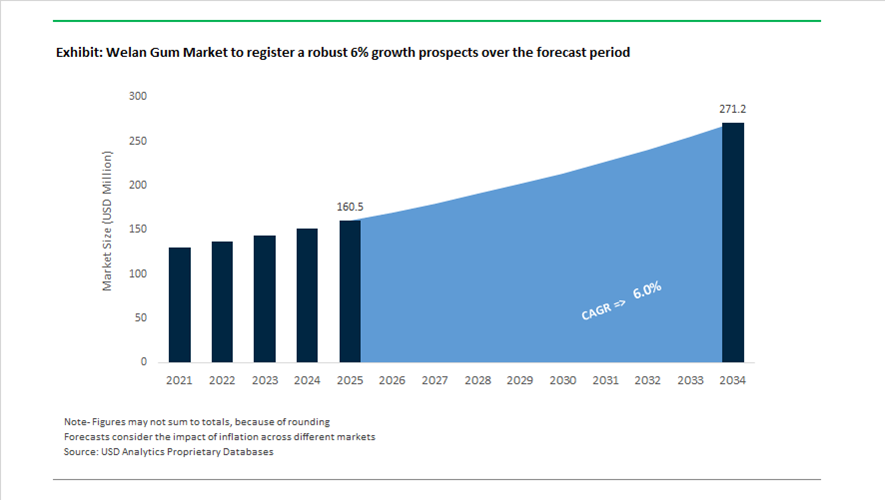
The Welan Gum market is valued at $160.5 million in 2025 and is projected to reach $271.2 million by 2034, expanding at a CAGR of 6%. Welan gum, a fermentation-derived anionic polysaccharide, is widely used for high-temperature rheology control, suspension stability, cement slurry modification, enhanced oil recovery (EOR), wastewater treatment thickening, and specialty construction binders. Its rod-like molecular structure provides superior viscosity stability under high salinity and thermal stress, positioning it as a preferred biopolymer in oilfield fluids and industrial formulations. Market expansion is closely tied to consolidation in the hydrocolloid sector, rising demand for bio-based performance additives, and increasing infrastructure projects requiring advanced rheology modifiers.
Structural consolidation reshaped the competitive landscape beginning in 2024. In November 2024, Tate & Lyle completed its $1.8 billion acquisition of CP Kelco from J.M. Huber Corporation, integrating welan gum into a broader global specialty hydrocolloid portfolio spanning the U.S., China, and Denmark. Following the transaction, J.M. Huber secured approximately a 16% stake in Tate & Lyle, with two executives joining the board, ensuring continued strategic focus on industrial gums and fermentation-derived polymers. In November 2025, Jungbunzlauer acquired Alliance Gums & Industries, signaling intensifying consolidation across fermentation-based hydrocolloids such as gellan, xanthan, and welan gum. The company further strengthened its North American presence in November 2025 by acquiring a multipurpose manufacturing facility in Thomson, Illinois, enhancing supply chain resilience for bio-based gums.
Product innovation and application diversification accelerated through 2025. In early 2025, research introduced a synergistic blend of welan gum and Beta vulgaris-derived polymers for enhanced oil recovery, demonstrating improved flow stability and thermal resistance in saline reservoirs. This validation reinforced welan gum’s suitability for high-temperature EOR fluids and stimulated new commercial interest from upstream oilfield service providers. In July 2025, Jungbunzlauer launched TayaGel® LA, a low-acyl biopolymer targeting clean-label stabilization trends in personal care and beverage applications, reflecting broader market convergence among fermentation-derived gums. In December 2025, Jungbunzlauer introduced TayaGel® Modus, leveraging advanced fermentation methods to provide high-viscosity suspension stability for industrial liquid systems. Sustainability credentials gained prominence in August 2025 when Jungbunzlauer achieved EcoVadis Platinum status, a critical differentiator for industrial buyers requiring ESG-compliant raw materials.
Emerging infrastructure and environmental applications further support growth. An August 2025 study identified welan gum as a viable cement-reduction binder in earth-based construction, capable of replacing up to 10% of conventional cement while maintaining compressive strength, reducing embodied carbon in infrastructure projects. In August 2025, the expansion of the South Bay sewage treatment plant incorporated advanced sludge thickening systems where high-performance biopolymers such as welan gum are increasingly preferred for water retention and solids separation efficiency. In 2025, Ningxia TOP Hydrocolloids achieved CNAS laboratory accreditation, strengthening international quality assurance for Chinese welan gum exports.
Trends and Opportunities in the Welan Gum Market
Trend 1: Strategic Deployment in HPHT Oilfield and Geothermal Operations
Welan gum is gaining material relevance in High Pressure High Temperature (HPHT) oilfield cementing and geothermal drilling, where thermal degradation, barite sag, and fluid-loss control remain persistent operational risks. Unlike xanthan gum, which begins to lose molecular integrity above ~120–140°C, Welan gum retains viscosity and suspension stability under far more extreme conditions.
Peer-reviewed research published in the Journal of Polymer Research (2025) confirms that nano-silica grafted Welan gum nanocomposites remain stable at temperatures up to 220°C. In high-density drilling fluids of 2.30 g/cm³, these systems exhibited a density deviation of only 0.02 g/cm³ after 16 hours of thermal aging. This directly addresses sedimentation and cement integrity failures that can compromise zonal isolation in deepwater and HPHT wells.
The geothermal sector is amplifying this trend. As drilling activity accelerates to support renewable baseload power targets, operators increasingly require clay-free, calcium-tolerant, water-based mud systems. Specialized suppliers such as OSS Ltd are positioning premium Welan gum grades like OS RHEO GUM for geothermal applications, emphasizing stability at 163°C, high pH tolerance, and resistance to divalent ions. This marks a strategic shift toward Welan gum as a critical material for mineral-rich, high-alkalinity geothermal reservoirs where conventional polymers collapse.
Trend 2: Transition to Clean-Label Suspension in Premium Food and Beverage Systems
In food and beverage applications, Welan gum is emerging as a high-performance, fermentation-derived stabilizer aligned with clean-label, non-GMO, and vegan formulation strategies. Its competitive advantage lies in maintaining rheological stability under simultaneous acid and thermal stress, a combination that limits the use of many plant-based hydrocolloids.
Welan gum maintains stable viscosity at temperatures exceeding 93°C, enabling its use in UHT-processed plant-based milks, acidic beverages (pH 3–5), and heat-treated sauces where particle sedimentation and phase separation directly impact shelf life. This thermal robustness allows formulators to maintain consistent mouthfeel without over-stabilization, which can negatively affect sensory perception.
From a regulatory and labeling standpoint, Welan gum benefits from its classification as a microbial exopolysaccharide, functionally comparable to gellan gum (E418). This aligns with the ingredient standards of major CPG manufacturers such as Unilever and Nestlé, which increasingly mandate non-GMO and fermentation-derived stabilizers. Industry briefings indicate that Welan gum’s effectiveness at concentrations as low as 0.05% enables meaningful reduction in additive counts, a critical advantage in the estimated $50 billion global clean-label food market.
Opportunity 1: Integration into High-Performance Flowable and Self-Compacting Concrete
The global shift toward high-rise construction, precast infrastructure, and complex reinforcement geometries is driving demand for advanced Viscosity Modifying Agents (VMAs). Welan gum is increasingly specified in Self-Compacting Concrete (SCC) and underwater concreting due to its ability to suppress segregation while maintaining high flowability.
An experimental investigation published in 2025 demonstrated that adding Welan gum at just 0.025% by binder mass increased SCC compressive strength by 5.29%. The study attributed this to the formation of a three-dimensional polymer–cement network that reduced bleeding rates to 2.13%–2.56%, significantly improving stability in densely reinforced structural elements.
In large-scale infrastructure projects across India, China, and Vietnam, Welan gum is being specified for underwater repairs, marine foundations, and long-distance pumping. Its anti-washout performance allows for up to 86% retention of compressive strength during direct underwater placement, making it a critical enabler for bridge pylons, offshore structures, and coastal defense projects where conventional VMAs underperform.
Opportunity 2: Rheological Control for Ceramic and Geopolymer Additive Manufacturing
Additive manufacturing of technical ceramics and geopolymers represents a high-value, emerging niche for Welan gum, particularly in aerospace, thermal protection, and medical implant applications. These processes demand inks that exhibit strong shear-thinning during extrusion while rapidly recovering viscosity to maintain shape fidelity.
Welan gum delivers this balance effectively. Technical evaluations conducted during 2024–2025 show that Welan-modified ceramic slurries enable smooth extrusion through fine nozzles while providing sufficient yield stress to prevent layer collapse. This is critical for maintaining dimensional accuracy in complex geometries and thin-walled structures.
Comparative studies on geopolymer binders indicate that Welan-type microbial gums significantly reduce interlayer sagging and deformation, improving structural stability and design accuracy of printed parts. As ceramic additive manufacturing expands into functional components such as thermal shields and biomedical implants, Welan gum is positioned as a precision rheology modifier rather than a commodity thickener.
Welan Gum Market Share and Segmentation Insights
Grade Market Share: Industrial Grade Leads with Oilfield and Construction Demand
Industrial grade welan gum accounts for 72.80% of the market in 2025, driven by its widespread use in oil and gas drilling fluids, construction materials such as self-consolidating concrete, and paints and coatings. Its cost efficiency and proven rheological performance make it the preferred choice for high-volume industrial applications. Food and pharmaceutical grade welan gum serves niche applications requiring higher purity standards. A key market driver is oilfield demand, where welan gum is used as a viscosifier and suspension agent in drilling and cementing operations, supported by its thermal stability and salt tolerance in complex well environments.
Application Market Share: Oil and Gas Segment Leads with High-Temperature Drilling Fluid Requirements
Oil and gas hold a 48.60% share in the welan gum market in 2025, reflecting its critical role in maintaining rheological control in drilling fluids, completion fluids, and cement slurries. Construction, paints and coatings, personal care, and other industrial applications contribute additional demand. A key growth trend is the expansion of high-pressure, high-temperature well development, where welan gum is increasingly used due to its ability to maintain viscosity and suspension properties under extreme conditions. This supports efficient drilling operations and well integrity in deepwater and unconventional resource extraction.
Welan Gum Market Competitive Landscape
The Welan Gum market in 2026 is defined by rheological precision, pseudoplastic biopolymer performance, and fermentation scalability, with strong demand from oilfield drilling, engineered concrete, and high-temperature industrial applications requiring salt tolerance, viscosity stability, and advanced flow control.
CP Kelco Strengthens High-Temperature Welan Gum Leadership with Advanced Fermentation and Rheology Expertise
CP Kelco is reinforcing its dominance in the Welan Gum market through advanced fermentation capabilities and high-performance biopolymer solutions. Its collaboration with ExoPolymer accelerates next-generation functional polysaccharide innovation. Expanded production capacity in the U.S. and China ensures global supply security for welan and diutan gums. The company’s welan gum maintains viscosity at temperatures up to 127°C, making it ideal for engineered cementitious composites and oilfield applications. CP Kelco provides advanced rheology modeling to optimize performance in tertiary oil recovery under varying salinity conditions. This focus on technical expertise and high-durability biopolymers strengthens its market leadership.
Deosen Scales Cost-Competitive Welan Gum Production with Integrated Fermentation Infrastructure
Deosen Biochemical is rapidly expanding its position in the Welan Gum market through large-scale fermentation and cost-efficient production. Its Zibozan® welan gum line serves dual applications in oil recovery and construction water retention systems. The introduction of DSTA gum enhances compatibility with calcium and silicate systems in green concrete formulations. With one of the largest biogum production bases globally, Deosen offers high-purity products compliant with international environmental standards. Strategic location advantages provide access to low-cost feedstocks and energy, ensuring competitive pricing. This integration and scale-driven approach strengthen its global competitiveness.
Fufeng Group Expands Specialty Hydrocolloids with Focus on Deep-Water Drilling Applications
Fufeng Group is advancing in the Welan Gum market by diversifying into high-margin specialty hydrocolloids. With revenues around RMB 28 billion, the company leverages its fermentation scale to support global supply stability. Increased R&D investment is improving welan gum yields for deep-water drilling applications in regions such as the Gulf of Mexico and Brazil. Closed-loop fermentation systems reduce carbon intensity and enhance sustainability. Expansion of international distribution hubs improves delivery efficiency for offshore operations. This combination of scale, sustainability, and application focus strengthens its position in industrial biopolymers.
Meihua Enhances Welan Gum Efficiency with Strain Optimization and Oil Recovery Innovations
Meihua Holdings is strengthening its role in the Welan Gum market through vertically integrated biotechnology and advanced strain engineering. The company is optimizing Sphingomonas strains to improve batch consistency and production efficiency. Its welan gum is integrated into broader amino acid value chains, enabling bundled solutions for industrial and feed applications. Development of low-adsorption variants enhances oil recovery efficiency by reducing polymer retention in reservoirs. Resolution of intellectual property issues supports expansion into regulated Western markets. This focus on innovation and integration enhances its competitiveness in high-performance biopolymers.
Hebei Xinhe Biochemical is positioning itself as a niche leader in the Welan Gum market through high-purity and application-specific formulations. Its dual-grade product strategy supports both construction chemicals and sensitive industrial applications. Welan gum formulations are increasingly used in personal care products due to their pH stability and salt tolerance. Upgraded purification systems ensure zero-residue profiles suitable for high-clarity gel systems. The company offers tailored viscosity solutions for specialized applications such as self-leveling floors and 3D concrete printing. This customization capability strengthens its position in precision-driven industrial markets.
China Welan Gum Market Anchored in Fermentation Scale and Infrastructure Pull-Through
China remains the undisputed center of gravity for the global Welan gum market, accounting for more than 70% of installed production capacity as of 2025. Concentrated fermentation clusters in Hebei and Zhejiang benefit from mature downstream utilities, strain optimization know-how, and integrated waste recovery systems, enabling competitive unit economics at scale. This structural advantage has been reinforced by product innovation. In late 2024, Deosen launched a dual-function Welan gum grade engineered to act both as an oil-displacing agent and a water-retention additive for concrete. This multifunctionality is resonating with large industrial groups seeking to streamline additive inventories across oilfield services and construction materials.
Process efficiency and regulatory alignment are tightening further. In 2025, manufacturers including Hebei Xinhe Biochemical announced R&D investments to upgrade fermentation strains, targeting 12–15% polysaccharide yield gains while cutting cooling-stage water consumption. Concurrently, the government’s Green Chemical Initiative standardized VOC limits for Welan gum production, effectively forcing smaller players to adopt closed-loop fermentation or exit export markets. Demand-side momentum remains strong. China’s accelerated high-speed rail expansion in 2025 has driven sustained procurement of Welan gum for specialty grouts and mortars where high water retention mitigates cracking under extreme thermal gradients. Export corridors are also widening. Under the Belt and Road framework, shipments to Vietnam and Indonesia increased in 2025 to support bridge and tunnel construction, reinforcing China’s role as both producer and project enabler.
United States Welan Gum Market Shaped by Energy Resilience and Infrastructure Renewal
The United States Welan gum market has entered a consolidation and application-expansion phase following a pivotal corporate transaction. In November 2024, Tate & Lyle completed the acquisition of CP Kelco, creating a global texturants leader with direct implications for R&D investment and distribution of the KELCO-CRETE Welan gum portfolio. This integration is enhancing technical service depth across construction chemicals and energy applications.
Energy sector dynamics are a primary demand catalyst. As U.S. shale operations transition toward deeper and hotter wells during 2025–2026, Welan gum is increasingly favored over xanthan due to superior viscosity retention at elevated bottom-hole temperatures, particularly in the Permian Basin. Regulatory alignment is reinforcing this shift. Updated federal procurement guidance for 2026 favors biodegradable drilling additives, providing a structural tailwind for microbial polymers such as Welan over synthetic polyacrylamides in offshore applications. Infrastructure spending adds another layer. As IIJA-funded bridge rehabilitation peaks toward 2026, demand for self-consolidating concrete containing Welan gum has increased, especially where high flowability without segregation is critical. Parallel trends in clean-label evaluation have also prompted new GRAS assessments for microbial gums, positioning Welan as a potential high-stability texturant for select shelf-stable, plant-based formulations.
India Welan Gum Market Advancing Through Localization and Urban Infrastructure
India’s Welan gum market is transitioning from import dependence toward localized capability, supported by upstream energy incentives and urban infrastructure programs. In 2025, the Ministry of Petroleum and Natural Gas expanded incentives for enhanced oil recovery in mature fields, catalyzing tertiary recovery trials where Welan gum is deployed for its viscosity stability in high-salinity injection waters. These pilots are building domestic familiarity with industrial-grade microbial gums beyond traditional construction uses.
Supply-side localization is gathering pace. Indian hydrocolloid specialist Meron Group announced a 2025 facility upgrade to produce industrial-grade microbial gums, aiming to reduce reliance on Chinese imports for construction chemicals. Demand is reinforced by urban development. Phase II of the Smart Cities Mission, rolled out across 100 cities in 2025, has increased the use of flowable fill and underwater concrete, applications where Welan gum functions as a critical anti-washout and rheology-control agent. Regulatory standardization is emerging as a quality driver. The Bureau of Indian Standards is drafting specifications for fermentation-derived gums used in specialty mortars to ensure consistent setting behavior under high-humidity tropical conditions, raising the bar for suppliers and favoring technically consistent products.
Brazil Welan Gum Market Defined by Deepwater Energy and Regional Technical Support
Brazil’s Welan gum market is closely linked to offshore energy and specialty coatings, with deepwater drilling acting as the principal demand vector. In 2025, Petrobras reported increased utilization of high-viscosity biopolymers in drilling fluids for pre-salt developments. Welan gum’s thermal resilience and shear stability make it a preferred stabilizer under the extreme pressures and temperatures characteristic of these reservoirs.
Commercial support structures are expanding in parallel. Following its 2025 strategic emphasis on texturization solutions in Latin America, Cargill strengthened its regional distribution hubs in Brazil. This expansion is providing localized technical service for Welan gum in paints and coatings, enabling formulators to optimize rheology and application performance in waterborne systems. Brazil’s market positioning is therefore less about production scale and more about high-value application support in energy and industrial coatings.
Summary of Country-Level Welan Gum Market Dynamics
Welan Gum Market County Level Snapshot
Country
Core Demand Driver
Key Application Focus
Strategic Positioning
China
Fermentation scale and infrastructure buildout
Grouts, mortars, oilfield fluids
Global production and export hub
United States
High-temperature shale wells and IIJA projects
Drilling fluids, SCC concrete
Technology-led application expansion
India
EOR trials and smart city construction
Flowable fill, specialty mortars
Emerging localization and demand growth
Brazil
Pre-salt offshore drilling and coatings
Deepwater fluids, waterborne paints
Application-driven regional market
Welan Gum Market Report Scope
Welan Gum Market
Parameter
Details
Market Size (2025)
$160.5 Million
Market Size (2034)
$271.2 Million
Market Growth Rate
6%
Segments
By Grade (Industrial Grade, Food and Pharmaceutical Grade), By Function (Thickening Agent, Stabilizer and Suspension Agent, Water Retention Agent, Oil Displacement Agent), By Application (Oil and Gas, Construction, Paints and Coatings, Personal Care, Other Industrial Applications)
Study Period
2019- 2025 and 2026-2034
Units
Revenue (USD)
Qualitative Analysis
Porter’s Five Forces, SWOT Profile, Market Share, Scenario Forecasts, Market Ecosystem, Company Ranking, Market Dynamics, Industry Benchmarking
Companies
Tate and Lyle plc, Deosen Biochemical Ltd., Hebei Xinhe Biochemical Co. Ltd., Cargill Incorporated, Fufeng Group, Zhejiang Tech-Way Biochemical Co. Ltd., DSM, Inner Mongolia Rainbow Biotech Co. Ltd., Meron Group, Dancheng Caixin Sugar Industry Co. Ltd., Hangzhou Gellan Solutions Biotec Co. Ltd., Waycoo Chemical, Sinofi Ingredients, Opal Biotech, H and A Canada Inc.
Countries
US, Canada, Mexico, Germany, France, Spain, Italy, UK, Russia, China, India, Japan, South Korea, Australia, South East Asia, Brazil, Argentina, Middle East, Africa
Welan Gum Market Segmentation
By Grade
Industrial Grade
Food and Pharmaceutical Grade
By Function
Thickening Agent
Stabilizer and Suspension Agent
Water Retention Agent
Oil Displacement Agent
By Application
Oil and Gas
Construction
Paints and Coatings
Personal Care
Other Industrial Applications
By Region
North America (United States, Canada, Mexico)
Europe (Germany, France, United Kingdom, Spain, Italy, Rest of Europe)
Asia Pacific (China, India, Japan, South Korea, Australia, Rest of APAC)
South and Central America (Brazil, Argentina, Rest of SCA)
Middle East and Africa (Saudi Arabia, UAE, South Africa, Rest of Middle East, Rest of Africa)
2. Welan Gum Market Landscape & Outlook (2025–2034)
2.1. Introduction to Welan Gum Market
2.2. Market Valuation and Growth Projections (2025–2034)
2.3. Fermentation Consolidation and Hydrocolloid Integration
2.4. Demand from Enhanced Oil Recovery and Industrial Applications
2.5. Sustainable Infrastructure and Bio-Based Polymer Adoption
3. Innovations Reshaping the Welan Gum Market
3.1. Trend: Deployment in HPHT Oilfield and Geothermal Operations
3.2. Trend: Clean-Label Stabilization in Food and Beverage Systems
3.3. Opportunity: Self-Compacting Concrete and Infrastructure Applications
3.4. Opportunity: Additive Manufacturing for Ceramics and Geopolymers
4. Competitive Landscape and Strategic Initiatives
4.1. Mergers and Acquisitions
4.2. R&D and Material Innovation
4.3. Sustainability and ESG Strategies
4.4. Market Expansion and Regional Focus
5. Market Share and Segmentation Insights: Welan Gum Market
5.1. By Grade
5.1.1. Industrial Grade
5.1.2. Food and Pharmaceutical Grade
5.2. By Function
5.2.1. Thickening Agent
5.2.2. Stabilizer and Suspension Agent
5.2.3. Water Retention Agent
5.2.4. Oil Displacement Agent
5.3. By Application
5.3.1. Oil and Gas
5.3.2. Construction
5.3.3. Paints and Coatings
5.3.4. Personal Care
5.3.5. Other Industrial Applications
5.4. By Region
5.4.1. North America
5.4.2. Europe
5.4.3. Asia Pacific
5.4.4. South and Central America
5.4.5. Middle East and Africa
6. Country Analysis and Outlook of Welan Gum Market
6.1. United States
6.2. Canada
6.3. Mexico
6.4. Germany
6.5. France
6.6. Spain
6.7. Italy
6.8. UK
6.9. Russia
6.10. China
6.11. India
6.12. Japan
6.13. South Korea
6.14. Australia
6.15. South East Asia
6.16. Brazil
6.17. Argentina
6.18. Middle East
6.19. Africa
7. Welan Gum Market Size Outlook by Region (2025-2034)
7.1. North America Welan Gum Market Size Outlook to 2034
7.1.1. By Grade
7.1.2. By Function
7.1.3. By Application
7.1.4. By Region
7.2. Europe Welan Gum Market Size Outlook to 2034
7.2.1. By Grade
7.2.2. By Function
7.2.3. By Application
7.2.4. By Region
7.3. Asia Pacific Welan Gum Market Size Outlook to 2034
7.3.1. By Grade
7.3.2. By Function
7.3.3. By Application
7.3.4. By Region
7.4. South America Welan Gum Market Size Outlook to 2034
7.4.1. By Grade
7.4.2. By Function
7.4.3. By Application
7.4.4. By Region
7.5. Middle East and Africa Welan Gum Market Size Outlook to 2034
7.5.1. By Grade
7.5.2. By Function
7.5.3. By Application
7.5.4. By Region
8. Company Profiles: Leading Players in the Welan Gum Market
8.1. Tate and Lyle plc
8.2. Deosen Biochemical Ltd.
8.3. Hebei Xinhe Biochemical Co. Ltd.
8.4. Cargill Incorporated
8.5. Fufeng Group
8.6. Zhejiang Tech-Way Biochemical Co. Ltd.
8.7. DSM
8.8. Inner Mongolia Rainbow Biotech Co. Ltd.
8.9. Meron Group
8.10. Dancheng Caixin Sugar Industry Co. Ltd.
8.11. Hangzhou Gellan Solutions Biotec Co. Ltd.
8.12. Waycoo Chemical
8.13. Sinofi Ingredients
8.14. Opal Biotech
8.15. H and A Canada Inc.
9. Methodology
9.1. Research Scope
9.2. Market Research Approach
9.3. Market Sizing and Forecasting Model
9.4. Research Coverage
9.5. Data Horizon
9.6. Deliverables
10. Appendix
10.1. Acronyms and Abbreviations
10.2. List of Tables
10.3. List of Figures
Welan Gum Market Segmentation
By Grade
Industrial Grade
Food and Pharmaceutical Grade
By Function
Thickening Agent
Stabilizer and Suspension Agent
Water Retention Agent
Oil Displacement Agent
By Application
Oil and Gas
Construction
Paints and Coatings
Personal Care
Other Industrial Applications
By Region
North America (United States, Canada, Mexico)
Europe (Germany, France, United Kingdom, Spain, Italy, Rest of Europe)
Asia Pacific (China, India, Japan, South Korea, Australia, Rest of APAC)
South and Central America (Brazil, Argentina, Rest of SCA)
Middle East and Africa (Saudi Arabia, UAE, South Africa, Rest of Middle East, Rest of Africa)
The welan gum market is valued at $160.5 million in 2025 and is projected to reach $271.2 million by 2034, growing at a CAGR of 6%. Growth is driven by oilfield applications, infrastructure expansion, and demand for bio-based rheology modifiers. Increasing adoption in HPHT environments supports long-term market expansion.
Welan gum offers superior thermal and salinity stability compared to alternatives like xanthan gum. It maintains viscosity under extreme HPHT conditions, making it ideal for drilling fluids and cementing. Its resistance to calcium ions and high pH environments further enhances performance in geothermal and deepwater wells.
Opportunities are expanding in self-compacting concrete, underwater construction, and additive manufacturing. Welan gum improves flow stability, reduces segregation, and enhances compressive strength in construction materials. It is also gaining traction in ceramic and geopolymer 3D printing applications for precision rheology control.
The market is witnessing consolidation through acquisitions such as Tate & Lyle’s purchase of CP Kelco and Jungbunzlauer’s expansion. These moves are strengthening global supply chains and R&D capabilities. Consolidation is also enabling broader hydrocolloid portfolios and improved fermentation scalability.
Key players include Tate & Lyle, Deosen Biochemical, Fufeng Group, Hebei Xinhe Biochemical, and Cargill. These companies focus on fermentation scale, product innovation, and application-specific formulations. Competitive differentiation is driven by rheology performance, cost efficiency, and global distribution networks.