
Municipal wastewater treatment is increasingly incorporating membrane bioreactors (MBRs) and integrated purification technologies as utilities address treatment-capacity requirements, nutrient discharge limits and demand for reclaimed water. Advanced biological treatment and membrane filtration are being deployed in municipal infrastructure upgrades, industrial water recycling systems and decentralized wastewater treatment facilities.
Recent projects across Australia, Brazil, New Zealand and the United States demonstrate how membrane technologies are being applied to increase treatment capacity, improve effluent quality and connect municipal wastewater infrastructure with industrial water demand. These developments are strengthening the commercial relevance of the Recycling Water Filtration Market, particularly where wastewater reclamation provides an alternative to conventional freshwater supply.
Wastewater Treatment Coverage Highlights Regional Infrastructure Differences
According to WHO and UN-Water's 2025 wastewater treatment assessment, 55.8% of global household wastewater was safely treated in 2024. Regional treatment coverage reached 92.2% in Australia and New Zealand and 87.2% in Europe and Northern America, compared with 27.9% in Central and Southern Asia. These differences establish the wider infrastructure context for wastewater treatment modernization, although safe-treatment coverage does not directly measure water reuse or membrane technology adoption.
Figure 1: Regional Share of Household Wastewater Safely Treated, 2024
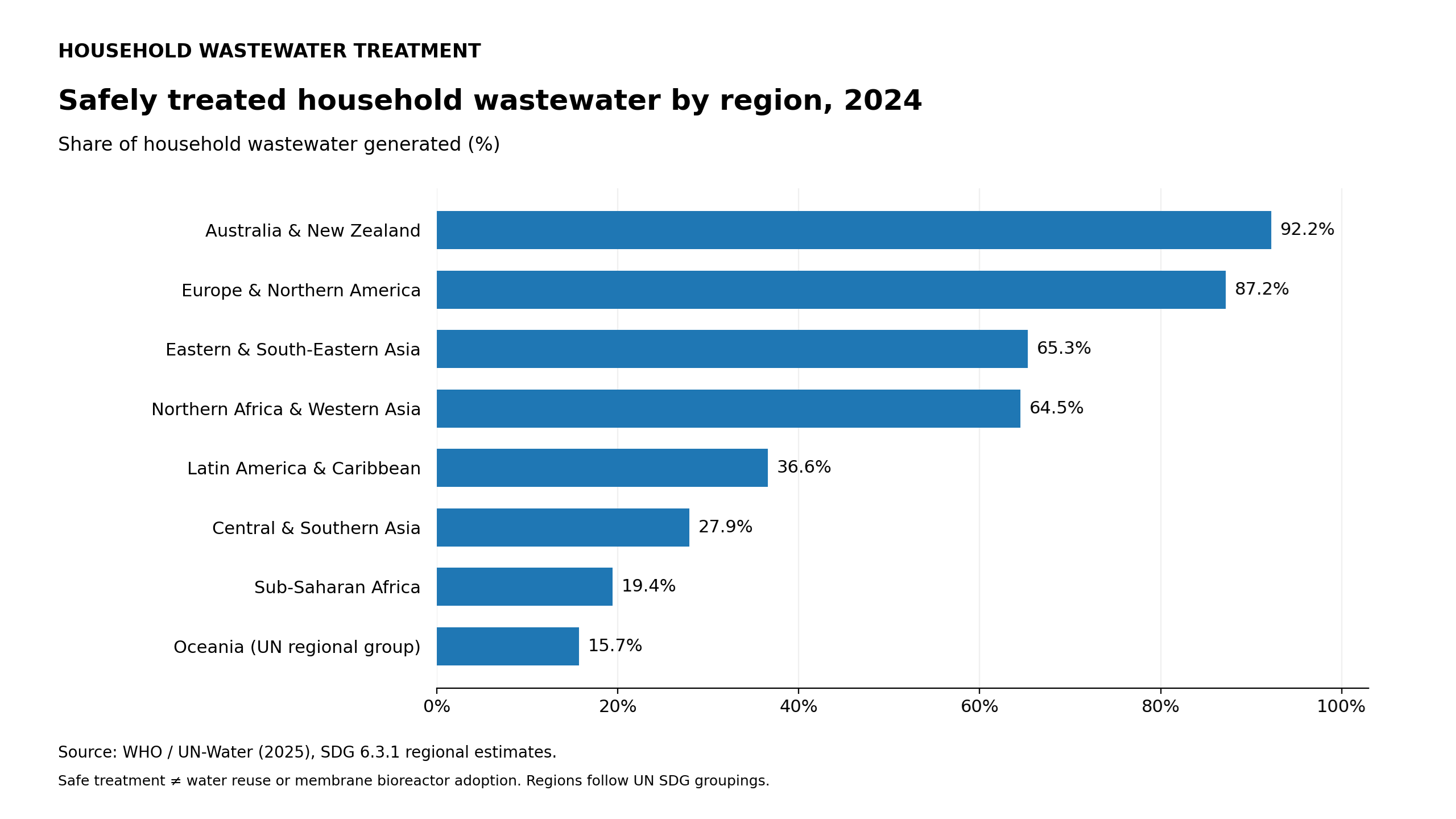
Source: WHO/UN-Water, 2025, SDG Indicator 6.3.1. Data represent safely treated household wastewater as a percentage of wastewater generated, not reclaimed-water production.
Membrane Bioreactor Technologies Support Compact Wastewater Treatment
Membrane bioreactor systems combine biological wastewater treatment with microfiltration (MF) or ultrafiltration (UF) membranes, replacing conventional secondary clarification with membrane-based solids separation. The Membrane Bioreactor Systems Market encompasses submerged and external configurations, which differ in membrane placement, hydraulic operation, maintenance requirements and energy consumption.
Submerged MBR systems position hollow-fiber or flat-sheet membrane modules within biological or dedicated membrane tanks. External systems circulate mixed liquor through separately mounted membrane equipment. The Immersed Membrane Bioreactor Systems Market is particularly associated with municipal wastewater applications where compact installations, solids separation and membrane aeration influence plant design and operating expenditure.
Hybrid configurations extend these treatment functions. Membrane-aerated biofilm reactors (MABRs) use gas-permeable membranes to deliver oxygen for biological treatment, while conventional MBR membranes separate suspended solids from treated water. Reverse osmosis (RO) and ultraviolet (UV) disinfection provide additional purification functions when reclaimed-water applications require more extensive contaminant control.
Table 1: Membrane Bioreactor and Hybrid Wastewater Treatment Configurations
|
Treatment configuration |
Principal function |
Commercial and operating characteristics |
|
Conventional biological treatment + tertiary filtration |
Biological contaminant removal, clarification and additional solids filtration |
Separate treatment stages, civil infrastructure and polishing requirements |
|
Submerged MBR |
Biological treatment with immersed MF/UF separation |
Compact plant configuration; membrane aeration, cleaning and replacement costs |
|
External/sidestream MBR |
Biological treatment with externally mounted membranes |
Membrane accessibility, recirculation energy and crossflow operation |
|
MABR + MBR |
Membrane-assisted biological oxygen delivery and solids separation |
Integrated biological treatment and distinct membrane operating requirements |
|
MBR + RO/UV |
Biological treatment followed by advanced purification |
Additional contaminant removal, disinfection and concentrate management |
Source: Technical comparison based on U.S. EPA membrane bioreactor documentation, manufacturer process specifications and Singapore PUB water-reclamation information.
The configurations serve different treatment requirements rather than representing interchangeable technologies. Plant capacity, wastewater composition, available space, discharge conditions and downstream reuse specifications influence equipment selection and lifecycle treatment costs.
Municipal Wastewater Upgrades Demonstrate Commercial MBR Deployment
Recent municipal projects demonstrate the use of membrane bioreactors in treatment-capacity expansion and infrastructure modernization.
In December 2025, Sarasota County completed an expansion of Florida's Bee Ridge Water Reclamation Facility, increasing capacity from 12 million to 18 million U.S. gallons per day—a 50% increase. The project incorporated DuPont MemPulse MBR modules and advanced wastewater treatment processes. U.S. EPA financing documentation identified a USD 105 million Water Infrastructure Finance and Innovation Act loan and approximately USD 214 million in broader project costs, covering facility conversion and expansion rather than membrane equipment alone.
Australian wastewater utilities are also incorporating MBR technology into major plant upgrades. In June 2026, DuPont announced the selection of its MemCor MBR system for Sydney's Riverstone Water Resource Recovery Facility, incorporating 2,592 MemPulse B50 modules. Two months later, the company announced an approximately 97 MLD membrane bioreactor system for the Lower Molonglo Water Quality Control Centre in Canberra.
Table 2: Selected Membrane Bioreactor and Hybrid Wastewater Treatment Projects, 2025–2026
|
Project and location |
Treatment technology |
Reported capacity |
Verified project status |
|
MemPulse MBR |
Expanded from 12 to 18 MGD |
Operating; expansion completed December 2025 |
|
|
MemPulse MBR + OxyMem MABR |
6,000 m³/day |
Operating; opened August 2025 |
|
|
MBR + RO |
38,880 m³/day |
Design and delivery project announced July 2025 |
|
|
MemCor MBR |
24.8 MLD average; 86 MLD peak design flow |
Upgrade contract announced June 2026 |
|
|
MemCor MBR |
Approximately 97 MLD MBR capacity |
Expansion contract announced August 2026 |
Sources: Official disclosures from Sarasota County, DuPont, Waikato District Council and Veolia. MGD = million U.S. gallons per day; MLD = million liters per day. Capacities have different engineering definitions and are not directly comparable measures of reclaimed-water production.
These projects demonstrate different demand characteristics. Bee Ridge represents completed treatment-capacity expansion, while Riverstone and Lower Molonglo reflect municipal infrastructure contracts associated with long-term service requirements. Vitória represents a planned water reclamation facility where municipal wastewater is intended to supply industrial users.
Hybrid Membrane Systems Extend Municipal Wastewater into Industrial Water Supply
Industrial water reuse requires treatment performance matched to the intended application, including cooling systems, manufacturing processes and higher-purity water requirements. Membrane technologies play different roles within these treatment trains, with MF and UF providing suspended-solids separation and RO addressing additional dissolved contaminants.
Singapore's NEWater infrastructure demonstrates this approach. The national water agency, PUB, incorporates membrane separation and advanced purification into reclaimed-water production. MBR technology can combine biological treatment and MF/UF functions, while downstream RO and UV treatment provide additional water-quality barriers. These applications connect municipal wastewater treatment with the broader Membranes for Water and Wastewater Market.
A more recent industrial application is the Vitória Water Reclamation Station in Brazil, announced by Veolia in July 2025. The planned facility integrates MBR and RO technologies and has a processing capacity of 38,880 m³/day. Its design targets reclamation of 85% of municipal wastewater from the Camburi basin, creating an alternative water source for industrial facilities.
Hybrid biological treatment follows a different operating model. The Raglan wastewater treatment plant in New Zealand, opened in August 2025, combines MemPulse MBR and OxyMem MABR technologies within a 6,000 m³/day facility. The arrangement integrates biological treatment and membrane filtration, followed by UV disinfection before discharge.
These projects illustrate two distinct applications within the Hybrid Membrane Systems Market: combining complementary biological treatment processes and integrating membrane filtration with advanced water reclamation technologies.
Treatment Economics Depend on Capacity, Energy Consumption and Water Quality
The commercial performance of MBR systems reflects capital expenditure, electricity consumption, membrane maintenance and treatment reliability. Installed costs include biological treatment infrastructure, membrane modules, pumps, aeration equipment, civil works and process controls. Operating expenditure is influenced by biological aeration, membrane air scouring, membrane fouling, chemical cleaning, sludge handling and module replacement.
MBR configurations can reduce the space required for conventional clarification and support treatment-capacity expansion within constrained sites. However, membrane equipment, cleaning and aeration contribute additional costs relative to some conventional biological treatment arrangements. The economic difference depends on plant scale, operating conditions and the treatment performance required.
Hybrid water reuse systems introduce additional cost components through RO pressure requirements, concentrate management and advanced disinfection. Industrial water tariffs, wastewater discharge charges and the availability of alternative water sources influence the economics of reclaimed-water production. The operating requirements of a municipal discharge facility therefore differ from those of a plant supplying reclaimed water to industrial users.
European Wastewater Regulations Establish Phased Treatment Requirements
The revised Urban Wastewater Treatment Directive (EU) 2024/3019 entered into force on January 1, 2025, strengthening provisions covering wastewater collection, nutrient removal, micropollutant treatment and resource recovery.
For plants serving wastewater loads of at least 150,000 population equivalent (p.e.), the directive establishes phased tertiary-treatment requirements. Among facilities not applying tertiary treatment on January 1, 2025, 30% must meet the applicable requirements by December 31, 2033, increasing to 70% by December 31, 2036. By December 31, 2039, all plants within the specified large-plant category must satisfy the relevant tertiary-treatment provisions.
Figure 2: EU Tertiary Wastewater Treatment Implementation Milestones
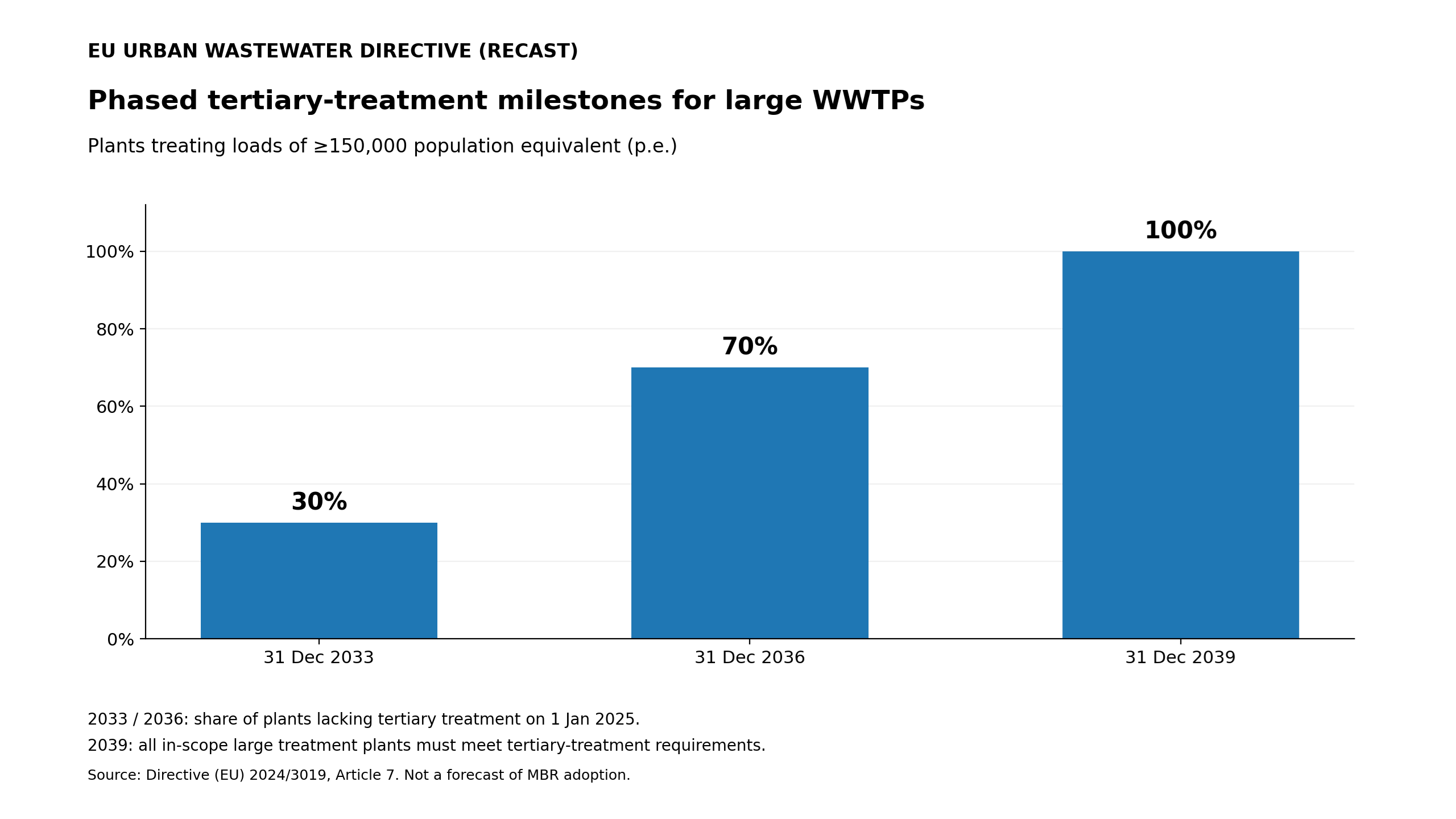
Source: Directive (EU) 2024/3019, Article 7. The 2033 and 2036 milestones apply to specified plants lacking tertiary treatment at the January 2025 baseline; the 2039 obligation applies to all plants within the stated large-plant category. These milestones do not represent MBR adoption forecasts.
The directive remains technology-neutral and does not establish a universal requirement for membrane bioreactors. Conventional nutrient-removal processes, membrane treatment and other technologies can contribute to compliance under different facility configurations.
Separately, Regulation (EU) 2020/741 on water reuse establishes minimum quality, monitoring, permitting and risk-management requirements for treated urban wastewater used in agricultural irrigation. Industrial and potable reuse applications remain subject to their respective applicable regulatory frameworks.
Integrated Membrane Treatment Becomes More Application-Specific
Recent municipal and industrial projects demonstrate increasing differentiation in membrane-based wastewater treatment. Municipal utilities are incorporating MBR systems into capacity expansion and advanced treatment projects, while hybrid processes are extending applications toward biological treatment integration and industrial water recovery.
The commercial significance of these developments lies in treatment capacity, effluent-quality requirements, operating costs and the availability of reclaimed water for defined applications. Projects such as Bee Ridge, Raglan, Riverstone, Lower Molonglo and Vitória illustrate the different infrastructure and operational requirements shaping membrane bioreactor and hybrid wastewater treatment deployment.