Baby Bottle Warmer and Sterilizer Market Overview: Growth Outlook and Strategic Insights
The global baby bottle warmer and sterilizer market is projected to grow from USD 168.5 million in 2025 to USD 302.1 million by 2034, at a CAGR of 6.7%. Being a critical segment of the infant care appliance market, the market enjoys growing parental concern for feeding cleanliness, convenience in time, and preserving nutrient content in infant milk. Newer products are substituting conventional boiling with intelligent, automated products that kill harmful bacteria, heat milk uniformly, and save time for working parents. The use of multi-functional products that merge warming and sterilizing functions with mobile, travel-convenient innovations is the indication of how the industry is evolving according to contemporary parenting requirements and urban life limitations.
Key Insights for Industry Professionals
- Hygiene Compliance – Health authorities, such as the NHS (UK), recommend bottle sterilization to reduce infant exposure to bacteria.
- Smart Appliance Transition – Devices now feature auto shut-off, temperature precision, and nutrient-preserving heat cycles.
- Multi-Function Trends – Space-saving units combining warming and sterilization cater to compact living spaces and multitasking parents.
- E-commerce Growth – Online retail dominates for brand variety, product comparisons, and verified reviews.
- Portability Demand – USB-rechargeable warmers and compact sterilizers are gaining adoption among mobile, travel-oriented families.
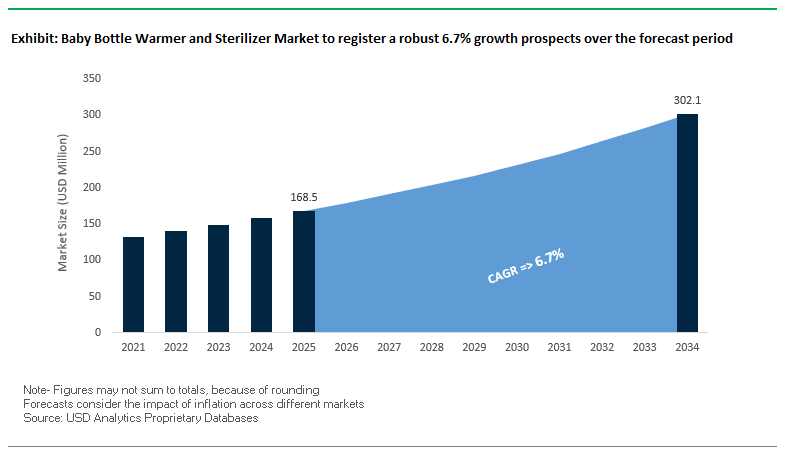
Baby Bottle Warmer and Sterilizer Market Analysis: Strategic Developments and Industry Momentum
The market is seeing product innovation, portfolio expansion, and strategic partnerships as brands vie to cater to changing consumer demands. In June 2024, Lifelong Online diversified its baby care business by adding bottle warmers to its online-driven portfolio. In August 2025, Philips Avent strengthened its brand positioning tied to healthcare through a strategic alliance with Apollo Cradle & Children's Hospital in India to offer support to maternal education and breastfeeding awareness. The same month, Philips India introduced its Hands-free Electric Breast Pump, reinforcing its ecosystem strategy for baby care products.
Product adaptability and safety continue to be essential to competitive differentiation. Dr. Brown's Deluxe Bottle Warmer and Sterilizer includes auto shut-off and sound signals, while Chicco's Sterilnatural 3 in 1 has three sterilization settings, accommodating different needs within a household. The travel and portable segment is increasingly popular, exemplified by Tommee Tippee's LetsGo Portable Bottle Warmer (2025), which warms to body temperature in 10 minutes and is rechargeable through USB. Even wider industry trends outside, like green packaging led by Evolve Organic Beauty (April 2025), are catching up with the baby care appliance market, encouraging brands towards adopting sustainable materials.
Emerging Hygiene Technologies and Market Opportunities in the Baby Bottle Warmer and Sterilizer Market
Hospital-Grade UV-C Sterilization Bringing Clinical Standards to Home Use
Hospital-grade UV-C sterility integrated with consumer baby bottle sterilizers is transforming infant feeding product hygiene. UV-C light, in the 200–280 nm wavelength range, destroys the DNA and RNA of bacteria and viruses, inhibiting reproduction and killing up to 99.9% of pathogens without using chemicals. Radboud University Medical Center research validated UV-C killing colony-forming units in 85.7% of medical endoscopes with performance comparable to, or better than, conventional chemical sterilization. Parents are being attracted by the tech's speed, safety, and residue-free operation. Products in the market today include portable sterilization boxes and countertop models, many of which employ low-pressure mercury-vapor discharge tubes for reliable germicidal performance, finishing sterilization cycles in minutes.
Innovative Formula Preparation for Increased Feeding Convenience
Smart baby bottle warmers are evolving into single-unit formula preparation devices that offer precise temperature control and auto-mixing and preserve nutrients in their natural form in both formula and mother's milk. As highlighted by brands such as Baby Brezza, the machines have 24/7 dispensing warm water, adjustable heat, and auto-mixing features particularly beneficial for night feedings. Scientific studies highlight the requirement for precise temperature and ratio control to avoid nutrient loss, and these smart warmers are eagerly sought by wellness-conscious parents. The new product launches consolidate warming, mixing, and sterilizing in a single device, addressing space-saving and multi-tool requirements in modern homes.
Handheld Bottle Warmers Made for Travel
Growing family travel is fueling demand for compact, TSA-compliant baby bottle warmers. Battery and USB-rechargeable baby warmers are now in the works for car travel, air travel, and outdoor adventures. With TSA clearance for medically necessary baby liquids over 3.4 ounces, the market potential for travel-friendly baby feeding is vast. Companies such as The Baby's Brew offer warmers with rechargeable 12-hour batteries, fast heating, and universal compatibility with all bottle brands. Sleek, compact designs with spill-proof build and auto shut-off are helping brands differentiate in this emerging category.
Affordable Hygiene Products for Growing Markets
In the global developing world where access to clean water and reliable electricity is not an option, low-energy and low-cost sterilizing technologies can be a determining factor in infant health. By adapting technologies like the SteriLux system, which uses ultraviolet light and ozone to sterilize medical equipment with minimal energy input, manufacturers can apply the same concepts to baby bottle sterilization. Initiatives like India's National Health Mission's newborn care programs are potential avenues of distribution for low-cost, culturally appropriate hygiene products. Sterilizers powered by solar or hand-crank energy might fill the infrastructure gap, offering an affordable route to preventable newborn disease elimination in hard-to-reach populations.
Baby Bottle Warmer and Sterilizer Market Share and Segmentation Insights
Market Share by Product: Electric Models Lead, Portable Solutions Accelerate
Warmers and electric sterilizers collectively account for 48% of the market, leading the market through their dependability, efficiency, and array of high-end features such as digital timers, auto-shutoff, and smart app connectivity. The majority of models now come with both warming and sterilizing, which is appealing to parents who want ease of use and space-effectiveness. Travel models account for 35% of the market and are the fastest-growing category, headed by on-the-go lifestyles and family travel on the increase. Battery-powered and USB-rechargeable models are perfect for parents who want instant feeding solutions on the go. Steam models, while lower market share, enjoy steady demand due to ease of use, affordability, and tried and tested germ-killing capacity.
.png)
Market Share by Technology: Steam Sterilization Dominates, UV-C Gains Ground
Steam sterilizing, at 68% market share, is most depended upon for chemical-free high-temperature pathogen destruction. Its low cost and proven effectiveness guarantee continued dominance in premium and economy segments. UV sterilizing, though, is the biggest-growing technology segment, providing fast, dry, and water-free disinfection strongly attractive to green and convenience-oriented consumers. Hybrid steam-and-UV appliances are entering the premium segment, combining the proven effectiveness of steam with the speed and convenience of UV. Energy efficiency and hospital-grade safety standards are becoming major purchase drivers in both technologies, as parents increasingly value both environmental stewardship and hygiene performance.
Competitive Landscape – Leading Brands Shaping the Baby Bottle Warmer and Sterilizer Industry
The market is dominated by trusted baby care brands that emphasize safety, compatibility, and convenience-driven innovation. Key players included are Philips Avent, Chicco, Tommee Tippee, Dr. Brown's, The First Years, Munchkin, Baby Brezza, Nuby, Béaba, Boon, NUK, Comotomo, Haakaa, Kiinde, Papablic, Others.
Philips Avent (Koninklijke Philips N.V.) – Integrated Baby Care Ecosystem
Philips Avent offers a full suite of baby feeding solutions, from bottles and breast pumps to sterilizers and warmers. Devices feature smart temperature controls to preserve milk nutrients and ensure uniform heating. The brand’s collaboration with Apollo Cradle reinforces its healthcare-linked trust positioning, while its steam sterilizers are recognized for eliminating 99.9% of germs.
Chicco (Artsana S.p.A.) – Multi-Configuration Sterilization Expertise
Chicco integrates its warmers and sterilizers into a broad infant care portfolio. The Sterilnatural 3 in 1 offers flexibility with three operating modes and universal compatibility. Ease of use is central, with features like “safe stop” auto-switch-off, appealing to parents seeking efficient, low-maintenance solutions.
Tommee Tippee (Mayborn Group) – Portable, Parent-Centric Innovation
Tommee Tippee focuses on modern parenting convenience, with intuitive designs and cross-brand compatibility. The LetsGo Portable Bottle Warmer addresses mobility needs, while bundled Complete Feeding Sets offer a comprehensive solution. Compatibility with multiple bottle brands broadens its consumer appeal.
Dr. Brown’s (Handi-Craft Company) – Anti-Colic System Integration
Dr. Brown’s specializes in feeding systems with anti-colic technology, integrating sterilizers and warmers as part of a complete infant feeding ecosystem. Its devices offer precise heating, LCD controls, and electric steam sterilization capable of eliminating 99.9% of bacteria, reinforcing its safety-first brand image.
United States: Smart, BPA-Free Baby Bottle Warmers and Sterilizers Driven by Safety and Convenience
The U.S. market is rapidly adopting smart, multifunctional baby bottle warmers and sterilizers that pair with smartphones, letting parents start a warming cycle from another room and switch seamlessly between warming, sterilizing, and thawing modes. Product roadmaps emphasize high-precision temperature control to protect breast-milk nutrients, auto-shutoff safety, quick-warm cycles for night feeds, and compact designs that fit modern kitchens and nurseries. A strong aftermarket ecosystem has emerged via e-commerce, including portable, battery-powered travel warmers and accessories optimized for on-the-go use.
Safety regulation and materials innovation are central buying triggers. While not a blanket plastic ban, the FDA’s prohibition of BPA in baby bottles and sippy cups raised the bar across categories, accelerating adoption of BPA-free, food-grade materials in warmers, sterilizers, and accessories. Brands are also leaning into durability and sustainable packaging to appeal to eco-conscious parents. The result is a premium, convenience-led market where speed, safety, and connected features define competitive positioning.
European Union: Regulation-Led Trust, UV Sterilization, and Circular-Economy Design
The EU’s stringent product-safety regime (e.g., General Product Safety Regulations) and the ban on polycarbonate baby bottles with BPA have propelled suppliers toward safer material choices and meticulous engineering. European brands differentiate through minimalist, high-quality designs and clear labeling/traceability, giving parents confidence in use and maintenance. Innovation is trending toward UV baby bottle sterilizers as a chemical-free, water-saving alternative to steam, often bundled with warming and drying to save counter space and time.
Policy momentum around the circular economy is shaping roadmaps: companies are adopting eco-design principles, recyclable or reduced packaging, and longer-lifecycle components to minimize waste (including compliance with restrictions on destroying unsold goods). In this environment, safety compliance + sustainability is a powerful SEO and sales narrative for EU-focused baby care brands.
China: Manufacturing Scale, Smart Connectivity, and Livestream-Fueled Demand
China remains a global manufacturing hub for baby bottle warmers and sterilizers, supplying both domestic and export markets through an integrated supply chain that enables rapid iteration and broad price coverage. Local consumers are quick adopters of app-connected warmers, smart UV sterilizers, and compact countertop units designed for small urban apartments. E-commerce marketplaces and livestreaming dominate discovery and conversion, where reviews, demos, and limited-time deals accelerate product uptake across tiers.
As the market matures, parents increasingly favor premium, safety-certified devices, pushing manufacturers to tighter quality and reliability standards. Although broader national policies (e.g., green and family-friendly living) are not product-specific, they align with rising expectations for modern, efficient, and hygienic infant-care solutions.
India: BIS-Anchored Safety, D2C Expansion, and Multifunctional Value Devices
India’s regulatory backbone Bureau of Indian Standards (BIS) norms anchors parental trust by emphasizing non-toxic materials, durability, and hazard avoidance. Access has expanded rapidly through e-commerce and D2C brands, which reach Tier-2 and Tier-3 cities with competitive pricing and extensive education via product pages, videos, and social content. Urbanization and the rise of nuclear, dual-income families elevate demand for time-saving, easy-to-use baby bottle warmers and reliable sterilizers that support hygienic feeding routines.
Local innovators are tailoring offerings to Indian use cases: portable, affordable, multi-function units (warm-sterilize-thaw-dry) that handle diverse bottle types, variable power conditions, and tight spaces. Growing health and hygiene awareness among new parents further boosts adoption, making India a high-growth, value-driven market where safety certification, practicality, and price-performance drive conversion.
Baby Bottle Warmer and Sterilizer Market Report Scope
Baby Bottle Warmer and Sterilizer Market
|
Parameter
|
Details
|
|
Market Size (2025)
|
$168.5 Million
|
|
Market Size (2034)
|
$302.1 Million
|
|
Market Growth Rate
|
6.7%
|
|
Segments
|
By Product (Bottle Warmers (Electric, Portable, Steam), Sterilizers (Steam, UV, Microwave)), By Technology (Steam Sterilization, UV Sterilization), By Capacity (Single-Bottle, Multi-Bottle), By End-Use (Residential, Commercial (Daycare, Hospitals)), By Distribution Channel (Online Stores, Specialty Stores, Supermarkets, Pharmacies)
|
|
Study Period
|
2019- 2024 and 2025-2034
|
|
Units
|
Revenue (USD)
|
|
Qualitative Analysis
|
Porter’s Five Forces, SWOT Profile, Market Share, Scenario Forecasts, Market Ecosystem, Company Ranking, Market Dynamics, Industry Benchmarking
|
|
Companies
|
Philips Avent, Chicco, Tommee Tippee, Dr. Brown's, The First Years, Munchkin, Baby Brezza, Nuby, Béaba, Boon, NUK, Comotomo, Haakaa, Kiinde, Papablic, Others.
|
|
Countries
|
US, Canada, Mexico, Germany, France, Spain, Italy, UK, Russia, China, India, Japan, South Korea, Australia, South East Asia, Brazil, Argentina, Middle East, Africa
|
Baby Bottle Warmer and Sterilizer Market Segmentation
By Product
- Bottle Warmers
- Sterilizers
By Technology
- Steam Sterilization
- UV Sterilization
By Capacity
- Single-Bottle
- Multi-Bottle
By End-Use
By Distribution Channel
- Online Stores
- Specialty Stores
- Supermarkets
- Pharmacies
Countries Analyzed
- North America (US, Canada, Mexico)
- Europe (Germany, UK, France, Spain, Italy, Russia, Rest of Europe)
- Asia Pacific (China, India, Japan, South Korea, Australia, South East Asia, Rest of Asia)
- South America (Brazil, Argentina, Rest of South America)
- Middle East and Africa (Saudi Arabia, UAE, Rest of Middle East, South Africa, Egypt, Rest of Africa)
Top Companies in Baby Bottle Warmer and Sterilizer Market
- Philips Avent
- Chicco
- Tommee Tippee
- Dr. Brown's
- The First Years
- Munchkin
- Baby Brezza
- Nuby
- Béaba
- Boon
- NUK
- Comotomo
- Haakaa
- Kiinde
- Papablic
* List Not Exhaustive
Research Coverage
This report investigates the Baby Bottle Warmer and Sterilizer Market end-to-end, packaging strategic breakthroughs, analysis reviews, and highlights that decode how hygiene standards, smart-appliance features, and omnichannel retail are reshaping demand patterns and pricing power. Built by USDAnalytics, the study links technology roadmaps (steam, UV-C, multi-function designs) with country-level compliance and consumer behavior to size near-term pockets of growth and long-term value creation. By benchmarking leading brands’ product ecosystems, materials choices, and go-to-market plays, this report is an essential resource for executives, product managers, investors, and retailers seeking evidence-based decisions on portfolio mix, channel priorities, and differentiation in both premium and value tiers. Scope includes-
- Segmentation covered:
- By Product: Bottle Warmers; Sterilizers
- By Technology: Steam Sterilization; UV Sterilization
- By Capacity: Single-Bottle; Multi-Bottle
- By End-Use: Residential; Commercial
- By Distribution Channel: Online Stores; Specialty Stores; Supermarkets; Pharmacies
- Geographic Scope: Analysis spans 25+ countries across North America, Europe, Asia Pacific, Latin America, and the Middle East & Africa.
- Timeframe: Historical 2021–2024 and forecasts 2025–2034.
- Companies: Strategic assessments and profiles of 15+ participants.
Methodology
USDAnalytics applies a triangulated approach combining primary interviews (appliance engineers, neonatology advisors, quality/regulatory leads, retail buyers, and D2C operators) with secondary intelligence (standards databases, import/export stats, ecommerce price trackers, patents, safety advisories, and company filings). Market size is modeled bottom-up by product × technology × channel at a country level and reconciled top-down to infant-care baselines. Forecasts incorporate penetration curves for UV-C adoption, attachment rates for multi-function units, and scenario tests for regulatory tightening and input-cost swings. Competitive benchmarking scores brands on sterilization efficacy claims, true-to-temperature warming accuracy, cycle time, energy use, safety features, connectivity, and serviceability. All figures are validated through multi-source triangulation and sensitivity analysis.
Deliverables:
- Comprehensive Market Research Report (PDF and Excel) with detailed tables, charts, and interactive visualizations.
- Country-Specific Forecasts & Analysis.
- Segment-Wise Revenue Forecasts (2025–2034).
- Competitive Analysis, Benchmarking, and SWOT Profiles.
- Recent Developments & Innovation Tracker.
- Executive Summary & Analyst Commentary.
- Post-Purchase Analyst Support for Client-Specific Questions and Custom Data Requirements.
