
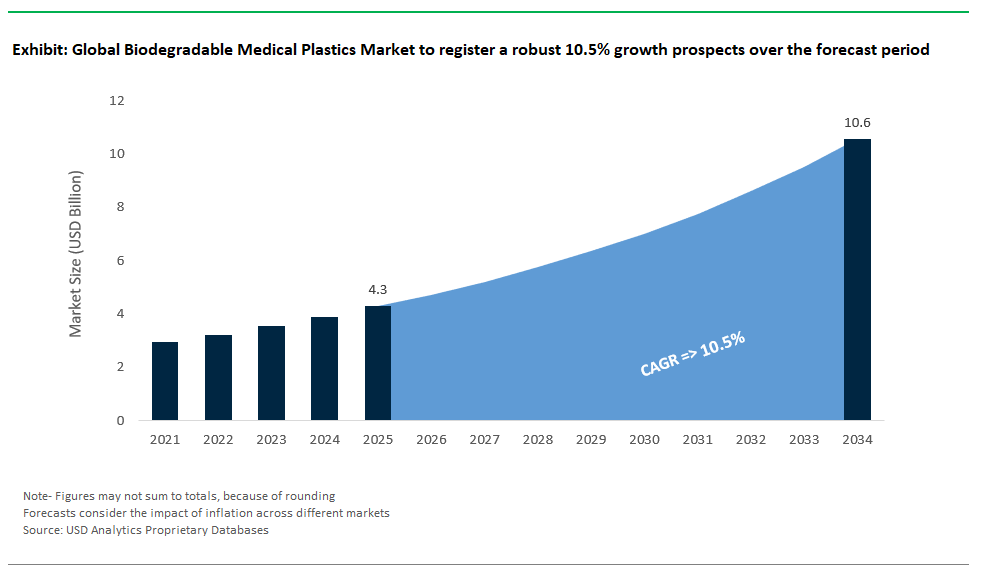
The Global Biodegradable Medical Plastics Market is charting a robust growth path between 2025 and 2034, as healthcare industries increasingly turn to sustainable, biocompatible materials to meet medical performance demands and regulatory sustainability goals. Industry estimates forecast the market’s expansion from USD 4.3 billion in 2025 to USD 10.6 billion by 2034, reflecting a strong CAGR of 10.5%. This growth is fueled by technological breakthroughs in biodegradable polymers, surging demand for advanced drug delivery systems, and rising use of biodegradable solutions across surgical, orthopedic, and regenerative medicine applications.
Incorporating proprietary research from USDAnalytics, this latest report offers a sweeping analysis and future outlook for the global Biodegradable Medical Plastics Market market, covering trends in 21 countries and detailing profiles of over 20 prominent corporations- By Material Type (Polylactic Acid (PLA), Polyglycolic Acid (PGA), Polycaprolactone (PCL), Polyhydroxyalkanoates (PHAs), Poly (lactic-co-glycolic acid) (PLGA), Cellulose-based Materials, Others), By Product Type (Biodegradable Sutures, Biodegradable Implants, Drug Delivery Systems, Wound Care Products, Tissue Engineering & Regenerative Medicine Scaffolds, Medical Device Components, Medical Packaging, Disposable Medical Equipment), By Application (Cardiovascular, Orthopedic, Dental, Tissue Engineering, Wound Care, Drug Delivery, General Surgery, Others), By End-User (Hospitals, Clinics & Ambulatory Surgical Centers (ASCs), Medical Device Manufacturers, Pharmaceutical & Biotechnology Companies, Academic & Research Institutes).
This report offers a deep dive into the innovative landscape of biodegradable medical plastics, highlighting emerging materials like PLGA, PHAs, and cellulose derivatives that are transforming drug delivery, surgical implants, and regenerative medicine scaffolds. It explores how manufacturers are integrating biodegradable polymers into complex medical device designs, improving patient outcomes while aligning with regulatory drives toward sustainability and environmental safety. The analysis details strategic collaborations between polymer producers and medical device innovators, advances in processing technologies such as precision molding and additive manufacturing, and evolving compliance requirements shaping global adoption. With practical insights and verified intelligence, this report is a vital tool for medical device manufacturers, healthcare providers, polymer innovators, investors, and regulatory bodies seeking to capture opportunities in the fast-evolving biodegradable medical plastics market through 2034.
The global biodegradable medical plastics market is rapidly changing, driven by new demands for sustainability, evolving regulations, and advanced technology. The healthcare sector, traditionally using non-degradable polymers, is now adopting biodegradable plastics for medical devices, implants, surgical tools, and drug delivery systems, seeking better clinical performance and environmental safety. This market is expanding from specialized surgical uses to a wider range of high-value medical applications.
Innovations in biodegradable medical plastics are creating new product categories and improving patient care. For instance, Corbion’s PURASORB® PL38, a medical-grade PLA polymer, supports absorbable orthopedic devices like screws and bone fixation, with engineered degradation rates for healing. Similarly, Evonik’s customizable RESOMER® biomaterials are used in drug-eluting stents and implant coatings, ensuring controlled release and biocompatibility. Furthermore, advanced copolymer sutures are designed for balanced strength during healing and complete absorption, reducing post-operative issues.
Increased production capacity indicates growing market readiness for sustainable medical materials. Companies like DSM Engineering Materials are scaling up bio-based materials like Arnitel® Eco for various medical uses, including surgical meshes. Covestro's GMP-certified facilities are producing advanced medical-grade polyurethanes for wound care. Additionally, significant investments in 3D-printing technologies using biodegradable plastics like PLGA and PCL are enabling personalized, patient-specific implants, advancing tailored medicine.
Collaborations are speeding up the adoption of biopolymers in complex medical fields. Leading medical device companies are integrating biodegradable plastics into critical implant markets, such as spinal fusion cages, previously dominated by traditional materials. Acquisitions are also expanding the use of biodegradable polymers in areas like neurosurgery and regenerative medicine, where precise degradation is vital for tissue regrowth. Research into "smart" biodegradable plastics, engineered to respond to biological cues for controlled degradation, is a key trend.
The regulatory environment is becoming more supportive of biodegradable medical plastics, facilitating innovation and market entry. Regulatory bodies like the FDA are refining approval pathways for advanced biodegradable implants, recognizing their potential for complex applications. The EU's Medical Device Regulation (MDR) sets strict biocompatibility standards, often referencing ISO 10993, providing clear guidelines for manufacturers. Japan’s PMDA is also actively working to streamline approvals for advanced bioabsorbable medical devices, showing a commitment to integrating sustainable materials into healthcare.
Technological advancements are transforming biodegradable medical plastics, enabling new applications. Research into antibacterial chitosan-PLA nanocomposites is opening doors for infection-resistant implants. Bio-inspired materials, like surgical adhesives developed by the Harvard Wyss Institute, offer revolutionary biodegradable options for tissue bonding with excellent performance and biocompatibility. Additionally, advanced hydrogels, sometimes bio-based, are being developed for applications like burn dressings, showcasing how these materials are becoming active therapeutic agents.
Widespread adoption by major medical device manufacturers confirms the market's shift from research to practical use. Companies like Stryker are launching resorbable anchors for orthopedic procedures, replacing permanent hardware. B. Braun is integrating sustainable PGLA-based materials into high-volume surgical consumables like sutures. Similarly, major players are adopting advanced biodegradable polymers for soft-tissue repair, demonstrating the critical role of precise degradation timing in successful clinical outcomes.
The global biodegradable medical plastics industry is transforming as implantable resorbable devices gain momentum, driven by the need to avoid secondary surgeries and reduce infection risks. The FDA’s “Breakthrough Device” designation granted to several innovative biodegradable implants in 2024 is streamlining regulatory approval, highlighting strong support for medical solutions that address critical healthcare gaps. Clinically, biodegradable implants like PLLA/PGA bone screws are delivering superior tissue integration compared to traditional titanium options, helping reduce follow-up surgeries and improving long-term patient outcomes.
Economic advantages are fueling this shift as well. Biodegradable implants can lower healthcare costs by eliminating expensive revision surgeries tied to permanent implants. Material innovation is advancing rapidly, with poly-4-hydroxybutyrate (P4HB) standing out for its biocompatibility and mechanical strength, making it suitable for load-bearing uses in orthopedic and soft-tissue repairs due to its predictable degradation rate. As regulatory incentives, strong clinical results, and cost savings align, biodegradable medical plastics are setting new standards in surgical care and reshaping the medical device industry globally.
A major growth opportunity in the biodegradable medical plastics sector is the development of antimicrobial wound dressings that fight biofilm formation while delivering drugs precisely. This innovation addresses critical healthcare issues, as surgical site infections remain a leading cause of complications and hospital readmissions. Chitosan-based films are emerging as promising solutions, offering antibiotic delivery and strong infection prevention compared to traditional dressings. Beyond infection control, biodegradable wound dressings are transforming drug delivery systems. For example, starch-based films are enabling controlled, sustained release of antibiotics like vancomycin, offering a significant upgrade over standard intermittent treatments.
Crucially, these advanced materials are designed for controlled degradation and resorption, with timelines tailored to specific medical needs and materials used. They also comply with strict international standards like ISO 10993, ensuring safety through rigorous testing for factors like cytotoxicity. As innovation accelerates, biodegradable wound dressings are poised to enhance patient care by combining effective infection control with precise, sustained drug delivery, marking a significant leap forward in modern wound management.
The global biodegradable medical plastics market is advancing rapidly in 2024 as sustainability and biocompatibility become critical drivers in medical device manufacturing, drug delivery systems, and healthcare packaging. Biodegradable polymers like PLA, PCL, PGA, PHBH, and bio-based polyamides are increasingly replacing traditional plastics in absorbable implants, surgical tools, wound care products, and medical packaging. Leading companies are scaling up production, acquiring new technologies, and forging partnerships with major healthcare players to integrate bio-based materials into high-performance medical applications. The competitive landscape reflects a dynamic and highly specialized market committed to improving patient outcomes while reducing environmental impact.
Corbion (Netherlands) Corbion remains a leader in medical-grade PLA, with annual sales of €1,288.1 million in 2024. Corbion offers a comprehensive PURASORB® portfolio of cutting-edge, resorbable polymers specifically created for use across the medical and pharmaceutical industries. These polymers, based on lactide, glycolide, and caprolactone monomers, are used in various medical applications including absorbable sutures, orthopedic devices, drug delivery systems, tissue regeneration scaffolds, and wound management. Corbion emphasizes its expertise in polymer development and supply to customers for over 45 years.
Evonik Industries (Germany) Evonik Industries is expanding its presence in biodegradable medical polymers with significant developments. Evonik's RESOMER® range includes bioresorbable polymers like PLGA and PGA materials, which are widely used in implantable medical device applications such as orthopedic devices, tissue reconstruction, dental meshes, and 3D-printed implantable devices. In July 2025, Evonik entered a strategic distribution agreement with IMCD, making IMCD its exclusive European distributor for RESOMER® bioresorbable polymers for implantable medical device applications, aiming to expand Evonik's reach and better serve its customers. Evonik also acquired German biotech company JeNaCell in August 2021 to expand its biomaterials portfolio with biotechnologically derived cellulose, used in medical technology and dermatology for wound and burn treatment. These moves reinforce Evonik’s leadership in delivering advanced biomaterials for complex medical applications, from implants to tissue engineering.
Poly-Med, Inc. (US) Poly-Med, Inc. has solidified its niche in biodegradable surgical solutions. Research on surgical meshes indicates that while commercial surgical meshes are typically made of non-absorbable synthetic polymers, there is increasing interest in bioresorbable alternatives to address postoperative complications. Biodegradable polyesters like PCL are also being explored for drug delivery systems, showing potential for effective and sustained release of active ingredients like antibiotics. Poly-Med, Inc. is a recognized company in the development and manufacturing of biodegradable polymers for medical applications, including absorbable sutures and other implantable devices.
DSM-Firmenich (Netherlands/Switzerland) DSM-Firmenich is actively innovating in biodegradable medical materials. The company's biomaterials technology portfolio includes biodegradable Polyester Amide (PEA) platforms and biostable polyurethanes for sustained and controlled drug delivery solutions. DSM-Firmenich also offers UHMW Polyethylene for orthopedic sutures and has a long clinical history with polyurethanes for medical devices. DSM-Firmenich emphasizes its role as an "unrivaled biomaterials expert and committed partner in driving sustainable innovation in healthcare" through customized solutions leveraging proprietary material technologies.
KLS Martin (Germany) KLS Martin specializes in neurosurgery and craniomaxillofacial (CMF) solutions and has made significant strides in biodegradable implant technology. KLS Martin offers resorbable osteosynthesis systems under its SonicWeld Rx® technique, which combines ultrasound technology with resorbable implants for stable fixation and eliminates the need for a second operation. Their Resorb x polymer is 100% Poly-D,L-Lactic Acid (PDLLA), and Resorb xG polymer consists of 85% Poly-L-Lactic Acid (PLLA) and 15% Poly Glycolic Acid (PGA). These resorbable polymers maintain strength for 8-10 weeks, allowing complete fracture healing. They are commonly used in non-load-bearing craniomaxillofacial areas, including pediatric neurosurgery.
Mitsui Chemicals (Japan) Mitsui Chemicals is expanding its footprint in medical bioplastics. The company produces BioPBS™ (polybutylene succinate), a biodegradable plastic that decomposes into water and carbon dioxide with microorganisms under the soil, which can be used in medical applications, though its primary mentions are often for agricultural films and packaging. Mitsui Chemicals has a joint venture with PTT Global Chemical Public Company Limited (PTTGC) called PTT MCC Biochem Company Limited, which produces BioPBS™. The "MITSUI CHEMICALS REPORT 2024" highlights the company's long-term business plan- “VISION 2030”, which includes a focus on health care-related materials. Mitsui Chemicals' broader commitment to innovative materials for healthcare is evident through its Vision Care Materials Division, supplying eyeglass lens materials globally, and other chemical products used in medical devices.
Biome Bioplastics (UK) Biome Bioplastics is carving out a niche in sustainable packaging, including potential applications in medical packaging. Biome Bioplastics develops biodegradable and compostable polymers designed to replace traditional oil-based plastics. Their products meet industrial compostability standards (ASTM D6400 and EN13432) and are designed for applications like films for food and industrial packaging, shopper bags, and waste bags. The company's focus on sustainable, industrially compostable film grades positions it to address the growing demand for greener medical materials as regulatory scrutiny increases around PVC and other traditional plastics.
In 2025, polylactic acid (PLA) commands a 32.8% market share in biodegradable medical plastics, driven by its excellent biocompatibility, FDA approval, and widespread use in implants and drug delivery systems. Polyhydroxyalkanoates (PHAs) and poly (lactic-co-glycolic acid) (PLGA) are the fastest-growing segments, with CAGR up to 11.7%, as these materials offer superior biodegradability and tunable controlled-release properties for next-generation medical devices. Polyglycolic acid (PGA) also remains a preferred material for sutures and short-term implants due to its rapid absorption and proven safety profile.
Orthopedic applications lead the market with a 24.8% share in 2025, reflecting strong demand for biodegradable screws, pins, plates, and scaffolds that support healing and eliminate the need for secondary removal surgeries. Tissue engineering is the fastest-growing application, powered by innovations in 3D-printed biodegradable scaffolds, regenerative medicine, and bioresorbable matrices. The drug delivery segment is also expanding, leveraging PLA and PLGA nanoparticles and microparticles for highly effective, controlled-release therapeutic solutions in oncology, antibiotics, and pain management.
.png)
The United States holds a commanding position as both the largest market and primary innovation hub for biodegradable medical plastics. A major contributor to this leadership is the widespread use of absorbable sutures crafted from PGA/PLA blends, representing a significant market segment. The country is also at the forefront of medical device innovation, with FDA-approved 3D-printed PLA/PHA implants increasingly becoming viable alternatives for traditional materials in orthopedic, dental, and reconstructive surgeries. PLA (Polylactic Acid) is a widely recognized bio-based, biodegradable, and biocompatible polymer, approved by the FDA for use in healthcare and medical devices, including bioabsorbable medical implants. PLA blends with PHA have shown significant improvements in properties, making them suitable for various medical applications. Recent milestones include Johnson & Johnson’s progress in developing absorbable stents, contributing to advancements in minimally invasive cardiovascular treatments. The global coronary stents market is estimated to be valued at USD 13,944.9 million in 2025, with increasing product approvals by regulatory authorities supporting market growth. Furthermore, the FDA is facilitating approvals for innovative wound dressings, underscoring the nation’s commitment to advancing sustainable healthcare materials. The FDA continues to review and approve novel medical products in 2025, contributing to the expanding landscape of medical innovations. Backed by strong regulatory frameworks and significant R&D investments, the U.S. is poised to sustain its leadership in biodegradable medical plastics.
Germany has established itself as Europe’s center of excellence for high-performance biodegradable medical plastics. BASF has introduced Ecovio® MD, a sterilizable polycaprolactone (PCL) specifically designed for surgical tools, merging biocompatibility with stringent sterilization requirements. BASF's Ecovio® is a certified compostable biopolymer with variable bio-based content, suitable for various applications, including rigid packaging, and its properties align with the needs of certain medical device components. Meanwhile, the Fraunhofer Institute has engineered drug-eluting PHA films, opening avenues for biodegradable drug delivery systems that reduce reliance on conventional polymers. The Fraunhofer Institute is actively engaged in advanced polymer research, with ongoing projects in 2025 focusing on sustainable materials and innovative applications like smart films. The German medical technology sector is embracing these materials, with Siemens Healthineers actively exploring sustainable components for imaging devices to align with sustainability goals. Siemens Healthineers is introducing innovative diagnostic imaging solutions in 2025, including systems with reduced helium requirements, reflecting a broader commitment to sustainability in healthcare technology. The forthcoming EU Medical Device Regulation (MDR) of 2027, mandating recyclable and sustainable devices, further accelerates Germany’s momentum. Germany’s fusion of technical innovation and regulatory foresight ensures it remains a key player in advancing biodegradable solutions for medical applications.
Japan is a technological powerhouse in precision biodegradable medical plastics, underpinned by its deep expertise in advanced materials and regulatory agility. Companies like Mitsubishi are developing advanced materials for medical applications, including absorbable bone screws, offering surgeons innovative solutions for orthopedic repairs with reduced long-term foreign-body risks. The global bioabsorbable screws market is predicted to grow significantly from 2025 to 2031, with a focus on materials like poly L-lactic acid (PLLA). Teijin has created PLA-based surgical meshes that combine high tensile strength with biodegradability, catering to a range of surgical applications from hernia repairs to reconstructive procedures. The global surgical mesh market is expected to reach USD 3,576.54 million in 2025 and continue to grow, with absorbable surgical meshes constituting a significant portion. In a testament to its regulatory efficiency, Japan’s Pharmaceuticals and Medical Devices Agency (PMDA) continues to streamline approval processes for medical devices, supporting faster commercialization and market adoption. Japan's regulatory landscape is undergoing significant transformation in 2025, aiming to streamline drug development, accelerate access to novel therapies, and align Japan's regulatory frameworks with global best practices. As Japan continues to invest heavily in medical biopolymers, it remains at the forefront of sustainable innovation in healthcare devices.
China is rapidly emerging as a mass production hub for biodegradable medical plastics, supported by its extensive manufacturing infrastructure and strong domestic demand. The country’s biodegradable medical plastics market is witnessing robust growth for disposable medical products such as surgical drapes, wound dressings, and implantable devices. The biodegradable medical plastics market is projected to reach $485.81 million in 2025 globally, with Asia-Pacific expected to witness significant growth. Major players like Sinopec Medical Polymers are producing PBS-based surgical supplies at scale, while MicroPort is developing PLA coronary scaffolds for cardiovascular procedures. The global coronary stents market is estimated at USD 10.35 billion in 2025, with prominent players including MicroPort Scientific Corporation. China’s regulatory bodies, including the National Medical Products Administration (NMPA), are increasingly endorsing advanced materials to align with national sustainability goals. The NMPA released an updated clinical evaluation exemption list in May 2025, which includes personalized 3D-printed surgical models made from polymer materials like polylactic acid, indicating a streamlined process for certain innovative medical devices. As a result, China is positioned to significantly influence global supply chains for biodegradable medical plastics, catering to both domestic consumption and export markets.
The Netherlands stands out in Europe for its circular economy approach to biodegradable medical plastics. Dutch innovation is driven by companies like DSM, which has developed bio-based polyamides suitable for MRI-compatible medical devices, offering unique benefits like lower environmental impact and high-performance mechanical properties. The global medical polymer market size is estimated at USD 25.43 billion in 2025, with the biodegradable segment showing strong growth. Philips has announced a transformative goal to transition all patient monitoring sensors to 100% biodegradable materials by 2030, reflecting the company’s strong corporate sustainability commitments. Philips continues to integrate sustainability into its product lifecycle in 2025, with an ongoing focus on circular economy principles and sustainable materials for its medical devices, making progress towards its 2030 biopolymer target. Further momentum comes from significant public investment, with EU Horizon Grant calls for proposals in 2025 focusing on various bio-based solutions, including initiatives relevant to reducing plastic waste. A partnership project in the Northern Netherlands began in April 2025 to investigate the use of a biodegradable plastic produced by bacteria (PHA) to create circular, renewable alternatives for non-renewable polystyrene culture trays used in the biomedical sector. The Netherlands’ integrated approach, combining technological innovation, policy support, and industry commitment, is positioning it as a leader in sustainable healthcare solutions.
|
Parameter |
Details |
|
Market Size (2025) |
$4.3 Billion |
|
Market Size (2034) |
$10.6 Billion |
|
Market Growth Rate |
10.5% |
|
Segments |
By Material Type (Polylactic Acid (PLA), Polyglycolic Acid (PGA), Polycaprolactone (PCL), Polyhydroxyalkanoates (PHAs), Poly (lactic-co-glycolic acid) (PLGA), Cellulose-based Materials, Others), By Product Type (Biodegradable Sutures, Biodegradable Implants, Drug Delivery Systems, Wound Care Products, Tissue Engineering & Regenerative Medicine Scaffolds, Medical Device Components, Medical Packaging, Disposable Medical Equipment), By Application (Cardiovascular, Orthopedic, Dental, Tissue Engineering, Wound Care, Drug Delivery, General Surgery, Others), By End-User (Hospitals, Clinics & Ambulatory Surgical Centers (ASCs), Medical Device Manufacturers, Pharmaceutical & Biotechnology Companies, Academic & Research Institutes) |
|
Study Period |
2019- 2024 and 2025-2034 |
|
Units |
Revenue (USD) |
|
Qualitative Analysis |
Porter’s Five Forces, SWOT Profile, Market Share, Scenario Forecasts, Market Ecosystem, Company Ranking, Market Dynamics, Industry Benchmarking |
|
Companies |
Evonik Industries AG (Germany), Corbion (TotalEnergies Corbion JV) (Netherlands), NatureWorks LLC (U.S.), BASF SE (Germany), DSM (Koninklijke DSM N.V.) (Netherlands), Arkema Group (France / U.S.), Mitsubishi Chemical Group Corporation (Japan), Danimer Scientific (U.S.), Trelleborg AB (Sweden), Shenzhen Esun Industrial Co., Ltd. (China), Biomerics, LLC (U.S.), Toray Industries, Inc. (Japan), and Others. |
|
Countries |
US, Canada, Mexico, Germany, France, Spain, Italy, UK, Russia, China, India, Japan, South Korea, Australia, South East Asia, Brazil, Argentina, Middle East, Africa |
* List Not Exhaustive
The research methodology for the Global Biodegradable Medical Plastics Market combines extensive primary interviews with leading polymer producers, medical device manufacturers, healthcare innovators, regulatory professionals, and industry experts to capture first-hand insights on emerging material technologies, clinical adoption trends, and regulatory pathways. These primary findings are validated and enriched through robust secondary research, leveraging credible sources such as company annual reports, regulatory filings (including FDA, EMA, and PMDA documents), scientific publications, patent databases, medical conference proceedings, and market intelligence reports from recognized industry associations. A thorough triangulation process ensures the reliability and precision of market size estimates, growth forecasts, and segmentation insights. This meticulous approach underpins the development of well-founded market projections through 2034 and ensures actionable intelligence for stakeholders across the biodegradable medical plastics value chain.
Table of Contents: Biodegradable Medical Plastics Market Outlook: Advanced Materials & Healthcare Innovation (2025–2034)
1. Executive Summary
2. Biodegradable Medical Plastics Market Landscape & Outlook (2025–2034)
3. Market Analysis of Global Biodegradable Medical Plastics Market: Eco-Friendly Solutions
4. Market Dynamics: Biodegradable Medical Plastics Industry
5. Competitive Landscape of the Global Biodegradable Medical Plastics Market
6. Market Share & Segmentation Analysis: Biodegradable Medical Plastics Market
7. Country Analysis and Outlook of Biodegradable Medical Plastics Market
8. Biodegradable Medical Plastics Market Size Outlook by Region (2025-2034)
9. Company Profiles: Leading Players in the Biodegradable Medical Plastics Market
10. Methodology
11. Appendix
The global biodegradable medical plastics market is projected to expand from USD 4.3 billion in 2025 to USD 10.6 billion by 2034, achieving a solid CAGR of 10.5% as sustainable materials become central to next-generation medical devices and healthcare solutions.
Biodegradable medical plastics are widely used in absorbable sutures, orthopedic implants, drug delivery systems, wound care products, tissue engineering scaffolds, medical device components, and sustainable medical packaging, offering excellent biocompatibility and controlled degradation profiles.
Polylactic acid (PLA) dominates the market due to its biocompatibility and FDA approvals, while polyhydroxyalkanoates (PHAs) and PLGA are the fastest-growing materials, valued for their tunable degradation rates and suitability in advanced drug delivery and regenerative medicine applications.
The healthcare industry is adopting biodegradable plastics to reduce environmental impact, comply with stringent regulatory frameworks, and improve clinical outcomes through implants and devices that resorb safely in the body, eliminating the need for secondary surgeries and reducing patient risks.
A key example is Evonik Industries partnering with IMCD in 2025 to distribute RESOMER® bioresorbable polymers across Europe, expanding access to advanced biodegradable materials used in implants, drug delivery systems, and medical device manufacturing, and supporting sustainable healthcare innovation.