Biopolymer Coatings Market Overview: Sustainable Solutions & Industry Expansion
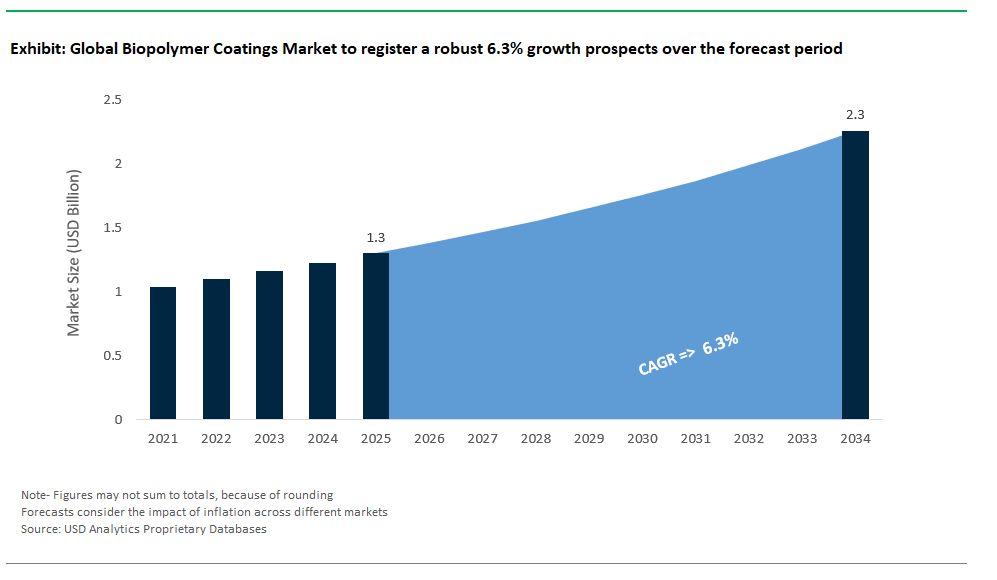
The Global Biopolymer Coatings Market is progressing steadily from 2025 to 2034, driven by rising environmental regulations, consumer demand for eco-friendly products, and technological advances that expand the functionality of biopolymer-based protective solutions. Industry forecasts indicate the market will grow from USD 1.3 billion in 2025 to USD 2.3 billion by 2034, achieving a solid CAGR of 6.3%. Growth momentum is particularly strong in applications requiring sustainable alternatives for barrier protection, corrosion resistance, and food-safe coatings across diverse industries, including packaging, automotive, electronics, and healthcare.
Powered by proprietary research insights from USDAnalytics, the latest edition provides a comprehensive examination and forecasts for the global biopolymer coatings market, capturing trends across 21 countries and profiling more than 20 leading enterprises- By Type (Polysaccharide-based, Protein-based, Lipid-based, Biodegradable Polyesters, Bio-based (Non-Biodegradable) Polymers), By Coating Function (Barrier Coatings, Antimicrobial Coatings, Corrosion Protective Coatings, Adhesive Coatings, Scratch/Abrasion Resistant Coatings, Hydrophobic/Hydrophilic Coatings, UV Protective Coatings, Edible Coatings), By Technology (Waterborne Coatings, Solvent-borne Coatings, Powder Coatings, Dispersion/Emulsion Coatings, Lacquers & Varnishes, Extrusion Coatings), By End-Use Industry (Packaging, Food & Beverages, Automotive, Textiles, Construction, Healthcare, Electronics, Agriculture, Others).
Providing a nuanced look at evolving market dynamics, this report investigates how biopolymer coatings are replacing conventional synthetic coatings in applications requiring sustainability without sacrificing performance. It examines breakthroughs in polysaccharide-based and protein-based coatings for edible applications, lipid-based coatings for moisture barriers, and bio-based polyesters delivering durability in industrial uses. The analysis reviews developments in waterborne and powder coating technologies designed to reduce VOC emissions and environmental impact. It also highlights strategic collaborations, emerging material innovations, and regulatory initiatives shaping adoption trends across key industries. Backed by practical insights and validated intelligence, this report is an essential resource for manufacturers, coatings formulators, end-use industries, investors, and policymakers looking to harness biopolymer coatings for sustainable growth through 2034.
Biopolymer Coatings Market Dynamics: PFAS-Free Barriers and Smart Active Packaging Solutions
Trend: Biopolymer Coatings Rapidly Replace PFAS in Food Packaging Under Global Regulatory Pressure
The global biopolymer coatings industry is transforming rapidly as regulatory crackdowns on PFAS, known as “forever chemicals,” drive demand for safer alternatives in food packaging. By 2028, key markets like the EU, several US states, and potentially Japan plan to ban or tighten restrictions on PFAS in food-contact coatings, creating an urgent need for sustainable replacements. Biopolymer coatings are stepping in to fill this gap, with innovative formulations like chitosan-carnauba wax blends showing strong moisture barrier performance, positioning them as promising PFAS-free alternatives. Ongoing research is enhancing these biopolymer coatings to meet the stringent requirements of diverse food packaging applications.
Cost competitiveness for bio-based barrier coatings is improving, making them increasingly practical substitutes for traditional materials. This progress is vital for broader industry adoption as companies look for sustainable solutions that remain economically viable. Many global food brands are already transitioning to biopolymer coatings in their paper packaging, signaling growing confidence in these sustainable options. With regulatory deadlines approaching and sustainability commitments strengthening across supply chains, biopolymer coatings are poised to become the leading solution for safe, eco-friendly food packaging worldwide.
Opportunity: Smart Active Coatings Propel Biopolymers into High-Value Functional Packaging Applications
A significant opportunity in the global biopolymer coatings market lies in developing smart active coatings that offer advanced features like antimicrobial protection and oxygen scavenging. These innovations address crucial challenges in food safety and shelf-life extension. For example, nisin-incorporated biopolymer coatings have proven highly effective in reducing microbial contamination, such as Listeria on fresh produce, providing a substantial improvement over traditional food safety methods. Meanwhile, enzyme-embedded biopolymer coatings based on materials like PLA are being engineered to act as active oxygen scavengers, dramatically lowering headspace oxygen in packaging. This technology helps extend product freshness and shelf life without relying on chemical preservatives.
The commercial potential for active biopolymer coatings is strong, driven by the rising demand for packaging that combines sustainability with functional benefits. This specialized segment of the broader biopolymer market is on a growth trajectory, supported by a surge in innovation and patent activity related to stimuli-responsive biopolymer materials. As food brands seek to enhance product differentiation and comply with strict safety regulations, smart active biopolymer coatings are emerging as a transformative solution. They represent a powerful blend of environmental sustainability and advanced performance, redefining the future of sustainable food packaging.
Competitive Landscape of the Global Biopolymer Coatings Market
The global biopolymer coatings industry is thriving in 2024, driven by escalating sustainability mandates, consumer demand for eco-friendly packaging, and the need for functional alternatives to petroleum-based coatings. From food packaging and textiles to electronics and industrial applications, biopolymer coatings are gaining momentum as brands seek materials that provide barrier performance, biodegradability, and recyclability. Leading players are launching innovative formulations based on PLA, PHA, bio-acrylics, starch, and bio-polyesters while expanding production capacity and forging partnerships with global consumer brands. The competitive landscape reflects a dynamic industry poised to redefine sustainable surface solutions across multiple sectors.
Arkema: Frontrunner in Bio-Based Coatings
Arkema (France) Arkema has established itself as a frontrunner in bio-based coatings. At the American Coatings Show in April 2024 and Paint India in February 2024, Arkema showcased new technologies and advancements aimed at increasing circularity, energy efficiency, and decarbonization through more sustainable paint and coating solutions. Their offerings include Synaqua® bio-based waterborne resins with up to 97% renewable content, which combine the performance properties of alkyd-based coatings with the advantages of water-based formulations. Arkema also highlighted the progressive introduction of powder and acrylic-based biomass-balance solutions. Arkema's focus on bio-attributed acrylic chains and low-VOC, solvent-free, UV-cured dielectric coatings for electronics demonstrates its commitment to high-performance, eco-friendly coatings.
Corbion: Expanding PLA-Based Coatings Portfolio
Corbion (Netherlands) Corbion continues to expand its PLA-based coatings portfolio, delivering solutions for various applications. TotalEnergies Corbion (formerly Total Corbion PLA) is a global technology leader in Poly Lactic Acid (PLA) and lactide monomers. Their Luminy® PLA portfolio is a bio-based and biodegradable polymer used in a wide range of markets, including packaging and consumer goods. Corbion also emphasizes its PURALACT® B3 monomer for coating resins, which boosts resin and coating performance in areas like scratch resistance and adhesion while lowering resin viscosity for lower VOC systems. Corbion's expertise in bio-based materials and strong partnerships within the packaging industry underscore its influential role in transitioning the coatings industry toward sustainable alternatives.
DSM-Firmenich (Netherlands/Switzerland) DSM-Firmenich is diversifying its biopolymer coatings offerings with high-performance and recyclable solutions. Their Integrated Annual Report 2024 highlights their commitment to "developing more sustainable practices and innovations" and their efforts to achieve near-term climate goals and long-term net-zero ambitions across their businesses. Research indicates that biodegradable co-polyesters like PBSAT and PBSA are being explored as potential solutions to ghost fishing and marine plastic pollution, suggesting areas of interest for companies like DSM-Firmenich.
Dow Chemical: Leveraging Materials Science for Biopolymer Coatings
Dow Chemical (US) Dow Chemical is leveraging its materials science expertise to bring biopolymer coatings to demanding applications. Dow offers various coating solutions for protective, automotive, and industrial applications, including waterborne, solventborne, and high solids resins and additives, some of which are designed for corrosion resistance. Dow's Ecolibrium™ brand signifies products with some percentage of materials derived from biomass, indicating their commitment to bio-based solutions. Dow's collaborations with P&G on polyethylene recycling and their extensive materials for absorbent and hygiene products (including backsheet films for diapers) demonstrate their capability to integrate sustainable solutions into consumer products where performance is critical.
NatureWorks: Extending PLA Applications into Coatings
NatureWorks (US) NatureWorks is extending the applications of PLA into coatings with significant advancements. NatureWorks' Ingeo™ PLA biopolymer is used in various coating applications, including paper and board coatings for food service ware, enabling biodegradability and compostability. Ingeo is also widely used in 3D printing, offering a sustainable alternative for components. In April 2024, NatureWorks and IMA announced a turn-key compostable coffee pod solution compatible for North America, with the rigid capsule body, filter, and lidding made from Ingeo™ PLA biopolymer. NatureWorks' continuous innovation in Ingeo™ PLA for diverse applications, from packaging to 3D printing, highlights its focus on sustainable solutions for high-performance requirements.
Solvay: Innovating Bio-Based Coatings for Foodservice and Packaging
Solvay (Belgium) Solvay is innovating in bio-based coatings for foodservice and packaging markets. Solvay's product portfolio includes various specialty polymers and chemicals relevant to coatings. Solvay is actively engaged in sustainability initiatives. Solvay's "Integrated Report 2023" highlights its strategy of strengthening its portfolio with solutions that enable circularity and reduce environmental impact.
Mitsubishi Chemical Corporation (Japan): Strengthening Presence with BioPBS™ Moisture-Barrier Coatings
Mitsubishi Chemical Corporation (Japan) Mitsubishi Chemical Corporation continues to strengthen its presence in biopolymer coatings with its BioPBS™ (polybutylene succinate). BioPBS™ is a biodegradable plastic that decomposes into water and carbon dioxide with microorganisms under the soil and offers high heat resistance. It can be used for food packaging, like disposable tableware, paper cups, and gas barrier packaging. Mitsubishi Chemical Corporation (MCC) established PTT MCC Biochem Company Limited, a 50-50 joint venture with PTT Global Chemical Public Company Limited (PTTGC), which has been producing and selling bio-based PBS (BioPBS™) since 2017. Mitsubishi Chemical's ongoing development in sustainable materials and its strategic ventures position it as a major player in sustainable packaging solutions.
Biopolymer Coatings Market Analysis: Green Solutions and Market Momentum
The global biopolymer coatings market is growing fast, driven by regulations, brand sustainability goals, and new tech. Industries like packaging and automotive are switching from fossil-based coatings to bio-based, biodegradable, or recyclable options for environmental and performance needs. This sector is quickly moving into widespread use.
Innovative Product Launches Target High-Performance and Sustainable Applications
New coating innovations combine sustainability with tough performance. Advanced fire-protective coatings are now entering regulated sectors like aerospace. AkzoNobel's sustainable powder coatings are popular for architectural uses, supporting circular design. The demand for fully recyclable coatings for packaging is also growing, boosting true circular economies.
Capacity Expansions Signal Readiness for Industrial-Scale Production
Increased production capacity shows confidence in biopolymer coatings. Sherwin-Williams is boosting the output of low-VOC, bio-based architectural coatings. Covestro is expanding sustainable polyurethane coatings for cars, meeting low-emission and eco-conscious demands. Allnex is also strategically expanding bio-based resin production in regions like Latin America, aligning with local sustainability goals.
Partnerships are speeding up biopolymer coating development. Collaborations are creating advanced barrier coatings for food packaging that are both high-performing and biodegradable. Companies are also adding antimicrobial features to coatings for medical devices. High-profile tech brands are pushing bio-based coatings into consumer electronics, balancing looks, durability, and eco-friendliness.
Regulatory Drivers Propel Market Adoption
Regulations are making biopolymer coatings a must-have. The EU's Ecodesign Regulation is setting strict VOC limits for industrial coatings, boosting demand for bio-based options. California regulations are driving shifts towards safer alternatives in specialized industries like aerospace. Japan's Green Procurement Law is prioritizing eco-friendly electronics for government purchases, creating stable demand for bio-based solutions.
Technological Breakthroughs Elevate Functionality and Market Scope
New material science is expanding, where biopolymer coatings can be used. Research is developing edible, antimicrobial nanocoatings for fresh produce, improving food safety. Self-healing coatings are emerging for industries like automotive, enhancing durability. Also, new marine antifouling coatings are designed to be biodegradable, reducing toxic chemicals in oceans.
Commercial Adoption Validates Market Viability
Major brands are widely adopting biopolymer coatings, proving their real-world success. Aerospace leaders like Boeing are using advanced coating systems meeting tough safety and sustainability standards. IKEA is shifting to bio-based resins for furniture coatings, aligning with regulations and customer demand. High-end brands are also using sustainable coatings to differentiate their products, combining aesthetics with eco-credentials.
Biopolymer Coatings Market Share and Segmentation Insights
By Type: Polysaccharide-Based Coatings Lead Market, Biodegradable Polyesters Grow Fastest
In 2025, polysaccharide-based coatings command a 29.3% market share, reflecting their widespread use in food packaging, driven by natural abundance and regulatory support for safer, eco-friendly solutions. Biodegradable polyesters are the fastest-growing segment with a CAGR of 7.1%, as demand rises for compostable and flexible packaging coatings that combine strong barrier properties with end-of-life sustainability. Protein-based coatings, while niche, are gaining momentum in high-barrier food and specialized medical applications.
By Technology: Waterborne Coatings Dominate, Powder Coatings Show Highest Growth
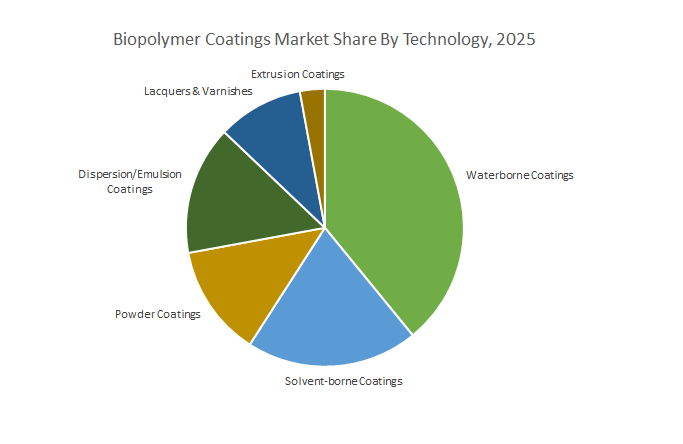
Waterborne coatings lead the market with a 39.1% share in 2025, favored for their low VOC emissions and alignment with global sustainability standards in packaging and industrial applications. Powder coatings represent the fastest-growing technology, benefiting from zero-waste, solvent-free application processes that are increasingly popular in automotive and durable goods manufacturing. Dispersion/emulsion and extrusion coatings continue to see steady adoption, while solvent-borne coatings are in decline due to tightening environmental regulations.
By End-Use Industry: Packaging Remains Key Driver, Healthcare Expands Most Rapidly
Packaging is the largest end-use industry for biopolymer coatings in 2025, as sustainable food packaging trends drive innovation in compostable and biodegradable coated papers and films. Healthcare is the fastest-growing segment, as medical device manufacturers turn to biopolymer coatings for bioresorbable implants and antimicrobial surfaces. The automotive sector is also witnessing significant growth, with bio-based coatings being adopted for both interior and exterior vehicle components.
Germany Leads Global Innovation in Biopolymer Coatings
Germany stands as the technology and innovation leader in the global biopolymer coatings market. Pioneering solutions from German companies are transforming industries with sustainable alternatives. BASF has developed Ecovio® coatings specifically designed for compostable food packaging, offering durability and compliance with stringent EU compostability standards. As of May 2025, BASF is partnering with Metpack to introduce Ezycompost coated paper and paperboard, which is home compostable and features BASF's Ecovio 70 PS14H6 biopolymer coating. This coating offers excellent barrier properties against liquids, fats, grease, and mineral oil, and is temperature-stable up to 100°C, with FDA food-contact approval. Covestro has introduced bio-based polyurethane coatings featuring up to 70% renewable content, ideal for diverse industrial and consumer applications. At the European Coatings Show (ECS) 2025 in March, Covestro showcased its innovative and sustainable solutions for the coatings and adhesives industry, with a focus on sustainable products containing at least 25% alternative raw materials, some of which are partially bio-based resins for food packaging. Meanwhile, Fraunhofer Institute’s groundbreaking nanocellulose-barrier coatings deliver exceptional oxygen barrier performance, opening new doors for sustainable flexible packaging solutions. The Fraunhofer Institute for Manufacturing Technology and Advanced Materials (IFAM) is presenting various coating technology topics at ECS 2025, including barrier coatings, indicating ongoing research and development in this area. Regulatory drivers like the EU Single-Use Plastics Directive are further accelerating the shift toward biopolymer coatings. By 2025, the EU aims to achieve a 77% separate collection rate for plastic bottles and reduce single-use plastic takeaway containers by 50%, which are key targets of the Single-Use Plastics Directive, further supporting the adoption of biopolymer coatings as alternatives. Germany's robust R&D ecosystem positions it at the forefront of sustainable materials innovation.
United States Emerges as a Rapidly Growing Biopolymer Coatings Market
The United States is experiencing significant momentum as a rapidly growing market for biopolymer coatings, fueled by aggressive sustainability goals and significant corporate investment. Companies like NatureWorks are leading the charge with their Ingeo™ PLA coatings, offering renewable, compostable solutions for paperboard and foodservice packaging. In March 2025, NatureWorks introduced the Ingeo™ Extend platform, designed to enable faster rates of biodegradation and disintegration for BOPLA films, suitable for small-format food packaging like condiment packets and snack wrappers, and offering improved manufacturing efficiency and heat resistance. Danimer Scientific is pioneering PHA-based coatings, including innovative marine coatings that break down in ocean environments, addressing the global plastics pollution crisis. Danimer Scientific continues to work on developing biodegradable coatings for the paper and board industry, as part of its biobased strategy. Recent developments include the USDA BioPreferred Program, which certifies bio-based coatings and helps manufacturers secure green credentials. The USDA BioPreferred Program continues to certify bio-based products, encouraging market adoption of sustainable alternatives. Additionally, Avery Dennison is offering compostable label coatings, responding to increased demand from brands seeking sustainable packaging solutions. Avery Dennison emphasizes its sustainable labeling and adhesive solutions, including those that contribute to packaging circularity and recyclability. The U.S. biopolymer coatings sector is experiencing robust growth, highlighting its role as a key driver in the global sustainability transition.
Japan Advances High-Performance Biopolymer Coating Solutions
Japan continues to excel in developing high-performance biopolymer coatings that combine sustainability with advanced functional properties. Mitsubishi Chemical has introduced BioPBS™ moisture-barrier coatings, ideal for food packaging and disposable items requiring water resistance. Mitsubishi Chemical's BioPBS™ is a biodegradable plastic with high heat resistance and compatibility, used in applications like paper coating and flexible packaging. DIC Corporation is at the forefront with plant-based epoxy coatings suitable for industrial applications, providing strong mechanical and chemical resistance without relying on petroleum-based materials. DIC Corporation continues to offer a range of coating resins, including epoxy resins, for various applications such as consumer goods, mobility, and consumer electronics, indicating their ongoing focus on functional coatings. The adoption rate in Japan is significant, with an increasing trend towards utilizing bio-based coatings in flexible packaging. Toyo Seikan, a major player in the beverage can market, is exploring sustainable coating innovations for beverage cans, aligning with the broader industry trend towards eco-friendly packaging. The beverage can market report for 2025 highlights ongoing innovations in material and manufacturing processes, with a focus on sustainability and eco-friendly packaging. As Japanese manufacturers continue integrating biopolymer technologies across multiple industries, Japan’s leadership in high-performance, sustainable coatings remains strong.
China Dominates Global Biopolymer Coatings Production
China has established itself as a major global production hub for biopolymer coatings. Domestic giants like Kingfa are major players, producing PBAT-based coatings that are increasingly used in China’s food service sector, from takeaway containers to disposable tableware. The poly (butylene adipate-co-terephthalate) (PBAT) market is projected to reach USD 2.91 billion by 2030, with Asia Pacific as the largest market, indicating China's significant role in PBAT production and its application in coatings for packaging. Recent investments include Sinopec increasing its capacity for bio-based plasticizers, signaling China’s commitment to scaling biopolymer solutions. The epoxy resin market, which includes some coating applications, is projected to grow from USD 14.77 billion in 2025, with Asia Pacific being a significant driver. Policy mandates are also shaping the market: Alibaba, one of China’s largest e-commerce players, is actively promoting sustainable packaging. The global closed-loop packaging systems market is accelerating in 2025, with a growing use of durable bioplastics and smart active packaging films to design long-lasting, recyclable, or reusable products within circular systems, which aligns with the efforts of major e-commerce players like Alibaba. These efforts reflect China’s strategic push to reduce reliance on petroleum-based materials while positioning itself as a global supplier of sustainable coating solutions.
Netherlands Pioneers Circular Economy Innovations in Biopolymer Coatings
The Netherlands is positioning itself as a circular economy leader within the global biopolymer coatings industry. Dutch innovators are focused on creating sustainable solutions that are not only bio-based but fully recyclable or compostable. Avantium has introduced PEF coatings that deliver exceptional gas barrier properties, significantly outperforming conventional PET and extending product shelf life in food and beverage applications. Avantium's PEF (Releaf®) offers superior barrier properties, a lower carbon footprint, and higher mechanical strength compared to PET, making it a next-generation polyester for packaging. DSM is advancing circular economy principles through its Niaga® fully recyclable coating systems, ensuring products can be disassembled and recycled efficiently. OBJECT CARPET, in partnership with Niaga® technology, is setting new standards for the carpet industry by creating fully recyclable carpets, demonstrating the application of Niaga®'s circular economy principles. Heineken is exploring the adoption of sustainable packaging solutions, showcasing how sustainable materials are moving into mainstream consumer brands. Heineken's 2024 annual report, discussed in February 2025, highlights its ongoing focus on sustainability within its operations. Supported by government policy and strong public-private collaboration, the Netherlands is leading the charge toward a truly circular biopolymer coatings economy. The Integral Circular Economy Report 2025 by PBL Netherlands Environmental Assessment Agency provides an overview of the state of the circular economy transition in the Netherlands, including efforts related to plastic packaging.
Biopolymer Coatings Market Report Scope
Biopolymer Coatings Market
Parameter
Details
Market Size (2025)
$1.3 Billion
Market Size (2034)
$2.3 Billion
Market Growth Rate
6.3%
Segments
By Type (Polysaccharide-based, Protein-based, Lipid-based, Biodegradable Polyesters, Bio-based (Non-Biodegradable) Polymers), By Coating Function (Barrier Coatings, Antimicrobial Coatings, Corrosion Protective Coatings, Adhesive Coatings, Scratch/Abrasion Resistant Coatings, Hydrophobic/Hydrophilic Coatings, UV Protective Coatings, Edible Coatings (for food)), By Technology (Waterborne Coatings, Solvent-borne Coatings, Powder Coatings, Dispersion/Emulsion Coatings, Lacquers & Varnishes, Extrusion Coatings), By End-Use Industry (Packaging, Food & Beverages, Automotive, Textiles, Construction, Healthcare, Electronics, Agriculture, Others)
Study Period
2019- 2024 and 2025-2034
Units
Revenue (USD)
Qualitative Analysis
Porter’s Five Forces, SWOT Profile, Market Share, Scenario Forecasts, Market Ecosystem, Company Ranking, Market Dynamics, Industry Benchmarking
Companies
BASF SE (Germany), AkzoNobel N.V. (Netherlands), Cargill, Inc. (U.S.), NatureWorks LLC (U.S.), Novamont S.p.A. (Italy), Roquette Frères (France), DuPont (U.S.), Corbion N.V. (Netherlands), Mitsubishi Chemical Group Corporation (Japan), EcoSynthetix Inc. (Canada), WestRock Company (U.S.), Archer Daniels Midland (ADM) Company (U.S.), Evonik Industries AG (Germany), Danimer Scientific (U.S.), Safepack Industries Ltd. (India), FMC Corporation (U.S.), Solanyl Biopolymers Inc. (Canada), Arkema S.A. (France), Covestro AG (Germany), dsm-firmenich (Netherlands), Stora Enso Oyj (Finland), UPM-Kymmene Oyj (Finland), Borregaard AS (Norway), and Others.
Countries
US, Canada, Mexico, Germany, France, Spain, Italy, UK, Russia, China, India, Japan, South Korea, Australia, South East Asia, Brazil, Argentina, Middle East, Africa
Biopolymer Coatings Market Segmentation
By Type
Polysaccharide-based
Protein-based
Lipid-based
Biodegradable Polyesters
Bio-based (Non-Biodegradable) Polymers
By Coating Function
Barrier Coatings
Antimicrobial Coatings
Corrosion Protective Coatings
Adhesive Coatings
Scratch/Abrasion Resistant Coatings
Hydrophobic/Hydrophilic Coatings
UV Protective Coatings
Edible Coatings
By Technology
Waterborne Coatings
Solvent-borne Coatings
Powder Coatings
Dispersion/Emulsion Coatings
Lacquers & Varnishes
Extrusion Coatings
By End-Use Industry
Packaging
Food & Beverages
Automotive
Textiles
Construction
Healthcare
Electronics
Agriculture
Others
Countries Analyzed
North America (US, Canada, Mexico)
Europe (Germany, UK, France, Spain, Italy, Russia, Rest of Europe)
Asia Pacific (China, India, Japan, South Korea, Australia, South East Asia, Rest of Asia)
South America (Brazil, Argentina, Rest of South America)
Middle East and Africa (Saudi Arabia, UAE, Rest of Middle East, South Africa, Egypt, Rest of Africa)
Top Companies in the Biopolymer Coatings Market
BASF SE (Germany)
AkzoNobel N.V. (Netherlands)
Cargill, Inc. (US)
NatureWorks LLC (US)
Novamont S.p.A. (Italy)
Roquette Frères (France)
DuPont (US)
Corbion N.V. (Netherlands)
Mitsubishi Chemical Group Corporation (Japan)
EcoSynthetix Inc. (Canada)
WestRock Company (US)
Archer Daniels Midland (ADM) Company (US)
Evonik Industries AG (Germany)
Danimer Scientific (US)
Safepack Industries Ltd. (India)
FMC Corporation (US)
Solanyl Biopolymers Inc. (Canada)
Arkema S.A. (France)
Covestro AG (Germany)
dsm-firmenich (Netherlands)
Stora Enso Oyj (Finland)
UPM-Kymmene Oyj (Finland)
Borregaard AS (Norway)
* List Not Exhaustive
Methodology:
The research methodology for the Global Biopolymer Coatings Market integrates comprehensive primary research, including interviews with coating formulators, polymer manufacturers, sustainability experts, and end-users across key industries such as packaging, automotive, and electronics. Insights from these stakeholders are cross-verified and strengthened through extensive secondary research drawn from authoritative sources corporate annual reports, regulatory publications (e.g., EU Single-Use Plastics Directive, Ecodesign Regulation), patent filings, scientific journals, and reputable industry databases. Market sizing and forecasts for the period 2025–2034 are derived using a multi-tiered triangulation approach to ensure robust accuracy and granularity. This rigorous methodology enables precise analysis of emerging technologies, market dynamics, and regional trends impacting the biopolymer coatings landscape.
Research Coverage:
Geographic Scope: Coverage spans over 25 countries across North America, Europe, Asia Pacific, South America, and the Middle East & Africa.
Competitive Landscape: Profiles and strategic assessments of over 20 leading biopolymer coatings manufacturers and innovators.
Key Themes: Technological breakthroughs in coating chemistries, shifts in regulatory frameworks, sustainability-driven market transformation, competitive benchmarking, and pipeline innovations reshaping market dynamics.
Industry Dynamics: Detailed coverage of market drivers, constraints, opportunities, technological disruptions, sustainability goals, and future trends shaping the industry outlook.
Historic data from 2021 to 2024 and forecasts from 2025 to 2034.
Deliverables:
Comprehensive Market Research Report (PDF and Excel) with detailed tables, charts, and interactive visualizations.
Country-Specific Forecasts & Analysis.
Segment-Wise Revenue Forecasts (2025–2034).
Competitive Analysis, Benchmarking, and SWOT Profiles.
Recent Developments & Innovation Tracker.
Executive Summary & Analyst Commentary.
Post-Purchase Analyst Support for Client-Specific Questions and Custom Data Requirements.
Table of Contents: Biopolymer Coatings Market Overview: Sustainable Solutions & Industry Expansion (2025–2034)
1. Executive Summary
1.1. Market Highlights
1.2. Key Findings
1.3. Global Market Snapshot
2. Biopolymer Coatings Market Landscape & Outlook (2025–2034)
2.1. Introduction to Biopolymer Coatings
2.2. Market Valuation and Growth Projections (2025–2034)
2.2.1. Current Market Size (2025): USD 1.3 Billion
2.2.2. Forecasted Market Size and CAGR (2025–2034): USD 2.3 Billion at 6.3% CAGR
The global biopolymer coatings market is projected to expand from USD 1.3 billion in 2025 to USD 2.3 billion by 2034, registering a CAGR of 6.3%, driven by sustainability mandates, consumer preferences, and technological advances enabling biopolymer coatings to match or exceed traditional performance standards.
Major growth drivers include food packaging seeking PFAS-free barriers, automotive coatings focusing on sustainability, electronics requiring eco-friendly protective layers, and healthcare adopting biopolymer coatings for medical devices and bioresorbable implants. Edible coatings in food applications are also expanding rapidly.
Biodegradable polyesters are the fastest-growing biopolymer type due to strong performance in flexible packaging and industrial uses. Powder coatings are the fastest-growing technology segment because of their zero-waste processes and appeal for durable goods and automotive manufacturing.
Manufacturers are adopting biopolymer coatings to comply with tightening global regulations, reduce VOC emissions, respond to consumer demand for sustainable products, and differentiate themselves in competitive markets. Biopolymer coatings also open opportunities for innovative features like antimicrobial properties and smart active packaging.
Commercial adoption is accelerating as major brands integrate biopolymer coatings into real-world applications. Companies like IKEA are shifting to bio-based coatings for furniture, while Boeing and Airbus explore sustainable coatings for aerospace. Food packaging giants are adopting PFAS-free biopolymer barriers, and electronics brands are incorporating bio-based protective coatings. These moves show biopolymer coatings have moved beyond pilot projects into large-scale, viable production, proving their competitiveness in demanding markets.