Oxygen Scavengers Market Expands to $4.5 Billion by 2034 as Active Packaging and Hydrogen Purification Accelerate
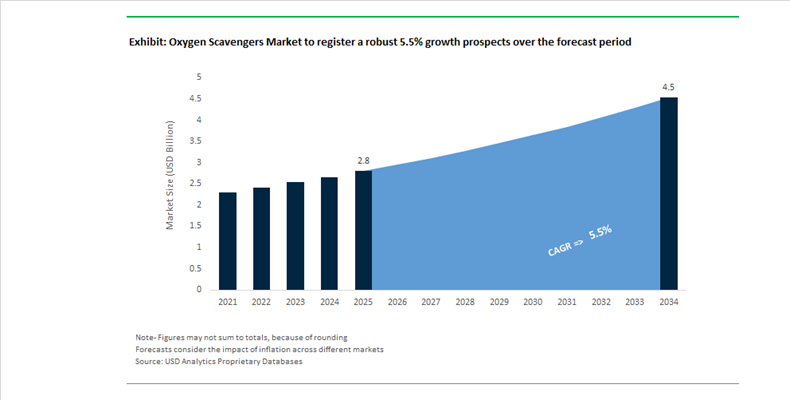
The Oxygen Scavengers Market is valued at $2.8 billion in 2025 and is projected to reach $4.5 billion by 2034, growing at a CAGR of 5.5%. Market expansion is being driven by rising demand for active packaging in pharmaceuticals, beverages, and high-value food products, alongside new applications in hydrogen purification and advanced materials processing. Oxygen scavengers, including iron-based sachets, polymer-integrated masterbatches, liquid PET additives, and catalytic deoxygenation systems, are increasingly deployed to prevent oxidative degradation, color loss, rancidity, and active pharmaceutical ingredient instability. Regulatory shifts toward recyclable packaging and the integration of high rPET content are reshaping additive chemistry, particularly in PET and multilayer barrier systems.
In February 2025, Avient introduced ColorMatrix™ Amosorb™ 4020L, a liquid oxygen-scavenging additive engineered to eliminate haze formation in PET bottles. The technology enables up to 100% recycled PET content while maintaining clarity and oxygen protection for sensitive beverages. In July 2025, Aptar launched a dual-active material science platform capable of controlling both oxygen and moisture in pharmaceutical packaging. The solution specifically targets oral solid dose GLP-1 therapies and medical devices where oxidative sensitivity directly impacts drug efficacy. In January 2025, Mitsubishi Gas Chemical received industry recognition for its OXYCAPT™ multilayer vial and syringe system, which integrates an internal oxygen-scavenging layer to replicate glass-level oxygen barriers while retaining polymer impact resistance.
Active packaging integration continues across flexible and rigid formats. In 2024, Sealed Air completed the integration of Liquibox, expanding its Cryovac portfolio of bag-in-box and flexible films with embedded oxygen-scavenging layers for liquid foods and industrial fluids. In late 2024, LOG Pharma Primary introduced its Eco-Line barrier solutions, entering full commercialization in 2025 with integrated scavenging structures tailored to pharmaceutical supply chains. In 2024, Sorbchem India launched the OxySorb series in sachet and label formats, targeting India’s expanding food export and pharma packaging markets with FDA-compliant oxygen absorption systems. Meanwhile, Henkel inaugurated its Packaging RecycLab in Shanghai in October 2025 to evaluate how oxygen scavengers and adhesives behave within recycling streams, aligning packaging design with emerging EU PPWR and Asian regulatory standards.
Beyond packaging, oxygen-scavenging chemistry is expanding into energy infrastructure. In May 2025, BASF and Plug Power signed a cooperation agreement to deploy Purivate™ Pd15 DeOxo catalysts in green hydrogen liquefaction facilities. These organometallic catalysts remove trace oxygen from electrolyzed hydrogen, ensuring fuel purity and system safety. In November 2025, BASF and ExxonMobil advanced methane pyrolysis collaboration, incorporating oxygen management catalysts to produce high-purity hydrogen and solid carbon. In parallel, Clariant launched PFAS-free AddWorks® PPA at NPE2024, influencing the formulation of oxygen-scavenging masterbatches such as Cesa ProTect to comply with tightening fluorochemical restrictions.
Commercial Trends and Scalable Opportunities in the Oxygen Scavengers Market
Mandatory Integration of Oxygen Scavengers in rPET Bottles to Enable Beverage Circularity
The global push toward circular packaging is structurally transforming the oxygen scavengers market, particularly within beverages. Between 2025 and 2030, leading soft drink, juice, and functional beverage brands are under binding commitments to move toward 50% to 100% recycled PET content. While rPET significantly lowers carbon footprints, it also introduces higher oxygen permeability and oxidative instability, directly threatening shelf life, flavor retention, and visual clarity. As a result, oxygen scavengers are no longer optional enhancements but embedded performance enablers in next-generation bottle designs.
In July 2025, Avient Corporation launched ColorMatrix Amosorb Oxyloop-1, the first oxygen scavenger formally endorsed by the European Platform for Bottle Packaging for full bottle-to-bottle recyclability in colored PET streams. Unlike legacy nylon-based scavengers, this polymer-integrated solution is optimized for 100% rPET applications, extending the shelf life of juices and vitamin drinks while preventing yellowing, a critical issue for recycled-content bottles.
This shift aligns with the broader rPET expansion strategy of The Coca-Cola Company, which rolled out 100% rPET bottles across more than 40 markets during 2024 and 2025, including India and Bangladesh. To maintain carbonation retention and flavor stability in thinner, recycled packaging, Coca-Cola increasingly relies on proprietary barrier systems combined with active oxygen scavengers. Regulatory momentum is reinforcing this trajectory. Updated 2025 frameworks from FSSAI and the European Commission now explicitly support food-contact recycled plastics, provided that active packaging components do not disrupt mechanical recycling. This is accelerating the shift away from iron-based sachets toward integrated, polymer-matrix scavengers, positioning oxygen scavengers as a cornerstone technology in beverage circularity strategies.
Flexible “Can-Replacement” Packaging Accelerates Adoption of High-Capacity Scavengers
Food brands pursuing net-zero targets and logistics efficiency are rapidly replacing metal cans and glass jars with high-barrier flexible packaging. This transition is structurally expanding demand for oxygen scavengers capable of maintaining internal oxygen levels below 0.1%, enabling long shelf life without heavy, carbon-intensive materials. Flexible pouches combined with scavenger systems can reduce total packaging weight by up to 70%, directly lowering transport emissions and costs.
A major inflection point occurred when Mitsubishi Gas Chemical transitioned its AGELESS oxygen scavenger portfolio to 100% PFAS-free formulations in late 2024 and 2025. This move ensured compliance with emerging EU and U.S. state-level bans on forever chemicals, unlocking adoption in sauces, ready meals, and processed meats. These solutions allow brands to achieve shelf lives exceeding 24 months, rivaling metal canning while supporting flexible packaging formats.
At the same time, formulation innovation is enabling clean-label positioning. A 2025 study published in Sustainable Food Technology demonstrated that non-iron oxygen scavengers can absorb up to 200 mL of oxygen per gram, allowing manufacturers to remove chemical antioxidants such as BHA and BHT from food recipes. Waste reduction is also becoming a value driver. At Labelexpo Europe 2025, Avery Dennison showcased active labels combining oxygen scavenging with RFID tracking, helping retailers better manage fresh-cut produce inventories and supporting Walmart’s target to halve operational food waste by 2030.
Precision Oxygen and Radical Scavenging for Hydrogen Fuel Cells and Energy Storage
The rapid emergence of the hydrogen economy is opening a high-margin, technology-driven opportunity for oxygen scavengers beyond packaging. In proton exchange membrane fuel cells, trace oxygen contamination and peroxide radical formation accelerate membrane degradation, directly reducing system efficiency and lifespan. Addressing this issue has become a strategic priority as fuel cells move from pilot deployments to commercial fleets.
The European Clean Hydrogen Joint Undertaking’s 2025 work programme has placed degradation mitigation at the center of fuel cell R&D funding. This has driven adoption of radical scavengers integrated directly into membrane electrode assemblies, with industrial data indicating potential lifetime extensions from roughly 5,000 operating hours to more than 20,000 hours. Parallel developments are visible in energy storage and electronics, where solid-state, moisture-independent scavengers are being deployed to protect sealed hydrogen sensors and high-voltage battery enclosures from internal corrosion. Benchmarking shows that effective scavenging can prevent the 10% to 20% power density loss typically observed in aging fuel cells, repositioning oxygen scavengers as critical engineering components rather than auxiliary materials.
Foil-Free Pharmaceutical Blisters Create Premium Demand for Active Scavenging Films
The expansion of biologics, vaccines, and high-value nutraceuticals is reshaping pharmaceutical packaging requirements. With the global biologics market approaching USD 500 billion, manufacturers are seeking oxygen protection solutions that avoid the opacity, recyclability challenges, and material intensity of aluminum foil. This is creating a premium opportunity for integrated oxygen scavenging films.
In January 2025, Aptar CSP Technologies released new performance data for its 3-Phase Activ-Polymer films, which actively remove oxygen from blister and bottle headspaces without the need for sachets. These solutions protect sensitive active pharmaceutical ingredients from oxidative degradation while supporting more streamlined, patient-friendly packaging designs. Complementing this, clear oxygen-scavenging and UV-barrier films introduced by Avery Dennison in September 2025 enable visual inspection of medicines while delivering protection comparable to traditional foil.
In the nutraceutical segment, adoption of iron-free scavengers based on ascorbic acid and gallic acid has accelerated since mid-2025. These systems align with consumer demand for green and clean-label supplements while ensuring the oxidative stability of fat-soluble vitamins during global distribution. Together, these developments signal a shift of the oxygen scavengers market toward high-margin, regulation-sensitive pharmaceutical and healthcare applications.
Oxygen Scavengers Market Share and Segmentation Insights
Inorganic Oxygen Scavengers Lead Market Adoption with Iron-Based Absorption Technology
Inorganic scavengers accounted for 58.60% of the Oxygen Scavengers Market by composition in 2025, reflecting their widespread use in oxygen control solutions for packaging and industrial environments. Iron-based oxygen scavengers dominate this segment due to their cost effectiveness, reliability, and long-standing regulatory acceptance in food packaging applications. These scavengers typically operate through moisture activated oxidation reactions that rapidly absorb residual oxygen within sealed packaging environments. Continuous advancements in iron particle activation and sachet permeability design have improved oxygen absorption rates and enabled lower residual oxygen levels in packaged products. In 2025, manufacturers are optimizing iron-based scavenger systems for compatibility with high speed packaging operations, supporting efficient oxygen control in large scale food packaging lines.
Food and Beverage Industry Drives Oxygen Scavenger Demand for Shelf Life Protection
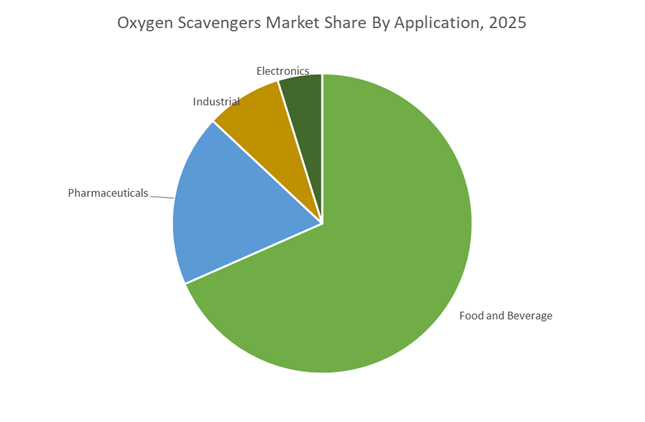
The food and beverage sector represented 68.4% of the Oxygen Scavengers Market by application in 2025, making it the primary consumer of oxygen removal technologies in packaging systems. Oxygen scavengers are widely used in packaged foods such as processed meats, dairy products, coffee, baked goods, snacks, and ready meals where oxygen exposure accelerates spoilage, discoloration, and flavor degradation. Packaging formats including sachets, oxygen absorbing labels, and active barrier films help maintain product quality during storage and distribution. In 2025, the global focus on food waste reduction and supply chain efficiency is increasing the adoption of oxygen scavenger technologies that extend product shelf life and support sustainability initiatives across food retail and packaged food manufacturing sectors.
Oxygen Scavengers Market Competitive Landscape
The Oxygen Scavengers Market is transitioning toward active-barrier resins, PFAS-free chemistries, and recyclable mono-material packaging. Industry leaders are integrating oxygen scavenging technologies into smart packaging systems, high-purity electronic-grade materials, and circular economy-compatible solutions to meet stringent food safety, pharmaceutical stability, and semiconductor processing requirements.
MGC pioneers active oxygen scavenging systems for biologics and semiconductor applications
Mitsubishi Gas Chemical (MGC) Company, Inc. continues to lead the oxygen scavengers market through its AGELESS™ technology while advancing high-performance active packaging systems. The company is developing next-generation scavengers for ready-to-eat and retort food applications, ensuring stability under high-moisture conditions. Its OXYCAPT™ multilayer vial and syringe system integrates oxygen-absorbing layers to protect oxygen-sensitive biologics, combining glass-like barrier performance with plastic durability. Expansion of electronic materials capacity enhances MGC’s position in semiconductor-grade oxygen scavengers for cleaning and etching processes. The integration of renewable plastics into its supply chain targets a 20–30% reduction in lifecycle carbon footprint by 2030. This combination of innovation, sustainability, and cross-industry application strengthens MGC’s global leadership.
Amcor integrates oxygen scavengers into recyclable mono-material pharma and food packaging
Amcor plc is redefining oxygen scavenger integration through its Responsible Packaging strategy, embedding scavenging functionality directly into recyclable mono-material films. Its AmSky™ thermoform blister system eliminates aluminum and PFAS while maintaining high-barrier performance for pharmaceutical packaging. The ClariPPil™ polypropylene containers deliver up to 84% improved oxygen and moisture protection compared to PET, supporting sensitive drug and nutraceutical applications. Through its Lift-Off 2025/26 Challenge, Amcor is investing in compostable and bio-based oxygen barrier technologies, accelerating innovation in sustainable packaging. Its CDMO capabilities enable end-to-end development of customized scavenger-integrated solutions. This approach positions Amcor at the forefront of circular, high-performance packaging systems.
BASF advances organic oxygen scavengers for industrial water treatment and polymer stabilization
BASF SE is strengthening its position in the oxygen scavengers market through its integrated Verbund production system and focus on industrial applications. The company specializes in organic oxygen scavengers, including advanced amine-based chemistries that replace hazardous hydrazine in boiler water treatment systems. Expansion of its Zhanjiang Verbund site enhances supply capacity for performance chemicals across Asia-Pacific industrial markets. BASF’s cost optimization program, targeting €2.3 billion by 2026, supports investment in carbon-neutral and bio-based scavenging solutions. With projected EBITDA of €6.2–€7.0 billion, its Chemicals and Nutrition & Care segments remain key growth drivers. This integration of scale, sustainability, and application-specific chemistry strengthens BASF’s competitive position.
Berry Global scales recyclable active-barrier packaging with integrated oxygen scavenging resins
Berry Global Group, Inc. is advancing the commercialization of oxygen scavenging technologies through integrated active-barrier packaging solutions. Its newly launched lightweight packaging reduces material usage by 15% while extending shelf life via embedded oxygen-absorbing resins. The acquisition of a flexible films business enhances its capacity in pet food and specialty beverage packaging requiring advanced oxygen control. BerryBarrier™ PCR solutions demonstrate that high oxygen scavenging efficiency can be maintained even with significant recycled content integration. The company’s localized manufacturing strategy in the IMEA region supports growing demand for shelf-stable dairy and beverage packaging. This combination of sustainability, scalability, and performance strengthens Berry’s market positioning.
Avient enables monolayer recyclable packaging with oxygen scavenger masterbatch technology
Avient Corporation is a key enabler in the oxygen scavengers market, providing advanced masterbatch technologies that transform standard plastics into high-performance oxygen barriers. Its Cesa™ ProTect masterbatch allows monolayer PET packaging to achieve barrier performance comparable to multi-layer structures, significantly improving recyclability. The company is expanding R&D efforts to develop sustainable, recycling-compatible oxygen scavenger additives aligned with modern sortation systems. Its solutions are widely used in beverage packaging, particularly for craft beer and wine, where oxidation control is critical for product quality. Expansion of technical centers in Europe and Asia supports customized formulation of scavenging rates for specific applications. This focus on material innovation and circular compatibility positions Avient as a critical value-chain player.
Japan – PFAS-Free Benchmarking and Pharmaceutical-Grade Integration
Japan remains the global reference point for advanced oxygen scavenger technologies, driven by regulatory foresight, IP leadership, and strong integration with pharmaceutical packaging. During 2024–2025, Mitsubishi Gas Chemical accelerated the global rollout of its AGELESS® PFAS-free oxygen absorbers, positioning them as the first universal scavenger system capable of eliminating grease-proofing agents while preserving oil resistance for fresh and processed foods. This transition has materially reshaped food packaging specifications, particularly for bakery, ready meals, and high-fat snack categories that previously relied on fluorinated chemistries. Parallel innovation is visible in biopharmaceutical packaging, where MGC’s OXYCAPT™ multilayer vials and syringes gained traction in 2025 for cell and gene therapies due to their superior UV shielding, intrinsic oxygen barrier performance, and reduced inorganic extractables compared with Type I glass.
Japan’s leadership is further reinforced by strategic IP and circularity-driven design. In December 2025, Mitsubishi Chemical Group received the Asia IP Elite award, underscoring its dominance in gas barrier resins such as SoarnoL, which are increasingly paired with active oxygen scavengers in multilayer films and paper-based packaging. The December 2025 announcement of SoarnoL-coated paper packaging marked a critical breakthrough, enabling PFAS-free, oil-resistant, and oxygen-sensitive paper formats suitable for recycling. At Expo 2025 Osaka, Japanese majors showcased Value Loop plastics, demonstrating scavenger systems engineered for compatibility with advanced mechanical recycling, reinforcing Japan’s role as the technology and compliance benchmark for the oxygen scavengers industry.
China – Recycling Readiness, Green Manufacturing, and Material Security
China’s oxygen scavengers market is being shaped by regulatory alignment with global packaging rules and strategic control over upstream materials. In October 2025, Henkel opened its Packaging RecycLab in Shanghai to evaluate how adhesives and oxygen scavengers influence flexible packaging recyclability under forthcoming EU PPWR requirements. This facility has accelerated domestic qualification of scavenger-compatible adhesive systems for export-oriented converters. On the production side, BASF SE commissioned a high-performance dispersant line in Nanjing in November 2025 using Controlled Free Radical Polymerization technology, supporting localized stabilization of liquid oxygen scavengers for coatings and industrial applications.
Regulatory pressure and resource governance are key structural forces. Updated RoHS conformity systems issued by the Ministry of Industry and Information Technology of China in November 2025 are pushing electronic-grade oxygen scavengers toward Green Manufacturing certification. Simultaneously, new Ministry of Commerce of China rules extending extraterritorial jurisdiction over rare earth elements are affecting supply chains for specialized inorganic scavengers used in high-temperature industrial environments. Counterbalancing this risk, BASF’s loopamid® polyamide 6 facility launched in Shanghai in early 2025 provides a circular, high-barrier carrier resin for active scavenging additives in automotive and apparel packaging, strengthening domestic material resilience.
United States – Regulatory Acceleration and Automation-Led Adoption
The U.S. oxygen scavengers industry is undergoing rapid transformation driven by state-level chemical bans and automation across packaging lines. From January 1, 2026, multiple states including Vermont and New Jersey fully enforced bans on intentionally added PFAS in food packaging, forcing a nationwide transition toward next-generation oxygen-absorbing sachets and integrated scavenger systems. This regulatory shift is accelerating reformulation away from fluorinated grease barriers toward iron-based, enzyme-driven, and polymer-embedded oxygen scavengers suitable for meat, dairy, and shelf-stable foods.
Technology adoption is equally influential. In January 2025, U.S. packaging forums highlighted robotic insertion systems for oxygen scavenger canisters, significantly reducing manual handling in pharmaceutical bottling and improving GMP compliance. At MD&M West 2025, U.S. developers introduced O2Block additives, layered clay carriers enabling uniform dispersion of iron-based scavengers directly into PE and PET trays for medical devices. Beyond packaging, the U.S. Department of Energy emphasized non-hydrazine oxygen scavengers in its 2025 industrial efficiency reports, reinforcing demand in boiler water treatment and high-pressure steam systems where corrosion control is mission-critical.
Germany – Carbon Accounting, BPA-Free Systems, and Bioprocess Applications
Germany’s oxygen scavengers market is being redefined by EU sustainability regulation and advanced material engineering. In response to EU PPWR requirements, German producers including BASF SE and Evonik Industries have reoriented 2026 portfolios toward certified mass-balanced oxygen scavengers. These systems allow brand owners to demonstrate lower Scope 3 emissions while maintaining high oxygen absorption efficiency in flexible and rigid packaging. The January 20, 2025 EU ban on Bisphenol A in food contact materials has further accelerated R&D into scavenger-integrated, BPA-free coatings for metal cans, replacing epoxy-based linings without compromising shelf life.
Specialty applications are expanding beyond packaging. In 2025, Evonik extended its additive portfolio to include enzymatic oxygen reduction agents tailored for high-purity fermentation and biopharmaceutical processes. These scavengers enable precise oxygen control in sensitive biologics manufacturing, reinforcing Germany’s role as a high-end, regulation-driven innovation hub within the global oxygen scavengers value chain.
India – Industrial Maintenance and Food Packaging Governance
India’s oxygen scavengers demand profile is anchored in industrial process reliability and evolving food safety regulation. In 2025, Hindustan Urvarak & Rasayan Limited issued centralized tenders for oxygen scavengers to support large-scale shutdowns at ammonia and urea plants, highlighting the critical role of oxygen removal in corrosion prevention and equipment longevity across public-sector infrastructure. This has sustained steady demand for non-hydrazine scavengers in boiler and process water treatment.
On the consumer side, regulatory clarity is emerging. In October 2025, the Food Safety and Standards Authority of India initiated consultations on the Food Safety and Standards (Packaging) Amendment Regulations 2025, proposing new migration limits for active packaging components such as oxygen scavengers. These consultations are expected to formalize adoption pathways for sachets and embedded scavenger systems in packaged foods, aligning India’s regulatory framework more closely with global best practices.
Comparative Snapshot – Oxygen Scavengers Industry by Country
Oxygen Scavengers Market County Level Snapshot
Country
Primary Demand Driver
Regulatory or Policy Trigger
Strategic Position
Japan
PFAS-free food and pharma packaging
Climate and circularity programs
Global technology benchmark
China
Recyclability and green manufacturing
RoHS and rare earth controls
Scale-driven, export-aligned hub
United States
PFAS bans and automation
State-level food packaging laws
Rapid adoption and integration
Germany
Carbon accounting and BPA ban
EU PPWR and food contact rules
Premium compliant solutions
India
Industrial maintenance and food safety
FSSAI packaging reforms
Emerging regulated growth market
Oxygen Scavengers Market Report Scope
Oxygen Scavengers Market
Parameter
Details
Market Size (2025)
$2.8 Billion
Market Size (2034)
$4.5 Billion
Market Growth Rate
5.5%
Segments
By Composition (Inorganic Scavengers, Organic Scavengers, Enzymatic Scavengers), By Form (Sachets and Canisters, Masterbatches and Resins, Bottle Caps and Labels, Liquid, Powder, Films), By Application (Food and Beverage, Pharmaceuticals, Industrial, Electronics)
Study Period
2019- 2025 and 2026-2034
Units
Revenue (USD)
Qualitative Analysis
Porter’s Five Forces, SWOT Profile, Market Share, Scenario Forecasts, Market Ecosystem, Company Ranking, Market Dynamics, Industry Benchmarking
Companies
Mitsubishi Gas Chemical Company, Mitsubishi Chemical Group, BASF, Henkel, Ecolab, Solenis, Nouryon, Kemira, Evonik Industries, Desiccare, Arkema, Kuraray, Sealed Air, Multisorb, Clariant
Countries
US, Canada, Mexico, Germany, France, Spain, Italy, UK, Russia, China, India, Japan, South Korea, Australia, South East Asia, Brazil, Argentina, Middle East, Africa
Oxygen Scavengers Market Segmentation
By Composition
Inorganic Scavengers
Organic Scavengers
Enzymatic Scavengers
By Form
Sachets and Canisters
Masterbatches and Resins
Bottle Caps and Labels
Liquid
Powder
Films
By Application
Food and Beverage
Pharmaceuticals
Industrial
Electronics
By Region
North America (United States, Canada, Mexico)
Europe (Germany, France, United Kingdom, Spain, Italy, Rest of Europe)
Asia Pacific (China, India, Japan, South Korea, Australia, Rest of APAC)
South and Central America (Brazil, Argentina, Rest of SCA)
Middle East and Africa (Saudi Arabia, UAE, South Africa, Rest of Middle East, Rest of Africa)
2. Oxygen Scavengers Market Landscape & Outlook (2025–2034)
2.1. Introduction to Oxygen Scavengers Market
2.2. Market Valuation and Growth Projections (2025–2034)
2.3. Role of Oxygen Scavengers in Active Packaging and Pharmaceutical Stability
2.4. Expansion into Hydrogen Purification and Advanced Materials Processing
2.5. Regulatory Shift Toward Recyclable Packaging and rPET Integration
3. Innovations Reshaping the Oxygen Scavengers Market
3.1. Trend: Mandatory Integration of Oxygen Scavengers in rPET Bottles for Beverage Circularity
3.2. Trend: Flexible “Can-Replacement” Packaging Driving High-Capacity Scavenger Adoption
3.3. Opportunity: Precision Oxygen and Radical Scavenging in Hydrogen Fuel Cells and Energy Storage
3.4. Opportunity: Foil-Free Pharmaceutical Blisters Driving Demand for Active Scavenging Films
4. Competitive Landscape and Strategic Initiatives
4.1. Mergers and Acquisitions
4.2. R&D and Material Innovation
4.3. Sustainability and ESG Strategies
4.4. Market Expansion and Regional Focus
5. Market Share and Segmentation Insights: Oxygen Scavengers Market
5.1. By Composition
5.1.1. Inorganic Scavengers
5.1.2. Organic Scavengers
5.1.3. Enzymatic Scavengers
5.2. By Form
5.2.1. Sachets and Canisters
5.2.2. Masterbatches and Resins
5.2.3. Bottle Caps and Labels
5.2.4. Liquid
5.2.5. Powder
5.2.6. Films
5.3. By Application
5.3.1. Food and Beverage
5.3.2. Pharmaceuticals
5.3.3. Industrial
5.3.4. Electronics
5.4. By Region
5.4.1. North America
5.4.2. Europe
5.4.3. Asia Pacific
5.4.4. South and Central America
5.4.5. Middle East and Africa
6. Country Analysis and Outlook of Oxygen Scavengers Market
6.1. United States
6.2. Canada
6.3. Mexico
6.4. Germany
6.5. France
6.6. Spain
6.7. Italy
6.8. UK
6.9. Russia
6.10. China
6.11. India
6.12. Japan
6.13. South Korea
6.14. Australia
6.15. South East Asia
6.16. Brazil
6.17. Argentina
6.18. Middle East
6.19. Africa
7. Oxygen Scavengers Market Size Outlook by Region (2025–2034)
7.1. North America Oxygen Scavengers Market Size Outlook to 2034
7.1.1. By Composition
7.1.2. By Form
7.1.3. By Application
7.1.4. By Region
7.2. Europe Oxygen Scavengers Market Size Outlook to 2034
7.2.1. By Composition
7.2.2. By Form
7.2.3. By Application
7.2.4. By Region
7.3. Asia Pacific Oxygen Scavengers Market Size Outlook to 2034
7.3.1. By Composition
7.3.2. By Form
7.3.3. By Application
7.3.4. By Region
7.4. South America Oxygen Scavengers Market Size Outlook to 2034
7.4.1. By Composition
7.4.2. By Form
7.4.3. By Application
7.4.4. By Region
7.5. Middle East and Africa Oxygen Scavengers Market Size Outlook to 2034
7.5.1. By Composition
7.5.2. By Form
7.5.3. By Application
7.5.4. By Region
8. Company Profiles: Leading Players in the Oxygen Scavengers Market
8.1. Mitsubishi Gas Chemical Company
8.2. Mitsubishi Chemical Group
8.3. BASF
8.4. Henkel
8.5. Ecolab
8.6. Solenis
8.7. Nouryon
8.8. Kemira
8.9. Evonik Industries
8.10. Desiccare
8.11. Arkema
8.12. Kuraray
8.13. Sealed Air
8.14. Multisorb
8.15. Clariant
9. Methodology
9.1. Research Scope
9.2. Market Research Approach
9.3. Market Sizing and Forecasting Model
9.4. Research Coverage
9.5. Data Horizon
9.6. Deliverables
10. Appendix
10.1. Acronyms and Abbreviations
10.2. List of Tables
10.3. List of Figures
Oxygen Scavengers Market Segmentation
By Composition
Inorganic Scavengers
Organic Scavengers
Enzymatic Scavengers
By Form
Sachets and Canisters
Masterbatches and Resins
Bottle Caps and Labels
Liquid
Powder
Films
By Application
Food and Beverage
Pharmaceuticals
Industrial
Electronics
By Region
North America (United States, Canada, Mexico)
Europe (Germany, France, United Kingdom, Spain, Italy, Rest of Europe)
Asia Pacific (China, India, Japan, South Korea, Australia, Rest of APAC)
South and Central America (Brazil, Argentina, Rest of SCA)
Middle East and Africa (Saudi Arabia, UAE, South Africa, Rest of Middle East, Rest of Africa)
The Oxygen Scavengers Market is valued at $2.8 billion in 2025 and is projected to reach $4.5 billion by 2034, growing at a CAGR of 5.5%. Growth is driven by rising adoption of active packaging solutions and increasing demand for oxygen control in high-value applications. Expansion into hydrogen purification and advanced materials is further strengthening long-term growth prospects.
Food and beverage packaging dominates demand, accounting for 68.40% of the market in 2025 due to the need for extended shelf life and oxidation prevention. Pharmaceutical packaging is emerging as a high-value segment, particularly for biologics and oxygen-sensitive drugs. Additionally, industrial applications such as boiler water treatment and electronics are expanding steadily.
The shift toward 50% to 100% recycled PET in beverage packaging is increasing oxygen permeability challenges, making scavengers essential. Polymer-integrated oxygen scavenger masterbatches are being adopted to maintain clarity, carbonation retention, and flavor stability. This transition is moving the market away from sachets toward embedded, recyclable-compatible scavenging systems.
Key players include Mitsubishi Gas Chemical, BASF, Avient, Amcor, Berry Global, and Evonik Industries. These companies are focusing on integrated active-barrier packaging, PFAS-free formulations, and recyclable mono-material solutions. Strategic investments in hydrogen purification catalysts and high-purity pharmaceutical packaging are enhancing their competitive positioning.
Major opportunities are emerging in hydrogen fuel cells and energy systems, where oxygen removal is critical for performance and safety. Flexible packaging replacing metal cans is driving demand for high-capacity scavengers. Additionally, pharmaceutical blister packaging and nutraceutical applications are creating premium demand for advanced oxygen-scavenging films.