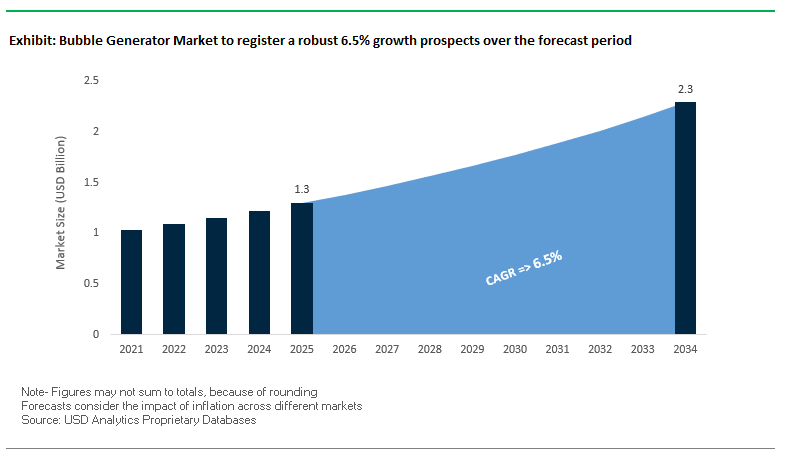
Bubble Generator Market to Reach USD 2.3 Billion by 2034, Driven by Nanobubble Innovations at 6.5% CAGR
The global bubble generator market is projected to grow from USD 1.3 billion in 2025 to USD 2.3 billion by 2034, registering a steady CAGR of 6.5%. Growth is underpinned by the rapid adoption of fine bubble technologies including microbubbles and nanobubbles in water treatment, aquaculture, agriculture, and industrial cleaning applications.
Unlike conventional aeration methods, nanobubbles persist in water for extended periods, offering superior gas transfer efficiency, reduced energy consumption, and chemical-free purification capabilities. This makes bubble generators highly attractive for industries under pressure to reduce environmental footprints while boosting operational performance. The rise of regulatory mandates favoring chemical-free processes and the increasing adoption of precision agriculture and aquaculture systems are further fueling demand.
Efficiency gains: Energy savings of up to 20% in wastewater treatment plants.
Aquaculture growth: Nanobubbles improve oxygenation and fish survival rates.
Chemical-free adoption: Strong momentum in industrial cleaning and disinfection.
Regulatory push: EU and APAC governments supporting eco-friendly aeration methods.
Market Analysis: Regulatory Policies and R&D Investments Accelerate Fine Bubble Technology
The bubble generator industry is undergoing a period of strong regulatory and technological transformation, with recent developments highlighting both regional adoption trends and corporate expansions.
In August 2025, a new academic study showcased the potential of ultrafine bubble (UFB) technology in wound healing, widening the scope of applications beyond traditional water treatment. The same month, the EU introduced stricter regulations on chemical usage in industrial processes, which is expected to accelerate the integration of bubble generators as sustainable, chemical-free cleaning and aeration alternatives.
The corporate landscape is equally dynamic. Honeywell’s acquisition of Sundyne in June 2025 for USD 2.16 billion strengthened its presence in engineered pumps and compressors an adjacent market with potential for fine bubble integration. Xylem Inc. (April 2025) expanded its innovation footprint by establishing a new R&D hub in Singapore, focusing on nanobubble technologies for advanced water treatment. Similarly, Moleaer (March 2025) launched its Trinity Nanobubble Generator, targeting the agricultural sector with improved crop health and irrigation efficiency.
Collaborations and regional expansions are also reshaping the market. Acniti (September 2024) partnered with Vsquare Holding B.V. to bring its nanobubble generators to the Benelux region, while Moleaer (October 2024) deepened its footprint in Europe through a partnership with Spain’s BS Nature. Strategic acquisitions, such as Pentair’s purchase of advanced aeration technology in December 2023, reinforce the industry’s move toward consolidated portfolios and cross-sector applicability.
Innovative Trends and Strategic Growth Opportunities in the Bubble Generator Market
Adoption of Fine Bubble Aeration for Enhanced Wastewater Treatment Efficiency
The bubble generator market is witnessing a shift toward fine bubble aeration systems, replacing traditional coarse bubble diffusers in municipal and industrial wastewater treatment plants. This trend is driven by the need to reduce energy consumption, which can account for 50-60% of a facility’s total energy use, and to comply with stricter environmental discharge regulations. Fine bubble systems provide superior oxygen transfer efficiency, with technical studies showing rates of approximately 6.5 lb-O2/hp-hr, compared to 2.0 lb-O2/hp-hr for coarse bubble diffusers. Historical data from the U.S. EPA highlights that upgrading to fine bubble aeration can reduce energy use by 30-40%, offering a clear economic and environmental advantage. European examples, such as Stavnsholt, Denmark, demonstrate tangible benefits, including a 5.3% reduction in electricity consumption, increased treatment capacity, and reduced chemical usage. Leading municipalities and industrial operators are increasingly prioritizing fine bubble technology to achieve cost-effective, energy-efficient wastewater treatment.
Integration of Nanobubble Technology in Aquaculture and Agriculture
Nanobubble generators, producing bubbles smaller than 200 nanometers, are gaining traction in agriculture, aquaculture, and water treatment, due to their high stability and gas transfer efficiency. Unlike conventional bubbles, nanobubbles remain suspended for days or months, providing sustained oxygenation without disturbing aquatic life. Companies such as Moleaer, in partnership with Xylem Inc., are scaling these technologies for municipal and industrial applications globally. In agriculture, trials by the Delphy Research Institute demonstrated a 14% yield increase in strawberries and a 74% reduction in root disease using nanobubble irrigation. Similarly, municipal treatment facilities in California achieved up to 20% increased wastewater treatment capacity while reducing energy and chemical usage by 40%. Nanobubble technology presents a powerful growth avenue for operational savings, enhanced water treatment efficiency, and sustainable agricultural productivity.
Application of Nanobubbles for In-Situ Groundwater Remediation
A significant market opportunity lies in using nanobubbles for groundwater remediation. Oxygen or ozone nanobubbles can be injected directly into contaminated aquifers to stimulate the biodegradation of pollutants by native bacteria, offering a cost-effective and environmentally friendly alternative to traditional pump-and-treat methods. Academic studies highlight the efficacy of in-situ nanobubble applications in accelerating contaminant breakdown. Pilot projects, such as Moleaer’s use in water hazard management in Florida, demonstrate the technology’s potential for targeted water quality improvement. The adoption of robust nanobubble systems could revolutionize groundwater remediation by reducing remediation time, operational costs, and environmental impact, creating a transformative opportunity in environmental management markets.
Development of Energy-Efficient, Solar-Powered Bubble Generators for Developing Markets
Another strategic opportunity is the deployment of solar-powered, off-grid bubble generators, targeting remote aquaculture farms and communities lacking reliable electricity. Low-cost solar aeration systems address oxygen deficiencies in ponds, prevent massive fish kills, and enhance food security in developing regions. Companies such as BioRemedy and DIFFUL are developing durable solar-powered aeration systems with high-efficiency panels. The declining cost of solar energy makes these solutions increasingly feasible. Adoption of solar-powered bubble generators can drive economic stability, improved livelihoods, and public health by providing reliable aeration and water treatment solutions. This trend positions the bubble generator market at the intersection of sustainable technology, social impact, and agricultural innovation.
Competitive Landscape: Leading Companies in Global Bubble Generator Industry
The bubble generator market is moderately consolidated, with nanobubble specialists, water technology giants, and fluid engineering leaders driving innovation and global expansion.
Moleaer Inc. Strengthens Agricultural Applications with Nanobubble Generators
Moleaer has emerged as a leader in nanobubble generation, supplying systems for agriculture, aquaculture, and water treatment. In March 2025, it launched the Trinity Nanobubble Generator, reinforcing its position in precision agriculture by improving crop yield and water quality. Moleaer’s patented technology, capable of generating trillions of nanobubbles per second, is a core differentiator in sustainable water management.
Acniti Expands European Presence Through Strategic Partnerships
Acniti specializes in nanobubble generators and oxygen concentrators, with flagship products like the miniGaLF and GaLF series. In September 2024, it partnered with Vsquare Holding B.V. to expand across Benelux, extending its reach to more than 50 global markets. Acniti’s strength lies in user-friendly designs and versatile bubble sizes, making it adaptable for industrial, agricultural, and healthcare uses.
Xylem Inc. Invests in Nanobubble R&D in Singapore
Xylem, a global water technology powerhouse, is embedding fine bubble systems into its wastewater and aquaculture solutions. Its April 2025 R&D investment in Singapore signals a stronger APAC focus, aligning with rising demand in Asia’s urban water infrastructure. With its integrated business model, Xylem delivers seamless treatment and aeration systems that combine scale, efficiency, and sustainability.
Sulzer Ltd. Leverages Fluid Engineering Expertise in Fine Bubble Systems
Sulzer applies its fluid engineering capabilities to fine bubble diffusers and aeration systems widely used in municipal and industrial treatment plants. In June 2025, it enhanced its product portfolio with new sustainable designs, focusing on performance optimization and lower lifecycle costs. Sulzer’s global network and engineering depth position it as a reliable partner for large-scale water infrastructure projects.
Pentair Expands Portfolio with Aeration System Acquisition
Pentair, known for its advanced water treatment systems, reinforced its fine bubble technology capabilities through a December 2023 acquisition of a specialist aeration company. This move strengthens Pentair’s offering for aquaculture and industrial water treatment, aligning with its strategy of providing energy-efficient and chemical-free solutions. Its global presence and acquisition-driven growth continue to enhance its competitive positioning.
Bubble Generator Market Share Insights
Micro Bubbles Dominate Market Share by Bubble Size in the Bubble Generator Industry
Micro bubble generators command the largest share at 45%, establishing themselves as the efficiency benchmark in the bubble generator industry. Their dominance stems from the superior gas transfer efficiency created by their high surface area-to-volume ratio, which makes them indispensable in oxygen-intensive processes such as wastewater treatment aeration, aquaculture systems, and fermentation processes. Industrial operators favor micro bubbles because they optimize dissolved oxygen transfer while maintaining cost-effective energy consumption, an essential balance in sectors where aeration is the single largest operational energy draw. While macro bubbles retain a strong position in rugged, high-flow applications and nano bubbles are gaining traction for advanced, precision uses like oxidation and groundwater remediation, micro bubbles remain the industry workhorse, capturing share through their scalability, reliability, and balance of efficiency with operating costs.
Industrial End-Users Drive the Largest Market Share in the Bubble Generator Industry
The industrial sector accounts for 50% of global bubble generator demand, highlighting its central role in process-critical operations. This segment includes diverse applications across chemical processing, oil & gas, mining, aquaculture, power generation, and food & beverage manufacturing, where gas infusion and aeration are not auxiliary but core to efficiency and compliance. Industrial end-users prioritize robust, high-performance systems to meet increasingly stringent environmental discharge regulations while controlling costs. The scale of industrial wastewater and process gas treatment creates consistent demand, with investments often tied to broader sustainability goals and ESG reporting. Municipal wastewater plants, while substantial at 35%, remain more cyclical and regulation-driven, whereas commercial and residential applications represent emerging but niche markets. The dominance of industrial end-users underscores how bubble generators are positioned as strategic capital equipment that delivers measurable operational efficiency and regulatory compliance.
United States: Smart Technologies and Regulatory Backing Driving Fine Bubble Generator Adoption
The United States bubble generator market is rapidly evolving due to strong regulatory emphasis on water treatment efficiency and sustainability. The Environmental Protection Agency’s National Strategy to Prevent Plastic Pollution indirectly fuels demand for fine and ultrafine bubble technologies, as industries seek advanced aeration and purification solutions. Companies are investing heavily Moleaer’s INDALO gas-to-liquid nanobubble system, launched in October 2023, was specifically designed for harsh environmental conditions, while acniti’s partnership with Vsquare Holding expands nanobubble adoption across global markets. Around 28% of U.S. industries now integrate smart sensors into nanobubble systems, unlocking real-time monitoring and predictive analytics to optimize energy use and performance.
Applications are diverse, spanning municipal water treatment, where fine bubble generators improve dissolved oxygen levels and cut chemical usage, to healthcare, where about 31% of ultrafine bubble generators are applied in wound healing and sterilization. Energy savings are a decisive adoption factor, with nearly 29% of U.S. manufacturers reporting over 20% energy efficiency gains compared to traditional aeration. This focus on operational cost reduction, coupled with government support for carbon-neutral purification technologies, makes the U.S. a global leader in bubble generator innovation and commercialization.
Germany: Industry 4.0 and Sustainability Anchoring Bubble Generator Growth
Germany’s bubble generator market is shaped by a strict sustainability and regulatory framework, aligned with the EU’s circular economy goals. Strong water quality standards and a robust deposit-return system are pushing industries toward advanced aeration technologies that reduce chemical inputs. The country’s Plattform Industrie 4.0 initiative is further accelerating the integration of digital automation and smart manufacturing into fine and nanobubble generators, enabling data-driven operations and efficiency gains.
Germany is a research and development hub, with companies investing in systems optimized for wastewater, industrial processing, and aquaculture. Fine bubble generators are increasingly used to enhance oxygen supply in aquaculture, boosting fish health and productivity. Collaborative R&D projects between industrial players and research institutions aim to refine gas-liquid mixing efficiency and tailor solutions for different water sources. The market’s sustainability push has also prompted German industries to deploy bubble generators to cut energy consumption and reduce chemical reliance, reinforcing Germany’s position as a European leader in clean water and precision aeration solutions.
China: Dual Carbon Goals and Domestic Substitution Fueling Market Expansion
China’s bubble generator market is propelled by the government’s dual carbon policy, which targets carbon peaking by 2030 and neutrality by 2060. This policy has spurred stricter environmental regulations and greater support for bio-based and clean technologies, making fine and nanobubble generators a natural fit for wastewater and agricultural applications. The State Administration for Market Regulation (SAMR) continues to strengthen “GB” regulatory standards, aligning them with international safety benchmarks while driving industrial modernization.
Technological advancements are transforming China’s manufacturing ecosystem, with companies integrating AI, automation, and 5G-enabled industrial internet platforms to optimize bubble generator production. A key trend is domestic substitution, where local firms like Shanghai Mutao Environmental Technology are scaling up production to reduce dependence on imports. Applications are expanding across aquaculture, agriculture, and industrial wastewater treatment, where efficient nanobubble systems deliver both cost savings and environmental benefits. China is also one of the top contributors to nanobubble technology patents, reflecting its role as both a large-scale user and global innovator in this sector.
India: Agriculture and Food Processing Driving Bubble Generator Demand
India’s bubble generator market is shaped by government initiatives such as Make in India and the National Mission on Sustainable Packaging Solutions, which emphasize local manufacturing and sustainability. Regulatory measures from the Ministry of Environment, Forest, and Climate Change (MoEFCC), particularly the ban on single-use plastics, are pushing industries toward eco-friendly water treatment and aeration technologies. These policies create fertile ground for bubble generators in wastewater treatment, industrial cleaning, and agricultural applications.
Agriculture remains the centerpiece of demand, with bubble generators being used to improve irrigation efficiency and nutrient absorption, vital for India’s large farming sector. Corporate activity is also robust Siegwerk’s INR 350 crore investment in September 2025 highlights the country’s growing focus on innovation and sustainability in industrial processes. Rising adoption of automation and affordability-focused designs is helping expand market accessibility. Additionally, the food processing sector and online retail ecosystem are creating a surge in demand for bubble generators that enhance water treatment, product safety, and process efficiency, positioning India as a high-growth market in the global bubble generator industry.
Brazil: Regulatory Shifts and Sustainable Manufacturing Powering Market Growth
Brazil’s bubble generator market is gaining momentum due to sweeping regulatory reforms and sustainability goals. The 2010 National Solid Waste Policy and a 2024 law banning single-use items by 2030 are steering industries toward eco-friendly production. The ANVISA Collegiate Board Resolution (RDC) 843/2024 streamlined regulatory processes, accelerating the introduction of compliant technologies. The government’s targets of 30% mandatory recycling now and 50% by 2040 will directly impact equipment design, pushing adoption of bubble generators aligned with green manufacturing.
Technological modernization is another key driver, as Brazilian industries increasingly adopt robotics and AI-driven solutions for sorting, defect detection, and process efficiency. Corporate initiatives center on investing in advanced equipment that can handle biodegradable and recyclable materials, aligning with sustainability trends. Demand is particularly high in agriculture and industrial water treatment, where bubble generators play a critical role in food safety and environmental compliance. The convergence of regulatory support, corporate investments, and sustainability-driven innovation makes Brazil one of the most promising emerging markets for bubble generators in Latin America.
Japan: Precision Manufacturing and Research Excellence Elevating Bubble Generator Innovation
Japan’s bubble generator market thrives on a unique combination of regulatory support, technological precision, and academic innovation. The Plastic Resource Circulation Act of 2022 established a framework for manufacturers to design environmentally friendly products and reduce single-use plastics. Research initiatives into microbubble generation using swirl jets showcase Japan’s engineering excellence in controlling bubble size and distribution, key to enhancing efficiency in industrial and healthcare applications.
Corporate and academic collaborations continue to push boundaries. Companies like Toppan are developing recyclable, lightweight, and high-barrier paper-based packaging solutions, indirectly shaping machinery design requirements for bubble applications. Meanwhile, Japanese universities are pioneering the use of biopolymers and natural agents in packaging-related water treatment technologies, underscoring the deep connection between academic research and industrial deployment. Japan’s ready adoption of smart packaging technologies, integration of sensors, and focus on specialized high-performance applications highlight its role as a global frontrunner in the next-generation bubble generator industry.
Bubble Generator Market Report Scope
Bubble Generator Market
Parameter
Details
Market Size (2025)
$1.3 Billion
Market Size (2034)
$2.3 Billion
Market Growth Rate
6.5%
Segments
By Bubble Size (Macro Bubble, Micro Bubbles, Nano Bubbles), By Technology (Diffused Air Systems, Electrolytic Generators, Mechanical Aerators, Ultrasonic Generators), By Application (Aquaculture, Chemical & Petrochemical, Food & Beverage, Pharmaceutical & Biotechnology, Water & Wastewater Treatment, Agriculture & Horticulture, Medical & Healthcare, Others), By Function (Flotation, Gas-Liquid Mixing, Ozonation, Particle Aggregation & Removal), By End-Use Industry (Industrial, Residential, Municipal, Commercial)
Study Period
2019- 2024 and 2025-2034
Units
Revenue (USD)
Qualitative Analysis
Porter’s Five Forces, SWOT Profile, Market Share, Scenario Forecasts, Market Ecosystem, Company Ranking, Market Dynamics, Industry Benchmarking
Companies
Moleaer Inc., LIVING ENERIGES & Co., Nikuni Co., Ltd., acniti LLC., Armstrong International, Watergen Ltd., Fine Bubble Technologies, SUEZ Water Technologies & Solutions, Aqua-Q AB, Shanghai Mutao Environmental Technology Co., Ltd., YAMAGEN MT & T PTE. LTD., Maruhachi Pump Manufacturing Co., Ltd., Nano Gas Technologies, Inc., Nanobubble Technologies Inc., Aeration Industries International, Inc.
Countries
US, Canada, Mexico, Germany, France, Spain, Italy, UK, Russia, China, India, Japan, South Korea, Australia, South East Asia, Brazil, Argentina, Middle East, Africa
Bubble Generator Market Segmentation
By Bubble Size
Macro Bubble
Micro Bubbles
Nano Bubbles
By Technology
Diffused Air Systems
Electrolytic Generators
Mechanical Aerators
Ultrasonic Generators
By Application
Aquaculture
Chemical & Petrochemical
Food & Beverage
Pharmaceutical & Biotechnology
Water & Wastewater Treatment
Agriculture & Horticulture
Medical & Healthcare
Others
By Function
Flotation
Gas-Liquid Mixing
Ozonation
Particle Aggregation & Removal
By End-Use Industry
Industrial
Residential
Municipal
Commercial
Countries Analyzed
North America (US, Canada, Mexico)
Europe (Germany, UK, France, Spain, Italy, Russia, Rest of Europe)
Asia Pacific (China, India, Japan, South Korea, Australia, South East Asia, Rest of Asia)
South America (Brazil, Argentina, Rest of South America)
Middle East and Africa (Saudi Arabia, UAE, Rest of Middle East, South Africa, Egypt, Rest of Africa)
Top Companies in Bubble Generator Market
Moleaer Inc.
LIVING ENERIGES & Co.
Nikuni Co., Ltd.
acniti LLC.
Armstrong International
Watergen Ltd.
Fine Bubble Technologies
SUEZ Water Technologies & Solutions
Aqua-Q AB
Shanghai Mutao Environmental Technology Co., Ltd.
YAMAGEN MT & T PTE. LTD.
Maruhachi Pump Manufacturing Co., Ltd.
Nano Gas Technologies, Inc.
Nanobubble Technologies Inc.
Aeration Industries International, Inc.
* List Not Exhaustive
Methodology
USDAnalytics employs a robust, data-driven methodology to deliver precise insights into the global bubble generator market. Our approach integrates primary research including interviews with industry stakeholders such as bubble generator manufacturers, aquaculture specialists, wastewater treatment operators, and regulatory authorities with extensive secondary research derived from company filings, patent databases, academic studies, trade publications, and government policies. Market sizing, CAGR projections, and trend analyses are generated by evaluating technologies such as microbubbles, nanobubbles, diffused air systems, electrolytic generators, and ultrasonic generators, alongside applications spanning aquaculture, agriculture, industrial cleaning, and water treatment. USDAnalytics also examines the impact of regulatory mandates, energy efficiency requirements, and sustainability initiatives across key regions including the U.S., EU, China, India, Brazil, and Japan. Corporate strategies, mergers, R&D investments, and technological innovations by leading players such as Moleaer, Xylem, Acniti, Sulzer, and Pentair are assessed to provide actionable insights on market drivers, competitive dynamics, and growth opportunities, enabling professionals to make informed decisions in this rapidly evolving sector.
Deliverables:
Comprehensive Market Research Report (PDF and Excel) with detailed tables, charts, and interactive visualizations.
Country-Specific Forecasts & Analysis.
Segment-Wise Revenue Forecasts (2025–2034).
Competitive Analysis, Benchmarking, and SWOT Profiles.
Recent Developments & Innovation Tracker.
Executive Summary & Analyst Commentary.
Post-Purchase Analyst Support for Client-Specific Questions and Custom Data Requirements.
2. Bubble Generator Market Landscape & Outlook (2025–2034)
2.1. Introduction to Bubble Generator Market
2.2. Market Valuation and Growth Projections (2025–2034)
2.3. Regulatory Policies Driving Market Adoption
2.4. R&D Investments and Technological Advancements
2.5. Corporate Expansions and Strategic Partnerships
3. Innovations Reshaping the Bubble Generator Market
3.1. Trend: Adoption of Fine Bubble Aeration for Enhanced Wastewater Treatment Efficiency
3.2. Trend: Integration of Nanobubble Technology in Aquaculture and Agriculture
3.3. Opportunity: Application of Nanobubbles for In-Situ Groundwater Remediation
3.4. Opportunity: Development of Energy-Efficient, Solar-Powered Bubble Generators for Developing Markets
4. Competitive Landscape and Strategic Initiatives
4.1. Mergers, Acquisitions and Strategic Alliances
4.2. R&D and Material Innovation
4.3. Sustainability and Strategies
4.4. Market Expansion and Regional Focus
5. Market Share and Segmentation Insights: Bubble Generator Market
5.1. By Bubble Size
5.1.1. Macro Bubble
5.1.2. Micro Bubbles
5.1.3. Nano Bubbles
5.2. By Technology
5.2.1. Diffused Air Systems
5.2.2. Electrolytic Generators
5.2.3. Mechanical Aerators
5.2.4. Ultrasonic Generators
5.3. By Application
5.3.1. Aquaculture
5.3.2. Chemical & Petrochemical
5.3.3. Food & Beverage
5.3.4. Pharmaceutical & Biotechnology
5.3.5. Water & Wastewater Treatment
5.3.6. Agriculture & Horticulture
5.3.7. Medical & Healthcare
5.3.8. Others
5.4. By Function
5.4.1. Flotation
5.4.2. Gas-Liquid Mixing
5.4.3. Ozonation
5.4.4. Particle Aggregation & Removal
5.5. By End-Use Industry
5.5.1. Industrial
5.5.2. Residential
5.5.3. Municipal
5.5.4. Commercial
6. Country Analysis and Outlook of Bubble Generator Market
6.1. United States
6.2. Canada
6.3. Mexico
6.4. Germany
6.5. France
6.6. Spain
6.7. Italy
6.8. UK
6.9. Russia
6.10. China
6.11. India
6.12. Japan
6.13. South Korea
6.14. Australia
6.15. South East Asia
6.16. Brazil
6.17. Argentina
6.18. Middle East
6.19. Africa
7. Bubble Generator Market Size Outlook by Region (2025–2034)
7.1. North America Bubble Generator Market Size Outlook to 2034
7.1.1. By Bubble Size
7.1.2. By Technology
7.1.3. By Application
7.1.4. By End-Use Industry
7.2. Europe Bubble Generator Market Size Outlook to 2034
7.2.1. By Bubble Size
7.2.2. By Technology
7.2.3. By Application
7.2.4. By End-Use Industry
7.3. Asia Pacific Bubble Generator Market Size Outlook to 2034
7.3.1. By Bubble Size
7.3.2. By Technology
7.3.3. By Application
7.3.4. By End-Use Industry
7.4. South America Bubble Generator Market Size Outlook to 2034
7.4.1. By Bubble Size
7.4.2. By Technology
7.4.3. By Application
7.4.4. By End-Use Industry
7.5. Middle East and Africa Bubble Generator Market Size Outlook to 2034
7.5.1. By Bubble Size
7.5.2. By Technology
7.5.3. By Application
7.5.4. By End-Use Industry
8. Company Profiles: Leading Players in the Bubble Generator Market
8.1. Moleaer Inc.
8.2. LIVING ENERGIES & Co.
8.3. Nikuni Co., Ltd.
8.4. Acniti LLC.
8.5. Armstrong International
8.6. Watergen Ltd.
8.7. Fine Bubble Technologies
8.8. SUEZ Water Technologies & Solutions
8.9. Aqua-Q AB
8.10. Shanghai Mutao Environmental Technology Co., Ltd.
8.11. YAMAGEN MT & T PTE. LTD.
8.12. Maruhachi Pump Manufacturing Co., Ltd.
8.13. Nano Gas Technologies, Inc.
8.14. Nanobubble Technologies Inc.
8.15. Aeration Industries International, Inc.
9. Methodology
9.1. Research Scope
9.2. Market Research Approach
9.3. Market Sizing and Forecasting Model
9.4. Research Coverage
9.5. Data Horizon
9.6. Deliverables
10. Appendix
10.1. Acronyms and Abbreviations
10.2. List of Tables
10.3. List of Figures
Bubble Generator Market Segmentation
By Bubble Size
Macro Bubble
Micro Bubbles
Nano Bubbles
By Technology
Diffused Air Systems
Electrolytic Generators
Mechanical Aerators
Ultrasonic Generators
By Application
Aquaculture
Chemical & Petrochemical
Food & Beverage
Pharmaceutical & Biotechnology
Water & Wastewater Treatment
Agriculture & Horticulture
Medical & Healthcare
Others
By Function
Flotation
Gas-Liquid Mixing
Ozonation
Particle Aggregation & Removal
By End-Use Industry
Industrial
Residential
Municipal
Commercial
Countries Analyzed
North America (US, Canada, Mexico)
Europe (Germany, UK, France, Spain, Italy, Russia, Rest of Europe)
Asia Pacific (China, India, Japan, South Korea, Australia, South East Asia, Rest of Asia)
South America (Brazil, Argentina, Rest of South America)
Middle East and Africa (Saudi Arabia, UAE, Rest of Middle East, South Africa, Egypt, Rest of Africa)
Growth is fueled by the adoption of microbubble and nanobubble technologies across water treatment, aquaculture, agriculture, and industrial cleaning. Energy efficiency, chemical-free purification, regulatory mandates, and rising demand for sustainable processes are key contributors to the market’s 6.5% CAGR.
Nanobubbles improve oxygenation and nutrient delivery in water systems, supporting higher crop yields and healthier aquatic life. Studies show up to 14% crop yield increase and 74% reduction in root diseases, while also enabling chemical-free irrigation and water treatment.
Fine bubble aeration systems increase oxygen transfer efficiency, reduce energy consumption by 20–40%, and minimize chemical use in municipal and industrial wastewater treatment plants. This enables cost-effective, sustainable operations aligned with stricter environmental regulations.
Key players include Moleaer, Xylem, Acniti, Sulzer, and Pentair. They focus on nanobubble and fine bubble systems, energy-efficient designs, and integrated solutions across industrial, municipal, agricultural, and healthcare applications, driving global adoption and technological advancements.
Opportunities include solar-powered bubble generators for off-grid applications, in-situ groundwater remediation using oxygen or ozone nanobubbles, and hybrid systems integrating micro- and nanobubbles. These innovations reduce operational costs, enhance sustainability, and open new markets in developing regions and precision agriculture.