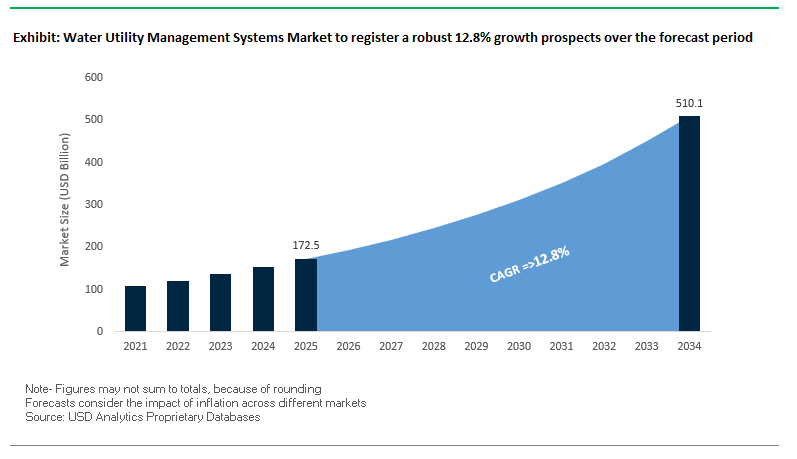
The global water utility management systems market is projected to grow from $172.5 billion in 2025 to $510 billion by 2034, representing a robust CAGR of 12.8%. This rapid growth is being fueled by increasing urbanization, escalating non-revenue water (NRW) concerns, climate change-induced water stress, and widespread digitalization of water networks. Utilities are under significant pressure to modernize aging infrastructure while adopting smart and resilient management systems that integrate predictive analytics, IoT, and AI technologies.
Rising global water scarcity and growing regulatory mandates are accelerating the adoption of digital utility management solutions. Smart water platforms enable utilities to monitor network efficiency, reduce water losses, and enhance operational reliability. Moreover, cybersecurity is emerging as a critical requirement as digital infrastructure becomes more integrated with cloud-based platforms and IoT-connected devices.
Key Insights for Industry Stakeholders:
Urbanization is stressing existing water networks, creating opportunities for modernization using smart utility management systems.
Non-revenue water remains a significant challenge, with some regions losing up to 47% of produced water.
Climate change and water scarcity are driving demand for resilient, predictive, and efficient utility management solutions.
Digitalization introduces operational efficiencies but also increases the need for cybersecurity in critical water infrastructure.
Integration of AI, cloud computing, and IoT is reshaping water utility operations, enabling real-time monitoring and analytics.
Market Analysis: Recent Developments in Water Utility Management Systems
The water utility management systems market has experienced a surge in innovative deployments and strategic partnerships. In August 2025, Itron Inc. partnered with the Water Authority of Fiji to launch the first smart water metering project in the Fiji Islands, leveraging Cyble communication modules and the Temetra cloud platform to reduce NRW, which is estimated at 47%. During the same month, the European Investment Bank (EIB) committed €250 million to support modernization efforts at EYDAP, Athens Water Supply and Sewerage Company, targeting smart meters and digital systems.
In May 2025, the New Zealand government passed legislation for its "Local Water Done Well" reform plan, restructuring water asset management and promoting the adoption of advanced utility management systems. Earlier, in April 2025, OTT HydroMet launched its OTT Flood Monitoring System, integrating IoT devices with radar sensors for high-accuracy water level and quality measurement to improve flood risk management. Meanwhile, in February 2025, Veolia Environnement partnered with Mistral AI to develop the Veolia Secure GPT, integrating generative AI for enhanced resource management and operational optimization.
Key strategic acquisitions and technology integrations have further shaped the market. In November 2024, In-Situ Inc. acquired ChemScan to expand its real-time monitoring capabilities. Earlier, in October 2023, SUEZ and SAMP partnered to accelerate digital twin deployment in water and wastewater infrastructure. Additionally, Schneider Electric’s automation of India’s largest water treatment plant in January 2024 demonstrated the practical application of IoT-enabled platforms to improve operational efficiency for millions of residents.
Key Trends Driving Digital Water Utility Management
Digital Transformation and the Rise of Digital Twins
The water utility management systems market is being transformed by digital twin technology, AI, and IoT-enabled monitoring. A 2025 academic review highlights how utilities are leveraging digital twins to simulate real-time operational scenarios, predict maintenance needs, and optimize system performance. For example, the Alder Dam project in Washington, operated by Tacoma Public Utilities and supported by the U.S. Department of Energy, uses digital twins to simulate turbine operations under varying conditions like low water flow or high energy demand. Companies like Xylem are deploying "smart sewer" technologies, achieving up to 80% reduction in Combined Sewer Overflow (CSO) and avoiding hundreds of millions in capital expenditure. This trend emphasizes the industry’s shift toward data-driven, predictive water management.
Non-Revenue Water (NRW) Reduction as a Strategic Imperative
Reducing Non-Revenue Water (NRW) water lost through leaks, bursts, or theft is a critical trend for utilities globally. Advanced metering infrastructure (AMI), real-time analytics, and AI algorithms are enabling precise detection of leaks and anomalies, minimizing water loss, and enhancing revenue protection. The Jal Jeevan Mission in India demonstrates a decentralized, data-driven approach, training women to use Field Testing Kits (FTKs) and upload water quality data online. Such initiatives highlight how technology and community engagement are increasingly integrated to improve water system efficiency and public health outcomes.
Climate Resilience and Sustainability Integration
Utilities are prioritizing resilient, climate-ready water infrastructure to withstand extreme weather and environmental challenges. The U.S. Infrastructure Investment and Jobs Act of 2021 allocates significant federal funding for modernization and resilience in water utilities. Corporates like Veolia Water Technologies and Solutions are implementing holistic sustainability strategies, recovering energy from wastewater and nutrients for fertilizer, turning water systems into revenue-generating and environmentally sustainable operations. These trends indicate a strong market push toward green, efficient, and climate-resilient water utility management.
Strategic Opportunities in Water Utility Management Systems
The Water Utility Management Systems Market offers robust opportunities for vendors providing integrated SCADA, AMI, asset management, and leak detection solutions. Utilities are seeking platforms that enable proactive asset management, NRW reduction, and digital integration. Cloud-based deployment, predictive analytics, and mobile workforce tools represent high-growth avenues. Additionally, sustainability initiatives and customer engagement technologies create long-term opportunities for solutions that optimize operational efficiency, reduce losses, and improve transparency.
Market Share Insights of Water Utility Management Systems
Market Share by Solution Type: SCADA Leads with Strategic Asset Management Growth
By solution type, SCADA systems (20.9%) remain the backbone of operations, providing real-time control over pumps, valves, and treatment processes. AMI/AMR drives revenue protection and operational efficiency by enabling accurate billing, remote reads, and leak alerts. Asset Management Systems (13.2%) and Leak Detection Systems (7–9%) reflect the shift toward proactive infrastructure maintenance. Other solutions like CIS, GIS, Workforce Management, MDM, Water Quality Monitoring, Hydraulic Modeling, LIMS, and EAM integrate operational, financial, and compliance functions, creating a unified data ecosystem. The trend toward integrated and proactive water utility management is clearly reflected in this segmentation.
Market Share by Deployment Mode: Cloud-Based Solutions Dominate
Cloud-based (SaaS) deployment (65%) leads the market, offering utilities lower upfront costs, scalability, and automatic updates. On-premise solutions (35%) remain relevant for large utilities requiring customized, secure systems with direct control over servers. The growing preference for cloud reflects the industry’s move toward flexible, scalable, and cost-efficient digital water solutions, especially for small and medium-sized utilities lacking extensive IT infrastructure.
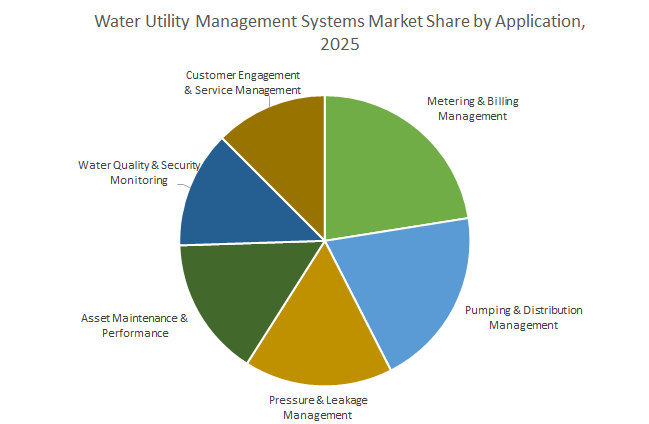
Market Share by Application: Metering, Pumping, and Leakage Management Lead
Metering & Billing Management (22.5%) is the largest application, driven by AMI-enabled revenue protection and customer interaction. Pumping & Distribution Management (20.9%) optimizes energy and system reliability, while Pressure & Leakage Management targets reduction of NRW, which can reach 25–50% of produced water in some networks. Asset Maintenance & Performance (14.9%), Water Quality & Security Monitoring (13.2%), and Customer Engagement & Service Management represent critical applications that improve operational efficiency, regulatory compliance, and customer satisfaction, emphasizing the multi-dimensional value of modern water utility management systems.
United States: AI-Driven Water Utility Management for Infrastructure Modernization
The United States water utility management systems (WUMS) market is strongly influenced by federal initiatives, regulatory support, and technological innovations. The U.S. Environmental Protection Agency (EPA) actively promotes the Effective Utility Management (EUM) framework, focusing on ten attributes of well-managed water systems. The Bipartisan Infrastructure Law (BIL) provides over $50 billion to enhance water infrastructure, with significant portions allocated to the adoption of digital WUMS solutions. Updated guidance, such as the August 2024 EUM Primer, emphasizes asset management, risk and resilience, and customer satisfaction, which are all strengthened through WUMS integration. Additionally, programs like the USDA Rural Energy for America Program (REAP) provide grants and loan guarantees for WUMS-integrated projects, including farm-based anaerobic digesters. Corporate innovations, exemplified by Itron’s 2024 upgrade of the Temetra platform with AI-driven analytics, enable early fault detection, leak prevention, and improved network resilience. The market is primarily driven by the need to modernize aging infrastructure, reduce non-revenue water (NRW), and comply with expanding federal and state regulations.
China: Smart Water Governance and Sponge City Initiatives
China’s WUMS market growth is propelled by urban modernization projects and government-backed infrastructure initiatives. The "Sponge City" program aims for more than 80% of urban built-up areas to meet stormwater management standards by 2030, necessitating sophisticated WUMS for real-time monitoring and management. Large-scale infrastructure projects, including the Yarlung Zangbo hydropower dam, require advanced water management systems to ensure water security and flood mitigation. Regulatory reforms, such as the "Strictest Water Resources Management System," create a demand for data-driven governance, while technological advancements in smart water management (SWM) leveraging IoT, AI, and big data enable predictive maintenance and operational efficiency. Key applications include urban flood control, sustainable stormwater management, and compliance with water pollution regulations.
India: IoT-Enabled Water Monitoring and Rural Water Supply Enhancement
India’s water utility management systems market is driven by government programs, infrastructure investments, and AI-based technological adoption. The "Jal Jeevan Mission" deploys sensor-based IoT devices to monitor rural drinking water supply systems in over six lakh villages, providing near real-time data without manual intervention. The Union Budget for 2025–26 allocated significant funding for water management, further boosting demand for WUMS. Regulatory frameworks such as the Central Pollution Control Board’s (CPCB) National Water Quality Monitoring Programme (NWMP) depend on WUMS for accurate, timely, and publicly available water quality data. Technological partnerships, including Pani Energy and Murugappa Water Technology & Solutions in November 2024, emphasize AI-driven solutions for proactive water management. Market applications include improving rural water quality, enhancing urban water network efficiency, and supporting sustainable sanitation.
Germany: Digital Twins and AI-Enhanced Water Management
Germany’s WUMS market is shaped by regulatory compliance, climate adaptation strategies, and digital transformation initiatives. The revised EU Urban Wastewater Treatment Directive (January 2025) requires wastewater plants to implement a "4th purification stage" to remove micropollutants, driving innovation in advanced monitoring and management systems. German cities, guided by the Federal Environment Agency (UBA), are adopting digital twins, AI, and IoT-enabled monitoring for optimized water management, critical for remote operations and WUMS integration. Corporate initiatives, such as the German Water Partnership’s "WATER 4.0" working group, highlight the role of IoT and service-based solutions in resource-efficient, flexible, and competitive water utility management. Applications focus on compliance, climate resilience, and operational optimization.
United Kingdom: Regulatory Frameworks and Real-Time Monitoring
The UK water utility management systems market benefits from regulatory oversight, corporate innovation, and infrastructure modernization. The Water Industry National Environment Programme (WINEP) outlines environmental obligations and allocates £22.1 billion for asset improvements, including sludge management and other water infrastructure upgrades. Innovative solutions such as Siemens’ Water Quality Analytics as a Service (WQAaaS), introduced in 2024, provide real-time data and predictive analytics for asset optimization, making WUMS a critical tool for operational efficiency. Market drivers include modernization of aging infrastructure, enhanced service resilience, and integration of digital monitoring for proactive water management.
Australia: Remote Monitoring and Digital Twin Integration for Water Utilities
Australia’s WUMS market is supported by significant infrastructure investments, technological innovation, and corporate leadership in digital solutions. Sydney Water announced a $34 billion investment over the next 10 years to renew existing assets and implement new projects, including advanced remote monitoring systems. The Commonwealth Scientific and Industrial Research Organisation (CSIRO) leads in remote sensing and data analytics, employing satellite imagery and ground-based sensors to track water quality across large water bodies. Companies like Aqua Analytics are pioneering digital twin development for water networks, enabling non-revenue water reduction, operational efficiency, and informed decision-making. Key applications include water conservation, network optimization, and sustainable management of urban and regional water systems.
Competitive Landscape of Water Utility Management Systems Market
The water utility management systems market is highly competitive, with leading players emphasizing digital transformation, AI integration, and IoT-enabled solutions. Companies offer end-to-end platforms that enable utilities to reduce water loss, optimize network performance, and improve operational sustainability.
Xylem Inc. excels in smart water solutions and network optimization
Xylem Inc. combines advanced water technologies with digital analytics and services. Its Sensus smart meters and Xylem Vue platform enable real-time monitoring and decision support for utilities. Strategic acquisitions, including Evoqua Water Technologies for $7.5 billion (2024), have expanded Xylem’s portfolio across treatment and utility management. With a presence in over 150 countries, Xylem also contributes to community resilience via its Xylem Watermark program, supporting education and access to safe water.
SUEZ S.A. leads in predictive and integrated water management
SUEZ S.A. provides end-to-end water cycle services with its AQUADVANCED® suite, offering real-time monitoring and predictive analytics. In a 2023 Macao case study, SUEZ achieved a water loss rate of under 9%, outperforming national targets. The company also leverages digital twin technology in partnership with SAMP and has expanded in Asia through strategic projects, reinforcing its position in advanced water utility management.
Veolia Environnement specializes in optimized resource management, focusing on circular economy principles. Its Hubgrade platform integrates AI and analytics for predictive maintenance and operational optimization. In February 2025, Veolia partnered with Mistral AI to incorporate generative AI into its operations, aiming to prevent 18 million tons of CO₂ equivalent at client sites by 2027. The company emphasizes sustainability, decarbonization, and resource efficiency in water utility operations.
Itron Inc. provides scalable smart metering and data management
Itron Inc. offers advanced metering infrastructure (AMI) solutions and cloud-based platforms. Its Temetra system enables multi-vendor data management for utilities. The August 2025 smart water project in Fiji demonstrated Itron’s ability to convert mechanical meters into smart devices using clip-on communication modules, facilitating phased and cost-effective digital transformation for utilities worldwide.
Schneider Electric SE leads in IoT-enabled water infrastructure automation
Schneider Electric delivers digital and automation solutions through its EcoStruxure platform, offering IoT-enabled monitoring of water treatment plants and distribution networks. The January 2024 automation of Mumbai’s largest water treatment plant showcases the scalability and efficiency of Schneider’s solutions. The company focuses on sustainability, achieving up to 30% energy savings and significant CO₂ reduction for water utilities.
Water Utility Management Systems Market Report Scope
Water Utility Management Systems Market
Parameter
Details
Market Size (2025)
$172.5 Billion
Market Size (2034)
$510 Billion
Market Growth Rate
12.8%
Segments
By Solution Type (Customer Information Systems & Billing, Asset Management Systems, Supervisory Control and Data Acquisition, Geographic Information Systems, Advanced Metering Infrastructure & Automatic Meter Reading, Meter Data Management, Laboratory Information Management Systems, Workforce Management Systems, Hydraulic Modeling & Simulation Software, Enterprise Asset Management, Leak Detection Systems, Water Quality Monitoring Systems), By Deployment Mode (On-premise, Cloud-based), By Application (Water Quality & Security Monitoring, Pumping & Distribution Management, Pressure & Leakage Management, Metering & Billing Management, Asset Maintenance & Performance, Customer Engagement & Service Management), By Utility Size (Large Utilities, Medium Utilities, Small Utilities), By End-User (Municipal Water Utilities, Industrial Water Utilities, Private Water Utilities)
Study Period
2019- 2024 and 2025-2034
Units
Revenue (USD)
Qualitative Analysis
Porter’s Five Forces, SWOT Profile, Market Share, Scenario Forecasts, Market Ecosystem, Company Ranking, Market Dynamics, Industry Benchmarking
US, Canada, Mexico, Germany, France, Spain, Italy, UK, Russia, China, India, Japan, South Korea, Australia, South East Asia, Brazil, Argentina, Middle East, Africa
Water Utility Management Systems Market Segmentation
By Solution Type
Customer Information Systems (CIS) & Billing
Asset Management Systems
Supervisory Control and Data Acquisition (SCADA)
Geographic Information Systems (GIS)
Advanced Metering Infrastructure (AMI) & Automatic Meter Reading (AMR)
Meter Data Management (MDM)
Laboratory Information Management Systems (LIMS)
Workforce Management Systems
Hydraulic Modeling & Simulation Software
Enterprise Asset Management (EAM)
Leak Detection Systems
Water Quality Monitoring Systems
By Deployment Mode
On-premise
Cloud-based
By Application
Water Quality & Security Monitoring
Pumping & Distribution Management
Pressure & Leakage Management
Metering & Billing Management
Asset Maintenance & Performance
Customer Engagement & Service Management
By Utility Size
Large Utilities
Medium Utilities
Small Utilities
By End-User
Municipal Water Utilities
Industrial Water Utilities
Private Water Utilities
Countries Analyzed
North America (US, Canada, Mexico)
Europe (Germany, UK, France, Spain, Italy, Russia, Rest of Europe)
Asia Pacific (China, India, Japan, South Korea, Australia, South East Asia, Rest of Asia)
South America (Brazil, Argentina, Rest of South America)
Middle East and Africa (Saudi Arabia, UAE, Rest of Middle East, South Africa, Egypt, Rest of Africa)
Top Companies in the Water Utility Management Systems Industry include-
Xylem Inc.
Veolia
SUEZ
Evoqua Water Technologies
Itron Inc.
ABB Ltd.
Trimble Inc.
Siemens
Bentley Systems, Incorporated
Schneider Electric
Hach (Danaher Corporation)
Badger Meter
Oracle Corporation
Rockwell Automation, Inc.
Emerson Electric Co.
*- List not Exhaustive
Research Coverage
The latest Water Utility Management Systems Market Report by USDAnalytics investigates the transformative role of digital platforms, predictive analytics, IoT, and AI in modernizing water infrastructure and addressing global water scarcity challenges. This report highlights breakthroughs in digital twin deployments, smart metering projects, and AI-driven predictive maintenance while providing detailed analysis reviews on the integration of cybersecurity, sustainability, and climate resilience in water management. By examining strategic acquisitions, regulatory frameworks, and real-world case studies across utilities, this report is an essential resource for decision-makers, policymakers, and industry leaders seeking to optimize operational efficiency, reduce non-revenue water, and implement future-ready utility management strategies. Scope Includes-
Segmentation: By solution type, deployment mode, application, utility size, and end-user
Geographic Scope: Analysis spans 25+ countries across North America, Europe, Asia Pacific, Latin America, the Middle East & Africa
Historic & Forecast Data: Historic data from 2021 to 2024 and forecast data from 2025 to 2034
Companies: Analysis/profiles of 15+ companies including Xylem Inc., Veolia, SUEZ, Evoqua Water Technologies, Itron Inc., ABB Ltd., Trimble Inc., Siemens, Bentley Systems, Schneider Electric, Hach (Danaher Corporation), Badger Meter, Oracle Corporation, Rockwell Automation, and Emerson Electric Co.
Methodology
The methodology adopted by USDAnalytics combines primary and secondary research with data triangulation to deliver fact-based insights. Primary research involved interviews with utility operators, technology providers, policymakers, and industry experts, while secondary research encompassed government reports, regulatory filings, company disclosures, and technical journals. Advanced modeling tools were used to forecast market growth across segments and geographies, ensuring accurate projections from 2025 to 2034. The study also integrates SWOT analysis, technology benchmarking, and recent case studies to present a holistic and practical view of market opportunities and risks for industry professionals.
Deliverables:
Comprehensive Market Research Report (PDF and Excel) with detailed tables, charts, and interactive visualizations.
Country-Specific Forecasts & Analysis.
Segment-Wise Revenue Forecasts (2025–2034).
Competitive Analysis, Benchmarking, and SWOT Profiles.
Recent Developments & Innovation Tracker.
Executive Summary & Analyst Commentary.
Post-Purchase Analyst Support for Client-Specific Questions and Custom Data Requirements.
Table of Contents: Water Utility Management Systems Market
1. Executive Summary
1.1. Market Highlights & Key Projections
1.2. Global Market Snapshot
1.3. Key Findings
2. Water Utility Management Systems Market Outlook (2025–2034)
2.1. Introduction: Digitalization of Water Networks
2.2. Market Valuation and Growth Projections (2025–2034)
The market is expanding rapidly due to urbanization, rising non-revenue water (NRW) concerns, climate change-driven water stress, and digital transformation. Utilities are adopting smart systems powered by IoT, AI, and predictive analytics to modernize infrastructure and ensure resilience against water scarcity and regulatory pressures.
Digital twins enable utilities to simulate network operations, optimize maintenance schedules, and predict failures under various conditions. Case studies such as Tacoma Public Utilities’ Alder Dam demonstrate how digital twin integration reduces downtime, boosts efficiency, and supports climate resilience in water management operations.
North America and Europe lead adoption, driven by federal funding, strict regulations, and modernization programs. Meanwhile, Asia Pacific markets like China and India are advancing rapidly with initiatives such as China’s Sponge City program and India’s Jal Jeevan Mission, both emphasizing smart metering, IoT monitoring, and digital governance.
As utilities integrate IoT, AI, and cloud-based solutions, cybersecurity has become a top priority. Digital water networks are increasingly vulnerable to cyber threats, making secure platforms and AI-based threat detection crucial to safeguarding critical infrastructure and ensuring operational continuity.
Key players include Xylem Inc., Veolia, SUEZ, Itron Inc., ABB Ltd., Siemens, Bentley Systems, Schneider Electric, Oracle Corporation, Rockwell Automation, and Emerson Electric Co. These companies are leading innovation in smart metering, IoT-enabled platforms, automation, and AI-driven solutions that enhance efficiency and reduce water losses.