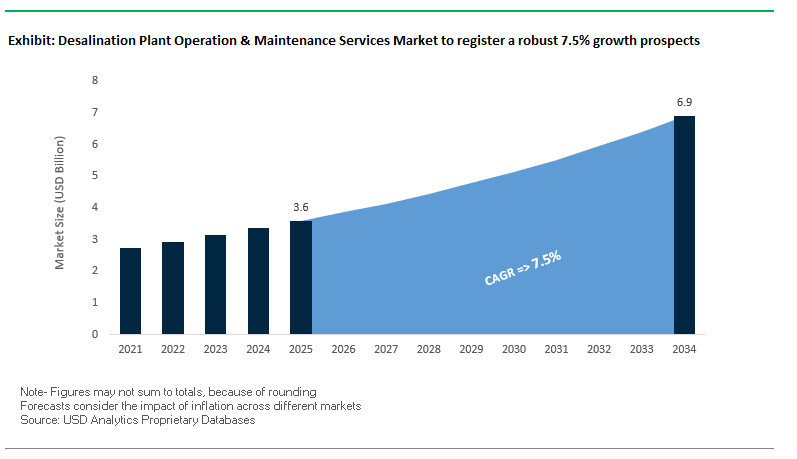
The global desalination plant operation & maintenance (O&M) services market is projected to grow from $3.6 billion in 2025 to $6.9 billion by 2034, reflecting a CAGR of 7.5%. The market growth is primarily driven by increasing global water scarcity, declining desalination costs, and the rising adoption of energy-efficient technologies. Utilities and industrial players are actively seeking reliable O&M partners to ensure continuous operations, reduce energy consumption, and optimize asset lifecycle management.
Desalination plants are evolving beyond mere water production facilities to digitally optimized, energy-efficient assets that integrate AI, predictive maintenance, and digital twins. Public-private partnerships (PPPs) are increasingly shaping the market landscape, enabling long-term O&M contracts and financing solutions. Industry Stakeholders are focusing on sustainability, automation, and operational resilience as key differentiators for selecting O&M service providers.
Key Insights for Industry Stakeholders:
Persistent global water scarcity is driving investment in new desalination capacity and advanced O&M services.
Energy-efficient reverse osmosis (RO) plants, with energy intensities below 3 kWh per cubic meter, are making large-scale desalination more economically viable.
Governments and utilities are leveraging PPPs to finance complex desalination projects, with O&M contracts providing long-term operational stability.
AI-driven asset management and digital twin solutions are increasingly adopted to optimize plant performance and reduce energy costs.
O&M services now emphasize sustainability, automation, and predictive maintenance to maximize asset longevity and efficiency.
Market Analysis: Recent Developments in Desalination Plant O&M Services
The desalination plant O&M services market has seen notable developments in project financing, technological integration, and sustainable operations. In August 2025, a consultant was appointed to revamp the Minjur desalination plant in Chennai, India, which had been non-operational for months. The plant is expected to resume partial operations within the year, reflecting growing attention to revitalize existing infrastructure. During the same month, the European Investment Bank (EIB) announced a €250 million investment program supporting modernization efforts at EYDAP, Athens Water Supply and Sewerage Company, likely integrating advanced management systems for both current and future plants.
In May 2025, Acciona Agua secured financing for the Casablanca desalination plant in Morocco, which will produce 300 million cubic meters per year entirely powered by renewable energy, highlighting the trend toward sustainable solutions. Earlier, in April 2025, SUEZ commissioned China’s largest industrial membrane-based seawater desalination plant for Wanhua Chemical’s Penglai Industrial Park, the country’s first fully automated facility. In March 2025, Veolia Water Technologies expanded its mobile water services in Malaysia with three new assets, demonstrating strategic flexibility for industrial clients.
Significant contract awards in previous years include VA Tech Wabag’s $10 million O&M contract in May 2024 for Oman’s Al Duqm Desalination Plant and Veolia’s commissioning of the Al Dur 1 IWPP in Bahrain (January 2023) with a 218,000 m³/day capacity. Notably, in August 2022, Doosan Enerbility secured a $640 million contract with ACWA Power for the Shuaibah 3 IWP in Saudi Arabia, designed to produce 600,000 tons of water daily, reflecting strong demand for large-scale desalination projects in the Middle East.
Key Trends Driving O&M Services in Desalination
Integration of Digital Solutions for Predictive Maintenance
The desalination plant operation & maintenance (O&M) services market is increasingly driven by digital twin technology, real-time monitoring, and predictive maintenance. A 2025 study from ACS Publications highlights that digital twins allow operators to simulate plant operations, optimize energy consumption, and prevent membrane fouling a critical challenge in desalination. Leading companies like IDE Technologies demonstrate the impact of these technologies, achieving 98% plant availability over two decades through proactive operational strategies and low-maintenance designs. This trend illustrates how digital solutions are transforming O&M into a value-generating function, improving plant reliability and longevity.
Shift Towards Performance-Based Public-Private Partnerships (PPPs)
Governments and utilities are increasingly adopting performance-based PPP models for desalination projects, linking O&M responsibility to long-term contracts. For instance, the V.O. Chidambaranar Port Authority in India issued a 5 MLD desalination plant project on a DBFOT basis, requiring private entities to manage long-term operations. Similarly, the Shuqaiq 3 plant in Saudi Arabia has achieved global recognition for its energy-efficient design and long-term PPP model, which incentivizes operational excellence. Such frameworks are accelerating the adoption of specialized O&M services, emphasizing efficiency, reliability, and contractual accountability.
Strategic Focus on Energy Efficiency and Sustainability
Energy consumption is a critical factor in desalination O&M. The Saudi Water Authority (SWA) has achieved a 10.9% reduction in specific energy consumption since 2020 by prioritizing Reverse Osmosis (RO) technology and implementing energy-saving strategies. Companies like VA TECH WABAG are securing long-term O&M contracts, such as the 7-year SWRO Nemmeli Desalination Plant project in Chennai, emphasizing performance, efficiency, and sustainable water supply. The integration of energy-efficient practices and sustainability measures is redefining O&M as a strategic, high-value service.
Strategic Opportunities in Desalination O&M Services
The market presents strong opportunities for service providers offering integrated operation, maintenance, spare parts management, and consulting. Digital solutions for predictive maintenance, coupled with performance-based PPPs, create demand for long-term, specialized O&M contracts. Energy-efficient and sustainable O&M practices are opening avenues for cost savings and environmental compliance. Additionally, distributed and small-scale desalination plants present growth opportunities for standardized O&M packages, while mobile and containerized units offer niche solutions for emergency or temporary water supply needs.
Market Share Insights of Desalination Plant Operation & Maintenance Services
By Service Type: Operation Services Lead with Maintenance and Spare Parts Growing
By service type, Operation Services (44.1%) dominate the market, encompassing 24/7 plant operations, process control, monitoring, and reporting. Maintenance Services (32.8%) are critical for preventing unplanned shutdowns, membrane fouling, and corrosion in thermal plants. Spare Parts Management (16.9%) mitigates risk by ensuring availability of proprietary components such as high-pressure pumps and membrane vessels. Training & Consulting Services provide knowledge transfer, performance optimization, and advisory support, enhancing long-term plant efficiency. The segmentation highlights the strategic importance of operations and maintenance in securing water supply reliability.
By Plant Technology: RO Plants Dominate, Thermal and Hybrid Offer Premium O&M
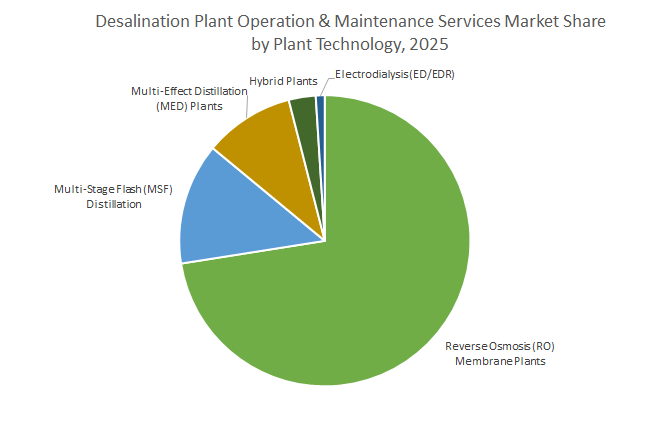
Reverse Osmosis (RO) Membrane Plants (72%) lead due to their prevalence in new installations and specialized O&M requirements for membrane management, chemical dosing, and energy recovery. Multi-Stage Flash (MSF) (13.2%) and Multi-Effect Distillation (MED) Plants represent legacy thermal systems requiring extensive mechanical maintenance for scaling, corrosion, and high-temperature operations. Hybrid Plants combine RO and thermal technologies, demanding dual expertise and commanding premium O&M contracts. Electrodialysis (ED/EDR) (1–3%) serves niche applications. This segmentation underscores technology-driven complexity and specialization in desalination O&M.
By Plant Capacity & Type: Large-Scale Plants Capture Maximum Value
Large-Scale Plants (>50,000 m³/day, 52.5%) dominate market value due to the complexity and long-term nature of their O&M contracts, often spanning hundreds of millions of dollars. Medium-Scale Plants (26.9%) cater to municipalities and large industries and represent a fast-growing segment. Small-Scale & Modular Plants (16.9%) support remote communities, tourism, and mining operations, while Mobile & Containerized Units provide emergency or temporary solutions with bundled O&M services. This distribution highlights the market’s dual focus on high-value large-scale operations and flexible, distributed desalination solutions.
Saudi Arabia: Vision 2030 Driving Advanced Desalination O&M Services
Saudi Arabia is positioning itself as a global hub for desalination operation and maintenance services, underpinned by its Vision 2030 strategy which prioritizes water security as a national pillar. The Ministry of Environment, Water, and Agriculture (MEWA) has set a bold target to meet over 90% of water demand through desalination by 2030, which translates into an enormous pipeline of O&M contracts. The Saudi Water Partnership Company (SWPC) continues to roll out new Public-Private Partnership (PPP) desalination projects, while the Saudi Water Authority (SWA) recently awarded two large-scale projects in July 2025. This influx of infrastructure not only strengthens the Kingdom’s water resilience but also creates sustained opportunities for specialized O&M firms.
Saudi Arabia is also emerging as a technological leader in reverse osmosis (RO)-based desalination, with landmark facilities like the Shuaibah plant setting new efficiency standards in energy consumption and environmental stewardship. A major trend shaping the O&M market in the Kingdom is the integration of renewable energy particularly solar into desalination operations, reducing dependency on fossil fuels while enhancing sustainability. These advancements necessitate highly skilled O&M teams to manage complex hybrid systems, as desalination is increasingly deployed to serve the Kingdom’s growing population and expanding industrial base.
United Arab Emirates: Mega Projects Fuel Demand for Long-Term O&M Contracts
The United Arab Emirates (UAE) is accelerating its investments in desalination O&M services through a national water security strategy that ensures sustainable access to water under all conditions. A defining example is the Taweelah desalination plant, one of the world’s largest reverse osmosis facilities, which demonstrates the UAE’s focus on scale and efficiency. These mega-projects demand sophisticated and long-term O&M expertise, creating a strong growth platform for contractors specializing in asset management, predictive maintenance, and digital monitoring solutions.
From a regulatory perspective, the Dubai Electricity and Water Authority (DEWA) is spearheading initiatives to cut non-revenue water (NRW) to world-class levels, driving demand for advanced maintenance practices and precision leak detection. At the same time, the UAE is exploring disruptive innovations such as regenerative data centers that utilize waste heat to power desalination systems, reinforcing a circular economy model. These technological integrations call for highly specialized O&M skill sets, positioning the UAE as one of the most dynamic markets for desalination services globally.
Morocco’s desalination O&M market is being reshaped by its National Water Plan, which allocates nearly $40 billion to combat chronic water shortages from decades-long drought. A significant share of this investment is directed toward seawater desalination projects, reflecting the country’s urgency to secure drinking water for its growing urban populations. In October 2024, Veolia entered a landmark 35-year public-private partnership with Morocco for a new desalination plant near Rabat, a contract that includes long-term O&M responsibilities. This trend signals rising opportunities for global players to enter Morocco’s desalination services ecosystem.
The country is also advancing renewable-powered desalination, with a large-scale Casablanca project led by ACCIONA set to run entirely on wind energy. This integration of renewable energy not only reduces carbon footprints but also requires new O&M protocols and advanced skill sets. The primary applications driving Morocco’s desalination O&M market are urban drinking water supply in drought-hit regions like Rabat-Salé-Kénitra and Fès-Meknès, alongside support for the agricultural sector. Such dual demand strengthens the long-term relevance of specialized maintenance services in the country.
China: Industrial Desalination and Hybrid Systems Expanding O&M Demand
China’s desalination O&M market is closely tied to its national regulatory framework under the 14th Five-Year Plan, which prioritizes water conservation, reuse, and sustainable supply for both industrial and municipal sectors. With more than 35 new desalination projects announced in 2020 alone, the demand for long-term maintenance and compliance services is surging, particularly in coastal provinces where freshwater demand continues to outpace supply.
Chinese companies are rapidly innovating in advanced membrane technologies and hybrid desalination systems that combine thermal and reverse osmosis processes, enhancing efficiency while lowering costs. These complex systems require specialized O&M expertise to ensure smooth operations and regulatory compliance. Key demand drivers include industrial sectors such as power generation, petrochemicals, and manufacturing, in addition to municipal water supply for expanding coastal cities. This makes China one of the fastest-evolving markets for desalination maintenance services worldwide.
Israel: Global Innovation Leader in Desalination O&M Practices
Israel’s desalination O&M market stands out due to its pioneering water management strategy, led by Mekorot, the national water company. The country has transformed its water security landscape by meeting a majority of its domestic demand through desalination, making operation and maintenance services critical for system reliability. The market is defined by a strong emphasis on efficiency, redundancy, and resilience to ensure a consistent water supply for households, agriculture, and high-tech industries.
IDE Technologies, a global leader in desalination innovation, is headquartered in Israel and continues to set global benchmarks. In March 2025, IDE commissioned the Sorek 2 - Be’er Miriam facility, the world’s first steam-driven seawater reverse osmosis (SWRO) plant. This groundbreaking project demonstrates Israel’s leadership in energy-efficient desalination, requiring advanced O&M protocols for cutting-edge systems. Israel’s combination of innovation and operational excellence positions it as a model for desalination maintenance practices globally.
Algeria is rapidly expanding its desalination capacity with multiple new projects designed to alleviate chronic water scarcity. The government is pushing ahead with projects such as Fouka 2, Cap Djinet 2, and Koudiet Eddraouche, all scheduled to come online in 2025. These facilities will require continuous O&M services, opening up opportunities for both local and international service providers with expertise in large-scale reverse osmosis operations.
The core application for desalination in Algeria is municipal supply, as the government looks to provide reliable drinking water to its largest coastal cities. By diversifying its water sources away from rainfall and groundwater dependence, Algeria is laying the groundwork for a sustainable water future. The expansion of new plants directly correlates with a growing need for skilled O&M personnel, making the country an emerging hotspot for desalination service providers.
Competitive Landscape of Desalination Plant O&M Services Market
The desalination plant O&M services market is dominated by global players providing end-to-end services, from design and construction to long-term operation. Companies differentiate themselves through technology adoption, sustainability initiatives, and integrated digital platforms that enhance efficiency, reduce energy consumption, and extend asset life.
Veolia Environnement S.A. drives sustainable and digitally optimized desalination
Veolia Environnement delivers a comprehensive portfolio of desalination O&M services, emphasizing sustainability and digital optimization. Its proprietary Barrel™ and Intelligent RO processes enhance operational efficiency while reducing environmental impact. Through its GreenUp program, Veolia aims to double its operated desalination capacity by 2030. Recent project awards in 2024 included contracts for Mirfa 2 and Hassyan (UAE) and the Cornwall Desalination Plant (UK), demonstrating its global reach and technological leadership.
SUEZ S.A. excels in automated and low-carbon desalination operations
SUEZ S.A. provides full-spectrum O&M services, from engineering to long-term plant operation. In April 2025, SUEZ commissioned China’s largest industrial membrane-based seawater desalination plant at Penglai Industrial Park, the country’s first fully automated facility. The company has also partnered with SAMP to implement digital twin technology, enhancing predictive maintenance and operational efficiency. SUEZ’s low-carbon processes, as seen in Penglai, achieved a 15% cost saving compared to conventional dual-membrane technologies.
IDE Technologies leads in advanced thermal and membrane desalination
IDE Technologies is renowned for large-scale RO and MED desalination plants, offering comprehensive O&M services across project lifecycles. In 2024, IDE expanded the Hato Water Facility in Bonaire by 30%, serving over 20,000 residents with a chemical-free RO process. IDE frequently integrates design, construction, and O&M, as demonstrated in Sorek I and II in Israel, showcasing full lifecycle management capabilities.
Acciona Agua pioneers renewable-powered desalination projects
Acciona Agua specializes in sustainable water solutions and desalination powered by renewable energy. The Casablanca plant (May 2025) will be the world’s largest fully solar-powered desalination facility. Acciona maintains a strong presence in high-growth regions like the Middle East, constructing five desalination plants in Saudi Arabia with a combined output of 1.8 million m³/day. Its strategy emphasizes low-carbon operations, including integrating photovoltaic plants into desalination projects such as Shuqaiq 3.
Doosan Enerbility Co. Ltd. focuses on large-scale EPC and O&M solutions
Doosan Enerbility delivers engineering, procurement, and construction services alongside O&M for large-scale desalination projects. The Shuaibah 3 IWP in Saudi Arabia (August 2022), producing 600,000 tons/day and incorporating a 60MW PV plant, highlights Doosan’s integrated approach to energy-efficient desalination. The company continues to target the Middle East, a region with high desalination demand, offering bundled EPC and O&M contracts to ensure operational excellence.
By Service Type (Operation Services, Maintenance Services, Spare Parts Management, Training & Consulting Services), By Plant Technology (Reverse Osmosis (RO) Membrane Plants, Multi-Stage Flash (MSF) Distillation Plants, Multi-Effect Distillation (MED) Plants, Electrodialysis (ED)/Electrodialysis Reversal (EDR), Hybrid Plants), By Plant Capacity & Type (Large-Scale Plants, Medium-Scale Plants, Small-Scale & Modular Plants, Mobile & Containerized Units), By End-User/Customer (Municipalities & Public Utilities, Industrial), By Contract Model (Build-Own-Operate-Transfer (BOOT), Operation & Maintenance (O&M) Contracts, Performance-based Contracts, Time & Material Contracts)
Study Period
2019- 2024 and 2025-2034
Units
Revenue (USD)
Qualitative Analysis
Porter’s Five Forces, SWOT Profile, Market Share, Scenario Forecasts, Market Ecosystem, Company Ranking, Market Dynamics, Industry Benchmarking
Companies
Veolia, SUEZ, ACCIONA, Xylem Inc., IDE Technologies, Mitsubishi Heavy Industries, Ltd., DuPont de Nemours, Inc., Aquatech International, Kubota Corporation, The Dow Chemical Company, VA Tech Wabag Ltd., Kurita Water Industries Ltd., Abengoa, Doosan Corporation, Toray Industries, Inc.
Countries
US, Canada, Mexico, Germany, France, Spain, Italy, UK, Russia, China, India, Japan, South Korea, Australia, South East Asia, Brazil, Argentina, Middle East, Africa
Europe (Germany, UK, France, Spain, Italy, Russia, Rest of Europe)
Asia Pacific (China, India, Japan, South Korea, Australia, South East Asia, Rest of Asia)
South America (Brazil, Argentina, Rest of South America)
Middle East and Africa (Saudi Arabia, UAE, Rest of Middle East, South Africa, Egypt, Rest of Africa)
Top Companies in the Desalination Plant Operation & Maintenance Services Industry include-
Veolia
SUEZ
ACCIONA
Xylem Inc.
IDE Technologies
Mitsubishi Heavy Industries, Ltd.
DuPont de Nemours, Inc.
Aquatech International
Kubota Corporation
The Dow Chemical Company
VA Tech Wabag Ltd.
Kurita Water Industries Ltd.
Abengoa
Doosan Corporation
Toray Industries, Inc.
*- List not Exhaustive
Research Coverage
The Desalination Plant Operation & Maintenance Services Market Report by USDAnalytics investigates how global water scarcity, energy efficiency targets, and public-private partnership (PPP) models are reshaping long-term O&M strategies for desalination facilities. This report highlights breakthroughs in renewable-powered desalination, fully automated facilities, and AI-enabled predictive maintenance while providing comprehensive analysis reviews of contract models, regional investments, and technology-specific service requirements. By covering case studies from the Middle East, North Africa, Asia-Pacific, and beyond, the study offers essential insights into how O&M services are becoming value-generating assets through digital twins, remote monitoring, and sustainability-focused frameworks. This report is an essential resource for stakeholders aiming to secure reliable water supply, optimize plant lifecycle, and adapt to rapidly evolving operational standards worldwide. Scope Includes-
Segmentation: By service type, plant technology, plant capacity & type, end-user/customer, and contract model
Geographic Scope: Analysis spans 25+ countries across North America, Europe, Asia Pacific, Latin America, the Middle East & Africa
Historic & Forecast Data: Historic data from 2021 to 2024 and forecast data from 2025 to 2034
Companies: Analysis/profiles of 15+ companies including Veolia, SUEZ, ACCIONA, Xylem Inc., IDE Technologies, Mitsubishi Heavy Industries, DuPont de Nemours Inc., Aquatech International, Kubota Corporation, The Dow Chemical Company, VA Tech Wabag Ltd., Kurita Water Industries Ltd., Abengoa, Doosan Corporation, and Toray Industries, Inc.
Methodology
The methodology applied by USDAnalytics integrates a blend of primary research, secondary research, and data modeling to ensure accuracy and reliability. Primary research involved direct interviews with O&M service providers, utilities, regulators, and technology vendors, while secondary research leveraged government reports, financial filings, technical journals, and international water association publications. Market forecasts were derived using bottom-up and top-down approaches validated through data triangulation, ensuring realistic projections for each segment and geography. The report also employs technology benchmarking, competitive landscaping, and contract model evaluations to provide a holistic and fact-based outlook on desalination O&M services.
Deliverables:
Comprehensive Market Research Report (PDF and Excel) with detailed tables, charts, and interactive visualizations.
Country-Specific Forecasts & Analysis.
Segment-Wise Revenue Forecasts (2025–2034).
Competitive Analysis, Benchmarking, and SWOT Profiles.
Recent Developments & Innovation Tracker.
Executive Summary & Analyst Commentary.
Post-Purchase Analyst Support for Client-Specific Questions and Custom Data Requirements.
Table of Contents: Desalination Plant Operation & Maintenance Services Market
The market is expanding due to rising global water scarcity, declining desalination costs, and advancements in energy-efficient RO plants. Governments and utilities are increasingly outsourcing long-term O&M contracts to specialized service providers to ensure plant reliability, reduce energy consumption, and extend asset lifecycles.
Digital twins, AI-driven predictive maintenance, and real-time monitoring are revolutionizing desalination plant operations. These solutions help operators optimize energy usage, detect membrane fouling early, and simulate performance scenarios. Companies like IDE Technologies and Veolia are leading the shift toward digitally optimized O&M frameworks.
The Middle East leads in large-scale O&M contracts due to mega projects in Saudi Arabia and the UAE, while North Africa, particularly Morocco and Algeria, is emerging as a strong market driven by renewable-powered desalination. Asia-Pacific markets such as China and India are also seeing rapid growth in industrial and municipal desalination O&M demand.
Public-private partnerships (PPPs) are increasingly being adopted, linking O&M responsibilities to long-term contracts that incentivize operational efficiency. Projects like Saudi Arabia’s Shuqaiq 3 and Morocco’s Casablanca desalination plant highlight how PPPs ensure financing, accountability, and performance-based service delivery.
Key players include Veolia, SUEZ, ACCIONA, IDE Technologies, Doosan Enerbility, VA Tech Wabag, Mitsubishi Heavy Industries, and Aquatech International. These companies differentiate themselves by leveraging AI, digital twins, renewable integration, and performance-based O&M contracts to deliver reliable, sustainable water supply solutions globally.