Diamino Stilbene Disulfonic Acid Market to Reach $4.4 Billion by 2034 at 5.6% CAGR Driven by OBA Demand, Trade Actions, and High-Purity Grade Expansion
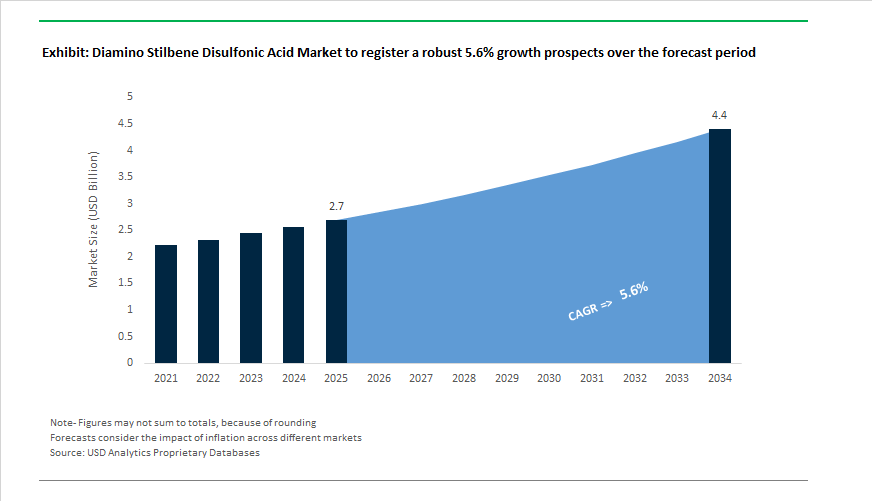
The Diamino Stilbene Disulfonic Acid (DASDA) Market is projected to grow from $2.7 billion in 2025 to $4.4 billion by 2034, registering a CAGR of 5.6%. DASDA remains a critical intermediate in the production of optical brightening agents (OBAs) used across textiles, detergents, paper, plastics, and specialty coatings. Rising demand for high-contrast fluorescent whitening agents in premium packaging paper, technical textiles, and performance detergents is strengthening global consumption patterns. The market is also being reshaped by regulatory scrutiny, anti-dumping measures, and investments in high-purity electronic-grade DASDA, signaling a transition from commodity-grade intermediates toward application-specific, performance-driven formulations.
A major inflection point occurred in December 2024, when India’s Directorate General of Trade Remedies initiated an anti-dumping investigation into imports of 4,4-Diamino Stilbene-2,2-Disulphonic Acid from China. The investigation followed petitions from domestic manufacturers alleging price suppression and material injury to local producers. This trade action introduced volatility into regional supply chains and influenced pricing strategies for OBAs in South Asia. The regulatory landscape evolved further in December 2025, when the statutory deadline for completing the investigation was extended into early 2026 to allow additional hearings and verified data collection. Parallel to this, Tsaker Chemical (Dongguang) Co., Ltd., formerly Hebei Hua-Chem, underwent corporate restructuring in 2025 and participated in regulatory duty reviews, reinforcing the strategic importance of Chinese exporters in the global DASDA trade flow. Meanwhile, Deepak Nitrite strengthened its export orientation during 2024–2025, leveraging its vertically integrated OBA value chain through its Hyderabad Specialities Division to capture growing European and North American demand for premium paper whitening agents. Pricing pressure intensified in November 2025, when BASF announced price increases for specialty intermediates in South Asia, reflecting rising energy and logistics costs that cascaded into DASDA production economics.
Capacity expansion and technology upgrades are reinforcing the next growth cycle. In 2025, Matangi Industries proposed a new chemical manufacturing unit in Gujarat to produce DASDA, DASA, and Vinyl Sulphone, with a commitment to zero liquid discharge systems to address high-concentration effluent concerns. In February 2026, Silox India secured approximately ₹300–360 crore in investment under the Dahej project to expand high-purity intermediate production lines, supporting specialty chemical and OBA supply chains. Application diversification accelerated in March 2025 with the launch of optical brightener microspheres for cosmetics, positioning DASDA-derived compounds within premium face powders and eye makeup formulations aimed at luminance correction. Sustainability-driven innovation gained traction in late 2025 as permanganate-free bleaching systems incorporated DASDA-based whitening agents to comply with ZDHC standards in denim and paper processing. Technological sophistication increased further in November 2025, when BASF commissioned a new production line in Nanjing utilizing Controlled Free Radical Polymerization to enhance dispersant and fluorescent emulsion stability. By January 2026, several Asia-Pacific manufacturers announced commercial availability of electronic-grade DASDA with reduced impurity profiles for LCD fluorescent materials and UV-absorbing polymers, signaling a strategic pivot toward high-performance electronic and specialty polymer applications.
Trends and Opportunities in the Global Diamino Stilbene Disulfonic Acid (DSD Acid) Market
Regulatory Phase-Out of DSD-Based Optical Brighteners in Consumer Applications
Sustainability frameworks across Europe and global retail supply chains are rapidly constraining the use of DSD Acid in mass-market detergents and textiles. Following the implementation of Commission Regulation (EU) 2025/1731 under REACH Annex XVII, tighter concentration thresholds were introduced for selected stilbene derivatives used in consumer formulations. From September 1, 2025, major EU retailers adopted a pre-emptive exit strategy, reducing DSD-based fluorescent whitening agent concentrations in liquid detergents to below 0.01% in order to align with voluntary ecolabel criteria and future-proof product portfolios against enforcement risk.
Environmental toxicology has reinforced this regulatory direction. Peer-reviewed studies published in early 2024 using Caenorhabditis elegans models demonstrated statistically significant reductions in locomotion and reproductive capacity at elevated stilbene brightener exposure levels. These findings prompted the ZDHC Roadmap to Zero Programme to place DSD Acid on its candidate list for phase-out in textile finishing as of January 2025. As a result, demand from detergent and apparel brands is structurally declining, pushing producers to diversify into non-consumer, function-led applications where regulatory exposure is lower and margins are higher.
Transition to Ultra-High-Purity DSD Acid for Functional Polymer and Coating Systems
In parallel with the consumer phase-down, manufacturers are upgrading synthesis and purification routes to deliver ultra-high-purity DSD Acid exceeding 99.5 %, with sharply reduced inorganic salt residues. This shift is driven by growing demand from advanced polymer systems where ionic contamination directly impacts conductivity, film uniformity, and long-term stability. Research published in April 2025 in the Journal of Materials Chemistry highlighted the role of DSD Acid as a sulfonated dopant in conductive polymers such as polyaniline and PEDOT. Its rigid, planar stilbene backbone enhances chain alignment and sp2 hybridization, delivering a 20 to 25% improvement in charge carrier mobility for biosensors and wearable electronics.
Industrial adoption is following academic validation. In 2025, exporters such as Suzhou Senfeida prioritized high-purity DSD Acid derivatives for use as epoxy active diluents and polyurethane catalysts. In automotive and industrial UV-curable coatings, these materials leverage the DSD scaffold’s intrinsic light-absorbing characteristics to enhance UV resistance, color stability, and coating lifespan. This repositioning is transforming DSD Acid from a commoditized intermediate into a performance-enabling molecule for specialty resin systems.
DSD Acid Scaffolds for NIR Bioimaging and Medical Diagnostics
One of the most promising growth avenues for DSD Acid lies in biomedical imaging and diagnostics, where its fluorescence properties and water solubility offer clear functional advantages. Advances reported in 2024 and 2025 by research groups publishing in Royal Society of Chemistry journals demonstrate the use of stilbene-based intermediates in the development of near-infrared probes for fluorescence-guided surgery. DSD Acid-derived fluorophores exhibit extinction coefficients exceeding 100,000 M−1cm−1, enabling deeper tissue penetration and higher signal clarity during real-time surgical visualization.
Clinical evaluations published in September 2025 further identified DSD Acid as a preferred scaffold for multimodal imaging agents. Its sulfonic acid groups enable efficient conjugation with targeting peptides and ligands, allowing selective binding to biomarkers such as integrins overexpressed in tumor cells. Reported dissociation constants as low as 21 nanomolar indicate substantially higher diagnostic sensitivity than conventional organic dyes. These characteristics position DSD Acid derivatives as strategic building blocks for next-generation diagnostic tools rather than bulk chemical inputs.
Building Blocks for Proton-Conductive Ionomer Membranes in Energy Systems
The global acceleration of hydrogen technologies and electrochemical energy storage is creating a structurally new demand center for DSD Acid-based ionomers. Its high sulfonic acid density makes it an attractive, cost-competitive alternative to perfluorinated membranes in proton exchange systems. In 2025, academic-industrial collaborations demonstrated that incorporating DSD Acid into polybenzimidazole and polyvinyl alcohol blend electrolytes can achieve proton conductivities exceeding 1.38×10⁻³ S/cm at ambient temperatures. This level of performance is increasingly relevant for proton exchange membrane fuel cells operating under variable load conditions.
Macro energy investment trends reinforce this opportunity. Under global net-zero transition pathways, annual clean energy investment is expected to surpass two trillion US dollars by 2030, accelerating deployment of solid polymer electrolyte films across fuel cells, redox flow batteries, and electrochemical capacitors. DSD Acid-crosslinked membranes have demonstrated electrochemical stability windows up to 1.09 volts, making them viable for electric double-layer capacitors and stationary energy storage systems. As energy infrastructure scales, DSD Acid is emerging as a functional enabler in advanced ion-conductive materials rather than a legacy brightener chemistry.
Diamino Stilbene Disulfonic Acid (DASDA) Market Share and Segmentation Insights
Market Share by Application : Fluorescent Whitening Agents Anchor Demand Across Textiles and Paper
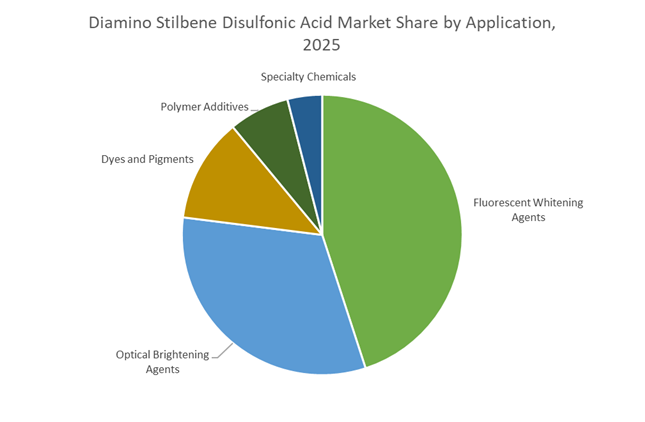
Fluorescent whitening agents account for 45% of DASDA consumption in 2025, positioning diamino stilbene disulfonic acid as a critical precursor for triazinyl-stilbene brighteners used in textiles and paper. These compounds absorb ultraviolet light and re-emit blue light, delivering enhanced fabric and paper whiteness. Optical brightening agents represent a closely related and substantial segment, particularly in detergents, where DASDA-derived molecules deposit on fibers to counter yellowing during repeated wash cycles. Dyes and pigments form a mid-sized application, leveraging DASDA in direct dye synthesis for cotton and viscose with improved light fastness. Polymer additives are gaining traction in plastics and packaging to mask thermal yellowing and improve visual appeal. Specialty chemicals remain niche but strategic, supporting biological staining, tracers, and research-grade fluorescent materials that capitalize on DASDA’s unique photophysical properties.
Market Share by End-Use Industry : Textiles Lead While Plastics Drive Incremental Growth
The textile industry commands 48% of DASDA demand, driven by widespread use of optical brighteners in cotton, viscose, and blended fabrics during fiber production, finishing, and garment care. Paper and pulp represent a major secondary market, where brighteners enable premium brightness in printing papers and packaging boards while allowing lower-grade pulp utilization. Consumer goods contribute steady volume through laundry detergents and fabric care products formulated to maintain long-term garment whiteness. Plastics and polymers are an emerging growth segment, incorporating DASDA-derived brighteners into packaging, synthetic fibers, and molded components to enhance aesthetics and counter UV-induced discoloration. Inks and coatings occupy a smaller niche, supplying specialty printing and security applications requiring fluorescence. Cosmetics remain limited but stable, using brighteners selectively for optical effects under strict regulatory frameworks.
Competitive Landscape of the Diamino Stilbene Disulfonic Acid (DASDA) Market
The Diamino Stilbene Disulfonic Acid (DASDA) market is highly consolidated, driven by backward integration, optical brightener demand, and export-oriented capacity expansions, with Asia leading global supply while Europe and North America anchor high-value, compliance-driven applications.
Deepak Nitrite dominates global DASDA exports through backward integration and scale economics
Deepak Nitrite Limited stands as the world’s largest DASDA producer, leveraging deep backward integration into nitrotoluene to shield operations from the 2025 raw-material disruptions. The company supplies high-purity DASDA in both powder and paste forms, primarily serving CBS-X fluorescent whitening agent manufacturers across detergents, paper, and textiles. In late 2025, Deepak confirmed plans to sustain over 60% domestic market share via expanded Gujarat production, targeting rising North American export demand. Its unmatched economies of scale enable more than 370 global shipments annually by mid-2026, positioning Deepak as the single largest DASDA exporter worldwide. This vertically integrated model delivers cost leadership, supply security, and consistent purity, reinforcing its dominance across optical brighteners and specialty chemical intermediates.
Tsaker Chemical controls China’s DASDA value chain from DNT to optical brighteners
Tsaker Chemical Group commands China’s DASDA ecosystem through near-total vertical integration, spanning dinitrotoluene production, DASDA synthesis, and downstream optical brighteners for paper and pulp. In 2025, Tsaker introduced a proprietary catalytic hydrogenation process that reduced wastewater pollutants by 25%, aligning operations with China’s Green Chemical Hub mandates. The company remains the primary supplier to China’s paper industry, forecast to expand at a 5.9% CAGR through 2030, while diversifying into agrochemical intermediates in early 2026. This “vertical monopoly” strategy enables Tsaker to optimize margins across the entire stilbene chain, securing leadership in technical-grade DASDA while supporting massive domestic demand for whitening agents and specialty derivatives.
Huntsman targets high-value DASDA applications through regulatory-grade performance products
Huntsman Corporation operates at the premium end of the DASDA market, supplying pharmaceutical and technical grades with ultra-low impurity profiles for diagnostics, textiles, and specialty coatings. In 2026, Huntsman expanded its Smart Brightening portfolio, introducing DASDA derivatives engineered for enhanced UV stability in automotive finishes. The company is also actively mapping OEM partnerships with global detergent leaders to secure long-term sourcing for premium laundry whiteners. Rather than competing on volume, Huntsman concentrates on the US and European markets, where REACH and TSCA compliance drives value creation. This regulatory-first strategy positions Huntsman as a trusted supplier for high-performance DASDA formulations in sensitive industrial and consumer applications.
Archroma advances eco-advanced DASDA solutions for sustainable textile finishing
Archroma remains a global benchmark for sustainable DASDA-based textile chemistry through its Leucophor® optical brightener portfolio, offering strong fiber affinity for cotton and polyamide. The company achieved a 15.4% share of the broader stilbene market in 2025 and is targeting conversion of 50% of brightener sales to zero-formaldehyde variants in 2026. Under its “Archroma Way” initiative, DASDA formulations now enable lower wash temperatures in industrial laundries, reducing energy footprints. Early 2026 also saw the launch of liquid DASDA concentrates that minimize dust exposure in mills, improving worker safety. Archroma’s eco-advanced chemistry is reshaping fabric finishing standards globally.
Meghmani Group scales boutique DASDA production for inks, coatings, and agrochemicals
Meghmani Group, via Trent Chemical Industries, represents India’s fast-growing secondary DASDA supply base, emphasizing agile exports and niche applications. Acting as a backward integration hub, Trent secures internal DASDA and H-Acid supply for Meghmani’s dye and pigment operations. A newly commissioned Madhya Pradesh unit is expanding output for North American agrochemical and paint markets, while the company maintains strong traction in inks and coatings, supplying fluorescent dyes for security printing. Meghmani’s strategy centers on regional dominance, leveraging India’s 43.9% APAC growth momentum to become a preferred alternative supplier for multinational optical brightener producers seeking diversified sourcing beyond China.
China Diamino Stilbene Disulfonic Acid (DASDA) Market: AI-Driven Fine Chemical Modernization and High-Solubility OBA Expansion
China dominates the global Diamino Stilbene Disulfonic Acid (DASDA) Market, accounting for the largest share of production capacity and exports of key optical brightener intermediates. Under the 14th and upcoming 15th Five-Year Plans for 2026 to 2030, the Ministry of Industry and Information Technology of China launched a petrochemical stability plan in September 2025 targeting 5% annual value-added growth, specifically incentivizing modernization of fine chemical intermediates such as DASDA. Industrial hubs in Jiangsu and Zhejiang are upgrading to AI-driven production lines, deploying machine learning algorithms to optimize nitration and sulfonation reaction parameters, significantly improving batch consistency, yield optimization, and effluent reduction.
Volatility in upstream toluene and nitrotoluene prices during H1 2025 compressed DASDA margins, prompting large-scale producers to adopt integrated feedstock monitoring systems and backward integration strategies. Strict provincial environmental compliance mandates have resulted in the closure of smaller non-compliant units, consolidating output within high-tech Chemical Parks equipped with centralized effluent treatment and real-time emission tracking. To mitigate trade scrutiny, Chinese manufacturers are increasing Overseas Direct Investment in Southeast Asia, establishing finishing plants closer to textile clusters. On the application side, expansion into liquid optical brightening agent formulations for premium detergents is accelerating demand for DASDA variants with superior water solubility and ultra-low residual impurities, reinforcing China’s leadership in high-performance DASDA derivatives.
India Diamino Stilbene Disulfonic Acid (DASDA) Market: China+1 Sourcing Shift and Zero Liquid Discharge Capacity Expansion
India is rapidly emerging as a strategic alternative supplier in the global DASDA Market, capitalizing on the China+1 sourcing strategy and strong environmental compliance credentials. Between 2024 and 2025, Meghmani Organics commissioned new DASDA capacity in Gujarat equipped with a state-of-the-art Zero Liquid Discharge system, enabling sustainable production tailored for European and North American textile and paper customers. Industry players such as Shivtek Spechemi Industries have announced ambitions to quadruple revenue by 2030, driven by specialty intermediate expansion including DASDA and downstream fluorescent whitening agents.
Indian exporters including Bhageria Industries and Transpek-Silox secured EU REACH pre-registration in late 2024, facilitating smoother access to high-margin European paper and textile markets. The Production Linked Incentive Scheme for chemicals is encouraging backward integration into 4,4’-Dinitrostilbene-2,2’-disulfonic acid feedstock supply, strengthening cost competitiveness. Technological advancements such as the introduction of ColorJet Fab Jet Pro digital textile printing solutions are increasing localized demand for high-purity DASDA-based fluorescent whitening agents. Pilot batches of ultra-high solubility DASDA targeting Korean and Japanese detergent markets signal India’s move into premium, residue-free liquid OBA applications.
Germany Diamino Stilbene Disulfonic Acid (DASDA) Market: Green Chemistry Compliance and High-Purity Analytical Leadership
Germany represents the sustainability benchmark in the DASDA Market, emphasizing biodegradable stilbene derivatives and high-purity compliance. Implementation of Commission Implementing Regulation EU 2025/2091 is accelerating the shift toward environmentally compliant DASDA-based brighteners aligned with European Chemicals Agency safety standards. Producers in the Rhine-Ruhr chemical corridor are piloting bio-based feedstock routes for stilbene derivatives, aiming to reduce dependence on volatile petrochemical inputs and improve lifecycle carbon intensity.
Distribution specialists such as Grolman established new partnerships in late 2025 to expand eco-friendly DASDA-based additives for sustainable paints and coatings. A key market trend is the development of multifunctional DASDA derivatives that offer enhanced UV stability and improved light fastness for premium packaging substrates. German laboratories lead advanced chromatography-based purity testing protocols for DASDA, ensuring compliance for high-sensitivity pharmaceutical, cosmetic, and food-contact applications. This precision-driven ecosystem positions Germany as the global reference point for green chemistry transformation in the DASDA industry.
United States Diamino Stilbene Disulfonic Acid (DASDA) Market: Premium Detergent Brighteners and Circular Economy Alignment
The United States DASDA Market is characterized by strong demand for specialty optical brightening agent formulations used in premium paper, professional laundry, and high-end packaging applications. Premiumization trends in household detergents emphasizing extra-white and high-brightness claims are increasing consumption of high-efficiency DASDA derivatives with enhanced fluorescence performance and wash durability.
Heightened oversight from the U.S. Environmental Protection Agency regarding substances of concern in packaging waste is driving research into DASDA formulations compatible with circular recycling streams. North American distributors are integrating AI-driven demand forecasting systems to optimize just-in-time supply of DASDA powders and intermediates to regional detergent manufacturers. Major OBA producers in the Southeast U.S. have upgraded blending facilities to process higher-concentration DASDA slurries, improving cost efficiency and logistics. Growth in industrial printing and premium e-commerce packaging is further expanding demand for stilbene-based whitening agents, where superior brightness enhances brand shelf visibility and perceived product quality.
Southeast Asia Diamino Stilbene Disulfonic Acid (DASDA) Market: Textile Export Growth and Closed-Loop Sulfonation Systems
Southeast Asia, particularly Vietnam and Indonesia, is evolving into a high-growth consumption and secondary manufacturing hub within the global DASDA Market. A cross-border joint venture formed in 2024 between a regional detergent additive company and a Chinese DASDA producer secured localized intermediate production capacity, reducing import dependency and improving supply security for textile and paper manufacturers.
Vietnam’s expanding textile export sector, especially for fabrics destined for European and Japanese luxury markets, is significantly increasing imports of DASDA-based optical brightening intermediates. Regional producers are implementing closed-loop sulfonation systems to minimize acid waste and align with sustainability requirements imposed by global apparel brands. While markets such as South Africa and the UAE are emerging as niche adopters due to paper and packaging modernization, Southeast Asia remains the fastest-growing regional cluster for DASDA consumption, supported by export-oriented textile production and tightening environmental compliance standards.
By Product Form (Powder, Paste, Liquid), By Grade (Technical Grade, Reagent Grade), By Application (Optical Brightening Agents, Fluorescent Whitening Agents, Dyes and Pigments, Polymer Additives, Specialty Chemicals), By End-Use Industry (Textile Industry, Paper and Pulp, Consumer Goods, Plastics and Polymers, Cosmetics, Inks and Coatings)
Study Period
2019- 2025 and 2026-2034
Units
Revenue (USD)
Qualitative Analysis
Porter’s Five Forces, SWOT Profile, Market Share, Scenario Forecasts, Market Ecosystem, Company Ranking, Market Dynamics, Industry Benchmarking
Companies
Tsaker Chemical Group, Deepak Nitrite Limited, Meghmani Group, BASF SE, Merck KGaA, Cangzhou Lingang Yueguo Chemical, Zhejiang Hongda Chemicals, Pranav Chemicals, Lianyungang Lion Chemical, Tokyo Chemical Industry, Thermo Fisher Scientific Inc., Luoyang Dongyuan Chemical, MIT-IVY Industry, Camex Limited, Roopdhara Industries
Countries
US, Canada, Mexico, Germany, France, Spain, Italy, UK, Russia, China, India, Japan, South Korea, Australia, South East Asia, Brazil, Argentina, Middle East, Africa
2. Diamino Stilbene Disulfonic Acid (DASDA) Market Landscape & Outlook (2026–2034)
2.1. Introduction to Diamino Stilbene Disulfonic Acid (DASDA) Market
2.2. Market Valuation and Growth Projections (2026–2034)
2.3. Trade Actions, Anti-Dumping Measures, and Pricing Volatility
2.4. Transition from Commodity-Grade to High-Purity and Electronic-Grade DASDA
2.5. Capacity Expansion, Zero Liquid Discharge Systems, and Application Diversification
3. Innovations Reshaping the Diamino Stilbene Disulfonic Acid (DASDA) Market
3.1. Trend: Regulatory Phase-Out of DSD-Based Optical Brighteners in Consumer Applications
3.2. Trend: Ultra-High-Purity DSD Acid for Functional Polymer and Coating Systems
3.3. Opportunity: DSD Acid Scaffolds for NIR Bioimaging and Medical Diagnostics
3.4. Opportunity: Proton-Conductive Ionomer Membranes for Hydrogen and Energy Systems
4. Competitive Landscape and Strategic Initiatives
4.1. Mergers and Acquisitions
4.2. R&D and Material Innovation in High-Purity and Electronic-Grade DASDA
4.3. Sustainability and ESG Strategies Including ZLD and Green Chemistry Compliance
4.4. Market Expansion, Export Orientation, and Regional Capacity Upgrades
5. Market Share and Segmentation Insights: Diamino Stilbene Disulfonic Acid (DASDA) Market
5.1. By Product Form
5.1.1. Powder
5.1.2. Paste
5.1.3. Liquid
5.2. By Grade
5.2.1. Technical Grade
5.2.2. Reagent Grade
5.3. By Application
5.3.1. Optical Brightening Agents
5.3.2. Fluorescent Whitening Agents
5.3.3. Dyes and Pigments
5.3.4. Polymer Additives
5.3.5. Specialty Chemicals
5.4. By End-Use Industry
5.4.1. Textile Industry
5.4.2. Paper and Pulp
5.4.3. Consumer Goods
5.4.4. Plastics and Polymers
5.4.5. Cosmetics
5.4.6. Inks and Coatings
5.5. By Region
5.5.1. North America
5.5.2. Europe
5.5.3. Asia Pacific
5.5.4. South and Central America
5.5.5. Middle East and Africa
6. Country Analysis and Outlook of Diamino Stilbene Disulfonic Acid (DASDA) Market
6.1. United States
6.2. Canada
6.3. Mexico
6.4. Germany
6.5. France
6.6. Spain
6.7. Italy
6.8. UK
6.9. Russia
6.10. China
6.11. India
6.12. Japan
6.13. South Korea
6.14. Australia
6.15. South East Asia
6.16. Brazil
6.17. Argentina
6.18. Middle East
6.19. Africa
7. Diamino Stilbene Disulfonic Acid (DASDA) Market Size Outlook by Region (2026–2034)
7.1. North America Diamino Stilbene Disulfonic Acid (DASDA) Market Size Outlook to 2034
7.1.1. By Product Form
7.1.2. By Grade
7.1.3. By Application
7.1.4. By End-Use Industry
7.2. Europe Diamino Stilbene Disulfonic Acid (DASDA) Market Size Outlook to 2034
7.2.1. By Product Form
7.2.2. By Grade
7.2.3. By Application
7.2.4. By End-Use Industry
7.3. Asia Pacific Diamino Stilbene Disulfonic Acid (DASDA) Market Size Outlook to 2034
7.3.1. By Product Form
7.3.2. By Grade
7.3.3. By Application
7.3.4. By End-Use Industry
7.4. South America Diamino Stilbene Disulfonic Acid (DASDA) Market Size Outlook to 2034
7.4.1. By Product Form
7.4.2. By Grade
7.4.3. By Application
7.4.4. By End-Use Industry
7.5. Middle East and Africa Diamino Stilbene Disulfonic Acid (DASDA) Market Size Outlook to 2034
7.5.1. By Product Form
7.5.2. By Grade
7.5.3. By Application
7.5.4. By End-Use Industry
8. Company Profiles: Leading Players in the Diamino Stilbene Disulfonic Acid (DASDA) Market
8.1. Tsaker Chemical Group
8.2. Deepak Nitrite Limited
8.3. Meghmani Group
8.4. BASF SE
8.5. Merck KGaA
8.6. Cangzhou Lingang Yueguo Chemical
8.7. Zhejiang Hongda Chemicals
8.8. Pranav Chemicals
8.9. Lianyungang Lion Chemical
8.10. Tokyo Chemical Industry
8.11. Thermo Fisher Scientific Inc.
8.12. Luoyang Dongyuan Chemical
8.13. MIT-IVY Industry
8.14. Camex Limited
8.15. Roopdhara Industries
9. Methodology
9.1. Research Scope
9.2. Market Research Approach
9.3. Market Sizing and Forecasting Model
9.4. Research Coverage
9.5. Data Horizon
9.6. Deliverables
10. Appendix
10.1. Acronyms and Abbreviations
10.2. List of Tables
10.3. List of Figures
The Diamino Stilbene Disulfonic Acid Market is valued at $2.7 billion in 2025 and is projected to reach $4.4 billion by 2034, registering a CAGR of 5.6%. Growth is anchored in sustained demand for optical brightening agents across textiles and paper, alongside emerging high-purity applications. Trade actions and regulatory shifts are reshaping regional supply chains and pricing structures.
India’s anti-dumping investigation into Chinese DASDA imports has introduced pricing volatility and supply chain recalibration across South Asia. In Europe, REACH-related restrictions and ZDHC alignment are reducing DSD-based brightener usage in mass consumer detergents. These developments are pushing producers toward specialty, non-consumer, and performance-driven applications with stronger compliance positioning and margin resilience.
While fluorescent whitening agents account for nearly 45% of consumption, high-purity DASDA above 99.5% is gaining momentum in conductive polymers, UV-curable coatings, and electronic materials. Applications in LCD fluorescent systems, UV-absorbing polymers, and proton-conductive ionomer membranes are expanding. Biomedical imaging and NIR diagnostics represent high-value niche opportunities with strong R&D-backed validation.
China remains the largest producer, supported by AI-driven chemical parks and backward integration. India is benefiting from China+1 sourcing strategies and zero liquid discharge facilities, enhancing export competitiveness. Germany leads in green chemistry and analytical-grade purity standards, while Southeast Asia is emerging as a fast-growing textile-linked consumption hub.
Key players include Deepak Nitrite Limited, Tsaker Chemical Group, BASF SE, Meghmani Group, and Huntsman Corporation. These companies are focusing on backward integration, high-purity grade expansion, export diversification, and regulatory-compliant specialty derivatives to capture premium global demand.