Diethyl Ether Market to Reach $14.9 Billion by 2034 at 5% CAGR as India Leads EU Supply and Electronic-Grade Demand Rises
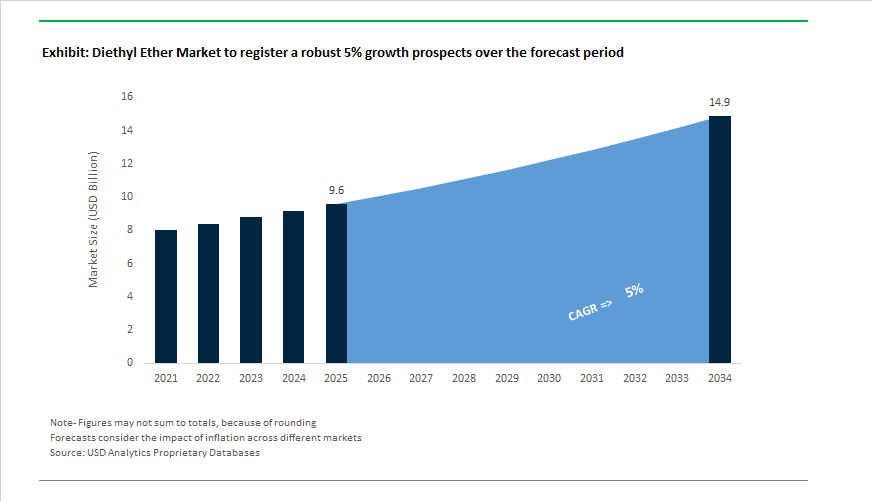
The Diethyl Ether Market is projected to expand from $9.6 billion in 2025 to $14.9 billion by 2034, registering a CAGR of 5%. Diethyl ether remains a critical industrial solvent across pharmaceuticals, laboratory reagents, fuel additives, extraction processes, and specialty chemical synthesis. Market momentum is increasingly shaped by trade realignments, high-purity solvent demand for electronics and battery applications, and structural changes in European chemical production. Supply chain rebalancing and feedstock decarbonization are redefining global trade flows, particularly between Asia and Europe.
In January 2026, trade data confirmed that India has become the leading exporter of diethyl ether to the European Union. During 2024, the EU imported nearly one million kilograms, with more than 65% originating from Indian manufacturers. This shift reflects sustained production pressure in Europe, where output declined by 2.5% in late 2025 amid high energy costs and plant rationalizations. In February 2026, industry leaders including INEOS and Cefic warned of structural competitiveness challenges for European chemical manufacturing, highlighting a six-fold rise in plant closures since 2022. LyondellBasell reinforced this trend in January 2026 by raising its Cash Improvement Plan target to $1.3 billion and strategically idling units in Wesseling and Channelview to optimize intermediates production. Meanwhile, INEOS and Sinopec advanced their strategic cooperation through 2024 and 2025, including INEOS’s 50% stake acquisition in Shanghai SECCO Petrochemical, strengthening Asian solvent and petrochemical integration. BASF reported preliminary 2025 sales of €59.7 billion in January 2026, confirming continued restructuring and green transformation investments, including more sustainable ether production routes. BASF also announced the launch of a Global Digital Hub in Hyderabad in Q1 2026 to accelerate AI-driven solvent formulation and digital twin modeling for customized ether-based reagents.
Product purity and sustainability are reshaping competitive differentiation. Throughout 2025, manufacturers increasingly prioritized Electronic-Grade diethyl ether at 99.9%+ purity for semiconductor fabrication and lithium-ion battery component extraction, where trace moisture or peroxide formation can compromise yield. Silox India secured ₹300–360 crore in February 2026 for expansion of high-purity solvent capacity in Dahej, targeting pharmaceutical and export growth. In 2024, several Southeast Asian producers transitioned diethyl ether synthesis toward bio-ethanol feedstock, aligning with green chemistry mandates and lowering carbon intensity relative to fossil-derived ethanol routes. Sumitomo Chemical, recognized in January 2026 as a Clarivate Top 100 Global Innovator, continues to invest in synthetic biology platforms for eco-friendly functional chemicals, reinforcing innovation within specialty solvent portfolios. ICL Group’s strategic realignment in November 2025 emphasized industrial specialties and supply-chain security for critical laboratory reagents, supporting stability in high-value ether markets. These developments underscore a market increasingly defined by regional production shifts, digital optimization, regulatory cost pressure in Europe, and premiumization through ultra-high purity and sustainable feedstocks.
Trends and Opportunities Shaping the Global Diethyl Ether Market
Captive Integration for Grignard-Based API Manufacturing
In pharmaceutical synthesis, diethyl ether is increasingly produced and consumed within captive, in-house systems rather than sourced from the merchant solvent market. This shift is driven by the solvent’s irreplaceable role in stabilizing Grignard reagents used for constructing complex carbon-carbon bonds in oncology, neurology, and cardiovascular drugs. Industry data from 2024 and 2025 confirms that diethyl ether continues to outperform alternative ethers by improving Grignard reaction yields by approximately 12 to 15% due to its strong Lewis base coordination with magnesium centers.
Regulatory scrutiny is reinforcing this integration trend. Updated residual solvent guidance issued in early 2025 by the European Medicines Agency has tightened expectations around moisture control and impurity consistency in high-potency APIs. As a result, pharmaceutical manufacturers are investing in closed-loop ether synthesis and purification blocks capable of maintaining water content below 10 ppm. These systems reduce degradation risk, ensure batch-to-batch reproducibility, and strengthen compliance during regulatory audits, particularly for injectable and narrow-therapeutic-index drugs.
Strategic Role as a Colloiding Solvent in Energetic and Aerospace Materials
Despite its classification as a legacy solvent, diethyl ether remains strategically indispensable in modern energetic materials and aerospace lubrication systems. In smokeless propellant manufacturing, it functions as the primary colloiding agent for nitrocellulose gelatinization. Technical bulletins released in 2025 confirm that the long-established 2:1 ether-to-ethanol ratio continues to deliver optimal grain density and uniform burn characteristics, directly influencing ballistic consistency and accuracy in military-grade ammunition.
In parallel, aerospace applications are sustaining demand for diethyl ether as a carrier solvent for perfluoropolyether lubricants. Space qualification trials conducted between 2024 and 2025 rely on ether’s low boiling point and residue-free evaporation to deposit micron-scale lubricant films on satellite bearings and actuators. In high-vacuum orbital environments, even trace organic residues can lead to stiction or mechanical seizure, positioning diethyl ether as a critical enabler for long-duration satellite reliability rather than a replaceable commodity solvent.
The race toward next-generation electric vehicle batteries is opening a premium growth avenue for ultra-pure diethyl ether in electrolyte formulation. Ether-based electrolytes are increasingly viewed as essential for stabilizing lithium-metal anodes, which offer significantly higher energy density than graphite. A December 2025 study published through the Royal Society of Chemistry reported Coulombic efficiencies as high as 99.98% in Li||NCM cells using ether-rich electrolyte systems. These performance gains are attributed to the formation of an anion-derived solid electrolyte interphase that is more chemically stable than carbonate-based alternatives.
Diethyl ether is also gaining traction as a recrystallization solvent for lithium bis(fluorosulfonyl)imide salts. Pilot-scale battery material facilities in Japan and South Korea reported up to an 18% reduction in internal cell resistance when LiFSI was purified using anhydrous ether. As solid-state and lithium-metal battery platforms move from laboratory validation to pilot production between 2026 and 2028, demand for electronics-grade ether is expected to rise disproportionately relative to traditional solvent applications.
Selective Extraction of Cannabinoids and Heat-Sensitive Bioactives
In the botanical and medical cannabis industries, diethyl ether is emerging as a high-selectivity extraction solvent for full-spectrum products. Research published in mid-2025 by European academic institutions demonstrates that ether-based extraction preserves up to 30% more volatile terpenes than ethanol-based methods. This advantage is directly linked to ether’s ability to evaporate below 35°C, minimizing thermal degradation of aroma compounds and minor cannabinoids that define therapeutic and sensory value.
Commercial adoption is accelerating through explosion-proof, closed-loop extraction systems introduced in 2025. These platforms achieve solvent recovery rates of approximately 98% while meeting pharmaceutical-grade Good Manufacturing Practice requirements. For producers of high-purity CBD and THC isolates, this combination of selectivity, efficiency, and regulatory compliance positions diethyl ether as a high-margin processing solvent rather than a bulk chemical, particularly as medical and nutraceutical cannabinoid markets continue to professionalize globally.
Diethyl Ether Market Share and Segmentation Insights
Market Share by Product Grade : Technical Grade Leads Volume While High-Purity Grades Support Pharma and R&D
Technical grade diethyl ether holds 45% market share in 2025, serving as the standard solvent for industrial extraction, chemical synthesis, and manufacturing processes where ultra-high purity is unnecessary. Its cost-effectiveness drives bulk consumption across specialty chemicals and intermediates production. Anhydrous grade represents a substantial secondary segment, essential for moisture-sensitive reactions such as Grignard chemistry, organometallic synthesis, and pharmaceutical intermediate manufacturing, where low water content directly impacts yield and reaction selectivity. Analytical reagent grade occupies a premium laboratory niche, supporting research institutions and quality control labs that require tightly specified purity for reproducible analytical results. Pharmaceutical grade remains the smallest but highest-value segment, supplying cGMP-compliant extraction and synthesis operations in regulated drug manufacturing. This grade commands premium pricing due to rigorous quality testing, trace impurity control, and documentation requirements, underscoring diethyl ether’s continued relevance in modern pharmaceutical processing.
Market Share by Application : Chemical Intermediates Lead as Fuel and Aerosol Uses Expand
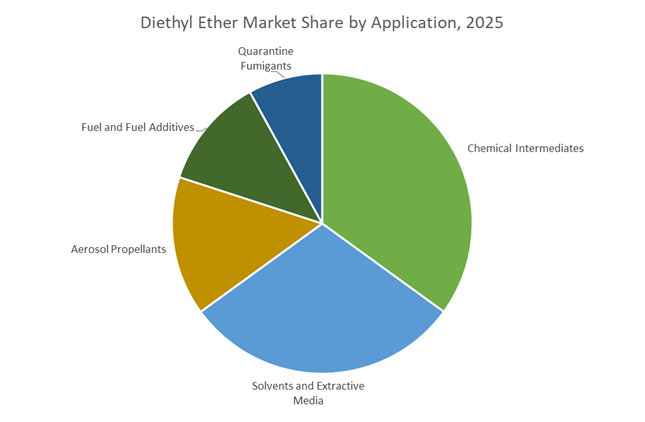
Chemical intermediates account for 35% of global diethyl ether consumption in 2025, reinforcing its importance as a core solvent and reaction medium in fine chemical manufacturing. Diethyl ether plays a critical role in Grignard reactions and organometallic synthesis, supporting production of pharmaceutical intermediates, agrochemical actives, and fragrance compounds. Solvents and extractive media form a major secondary segment, leveraging diethyl ether’s strong solvency for oils, fats, waxes, and alkaloids in laboratory extraction, industrial degreasing, smokeless powder production, and cellulose-based processing. Aerosol propellants represent a significant application, particularly in automotive starting fluids where diethyl ether’s high volatility and low flash point enable reliable cold-weather engine ignition. Fuel and fuel additives are a growing segment, driven by demand for cold-start enhancers in diesel engines and specialty fuel blends for extreme climates. Quarantine fumigants remain a small niche, constrained by regulatory pressure and gradual replacement with alternative pest control technologies.
Competitive Landscape of the Diethyl Ether Market
The Diethyl Ether market is shaped by vertically integrated petrochemical majors and high-purity solvent specialists supplying pharmaceutical intermediates, fuel additives, laboratory reagents, and industrial extraction applications, with 2026 competitiveness driven by feedstock integration, low-carbon solvent transitions, and secure global logistics.
INEOS dominates industrial and pharma-grade diethyl ether through full ethanol-to-ether integration
INEOS stands as one of the most influential producers in the global diethyl ether market, leveraging a fully integrated ethanol-to-ether value chain across its European assets to ensure supply resilience amid 2026 logistics disruptions. The company maintains a leading share in the fuel additive “starting fluid” segment, supplying diethyl ether for diesel engines operating in sub-zero climates. Its late-2025 acquisition of a 50% stake in Shanghai SECCO Petrochemical (with Sinopec) strategically strengthens access to East Asia’s fast-growing pharmaceutical solvent market by mid-2026. INEOS continues to prioritize high-margin pharmaceutical-grade ether under its asset-discipline strategy, offsetting elevated EU energy costs while reinforcing its scale-driven leadership.
BASF advances low-carbon pharmaceutical ether under its Winning Ways strategy
BASF remains a top-tier supplier, embedding diethyl ether deeper into its Production Verbund under the 2026 “Winning Ways” framework to maximize resource efficiency. By transitioning ether operations into its Core Chemicals segment, BASF improves feedstock utilization while supporting customers’ green transformation goals. In early 2026, BASF deployed AI-driven logistics for just-in-time solvent delivery, reducing storage risks associated with volatile ethers. Its pharmaceutical-grade diethyl ether is widely used for API synthesis in cardiovascular and neurological therapies. BASF also launched 2026 pilot programs using bio-ethanol-derived ether, aligning its solvent portfolio with a broader 2030 low-carbon precursor roadmap.
Merck KGaA sets the global benchmark for reagent-grade diethyl ether purity
Merck KGaA, via its Sigma-Aldrich and Supelco platforms, dominates the laboratory and analytical-grade diethyl ether segment. Its EMPLURA® and EMPARTA® ACS grades (≥99.0% to ≥99.5%), stabilized with BHT to prevent peroxide formation, are the standard for pharmaceutical R&D and quality-control laboratories worldwide. In February 2026, Merck expanded its Darmstadt distribution hub to manage high-volatility solvents across EMEA. A key differentiator is Merck’s digital M-Shop ecosystem, enabling real-time access to lot-specific certificates of analysis and SDS documentation. This life-science logistics leadership makes Merck indispensable to research institutes and regulated manufacturing environments.
LyondellBasell scales fuel ether supply while pivoting to circular solvent platforms
LyondellBasell remains the world’s largest producer of fuel ethers, supporting high-volume industrial and specialty solvent applications. In early 2026, the company launched a Cash Improvement Plan targeting USD 500 million in liquidity, optimizing European solvent assets while accelerating its CirculenRenew circular portfolio. A 10-year renewable power purchase agreement signed in late 2025 ensures that by 2026, key European sites producing ether intermediates increasingly run on wind energy. LyondellBasell supplies diethyl ether extensively to the plastics and fragrance industries, where it serves as a critical extraction solvent for gums, fats, and resins, reinforcing its role in large-scale specialty materials.
ISCPL emerges as India’s export powerhouse for pharmaceutical and industrial diethyl ether
Industrial Solvents & Chemicals Pvt. Ltd. (ISCPL) has rapidly become a pivotal global supplier as India now accounts for nearly 64% of EU diethyl ether import value. ISCPL captured a substantial share of global exports in 2025–2026 by leveraging cost-competitive manufacturing and scalable capacity expansions that addressed Western supply shortages. Specializing in both industrial and pharmaceutical grades, ISCPL is favored by toll manufacturers requiring bulk volumes at competitive pricing. Its 2026 strategy centers on international quality certifications, shifting from pure cost leadership toward premium compliance, positioning ISCPL as a long-term bridge supplier in the global pharmaceutical solvent supply chain.
India: Feedstock Security, Fuel Blending Policy, and Pharma-Grade Localization
India’s diethyl ether market is undergoing a structural transition driven by coordinated feedstock policy, downstream standards, and domestic manufacturing incentives. A key inflection point came in September 2025, when the Directorate General of Foreign Trade issued Trade Notice No. 12/2025–26, streamlining exports of second-generation ethanol. This move has materially improved the availability of cellulosic ethanol for domestic etherification, anchoring diethyl ether production within the broader Make in India specialty chemicals framework. By securing ethanol feedstock from agricultural residues rather than food-grade molasses, Indian producers are reducing cost volatility while improving the sustainability profile of ether manufacturing.
Demand-side pull is being reinforced by regulatory action in fuels and aerosols. The Bureau of Indian Standards finalized a landmark gazette notification by Q4 FY 2024–25 permitting blending of up to 20% dimethyl ether or diethyl ether with LPG. This standard is reshaping domestic heating and aerosol propellant formulations by prioritizing low-carbon, high-volatility additives that reduce carbon monoxide emissions. On the supply side, Balaji Amines advanced its Unit-IV expansion in 2025, commissioning new ether derivative capacity aligned with rising demand from fragrances, personal care aerosols, and industrial sprays. Parallelly, pharmaceutical-grade localization is accelerating. In mid-2025, TKM Pharma upgraded its Hyderabad facility with automated distillation lines to consistently deliver anhydrous diethyl ether above 99.0% purity with moisture levels below 0.2% W/V, meeting global API extraction standards. Strategic interest from public sector energy players such as Indian Oil Corporation Limited in ether-based ignition enhancers for sub-zero Himalayan fuel formulations further illustrates how diethyl ether is moving beyond laboratory solvents into energy security applications. These dynamics are reinforced by Production Linked Incentive support for reaction solvents in Gujarat-based chemical hubs, reducing import reliance and strengthening domestic supply chains.
United States: Research-Driven Demand, Safety Digitization, and Bio-Based Transition
In the United States, the diethyl ether market is primarily shaped by pharmaceutical R&D intensity, defense-funded fuel innovation, and heightened safety governance for peroxide-forming solvents. NIH expenditure data for 2024–2025 indicate sustained growth in pharmaceutical research spending, which has translated into higher consumption of ultra-high-purity laboratory ethers used in Grignard reactions, lithium aluminum hydride reductions, and other moisture-sensitive synthesis routes. This trend is reinforced by updated FDA solvent residue guidelines in early 2025, which raised purity expectations for extraction solvents used in nutraceuticals and bioactive compound isolation.
At the intersection of energy and defense, the Department of Energy funded targeted research in 2025 on bio-derived diethyl ether as a cold-start additive for military diesel. The compound’s ability to lower cold-filter plugging points has renewed its relevance in Arctic and high-altitude operational theaters, positioning diethyl ether as a functional performance additive rather than a legacy solvent. On the manufacturing side, digital safety has become a defining theme. Eastman Chemical and other North American producers implemented IoT-integrated peroxide monitoring systems in late 2025, addressing long-standing storage and transport risks associated with ethers. Sustainability considerations are also gaining commercial traction. In 2024–2025, a specialty chemicals manufacturer launched a dedicated bio-based diethyl ether line aimed at analytical laboratories seeking green chemistry credentials, signaling early-stage market segmentation based on renewable sourcing and lifecycle transparency.
China: Ethanol Surplus Utilization and Industrial Infrastructure Consolidation
China’s diethyl ether market is evolving through upstream optimization and downstream regulatory substitution. Under the 2025 NDRC Petrochemical Work Plan, authorities prioritized the conversion of surplus ethanol into value-added ethers, positioning diethyl ether as a strategic outlet for excess alcohol capacity. Large-scale plants in Jiangsu province integrated AI-driven process control systems to optimize ethanol dehydration yields, improving energy efficiency and reducing off-spec production. This digitalization aligns with broader national objectives to enhance competitiveness in basic and intermediate chemicals without expanding carbon intensity.
End-use diversification is equally significant. In aerospace and defense applications, Chinese technical publications in 2025 highlighted the deployment of ether-based starting fluids for high-altitude aeronautics, leveraging diethyl ether’s low autoignition temperature of around 160°C. In parallel, environmental regulation is reshaping agrochemical processing. The Ministry of Ecology and Environment enforced stricter limits on chlorinated solvents in 2025, prompting agrochemical formulators to adopt diethyl ether as an alternative extractive medium. To support safe scaling, the Zibo chemical cluster completed a centralized hazardous material storage hub in late 2025, purpose-built for volatile solvents. This infrastructure investment reduces logistical risk and enables larger batch handling, strengthening China’s position as a competitive supplier in regional ether markets.
Germany and the European Union: Compliance Economics and Green Extraction Pathways
Within the European Union, Germany represents the epicenter of regulatory, technological, and sustainability-driven change in the diethyl ether market. The European Commission’s decision to raise REACH registration fees by 19.5% effective November 2025 has accelerated consolidation among ether distributors. Large integrated players such as BASF and Merck KGaA have absorbed smaller entities to amortize compliance costs and maintain uninterrupted supply to pharmaceuticals, flavors, and specialty manufacturing customers.
Innovation is increasingly aligned with the European Green Deal trajectory. In late 2025, German research institutions demonstrated pilot-scale direct catalytic dehydration of biomass-derived ethanol into diethyl ether, achieving roughly 30% lower specific energy consumption compared with conventional processes. This breakthrough strengthens the case for ether as a low-toxicity, bio-aligned extractant, particularly in perfume and flavor production where regulators are discouraging hexane use. Looking ahead, digital transparency will further differentiate suppliers. From 2026, Germany is piloting the Digital Product Passport for solvents, requiring batch-level tracking of purity, stabilizer content such as BHT, and embedded carbon footprint. For diethyl ether producers, this shifts competitiveness toward those with integrated digital quality systems and traceable bio-based feedstocks.
Comparative Snapshot: Diethyl Ether Market Dynamics by Country
Diethyl Ether Market County Level Snapshot
Country / Region
Primary Policy or Driver
Key Industrial Response
Strategic Implication
India
2G ethanol policy, LPG blending standards
Ether capacity expansion and pharma-grade localization
Import substitution and fuel additive diversification
United States
Pharma R&D growth, DOE cold-start research
High-purity and bio-based ether, digital safety systems
Value-added solvent positioning and risk mitigation
AI-optimized dehydration and cluster-scale storage
Cost-efficient scaling with improved safety
Germany / EU
REACH fee increase, Green Deal mandates
Consolidation and bio-based ether pilots
Compliance-driven concentration and green differentiation
Diethyl Ether Market Report Scope
Diethyl Ether Market
Parameter
Details
Market Size (2025)
$9.6 Billion
Market Size (2034)
$14.9 Billion
Market Growth Rate
5%
Segments
By Product Grade (Anhydrous Grade, Technical Grade, Analytical Reagent Grade, Pharmaceutical Grade), By Application (Solvents and Extractive Media, Fuel and Fuel Additives, Chemical Intermediates, Aerosol Propellants, Quarantine Fumigants), By End-User Industry (Pharmaceuticals and Healthcare, Chemical Manufacturing, Automotive and Transportation, Fragrances and Flavors, Plastics and Polymers, Research and Academia)
Study Period
2019- 2025 and 2026-2034
Units
Revenue (USD)
Qualitative Analysis
Porter’s Five Forces, SWOT Profile, Market Share, Scenario Forecasts, Market Ecosystem, Company Ranking, Market Dynamics, Industry Benchmarking
Companies
BASF SE, Dow Inc., Merck KGaA, Eastman Chemical Company, LyondellBasell Industries Holdings B.V., INEOS Group Limited, TKM Pharma, Sasol Limited, Standard Reagents Pvt. Ltd., Thermo Fisher Scientific Inc., Nandkrishna Chemicals Pvt. Ltd., Mitsu Fine Chemicals Pvt. Ltd., Fuji Silysia Chemical Ltd., Tokyo Chemical Industry Co., Ltd., China Petroleum & Chemical Corporation
Countries
US, Canada, Mexico, Germany, France, Spain, Italy, UK, Russia, China, India, Japan, South Korea, Australia, South East Asia, Brazil, Argentina, Middle East, Africa
Diethyl Ether Market Segmentation
By Product Grade
Anhydrous Grade
Technical Grade
Analytical Reagent Grade
Pharmaceutical Grade
By Application
Solvents and Extractive Media
Fuel and Fuel Additives
Chemical Intermediates
Aerosol Propellants
Quarantine Fumigants
By End-User Industry
Pharmaceuticals and Healthcare
Chemical Manufacturing
Automotive and Transportation
Fragrances and Flavors
Plastics and Polymers
Research and Academia
By Region
North America (United States, Canada, Mexico)
Europe (Germany, France, United Kingdom, Spain, Italy, Rest of Europe)
Asia Pacific (China, India, Japan, South Korea, Australia, Rest of APAC)
South and Central America (Brazil, Argentina, Rest of SCA)
Middle East and Africa (Saudi Arabia, UAE, South Africa, Rest of Middle East, Rest of Africa)
2. Diethyl Ether Market Landscape & Outlook (2026–2034)
2.1. Introduction to Diethyl Ether Market
2.2. Market Valuation and Growth Projections (2026–2034)
2.3. European Production Rationalization and Trade Realignment
2.4. High-Purity and Electronic-Grade Demand Expansion
2.5. Feedstock Decarbonization and Bio-Ethanol Transition
3. Innovations Reshaping the Diethyl Ether Market
3.1. Trend: Captive Integration for Grignard-Based API Manufacturing
3.2. Trend: Strategic Role as a Colloiding Solvent in Energetic and Aerospace Materials
3.3. Opportunity: High-Voltage Lithium-Metal Battery Electrolytes
3.4. Opportunity: Selective Extraction of Cannabinoids and Heat-Sensitive Bioactives
4. Competitive Landscape and Strategic Initiatives
4.1. Mergers and Acquisitions
4.2. R&D and Material Innovation in High-Purity and Bio-Based Ether
4.3. Sustainability and ESG Strategies in Feedstock and Digital Optimization
4.4. Market Expansion and Regional Export Realignment
5. Market Share and Segmentation Insights: Diethyl Ether Market
5.1. By Product Grade
5.1.1. Anhydrous Grade
5.1.2. Technical Grade
5.1.3. Analytical Reagent Grade
5.1.4. Pharmaceutical Grade
5.2. By Application
5.2.1. Solvents and Extractive Media
5.2.2. Fuel and Fuel Additives
5.2.3. Chemical Intermediates
5.2.4. Aerosol Propellants
5.2.5. Quarantine Fumigants
5.3. By End-User Industry
5.3.1. Pharmaceuticals and Healthcare
5.3.2. Chemical Manufacturing
5.3.3. Automotive and Transportation
5.3.4. Fragrances and Flavors
5.3.5. Plastics and Polymers
5.3.6. Research and Academia
5.4. By Region
5.4.1. North America
5.4.2. Europe
5.4.3. Asia Pacific
5.4.4. South and Central America
5.4.5. Middle East and Africa
6. Country Analysis and Outlook of Diethyl Ether Market
6.1. United States
6.2. Canada
6.3. Mexico
6.4. Germany
6.5. France
6.6. Spain
6.7. Italy
6.8. UK
6.9. Russia
6.10. China
6.11. India
6.12. Japan
6.13. South Korea
6.14. Australia
6.15. South East Asia
6.16. Brazil
6.17. Argentina
6.18. Middle East
6.19. Africa
7. Diethyl Ether Market Size Outlook by Region (2026–2034)
7.1. North America Diethyl Ether Market Size Outlook to 2034
7.1.1. By Product Grade
7.1.2. By Application
7.1.3. By End-User Industry
7.1.4. By Region
7.2. Europe Diethyl Ether Market Size Outlook to 2034
7.2.1. By Product Grade
7.2.2. By Application
7.2.3. By End-User Industry
7.2.4. By Region
7.3. Asia Pacific Diethyl Ether Market Size Outlook to 2034
7.3.1. By Product Grade
7.3.2. By Application
7.3.3. By End-User Industry
7.3.4. By Region
7.4. South America Diethyl Ether Market Size Outlook to 2034
7.4.1. By Product Grade
7.4.2. By Application
7.4.3. By End-User Industry
7.4.4. By Region
7.5. Middle East and Africa Diethyl Ether Market Size Outlook to 2034
7.5.1. By Product Grade
7.5.2. By Application
7.5.3. By End-User Industry
7.5.4. By Region
8. Company Profiles: Leading Players in the Diethyl Ether Market
8.1. BASF SE
8.2. Dow Inc.
8.3. Merck KGaA
8.4. Eastman Chemical Company
8.5. LyondellBasell Industries Holdings B.V.
8.6. INEOS Group Limited
8.7. TKM Pharma
8.8. Sasol Limited
8.9. Standard Reagents Pvt. Ltd.
8.10. Thermo Fisher Scientific Inc.
8.11. Nandkrishna Chemicals Pvt. Ltd.
8.12. Mitsu Fine Chemicals Pvt. Ltd.
8.13. Fuji Silysia Chemical Ltd.
8.14. Tokyo Chemical Industry Co., Ltd.
8.15. China Petroleum & Chemical Corporation
9. Methodology
9.1. Research Scope
9.2. Market Research Approach
9.3. Market Sizing and Forecasting Model
9.4. Research Coverage
9.5. Data Horizon
9.6. Deliverables
10. Appendix
10.1. Acronyms and Abbreviations
10.2. List of Tables
10.3. List of Figures
Diethyl Ether Market Segmentation
By Product Grade
Anhydrous Grade
Technical Grade
Analytical Reagent Grade
Pharmaceutical Grade
By Application
Solvents and Extractive Media
Fuel and Fuel Additives
Chemical Intermediates
Aerosol Propellants
Quarantine Fumigants
By End-User Industry
Pharmaceuticals and Healthcare
Chemical Manufacturing
Automotive and Transportation
Fragrances and Flavors
Plastics and Polymers
Research and Academia
By Region
North America (United States, Canada, Mexico)
Europe (Germany, France, United Kingdom, Spain, Italy, Rest of Europe)
Asia Pacific (China, India, Japan, South Korea, Australia, Rest of APAC)
South and Central America (Brazil, Argentina, Rest of SCA)
Middle East and Africa (Saudi Arabia, UAE, South Africa, Rest of Middle East, Rest of Africa)
The Diethyl Ether Market is valued at $9.6 billion in 2025 and is forecast to reach $14.9 billion by 2034, registering a CAGR of 5%. Growth is fueled by high-purity solvent demand, lithium-metal battery development, and pharmaceutical API integration. Trade realignments, particularly India’s dominance in EU exports, are structurally reshaping global supply chains.
India now accounts for more than 65% of EU diethyl ether imports, reflecting Europe’s 2.5% production decline in late 2025 and rising plant rationalizations. Policy support for second-generation ethanol and Production Linked Incentives has strengthened feedstock security. This positions India as both a cost-competitive and sustainability-aligned supplier for pharma and industrial buyers.
Electronic-grade diethyl ether at 99.9%+ purity is gaining traction in semiconductor fabrication and lithium-metal battery electrolyte systems. Studies in 2025 reported Coulombic efficiencies of 99.98% in ether-based lithium cells. As solid-state and Li-metal batteries move toward pilot commercialization between 2026 and 2028, ultra-low moisture and peroxide-controlled ether demand is expected to grow faster than bulk technical grades.
Chemical intermediates lead with around 35% market share, particularly in Grignard-based API synthesis where ether improves yields by 12 to 15%. Aerospace propellants, smokeless powder colloiding, and cannabinoid extraction systems are expanding niche high-margin demand. Fuel additives for cold-start diesel and LPG blending standards in India further diversify growth avenues beyond traditional solvent uses.
Major players include INEOS Group Limited, BASF SE, Merck KGaA, LyondellBasell Industries Holdings B.V., and Eastman Chemical Company. These firms are investing in bio-ethanol routes, AI-driven solvent optimization, circular feedstocks, and pharmaceutical-grade expansions to capture premium growth segments.