Market Overview: Rapid Expansion in Bulk Liquid Logistics Solutions
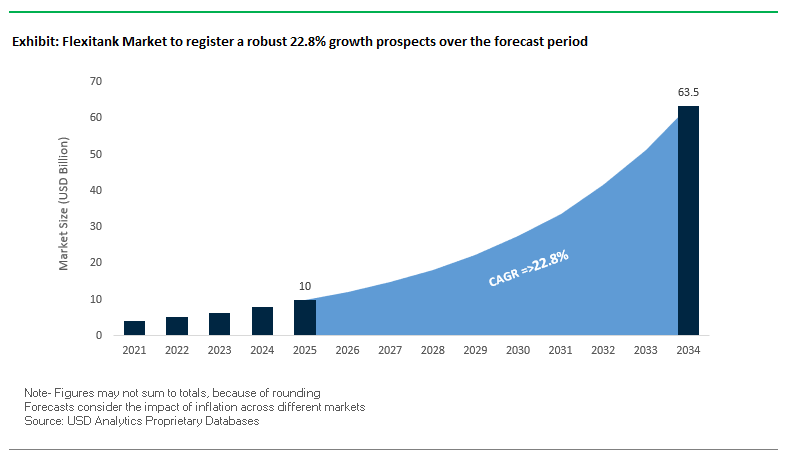
The Global Flexitank Market is forecast to surge from USD 10.0 billion in 2025 to USD 63.5 billion by 2034, expanding at an exceptional CAGR of 22.8%. Flexitanks have emerged as a transformative logistics solution, enabling safe, cost-effective, and sustainable transportation of non-hazardous bulk liquids. By converting standard 20-foot shipping containers into bulk liquid carriers, flexitanks deliver significant savings in freight, handling, and cleaning compared to drums, IBCs, or ISO tanks.
A major growth driver is the rising global trade of liquid food commodities, including wine, edible oils, fruit juices, and syrups, which demand efficient, contamination-free transport. The pharmaceutical and chemical sectors are also adopting flexitanks for transporting high-value liquids due to their sterility and structural integrity.
Sustainability is becoming a core differentiator. Flexitanks reduce carbon emissions by maximizing container payloads and minimizing empty returns. Additionally, the development of multi-layer, composite-film tanks ensures higher durability, leak prevention, and extended usability for sensitive cargo.
Key Insights for industry professionals and buyers:
Market to reach USD 63.5B by 2034 at CAGR 22.8%.
Food-grade liquid trade is the largest demand driver, including wine, juices, and edible oils.
Sustainability advantage over drums and ISO tanks through reduced fuel consumption and cleaning.
Strong adoption in pharma and chemical logistics due to sterility and safety.
Market Analysis: Recent Developments in the Flexitank Industry
The Flexitank Industry is undergoing rapid consolidation and innovation, supported by investments in sustainable facilities, strategic mergers, and technological upgrades.
In June 2025, LAF Technology launched the world’s first ESG-driven flexitank industrial park in Qingdao, China. The 51,000 sq. meter facility integrates solar-powered production and vertical manufacturing, setting a benchmark for sustainable flexitank production. Earlier in June 2024, the company’s products passed the AAR (Association of American Railroads) test, placing them on the approval list for intermodal rail transport.
In December 2024, Hillebrand completed the acquisition of Braid Logistics, consolidating its position in bulk liquid logistics and expanding capacity with new facilities in the UK and China. This followed multiple M&A activities in December 2023, signaling strong consolidation trends in the sector.
Collaborations are also shaping innovation. In August 2024, Qingdao LAF Technology signed a five-year research partnership with the Qingdao University of Science and Technology, focusing on material science and advanced flexitank designs.
Parallel developments in packaging technologies are indirectly impacting the flexitank sector. Reports from April and March 2025 noted the rise of smart packaging (QR, NFC, RFID) and pharma adoption of flexible lid stock for single-dose medications, showing how the packaging ecosystem is moving toward traceability and sterility—attributes that also enhance the case for flexitank adoption.
Meanwhile, volatile raw material costs were reported in February 2025, when petrochemical fluctuations reduced adhesive production capacity by 6%. This emphasizes the need for robust procurement strategies and may push manufacturers to seek alternative raw materials for flexitank films.
Emerging Trends and Strategic Opportunities Driving the Flexitank Market
Material Innovation for Enhanced Safety and Multi-Compatibility
The flexitank market is witnessing a decisive shift toward multi-layer, high-performance materials that go beyond standard polyethylene films. Leading manufacturers are focusing on enhanced puncture resistance, reduced permeability, and compatibility with a wider range of chemicals and food-grade liquids, significantly reducing risk of leaks or contamination. Publications from MSC Shipping highlight that modern flexitanks are constructed with reinforced polyethylene and polyester layers, enabling safer transportation of high-value and sensitive liquids. Companies like DHL Global Forwarding have developed patented tri-laminate flexitanks with barrier technology to protect against oxygen ingress and water vapor, making them suitable for premium juices, wine, and other delicate liquids. Globally, multi-layer flexitanks have shown to cut oxygen transmission by up to 50%, unlocking new markets and creating high-value growth avenues. This trend is reshaping the supply chain, necessitating collaboration between raw material suppliers, converters, and manufacturers to develop durable, multi-compatible solutions.
Integration of Smart Tracking and Monitoring Technologies
To enhance transparency and mitigate risks, the flexitank industry is increasingly adopting IoT-enabled smart tracking and monitoring solutions. These sensors track temperature, pressure build-up, and GPS location in real-time, providing verifiable data for insurance and quality assurance. Logistics leaders such as Hapag-Lloyd use IoT devices from Nexxiot and Orbcomm to monitor container status, reducing damage, spoilage, and blind spots in the supply chain. OpenText solutions enable real-time alerts to stakeholders, and companies report reductions in shipment damage by up to 90% through proactive monitoring. The deployment of these technologies fosters a data-driven and interconnected value chain, where flexitank manufacturers, logistics providers, and technology firms collaborate to deliver safe, efficient, and transparent bulk liquid transport services.
Expansion into New Liquid Bulk Commodities with High Growth Potential
While flexitanks have traditionally served food-grade liquids, there is a growing opportunity to transport non-hazardous, high-value liquids such as synthetic resins, lubricants, agricultural inputs, and pharmaceuticals. Advancements in multi-layer flexitank design and chemical compatibility have opened doors to these new markets. According to MSC Shipping, flexitanks offer a cost-effective alternative to ISO tanks and drums, making them attractive for industrial liquids, fertilizers, and paints. Expansion into Asia-Pacific, with its growing manufacturing and chemical sectors, represents a significant growth avenue. This opportunity is driving collaborations between flexitank manufacturers and chemical, pharmaceutical, and agricultural companies, creating an integrated value chain capable of serving diverse liquid commodities efficiently.
Development of Circular and Sustainable End-of-Life Solutions
The single-use nature of flexitanks presents a critical environmental challenge, creating opportunities for circular economy initiatives. Innovations include mono-material flexitanks (all-PE) that are fully recyclable, dedicated collection systems at ports, and chemical recycling technologies to handle contaminated films. Industry leaders like Cepsa Química, in partnership with DHL Global Forwarding, are developing flexitanks with two layers made from up to 70% recycled polyethylene, reducing plastic waste by 35%. Research into bio-based and home-compostable films shows that advanced bioplastics can withstand mechanical stress and moisture, offering the same protection as conventional materials. These sustainable solutions create a high-value growth avenue, aligning with global ESG initiatives and meeting the increasing demand from environmentally conscious companies and consumers for eco-friendly bulk liquid packaging.
Competitive Landscape: Key Players Driving Innovation and Growth
The Global Flexitank Market is defined by a mix of logistics providers and specialist manufacturers who are expanding their global footprint and investing in R&D to meet rising demand.
Braid Logistics expands under Hillebrand ownership
Braid Logistics is a recognized leader in bulk liquid transport solutions, with its Braid Flexitank widely used across food and beverage supply chains. Following its acquisition by Hillebrand in December 2024, Braid is scaling operations in the UK and China while enhancing service integration. The move strengthens Hillebrand’s position in alcoholic beverage logistics while expanding Braid’s reach and manufacturing capacity.
Trans Ocean Bulk Logistics strengthens global service network
Trans Ocean Bulk Logistics is a leading provider of flexitank services for edible oils, fruit concentrates, and food-grade liquids. The company’s strategic contracts highlight its strong reliability and safety standards. With a focus on multimodal transport—sea, rail, and road—Trans Ocean ensures optimized global liquid supply chains. Its recent contract wins underscore its robust backlog and reputation for operational excellence.
Bulk Liquid Solutions invests in smart tank technologies
Bulk Liquid Solutions specializes in advanced flexitank and storage tank systems, focusing on sealing technologies and corrosion resistance. The company has pioneered real-time monitoring systems, enabling clients to track liquid conditions, detect leaks, and optimize processes. Its emphasis on safety, automated inventory management, and design innovation helps customers minimize downtime and enhance cost efficiency.
Trust Flexitanks drives European innovation and aseptic designs
Trust Flexitanks, based in Europe, differentiates itself by producing both monolayer and multilayer flexitanks in a single facility. Its flagship Aseptic Flexitank is designed for sterile food and beverage transport, catering to high-purity applications. As a member of the Container Owners Association (COA), the company upholds global standards for quality and safety, ensuring trust among its global clientele.
Qingdao LAF Packaging leads with ESG-driven production
Qingdao LAF Packaging is one of China’s largest flexitank manufacturers, producing flexitanks, container liners, and IBCs. In June 2025, it launched the world’s first ESG-driven flexitank park with solar-powered, integrated production. LAF has also pioneered heat-resistant flexitanks for high-temperature liquids like bitumen. With AAR certification, it is expanding into intermodal rail logistics. Its strategic focus remains on reducing costs and environmental impact while scaling advanced global logistics solutions.
Flexitank Market Share Insights
Single-Trip Flexitanks Dominate Market Share by Product Type
The flexitank industry is overwhelmingly dominated by single-trip flexitanks, holding a projected 95% share in 2025, a clear reflection of the industry’s preference for operational simplicity, safety, and regulatory compliance. Single-use units eliminate the logistical burdens and hidden costs of cleaning, sterilization, certification, and return shipping that burden multi-trip systems, making them the most practical option for global exporters. Their adoption is especially strong in food-grade liquids and pharmaceuticals, where contamination risks, cross-contact concerns, and certification complexities leave no margin for error. For shippers, the guarantee of a sterile, uncontaminated flexitank for every shipment is worth far more than potential marginal cost savings from reusability. In contrast, multi-trip flexitanks occupy only a niche role in closed-loop logistics where a company controls both ends of the supply chain and transports the same non-sensitive product repeatedly. This narrow application underscores the fact that single-trip flexitanks will remain the undisputed industry standard, driven by risk mitigation, certification assurance, and total cost optimization in global liquid logistics.
Non-Hazardous Chemicals Lead Market Share by Flexitank Application
Non-hazardous chemicals account for 50% of the flexitank market share in 2025, underscoring the technology’s cost-effectiveness in transporting bulk volumes of industrial oils, lubricants, detergents, surfactants, and liquid fertilizers. Flexitanks provide substantial cost savings compared to ISO tanks or drums, allowing chemical exporters to optimize freight utilization while reducing handling complexity. Following closely, food-grade liquids represent 40% share, highlighting their critical role in global trade for edible oils, juices, wines, and syrups. The demand here is defined by strict purity requirements and adherence to certifications such as FDA and EFSA, further strengthening the dominance of single-trip flexitanks. Industrial products transported in fluidized states, such as synthetic rubber or certain polymers, add emerging opportunities, while pharmaceuticals remain a high-value, specification-driven niche. Though small in volume, pharmaceutical shipments using flexitanks require the highest certification levels for solvents, glycerin, and API intermediates. This segmentation demonstrates how non-hazardous chemicals drive bulk adoption, food-grade liquids fuel premium demand, and pharmaceuticals establish the benchmark for compliance-driven innovation.
United States Flexitank Market Expands with Multi-Layer Barrier Technology and Smart Logistics
The U.S. flexitank market is shaped by a fragmented regulatory landscape and active oversight from organizations such as the Container Owners Association (COA), ensuring safe transport of non-hazardous liquids. Prohibitions on hazardous goods drive innovation toward food-grade and chemical applications, prompting the development of multi-layer flexitanks with enhanced barrier technology that prevents contamination and oxidation. The integration of IoT sensors allows real-time monitoring, improving shipment efficiency, security, and supply chain visibility.
Corporate investments are accelerating capacity expansion, exemplified by Liquitank Solutions’ January 2025 material upgrades, enhancing operational efficiency. Demand is strong across the food and beverage and pharmaceutical sectors, driven by rising consumption of wines, juices, edible oils, and the need for hygienic, contamination-free transport. Sustainability is increasingly a business imperative, with reusable and multi-trip flexitanks reducing environmental impact and aligning with corporate sustainability goals.
Germany Flexitank Market Leads in Circular Economy and High-Value Liquid Transport
Germany’s flexitank industry operates under strict regulations, including the EU Packaging and Packaging Waste Regulation (PPWR), which emphasizes reusable and recyclable packaging. This aligns with the country’s commitment to carbon footprint reduction, positioning Germany as a leader in sustainable bulk liquid transport solutions.
Technological advancements focus on specialized flexitanks for high-value liquids, such as advanced barrier films for wine and chemicals, ensuring oxygen transmission control and product integrity. Germany’s chemical and food-grade liquid sectors drive demand, supported by a robust manufacturing base and strong export activities. Companies like Büscherhoff Packaging Solutions GmbH contribute to market growth by providing innovative packaging and logistics solutions for bulk liquids.
China Flexitank Market Accelerates with Green Policies and Domestic Production Expansion
China’s flexitank market is increasingly shaped by the government’s “dual carbon” strategy and the March 2024 Action Plan for large-scale equipment updates, promoting recycling and sustainable materials. Regulatory reforms, effective September 2023, limit packaging layers and void ratios, directly impacting e-commerce and food-grade liquid transport.
Technological adoption is a key trend, with automation, AI, and “5G plus industrial internet” integration optimizing production efficiency. Domestic manufacturing is expanding to reduce dependence on imports, with companies like Qingdao BLT Flexitank Solution Co. launching FDA-compliant oil bags in May 2025. Rapid growth in edible oils, non-hazardous chemicals, and food and beverage industries is fueling the demand for reliable flexitank solutions that meet international quality standards.
India Flexitank Market Grows with Circular Economy Initiatives and Multi-Layer Innovations
India’s flexitank market benefits from government initiatives promoting a circular economy, alongside the Food Safety and Standards (Packaging) Regulations, 2018, which mandate food-grade safety and restrict the use of recycled plastics for liquid transport. Technological adoption is increasing, with companies developing multi-layer, leakproof flexitanks for enhanced durability and performance.
Corporate investments are boosting production capabilities, with Indian manufacturers obtaining food-grade and ISO certifications to compete globally. Key demand drivers include the food processing, pharmaceutical, and chemical industries, alongside rising exports of edible oils and fruit concentrates. The “Make in India” initiative further accelerates local manufacturing, technological innovation, and domestic market growth.
Brazil Flexitank Market Accelerates Through Sustainability and Technological Innovation
Brazil’s flexitank industry is propelled by government policies promoting sustainable waste management, including the 2025 amendment to the National Solid Waste Policy, which encourages domestic recycling programs and circular economy practices. Technological advancements involve robotics and AI for efficiency, automated labeling, and defect detection in bulk liquid transport.
The market is shifting toward premium and specialized logistics solutions that preserve product quality and extend shelf life. Sustainability initiatives are notable, such as iFood’s collaboration with XPRIZE on a $20 million global competition to develop flexible, biodegradable packaging, highlighting Brazil’s commitment to innovative, eco-friendly flexitank solutions.
Japan Flexitank Market Advances Through High-Performance Materials and Sustainability Regulations
Japan’s flexitank market benefits from the country’s leadership in precision manufacturing and sustainable material development. Innovations like Toppan Inc.’s recycled BOPP film (September 2024) demonstrate Japan’s focus on materials science, which influences protective packaging solutions for liquid transport. The Plastic Resource Circulation Act (April 2022) promotes environmentally conscious design, driving companies toward multi-trip and sustainable flexitank models.
The market emphasizes high-performance films with superior barrier properties to protect sensitive liquids and incorporates functional innovations for specialized transport of high-value commodities. Constant technological and functional innovations in Japan’s logistics and packaging sectors support efficiency, product safety, and sustainability, reinforcing the country’s position as a hub for advanced flexitank solutions.
Flexitank Market Report Scope
Flexitank Market
Parameter
Details
Market Size (2025)
$10 Billion
Market Size (2034)
$63.5 Billion
Market Growth Rate
22.8%
Segments
By Product Type (Single-Trip Flexitanks, Multi-Trip Flexitanks), By Layer (Monolayer, Multilayer), By Loading Type (Top Loading, Bottom Loading), By Application (Food Grade Liquids, Non-Hazardous Chemicals, Pharmaceuticals, Industrial Products)
Study Period
2019- 2024 and 2025-2034
Units
Revenue (USD)
Qualitative Analysis
Porter’s Five Forces, SWOT Profile, Market Share, Scenario Forecasts, Market Ecosystem, Company Ranking, Market Dynamics, Industry Benchmarking
Companies
Bulk Liquid Solutions (BLS), Braid Logistics UK Ltd., SIA Flexitanks, Trans Ocean Bulk Logistics Ltd., UWL Inc., Trust Flexitanks SL, Hillebrand Gori, SGS S.A., Qingdao LAF Packaging Co., Ltd., My Flexitank Industries Sdn Bhd, Environmental Packaging Technologies, Inc., Bulk-Flow, Büscherhoff Packaging Solutions GmbH, Rishi FIBC Solutions Pvt Ltd., Technogroup USA
Countries
US, Canada, Mexico, Germany, France, Spain, Italy, UK, Russia, China, India, Japan, South Korea, Australia, South East Asia, Brazil, Argentina, Middle East, Africa
Flexitank Market Segmentation
By Product Type
Single-Trip Flexitanks
Multi-Trip Flexitanks
By Layer
Monolayer
Multilayer
By Loading Type
Top Loading
Bottom Loading
By Application
Food Grade Liquids
Non-Hazardous Chemicals
Pharmaceuticals
Industrial Products
Countries Analyzed
North America (US, Canada, Mexico)
Europe (Germany, UK, France, Spain, Italy, Russia, Rest of Europe)
Asia Pacific (China, India, Japan, South Korea, Australia, South East Asia, Rest of Asia)
South America (Brazil, Argentina, Rest of South America)
Middle East and Africa (Saudi Arabia, UAE, Rest of Middle East, South Africa, Egypt, Rest of Africa)
Top Companies in Flexitank Market
Bulk Liquid Solutions (BLS)
Braid Logistics UK Ltd.
SIA Flexitanks
Trans Ocean Bulk Logistics Ltd.
UWL Inc.
Trust Flexitanks SL
Hillebrand Gori
SGS S.A.
Qingdao LAF Packaging Co., Ltd.
My Flexitank Industries Sdn Bhd
Environmental Packaging Technologies, Inc.
Bulk-Flow
Büscherhoff Packaging Solutions GmbH
Rishi FIBC Solutions Pvt Ltd.
Technogroup USA
* List Not Exhaustive
Methodology
USDAnalytics employed a comprehensive, multi-dimensional research methodology to deliver an in-depth analysis of the Global Flexitank Market. This approach combined extensive primary research, including interviews with industry leaders, logistics operators, manufacturers, and sustainability experts, with secondary research drawn from company filings, industry publications, regulatory reports, and trade associations. Market sizing, growth forecasting, and trend identification were evaluated across product types, material layers, loading methods, and end-use applications, with particular focus on single-trip and multi-layer flexitanks, as well as their adoption in food-grade, chemical, pharmaceutical, and industrial liquid transport. Regional regulations, sustainability initiatives, and technological advancements in the U.S., Germany, China, India, Japan, and Brazil were carefully analyzed to understand their impact on market expansion, material innovation, and ESG compliance. Key corporate developments, mergers, acquisitions, and R&D activities were incorporated to highlight strategic growth opportunities and competitive positioning. The resulting insights provide actionable guidance for manufacturers, logistics providers, and industrial buyers seeking cost-effective, safe, and environmentally sustainable solutions for bulk liquid transportation.
Deliverables:
Comprehensive Market Research Report (PDF and Excel) with detailed tables, charts, and interactive visualizations.
Country-Specific Forecasts & Analysis.
Segment-Wise Revenue Forecasts (2025–2034).
Competitive Analysis, Benchmarking, and SWOT Profiles.
Recent Developments & Innovation Tracker.
Executive Summary & Analyst Commentary.
Post-Purchase Analyst Support for Client-Specific Questions and Custom Data Requirements.
Table of Contents: Global Flexitank Market
1. Executive Summary
1.1. Market Highlights
1.2. Key Findings
1.3. Global Market Snapshot
2. Flexitank Market Landscape & Outlook (2025–2034)
2.1. Introduction to Flexitank Market
2.2. Market Valuation and Growth Projections (2025–2034)
2.3. Market Drivers and Opportunities
2.4. Industry Challenges and Risk Factors
2.5. Regulatory Landscape and Standards
3. Innovations Reshaping the Flexitank Market
3.1. Trend: Material Innovation for Enhanced Safety and Multi-Compatibility
3.2. Trend: Integration of Smart Tracking and Monitoring Technologies
3.3. Opportunity: Expansion into New Liquid Bulk Commodities
3.4. Opportunity: Development of Circular and Sustainable End-of-Life Solutions
4. Competitive Landscape and Strategic Initiatives
4.1. Mergers, Acquisitions and Strategic Alliances
4.2. R&D and Material Innovation
4.3. Sustainability and Strategies
4.4. Market Expansion and Regional Focus
5. Market Share and Segmentation Insights: Flexitank Market
5.1. By Product Type
5.1.1. Single-Trip Flexitanks
5.1.2. Multi-Trip Flexitanks
5.2. By Layer
5.2.1. Monolayer
5.2.2. Multilayer
5.3. By Loading Type
5.3.1. Top Loading
5.3.2. Bottom Loading
5.4. By Application
5.4.1. Food Grade Liquids
5.4.2. Non-Hazardous Chemicals
5.4.3. Pharmaceuticals
5.4.4. Industrial Products
6. Country Analysis and Outlook of Flexitank Market
6.1. United States
6.2. Canada
6.3. Mexico
6.4. Germany
6.5. France
6.6. Spain
6.7. Italy
6.8. UK
6.9. Russia
6.10. China
6.11. India
6.12. Japan
6.13. South Korea
6.14. Australia
6.15. South East Asia
6.16. Brazil
6.17. Argentina
6.18. Middle East
6.19. Africa
7. Flexitank Market Size Outlook by Region (2025–2034)
7.1. North America Flexitank Market Size Outlook to 2034
7.1.1. By Product Type
7.1.2. By Layer
7.1.3. By Loading Type
7.1.4. By Application
7.2. Europe Flexitank Market Size Outlook to 2034
7.2.1. By Product Type
7.2.2. By Layer
7.2.3. By Loading Type
7.2.4. By Application
7.3. Asia Pacific Flexitank Market Size Outlook to 2034
7.3.1. By Product Type
7.3.2. By Layer
7.3.3. By Loading Type
7.3.4. By Application
7.4. South America Flexitank Market Size Outlook to 2034
7.4.1. By Product Type
7.4.2. By Layer
7.4.3. By Loading Type
7.4.4. By Application
7.5. Middle East and Africa Flexitank Market Size Outlook to 2034
7.5.1. By Product Type
7.5.2. By Layer
7.5.3. By Loading Type
7.5.4. By Application
8. Company Profiles: Leading Players in the Flexitank Market
8.1. Bulk Liquid Solutions (BLS)
8.2. Braid Logistics UK Ltd.
8.3. SIA Flexitanks
8.4. Trans Ocean Bulk Logistics Ltd.
8.5. UWL Inc.
8.6. Trust Flexitanks SL
8.7. Hillebrand Gori
8.8. SGS S.A.
8.9. Qingdao LAF Packaging Co., Ltd.
8.10. My Flexitank Industries Sdn Bhd
8.11. Environmental Packaging Technologies, Inc.
8.12. Bulk-Flow
8.13. Büscherhoff Packaging Solutions GmbH
8.14. Rishi FIBC Solutions Pvt Ltd.
8.15. Technogroup USA
9. Methodology
9.1. Research Scope
9.2. Market Research Approach
9.3. Market Sizing and Forecasting Model
9.4. Research Coverage
9.5. Data Horizon
9.6. Deliverables
10. Appendix
10.1. Acronyms and Abbreviations
10.2. List of Tables
10.3. List of Figures
Flexitank Market Segmentation
By Product Type
Single-Trip Flexitanks
Multi-Trip Flexitanks
By Layer
Monolayer
Multilayer
By Loading Type
Top Loading
Bottom Loading
By Application
Food Grade Liquids
Non-Hazardous Chemicals
Pharmaceuticals
Industrial Products
Countries Analyzed
North America (US, Canada, Mexico)
Europe (Germany, UK, France, Spain, Italy, Russia, Rest of Europe)
Asia Pacific (China, India, Japan, South Korea, Australia, South East Asia, Rest of Asia)
South America (Brazil, Argentina, Rest of South America)
Middle East and Africa (Saudi Arabia, UAE, Rest of Middle East, South Africa, Egypt, Rest of Africa)
The market is driven by the rising demand for bulk transport of non-hazardous liquids such as edible oils, wines, fruit juices, and chemicals. Cost-effectiveness, contamination prevention, and sustainability benefits over drums and ISO tanks are major growth levers, alongside technological advances in multi-layer and smart flexitanks.
Multi-layer flexitanks provide superior puncture resistance, chemical compatibility, and leak prevention, ensuring the safe transport of high-value and sensitive liquids. Innovations like tri-laminate barrier films reduce oxygen transmission by up to 50%, making them suitable for food-grade, pharmaceutical, and chemical cargo.
IoT-enabled sensors monitor temperature, pressure, and container location in real time, enabling proactive risk mitigation and enhanced supply chain transparency. Companies like Hapag-Lloyd and Bulk Liquid Solutions report up to 90% reduction in shipment damage through these smart monitoring systems.
The U.S. emphasizes multi-layer barriers and smart logistics, Germany leads in circular economy solutions, China focuses on domestic manufacturing and sustainable production, India leverages multi-layer, leakproof tanks for export growth, and Japan integrates high-performance materials with functional innovations.
Single-trip flexitanks dominate due to operational simplicity, sterility, and compliance with regulatory standards. They eliminate costs and risks associated with cleaning, certification, and returns, making them ideal for food-grade liquids, pharmaceuticals, and non-hazardous chemicals, where contamination avoidance is critical.