Furfuryl Alcohol Market to Reach $1,115.9 Million by 2034 at 6.6% CAGR Backed by Biorefinery Scale-Up and Advanced Resin Applications
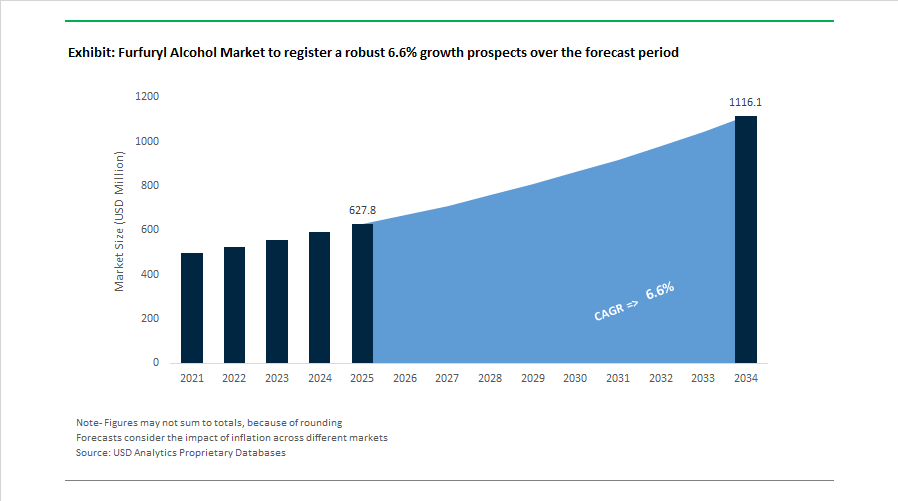
The Furfuryl Alcohol Market is projected to expand from $627.8 Million in 2025 to $1,115.9 Million by 2034, reflecting a CAGR of 6.6% during the forecast period. Market growth is primarily driven by expanding applications in furan resins for foundry casting, corrosion-resistant materials, refractory binders, poly(furfuryl alcohol) composites, and emerging biofuel additives. Increasing emphasis on biomass valorization, decarbonized chemical production, and formaldehyde-reduced binder systems is reinforcing furfuryl alcohol’s role as a high-value bio-based intermediate derived from furfural.
In July 2024, Hongye Holding Group announced a significant expansion of its furfural and furfuryl alcohol production lines to address growing global demand from foundry and resin manufacturers. In September 2024, AM Green Technology and Solutions B.V. acquired Chempolis Oy and Fortum 3 B.V., integrating advanced lignocellulosic biomass conversion technology to strengthen upstream furfural production and downstream furfuryl alcohol capabilities. In June 2024, DynaChem South Africa Pty Ltd launched high-reactivity furfuryl alcohol grades tailored for African foundries, enabling shorter curing cycles in sand casting molds. These capacity and technology expansions signal tightening integration between biomass processing and high-performance resin systems.
Feedstock security and biorefinery investments accelerated in 2025. In January 2025, Central Romana Corporation confirmed that its Dominican Republic facility reached 90 million pounds of annual furfural and derivative output, reinforcing supply reliability for North American and European resin producers. In February 2025, Sappi Limited committed $60 million to build a commercial-scale furfural plant at its Saiccor Mill, targeting 25,000 tonnes annually and ensuring a stable wood-based feedstock pipeline for furfuryl alcohol synthesis. During 2025–2026, Numaligarh Refinery Limited advanced its $4.4 billion second-generation biorefinery project, designed to convert bamboo into bio-ethanol and furfuryl alcohol, with commercial operation expected by mid-2026. These investments demonstrate a structural shift toward vertically integrated, biomass-driven chemical platforms.
Innovation in downstream applications is widening the market scope. In 2024, a leading global biorefinery implemented AI-based process control in catalytic hydrogenation operations, enabling real-time optimization of furfuryl alcohol yields and reduced energy consumption per ton produced. Research finalized in late 2025 and entering pilot stages in 2026 identified furfuryl alcohol as a high-oxygen bio-additive capable of increasing cetane numbers and lowering particulate emissions in diesel and aviation fuel blends. In parallel, a collaboration between TRB Lightweight Structures and University of Bristol reported performance advancements in poly(furfuryl alcohol) resin systems for lightweight, fire-resistant aerospace and rail composites. These developments indicate diversification beyond traditional foundry uses into mobility, transportation, and energy applications.
Market pricing and regulatory pressures influenced 2026 conditions. In January 2026, furfuryl alcohol prices in Northeast Asia increased by 17.4% following tighter environmental controls in China that constrained feedstock processing, combined with elevated construction and automotive demand. In November 2024, Avantium N.V. commenced operations at its flagship FDCA plant, validating commercial-scale furan chemistry and strengthening investor confidence in furfuryl alcohol as a strategic precursor for bio-based polymers such as PEF.
The Furfuryl Alcohol Market outlook reflects integrated biomass supply chains, advanced hydrogenation technologies, AI-enabled production optimization, expansion into sustainable fuel additives, and rising demand for low-emission foundry resins. Competitive positioning is increasingly defined by feedstock control, regional environmental compliance, process efficiency, and downstream polymer innovation across automotive, aerospace, construction, and renewable energy sectors.
Trends and Opportunities in the Global Furfuryl Alcohol Market
Consolidation of Foundry Binders Toward Low-Emission Eco-Resins
Environmental compliance has become the dominant procurement criterion for foundry binders, accelerating the transition away from legacy high-emission systems toward next-generation furfuryl alcohol based resins with controlled VOC and hazardous air pollutant profiles. In 2024, ASK Chemicals expanded the commercial deployment of its MAGNASET 2.0 furan binder series, engineered to significantly reduce free furfuryl alcohol content and eliminate formaldehyde-related emissions during casting. By August 2025, multiple automotive foundries in Western Europe reported that adoption of these low-emission binders was instrumental in meeting tighter manufacturing-related air quality thresholds associated with EURO 7 compliance.
Beyond regulation, performance economics are reinforcing adoption. Infrastructure-driven casting demand across Asia-Pacific is pushing foundries toward FA-based no-bake systems that deliver 15 to 20% higher mold and core strength while lowering scrap rates in large iron and steel components. With regional infrastructure investment requirements estimated at approximately 1.7 trillion dollars annually, foundry operators are prioritizing binder systems that simultaneously reduce environmental liabilities and improve throughput efficiency. This dual benefit is accelerating market consolidation toward a smaller number of high-performance, compliance-ready furfuryl alcohol resin platforms.
Vertical Integration and the Rise of Verified Bio-Sourced Chemistry
Supply chain security has emerged as a strategic differentiator in the furfuryl alcohol market, particularly in light of price volatility and export concentration in upstream furfural supply. In response, producers are increasingly backward-integrating into non-food, lignocellulosic biomass feedstocks such as corn cobs and sugarcane bagasse to ensure long-term availability and certification-ready sourcing.
A major milestone was reached in September 2025 when Engineers India Limited announced the successful completion of the Assam Bio Ethanol biorefinery, designed to produce 19,000 tons per annum of furfural. This capacity provides a dedicated domestic feedstock base for downstream furfuryl alcohol production, reducing exposure to imported material pricing and logistics risks. Similarly, in February 2025, Sappi confirmed plans for full-scale commercial furfural manufacturing at its Saiccor Mill in KwaZulu-Natal. By leveraging in-house lignocellulosic waste streams, Sappi is establishing a vertically integrated model aimed at supplying ISCC PLUS certified bio-based chemicals to European resin and textile markets. These developments signal a broader shift toward traceable, ESG-aligned furfuryl alcohol supply chains.
High-Purity Precursors for Aerospace Carbon–Carbon and Semiconductor Composites
One of the highest-value growth avenues for furfuryl alcohol lies in advanced composites, where its exceptional char yield exceeding 50% and ability to form glassy carbon make it an ideal liquid precursor for extreme-environment materials. As of late 2025, R&D activity in carbon–carbon composites for aerospace and defense has intensified, driven by hypersonic platforms, missile systems, and space exploration programs. Furfuryl alcohol is increasingly specified as the resin used to infiltrate carbon fiber preforms for rocket nozzles and thermal protection systems, delivering superior oxidation resistance at temperatures above 2,000 degrees Celsius.
A parallel opportunity is emerging in semiconductor manufacturing. Ultra-high-purity furfuryl alcohol, with purity levels above 99.5% and tightly controlled metallic impurities, is being adopted in the production of carbon–silicon carbide wafer carriers. In 2025, chip manufacturers processing at 3-nanometer nodes began specifying FA-derived C/SiC carriers due to their zero outgassing behavior, dimensional stability, and compatibility with high-vacuum deposition environments. These applications command premium pricing and favor suppliers with advanced purification, analytical control, and long-term supply assurances.
Innovation in Pharmaceutical Intermediates and Formaldehyde-Free Green Materials
The chemical versatility of the furan ring is opening new pathways for furfuryl alcohol in pharmaceutical synthesis and sustainable construction materials. In May 2025, a research breakthrough recognized at the Regeneron International Science and Engineering Fair demonstrated a low-cost antiviral drug synthesis route using furfuryl alcohol as a core building block. This validation highlights the growing relevance of FA as a bio-based scaffold for active pharmaceutical ingredients, creating demand for GMP-grade material in the 1.5 trillion dollar global pharmaceutical industry.
In parallel, construction and furniture markets are creating volume-driven opportunities through formaldehyde-free composites. A study published in November 2025 demonstrated that particleboard produced from sugarcane bagasse and furfuryl alcohol resin can match P5-grade mechanical performance under ISO 16893 standards, while eliminating added formaldehyde entirely. As healthy building certifications and indoor air quality regulations gain traction, this positions furfuryl alcohol as a key enabler in replacing urea–formaldehyde systems across flooring, furniture, and interior panels.
Furfuryl Alcohol Market Share and Segmentation Insights
Industrial Grade Furfuryl Alcohol Leads Global Production Through Dominance in Foundry Binder Applications
Industrial Grade Furfuryl Alcohol accounted for 86.40% of the Furfuryl Alcohol Market share in 2025, making it the overwhelmingly dominant purity category across global consumption. Industrial grade furfuryl alcohol—typically produced with purity levels between 98% and 99%—is primarily used as the key raw material for furan resin binders employed in foundry sand molds and cores. These resins provide essential performance characteristics such as high thermal stability, strong bonding strength, and controlled mold collapsibility, which are required for high-quality metal casting processes. Because foundry applications account for the majority of global demand, industrial-grade material remains the most commercially significant product type, offering the cost efficiency required for large-scale industrial manufacturing. In 2025, the market is witnessing growing demand for optimized impurity-controlled industrial grades specifically designed for foundry performance. Foundries increasingly require furfuryl alcohol with low nitrogen content, reduced water levels, and tightly controlled impurity profiles to improve resin curing behavior and reduce casting defects such as gas formation and surface imperfections. This trend has created a premium “foundry-grade” segment within industrial-grade furfuryl alcohol, which commands higher prices than commodity material while maintaining compatibility with standard resin binder production processes.
Foundry and Metallurgy Industry Drives the Largest Demand for Furfuryl Alcohol Worldwide
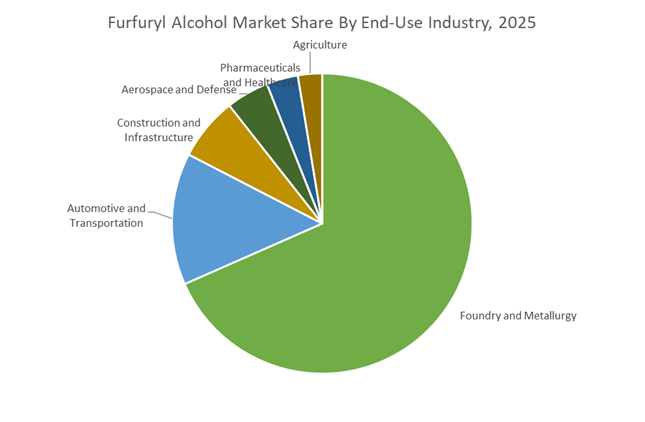
Foundry and Metallurgy represented 68.40% of the Furfuryl Alcohol Market share in 2025, reflecting the central role of furfuryl alcohol in global metal casting operations. Furfuryl alcohol serves as the primary precursor for furan resin binders used in sand mold and core production, which are essential components in the casting of iron, steel, and non-ferrous metal parts. These castings are widely used across industries such as automotive manufacturing, heavy equipment production, industrial machinery, and infrastructure development, where complex and high-strength metal components are required. Furan resin binder systems are particularly valued for their excellent mold strength, dimensional accuracy, and resistance to high temperatures during molten metal pouring, making them one of the most widely adopted binder technologies in modern foundries. In 2025, the foundry sector is experiencing technological transformation driven by the growing adoption of additive manufacturing technologies for mold and core production. Binder jetting systems allow manufacturers to 3D print sand molds and cores using furan resin binder chemistry, enabling rapid prototyping and the creation of complex internal geometries that traditional mold-making methods cannot easily achieve. This emerging digital foundry segment requires specialized low-viscosity furfuryl alcohol formulations optimized for inkjet printing compatibility and rapid layer curing, creating a new high-value niche within the global furfuryl alcohol market.
Competitive Landscape in Furfuryl Alcohol Market
Hongye Holding Leads Global Scale and REACH-Compliant Production
Hongye Holding Group is widely recognized as the world’s largest production base for furfuryl alcohol and furfural, leveraging China’s extensive agricultural biomass feedstock. The company operates as a leading global manufacturer of thiourea dioxide and furfuryl alcohol, maintaining full REACH registration to secure European market access. Its portfolio includes high-purity furfuryl alcohol, 2-methyl furan, and long-chain furan-based ester alcohols for Asia-Pacific and EU customers. In 2026, Hongye emphasized Reliable Global Partnerships, strengthening supply chain integration and expanding its visibility at international trade platforms such as Chemspec Europe. ISO9001, ISO14001, and ISO45001 certifications reinforce its position as a standardized supplier to pharmaceutical, coatings, and foundry resin manufacturers worldwide.
Central Romana Secures Feedstock Independence Through Bagasse Integration
Central Romana Corporation operates one of the most significant vertically integrated furfural-to-derivative complexes globally, utilizing sugarcane bagasse from its own milling operations. Its Romana By-Products facility maintains annual production capacity of approximately 90 million pounds, equivalent to about 41,000 metric tons, positioning it as a key supplier to North American and European markets. Distribution is coordinated through TransFurans Chemicals in Belgium and International Furan Chemicals in the Netherlands, strengthening global reach. In early 2026, Central Romana intensified its focus on foundry modernization, supplying high-purity furfuryl alcohol grades for low-emission furan resin formulations. Complete raw material self-sufficiency shields its pricing structure from agricultural commodity volatility, providing stability in a market sensitive to biomass fluctuations.
Illovo Advances Bio-Refinery Integration for Foundry and Coatings Applications
Illovo Sugar Africa, a subsidiary of Associated British Foods, operates an advanced biorefinery at its Sezela site in South Africa, producing high-grade furfuryl alcohol primarily for foundry sand binders and acid-resistant specialty coatings. In February 2026, the company highlighted a high-value, low-volume downstream strategy aimed at expanding exports of bio-based furan derivatives to the United States and Europe. Illovo integrates circular economy principles by extracting chemical constituents from sugarcane bagasse before redirecting residual biomass for on-site energy generation. It confirmed its leadership role within South Africa’s green economy by expanding derivative output alongside pharmaceutical-grade lactulose and ethanol. Its geographic position supports efficient supply to both EU environmental markets and growing Asian industrial sectors.
Pennakem Expands Sustainable Solvent and Infrastructure Resin Applications
Pennakem, part of the Minasolve and Biolandes Group, is the leading North American specialist in bio-based furan chemistry. In early 2026, the company commercialized advanced grades of tetrahydrofurfuryl alcohol, a furfuryl alcohol derivative widely used as a high-performance eco-friendly solvent in pharmaceutical and coatings applications. Its Safe and Sustainable by Design strategy focuses on replacing petroleum-based solvents such as tetrahydrofuran with safer furan-based alternatives. Pennakem anticipates approximately 20.3% capacity growth in its bio-based furanic segment to meet rising U.S. demand for sustainable chemical intermediates. The company positions furfuryl alcohol as a critical precursor for corrosion-resistant resins supporting infrastructure rehabilitation and industrial construction.
Silvateam Enhances High-Purity and Low-Emission Foundry Solutions
Silvateam S.p.A. integrates furfural and furfuryl alcohol production within a circular industrial processing model based on quebracho wood extract byproducts. Its Argentine operations produce 98.5% pure furfuryl alcohol using high-pressure catalytic hydrogenation technology. In late 2025 and early 2026, Silvateam optimized global transit packaging by introducing inert nitrogen atmospheres in steel containers to prevent oxidation and preserve amber-grade stability. The company supplies furfuryl alcohol for abrasive wheels, urea-formaldehyde adhesives, and specialty resins requiring strong wetting and dispersant properties. It is strengthening its role in the foundry resin segment by offering low-viscosity binders with reduced gas emission during metal casting, addressing evolving European environmental regulations for low-VOC industrial processes.
China: Continuous Processing, Battery Materials, and Automotive-Grade Purity
China’s furfuryl alcohol market is undergoing a structural upgrade driven by green manufacturing mandates and downstream demand from automotive, aerospace, and energy storage sectors. Under the 2025–2026 Action Plan issued by the Ministry of Industry and Information Technology, chemical producers are required to lift biomass-to-chemical conversion efficiency by 10%. This has accelerated the shift from legacy batch hydrogenation toward continuous processing for furfuryl alcohol, materially improving purity while lowering waste and emissions. The regulatory push is directly aligned with rising demand for low-free furfuryl alcohol grades used in advanced furan resins for high-temperature casting applications.
Capacity expansion is reinforcing China’s leadership. In July 2025, Jinan Shengquan Group announced an expansion at its flagship site to meet surging orders from automotive and aerospace foundries. Broader policy dynamics are also reshaping investment priorities. While the May 2025 Frugality Law constrained consumer alcohol markets, it redirected subsidies toward bio-based industrial manufacturing. More than one-fifth of domestic chemical producers have since increased R&D spending on sustainable materials using furfuryl alcohol as a core building block. Innovation is extending into energy storage, with late-2025 industrial trials validating furfuryl alcohol-derived porous carbon as an anode material for sodium-ion batteries, supporting China’s 2026 electric vehicle supply chain strategy.
India: Biorefinery Scale-Up and Automotive Coatings Pull-Through
India’s furfuryl alcohol market is transitioning from import reliance to domestic production through large-scale biorefinery investments and biofuel-linked downstream demand. In August 2025, Japan confirmed 60 billion yen in financing for a bamboo-based biorefinery in Northeast India, designed to process 5 million metric tonnes of biomass annually into furfural and furfuryl alcohol. This project is strategically positioned to stabilize domestic supply for foundry resins and specialty chemicals while reducing exposure to external feedstock volatility.
Public funding is accelerating execution. The Ministry of New and Renewable Energy provided central financial assistance to the Numaligarh Refinery biorefinery, which entered its final commissioning phase in late 2025. Beyond resins, India’s rapid advance toward a 20% ethanol blending target by 2026 is expanding use cases for furan-based protective coatings. Automotive manufacturers are increasingly adopting furfuryl alcohol-derived coatings for corrosion resistance in fuel systems exposed to higher alcohol content, linking biofuel policy directly to incremental FA demand.
South Africa: Integrated Biomass Valorization and Mining-Focused Binders
South Africa is strengthening its position in the furfuryl alcohol market through integrated biomass utilization and targeted product development for mining and metalworking. In February 2025, Sappi finalized engineering designs for a commercial plant at its Saiccor Mill, targeting 25,000 tonnes per annum of furfural, with a significant share slated for conversion into furfuryl alcohol. The investment leverages wood sugars and lignosulphonates from existing pulping operations, creating a low-carbon, circular supply chain oriented toward European foundry customers.
Product specialization is also emerging locally. In mid-2025, DynaChem launched a new range of furfuryl alcohol binders formulated for high-performance mining and metalwork environments. These binders address abrasive conditions and thermal stress common in African operations, positioning South Africa as both a feedstock-efficient producer and an application-focused innovator in the FA value chain.
United States: Tariff-Induced Localization and Aerospace Validation
The United States furfuryl alcohol market is being reshaped by trade policy, domestic feedstock innovation, and high-performance validation in aerospace. Escalating tariffs on Chinese chemical intermediates in early 2025 increased imported FA costs by an estimated 12 to 15%. This has prompted U.S. producers such as Pennakem to accelerate investment in corn-to-chemical infrastructure, anchoring furfuryl alcohol production to domestic agricultural residues.
Advanced applications are reinforcing strategic value. In September 2025, U.S. aerospace contractors reported successful trials of carbon-carbon composites derived from furfuryl alcohol for re-entry heat shields, supported by testing associated with National Aeronautics and Space Administration programs. These results highlighted superior thermal stability versus traditional phenolic systems. Regulatory compliance is also expanding FA use cases. To meet 2026 Lowest Additive Concentration requirements from the U.S. Environmental Protection Agency, refiners are increasingly using furfuryl alcohol derivatives as low-volatility solvent carriers in fuel detergent formulations.
European Union: REACH Substitution and Pharmaceutical-Grade Valorization
The European Union furfuryl alcohol market is advancing through regulatory substitution and high-purity biorefinery integration. With the October 2026 enforcement of REACH Entry 79 restrictions on PFHxA, manufacturers are rapidly replacing fluorinated surfactants with furan-based sustainable solvents. This regulatory deadline is elevating furfuryl alcohol from a foundry intermediate to a critical green solvent precursor across coatings, electronics, and specialty chemicals.
Value chain diversification is gaining momentum. In late 2025, Lenzing AG confirmed that its biorefinery side-streams achieved pharma-grade purity for furfuryl alcohol, enabling supply into antiviral drug synthesis and pharmaceutical intermediates. At a system level, Horizon Europe funding during 2025–2026 under the Circular Bio-based Europe initiative is supporting commercialization of polyethylene furanoate precursors derived from FA, embedding furfuryl alcohol in the EU’s next-generation sustainable packaging ecosystem.
Summary of Country-Level Strategic Drivers in the Furfuryl Alcohol Market
Furfuryl Alcohol Market County Level Snapshot
Country / Region
Primary Strategic Driver
Implications for Furfuryl Alcohol
China
Green manufacturing and battery materials
Higher-purity FA for resins and sodium-ion batteries
India
Biorefinery investments and E20 rollout
Import substitution and automotive coatings demand
South Africa
Circular biomass integration
Low-carbon FA supply for foundries and mining
United States
Tariff localization and aerospace testing
Domestic feedstock conversion and high-heat composites
European Union
REACH substitution and biorefining
Expansion into green solvents, pharma, and PEF precursors
Furfuryl Alcohol Market Report Scope
Furfuryl Alcohol Market
Parameter
Details
Market Size (2025)
$627.8 Million
Market Size (2034)
$1115.9 Million
Market Growth Rate
6.6%
Segments
By Purity (Industrial Grade, Pharmaceutical and High-Purity Grade), By Raw Material (Corn Cobs, Sugarcane Bagasse, Rice Husks, Bamboo and Wood Residues), By Application (Resins, Solvents, Chemical Intermediates, Additives), By End-Use Industry (Foundry and Metallurgy, Automotive and Transportation, Aerospace and Defense, Construction and Infrastructure, Pharmaceuticals and Healthcare, Agriculture)
Study Period
2019- 2025 and 2026-2034
Units
Revenue (USD)
Qualitative Analysis
Porter’s Five Forces, SWOT Profile, Market Share, Scenario Forecasts, Market Ecosystem, Company Ranking, Market Dynamics, Industry Benchmarking
Companies
Jinan Shengquan Group Shareholding Co., Ltd., Pennakem, LLC, Lenzing AG, Hongye Holding Group Corporation Ltd., Sappi Limited, Illovo Sugar Africa (Pty) Ltd., TransFurans Chemicals bvba, Central Romana Corporation, DynaChem South Africa (Pty) Ltd., Hebei Huaxian Chemical Co., Ltd., Silvateam S.p.A., Ashland Inc., ASK Chemicals GmbH, Kao Corporation, Xingtai Chunlei Furfuryl Alcohol Co., Ltd.
Countries
US, Canada, Mexico, Germany, France, Spain, Italy, UK, Russia, China, India, Japan, South Korea, Australia, South East Asia, Brazil, Argentina, Middle East, Africa
Furfuryl Alcohol Market Segmentation
By Purity
Industrial Grade
Pharmaceutical and High-Purity Grade
By Raw Material
Corn Cobs
Sugarcane Bagasse
Rice Husks
Bamboo and Wood Residues
By Application
Resins
Solvents
Chemical Intermediates
Additives
By End-Use Industry
Foundry and Metallurgy
Automotive and Transportation
Aerospace and Defense
Construction and Infrastructure
Pharmaceuticals and Healthcare
Agriculture
By Region
North America (United States, Canada, Mexico)
Europe (Germany, France, United Kingdom, Spain, Italy, Rest of Europe)
Asia Pacific (China, India, Japan, South Korea, Australia, Rest of APAC)
South and Central America (Brazil, Argentina, Rest of SCA)
Middle East and Africa (Saudi Arabia, UAE, South Africa, Rest of Middle East, Rest of Africa)
2. Furfuryl Alcohol Market Landscape & Outlook (2026–2034)
2.1. Introduction to Furfuryl Alcohol Market
2.2. Market Valuation and Growth Projections (2026–2034)
2.3. Expansion of Biomass Valorization and Integrated Biorefinery Platforms
2.4. Rising Demand for Low-Emission Foundry Resin Systems and Casting Binders
2.5. Technological Advancements in Hydrogenation, AI-Enabled Production, and Biofuel Applications
3. Innovations Reshaping the Furfuryl Alcohol Market
3.1. Trend: Consolidation of Foundry Binders Toward Low-Emission Eco-Resins
3.2. Trend: Vertical Integration and the Rise of Verified Bio-Sourced Chemistry
3.3. Opportunity: High-Purity Precursors for Aerospace Carbon–Carbon and Semiconductor Composites
3.4. Opportunity: Innovation in Pharmaceutical Intermediates and Formaldehyde-Free Green Materials
4. Competitive Landscape and Strategic Initiatives
4.1. Mergers and Acquisitions
4.2. R&D and Material Innovation
4.3. Sustainability and ESG Strategies
4.4. Market Expansion and Regional Focus
5. Market Share and Segmentation Insights: Furfuryl Alcohol Market
5.1. By Purity
5.1.1. Industrial Grade
5.1.2. Pharmaceutical and High-Purity Grade
5.2. By Raw Material
5.2.1. Corn Cobs
5.2.2. Sugarcane Bagasse
5.2.3. Rice Husks
5.2.4. Bamboo and Wood Residues
5.3. By Application
5.3.1. Resins
5.3.2. Solvents
5.3.3. Chemical Intermediates
5.3.4. Additives
5.4. By End-Use Industry
5.4.1. Foundry and Metallurgy
5.4.2. Automotive and Transportation
5.4.3. Aerospace and Defense
5.4.4. Construction and Infrastructure
5.4.5. Pharmaceuticals and Healthcare
5.4.6. Agriculture
6. Country Analysis and Outlook of Furfuryl Alcohol Market
6.1. United States
6.2. Canada
6.3. Mexico
6.4. Germany
6.5. France
6.6. Spain
6.7. Italy
6.8. UK
6.9. Russia
6.10. China
6.11. India
6.12. Japan
6.13. South Korea
6.14. Australia
6.15. South East Asia
6.16. Brazil
6.17. Argentina
6.18. Middle East
6.19. Africa
7. Furfuryl Alcohol Market Size Outlook by Region (2026–2034)
7.1. North America Furfuryl Alcohol Market Size Outlook to 2034
7.1.1. By Purity
7.1.2. By Raw Material
7.1.3. By Application
7.1.4. By End-Use Industry
7.2. Europe Furfuryl Alcohol Market Size Outlook to 2034
7.2.1. By Purity
7.2.2. By Raw Material
7.2.3. By Application
7.2.4. By End-Use Industry
7.3. Asia Pacific Furfuryl Alcohol Market Size Outlook to 2034
7.3.1. By Purity
7.3.2. By Raw Material
7.3.3. By Application
7.3.4. By End-Use Industry
7.4. South America Furfuryl Alcohol Market Size Outlook to 2034
7.4.1. By Purity
7.4.2. By Raw Material
7.4.3. By Application
7.4.4. By End-Use Industry
7.5. Middle East and Africa Furfuryl Alcohol Market Size Outlook to 2034
7.5.1. By Purity
7.5.2. By Raw Material
7.5.3. By Application
7.5.4. By End-Use Industry
8. Company Profiles: Leading Players in the Furfuryl Alcohol Market
8.1. Jinan Shengquan Group Shareholding Co., Ltd.
8.2. Pennakem, LLC
8.3. Lenzing AG
8.4. Hongye Holding Group Corporation Ltd.
8.5. Sappi Limited
8.6. Illovo Sugar Africa (Pty) Ltd.
8.7. TransFurans Chemicals bvba
8.8. Central Romana Corporation
8.9. DynaChem South Africa (Pty) Ltd.
8.10. Hebei Huaxian Chemical Co., Ltd.
8.11. Silvateam S.p.A.
8.12. Ashland Inc.
8.13. ASK Chemicals GmbH
8.14. Kao Corporation
8.15. Xingtai Chunlei Furfuryl Alcohol Co., Ltd.
9. Methodology
9.1. Research Scope
9.2. Market Research Approach
9.3. Market Sizing and Forecasting Model
9.4. Research Coverage
9.5. Data Horizon
9.6. Deliverables
10. Appendix
10.1. Acronyms and Abbreviations
10.2. List of Tables
10.3. List of Figures
Furfuryl Alcohol Market Segmentation
By Purity
Industrial Grade
Pharmaceutical and High-Purity Grade
By Raw Material
Corn Cobs
Sugarcane Bagasse
Rice Husks
Bamboo and Wood Residues
By Application
Resins
Solvents
Chemical Intermediates
Additives
By End-Use Industry
Foundry and Metallurgy
Automotive and Transportation
Aerospace and Defense
Construction and Infrastructure
Pharmaceuticals and Healthcare
Agriculture
By Region
North America (United States, Canada, Mexico)
Europe (Germany, France, United Kingdom, Spain, Italy, Rest of Europe)
Asia Pacific (China, India, Japan, South Korea, Australia, Rest of APAC)
South and Central America (Brazil, Argentina, Rest of SCA)
Middle East and Africa (Saudi Arabia, UAE, South Africa, Rest of Middle East, Rest of Africa)
The Furfuryl Alcohol Market is expected to grow from $627.8 million in 2025 to $1,115.9 million by 2034, registering a CAGR of 6.6%. Market expansion is driven by increasing use in furan resin binders for metal casting, corrosion-resistant materials, refractory binders, and emerging biofuel additives. Rising investment in biorefineries and biomass-derived chemical platforms is strengthening global supply chains.
The foundry and metallurgy industry accounted for 68.4% of market demand in 2025, making it the largest application segment. Furfuryl alcohol is the primary precursor for furan resin binders used in sand molds and cores for metal casting. These binder systems provide high thermal resistance, strong bonding strength, and dimensional accuracy, enabling production of complex automotive and industrial components.
Large-scale biomass-based biorefineries are improving feedstock security and production efficiency for furfuryl alcohol. Projects such as bamboo-based and wood-based furfural plants are converting agricultural residues into chemical intermediates used for furfuryl alcohol synthesis. These integrated platforms reduce dependence on fossil resources while enabling traceable bio-based chemical production aligned with global sustainability regulations.
New high-value applications include poly(furfuryl alcohol) composites for aerospace structures, carbon–carbon materials for extreme-temperature components, and biofuel additives that improve cetane numbers and reduce emissions. Research is also advancing its use as a precursor for carbon–silicon carbide materials used in semiconductor wafer carriers and high-temperature industrial equipment.
Major companies operating in the Furfuryl Alcohol Market include Hongye Holding Group, Central Romana Corporation, Pennakem LLC, Lenzing AG, Sappi Limited, Illovo Sugar Africa, Silvateam S.p.A., Ashland Inc., ASK Chemicals GmbH, and Kao Corporation. These companies are investing in biorefinery integration, high-purity production technologies, and sustainable furan-based chemical platforms to strengthen global market leadership.
More Biorefinery Chemicals and Derivatives Reports