Marine Enzymes Market 2025–2034: GMP-Grade Bioprocess Catalysts, Aquaculture Feed Optimization, and Marine-Inspired Green Chemistry Driving $343.6 Million Outlook at 6.4% CAGR
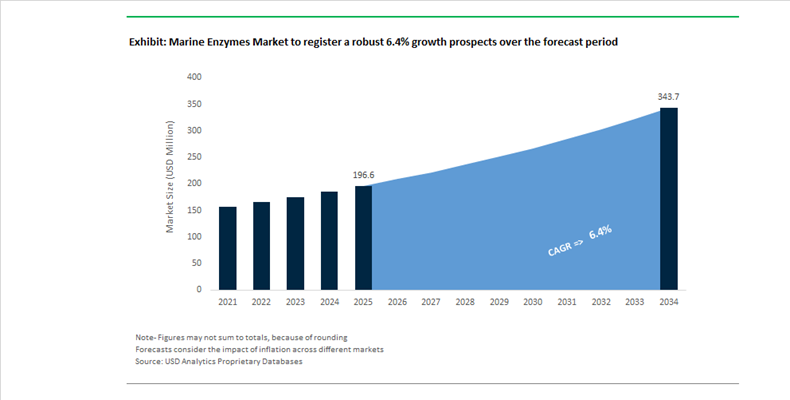
The Marine Enzymes Market is projected to expand from $196.6 Million in 2025 to $343.6 Million by 2034, registering a CAGR of 6.4%. Growth is supported by rising deployment of marine-derived proteases, lipases, nucleases, and carbohydrases across aquaculture nutrition, cell and gene therapy manufacturing, vaccine purification, biofuels, and sustainable industrial biocatalysis. Marine enzymes, often sourced from extremophilic microorganisms, demonstrate salt tolerance, thermal stability, and catalytic efficiency under harsh processing conditions that conventional terrestrial enzymes cannot withstand. Increasing demand for high-purity GMP-grade enzymes in advanced therapeutics and growing adoption of alternative proteins in fish feed are structurally expanding the addressable market.
In April 2024, ArcticZymes Technologies partnered with the Austrian Centre of Industrial Biotechnology to optimize bionanoparticle purification using marine-derived salt-active nucleases, strengthening applications in next-generation vaccine and drug delivery systems. In late 2024, ArcticZymes launched SAN HQ ELISA SensoPlus, enhancing DNA clearance in viral vaccine production while maintaining high virus recovery rates. In December 2024, the company introduced SAN HQ GMP neo, a high-purity salt-active nuclease designed for viral vector purification in cell and gene therapy, capable of functioning in high-salinity environments where conventional enzymes fail. Following its formation in 2024, Novonesis launched 45 new biosolutions including marine-inspired lipases such as Eversa Advance for biodiesel production, demonstrating the role of extremophilic catalysts in high-temperature waste oil conversion processes.
Strategic consolidation accelerated in 2025 and early 2026. In June 2025, Novonesis finalized its €1.5 billion acquisition of dsm-firmenich’s animal feed enzyme business, consolidating aquaculture-focused protease and carbohydrase systems used to enhance digestibility of alternative feed proteins. In October 2025, BASF and IFF formed a collaboration to advance Designed Enzymatic Biomaterials platforms aimed at translating marine-inspired biocatalysts into large-scale cleaning and personal care applications. In the same month, ArcticZymes appointed Brenntag Specialties Pharma as exclusive European distributor to strengthen logistics and technical support for its GMP-grade marine nuclease portfolio. BASF also confirmed evaluation of strategic options for its feed enzyme business to pivot toward higher-margin sustainable chemistry segments. In February 2026, ArcticZymes reported 106% year-on-year growth in GMP-grade marine enzyme sales, reflecting a shift from research-use-only products to clinical-stage manufacturing demand. In the same month, dsm-firmenich announced divestment of its Animal Nutrition and Health business for €2.2 billion, completing its repositioning toward consumer nutrition and beauty applications that leverage marine-derived enzymes for skin-barrier repair and gut health supplements.
Strategic Trends and High-Impact Opportunities in the Marine Enzymes Market
Trend: Bioprospecting of Cold-Active Marine Enzymes to Enable Low-Temperature Home Care
The marine enzymes market is gaining strategic momentum as detergent manufacturers reengineer formulations to support cold-water washing at 20°C and below, a critical lever for achieving Net-Zero 2050 targets. Conventional terrestrial enzymes exhibit sharp activity losses at low temperatures, creating a structural demand for cold-active proteases and amylases sourced from polar and deep-sea marine microorganisms. These enzymes deliver high catalytic efficiency under cold and dilute conditions, allowing detergents to maintain cleaning performance while sharply reducing energy consumption.
In February 2025, BASF highlighted that its Lavergy enzyme portfolio, inspired by cold-adapted marine biology, enables high-performance washing at 20°C. Industry benchmarks indicate that shifting wash cycles from 40°C to 20°C can reduce household laundry energy use by up to 50%, making enzyme performance at low temperatures a non-negotiable formulation requirement. Stability in liquid detergents is equally critical. Novozymes operating as Novonesis commercialized protease inhibitor technologies that preserve enzyme activity in high-pH, water-rich liquids even in the presence of strong chelators increasingly used to replace phosphates in eco-labeled detergents. By mid-2025, industry reports showed that more than 30% of new premium laundry launches in the EU and North America featured cold-active claims, supported by Ecocert certifications that reinforce biodegradability and low-energy use credentials.
Trend: Marine-Derived Polymerases Reshape NGS and PCR Diagnostic Performance
Marine bioprospecting is also transforming molecular diagnostics as biotechnology companies source DNA polymerases from thermophilic marine archaea inhabiting hydrothermal vents. These enzymes deliver the extreme thermal stability, inhibitor resistance, and high processivity required for next-generation sequencing and rapid point-of-care diagnostics, particularly where sample purity is compromised.
In 2025, the NorStruct project reported the identification of a broad panel of Arctic marine polymerases optimized for Isothermal Nucleation Amplification Technology, enabling accurate molecular diagnostics at ambient temperatures without complex thermal cyclers. Adoption is accelerating across personalized medicine, oncology, and forensic science, where diagnostic accuracy under inhibitor-rich conditions is essential. By late 2025, AI-driven structural modeling had become integral to rational enzyme design, allowing developers to tailor marine polymerases for single-cell genomics and CRISPR-Cas9 workflows. This convergence of marine biodiversity, computational biology, and diagnostics positions marine-derived polymerases as foundational tools for next-generation clinical testing platforms.
Opportunity: Enzymatic Depolymerization as a Pillar of Plastic Circularity
Global pressure to end plastic pollution is creating a high-growth opportunity for marine enzymes capable of depolymerizing complex plastics such as PET and polyethylene. The United Nations Environment Programme has catalyzed investment in enzymatic recycling as governments and brands seek scalable solutions that outperform mechanical recycling in recovery rates and material quality.
Scientific breakthroughs are accelerating commercialization. In January 2025, researchers at King Abdullah University of Science and Technology published findings in The ISME Journal identifying a novel M5 motif in marine PETases that enables plastic degradation even in deep-ocean conditions. Industrial scale-up is already underway. Carbios has demonstrated enzymatic PET recycling that enables 30 to 50 reuse cycles compared with 3 to 5 cycles for mechanical methods, achieving approximately 97% monomer recovery from one tonne of plastic. As negotiations for a legally binding Global Plastics Treaty resumed in Geneva in August 2025, corporations increased capital allocation toward enzymatic recycling to meet mandatory recycled-content thresholds across packaging, textiles, and consumer goods.
Opportunity: Marine Enzymes Enable Clean-Label Bioactive Extraction for Nutricosmetics
The shift toward clean-label processing is unlocking new demand for marine enzymes as selective biocatalysts in nutricosmetics and functional nutrition. These enzymes replace harsh solvents in the extraction of marine collagen, omega-3 algal oils, and bioactive peptides, preserving functionality while meeting regulatory and consumer expectations for natural processing.
NIH-published studies emphasize pepsin-solubilized collagen extraction using marine proteases to cleave telopeptide regions, increasing collagen purity while reducing antigenicity. This is critical for medical-grade skincare and premium supplements. Waste valorization is expanding the opportunity further. Enzymatic hydrolysis of fishery by-products is driving growth in marine protein hydrolysates used for skin microbiome support and anti-aging applications, with divisions such as BASF Care Chemicals increasing focus on biotech-derived actives. Regulatory momentum reinforces adoption. In Q3 2025, the U.S. Food and Drug Administration updated its GRAS inventory with numerous microorganism-related approvals, encouraging nutraceutical brands to adopt endogenous enzyme processing to retain clean-label status across aging and sports nutrition segments.
Marine Enzymes Market Share and Segmentation Insights
Marine Microorganisms Dominate Marine Enzymes Market with Fermentation-Based Production and Enzyme Diversity
Marine microorganisms accounted for 58.60% of the Marine Enzymes Market share in 2025, making them the leading biological source for industrial marine enzyme production. Marine bacteria, archaea, and fungi offer exceptional biochemical diversity and can be cultivated efficiently using controlled fermentation processes, enabling scalable production of specialized enzymes for industrial and biotechnology applications. These microorganisms often originate from extreme marine environments such as deep-sea hydrothermal vents, polar oceans, and hypersaline habitats, producing enzymes that function under unusual conditions including high salinity, low temperature, high pressure, and variable pH levels. Such properties make marine microbial enzymes valuable for food processing, pharmaceutical biocatalysis, detergent formulations, and biofuel production, where traditional terrestrial enzymes may fail to perform effectively. In 2025, rapid progress in metagenomics and environmental DNA sequencing has significantly accelerated the discovery of novel marine enzymes. Researchers can now analyze genetic material extracted directly from marine ecosystems, identifying previously unknown enzyme candidates and producing them through heterologous expression systems, greatly expanding the pipeline of commercially viable marine biocatalysts.
Food and Beverage Industry Drives the Largest Demand for Marine Enzymes
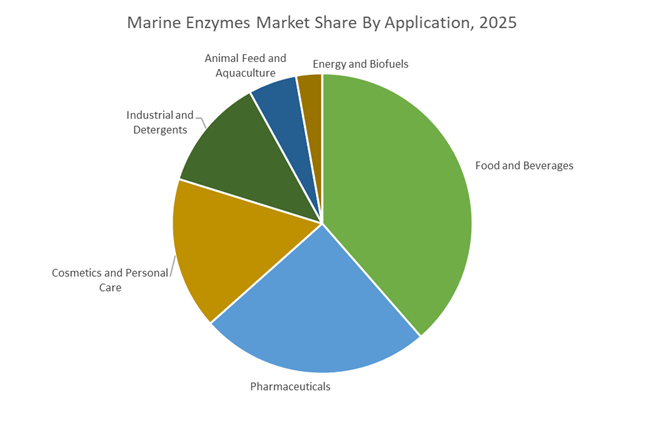
Food and beverage applications accounted for 38.60% of the Marine Enzymes Market share in 2025, making the sector the largest consumer of enzymes derived from marine biological sources. Marine enzymes provide unique advantages in seafood processing, fermentation technologies, protein hydrolysis, and functional ingredient development, supporting the growing demand for marine-derived food products and nutraceutical ingredients. Enzymes such as marine proteases, lipases, and amylases are widely used to improve efficiency in fish processing operations including deskinning, deboning, tenderization, and protein extraction, helping seafood processors reduce waste and increase product yield. The expansion of global aquaculture production and marine ingredient processing has further increased enzyme demand within the food industry. In 2025, marine proteases are increasingly utilized to generate bioactive peptides from marine proteins including fish byproducts and algae biomass, producing functional food ingredients with potential antioxidant, antihypertensive, and immunomodulatory properties. This approach supports the development of value-added marine nutraceuticals while promoting circular economy strategies that utilize seafood processing residues efficiently.
Marine Enzymes Market Competitive Landscape
The marine enzymes market in 2026 is driven by recombinant production of extremophile-derived biocatalysts, including cold-active and salt-tolerant enzymes. Competitive differentiation centers on metagenomic discovery, GMP-grade enzyme manufacturing, and low-temperature catalytic efficiency for applications in biopharma, detergents, and food processing.
Novozymes scales recombinant marine enzymes through global production and bioscience integration
Novozymes (Novonesis) leads the market by combining marine enzyme discovery with industrial-scale recombinant expression systems. Its expansion in China strengthens supply for marine biotechnology programs, while the €1.5 billion acquisition of DSM-Firmenich’s Feed Enzymes business enhances its control over specialty enzyme value chains. Development of marine agarase-derived oligosaccharides highlights its push into immune-support nutraceuticals. With deep expertise in scaling extremophilic enzymes, Novozymes enables industrial deployment of high-performance biocatalysts across food, feed, and bio-processing sectors.
ArcticZymes dominates cold-active enzyme niche with GMP-grade nuclease innovation
ArcticZymes Technologies is a specialist in cold-adapted and salt-active marine enzymes, focusing on high-value life sciences applications. Its M-SAN HQ nuclease addresses critical purification challenges in viral vector and mRNA manufacturing, enabling efficient DNA removal under high-salt conditions. Strong revenue growth driven by GMP-grade products reflects rising demand from gene therapy and diagnostics markets. Strategic distribution partnerships and a shift toward platform-based solutions position ArcticZymes as a key enabler of next-generation bioprocessing workflows.
BASF integrates marine-inspired enzymes into sustainable cleaning and industrial solutions
BASF SE is advancing marine enzyme applications through collaborations and product innovation in its Nutrition & Care segment. Partnership with IFF accelerates development of enzymatic biomaterials for ultra-low-temperature cleaning, while its Lavergy® portfolio incorporates lipases and amylases optimized for cold-wash performance. Expansion at its Zhanjiang site supports Asia-Pacific demand for sustainable biocatalysts. By integrating marine-derived enzyme stability into detergent and personal care formulations, BASF is reducing energy consumption and enhancing product performance.
Amano Enzyme expands specialty enzyme applications for plant-based and pharmaceutical markets
Amano Enzyme Inc. is leveraging its expertise in specialty enzymes to address evolving demands in food and pharmaceutical sectors. Its Plants Unlimited™ platform enhances texture and functionality in plant-based dairy alternatives, while Protein Glutaminase improves solubility and emulsification of plant proteins. The company’s focus on non-GMO and organic-compliant solutions aligns with clean-label trends. Expansion into medical and API applications highlights the growing role of marine-derived enzymes in stable, high-performance biochemical processes.
Kerry advances enzyme-driven nutrition platforms with fermentation and bioactive innovation
Kerry Group is integrating marine-inspired enzyme technologies into its taste and nutrition platforms, focusing on clean-label and functional ingredient solutions. Its enzyme-based sweetness modulation technology enables sugar reduction without compromising flavor, while Plenibiotic™ leverages fermentation to target gut-skin health. Increased R&D investment and expansion of biotechnology infrastructure support the development of high-value enzyme-derived ingredients. Through its Accelerate 2.0 strategy, Kerry is optimizing production efficiency and scaling advanced biocatalysts for global food and health markets.
United States: Bio-Economy Reshoring and Application-Led Commercialization
The United States marine enzymes market is being reshaped by federal bio-economy priorities that link national security, sustainability, and advanced biomanufacturing. Under the FY 2026 budget request, the National Science Foundation has earmarked targeted funding to reshore biotechnology supply chains, with marine biodiversity positioned as a strategic source of enzymes and active pharmaceutical ingredients. This policy direction is accelerating domestic discovery and scale-up of marine-derived enzymes to reduce reliance on foreign-manufactured biocatalysts, particularly for pharmaceutical, diagnostics, and high-value industrial applications.
Environmental remediation and consumer product innovation are parallel demand drivers. Through the National Sea Grant BIL Marine Debris Challenge finalized in 2024–2025, USD 16 million has been allocated to research-to-application projects focused on marine enzymes capable of plastic degradation in coastal ecosystems. In October 2025, BASF and International Flavors & Fragrances announced a collaboration to advance IFF’s Designed Enzymatic Biomaterials platform, integrating cold-adapted marine enzymes into fabric care and personal care formulations optimized for low-temperature performance. Industrial capacity is scaling in response, with Amano Enzyme USA expanding its Illinois facility in 2025 to support growing demand from the food and processing sectors. Additional momentum comes from DOE and NOAA initiatives promoting enzymatic conversion of marine biomass for maritime biofuels, reinforcing the role of marine enzymes across energy, materials, and environmental markets.
China: Blue Economy Policy and Precision Fermentation Scale-Up
China’s marine enzymes market is advancing under a top-down policy framework that embeds marine biotechnology into long-term economic planning. Officials from the National Development and Reform Commission** and the Ministry of Natural Resources confirmed in August 2025 that the 15th Five-Year Plan for 2026–2030 will prioritize breakthroughs in core marine technologies, explicitly including marine medicines and biological products. This aligns with China’s Sustainable Blue Economy strategy, where marine sectors contributed roughly 8% of national GDP in 2024, positioning marine enzymes as a foundational input across pharmaceuticals, materials, and environmental services.
Industrial execution is increasingly technology-driven. In November 2025, China hosted the 8th Sino-Japan Joint Symposium on Enzyme Technology, focusing on the industrialization of marine microbial enzymes for high-precision synthesis and hydrolysis. At the manufacturing level, chemical clusters in Jiangsu implemented AI-enabled biological data centers in late 2025 to optimize fermentation conditions for extremophilic marine enzymes, particularly for semiconductor and electronics cleaning applications where purity and consistency are critical. Policy emphasis from the Ministry of Natural Resources further frames marine biological products as a mechanism to modernize traditional industries while supporting marine energy, desalination, and ecosystem protection, reinforcing China’s scale advantage combined with rising process sophistication.
Germany: Circularity Compliance and Cold-Climate Performance
Germany’s marine enzymes market is characterized by regulatory leadership and integration into advanced industrial systems. By Q4 2025, BASF and Evonik transitioned their marine-derived enzyme portfolios to ISCC PLUS-certified production chains, aligning with the EU’s 2026 circular economy mandates. This move positions marine enzymes as compliant alternatives within detergents, fuels, and specialty chemicals where lifecycle transparency is becoming mandatory rather than optional.
Application innovation is expanding beyond traditional biocatalysis. At the 2025 UNITI Mineral Oil Technology Congress, German industry leaders showcased cold-adapted marine enzymes as viscosity index improvers and friction modifiers capable of stable performance in sub-zero Arctic shipping environments. Academic-industry collaboration remains a structural advantage. Research from the University of Greifswald in 2025 demonstrated large-scale heterologous expression of acidophilic marine amylases, eliminating the need for pH neutralization in starch processing and improving process efficiency. Looking ahead, the 2026 European Biomass Conference has prioritized integrated biorefinery concepts where marine enzymes enable co-production of sustainable aviation fuels and bio-based specialty chemicals, embedding these enzymes into Europe’s energy transition architecture.
Denmark: Global Enzyme Platforms and Aquaculture Leadership
Denmark plays a central global role in the marine enzymes market through multinational platforms that combine animal nutrition, aquaculture, and sustainability-driven feed solutions. Following the merger of Novozymes and Chr. Hansen, Novonesis launched its Biosolutions for Aquatic Excellence suite in late 2025, deploying marine-derived microbes and enzymes to mitigate hydrogen sulfide buildup and reduce mortality in intensive shrimp farming. These solutions directly address operational risks in high-density aquaculture systems across Asia and Latin America.
Strategic alliances are extending marine enzymes into broader protein systems. The DSM-Firmenich and Novonesis alliance reported in late 2025 that its latest enzyme portfolios are designed to support a projected 70% increase in global protein demand by 2050, using marine proteases to enhance nutrient absorption while reducing antibiotic reliance in livestock. Denmark-led groups continue to anchor the global feed enzyme landscape, with phytases representing 44.9% of the animal feed enzyme segment in 2025–2026 and an ongoing transition toward marine-sourced variants that offer superior heat stability during feed processing. This positions Denmark as a system integrator rather than a single-market producer within the marine enzymes value chain.
Country-Level Strategic Positioning in the Marine Enzymes Market
Marine Enzymes Market County Level Snapshot
Country / Region
Strategic Priority
Core Application Areas
Policy or Institutional Driver
Competitive Differentiation
United States
Bio-economy reshoring and sustainability
APIs, bioremediation, detergents, biofuels
NSF, DOE, NOAA programs
Application-led commercialization
China
Blue economy scale and AI fermentation
Pharma, electronics cleaning, materials
15th Five-Year Plan, SBE strategy
Scale with digital process control
Germany
Circularity and cold-climate performance
Fuels, shipping, starch processing
EU 2026 circular mandates
Regulatory and performance leadership
Denmark
Global biosolutions platforms
Aquaculture, feed enzymes
Industry alliances and protein demand
Integrated enzyme ecosystems
Marine Enzymes Market Report Scope
Marine Enzymes Market
Parameter
Details
Market Size (2025)
$196.6 Million
Market Size (2034)
$343.6 Million
Market Growth Rate
6.4%
Segments
By Source (Marine Microorganisms, Marine Algae, Marine Animals, Marine Plants), By Enzyme Type (Proteases, Lipases, Carbohydrases, Polymerases and Nucleases, Oxidoreductases), By Function (Biocatalysis, Bioremediation, Preservation and Stabilization, Molecular Biology Research), By Application (Food and Beverages, Pharmaceuticals, Cosmetics and Personal Care, Animal Feed and Aquaculture, Industrial and Detergents, Energy and Biofuels)
Study Period
2019- 2025 and 2026-2034
Units
Revenue (USD)
Qualitative Analysis
Porter’s Five Forces, SWOT Profile, Market Share, Scenario Forecasts, Market Ecosystem, Company Ranking, Market Dynamics, Industry Benchmarking
Companies
Novonesis, BASF, International Flavors and Fragrances, Amano Enzyme, DSM-Firmenich, Cargill, Associated British Foods, Adisseo, Kerry Group, Codexis, ArcticZymes Technologies, New England Biolabs, Biocatalysts, Antozyme Biotech, Takara Bio
Countries
US, Canada, Mexico, Germany, France, Spain, Italy, UK, Russia, China, India, Japan, South Korea, Australia, South East Asia, Brazil, Argentina, Middle East, Africa
Marine Enzymes Market Segmentation
By Source
Marine Microorganisms
Marine Algae
Marine Animals
Marine Plants
By Enzyme Type
Proteases
Lipases
Carbohydrases
Polymerases and Nucleases
Oxidoreductases
By Function
Biocatalysis
Bioremediation
Preservation and Stabilization
Molecular Biology Research
By Application
Food and Beverages
Pharmaceuticals
Cosmetics and Personal Care
Animal Feed and Aquaculture
Industrial and Detergents
Energy and Biofuels
By Region
North America (United States, Canada, Mexico)
Europe (Germany, France, United Kingdom, Spain, Italy, Rest of Europe)
Asia Pacific (China, India, Japan, South Korea, Australia, Rest of APAC)
South and Central America (Brazil, Argentina, Rest of SCA)
Middle East and Africa (Saudi Arabia, UAE, South Africa, Rest of Middle East, Rest of Africa)
2. Marine Enzymes Market Landscape & Outlook (2025–2034)
2.1. Introduction to Marine Enzymes Market
2.2. Market Valuation and Growth Projections (2025–2034)
2.3. Expansion of GMP-Grade Enzymes in Biopharma and Therapeutics
2.4. Aquaculture Feed Optimization and Alternative Protein Integration
2.5. Marine-Derived Biocatalysts in Industrial and Green Chemistry Applications
3. Innovations Reshaping the Marine Enzymes Market
3.1. Trend: Cold-Active Marine Enzymes for Low-Temperature Cleaning Applications
3.2. Trend: Marine Polymerases Advancing Molecular Diagnostics and Genomics
3.3. Opportunity: Enzymatic Plastic Depolymerization for Circular Economy
3.4. Opportunity: Clean-Label Bioactive Extraction for Nutricosmetics
4. Competitive Landscape and Strategic Initiatives
4.1. Mergers and Acquisitions
4.2. R&D in Extremophilic Enzyme Discovery and Recombinant Production
4.3. Sustainability and Circular Bioeconomy Strategies
4.4. Market Expansion and Regional Biomanufacturing Capabilities
5. Market Share and Segmentation Insights: Marine Enzymes Market
5.1. By Source
5.1.1. Marine Microorganisms
5.1.2. Marine Algae
5.1.3. Marine Animals
5.1.4. Marine Plants
5.2. By Enzyme Type
5.2.1. Proteases
5.2.2. Lipases
5.2.3. Carbohydrases
5.2.4. Polymerases and Nucleases
5.2.5. Oxidoreductases
5.3. By Function
5.3.1. Biocatalysis
5.3.2. Bioremediation
5.3.3. Preservation and Stabilization
5.3.4. Molecular Biology Research
5.4. By Application
5.4.1. Food and Beverages
5.4.2. Pharmaceuticals
5.4.3. Cosmetics and Personal Care
5.4.4. Animal Feed and Aquaculture
5.4.5. Industrial and Detergents
5.4.6. Energy and Biofuels
5.5. By Region
5.5.1. North America
5.5.2. Europe
5.5.3. Asia Pacific
5.5.4. South and Central America
5.5.5. Middle East and Africa
6. Country Analysis and Outlook of Marine Enzymes Market
6.1. United States
6.2. Canada
6.3. Mexico
6.4. Germany
6.5. France
6.6. Spain
6.7. Italy
6.8. UK
6.9. Russia
6.10. China
6.11. India
6.12. Japan
6.13. South Korea
6.14. Australia
6.15. South East Asia
6.16. Brazil
6.17. Argentina
6.18. Middle East
6.19. Africa
7. Marine Enzymes Market Size Outlook by Region (2025–2034)
7.1. North America Marine Enzymes Market Size Outlook to 2034
7.1.1. By Source
7.1.2. By Enzyme Type
7.1.3. By Function
7.1.4. By Application
7.1.5. By Region
7.2. Europe Marine Enzymes Market Size Outlook to 2034
7.2.1. By Source
7.2.2. By Enzyme Type
7.2.3. By Function
7.2.4. By Application
7.2.5. By Region
7.3. Asia Pacific Marine Enzymes Market Size Outlook to 2034
7.3.1. By Source
7.3.2. By Enzyme Type
7.3.3. By Function
7.3.4. By Application
7.3.5. By Region
7.4. South America Marine Enzymes Market Size Outlook to 2034
7.4.1. By Source
7.4.2. By Enzyme Type
7.4.3. By Function
7.4.4. By Application
7.4.5. By Region
7.5. Middle East and Africa Marine Enzymes Market Size Outlook to 2034
7.5.1. By Source
7.5.2. By Enzyme Type
7.5.3. By Function
7.5.4. By Application
7.5.5. By Region
8. Company Profiles: Leading Players in the Marine Enzymes Market
8.1. Novonesis
8.2. BASF
8.3. International Flavors and Fragrances
8.4. Amano Enzyme
8.5. DSM-Firmenich
8.6. Cargill
8.7. Associated British Foods
8.8. Adisseo
8.9. Kerry Group
8.10. Codexis
8.11. ArcticZymes Technologies
8.12. New England Biolabs
8.13. Biocatalysts
8.14. Antozyme Biotech
8.15. Takara Bio
9. Methodology
9.1. Research Scope
9.2. Market Research Approach
9.3. Market Sizing and Forecasting Model
9.4. Research Coverage
9.5. Data Horizon
9.6. Deliverables
10. Appendix
10.1. Acronyms and Abbreviations
10.2. List of Tables
10.3. List of Figures
Marine Enzymes Market Segmentation
By Source
Marine Microorganisms
Marine Algae
Marine Animals
Marine Plants
By Enzyme Type
Proteases
Lipases
Carbohydrases
Polymerases and Nucleases
Oxidoreductases
By Function
Biocatalysis
Bioremediation
Preservation and Stabilization
Molecular Biology Research
By Application
Food and Beverages
Pharmaceuticals
Cosmetics and Personal Care
Animal Feed and Aquaculture
Industrial and Detergents
Energy and Biofuels
By Region
North America (United States, Canada, Mexico)
Europe (Germany, France, United Kingdom, Spain, Italy, Rest of Europe)
Asia Pacific (China, India, Japan, South Korea, Australia, Rest of APAC)
South and Central America (Brazil, Argentina, Rest of SCA)
Middle East and Africa (Saudi Arabia, UAE, South Africa, Rest of Middle East, Rest of Africa)
The Marine Enzymes Market was valued at $196.6 million in 2025 and is projected to reach $343.6 million by 2034, growing at a CAGR of 6.4%. Growth is driven by increasing demand for extremophilic enzymes in pharmaceuticals and industrial biocatalysis. Expansion of aquaculture and advanced therapeutics is structurally increasing demand. GMP-grade enzyme adoption is a key growth accelerator.
Marine-derived nucleases and polymerases are increasingly used in viral vector purification and gene therapy production. Products such as salt-active nucleases enable efficient DNA removal in high-salinity environments. This improves yield and process efficiency in mRNA vaccines and cell therapies. The shift from research-use enzymes to GMP-grade solutions is driving high-margin growth.
Marine proteases and carbohydrases are critical in improving digestibility of alternative proteins used in aquafeed. They enhance nutrient absorption and reduce feed conversion ratios in fish and shrimp farming. Strategic consolidation, such as Novonesis acquiring feed enzyme assets, is strengthening this segment. This aligns with the global transition toward sustainable aquaculture production.
Marine enzymes are gaining traction in cold-water detergents, enabling effective cleaning at 20°C and reducing energy consumption. They are also being used in enzymatic plastic recycling, achieving high monomer recovery rates. In nutraceuticals, they support clean-label extraction of marine bioactives such as collagen and omega-3 oils. These applications are expanding the market into sustainability-driven industries.
Key players include Novonesis, BASF, ArcticZymes Technologies, Amano Enzyme, and Kerry Group. These companies focus on recombinant enzyme production, GMP-grade solutions, and application-specific innovation. Strategic acquisitions and partnerships are strengthening capabilities in feed, pharma, and industrial enzymes. Investments in metagenomics and AI-driven enzyme design are enhancing competitive positioning.