Narrow Range Ethoxylates Market 2025–2034: Low-Impurity Chemistry, Bio-Based Feedstocks, and High-Performance Surfactant Innovation
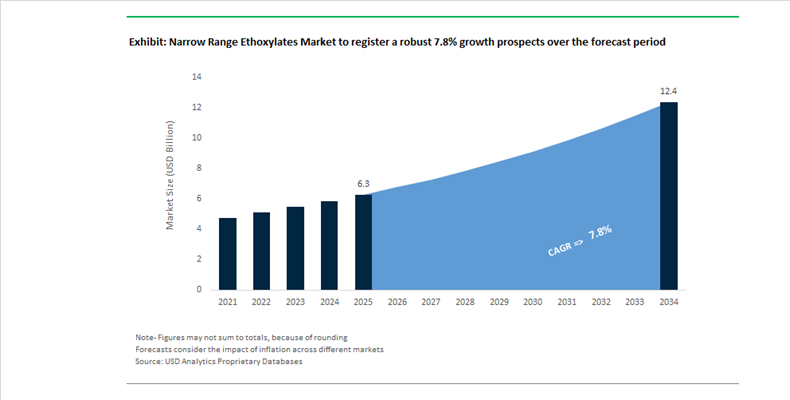
The Narrow Range Ethoxylates (NRE) Market is projected to expand from $6.3 billion in 2025 to $12.4 billion by 2034, registering a CAGR of 7.8%. Growth is being driven by tightening impurity regulations, rising demand for ultra-low-foam surfactants in industrial and institutional (I&I) cleaning, and the transition toward bio-based ethoxylation chemistry. Unlike conventional broad-range ethoxylates produced via KOH catalysis, NREs offer a tighter ethylene oxide distribution, delivering improved wetting efficiency, predictable cloud points, and reduced byproduct formation—critical parameters in pharmaceutical, agrochemical, and cold-water detergent formulations.
A defining technical differentiator in this market is residual 1,4-dioxane control. In 2024, Sasol intensified commercialization of its NOVEL® NRE platform, capable of achieving impurity levels below 1 ppm. This performance threshold is strategically aligned with stricter U.S. state-level limits and evolving EU oversight on trace contaminants in personal care and homecare products. Regulatory tightening is pushing formulators to replace conventional ethoxylates with narrow-range variants to minimize reformulation risk and avoid post-treatment purification costs. The result is a structural upgrade cycle across detergent and cosmetic manufacturing.
Product innovation is accelerating at the specialty level. At SEPAWA 2025 in Berlin, Nouryon launched Ethylan™ X4 and X6—multi-branched C10 surfactants engineered for twice the wetting speed of standard grades while maintaining ultra-low foam behavior. These grades directly target EU Ecolabel requirements for cold-water cleaning, enabling formulators to reduce wash temperatures without sacrificing soil removal performance. Earlier, in 2024, several Nouryon NREs received U.S. EPA Safer Choice qualification, reinforcing their adoption in North American sustainable cleaning platforms.
The decarbonization of ethoxylation feedstocks is reshaping competitive positioning. In early 2025, Clariant expanded its 100% bio-based VITA surfactant range, achieving a Renewable Carbon Index of 100% through segregated bio-ethylene oxide. Simultaneously, Clariant IGL Specialty Chemicals ramped production in Kashipur, India, leveraging renewable feedstocks to serve agrochemical and homecare sectors across South Asia. This aligns with broader corporate “fossil-free” roadmaps and growing procurement mandates from multinational consumer goods companies.
Capacity rationalization in Europe is also influencing trade flows. In July 2025, Dow Inc. announced shutdowns of three upstream European assets as part of its restructuring strategy, shifting focus toward higher-margin specialty surfactant platforms such as Decarbia and Ecolibrium. Production impacts are expected by mid-2026, potentially tightening European supply and supporting import growth from Asia-Pacific. Meanwhile, Taixing Lingfei Chemical expanded its NRE capacity from 18,000 to 30,000 tons annually in 2025, reinforcing China’s role as a volume supplier to textile processing and industrial cleaning markets.
Pharmaceutical demand is emerging as a premium growth segment. In 2025, suppliers reported a marked increase in high-purity NRE usage as solubilizers and stabilizers in advanced drug delivery systems. Their narrow molecular weight distribution reduces interaction with sensitive active pharmaceutical ingredients (APIs), improving formulation stability relative to broad-range alternatives.
Upstream integration continues to secure raw material stability. Following the expansion of its Alpha Olefins unit in Geismar in 2024, Shell Chemicals strengthened feedstock integration for its NEODOL alcohols and downstream ethoxylates, reinforcing supply security for concentrated liquid detergent markets.
Through 2034, the NRE market will be shaped by impurity thresholds, bio-based carbon mandates, and the premiumization of surfactant systems for pharma and high-efficiency cleaning. The sector’s competitive advantage will increasingly hinge on traceability, carbon intensity metrics, and molecular precision in ethoxylation chemistry.
Narrow Range Ethoxylates (NRE) Market Trends and Opportunities
Trend: Mandatory Adoption in Cold-Water Concentrates under EU ESPR Compliance
The Narrow Range Ethoxylates market is entering a compliance-led growth phase as detergent reformulation becomes unavoidable under the EU Ecodesign for Sustainable Products Regulation. With detergents designated as a priority product group in the first ESPR working plan, brands are being measured on energy efficiency and water-use reduction rather than ingredient substitution alone. NREs are emerging as the most practical surfactant solution because of their inherently narrow molecular weight distribution, which delivers superior performance in cold-water washing conditions.
Industrial benchmarks from Nouryon during 2024–2025 show that NREs maintain over 92% solubility efficiency at low temperatures where conventional alcohol ethoxylates phase-separate. This property enables the commercialization of ultra-concentrated liquid detergents designed specifically for cold-wash cycles. The downstream energy impact is substantial. Transitioning from hot-water to cold-water laundry cycles can reduce per-wash energy consumption by roughly 40%, a metric that directly supports the 2025 carbon reduction targets publicly committed by global consumer goods leaders such as Unilever and Procter & Gamble.
In parallel, NRE chemistry addresses formulation challenges that previously constrained high-concentration detergents. Typical NREs contain less than 1% unreacted alcohol compared with 8 to 10% in broad-range ethoxylates, significantly reducing VOC emissions and eliminating greasy odor profiles. This allows higher surfactant loading while remaining compliant with eco-labels and sensitive-scent requirements, positioning NREs as a regulatory and performance enabler rather than a premium niche ingredient.
Trend: Strategic Investment in Bio-Based NREs to De-Risk ESG Supply Chains
Beyond performance mandates, ESG scrutiny is reshaping feedstock strategies across the NRE value chain. Chemical producers are accelerating the shift toward bio-based Narrow Range Ethoxylates derived from RSPO-certified palm kernel oil and coconut oil to address Scope 3 emission exposure and long-term reputational risk. During 2024–2025, BASF expanded its RSPO-certified surfactant portfolio, reinforcing its commitment to sourcing palm-based fatty alcohols exclusively from certified sustainable origins.
Life cycle assessments completed in late 2024 confirm that PKO-derived NREs deliver full performance parity with petrochemical equivalents while achieving a carbon footprint reduction of approximately 36%. Importantly, these materials offer 100% renewable carbon content on the hydrophobe side, enabling compliance with EU Ecolabel and retailer sustainability scorecards without sacrificing detergency or stability. To secure supply continuity, producers such as Sasol and Stepan Company have entered multi-year offtake agreements with sustainability-focused brands. These contracts insulate buyers from ethylene oxide and petrochemical alcohol volatility, which reached 15 to 18% price swings during the 2024 fiscal year, and are redefining NREs as a strategic raw material rather than a spot-market input.
Opportunity: Low-Foam NREs for Automated Clean-in-Place Systems
The rapid automation of food, dairy, and beverage processing lines is creating a structurally attractive opportunity for low-foam NRE formulations. Modern Clean-in-Place systems require surfactants with precise ethoxylation profiles to ensure rapid foam collapse, high rinsability, and thermal stability across repeated cleaning cycles. Narrow Range Ethoxylates meet these requirements by delivering controlled foaming behavior without reliance on silicone defoamers that risk residue buildup.
As multi-tank CIP systems become standard through 2025, processors are reporting water savings of 10 to 15% due to fewer rinse cycles when NREs are used. This reduction translates directly into lower operating costs and wastewater loads, supporting increasingly strict water stewardship KPIs. High-purity NREs also prevent sensor interference in automated systems, as their rapid foam collapse avoids air locks that can disrupt flow and conductivity measurements. The Industrial and Institutional cleaning segment has consequently emerged as a primary demand driver, particularly in commercial dishwashing and food processing environments where NREs function effectively across wide pH ranges.
Opportunity: Specialized NREs for Pharmaceutical and Agrochemical Delivery
A high-margin growth avenue is developing in life sciences, where ultra-clean NREs are gaining acceptance as formulation adjuvants. By minimizing free alcohols and polyethylene glycol residues, NREs offer exceptional chemical consistency and low irritancy, qualities that are increasingly critical in pharmaceutical and agrochemical applications. In the vaccine adjuvant space, valued above $2 billion in 2025, high-purity NREs are being evaluated for stabilizing oil-in-water emulsions with reduced reactogenicity, supporting next-generation therapeutic and pandemic-preparedness platforms.
In agriculture, leading players such as UPL and Corteva have launched formulations utilizing Specialty Peaked Form technology. NRE-based adjuvants improve rainfastness and cuticular penetration on waxy leaf surfaces, enabling a 10 to 20% reduction in active ingredient dosage while maintaining efficacy. The narrow molecular weight distribution of NREs also reduces phytotoxicity and operator irritancy, making them the preferred surfactant platform for farmer-centric products targeting high-value crops such as paddy, maize, and cotton.
Narrow Range Ethoxylates Market Share and Segmentation Insights
Alcohol Ethoxylates Dominate Narrow Range Ethoxylates Market Due to Superior Detergency and Formulation Versatility
Alcohol ethoxylates accounted for 48.60% of the Narrow Range Ethoxylates Market share in 2025, making them the most widely used product type within the ethoxylated surfactants segment. Alcohol ethoxylates are valued for their excellent wetting, emulsification, detergency, and solubilization properties, which make them highly effective in cleaning formulations and industrial surfactant systems. Narrow-range ethoxylation technology produces surfactants with a more uniform distribution of ethylene oxide units, resulting in improved product consistency, enhanced performance, and reduced formation of unwanted byproducts compared with conventional ethoxylates. These characteristics are particularly important for applications that require predictable surfactant performance and stable formulation behavior. In 2025, the industry has increasingly adopted bio-based fatty alcohol feedstocks derived from natural oils such as palm, coconut, and rapeseed, reflecting the growing emphasis on renewable chemical sourcing. Narrow-range ethoxylation processes allow these bio-based alcohols to achieve performance characteristics comparable to petroleum-derived surfactants while supporting sustainability objectives across detergent and specialty chemical manufacturing sectors.
Household Cleaning Applications Drive the Largest Demand for Narrow Range Ethoxylates
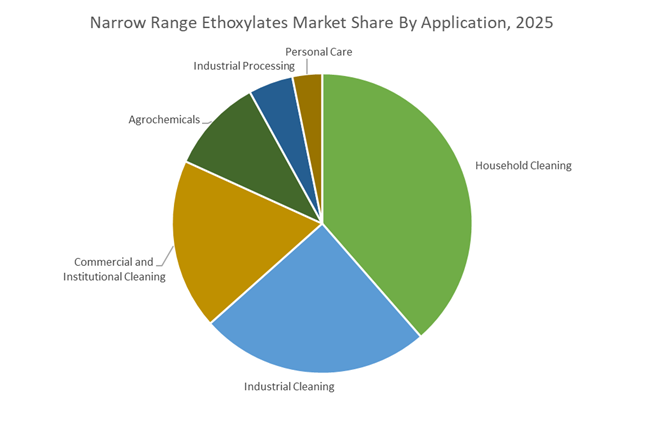
Household cleaning accounted for 38.60% of the Narrow Range Ethoxylates Market share in 2025, making detergents and home care formulations the largest application segment for these advanced surfactants. Narrow-range ethoxylates are widely used in liquid laundry detergents, automatic dishwashing liquids, surface cleaners, and multipurpose household cleaning products, where they deliver efficient soil removal, grease emulsification, and improved rinsing performance. Compared with traditional surfactants, narrow-range ethoxylates offer higher active efficiency, improved biodegradability, and better formulation stability, making them particularly suitable for modern detergent systems. In 2025, the rapid expansion of concentrated detergent formats and unit-dose laundry pods has significantly increased the demand for high-performance surfactants with tightly controlled chemical composition. Narrow-range ethoxylates meet these requirements by providing low impurity levels, predictable hydrophilic–lipophilic balance (HLB), and strong compatibility with other detergent ingredients, enabling manufacturers to formulate stable, high-efficiency cleaning products that perform effectively even in compact and highly concentrated detergent systems.
Narrow Range Ethoxylates Market Competitive Landscape
The narrow range ethoxylates (NRE) market in 2026 is driven by catalytic precision, low-VOC formulations, and bio-attributed ethylene oxide feedstocks. Competitive advantage centers on peaked molecular distribution, superior low-temperature performance, and high-efficiency surfactants for Clean-in-Place (CIP), industrial cleaning, and agrochemical applications.
Nouryon leads targeted ethoxylation with low-VOC high-efficiency NREs for industrial cleaning systems
Nouryon dominates the narrow range ethoxylates market through advanced targeted ethoxylation and high-performance non-ionic surfactants. Its Berol® 260/266 series delivers ultra-fast wetting and rapid foam collapse, eliminating inefficiencies caused by unreacted alcohol fractions. The Ethylan® 1005 grade meets U.S. EPA Safer Choice standards, positioning the company in low-VOC degreasing applications. Nouryon’s NREs enable low-temperature cleaning, reducing energy consumption in industrial laundries and CIP systems. Strategic partnerships ensure stable ethylene oxide supply for consistent production quality. Its focus on peaked distribution and sustainability strengthens its leadership in I&I cleaning markets.
Evonik expands specialty surfactant capabilities with tailored NRE solutions for cosmetics and agrochemicals
Evonik Industries AG is strengthening its position through its “Tailor Made” strategy, focusing on high-margin specialty surfactants. The company’s Care division is leveraging NRE technology to produce mild, consistent-performance ingredients for premium personal care formulations. Expansion of production capacity in Asia enhances proximity to high-growth markets such as coatings and electronics. With €1.87 billion EBITDA in 2025, Evonik is reinvesting in green chemistry and bio-based surfactants. Its agile operating model enables rapid customization of NRE blends for agrochemical adjuvants, improving pesticide efficiency and reducing spray drift. Evonik’s emphasis on precision and sustainability positions it strongly in specialty applications.
Sasol leverages integrated alcohol value chains to produce high-purity NREs with improved sustainability profile
Sasol Limited is capitalizing on its vertically integrated alcohol-to-ethoxylate value chain to deliver high-purity narrow range ethoxylates. Its International Chemicals segment achieved a 10% EBITDA increase in 2026, driven by a strategic shift toward specialty surfactants. Secunda operations provide stable feedstock supply, ensuring consistent production of tailored alcohol intermediates. Sasol’s renewable energy investments (1,200 MW secured) reduce the carbon intensity of its ethoxylation processes. Its NRE portfolio is widely used in oilfield chemicals and drilling fluids, where precise molecular distribution is critical. This integration enables superior control over performance characteristics and sustainability metrics.
Stepan expands alkoxylation capacity to deliver low-foam NREs for detergents and industrial cleaning markets
Stepan Company is strengthening its market position through expanded alkoxylation capacity and innovation in low-foaming NRE systems. Its Pasadena, Texas facility serves as a key hub for producing environmentally friendly ethoxylates for North American demand. Stepan’s low-foam NREs are used in over one-third of new industrial cleaning products, offering efficient wetting without excessive defoamers. Strategic partnerships are advancing bio-based surfactant development, aligning with global sustainability standards. The company’s integration in detergent formulations allows it to provide optimized system solutions for consumer and industrial applications. Its focus on performance and scalability reinforces its competitive edge.
Huntsman advances bio-based NRE innovation and specialty applications through strategic partnerships and R&D integration
Huntsman Corporation is focusing on high-value NRE applications through biotechnology partnerships and specialty chemical innovation. Its development of renewable fatty alcohol ethoxylates targets eco-conscious markets seeking verified sustainable surfactants. Huntsman’s NREs play a critical role in agrochemical adjuvants, enhancing emulsification, leaf adhesion, and pesticide efficacy. The company is optimizing its European production assets to prioritize high-margin, performance-driven ethoxylates. Its global R&D and production integration enables rapid development of customized NRE blends for coatings and textile processing. Huntsman’s strategy emphasizes sustainability, precision formulation, and specialty market leadership.
United States: Regulatory Gatekeeping, Low-Impurity Chemistry, and Bio-Feedstock Migration
The United States narrow range ethoxylates market is being reshaped by regulatory qualification and impurity control rather than volume expansion. As of late 2025, multiple NRE product families, including Nouryon’s Berol and Ethylan series, achieved qualification under the U.S. EPA Safer Choice Program. This designation has become a commercial prerequisite for household and institutional cleaning brands preparing for 2026 product refresh cycles, as it validates lower toxicity, biodegradability, and reduced byproducts. In parallel, proposed TSCA Section 5(e) Significant New Use Rules introduced in November 2025 now require a 90-day premanufacture notification for new NRE applications, effectively institutionalizing exposure controls across the value chain and favoring suppliers with established toxicological dossiers.
Compliance pressures are converging with formulation economics. Under the Modernization of Cosmetics Regulation Act, U.S. NRE producers are accelerating investments in impurity documentation and safety substantiation, particularly for residual alcohols and trace contaminants. Narrow range ethoxylates are gaining preference over conventional ethoxylates because of their inherently lower VOC and 1,4-dioxane profiles. This shift is reinforced by the deployment of advanced narrow range catalyst technologies such as NOVEL, which have reduced 1,4-dioxane content to below 1 ppm, a critical threshold for state-level regulations entering force in 2026. At the feedstock level, U.S. chemical hubs expanded the use of Ziegler and oleo-based alcohols in 2025, integrating palm and coconut derivatives to lower surfactant carbon intensity without compromising performance.
Germany: Mildness Data Leadership, Energy-Efficient Cleaning, and REACH-Driven Differentiation
Germany remains the technical anchor of the European NRE landscape, with competitiveness increasingly defined by data transparency and system-level performance. German producers aligned their 2025 portfolios with EU Ecolabel criteria, ensuring that NRE-based degreasers and multipurpose cleaners meet stringent aquatic toxicity and biodegradability benchmarks. This alignment is becoming essential for procurement by public institutions and multinational brands operating under pan-European sustainability frameworks.
Operational efficiency is emerging as a second differentiator. Industrial trials conducted in 2025 demonstrated that precisely ethoxylated NREs deliver superior detergency at lower temperatures and reduced alkalinity. These results translated into energy savings of up to 15% in textile processing and metal cleaning applications, reinforcing the value proposition of NREs in energy-constrained industrial environments. Looking ahead, updated 2026 REACH reporting requirements emphasize “system behavior” metrics such as mildness and irritation. German manufacturers are leading the industry in generating and substantiating this data, positioning NREs as preferred surfactants for next-generation personal care and sensitive surface cleaning formulations.
China: Green Manufacturing Mandates and Agrochemical Performance Pull
China’s narrow range ethoxylates market is advancing under a dual mandate of environmental compliance and functional performance. In July 2025, BASF’s expanded Nanjing site transitioned its amine and intermediate portfolio to operate on 100% renewable electricity, reducing average product carbon footprint by roughly 4%. This shift directly benefits downstream NRE formulators serving export-oriented consumer goods and industrial cleaning segments. Concurrently, the Ministry of Industry and Information Technology 2026 Green Manufacturing roadmap is prioritizing the substitution of high-VOC solvents, driving a measurable uptick in NRE adoption for industrial degreasing across the Yangtze River Delta.
Agriculture is reinforcing this demand. During late 2025, leading Chinese agrochemical producers integrated NREs into advanced pesticide and herbicide formulations to improve penetration, spreading, and rain-fastness. These performance attributes support national food security objectives for 2026 by improving application efficiency and reducing active ingredient loss. At the innovation frontier, funding allocated to the Wuhan SynBio hub is accelerating AI-assisted enzyme optimization for bio-surfactants, with the explicit goal of lowering production costs for bio-based NREs targeting the domestic household care market.
Thailand: Regional Manufacturing Hub and Export-Oriented Scale-Up
Thailand has emerged as a strategic manufacturing and export hub for non-ionic surfactants in Southeast Asia. In November 2025, BASF inaugurated a major expansion in Bangpakong, positioning the site as a regional center for bio-based and readily biodegradable surfactants, including NRE-compatible alkyl polyglucosides. This integration supports growing demand from personal care manufacturers seeking milder, plant-derived formulations.
Trade dynamics are reinforcing Thailand’s role. In 2025, the country’s chemical export value grew by 6.5%, supported by expanded capacity for high-purity non-ionic ethoxylates. Thailand now serves as a critical supply node for India and Vietnam, where local NRE capacity remains constrained but demand for low-impurity surfactants is rising across agrochemical and textile processing applications.
India: Capacity Localization and Policy-Driven Import Substitution
India’s narrow range ethoxylates trajectory is defined by infrastructure build-out and deliberate import substitution. In May 2025, Gujarat Alkalies and Chemicals Limited approved an ₹81 crore investment at Dahej to expand downstream units capable of producing specialty ethoxylates for agrochemical and textile end uses. These assets are designed to support domestic formulation requirements while improving control over impurity profiles demanded by export markets.
Policy support is accelerating localization. India implemented a Production Linked Incentive framework in 2025 that favored three major domestic surfactant producers, explicitly targeting a 20% reduction in NRE import reliance by 2027. As one of the world’s largest consumers of ethoxylates, India is positioning NREs as strategic intermediates that combine regulatory compliance, performance efficiency, and supply chain resilience.
Comparative Snapshot: Narrow Range Ethoxylates Market by Country
Narrow Range Ethoxylates Market County Level Snapshot
Country
Primary Catalyst
Structural Shift
Strategic Outcome
United States
Safer Choice, TSCA, MoCRA
Low-impurity, bio-feedstock NREs
Regulatory-compliant consumer and cosmetics growth
Germany
REACH, EU Ecolabel
Mildness data and low-temperature efficiency
Premium positioning in industrial and personal care
China
MIIT green mandates
Renewable-powered and bio-based NREs
Rapid adoption in degreasing and agrochemicals
Thailand
Capacity expansion
Export-oriented surfactant hub
Regional supply leadership in Southeast Asia
India
PLI incentives
Domestic capacity build-out
Reduced imports and localized specialty supply
Narrow Range Ethoxylates Market Report Scope
Narrow Range Ethoxylates Market
Parameter
Details
Market Size (2025)
$6.3 Billion
Market Size (2034)
$12.4 Billion
Market Growth Rate
7.8%
Segments
By Product Type (Alcohol Ethoxylates, Fatty Amine Ethoxylates, Fatty Acid Ethoxylates, Methyl Ester Ethoxylates, Specialty Ethoxylates), By Feedstock (Synthetic Alcohols, Natural and Bio-Based Alcohols), By Functionality (Wetting, Emulsification, Low Foaming and Defoaming, Detergency and Degreasing, Corrosion Inhibition), By Application (Household Cleaning, Commercial and Institutional Cleaning, Industrial Cleaning, Agrochemicals, Personal Care, Industrial Processing)
Study Period
2019- 2025 and 2026-2034
Units
Revenue (USD)
Qualitative Analysis
Porter’s Five Forces, SWOT Profile, Market Share, Scenario Forecasts, Market Ecosystem, Company Ranking, Market Dynamics, Industry Benchmarking
US, Canada, Mexico, Germany, France, Spain, Italy, UK, Russia, China, India, Japan, South Korea, Australia, South East Asia, Brazil, Argentina, Middle East, Africa
2. Narrow Range Ethoxylates Market Landscape & Outlook (2025–2034)
2.1. Introduction to Narrow Range Ethoxylates Market
2.2. Market Valuation and Growth Projections (2025–2034)
2.3. Low-Impurity Chemistry and 1,4-Dioxane Regulatory Thresholds
2.4. Bio-Based Feedstocks and Decarbonized Ethoxylation Pathways
2.5. High-Performance Surfactant Demand in Cleaning, Pharma, and Agrochemicals
3. Innovations Reshaping the Narrow Range Ethoxylates Market
3.1. Trend: Mandatory Adoption in Cold-Water Detergents under EU ESPR Compliance
3.2. Trend: Strategic Shift Toward Bio-Based NREs for ESG Supply Chain Alignment
3.3. Opportunity: Low-Foam NREs for Automated Clean-in-Place (CIP) Systems
3.4. Opportunity: Specialized NREs for Pharmaceutical and Agrochemical Delivery
4. Competitive Landscape and Strategic Initiatives
4.1. Mergers and Acquisitions
4.2. R&D and Material Innovation in Targeted Ethoxylation and Surfactant Engineering
4.3. Sustainability and ESG Strategies
4.4. Market Expansion and Regional Focus
5. Market Share and Segmentation Insights: Narrow Range Ethoxylates Market
5.1. By Product Type
5.1.1. Alcohol Ethoxylates
5.1.2. Fatty Amine Ethoxylates
5.1.3. Fatty Acid Ethoxylates
5.1.4. Methyl Ester Ethoxylates
5.1.5. Specialty Ethoxylates
5.2. By Feedstock
5.2.1. Synthetic Alcohols
5.2.2. Natural and Bio-Based Alcohols
5.3. By Functionality
5.3.1. Wetting
5.3.2. Emulsification
5.3.3. Low Foaming and Defoaming
5.3.4. Detergency and Degreasing
5.3.5. Corrosion Inhibition
5.4. By Application
5.4.1. Household Cleaning
5.4.2. Commercial and Institutional Cleaning
5.4.3. Industrial Cleaning
5.4.4. Agrochemicals
5.4.5. Personal Care
5.4.6. Industrial Processing
6. Country Analysis and Outlook of Narrow Range Ethoxylates Market
6.1. United States
6.2. Canada
6.3. Mexico
6.4. Germany
6.5. France
6.6. Spain
6.7. Italy
6.8. UK
6.9. Russia
6.10. China
6.11. India
6.12. Japan
6.13. South Korea
6.14. Australia
6.15. South East Asia
6.16. Brazil
6.17. Argentina
6.18. Middle East
6.19. Africa
7. Narrow Range Ethoxylates Market Size Outlook by Region (2025–2034)
7.1. North America Narrow Range Ethoxylates Market Size Outlook to 2034
7.1.1. By Product Type
7.1.2. By Feedstock
7.1.3. By Functionality
7.1.4. By Application
7.2. Europe Narrow Range Ethoxylates Market Size Outlook to 2034
7.2.1. By Product Type
7.2.2. By Feedstock
7.2.3. By Functionality
7.2.4. By Application
7.3. Asia Pacific Narrow Range Ethoxylates Market Size Outlook to 2034
7.3.1. By Product Type
7.3.2. By Feedstock
7.3.3. By Functionality
7.3.4. By Application
7.4. South America Narrow Range Ethoxylates Market Size Outlook to 2034
7.4.1. By Product Type
7.4.2. By Feedstock
7.4.3. By Functionality
7.4.4. By Application
7.5. Middle East and Africa Narrow Range Ethoxylates Market Size Outlook to 2034
7.5.1. By Product Type
7.5.2. By Feedstock
7.5.3. By Functionality
7.5.4. By Application
8. Company Profiles: Leading Players in the Narrow Range Ethoxylates Market
8.1. Sasol
8.2. BASF
8.3. Nouryon
8.4. Dow
8.5. Shell Chemicals
8.6. Evonik Industries
8.7. Clariant
8.8. Huntsman
8.9. Stepan
8.10. SABIC
8.11. Indorama Ventures
8.12. India Glycols
8.13. Kao
8.14. Galaxy Surfactants
9. Methodology
9.1. Research Scope
9.2. Market Research Approach
9.3. Market Sizing and Forecasting Model
9.4. Research Coverage
9.5. Data Horizon
9.6. Deliverables
10. Appendix
10.1. Acronyms and Abbreviations
10.2. List of Tables
10.3. List of Figures
Narrow Range Ethoxylates Market Segmentation
By Product Type
Alcohol Ethoxylates
Fatty Amine Ethoxylates
Fatty Acid Ethoxylates
Methyl Ester Ethoxylates
Specialty Ethoxylates
By Feedstock
Synthetic Alcohols
Natural and Bio-Based Alcohols
By Functionality
Wetting
Emulsification
Low Foaming and Defoaming
Detergency and Degreasing
Corrosion Inhibition
By Application
Household Cleaning
Commercial and Institutional Cleaning
Industrial Cleaning
Agrochemicals
Personal Care
Industrial Processing
By Region
North America (United States, Canada, Mexico)
Europe (Germany, France, United Kingdom, Spain, Italy, Rest of Europe)
Asia Pacific (China, India, Japan, South Korea, Australia, Rest of APAC)
South and Central America (Brazil, Argentina, Rest of SCA)
Middle East and Africa (Saudi Arabia, UAE, South Africa, Rest of Middle East, Rest of Africa)
The narrow range ethoxylates (NRE) market is projected to grow from $6.3 billion in 2025 to $12.4 billion by 2034, registering a CAGR of 7.8%. Growth is driven by stricter impurity regulations, increasing demand for high-performance surfactants, and rapid adoption in industrial cleaning and pharmaceutical formulations.
Key drivers include regulatory limits on 1,4-dioxane and VOCs, increasing demand for low-foam surfactants in Clean-in-Place (CIP) systems, and the shift toward concentrated cold-water detergents. NREs offer superior wetting efficiency, predictable performance, and reduced byproduct formation compared to conventional ethoxylates.
Producers are transitioning toward bio-based ethylene oxide and fatty alcohols derived from palm, coconut, and other renewable sources. These bio-based NREs deliver up to 36% lower carbon footprint while maintaining performance parity, enabling compliance with ESG mandates and eco-label requirements across global markets.
Key players include Sasol, BASF, Nouryon, Clariant, Evonik, Huntsman, and Stepan. These companies focus on low-impurity NRE technologies, bio-based surfactant development, and capacity expansion in Asia-Pacific. Strategic priorities include precision ethoxylation, regulatory compliance, and integration with sustainable feedstock supply chains.
Emerging opportunities include low-foam NREs for automated CIP systems, high-purity surfactants for pharmaceutical and vaccine formulations, and advanced agrochemical adjuvants. Growth is also supported by demand for cold-water detergents and ultra-concentrated cleaning products in both consumer and industrial segments.