Paper Pallet Market Overview: Lightweight and Sustainable Alternatives Transforming Logistics
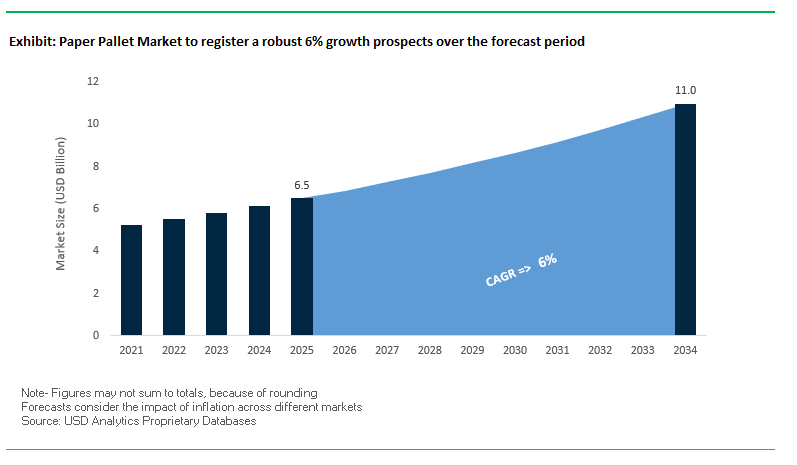
The Global Paper Pallet Market is projected to grow from $6.5 billion in 2025 to $11 billion by 2034, registering a steady CAGR of 6%. Paper pallets are emerging as a sustainable and lightweight alternative to wood and plastic pallets, offering significant benefits for global supply chains. Their reduced weight directly translates into lower transportation costs and carbon emissions, making them increasingly attractive for industries seeking both cost efficiency and environmental compliance.
Corrugated cardboard is the dominant material in paper pallet manufacturing, widely favored for its strength-to-weight ratio. It provides durability for handling and cost-effectiveness across diverse sectors such as e-commerce, food and beverage, pharmaceuticals, and industrial packaging. The adoption of automation in warehouses is also driving growth, as the uniform size and lightweight nature of paper pallets make them compatible with robotic systems, conveyor belts, and automated storage solutions.
Beyond cost and efficiency, sustainability is a defining factor. Made from renewable and recyclable materials, paper pallets align with the circular economy model, addressing global corporate commitments to reduce packaging waste and carbon footprints.
Key Insights for Industry Professionals
Lightweight paper pallets cut logistics costs and reduce carbon emissions in global supply chains.
Corrugated cardboard dominates due to its durability and cost-efficiency in industrial applications.
Automation-friendly pallets are fueling adoption in smart warehouses and distribution centers.
Sustainability is central, with paper pallets aligning with circular economy and recyclability goals.
Market Analysis: Strategic Developments in the Paper Pallet Industry
The paper pallet industry is being reshaped by mergers, acquisitions, and product innovations that reinforce both sustainability and operational efficiency. In August 2025, Brambles Ltd. reported strong annual results and announced a new share buy-back program, reflecting continued confidence in the pallet sector, including paper-based formats. Also in August 2025, Rehrig Pacific Company expanded its market presence with a new subsidiary, Rehrig Penn Inc., strengthening its services in pallet management. Around the same time, Nefab Group acquired FARUSA Emballage through its Danish unit, a move that boosts its leadership in heavy-duty corrugated solutions, directly supporting the expansion of paper pallet offerings.
Earlier in January 2025, the Smurfit Kappa–WestRock merger formed Smurfit WestRock, a new global giant in paper-based packaging. The company quickly launched an all-paper pallet stretch wrap, a recyclable alternative to polyethylene wraps, representing a breakthrough in sustainable palletization. Meanwhile, in November 2024, Nefab Group unveiled its award-winning EdgePak Collar, a recyclable fiber-based pallet collar that complements its engineered pallet solutions.
Despite a noted decline in packaging M&A activity in late 2024, industry megadeals such as Smurfit–WestRock highlighted ongoing consolidation.
Paper Pallet Market: Key Trends and Emerging Opportunities
Adoption Driven by Stringent International Phytosanitary Regulations
The rapid adoption of paper pallets is being driven by international compliance requirements, particularly ISPM 15, which mandates heat treatment or fumigation of wood packaging to prevent pest transfer. Paper pallets, by their very composition, are exempt from these requirements, offering exporters a significant regulatory and cost advantage. Unlike wood pallets, paper variants do not require treatment, inspection, or certification, eliminating delays and reducing overhead costs for global shipments. This exemption is particularly advantageous for air freight and export-heavy industries, where compliance failures can lead to fines, shipment rejections, or costly rerouting.
Beyond regulatory compliance, paper pallets deliver added environmental and safety benefits. While methyl bromide fumigation remains an accepted treatment for wood, it has raised concerns in food and pharmaceutical sectors due to chemical residues. Paper pallets bypass this issue entirely, ensuring a chemical-free platform suitable for sensitive goods. Additionally, they contribute to streamlined international trade by simplifying documentation processes and ensuring consistent regulatory acceptance. These combined factors are positioning paper pallets as a preferred alternative for companies seeking compliance-ready, sustainable, and globally accepted packaging solutions.
Strategic Use for Automated Warehouse and Retail Environments
The compatibility of paper pallets with automation systems is a key trend fueling their adoption in logistics and retail. Their consistent dimensions, smooth surfaces, and lack of protruding nails or splinters make them ideal for automated storage and retrieval systems (AS/RS) and robotic handling environments. Unlike traditional wood pallets, which may vary in size or quality, engineered paper pallets provide uniformity that reduces the risk of machine jams and downtime in automated warehouses.
Another critical advantage lies in their lightweight structure. Standard paper pallets weigh between 1.5 and 5 kilograms, compared to 20 kilograms or more for wooden pallets. This substantial weight reduction translates into energy efficiency within automated operations and significant freight cost savings, especially in air cargo, where weight directly impacts cost. By being up to 75% lighter than wood or plastic, paper pallets not only improve handling efficiency but also enable companies to lower logistics costs in one-way or export shipments. Their dual benefits of automation compatibility and cost reduction are solidifying paper pallets’ role in modernized, efficiency-driven supply chains.
Development of Heavy-Duty, Multi-Trip Engineered Designs
A major growth opportunity lies in advancing the structural strength and durability of paper pallets to support heavier loads and multi-trip applications. Traditionally used for one-way shipping, innovations in design and materials are opening doors for paper pallets to compete directly with wood block pallets in closed-loop pooling systems. New engineering approaches, such as honeycomb cell structures and spirally wound laminated fiberboard tubes, have demonstrated the ability to withstand loads of more than 500 kilograms in racking applications.
Material innovation is further enhancing this opportunity, with composites combining recycled corrugated paperboard and plywood offering improved durability and environmental performance. Some experimental designs have even proven effective in cold storage environments, traditionally a challenge for paper-based solutions. As manufacturers refine these designs, premium paper pallets capable of multiple reuse cycles are becoming commercially viable. Their integration into closed-loop systems not only broadens the applications of paper pallets but also aligns with circular economy models by extending asset lifecycles and reducing overall raw material consumption.
Embedded Smart Labeling and Disposable Tracking
Another transformative opportunity is the integration of smart technologies directly into the pallet structure, turning each unit into a disposable yet data-rich carrier. By embedding QR codes, RFID inlays, or low-cost sensors during manufacturing, paper pallets can provide unit-level tracking without the logistical burden of recovering expensive tags. This innovation enables each pallet to serve as a unique digital identifier, delivering real-time visibility into inventory location, route optimization, and handling conditions.
The seamless integration of smart labeling into the pallet itself simplifies supply chain operations, particularly in high-volume, low-margin industries where granular tracking can enhance efficiency. By eliminating reverse logistics for tag recovery, this approach reduces operational costs while maintaining sustainability, as both the pallet and its embedded identifiers can be recycled together. For companies seeking greater transparency and efficiency in logistics networks, disposable smart-enabled paper pallets offer a scalable, low-cost solution that merges traceability with sustainability.
Competitive Landscape: Leading Companies in the Global Paper Pallet Industry
The paper pallet industry is moderately consolidated, with key players focusing on sustainability, engineered design, and global distribution networks.
Nefab Group: Leading Sustainable Engineered Paper Pallet Solutions
Nefab is a global leader in engineered industrial packaging, with a strong focus on paper-based pallets, collars, and protective packaging. Its EdgePak Collar offers a recyclable alternative to wooden pallet collars, reducing both weight and environmental impact. In August 2025, Nefab strengthened its market presence with the acquisition of FARUSA Emballage, enhancing its corrugated capabilities in the Nordics. Its strategic priority remains sustainability-driven packaging efficiency, helping clients reduce emissions through optimized pallet systems.
Formed in January 2025 through the merger of Smurfit Kappa and WestRock, Smurfit WestRock is now a global giant in paper-based packaging. In early 2025, the company introduced a fully recyclable all-paper stretch wrap, a breakthrough innovation for pallet logistics. With vertical integration from forestry to recycling, Smurfit WestRock leverages its scale to deliver durable corrugated pallet solutions that support brand sustainability commitments and reduce reliance on plastics.
DS Smith Plc: Redefining Packaging with Closed-Loop Recycling
DS Smith is a recognized leader in fiber-based packaging and recycling. Its modular pallet boxes and corrugated pallet solutions are manufactured from 100% recycled materials, supporting closed-loop logistics models. The company’s focus on “Redefining Packaging for a Changing World” positions it as a strong advocate for fiber-based palletization. Its expertise in recycling and paper manufacturing enables consistent supply of high-quality paper pallets to global markets.
The Honeycomb Company of America: Expertise in Honeycomb Pallet Structures
Honeycomb Company of America specializes in lightweight honeycomb materials, a core technology for honeycomb paper pallets. These pallets provide a high strength-to-weight ratio and excellent shock absorption, making them suitable for industries like electronics, automotive, and chemicals. While primarily an aerospace and defense supplier, its honeycomb technology plays a critical role in advancing durable paper pallet solutions across industrial applications.
Conitex Sonoco: Expanding Paper Pallet and Supply Chain Solutions
Conitex Sonoco offers a portfolio of tubes, cores, spools, and paper pallets tailored for industrial and logistics markets. Its pallets are lightweight, customizable, and recyclable, providing cost savings in transportation. In early 2025, its partner Sonoco invested $250 million to convert a mill to containerboard production, enhancing its fiber packaging capacity. Conitex Sonoco’s strength lies in combining packaging innovation with integrated supply chain services, helping customers reduce logistics costs while meeting sustainability goals.
Paper Pallet Market Share Insights
Corrugated Pallets Command Market Share by Product Type in the Paper Pallet Industry
Corrugated pallets hold the largest 45% share of the paper pallet industry, driven by their strength-to-weight ratio and seamless integration with existing corrugated board production infrastructure. Their scalability, cost-effectiveness, and lightweight design up to 80% lighter than wood directly translate to reduced transportation costs and lower carbon emissions, aligning with global logistics efficiency and sustainability goals. Corrugated pallets are particularly favored in fast-moving consumer goods (FMCG) and export-oriented supply chains where weight limits, customs costs, and compliance with ISPM-15 regulations create strong incentives to move away from traditional wooden pallets. Their structural adaptability and ease of customization further secure their leadership in this evolving market.
Food & Beverages Hold the Largest Market Share by End-Use Industry in the Paper Pallet Market
The food and beverages industry represents the largest end-use sector for paper pallets, capturing around 30% of the market. This dominance stems from the industry’s strict requirements for hygienic, pest-free, and contamination-free packaging, which paper pallets fulfill by being ISPM-15 exempt and free from splinters, nails, or chemical treatments. Beyond compliance, paper pallets support cleanroom environments, ensuring safe transport for sensitive food categories and beverages. Their lightweight nature also lowers fuel costs in outbound logistics, making them attractive for high-volume, short-turnover supply chains. The F&B sector’s emphasis on sustainability and recyclability amplifies this demand, as paper pallets align perfectly with brand commitments to reducing plastic and non-renewable material use in global packaging portfolios.
United States: Rising Demand for Eco-Friendly and Smart Paper Pallets in Logistics
The U.S. paper pallet market is witnessing strong growth driven by increasing sustainability awareness among corporations and consumers. This trend is fueling demand for recyclable, eco-friendly paper pallets across industries, particularly in the booming e-commerce sector, where lightweight, cost-effective, and disposable solutions are highly valued. Technological innovations, such as the 5th generation Palletonator introduced by KraftPal Technologies in June 2024, are transforming automated paper pallet manufacturing, while the integration of RFID technology enhances tracking, inventory management, and logistics efficiency.
Government support through programs like the USDA Forest Service Wood Innovations Grant Program encourages the adoption of sustainable wood and paper products, further boosting the market. Key applications include customized pallets for pharmaceuticals and electrical goods, meeting stringent regulatory compliance standards. Moreover, APHIS ISPM 15 regulations for wood packaging create a strong incentive for businesses to shift toward paper pallets, which are exempt from fumigation and certification requirements, reducing cost and time in international shipping.
Germany: Circular Economy and Smart Paper Pallets Driving Regulatory Compliance
Germany’s paper pallet industry benefits from a stringent regulatory framework, including the EU Packaging and Packaging Waste Regulation (PPWR 2025), which emphasizes eco-friendly and fully recyclable solutions. With a circular economy focus, German companies are developing reusable and recyclable paper pallets to comply with national and EU targets, guided by laws like the Verpackungsgesetz (Packaging Act).
Technological innovation is a key trend, with the development of smart paper pallets equipped with integrated sensors for real-time monitoring during transit, enhancing supply chain efficiency and product safety. Government mandates from PPWR 2025, combined with regulatory updates favoring fiber-based packaging over plastics, are accelerating the adoption of paper pallets across multiple sectors, especially for logistics, pharmaceuticals, and high-value goods.
China: E-Commerce Growth and Sustainability Initiatives Fuel Paper Pallet Adoption
China’s paper pallet market is being shaped by the government’s dual carbon goals of achieving carbon peak and carbon neutrality, prompting companies to prioritize eco-friendly, reusable materials. Technological investments in automation, AI, and 5G-enabled industrial internet systems are enhancing production efficiency and flexible manufacturing capacity, enabling large-scale adoption of paper pallets.
The rapid expansion of domestic e-commerce platforms has created a surge in demand for lightweight, reliable, and secure packaging solutions, with paper pallets emerging as a key choice for long-distance shipping and bulk transport. Additionally, policies restricting non-degradable plastics by the end of 2025 are driving companies to shift toward sustainable alternatives, positioning paper pallets as a high-demand solution across logistics and retail sectors.
India: Government Support and Strategic Investments Expanding the Paper Pallet Market
India’s paper pallet market is experiencing strong growth due to initiatives like Make in India and Zero Effect Zero Defect, which support domestic production and industrial infrastructure development. The Production Linked Incentive (PLI) Scheme, with an outlay of INR 10,900 crore, is enabling manufacturers to adopt standardized, high-quality paper pallets for bulk transport, meeting growing demand in logistics, e-commerce, and food processing sectors.
Sustainability is a major focus, with regulations like the Plastic Waste Management (Amendment) Rules encouraging eco-friendly packaging alternatives. Strategic investments, such as Morgan Stanley India Infrastructure’s USD 25 million funding in LEAP India in 2021, aim to expand pallet pooling assets to 6 million units, highlighting the country’s emphasis on scalable, sustainable, and efficient paper pallet solutions.
Paper Pallet Market Report Scope
Paper Pallet Market
Parameter
Details
Market Size (2025)
$6.5 Billion
Market Size (2034)
$11 Billion
Market Growth Rate
6%
Segments
By Product Type (Corrugated Pallets, Honeycomb Pallets, Cardboard Pallets, Molded Pulp Pallets, Other Product Types), By Load Capacity (Light Duty, Medium Duty, Heavy Duty), By End-Use Industry (Food & Beverages, Pharmaceuticals & Healthcare, Chemicals, Electronics & Electricals, Shipping & Logistics, Automotive, Other Industries), By Structure (2-Way Pallets, 4-Way Pallets, Other Structures)
Study Period
2019- 2024 and 2025-2034
Units
Revenue (USD)
Qualitative Analysis
Porter’s Five Forces, SWOT Profile, Market Share, Scenario Forecasts, Market Ecosystem, Company Ranking, Market Dynamics, Industry Benchmarking
Companies
Smurfit Kappa Group, DS Smith plc, Mondi Group, KraftPal Technologies Ltd., International Paper, Conitex Sonoco, Elsons International, YOJ Pack-Kraft, LEAP India Pvt. Ltd., T5 Paper Pallet Co., Ltd., PACT Industries, PalletOne Inc., Greif, Inc., Litco International, Inc., Europal Packaging
Countries
US, Canada, Mexico, Germany, France, Spain, Italy, UK, Russia, China, India, Japan, South Korea, Australia, South East Asia, Brazil, Argentina, Middle East, Africa
Paper Pallet Market Segmentation
By Product Type
Corrugated Pallets
Honeycomb Pallets
Cardboard Pallets
Molded Pulp Pallets
Other Product Types
By Load Capacity
Light Duty
Medium Duty
Heavy Duty
By End-Use Industry
Food & Beverages
Pharmaceuticals & Healthcare
Chemicals
Electronics & Electricals
Shipping & Logistics
Automotive
Other Industries
By Structure
2-Way Pallets
4-Way Pallets
Other Structures
Countries Analyzed
North America (US, Canada, Mexico)
Europe (Germany, UK, France, Spain, Italy, Russia, Rest of Europe)
Asia Pacific (China, India, Japan, South Korea, Australia, South East Asia, Rest of Asia)
South America (Brazil, Argentina, Rest of South America)
Middle East and Africa (Saudi Arabia, UAE, Rest of Middle East, South Africa, Egypt, Rest of Africa)
Top Companies in Paper Pallet Market
Smurfit Kappa Group
DS Smith plc
Mondi Group
KraftPal Technologies Ltd.
International Paper
Conitex Sonoco
Elsons International
YOJ Pack-Kraft
LEAP India Pvt. Ltd.
T5 Paper Pallet Co., Ltd.
PACT Industries
PalletOne Inc.
Greif, Inc.
Litco International, Inc.
Europal Packaging
* List Not Exhaustive
Methodology
USDAnalytics has conducted a thorough, data-driven study of the global Paper Pallet Market, combining primary research with secondary insights to provide actionable intelligence for industry professionals. Our approach includes interviews with manufacturers, logistics operators, e-commerce companies, and sustainability experts, complemented by analysis of corporate reports, mergers and acquisitions, regulatory guidelines, and market trends. Market sizing and growth projections are based on historical demand patterns, the rising adoption of lightweight and sustainable paper pallets, and innovations in engineered honeycomb and corrugated designs. Key factors such as automation compatibility, regulatory advantages (e.g., ISPM 15 exemption), circular economy adoption, and embedded smart tracking technologies are incorporated to evaluate both regional and global growth opportunities. Segmentation analysis covers product type, load capacity, structure, and end-use industries, while competitive insights include strategic developments by leading players such as Smurfit WestRock, Nefab, DS Smith, and Conitex Sonoco. This methodology ensures USDAnalytics delivers precise, strategic, and market-ready insights for professionals navigating the evolving paper pallet industry.
Deliverables:
Comprehensive Market Research Report (PDF and Excel) with detailed tables, charts, and interactive visualizations.
Country-Specific Forecasts & Analysis.
Segment-Wise Revenue Forecasts (2025–2034).
Competitive Analysis, Benchmarking, and SWOT Profiles.
Recent Developments & Innovation Tracker.
Executive Summary & Analyst Commentary.
Post-Purchase Analyst Support for Client-Specific Questions and Custom Data Requirements.
2. Paper Pallet Market Landscape & Outlook (2025–2034)
2.1. Introduction to Paper Pallet Market
2.2. Market Valuation and Growth Projections (2025–2034)
2.3. Lightweight and Sustainable Packaging Trends
2.4. Automation and Warehouse Integration
2.5. Regulatory and Compliance Advantages
3. Innovations Reshaping the Paper Pallet Market
3.1. Trend: Adoption Driven by ISPM 15 Regulatory Compliance
3.2. Trend: Automation Compatibility in Warehousing and Retail
3.3. Opportunity: Heavy-Duty, Multi-Trip Engineered Designs
3.4. Opportunity: Embedded Smart Labeling and Disposable Tracking
4. Competitive Landscape and Strategic Initiatives
4.1. Mergers, Acquisitions and Strategic Alliances
4.2. R&D and Material Innovation
4.3. Sustainability and Strategic Goals
4.4. Market Expansion and Regional Focus
5. Market Share and Segmentation Insights: Paper Pallet Market
5.1. By Product Type
5.1.1. Corrugated Pallets
5.1.2. Honeycomb Pallets
5.1.3. Cardboard Pallets
5.1.4. Molded Pulp Pallets
5.1.5. Other Product Types
5.2. By Load Capacity
5.2.1. Light Duty
5.2.2. Medium Duty
5.2.3. Heavy Duty
5.3. By End-Use Industry
5.3.1. Food & Beverages
5.3.2. Pharmaceuticals & Healthcare
5.3.3. Chemicals
5.3.4. Electronics & Electricals
5.3.5. Shipping & Logistics
5.3.6. Automotive
5.3.7. Other Industries
5.4. By Structure
5.4.1. 2-Way Pallets
5.4.2. 4-Way Pallets
5.4.3. Other Structures
6. Country Analysis and Outlook of Paper Pallet Market
6.1. United States
6.2. Canada
6.3. Mexico
6.4. Germany
6.5. France
6.6. Spain
6.7. Italy
6.8. UK
6.9. Russia
6.10. China
6.11. India
6.12. Japan
6.13. South Korea
6.14. Australia
6.15. South East Asia
6.16. Brazil
6.17. Argentina
6.18. Middle East
6.19. Africa
7. Paper Pallet Market Size Outlook by Region (2025–2034)
7.1. North America Paper Pallet Market Size Outlook to 2034
7.1.1. By Product Type
7.1.2. By End-Use Industry
7.2. Europe Paper Pallet Market Size Outlook to 2034
7.2.1. By Product Type
7.2.2. By End-Use Industry
7.3. Asia Pacific Paper Pallet Market Size Outlook to 2034
7.3.1. By Product Type
7.3.2. By End-Use Industry
7.4. South America Paper Pallet Market Size Outlook to 2034
7.4.1. By Product Type
7.4.2. By End-Use Industry
7.5. Middle East and Africa Paper Pallet Market Size Outlook to 2034
7.5.1. By Product Type
7.5.2. By End-Use Industry
8. Company Profiles: Leading Players in the Paper Pallet Market
8.1. Smurfit Kappa Group
8.2. DS Smith plc
8.3. Mondi Group
8.4. KraftPal Technologies Ltd.
8.5. International Paper
8.6. Conitex Sonoco
8.7. Elsons International
8.8. YOJ Pack-Kraft
8.9. LEAP India Pvt. Ltd.
8.10. T5 Paper Pallet Co., Ltd.
8.11. PACT Industries
8.12. PalletOne Inc.
8.13. Greif, Inc.
8.14. Litco International, Inc.
8.15. Europal Packaging
9. Methodology
9.1. Research Scope
9.2. Market Research Approach
9.3. Market Sizing and Forecasting Model
9.4. Research Coverage
9.5. Data Horizon
9.6. Deliverables
10. Appendix
10.1. Acronyms and Abbreviations
10.2. List of Tables
10.3. List of Figures
Paper Pallet Market Segmentation
By Product Type
Corrugated Pallets
Honeycomb Pallets
Cardboard Pallets
Molded Pulp Pallets
Other Product Types
By Load Capacity
Light Duty
Medium Duty
Heavy Duty
By End-Use Industry
Food & Beverages
Pharmaceuticals & Healthcare
Chemicals
Electronics & Electricals
Shipping & Logistics
Automotive
Other Industries
By Structure
2-Way Pallets
4-Way Pallets
Other Structures
Countries Analyzed
North America (US, Canada, Mexico)
Europe (Germany, UK, France, Spain, Italy, Russia, Rest of Europe)
Asia Pacific (China, India, Japan, South Korea, Australia, South East Asia, Rest of Asia)
South America (Brazil, Argentina, Rest of South America)
Middle East and Africa (Saudi Arabia, UAE, Rest of Middle East, South Africa, Egypt, Rest of Africa)
The market is growing due to the lightweight, recyclable nature of paper pallets, which reduces logistics costs and carbon emissions. Adoption in automated warehouses, e-commerce, and export-heavy industries, combined with ISPM 15 regulatory exemption, is fueling widespread acceptance globally.
Paper pallets are naturally exempt from ISPM 15 requirements, avoiding heat treatment, fumigation, or inspection. This reduces shipment delays, lowers operational costs, and ensures chemical-free compliance, making them ideal for food, pharmaceutical, and international export applications.
Advanced designs like honeycomb structures, laminated fiberboard tubes, and composite materials now allow paper pallets to handle heavy loads and multiple trips. These engineered solutions align with circular economy models, extending pallet lifecycles while reducing raw material consumption.
Disposable QR codes, RFID inlays, and low-cost sensors embedded in paper pallets provide real-time tracking, inventory visibility, and route optimization. These solutions improve operational efficiency, reduce reverse logistics, and maintain sustainability by allowing recycling of pallets and identifiers together.
Industry leaders include Smurfit WestRock, Nefab, DS Smith, Honeycomb Company of America, and Conitex Sonoco. These companies focus on engineered paper designs, recycling-based production, lightweight solutions, and global distribution networks to deliver cost-effective, eco-friendly, and technologically advanced pallets.