Reusable Wrap Market Size, Overview, and Growth Outlook (2025–2034)
Global Reusable Wrap Market Expected to More Than Double by 2034 Driven by Consumer Shift to Sustainable Food Storage Solutions
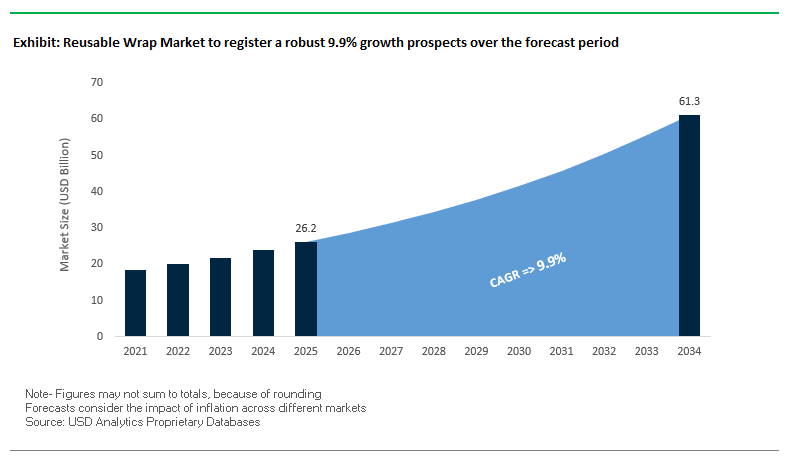
The global reusable wrap market is projected to grow from $26.2 billion in 2025 to $61.3 billion by 2034, representing a CAGR of 9.9%. Growth is fueled by rapid adoption of silicone lids, beeswax wraps, and other reusable alternatives as consumers prioritize sustainability, hygiene, and convenience. The market is particularly strong in North America and Europe, where eco-conscious consumer behavior and government initiatives encourage the reduction of single-use plastics.
Key Insights for industry professionals and buyers:
Widespread Adoption of Silicone Lids: Approximately 49% of U.S. households now use silicone lids, with 61% purchased online due to convenience.
Beeswax Wrap as a Sustainable Alternative: Single beeswax wraps can be reused up to 100 times, dramatically reducing plastic waste.
Transition from Disposable to Reusable: About 59% of households in Europe and North America have shifted from single-use plastic to reusable solutions over the last two years.
Design-Driven Consumer Purchases: Colorful and patterned wraps have driven a 26% growth in aesthetic-focused sales, highlighting the importance of style in eco-friendly products.
Durability and Longevity: Reusable wraps are designed for repeated use, reducing long-term costs and environmental impact.
Integration with Daily Lifestyle: Products like silicone lids and beeswax wraps cater to modern kitchens by offering versatile, easy-to-clean, and safe alternatives to plastic.
The market demonstrates a strong alignment between sustainability trends, consumer convenience, and product innovation, positioning reusable wraps as a key growth segment in the broader eco-friendly food storage industry.
Market Analysis: Industry Innovation and Strategic Acquisitions Are Accelerating the Global Reusable Wrap Market
The reusable wrap market is witnessing significant growth driven by technological advancements, strategic acquisitions, and new product launches. In August 2025, PolyFlute deployed its corrugated polypropylene boxes across the automotive, electronics, and agricultural sectors in Europe and Asia, signaling wider adoption of durable, reusable packaging solutions. Nefab Group, through its subsidiary Nefab Denmark, acquired FARUSA Emballage in August 2025, strengthening its sustainable packaging portfolio and expanding its international footprint.
Innovation in tracking and industrial solutions is also shaping the market. In July 2025, Avery Dennison launched enhanced industrial RFID inlays and tags such as AD Dogbone and AD Squarewave, improving reliability and real-time tracking of reusable packaging across logistics and retail networks. In June 2025, Mondi introduced a sustainable solution for the pet food industry, reflecting the growing demand for reusable and recyclable packaging across niche sectors.
Industry consolidation continues to impact the landscape. Amcor’s planned acquisition of Berry Global Group in December 2024, an $8.4 billion deal set to close in mid-2025, represents a major strategic consolidation in sustainable packaging. Other significant developments include GWP Correx launching Rapitainer in November 2024, Tri-Wall Circular’s YOYOBin Adjustable in October 2024, and Amcor introducing AmFiber Performance Paper in November 2024, each demonstrating innovation in reusable and eco-friendly wrap solutions.
Reusable Wrap Market: Trends and Opportunities Driving Mainstream Adoption and Innovation
Mainstream Retail Expansion Driven by Single-Use Plastic Bans
The most visible trend in the reusable wrap market is the rapid shift from niche to mainstream retail adoption, accelerated by global bans on single-use plastics. The European Union’s directive on single-use plastics has forced large grocery chains to redesign their packaging strategies and shelf space allocations. This has directly created demand for reusable alternatives to conventional plastic films, positioning reusable wraps as a standard product in supermarket aisles rather than a specialty item in health-conscious stores. Consumer demand is equally significant: a 2025 survey of U.S. and European shoppers revealed that a growing percentage actively prioritize sustainable household products. Retail giants like Target and Walmart are now stocking established reusable brands such as Bee’s Wrap and Food Huggers, exposing these products to millions of mainstream consumers. The combined forces of regulation, retailer adoption, and consumer preference are making reusable wraps a household staple across global markets.
Material Innovation for Enhanced Performance and Durability
Another defining trend is the continuous innovation in material science, enabling reusable wraps to compete with conventional packaging on performance. While beeswax-infused cotton remains the traditional format, manufacturers are developing new silicone-based wraps that deliver hermetic seals, making them suitable for liquid storage and far more versatile than earlier generations. A September 2025 academic paper highlighted their dishwasher-safe nature, significantly improving convenience and hygiene. Simultaneously, plant-based innovations are expanding the appeal to vegan and eco-conscious markets. Wraps created with candelilla wax, jojoba oil, and other plant-based resins are fully animal-free while offering natural antimicrobial properties, which extend produce shelf life and reduce spoilage. These material breakthroughs are pushing reusable wraps from simple eco-friendly alternatives to high-performance, multifunctional packaging solutions that meet diverse consumer and commercial needs.
Development of Compostable Reusable Wraps with Certified End-of-Life
While reusability is the core benefit of wraps, end-of-life disposal remains a critical consideration for zero-waste consumers. This creates a strong opportunity for products that are both long-lasting and certified home-compostable, closing the loop fully from usage to disposal. Research on compostable packaging highlights consumer preference for products that break down in a few months—faster than an orange peel—under home composting conditions. Innovations in biopolymers and renewable cellulose are paving the way for such solutions. A specialty cling wrap manufacturer has already launched cellulose-based materials certified for both industrial and home composting, providing a verifiable circular end-of-life pathway. By combining durability with compostability, these next-generation wraps can address consumer demand for true circular economy solutions, offering sustainability without compromise.
Integration of Smart Features for Food Freshness Monitoring
The future of the reusable wrap market lies in transforming these products into active food management tools. Early-stage research is focusing on embedding smart sensors and indicators into wraps to provide real-time insights on food freshness. A 2025 study on smart packaging technologies outlined how indicators that respond to spoilage gases could be color-coded directly onto reusable wraps, alerting consumers when food is no longer safe to eat. This innovation not only reduces waste by preventing premature disposal but also builds consumer trust through transparency and reliability. As smart packaging converges with sustainable materials, reusable wraps are positioned to evolve from passive protective layers into data-driven tools for food safety and household efficiency. Although still emerging, this opportunity has the potential to redefine the category and significantly increase adoption among both consumers and retailers.
Competitive Landscape: Key Players Are Driving Growth Through Sustainability, Innovation, and Consumer Education in the Reusable Wrap Industry
The global reusable wrap industry is shaped by companies that leverage sustainable materials, consumer-focused innovation, and market education to expand their footprint. These companies focus on durability, eco-friendly sourcing, and product versatility, catering to growing demand for plastic-free food storage solutions.
Bee's Wrap, LLC: Leading the Market with Ethical Beeswax Wraps and Consumer Education
Bee's Wrap specializes in beeswax wraps made from GOTS-certified organic cotton, sustainably sourced beeswax, jojoba oil, and tree resin. Its core strength lies in ethical sourcing and sustainability, ensuring bees are unharmed during production. Products include single wraps, multi-packs, and specialized wraps for bread and sandwiches, reusable for up to a year. The company emphasizes consumer education on eco-friendly food storage and promotes compostability at the end of product life.
U-Konserve: Offering Versatile Silicone Lids and Reusable Solutions for a Waste-Free Lifestyle
U-Konserve provides a wide range of silicone stretch lids, food containers, and insulated bags, supporting a health-conscious, zero-waste lifestyle. Products are dishwasher, microwave, and freezer safe, with airtight seals for various container shapes. In August 2025, the company launched a new collection of colorful silicone lids, catering to design-conscious consumers and driving engagement in aesthetic-driven sustainable products.
The Beeswax Wrap Co.: Expanding the UK Market with Handmade Sustainable Wraps
The Beeswax Wrap Co. produces handmade wraps from organic cotton, beeswax, pine resin, and jojoba oil, promoting low-waste, sustainable food storage. Products include various sizes and DIY kits for home users. The company focuses on retailer collaborations and expanding its market reach, actively contributing to plastic waste reduction and circular economy initiatives.
Glory Bee, with deep roots in the beekeeping and honey industry, offers a line of beeswax wraps made from natural beeswax. Its core strength is vertical integration, ensuring quality control over raw materials. In August 2025, Glory Bee partnered with a major grocery chain to expand distribution, enhancing market accessibility for its reusable wraps across North America.
Reusable Wrap Market Share Insights, 2025-2034
Food Storage dominates Market Share by Application in the Reusable Wrap Industry
Food storage applications account for nearly 75% of the reusable wrap industry, making it the undisputed growth driver. Consumers are replacing single-use cling film, aluminum foil, and disposable bags with beeswax-coated fabrics, silicone stretch lids, and reusable pouches that preserve freshness while aligning with zero-waste goals. The daily-use frequency of food storage ensures consistent demand, especially in urban households, meal prep routines, and professional kitchens, where sustainability and cost reduction converge. Gift wrapping, while smaller, plays into seasonal sustainability trends, particularly around holidays when packaging waste peaks, leveraging fabric wraps and reusable bags as eco-friendly alternatives. The “Others” category, including e-commerce packaging pilots, craft applications, and storage solutions for niche goods, represents an innovation sandbox where new use cases emerge, signaling future diversification beyond food preservation. Overall, the dominance of food storage reflects both consumer necessity and the sector’s alignment with plastic reduction regulations and green lifestyle adoption.
Household adoption drives Market Share by End-Use in the Reusable Wrap Industry
Household consumers represent nearly 85% of market share, highlighting the individual-driven nature of reusable wrap adoption. Early adopters are sustainability-conscious households influenced by social media, zero-waste influencers, and eco-focused retail campaigns. Aesthetics, reusability, and product longevity are as important as performance, with households driving bulk purchases of starter kits and subscription-based replenishment models. The commercial segment, though smaller, is steadily gaining traction in restaurants, cafes, and meal kit services, where washable silicone wraps and pouches support hygiene standards while reducing recurring packaging costs. Adoption is tempered by health code compliance and upfront investment barriers, but as durability improves and single-use bans expand, commercial uptake is expected to rise. Household dominance illustrates how grassroots consumer demand creates market stability, while commercial growth signals the potential for reusable wraps to scale into B2B environments as part of broader corporate ESG strategies.
United States: Consumer Demand and Corporate Sustainability Accelerating Reusable Wrap Adoption
The United States reusable wrap market is rapidly expanding, driven by both policy frameworks and consumer-driven sustainability trends. The U.S. Environmental Protection Agency (EPA) and the U.S. Plastics Pact are at the forefront, encouraging manufacturers and retailers to transition away from single-use plastics. A strong consumer preference for beeswax wraps and silicone wraps has emerged as households and food businesses seek eco-friendly alternatives to single-use cling film, motivated by health and environmental concerns over chemicals like BPA, PVC, and PFAS.
Major corporations are advancing innovation in this sector. Whirlpool Corporation has introduced SlimTech™ insulation technology, replacing traditional polyurethane foam with a powder-based vacuum-sealed material, improving both thermal efficiency and storage capacity in food preservation. On the infrastructure side, federal investments through the Infrastructure Investment and Jobs Act are strengthening advanced recycling and manufacturing systems, creating a supportive ecosystem for reusable packaging. Local initiatives, such as the Petaluma Reusable Cup Project in California, which has collected over 200,000 cups for reuse, highlight a growing consumer readiness for closed-loop systems. Furthermore, companies like PepsiCo are setting ambitious goals to make 97% of packaging reusable, recyclable, or compostable by 2030, underscoring the U.S.’s leadership in sustainability-driven packaging innovation.
European Union: PPWR and ESPR Regulations Reshaping Reusable Wrap Industry
The European Union reusable wrap market is heavily influenced by the Packaging and Packaging Waste Regulation (PPWR), which took effect in February 2025. This regulation mandates reuse targets across multiple sectors, aiming to reduce packaging waste per capita by 5% by 2030, 10% by 2035, and 15% by 2040. This push directly incentivizes businesses to adopt reusable wraps and packaging alternatives. The EU is also expanding Deposit Return Systems (DRS), boosting collection efficiency and reducing littering.
Germany stands out with its 2023 reusable packaging obligation, requiring catering outlets to offer reusable options at the same cost as disposables. Additionally, the Ecodesign for Sustainable Products Regulation (ESPR) introduces a Digital Product Passport, ensuring transparency about product origin and compliance. From August 2026, restrictions on PFAS in food contact materials will further accelerate the transition toward safer, reusable solutions. These legislative frameworks, combined with Europe’s established recycling infrastructure and innovation-driven industry, position the EU as a global leader in reusable wrap adoption.
China: Regulatory Push and Logistics Companies Driving Reusable Packaging Growth
The China reusable wrap market is seeing rapid growth due to strict regulatory mandates and logistics sector innovation. From June 1, 2025, express delivery firms are legally required to prioritize eco-friendly and reusable packaging, part of China’s 14th Five-Year Plan to curb plastic pollution. Leading delivery giants such as JDL Express and SF Express are deploying reusable circulation boxes, replacing single-use cardboard in inter-station transport, which directly supports large-scale adoption of reusable wraps in supply chains.
Policy measures extend to cities like Shanghai, which introduced new restrictions in September 2025, banning deceptive “greenwashing” products like paper lined with plastic film, along with prohibiting foam bowls and single-use plastic straws. Meanwhile, the government’s support for the remanufacturing industry and tax incentives for green technology investments are reinforcing corporate adoption. This dual pressure from regulators and logistics operators is making China a fast-growing market for reusable packaging formats, particularly in e-commerce and last-mile delivery.
India: EPR Mandates and Homegrown Innovations Boosting Reusable Wrap Adoption
The India reusable wrap market is advancing through a combination of regulatory reforms and local entrepreneurial innovation. The Plastic Waste Management (Amendment) Rules, 2024, put Extended Producer Responsibility (EPR) at the forefront, requiring large producers and importers to comply with stricter obligations while exempting MSMEs. From July 1, 2025, all plastic packaging must be traceable via QR codes or barcodes, ensuring accountability in waste management.
Industry-wide discussions are also shaping the market, with the Food Safety and Standards Authority of India (FSSAI) organizing a National Stakeholder Consultation in April 2025 on sustainable packaging trends. Local companies such as Bombus and Madhu Wrap are creating beeswax wraps using organic cotton and Indian-sourced beeswax, meeting consumer demand for eco-friendly food storage options. Meanwhile, the FSSAI is developing guidelines for recycled PET (rPET) in food packaging, further broadening the acceptance of sustainable materials. India’s market is distinguished by its blend of global regulatory alignment and grassroots-driven innovation, positioning it as a rising hub for reusable wraps in the Asia-Pacific region.
Japan: Circular Economy Laws and Premium Innovation in Reusable Materials
The Japan reusable wrap market is propelled by the government’s Plastic Resource Circulation Strategy, requiring all plastic packaging to be reusable or recyclable by 2025. Complementing this, the Plastic Resource Circulation Promotion Law (2025) mandates redesign of 12 single-use plastic products, compelling industries to adopt reusable and compostable alternatives. Additionally, Japan’s commitment to doubling renewable material use by 2030 underscores its leadership in sustainable packaging transformation.
Corporate innovation plays a crucial role. Companies like Shiseido and Tokiwa Cosmetics are pioneering refillable product packaging, while material science firms like Nippon Paper Industries have launched SHIELDPLUS, a paper-based material with barrier properties against oxygen and odors. Partnerships between LyondellBasell and Japanese manufacturers are accelerating the adoption of bio-polypropylene (bio-PP). Together, these measures are establishing Japan as a premium innovation hub for reusable wraps, with strong synergies between regulation, consumer demand, and corporate R&D.
Brazil: Reverse Logistics and Waste Import Ban Supporting Reusable Packaging
The Brazil reusable wrap market is governed by the National Solid Waste Policy (PNRS), which emphasizes responsible waste management, reuse, and recycling. To strengthen this framework, Law No. 15,088, effective January 2025, bans the import of solid waste including plastics, paper, glass, and metal, encouraging industries to rely on domestic recycling and reusable alternatives.
The government is also advancing a reverse logistics system that obligates producers to manage the recycling and reuse of their packaging post-consumption. These regulations are driving businesses to adopt reusable wraps and packaging solutions as part of their compliance strategies. Brazil’s policies, combined with its growing consumer awareness and focus on sustainable domestic production, are positioning the country as a key emerging market for reusable packaging in Latin America.
Reusable Wrap Market Report Scope
Reusable Wrap Market
Parameter
Details
Market Size (2025)
$26.2 Billion
Market Size (2034)
$61.3 Billion
Market Growth Rate
9.9%
Segments
By Material (Beeswax-Coated Fabric, Silicone, Plant-Based Wax-Coated Fabric, PU, Others), By Application (Food Storage, Gift Wrapping, Others), By End-Use Industry (Commercial, Household), By Distribution Channel (Online, Offline)
Study Period
2019- 2024 and 2025-2034
Units
Revenue (USD)
Qualitative Analysis
Porter’s Five Forces, SWOT Profile, Market Share, Scenario Forecasts, Market Ecosystem, Company Ranking, Market Dynamics, Industry Benchmarking
Companies
Abeego Designs Inc., The Beeswax Wrap Co., Bee's Wrap, LLC, Natrual Home, U-Konserve, Food Huggers, Sustomi, Superbee, Honeybee Wrap, Lily's Wraps, Madhu Wrap, Eco & Co., Z wrap, The Swag, The Cary Company
Countries
US, Canada, Mexico, Germany, France, Spain, Italy, UK, Russia, China, India, Japan, South Korea, Australia, South East Asia, Brazil, Argentina, Middle East, Africa
Reusable Wrap Market Segmentation
By Material
Beeswax-Coated Fabric
Silicone
Plant-Based Wax-Coated Fabric
PU
Others
By Application
Food Storage
Gift Wrapping
Others
By End-Use Industry
Commercial
Household
By Distribution Channel
Online
Offline
Countries Analyzed
North America (US, Canada, Mexico)
Europe (Germany, UK, France, Spain, Italy, Russia, Rest of Europe)
Asia Pacific (China, India, Japan, South Korea, Australia, South East Asia, Rest of Asia)
South America (Brazil, Argentina, Rest of South America)
Middle East and Africa (Saudi Arabia, UAE, Rest of Middle East, South Africa, Egypt, Rest of Africa)
Top Companies in Reusable Wrap Market
Abeego Designs Inc.
The Beeswax Wrap Co.
Bee's Wrap, LLC
Natrual Home
U-Konserve
Food Huggers
Sustomi
Superbee
Honeybee Wrap
Lily's Wraps
Madhu Wrap
Eco & Co.
Z wrap
The Swag
The Cary Company
* List Not Exhaustive
Methodology
USDAnalytics employs a rigorous, multi-faceted research methodology to deliver precise insights into the global reusable wrap market. Our approach combines comprehensive secondary research—including company reports, regulatory frameworks, sustainability and ESG disclosures, and industry publications—with primary interviews of manufacturers, retailers, distributors, and end-users across household and commercial segments. We evaluate key metrics such as product adoption rates, material innovations, lifecycle cost savings, and consumer preferences for beeswax, silicone, and plant-based wraps. Market sizing and forecasting incorporate global regulatory influences, including the EU PPWR, U.S. Plastics Pact, China’s plastic reduction mandates, and Japan’s Plastic Resource Circulation Strategy. USDAnalytics further analyzes competitive developments, strategic acquisitions, technological integration in smart and compostable wraps, and distribution channel trends (online/offline), producing actionable intelligence on CAGR, regional adoption patterns, end-use segmentation, and innovation-driven growth opportunities. This methodology ensures industry professionals gain a data-driven, holistic understanding of market dynamics, competitive positioning, and emerging opportunities in sustainable food storage solutions.
Deliverables:
Comprehensive Market Research Report (PDF and Excel) with detailed tables, charts, and interactive visualizations.
Country-Specific Forecasts & Analysis.
Segment-Wise Revenue Forecasts (2025–2034).
Competitive Analysis, Benchmarking, and SWOT Profiles.
Recent Developments & Innovation Tracker.
Executive Summary & Analyst Commentary.
Post-Purchase Analyst Support for Client-Specific Questions and Custom Data Requirements.
Table of Contents: Reusable Wrap Market
1. Executive Summary
1.1. Market Highlights
1.2. Key Findings
1.3. Global Market Snapshot
2. Reusable Wrap Market Landscape & Outlook (2025–2034)
2.1. Introduction to Reusable Wrap Market
2.2. Market Valuation and Growth Projections (2025–2034)
2.3. Consumer-Driven Sustainability Trends
2.4. Government Regulations Impacting Market Growth
2.5. Mainstream Retail Adoption and Market Penetration
3. Innovations Reshaping the Reusable Wrap Market
3.1. Trend: Material Innovation for Performance and Durability
3.2. Trend: Smart Packaging Integration for Food Freshness Monitoring
3.3. Opportunity: Development of Compostable Reusable Wraps
3.4. Opportunity: Expansion of Silicone and Beeswax Wrap Applications
4. Competitive Landscape and Strategic Initiatives
4.1. Mergers, Acquisitions and Strategic Alliances
4.2. R&D and Material Innovation
4.3. Sustainability and Strategies
4.4. Market Expansion and Regional Focus
5. Market Share and Segmentation Insights: Reusable Wrap Market
5.1. By Material
5.1.1. Beeswax-Coated Fabric
5.1.2. Silicone
5.1.3. Plant-Based Wax-Coated Fabric
5.1.4. PU
5.1.5. Others
5.2. By Application
5.2.1. Food Storage
5.2.2. Gift Wrapping
5.2.3. Others
5.3. By End-Use Industry
5.3.1. Commercial
5.3.2. Household
5.4. By Distribution Channel
5.4.1. Online
5.4.2. Offline
6. Country Analysis and Outlook of Reusable Wrap Market
6.1. United States
6.2. Canada
6.3. Mexico
6.4. Germany
6.5. France
6.6. Spain
6.7. Italy
6.8. UK
6.9. Russia
6.10. China
6.11. India
6.12. Japan
6.13. South Korea
6.14. Australia
6.15. South East Asia
6.16. Brazil
6.17. Argentina
6.18. Middle East
6.19. Africa
7. Reusable Wrap Market Size Outlook by Region (2025–2034)
7.1. North America Reusable Wrap Market Size Outlook to 2034
7.1.1. By Material
7.1.2. By Application
7.1.3. By End-Use Industry
7.1.4. By Distribution Channel
7.2. Europe Reusable Wrap Market Size Outlook to 2034
7.2.1. By Material
7.2.2. By Application
7.2.3. By End-Use Industry
7.2.4. By Distribution Channel
7.3. Asia Pacific Reusable Wrap Market Size Outlook to 2034
7.3.1. By Material
7.3.2. By Application
7.3.3. By End-Use Industry
7.3.4. By Distribution Channel
7.4. South America Reusable Wrap Market Size Outlook to 2034
7.4.1. By Material
7.4.2. By Application
7.4.3. By End-Use Industry
7.4.4. By Distribution Channel
7.5. Middle East and Africa Reusable Wrap Market Size Outlook to 2034
7.5.1. By Material
7.5.2. By Application
7.5.3. By End-Use Industry
7.5.4. By Distribution Channel
8. Company Profiles: Leading Players in the Reusable Wrap Market
8.1. Abeego Designs Inc.
8.2. The Beeswax Wrap Co.
8.3. Bee's Wrap, LLC
8.4. Natrual Home
8.5. U-Konserve
8.6. Food Huggers
8.7. Sustomi
8.8. Superbee
8.9. Honeybee Wrap
8.10. Lily's Wraps
8.11. Madhu Wrap
8.12. Eco & Co.
8.13. Z Wrap
8.14. The Swag
8.15. The Cary Company
9. Methodology
9.1. Research Scope
9.2. Market Research Approach
9.3. Market Sizing and Forecasting Model
9.4. Research Coverage
9.5. Data Horizon
9.6. Deliverables
10. Appendix
10.1. Acronyms and Abbreviations
10.2. List of Tables
10.3. List of Figures
Reusable Wrap Market Segmentation
By Material
Beeswax-Coated Fabric
Silicone
Plant-Based Wax-Coated Fabric
PU
Others
By Application
Food Storage
Gift Wrapping
Others
By End-Use Industry
Commercial
Household
By Distribution Channel
Online
Offline
Countries Analyzed
North America (US, Canada, Mexico)
Europe (Germany, UK, France, Spain, Italy, Russia, Rest of Europe)
Asia Pacific (China, India, Japan, South Korea, Australia, South East Asia, Rest of Asia)
South America (Brazil, Argentina, Rest of South America)
Middle East and Africa (Saudi Arabia, UAE, Rest of Middle East, South Africa, Egypt, Rest of Africa)
The global reusable wrap market is projected to expand from USD 26.2 billion in 2025 to USD 61.3 billion by 2034, achieving a CAGR of 9.9%. Strong growth is driven by consumer demand for eco-friendly food storage solutions, material innovation, and the mainstream adoption of silicone lids, beeswax wraps, and plant-based alternatives.
Beeswax-coated fabric and silicone dominate due to durability, reusability, and eco-friendliness. Beeswax wraps can be reused up to 100 times, reducing plastic waste, while silicone lids offer airtight seals and dishwasher-safe convenience. Plant-based wax fabrics are emerging to address vegan and compostable preferences, broadening market appeal.
Legislation such as the EU PPWR, U.S. Plastics Pact, Japan’s Plastic Resource Circulation Strategy, and India’s EPR rules are accelerating adoption by mandating reusable and recyclable alternatives. These policies compel retailers and households to transition from single-use plastics, expanding mainstream distribution and consumer acceptance of reusable wraps.
Consumers are prioritizing sustainability, convenience, and aesthetics. Colorful, patterned wraps are increasingly popular, accounting for 26% growth in design-focused sales. Households, representing 85% of market share, seek versatile, easy-to-clean, long-lasting solutions that integrate seamlessly into daily food storage routines.
Key players include Bee’s Wrap, LLC, U-Konserve, The Beeswax Wrap Co., and Glory Bee. These companies focus on sustainable materials, product durability, and consumer education while introducing smart features, compostable solutions, and aesthetically appealing designs. Strategic partnerships and retail expansion are also fueling global market penetration.