Stand-Up Pouches Market Size, Overview, and Growth Outlook (2025–2034)
Stand-Up Pouches Market Set to Surge from $50 Billion in 2025 to $97.5 Billion by 2034, Driven by Sustainability and Shelf-Ready Branding
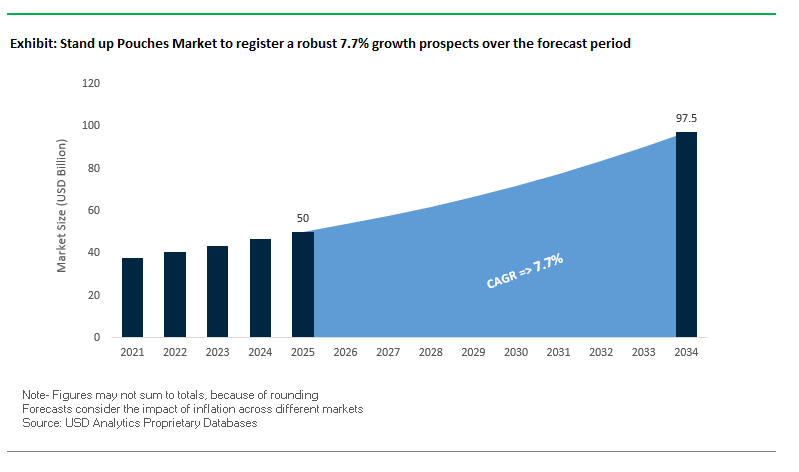
The global stand-up pouches market is projected to grow from $50 billion in 2025 to $97.5 billion by 2034, achieving a CAGR of 7.7%. Recognized for their stability on store shelves, lightweight construction, and high-impact branding potential, stand-up pouches have become indispensable across food & beverage, personal care, and pet food sectors.
Key Insights for Industry Professionals:
Sustainability and resource efficiency are driving adoption, with significant reductions in material usage compared to rigid containers.
Mono-material and recyclable solutions are increasingly adopted, incorporating post-consumer recycled (PCR) content to meet regulatory and consumer demands.
Enhanced consumer convenience with resealable zippers, spouts, and laser-scored tear notches improves product freshness and usability.
Advanced printing and branding capabilities leverage the large surface area to communicate brand value and differentiate on the shelf.
Lightweight design reduces transportation costs and carbon footprint, aligning with environmental goals.
Stand-up pouches continue to address both operational efficiency and consumer experience, establishing themselves as a key flexible packaging solution.
Market Analysis: Industry Momentum in Stand-Up Pouches Highlights Strategic Acquisitions, Sustainability, and Versatile Applications
The stand-up pouches market has experienced dynamic developments through strategic acquisitions and innovation in sustainable materials. In August 2025, ProAmpac acquired PAC Worldwide, expanding its flexible packaging capabilities globally. That same month, ProAmpac commercialized high-performance, recyclable-ready pouches for chunk cheese, demonstrating the application of sustainable pouch technology to new food categories. June 2025 saw Mondi and Saga Nutrition launch a paper-based stand-up pouch for pet food, underscoring the pivot toward eco-friendly materials.
Sustainability continues to be a core driver. In July 2025, Huhtamaki earned an EcoVadis gold medal for the fifth consecutive year, emphasizing its commitment to environmentally responsible packaging. Also in June 2025, ProAmpac developed a spouted refill pouch for pest control products, reflecting the versatility of stand-up pouches beyond food and beverage sectors. Consumer and industrial demand for recyclable, high-performance packaging is shaping these innovations.
Expanding market reach and operational capacity are key trends. In October 2024, Amcor and Mespack launched a recycle-ready stand-up pouch for home care products, optimizing larger flexible formats. In March–April 2024, Berry Global expanded production lines and recycling capacity across European and UK facilities, supporting increased post-consumer recycled (PCR) content in stand-up pouches. In October 2023, the launch of Entour™ high-performance PE lamination films by Berry Global consolidated recyclable solutions under a single-source brand, facilitating global adoption of sustainable pouch formats.
Trends and Opportunities Shaping the Stand-Up Pouches Market
Accelerated Shift to Mono-Material Polyolefin Structures for Recyclability
The stand-up pouches market is undergoing a fundamental transformation as manufacturers rapidly shift toward mono-material polyolefin structures, replacing traditional multi-material laminates that were historically incompatible with recycling streams. Independent certifications are validating these innovations, setting benchmarks for the industry. For example, the German Institute Cyclos-HTP certified Mondi Group’s PP-based mono-material stand-up pouch with an AAA rating, indicating over 95% recyclability. Such certifications enable brand owners to make credible recyclability claims while complying with regional sustainability mandates.
Overcoming technical barriers has been a central challenge. A February 2024 scientific article highlights the use of biaxially oriented polyethylene (BOPE) films as a key enabler for all-PE structures. These films deliver the stiffness, heat resistance, and machinability required for high-speed filling lines, making mono-material pouches a commercially viable replacement for multi-layer laminates. Demonstrations of performance are also proving their market-readiness. A collaboration between Hosokawa Alpine, Henkel, and ExxonMobil resulted in a recyclable pouch containing more than 95% PE content with a high-oxygen barrier. Notably, the pouch not only maintained performance but showed a 70% improvement in puncture energy compared to multi-material alternatives, highlighting the durability and protective capabilities of new mono-material designs.
Integration of Advanced Barrier Coatings to Extend Shelf Life
A second key trend is the deployment of advanced barrier coatings to ensure shelf life and product quality while eliminating non-recyclable metallized layers. In 2025, a case study introduced a high-barrier mono-material PE pouch that combined a 10-nanometer aluminum oxide (AlOx) layer with a new water-based polymer coating. This solution provided exceptional protection against oxygen and moisture—critical for packaging categories such as coffee, snacks, and powdered foods.
These ultra-thin coatings represent a breakthrough for circularity. Unlike traditional aluminum foil or metallized PET, which complicate recycling, AlOx and polymer nanocoatings enable stand-up pouches to remain compatible with polyolefin recycling streams. A review of barrier packaging innovations confirms that these new coatings deliver comparable preservation qualities to traditional laminates, ensuring that mono-material pouches can extend shelf life without compromising recyclability. This makes them highly attractive for food, beverage, and nutraceutical brands balancing sustainability with performance.
Incorporation of Post-Consumer Recycled (PCR) Content to Meet Legislation
One of the most significant opportunities for growth lies in the integration of post-consumer recycled (PCR) content into stand-up pouch packaging. With regulations mandating minimum recycled content in several regions, this has become a compliance-driven necessity rather than a voluntary measure. A notable collaborative project involving Braskem, Antilhas, and Gualapack successfully developed a pouch containing 43.3% PCR material (r-PE + r-PET) sourced from reverse logistics and landfill recovery. Importantly, the packaging passed rigorous stress and safety tests, establishing its commercial viability for non-food applications.
However, the challenge of sourcing high-quality PCR resin at scale remains a constraint. Many packaging suppliers are already offering pouches with PCR options on demand, as highlighted in a product brief for home care packaging. Building a stable PCR supply chain through investments in advanced recycling, sorting, and collection infrastructure will be critical for ensuring consistent material quality and availability. This opportunity positions converters and resin suppliers to play a pivotal role in enabling brands to meet their ESG and regulatory targets.
Development of Performance-Optimized Pouches for E-commerce Fulfillment
The rise of e-commerce is creating new demand for durable, lightweight, and cost-efficient stand-up pouches. Traditionally, corrugated boxes dominated last-mile delivery, but flexible pouches are increasingly being engineered to replace them for small-to-medium-sized goods. A report on e-commerce packaging emphasizes that flexible pouches are lighter and require less void fill, directly reducing freight costs and minimizing carbon emissions across logistics networks.
To succeed in e-commerce, however, durability is essential. A manufacturer’s technical sheet details a high-performance pouch with superior puncture and tear resistance, designed to withstand the rigors of parcel handling and transit. These advancements make stand-up pouches not only a sustainable option but also a practical one for online retail, ensuring customer satisfaction while reducing packaging costs. As direct-to-consumer sales accelerate globally, the demand for performance-optimized flexible packaging will continue to expand, making this a major growth driver in the next decade.
Competitive Landscape: Leading Players in Stand-Up Pouches Are Shaping the Market Through Sustainability, Innovation, and High-Performance Designs
The stand-up pouch industry is dominated by companies leveraging materials science, sustainable solutions, and innovative design to deliver durable, user-friendly, and environmentally responsible packaging.
Amcor plc: Driving Circular Economy with Recyclable and Large-Format Stand-Up Pouches
Amcor provides stand-up pouches across food, beverage, and personal care markets, focusing on recycle-ready, PCR-based, and biomaterial packaging. The company aims to make all packaging recyclable or reusable by 2025 and has introduced large-format, spouted stand-up pouches for bulk applications. Amcor’s global manufacturing footprint and vertically integrated operations support diverse regional markets, with a strategic emphasis on circular economy initiatives, brand protection, and product safety.
ProAmpac: Expanding Global Reach and Offering Sustainable, High-Barrier Stand-Up Pouches
ProAmpac delivers stand-up pouches for food, personal care, and industrial chemicals, combining advanced barrier films with award-winning graphics. In August 2025, it acquired PAC Worldwide, enhancing its global footprint. Its ProActive Sustainability platform focuses on recyclable and compostable solutions. ProAmpac’s strengths include material science innovation, seal integrity, and consumer-friendly features, with a strategy centered on high-performance, environmentally responsible packaging.
Sonoco provides customizable stand-up pouches featuring high-performance films, fitments, and ClearGuard™ technology. Its EnviroFlex® initiative incorporates post-consumer recycled content and flexible paper solutions, supporting sustainable practices. Sonoco’s capabilities in materials science, integrated design, and ID printing enhance brand protection and consumer engagement. Its strategy is to lead with innovative, sustainable packaging solutions across diverse markets.
Huhtamaki Oyj: Pioneering Compostable and Recyclable Stand-Up Pouch Solutions
Huhtamaki offers stand-up pouches alongside paper and fiber-based containers, focusing on sustainable alternatives. In July 2025, it earned its fifth EcoVadis gold medal and introduced recyclable and compostable ice cream packaging. Huhtamaki’s global manufacturing footprint and material expertise make it a key partner for brands seeking eco-friendly flexible packaging, with a strategy aligned with its 2030 sustainability goals.
Mondi Group: Leading Paper-Based Stand-Up Pouch Innovations for Sustainable Food and Pet Products
Mondi specializes in stand-up pouches with a focus on paper-based, sustainable alternatives to plastic. In June 2025, it partnered with Saga Nutrition to launch paper-based pouches for pet food. Its FunctionalBarrier Paper Ultimate delivers high-performance in eco-friendly packaging. Mondi’s core strengths include R&D capabilities, sustainability expertise, and custom solution development, guided by its “Growing with Purpose” strategy to deliver innovative and environmentally responsible packaging.
Stand up Pouches Market Share Insights, 2025-2034
Standard Pouches Dominate Market Share by Product Type in Stand-Up Pouches Industry
Standard stand-up pouches account for 48% of the global market, underscoring their unmatched versatility and cost-effectiveness across a wide range of applications. These pouches, typically composed of 3–4 multilayer laminates, are the default choice for dry goods, snacks, powders, and non-sterilized liquids, serving both high-volume FMCG brands and private labels. Their dominance is reinforced by superior printability, which enhances shelf visibility and brand recognition, as well as their lightweight nature, which reduces logistics costs compared to rigid formats. In contrast, aseptic and retort pouches are high-value niches serving specific sterilized applications, but they cannot match the volume-driven ubiquity of standard pouches. Regulatory pressure to reduce rigid plastics and rising consumer acceptance of flexible formats continue to sustain the stronghold of standard pouches as the backbone of the industry.
Food & Beverages Lead Market Share by Application in Stand-Up Pouches Industry
Food and beverages represent 72% of the stand-up pouches market, making it the dominant application segment by a wide margin. This supremacy is driven by the industry’s need to reduce packaging weight, extend shelf life, and enhance retail impact through bold, high-quality graphics. Stand-up pouches are now the go-to packaging for snacks, coffee, sauces, baby food, and beverages, where resealability and portion control drive consumer preference. Beyond consumer convenience, food manufacturers benefit from major supply chain efficiencies, as flexible pouches lower transport emissions and reduce warehouse space requirements. As retailers push brands toward sustainable packaging, the use of recyclable mono-material pouches and post-consumer recycled (PCR) content is accelerating, further cementing the format’s position in the food and beverage value chain.
United States: Recycling Goals, Automation, and E-Commerce Adoption
The United States stand-up pouches market is evolving under the influence of the U.S. Environmental Protection Agency’s (EPA) 2030 recycling goal, which aims to increase the national recycling rate to 50%. This has accelerated investments in sustainable materials and advanced recycling infrastructure. Companies such as ProAmpac and Amcor are pioneering the development of mono-material recyclable pouches, addressing both compliance and consumer demand for eco-friendly packaging. At the same time, the Association of Plastic Recyclers (APR) is guiding manufacturers on the use of washable inks and floatable films, boosting recyclability without compromising on performance.
Demand is also rising for automation in production through high-speed filling and sealing machinery, particularly in dairy and baby food packaging, where efficiency and safety are critical. In addition, features such as re-closable zippers and spouts are becoming standard in food and beverage packaging to improve convenience and reduce waste. The e-commerce revolution is another strong driver, with stand-up pouches gaining popularity due to their lightweight, durable, and space-efficient design, making them cost-effective and consumer-preferred for online delivery.
European Union: PPWR, Digital Product Passports, and Innovation in Barrier Films
The European Union stand-up pouches market is at the forefront of regulatory-driven transformation. The Packaging and Packaging Waste Regulation (PPWR), effective from February 2025, mandates that all plastic packaging, including stand-up pouches, must integrate minimum recycled content from post-consumer waste by 2030. Building on the Single-Use Plastics Directive (SUPD), the PPWR also introduces a Digital Product Passport, requiring manufacturers to disclose information on recyclability, origin, and compliance.
Another regulatory driver is the restriction on per- and polyfluoroalkyl substances (PFAS) in food contact packaging from August 2026, which is prompting innovation in alternative barrier coatings. Meanwhile, the EU is actively promoting refill and reuse systems, pushing companies to design more durable stand-up pouches. Industry leaders like Mondi are spearheading this shift, with recyclable mono-material solutions. For example, Mondi’s partnership with Henkel to launch a fully recyclable mono-material refill pouch highlights how compliance and sustainability are driving packaging innovation in the region.
China: Regulatory Pressure, Premiumization, and High-Barrier R&D
The China stand-up pouches market is advancing under strict government-led initiatives, particularly the 14th Five-Year Plan and new regulations effective June 1, 2025, which require express delivery companies to use eco-friendly and reusable packaging. This regulation has far-reaching implications for e-commerce and food delivery, where stand-up pouches are widely used.
Consumer preferences are also shifting, with increasing demand for premium and technologically advanced pouch designs. This is driving the adoption of UV-stabilized films and high-barrier oxygen protection, ensuring longer shelf life and better product safety. Additionally, the government is incentivizing the use of green technology through tax benefits, stimulating local innovation. Chinese manufacturers are making significant investments in mono-material PE films, positioning themselves to supply both domestic and export markets with fully recyclable stand-up pouches that meet global sustainability standards.
India: EPR Regulations and Rising Dairy & E-Commerce Consumption
In India, the stand-up pouch market is strongly influenced by the Plastic Waste Management (Amendment) Rules, 2024, effective April 2025, which emphasize Extended Producer Responsibility (EPR). This regulation compels producers, importers, and brand owners to manage recycling and post-consumer waste disposal. Starting July 1, 2025, all packaging must be traceable via barcodes or QR codes, making accountability and compliance essential. Notably, MSMEs are exempt from EPR obligations, shifting responsibility to larger players and raw material suppliers.
Market demand is growing rapidly, driven by the dairy sector’s modernization initiatives, the expansion of organized retail, and the e-commerce boom. Stand-up pouches are increasingly favored for their lightweight, hygienic, and cost-effective characteristics, especially for food, beverage, and personal care packaging. Local producers are diversifying their offerings to meet the demand from both urban and rural markets, while focusing on recyclability to align with government initiatives.
Japan: Circular Economy Goals and Renewable Material Innovation
The Japan stand-up pouch market is guided by the Plastic Resource Circulation Strategy, which mandates that all plastic packaging be reusable or recyclable by 2025. This is supported by the Plastic Resource Circulation Promotion Law, effective the same year, which requires the reduction and redesign of 12 types of single-use plastics. These policies are driving companies to transition toward paper-based, compostable, and reusable pouch alternatives.
Japan’s strategy also targets a doubling of renewable material use by 2030, with strict enforcement of waste sorting at collection to maximize recycling efficiency. This has accelerated investments in bio-based polymers, high-barrier recyclable films, and paper-based pouches, positioning Japan as a leader in sustainable flexible packaging solutions.
Brazil: Reverse Logistics and Food Contact Regulation Updates
The Brazil stand-up pouch market is shaped by the National Solid Waste Policy (PNRS), which emphasizes reuse, recycling, and reverse logistics systems. Under Law No. 15,088, effective January 2025, Brazil banned imports of plastic waste, pushing the industry toward sustainable domestic waste management.
The government is also reinforcing reverse logistics, holding producers accountable for post-consumer collection and recycling of stand-up pouch packaging. At the same time, Brazil’s Health Regulatory Agency (Anvisa) updated its food contact regulations in February 2025, adding new substances to the approved positive list for plastics. These regulatory pressures are encouraging manufacturers to innovate in safe and recyclable pouch materials, particularly for dairy, beverages, and snack products, ensuring compliance with both domestic and international standards.
Stand up Pouches Market Report Scope
Stand up Pouches Market
Parameter
Details
Market Size (2025)
$50 Billion
Market Size (2034)
$97.5 Billion
Market Growth Rate
7.7%
Segments
By Product Type (Standard Pouches, Retort Pouches, Aseptic Pouches, Hot-Filled Pouches), By Closure (Zipper, Spout, Tear Notch, Others), By Material (Plastic, Aluminum Foil, Paper & Paperboard, Bioplastics & Compostable Materials, Laminates), By Application (Food & Beverages, Personal Care & Cosmetics, Home Care, Healthcare & Pharmaceuticals, Industrial Products)
Study Period
2019- 2024 and 2025-2034
Units
Revenue (USD)
Qualitative Analysis
Porter’s Five Forces, SWOT Profile, Market Share, Scenario Forecasts, Market Ecosystem, Company Ranking, Market Dynamics, Industry Benchmarking
US, Canada, Mexico, Germany, France, Spain, Italy, UK, Russia, China, India, Japan, South Korea, Australia, South East Asia, Brazil, Argentina, Middle East, Africa
Stand up Pouches Market Segmentation
By Product Type
Standard Pouches
Retort Pouches
Aseptic Pouches
Hot-Filled Pouches
By Closure
Zipper
Spout
Tear Notch
Others
By Material
Plastic
Aluminum Foil
Paper & Paperboard
Bioplastics & Compostable Materials
Laminates
By Application
Food & Beverages
Personal Care & Cosmetics
Home Care
Healthcare & Pharmaceuticals
Industrial Products
Countries Analyzed
North America (US, Canada, Mexico)
Europe (Germany, UK, France, Spain, Italy, Russia, Rest of Europe)
Asia Pacific (China, India, Japan, South Korea, Australia, South East Asia, Rest of Asia)
South America (Brazil, Argentina, Rest of South America)
Middle East and Africa (Saudi Arabia, UAE, Rest of Middle East, South Africa, Egypt, Rest of Africa)
Top Companies in Stand up Pouches Market
Amcor plc
Huhtamaki Oyj
Sealed Air Corporation
Mondi Group
ProAmpac
Sonoco Products Company
Scholle IPN
Coveris Holdings S.A.
Constantia Flexibles
Gualapack S.p.A.
Winpak Ltd.
EPL Limited
Smurfit Kappa Group plc
Swiss Pack Pvt. Ltd.
Greif, Inc.
* List Not Exhaustive
Methodology
The Stand-Up Pouches Market report by USDAnalytics is built on a comprehensive research methodology combining primary and secondary data sources to ensure accuracy and relevance for industry professionals. Primary research included interviews and discussions with packaging engineers, R&D experts, supply chain managers, and brand managers from leading companies such as Amcor, Huhtamaki, ProAmpac, Mondi Group, and Sonoco, focusing on trends in sustainable materials, mono-material adoption, barrier coatings, and e-commerce optimized designs. Secondary research encompassed an extensive review of corporate filings, sustainability reports, regulatory documents, technical journals, industry news, and trade associations to analyze market drivers, regional policies, and technological innovations. Market sizing and forecasts were determined using both top-down and bottom-up approaches, considering regional influences such as EU PPWR, U.S. EPA recycling targets, India’s EPR regulations, China’s 14th Five-Year Plan, Japan’s Plastic Resource Circulation Strategy, and Brazil’s reverse logistics initiatives. Data triangulation and cross-validation ensured the accuracy of estimates across product types, materials, closures, and applications, providing a holistic, professional-grade view of market dynamics, competitive landscape, and growth opportunities in the global stand-up pouches industry.
Deliverables:
Comprehensive Market Research Report (PDF and Excel) with detailed tables, charts, and interactive visualizations.
Country-Specific Forecasts & Analysis.
Segment-Wise Revenue Forecasts (2025–2034).
Competitive Analysis, Benchmarking, and SWOT Profiles.
Recent Developments & Innovation Tracker.
Executive Summary & Analyst Commentary.
Post-Purchase Analyst Support for Client-Specific Questions and Custom Data Requirements.
Table of Contents: Stand-Up Pouches Market
1. Executive Summary
1.1. Market Highlights
1.2. Key Findings
1.3. Global Market Snapshot
2. Stand-Up Pouches Market Landscape & Outlook (2025–2034)
2.1. Introduction to Stand-Up Pouches Market
2.2. Market Valuation and Growth Projections (2025–2034)
2.3. Strategic Acquisitions and Market Expansion
2.4. Sustainability and Regulatory Drivers
2.5. Operational Efficiency and Consumer Experience
3. Innovations Reshaping the Stand-Up Pouches Market
3.1. Trend: Accelerated Shift to Mono-Material Polyolefin Structures for Recyclability
3.2. Trend: Integration of Advanced Barrier Coatings to Extend Shelf Life
3.3. Opportunity: Incorporation of Post-Consumer Recycled (PCR) Content to Meet Legislation
3.4. Opportunity: Development of Performance-Optimized Pouches for E-commerce Fulfillment
4. Competitive Landscape and Strategic Initiatives
4.1. Mergers, Acquisitions and Strategic Alliances
4.2. R&D and Material Innovation
4.3. Sustainability and Strategies
4.4. Market Expansion and Regional Focus
5. Market Share and Segmentation Insights: Stand-Up Pouches Market
5.1. By Product Type
5.1.1. Standard Pouches
5.1.2. Retort Pouches
5.1.3. Aseptic Pouches
5.1.4. Hot-Filled Pouches
5.2. By Closure
5.2.1. Zipper
5.2.2. Spout
5.2.3. Tear Notch
5.2.4. Others
5.3. By Material
5.3.1. Plastic
5.3.2. Aluminum Foil
5.3.3. Paper & Paperboard
5.3.4. Bioplastics & Compostable Materials
5.3.5. Laminates
5.4. By Application
5.4.1. Food & Beverages
5.4.2. Personal Care & Cosmetics
5.4.3. Home Care
5.4.4. Healthcare & Pharmaceuticals
5.4.5. Industrial Products
6. Country Analysis and Outlook of Stand-Up Pouches Market
6.1. United States
6.2. Canada
6.3. Mexico
6.4. Germany
6.5. France
6.6. Spain
6.7. Italy
6.8. UK
6.9. Russia
6.10. China
6.11. India
6.12. Japan
6.13. South Korea
6.14. Australia
6.15. South East Asia
6.16. Brazil
6.17. Argentina
6.18. Middle East
6.19. Africa
7. Stand-Up Pouches Market Size Outlook by Region (2025–2034)
7.1. North America Stand-Up Pouches Market Size Outlook to 2034
7.1.1. By Product Type
7.1.2. By Material
7.1.3. By Application
7.2. Europe Stand-Up Pouches Market Size Outlook to 2034
7.2.1. By Product Type
7.2.2. By Material
7.2.3. By Application
7.3. Asia Pacific Stand-Up Pouches Market Size Outlook to 2034
7.3.1. By Product Type
7.3.2. By Material
7.3.3. By Application
7.4. South America Stand-Up Pouches Market Size Outlook to 2034
7.4.1. By Product Type
7.4.2. By Material
7.4.3. By Application
7.5. Middle East and Africa Stand-Up Pouches Market Size Outlook to 2034
7.5.1. By Product Type
7.5.2. By Material
7.5.3. By Application
8. Company Profiles: Leading Players in the Stand-Up Pouches Market
8.1. Amcor plc
8.2. Huhtamaki Oyj
8.3. Sealed Air Corporation
8.4. Mondi Group
8.5. ProAmpac
8.6. Sonoco Products Company
8.7. Scholle IPN
8.8. Coveris Holdings S.A.
8.9. Constantia Flexibles
8.10. Gualapack S.p.A.
8.11. Winpak Ltd.
8.12. EPL Limited
8.13. Smurfit Kappa Group plc
8.14. Swiss Pack Pvt. Ltd.
8.15. Greif, Inc.
9. Methodology
9.1. Research Scope
9.2. Market Research Approach
9.3. Market Sizing and Forecasting Model
9.4. Research Coverage
9.5. Data Horizon
9.6. Deliverables
10. Appendix
10.1. Acronyms and Abbreviations
10.2. List of Tables
10.3. List of Figures
Stand up Pouches Market Segmentation
By Product Type
Standard Pouches
Retort Pouches
Aseptic Pouches
Hot-Filled Pouches
By Closure
Zipper
Spout
Tear Notch
Others
By Material
Plastic
Aluminum Foil
Paper & Paperboard
Bioplastics & Compostable Materials
Laminates
By Application
Food & Beverages
Personal Care & Cosmetics
Home Care
Healthcare & Pharmaceuticals
Industrial Products
Countries Analyzed
North America (US, Canada, Mexico)
Europe (Germany, UK, France, Spain, Italy, Russia, Rest of Europe)
Asia Pacific (China, India, Japan, South Korea, Australia, South East Asia, Rest of Asia)
South America (Brazil, Argentina, Rest of South America)
Middle East and Africa (Saudi Arabia, UAE, Rest of Middle East, South Africa, Egypt, Rest of Africa)
The global stand-up pouches market is projected to grow from USD 50 billion in 2025 to USD 97.5 billion by 2034, achieving a CAGR of 7.7%. Growth is primarily driven by sustainability adoption, high-impact branding opportunities, and increasing demand across food & beverage, personal care, and pet food sectors.
Plastic, aluminum foil, paper & paperboard, bioplastics, and laminates dominate the market. Mono-material polyolefin pouches and PCR-integrated solutions are gaining traction due to recyclability, regulatory compliance, and consumer demand for eco-friendly packaging.
Sustainability drives adoption of mono-material pouches, PCR content integration, and compostable films. Advanced barrier coatings and recyclable structures allow brands to extend shelf life while meeting environmental regulations and corporate ESG goals.
Standard pouches lead product share at 48%, serving dry goods, snacks, powders, and non-sterilized liquids. Food & beverages dominate applications with 72% share, especially in coffee, sauces, baby food, and beverages, driven by portability, resealability, and supply chain efficiency.
Top companies include Amcor, Huhtamaki, ProAmpac, Mondi Group, and Sonoco. These players focus on recyclable and compostable materials, high-barrier films, e-commerce optimized designs, and sustainable packaging innovations that combine performance, durability, and environmental responsibility.