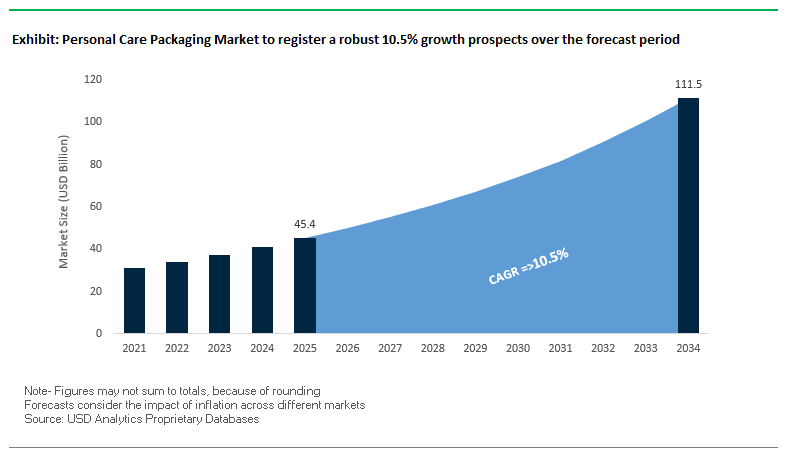
Market Overview: Personal Care Packaging Market Set to Surge to $111.5 Billion by 2034 with 10.5% CAGR, Driven by Sustainability, Innovation, and Premiumization
The Global Personal Care Packaging Market is a dynamic sector that delivers containers, closures, and dispensing systems for skincare, haircare, cosmetics, and hygiene products. Packaging is more than a functional necessity; it is a key driver of brand identity, consumer preference, and product protection. The market growth is propelled by trends in sustainability, smart packaging, and functional convenience, making it a critical area for investment and innovation.
Key Insights for industry professionals and buyers:
Market Expansion: Growing from $45.4 billion in 2025 to $111.5 billion by 2034 at a CAGR of 10.5%.
Sustainability Focus: Increased adoption of Post-Consumer Recycled (PCR) plastics, recycled glass, and bio-based materials to reduce environmental impact.
Smart Packaging Innovations: QR codes and NFC tags enhance consumer interaction, product authenticity verification, and brand storytelling.
Functional Design Advancements: Airless pump systems, refillable bottles, and ergonomic designs improve usability and protect sensitive formulations.
Minimalist and Inclusive Design Trends: Clean aesthetics and tactile markers cater to diverse consumer needs while embracing the “quiet luxury” trend.
Consumer-Centric Packaging: Demand for easy-to-use, hygienic, and refillable packaging formats is accelerating adoption and brand loyalty.
Market Analysis: Technological Integration and Sustainable Solutions are Reshaping the Personal Care Packaging Industry
The personal care packaging market is witnessing rapid transformation, driven by sustainability mandates, advanced technology adoption, and expanding global presence. In August 2025, Albéa Group acquired Amfora Packaging to strengthen its Latin American footprint and expand offerings in personal care, cosmetics, and fragrance. During the same month, Aptar Beauty achieved ISTA-6 Amazon certification for its Chieti, Italy lab, enhancing e-commerce testing capabilities and supporting a “local for local” supply strategy. Additionally, Bormioli Luigi launched an asymmetrical, refillable bottle for Ferragamo, showcasing advanced glass shaping and Italian craftsmanship.
July 2025 marked several significant developments. Aptar Beauty and Clarins introduced a new generation of their “Double Serum” with a patented, eco-designed double-chamber system for customizable dispensing. Simultaneously, Albéa Group earned its sixth consecutive EcoVadis Gold Medal, underlining its leadership in corporate sustainability. Earlier in the year, May 2025, Verescence showcased “Made in America” bottles at LUXE PACK New York, while in April 2025, Pochet du Courval inaugurated its first 100% electric furnace, a strategic step in halving greenhouse gas emissions by 2033.
Consumer-centric innovation remained a priority with Aptar Beauty's Nomad Refill launched in January 2025, allowing a 10ml purse spray to be refilled in under five seconds. Stoelzle Glass Group, in November 2024, received recognition for its Quali Glass coat 2.0, a solvent-free powder coating that reduces CO2 emissions by up to 77%. L’Oréal, also in November 2024, emphasized the refillable packaging movement, raising consumer awareness about eco-conscious product formats.
Trends and Opportunities Reshaping the Personal Care Packaging Market
Strategic Investment in Integrated Post-Consumer Recycled (PCR) Content Manufacturing
The personal care packaging market is undergoing a major shift as manufacturers vertically integrate recycling into their operations to secure a consistent supply of high-quality PCR content. Amcor’s investment in its Nicholasville, Kentucky facility exemplifies this strategy, featuring advanced silos that directly feed multiple production lines with PCR resin, supporting packaging with up to 100% recycled content. This vertical integration reduces dependence on third-party recyclers, enhances quality assurance, and ensures brands receive a reliable supply of sustainable materials.
Corporate sustainability commitments are the primary driver of these investments. Unilever’s pledge to reduce virgin plastic use by 25% by 2025 and 40% by 2028 highlights the urgency for packaging suppliers to meet brand expectations. As beauty and personal care companies align with regulatory pressure and consumer demand, the need for scalable PCR solutions intensifies. Moreover, chemical recycling technologies are expanding the role of PCR by producing near-virgin-quality polypropylene (PP), enabling its use in high-performance packaging applications where traditional mechanical recycling has fallen short. This transition not only addresses waste reduction but also lowers carbon footprints, creating a measurable impact within the circular economy.
Adoption of Refillable and Reusable Systems by Major Beauty Conglomerates
Another transformative trend in personal care packaging is the strategic adoption of refillable and reusable systems. L’Oréal’s “L’Oréal for the Future” program underscores this shift, with a commitment to making all packaging reusable, refillable, recyclable, or compostable by 2030. The company has actively promoted refill initiatives through global campaigns, normalizing consumer behavior around reusability.
Unilever’s 50+ pilots across beauty and home care further illustrate the rise of new business models. These include in-store refill stations, subscription-based concentrate systems, and refill pouches that use up to 70% less plastic. Such initiatives not only reduce packaging waste but also establish recurring consumer touchpoints, creating long-term brand loyalty. Partnerships with organizations like Closed Loop Partners and Circular Services ensure scalability by supporting collection, cleaning, and reuse infrastructures. Together, these initiatives show that refillability is evolving from a niche experiment into a central strategy for major global players, redefining how consumers interact with personal care brands.
Development of Barrier Packaging for Waterless and Concentrated Formulations
The rise of waterless beauty products—ranging from solid shampoo bars to powdered serums—is opening a significant growth avenue for advanced barrier packaging solutions. Waterless formats are lighter, reduce transportation emissions, and minimize the need for bulky secondary packaging. However, their concentrated active ingredients are often sensitive to environmental factors, requiring packaging with superior moisture and oxygen barriers.
Brands like Lush have pioneered “naked” packaging-free formats, but mainstream adoption demands innovative protective solutions. For example, airtight tubes and specialized containers are being designed to protect powdered formulations such as vitamin C serums that activate on contact with water. These advancements not only preserve product integrity but also extend shelf life, ensuring waterless products can scale across global retail environments. This opportunity aligns sustainability goals with functional performance, making barrier packaging for concentrated formulations one of the most promising frontiers in personal care packaging innovation.
Engineering of Inclusive and Accessible Dispensing Mechanisms
Inclusivity is emerging as a defining opportunity in packaging innovation, with companies rethinking design to serve diverse consumer needs. Unilever’s Degree Inclusive deodorant is a leading example, developed in collaboration with the disability community. Features such as a one-handed hook, magnetic cap, and Braille labeling transform accessibility into a competitive differentiator, demonstrating how inclusive design can broaden consumer reach.
Universal design principles are extending inclusivity beyond niche demographics. The EEASY Lid by Consumer Convenience Technologies, which reduces jar-opening force by 40%, benefits not only individuals with arthritis but also mainstream consumers seeking convenience. Similarly, tactile differentiation integrated by Procter & Gamble in Herbal Essences bottles—stripes for shampoo and circles for conditioner—provides visually impaired users with independence while improving usability for all.
Competitive Landscape: Leading Players Are Driving Sustainability, Innovation, and Consumer-Centric Design in Personal Care Packaging
The global personal care packaging industry is shaped by key players leveraging expertise in materials science, design, and manufacturing. Companies are innovating to deliver packaging that combines premium aesthetics, functionality, and eco-friendly solutions, serving diverse personal care applications.
AptarGroup, Inc.: Innovating Dispensing Technology for Refillable and Eco-Friendly Packaging
Aptar is a global leader in pumps, closures, and spray systems for lotions, creams, and fragrances. In August 2025, its Chieti lab received ISTA-6 Amazon certification, optimizing e-commerce distribution and reducing damage. Aptar's patented Nomad Refill system and airless pumps improve consumer experience, protect sensitive formulations, and advance sustainability through reusable and recyclable designs.
Albéa Group: Expanding Latin American Presence with Multi-Material, Sustainable Solutions
Albéa offers tubes, bottles, caps, and pumps for skincare, haircare, and cosmetics. In August 2025, it acquired Amfora Packaging to grow its Latin American footprint, and in July 2025, earned its sixth consecutive EcoVadis Gold Medal. Albéa focuses on recyclable, reusable, and PCR-content packaging to support circular economy initiatives under its “Beauty for the Planet” strategy.
Amcor plc: Leading in Customizable and Sustainable Monomaterial Packaging
Amcor provides flexible films, bottles, and pouches for personal care products. The launch of an all-polyethylene (PE) spouted pouch demonstrates its commitment to sustainable, monomaterial solutions without compromising performance. Amcor leverages its global manufacturing network and material science expertise to develop high-performance, customizable packaging solutions that enhance shelf life and brand appeal.
Verescence: Driving Luxury Glass Packaging with Sustainability at the Core
Verescence produces high-end glass bottles and jars with custom decoration options for luxury personal care brands. In March 2025, it was recognized on the CDP 'A List' for sustainability and invested in hybrid furnaces to reduce carbon emissions. Its “Glass made from Glass” initiative ensures eco-friendly production without compromising premium aesthetics.
Silgan provides plastic bottles, jars, tubes, and closures, with advanced dispensing systems. Its vertically integrated model streamlines the supply chain, ensuring compatibility between containers and closures. The company emphasizes operational efficiency, strategic acquisitions, and continuous innovation to serve the growing personal care market effectively.
Personal Care Packaging Market Share Insights, 2025-2034
Bottles & Jars Dominate Market Share by Product Type in the Personal Care Packaging Industry
Bottles and jars represent the largest share of the personal care packaging industry, accounting for 32% of the market. Their dominance stems from unmatched versatility across skincare, hair care, bath, and cosmetic applications, with PET and HDPE bottles being the most widely adopted due to their balance of durability, light weight, and cost efficiency. The rapid growth of airless bottles and jars has strengthened their position, particularly in premium skincare, where oxidation and contamination protection are essential for maintaining product efficacy. Brand owners are leveraging these formats to enhance consumer trust, integrating UV-protective coatings, refillable systems, and recycled content to align with both performance and sustainability targets. Bottles and jars not only provide functional storage but also serve as key brand carriers with endless design and decoration possibilities, ensuring their sustained leadership in the market.
Pumps & Dispensers Secure Strong Market Share with Premiumization of Skincare & Haircare
Pumps and dispensers hold the second-largest share at 22%, with growth underpinned by rising consumer expectations for convenience, hygiene, and precise dosage control. This segment has become central to the premiumization trend in skincare and haircare, where advanced dispensing mechanisms—airless pumps, locking systems, and leak-proof closures—add tangible value to the consumer experience. Their role is particularly critical in high-value formulations such as serums, oils, and luxury shampoos, where waste reduction and controlled application enhance perceived efficacy. Furthermore, innovation in recyclable and mono-material dispensers is accelerating adoption, allowing brands to balance premium aesthetics with eco-friendly functionality. Pumps and dispensers are increasingly viewed not as accessories but as integral elements of product performance and differentiation.
United States Personal Care Packaging Market Driven by Smart Solutions and Refillable Formats
The United States personal care packaging market is valued at USD 2.1 billion in 2025, with growth led by the skincare and color cosmetics sectors. A major driver is the rapid adoption of smart packaging technologies, such as QR codes and NFC-enabled labels, which allow brands to boost consumer engagement and provide product authenticity verification. At the same time, companies are investing in refillable and reusable systems that align with sustainability goals while fostering long-term customer loyalty.
A rising trend is the use of post-consumer recycled (PCR) materials, with leaders like AptarGroup, Inc. introducing certified recycled plastic packaging for cosmetics. The U.S. e-commerce boom is pushing for durable, lightweight, and shipping-ready formats, with brands like Goop Beauty adopting airless glass packaging to preserve sensitive ingredients such as retinol. Combined with increasing consumer preference for eco-friendly and premium formats, the U.S. is positioning itself as a leader in sustainable and high-performance personal care packaging innovation.
China Personal Care Packaging Market Influenced by GB 23350-2021 and Social-Commerce Growth
The China personal care packaging market is heavily shaped by GB 23350-2021 regulations, which restrict excessive packaging and encourage minimalistic, eco-conscious formats. As a result, brands are adopting thinner wall packaging, paperboard sleeves, and matte-finish plastics to comply with regulatory and consumer demands. The booming social-commerce ecosystem, powered by influencers and livestreaming, is reshaping aesthetics, with consumers favoring clean lines and modern minimalist packaging designs.
The skincare segment dominates, with innovative formats like airless jars gaining popularity as symbols of efficacy and hygiene. Refill-friendly formats, including flexible plastic pouches for bath and shower products, are also on the rise as part of China’s circular economy push. Meanwhile, domestic premium brands are attracting investment, such as Ushopal’s multimillion-dollar funding for fragrance brand Documents, which is influencing packaging innovation across beauty and personal care categories.
United Kingdom Personal Care Packaging Market Strengthened by EPR and Circular Economy Goals
The United Kingdom personal care packaging market is advancing under strict sustainability regulations. The Extended Producer Responsibility (EPR) framework has shifted financial responsibility for packaging waste to producers, pushing companies toward mono-material and recyclable packaging solutions. In addition, the UK government has mandated the collection of flexible plastics by March 2027, creating a strong incentive for investment in recycling technologies and alternative materials.
Government-funded initiatives such as the Smart Sustainable Plastic Packaging (SSPP) Challenge are fostering innovation in reuse and refill systems. A milestone was achieved in autumn 2023 with the launch of the world’s first mechanical recycling plant producing food-grade recycled polypropylene (rPP), a breakthrough that directly benefits the cosmetics sector. However, the British Beauty Council highlights that only 9% of cosmetic packaging is recycled, underscoring the urgency of circular economy adoption. Consumers are increasingly demanding plastic-free options, fueling the use of recycled PET, FSC-certified paperboard, and aluminum in personal care packaging.
Germany Personal Care Packaging Market Leading with Sustainable Innovation and High-End Printing
The Germany personal care packaging market is characterized by strong innovation driven by sustainability and precision engineering. Events like CosmeticBusiness 2025 highlight advancements in plant-based ingredients and eco-friendly packaging formats. German companies are pioneering refill sets for concentrates, which reduce logistics costs and minimize packaging material usage.
Manufacturers such as MM Group are pushing boundaries in high-end printing and finishing, utilizing UV offset and digital printing to create luxury paper-based personal care packaging. Innovations include multi-material solutions, such as aluminum tubes with brush applicators, alongside paper-based formats as plastic alternatives. As the cosmetics industry embraces sustainably cultivated active ingredients, packaging design is increasingly geared toward preserving product integrity while maintaining a strong premium, sustainable image.
India Personal Care Packaging Market Boosted by Plastic Ban and Localized Manufacturing
The India personal care packaging market is rapidly evolving under stricter environmental regulations, with the July 1, 2022, ban on single-use plastics setting the stage for eco-friendly alternatives. Leading players such as Hindustan Unilever aim to eliminate virgin plastic by 2025, while P&G India has introduced recyclable shampoo bottles in partnership with Plastics for Change. Companies like Amway India have also adopted eco-friendly packaging for brands such as Artistry and Attitude.
The rise of e-commerce platforms is driving demand for robust, tamper-evident, and visually appealing packaging that can withstand logistics while maintaining brand value. Consumer preferences are shifting toward natural ingredients and sustainable grooming products, creating demand for innovative personal care packaging. India’s combination of government support, strong domestic manufacturing, and rising disposable income positions it as one of the fastest-growing markets for sustainable packaging in the personal care sector.
France Personal Care Packaging Market Shaped by AGEC Law and PFAS Ban
The France personal care packaging market is strongly regulated by the Anti-Waste Law for a Circular Economy (AGEC), which mandates sorting symbols on cosmetic packaging for consumer clarity. Additionally, Law No. 2025-188 bans PFAS in cosmetics by January 2026, pushing companies to explore fluorine-free coatings and alternative materials for bottles, jars, and applicators.
French brands are pioneers in sustainability, with L’Occitane and Caudalie adopting refillable stations and eco-refill pouches, significantly reducing single-use packaging. Companies like Pachamamaï are innovating with compostable cardboard and recycled glass bottles, aligning with consumer demand for zero-waste and biodegradable options. France’s regulatory framework, combined with strong consumer awareness and luxury heritage, is ensuring that the country remains a leader in premium, sustainable personal care packaging.
Personal Care Packaging Market Report Scope
Personal Care Packaging Market
Parameter
Details
Market Size (2025)
$45.4 Billion
Market Size (2034)
$111.5 Billion
Market Growth Rate
10.5%
Segments
By Material (Plastic, Glass, Metal, Paper & Paperboard, Others), By Product Type (Bottles & Jars, Tubes, Pumps & Dispensers, Pouches, Boxes & Cartons, Others), By Application (Skincare, Hair Care, Cosmetics, Oral Care, Bath & Shower, Others), By End-User (Men, Women, Unisex, Children & Babies)
Study Period
2019- 2024 and 2025-2034
Units
Revenue (USD)
Qualitative Analysis
Porter’s Five Forces, SWOT Profile, Market Share, Scenario Forecasts, Market Ecosystem, Company Ranking, Market Dynamics, Industry Benchmarking
US, Canada, Mexico, Germany, France, Spain, Italy, UK, Russia, China, India, Japan, South Korea, Australia, South East Asia, Brazil, Argentina, Middle East, Africa
Personal Care Packaging Market Segmentation
By Material
Plastic
Glass
Metal
Paper & Paperboard
Others
By Product Type
Bottles & Jars
Tubes
Pumps & Dispensers
Pouches
Boxes & Cartons
Others
By Application
Skincare
Hair Care
Cosmetics
Oral Care
Bath & Shower
Others
By End-User
Men
Women
Unisex
Children & Babies
Countries Analyzed
North America (US, Canada, Mexico)
Europe (Germany, UK, France, Spain, Italy, Russia, Rest of Europe)
Asia Pacific (China, India, Japan, South Korea, Australia, South East Asia, Rest of Asia)
South America (Brazil, Argentina, Rest of South America)
Middle East and Africa (Saudi Arabia, UAE, Rest of Middle East, South Africa, Egypt, Rest of Africa)
Top Companies in Personal Care Packaging Market
Amcor plc
Mondi Group
AptarGroup, Inc.
Berry Global, Inc.
Silgan Holdings Inc.
Sonoco Products Company
Albéa
Gerresheimer AG
Quadpack
HCP Packaging
Pöppelmann GmbH & Co. KG
Lumson S.p.A.
Libo Cosmetics Company, Ltd.
The Estée Lauder Companies Inc.
Shiseido Company, Limited
* List Not Exhaustive
Methodology
USDAnalytics employs a rigorous, multi-dimensional research methodology to analyze the global Personal Care Packaging Market, integrating both primary and secondary sources to deliver highly accurate, actionable insights. Our approach includes interviews and surveys with leading packaging manufacturers, brand owners, distributors, and industry experts across major regions such as North America, Europe, Asia-Pacific, and Latin America. Secondary research encompasses regulatory reports, company filings, press releases, trade journals, and sustainability disclosures to capture historical trends, technological advancements, and competitive landscapes. USDAnalytics applies quantitative forecasting models alongside qualitative assessments to project market value, CAGR, and regional dynamics while evaluating key factors such as sustainability initiatives, refillable systems, barrier packaging for waterless formulations, smart and inclusive designs, and consumer-centric trends. Advanced data validation, triangulation, and expert review ensure precision, enabling decision-makers to devise informed strategies, investment plans, and operational initiatives in a rapidly evolving and highly competitive personal care packaging sector.
Deliverables:
Comprehensive Market Research Report (PDF and Excel) with detailed tables, charts, and interactive visualizations.
Country-Specific Forecasts & Analysis.
Segment-Wise Revenue Forecasts (2025–2034).
Competitive Analysis, Benchmarking, and SWOT Profiles.
Recent Developments & Innovation Tracker.
Executive Summary & Analyst Commentary.
Post-Purchase Analyst Support for Client-Specific Questions and Custom Data Requirements.
Table of Contents: Personal Care Packaging Market
1. Executive Summary
1.1. Market Highlights
1.2. Key Findings
1.3. Global Market Snapshot
2. Personal Care Packaging Market Landscape & Outlook (2025–2034)
2.1. Introduction to Personal Care Packaging Market
2.2. Market Valuation and Growth Projections (2025–2034)
2.3. Market Dynamics and Drivers
2.4. Technological Integration and Sustainability Trends
2.5. Regulatory Environment and Impact
3. Innovations Reshaping the Personal Care Packaging Market
3.1. Trend: Smart Packaging with QR Codes and NFC Tags
3.2. Trend: Minimalist, Inclusive, and Consumer-Centric Designs
3.3. Opportunity: Refillable and Reusable Packaging Systems
3.4. Opportunity: Barrier Packaging for Waterless and Concentrated Formulations
3.5. Opportunity: Engineering Inclusive and Accessible Dispensing Mechanisms
4. Competitive Landscape and Strategic Initiatives
4.1. Mergers, Acquisitions and Strategic Alliances
4.2. R&D and Material Innovation
4.3. Sustainability and Strategies
4.4. Market Expansion and Regional Focus
5. Market Share and Segmentation Insights: Personal Care Packaging Market
5.1. By Material
5.1.1. Plastic
5.1.2. Glass
5.1.3. Metal
5.1.4. Paper & Paperboard
5.1.5. Others
5.2. By Product Type
5.2.1. Bottles & Jars
5.2.2. Tubes
5.2.3. Pumps & Dispensers
5.2.4. Pouches
5.2.5. Boxes & Cartons
5.2.6. Others
5.3. By Application
5.3.1. Skincare
5.3.2. Hair Care
5.3.3. Cosmetics
5.3.4. Oral Care
5.3.5. Bath & Shower
5.3.6. Others
5.4. By End-User
5.4.1. Men
5.4.2. Women
5.4.3. Unisex
5.4.4. Children & Babies
6. Country Analysis and Outlook of Personal Care Packaging Market
6.1. United States
6.2. Canada
6.3. Mexico
6.4. Germany
6.5. France
6.6. Spain
6.7. Italy
6.8. UK
6.9. Russia
6.10. China
6.11. India
6.12. Japan
6.13. South Korea
6.14. Australia
6.15. South East Asia
6.16. Brazil
6.17. Argentina
6.18. Middle East
6.19. Africa
7. Personal Care Packaging Market Size Outlook by Region (2025–2034)
7.1. North America Personal Care Packaging Market Size Outlook to 2034
7.1.1. By Material
7.1.2. By Product Type
7.1.3. By Application
7.1.4. By End-User
7.2. Europe Personal Care Packaging Market Size Outlook to 2034
7.2.1. By Material
7.2.2. By Product Type
7.2.3. By Application
7.2.4. By End-User
7.3. Asia Pacific Personal Care Packaging Market Size Outlook to 2034
7.3.1. By Material
7.3.2. By Product Type
7.3.3. By Application
7.3.4. By End-User
7.4. South America Personal Care Packaging Market Size Outlook to 2034
7.4.1. By Material
7.4.2. By Product Type
7.4.3. By Application
7.4.4. By End-User
7.5. Middle East and Africa Personal Care Packaging Market Size Outlook to 2034
7.5.1. By Material
7.5.2. By Product Type
7.5.3. By Application
7.5.4. By End-User
8. Company Profiles: Leading Players in the Personal Care Packaging Market
8.1. Amcor plc
8.2. Mondi Group
8.3. AptarGroup, Inc.
8.4. Berry Global, Inc.
8.5. Silgan Holdings Inc.
8.6. Sonoco Products Company
8.7. Albéa
8.8. Gerresheimer AG
8.9. Quadpack
8.10. HCP Packaging
8.11. Pöppelmann GmbH & Co. KG
8.12. Lumson S.p.A.
8.13. Libo Cosmetics Company, Ltd.
8.14. The Estée Lauder Companies Inc.
8.15. Shiseido Company, Limited
9. Methodology
9.1. Research Scope
9.2. Market Research Approach
9.3. Market Sizing and Forecasting Model
9.4. Research Coverage
9.5. Data Horizon
9.6. Deliverables
10. Appendix
10.1. Acronyms and Abbreviations
10.2. List of Tables
10.3. List of Figures
Personal Care Packaging Market Segmentation
By Material
Plastic
Glass
Metal
Paper & Paperboard
Others
By Product Type
Bottles & Jars
Tubes
Pumps & Dispensers
Pouches
Boxes & Cartons
Others
By Application
Skincare
Hair Care
Cosmetics
Oral Care
Bath & Shower
Others
By End-User
Men
Women
Unisex
Children & Babies
Countries Analyzed
North America (US, Canada, Mexico)
Europe (Germany, UK, France, Spain, Italy, Russia, Rest of Europe)
Asia Pacific (China, India, Japan, South Korea, Australia, South East Asia, Rest of Asia)
South America (Brazil, Argentina, Rest of South America)
Middle East and Africa (Saudi Arabia, UAE, Rest of Middle East, South Africa, Egypt, Rest of Africa)
The Personal Care Packaging Market is valued at approximately $45.4 billion in 2025 and is projected to surge to $111.5 billion by 2034. This growth is driven by consumer demand for sustainable, premium, and functional packaging formats, alongside innovations in refillable and smart packaging technologies.
The market is expected to grow at a CAGR of 10.5% over the forecast period. Rapid adoption of post-consumer recycled (PCR) content, refillable systems, barrier packaging for waterless formulations, and digital engagement solutions are key growth enablers across global markets.
Bottles and jars dominate the market with 32% share, followed by pumps and dispensers at 22%. Popular materials include PET, HDPE, glass, metals, and bio-based polymers. Refillable bottles, airless systems, and ergonomic designs are being widely adopted for hygiene, product integrity, and premium positioning.
Sustainability is central to growth, with companies implementing PCR plastics, recycled glass, bio-based materials, and refillable formats. Vertical integration of recycling, chemical recycling technologies, and circular economy initiatives help brands meet corporate ESG targets, reduce carbon footprints, and respond to stringent regional regulations in Europe, North America, and Asia-Pacific.
High-growth regions include China, driven by e-commerce and social-commerce trends; India, influenced by plastic bans and localized manufacturing; the United States, with smart and refillable packaging adoption; and Europe, including France, Germany, and the UK, where regulatory mandates and circular economy initiatives are accelerating eco-friendly and premium packaging solutions.